
Judge, 1910-07-30 · page 12 of 16
Judge — July 30, 1910 — page 12: what you’re looking at
What you’re looking at
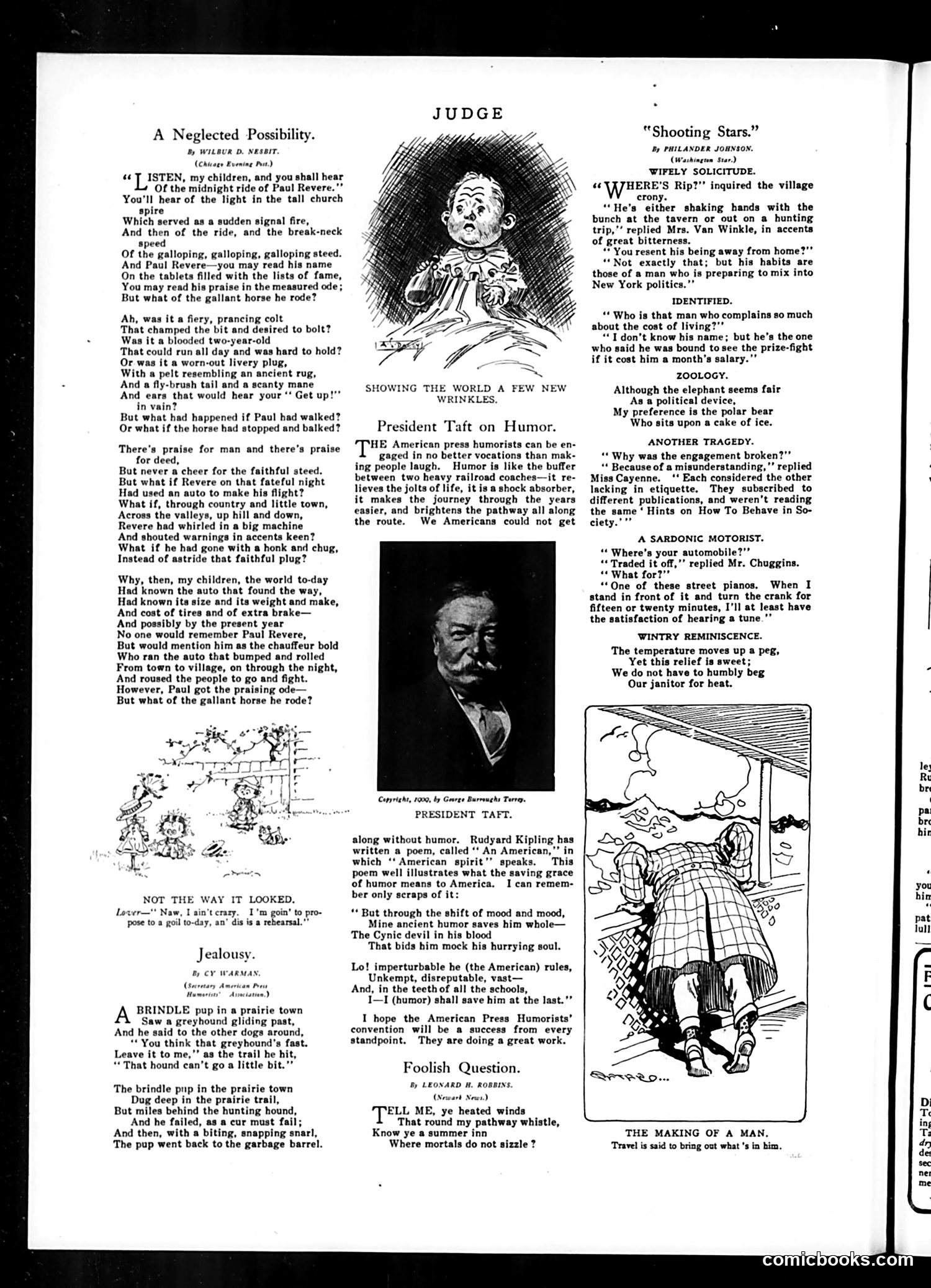
This page from Judge magazine (early 1900s) contains several satirical pieces: **"A Neglected Possibility"** by Wilbur D. Nesbit presents a humorous thought experiment: what if Paul Revere had ridden his famous midnight ride in an automobile instead of on horseback? The satire mocks America's obsession with new technology and credit-claiming. The poem suggests that had Revere used a car, history would remember the *vehicle* rather than the heroic rider—a jab at contemporary fixation on modern inventions over human achievement. **The President Taft section** quotes the president praising American humor as a social "shock absorber" that eases life's difficulties, using Kipling's poem to argue humor saves the American character. The page also includes lighter pieces like "Jealousy" (a prairie dog's envy of a greyhound) and various comic vignettes satirizing social pretensions and human nature—typical Judge fare blending political commentary with everyday absurdities.
📄 Transcribed text from this page (OCR, searchable)
Machine-transcribed from the original scan — historical spelling and the odd misread are preserved.
A Neglected Possibility. By WILBUR D. NESBIT. (chicas Evening Post) «LISTEN, my children, and you shall hear Of the midnight ride of Paul Revere.”” You'll hear of the light in the tall church spire Which served as a sudden signal fire, And then of the ride, and the break-neck speed Of the galloping, galloping, galloping steed. And Paul Revere—you may read his name On the tablets filled with the lists of fame, You may read his praise in the measured ode; But what of the gallant horse he rode? Ah, was it a fiery, prancing colt That champed the bit and desired to bolt? Was it a blooded two-year-old That could run all day and was hard to hold? Or was it a worn-out livery plug, With a pelt resembling an ancient rug, And a fly-brush tail and a scanty mane And ears that would hear your ‘‘ Get up!"’ in vain? But what had happened if Paul had walked? Or what if the horse had stopped and balked? There's praise for man and there's praise for deed, But never a cheer for the faithful steed. But what if Revere on that fateful night Had used an auto to make his flight? What if, through country and little town, Across the valleys, up hill and down, Revere had whirled in a big machine And shouted warnings in accents keen? What if he had gone ‘a honk and chug, Instead of astride that faithful plug? Why, then, my children, the world to-day Had known the auto that found the way, Had known its size and its weight and make, And cost of tires and of extra brake— And possibly by the present year No one would remember Paui Revere, But would mention him as the chauffeur bold Who ran the auto that bumped and rolled From town to village, on through the night, And roused the people to go and fight. However, Paul got the praising od But what of the gallant ho NOT THE WAY IT LOOKED. Lover—" Naw, [ain't crazy. I'm goin’ to pro- pose to a goil to-day, an’ dis is a rehearsal."’ Jealousy. By CY WARMAN BRINDLE pup in a prairi Saw a greyhound gliding A And he said to the other dogs “You think that greyhound’s fast. as the trail he hit, “That hound can’t go a little bit."" The brindle pup in the prairie town Dug deep in the prairie trail, But miles behind the hunting hound, ‘And he failed, as a cur must fail; And then, with a biting, snapping snarl, The pup went back to the garbage barrel. NG THE WORLD A FEW NEW WRINKLES, President Taft on Humor. HE American press humorist can be en- gaged in no better vocations than mak- ing people laugh. Humor is like the buffer between two heavy railroad coaches—it re- lieves the jolts of life, it is a shock absorber, it makes the journey through the years easier, and brightens the pathway all along the route. We Americans could not get Copyright, 1900, by George Burroughs Terra. PRESIDENT TAFT. along without humor. Rudyard Kipling has written a poem, called ‘An American,” in which ‘American spirit” speaks. ‘This poem well illustrates what the saving grace of humor means to America. I can remem- ber only scraps of it: “* But through the shift of mood and mood, Mine ancient humor saves him whole— The Cynic devil in his blood That bids him mock his hurrying soul. Lo! imperturbable he (the American) rules, Unkempt, disreputable, vast— And, in the teeth of all the schools, I—I (humor) shall save him at the last.’” I hope the American Press Humorists’ convention will be a success from every standpoint. They are doing a great work. Foolish Question. By LEONARD Ht. ROBBINS (reat Nees) TELL ME, ye heated winds That round my pathway whistle, Know ye a summer inn Where mortals do not sizzle? “Shooting Stars.” By PHILANDER JOUNSON. (Washington Star.) WIFELY SOLICITUDE. «¢\{7HERE'S Rip?” inquired the village crony. “*He’s either shaking hands with the bunch at the tavern or out on a hunting trip,”’ replied Mrs. Van Winkle, in accents of great bitterness. “You resent his being away from home?” “Not exactly that; but his habits are those of a who is preparing to mix into New York politics.” IDENTIFIED. “* Who is that man who complains so much about the cost of living?” “« I don’t know his name; but he’s the one who said he was bound to see the prize-fight if it cost him a month’s salary."” ZOOLOGY. Although the elephant seems fair As a political device, My preference is the polar bear Who sits upon a cake of ice. ANOTHER TRAGEDY. “« Why was the engagement broken?” “ Because of a misunderstanding,” replied Miss Cayenne. ‘‘ Each considered the other lacking in etiquette. They subscribed to different publications, and weren't reading the same ‘ Hints on How To Behave in So- ciety. A SARDONIC MOTORIST. ‘« Where’s your automobile?” “Traded it off,”’ replied Mr. Chuggins. ** What for?” “One of these street pianos. When I stand in front of it and turn the crank for fifteen or twenty minutes, I'll at least have the satisfaction of hearing a tune.”” WINTRY REMINISCENCE. ‘The temperature moves up a peg, Yet this relief is sweet; We do not have to humbly beg Our janitor for heat. THE MAKING OF A MAN. ‘Travel is said to bring out what's in him.