
Judge, 1910-07-30 · page 10 of 16
Judge — July 30, 1910 — page 10: what you’re looking at
What you’re looking at
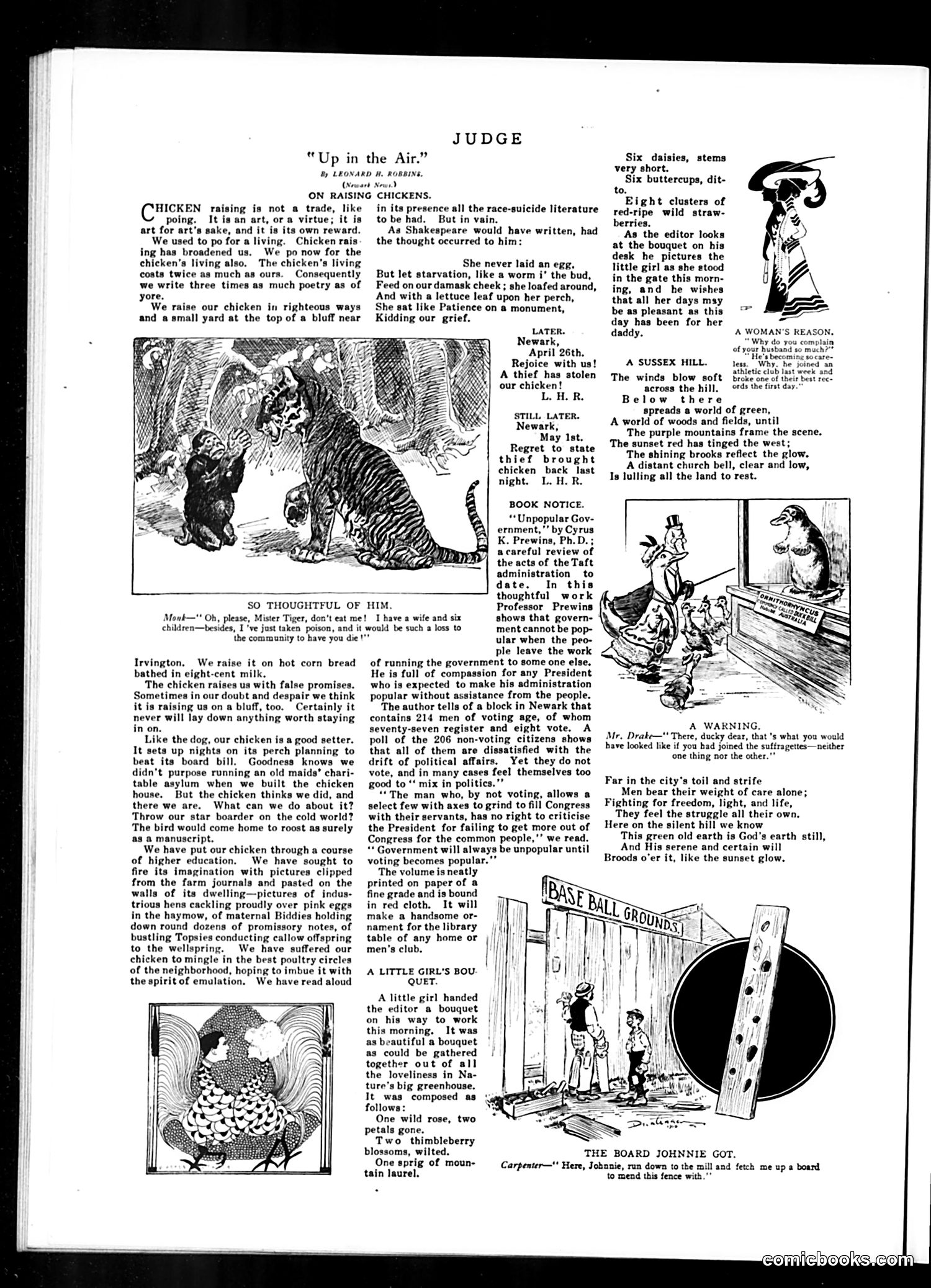
This Judge magazine page satirizes American apathy toward civic participation through two main pieces: **"On Raising Chickens"** (left): A humorous essay by Leonard H. Robbins uses chicken farming as an extended metaphor for futile, unrewarding labor. The impoverished narrator obsesses over an unproductive chicken that never lays eggs, costs more to feed than he earns, and represents wasted effort—likely critiquing either agricultural hardship or pointless government work. **"Unpopular Government" (book notice)**: A review of Cyrus K. Prewins's critique of the Taft administration (circa 1909-1913) that explicitly argues government cannot be popular when citizens shirk civic duties. It highlights a Newark block where 214 men of voting age exist, but only eight actually vote—the central point: democratic failure stems from public disengagement, not leadership. The page connects these pieces thematically: both mock apathy and wasted resources. The chicken represents the ungrateful public; the non-voting men represent citizens abandoning their democratic responsibility. Together, they critique American complacency.
📄 Transcribed text from this page (OCR, searchable)
Machine-transcribed from the original scan — historical spelling and the odd misread are preserved.
“Up in the Air.” By LEONARD (rear ON RAISING CHICKENS. (CHICKEN raising is not a trade, like poing. It is an art, or a virtue; it is art for art's sake, and it is its own reward. We used to po for a living. Chicken rais ing has broadened us. We po now for the chicken's living also, The chicken’s living costs twice as much as ours. Consequently we write three times as much poetry as of yore. We raise our chicken in righteous ways and a small yard at the top of a bluff near JUDGE Six daisies, stems very short. Six buttercups, dit- H. ROBBINS. to. Eight clusters of red-ripe wild straw- berries. As the editor looks at the bouquet on his desk he pictures the little girl as she stood in the gate this morn- ing, and he wishes ‘ace-suicide literature in its presence all th tobe had. But in vain. As Shakespeare would have written, had the thought occurred to hi She never laid an egg, But let starvation, like a worm i’ the bud, Feed on our damask cheek ; she loafed around, And with a lettuce leaf upon her perch, She sat like Patience on @ monument, Kidding our grief. day has been for her daddy. LATER. Newark, April 26th. Rejoice with us! A thief has stolen our chicken! A SUSSEX HILL. The winds blow soft across the hill. cords the first day." L. H.R. Below there | spreads a world of green, Neware™*™ A world of woods and fields, until May tat The purple mountains frame the scene. y Ist. ‘The sunset red has tinged the west; Regret to state thief brought chicken back last night. L. H.R. The shining brooks reflect the glow. A distant church bell, clear and low, Is lulling all the land to rest. BOOK NOTICE. ““Unpopular Gov- ernment,” by Cyrus K. Prewins, Ph. D. acareful review o} the acts of the Taft administration to date. In SO THOUGHTFUL OF HI Monk—"* Ob, please, Mister Tiger, don't eat me! children—besides, I ‘ve just taken poison, and it would be such a loss to the community to have you die !"" Irvington, We raise it on hot corn bread bathed in eight-cent milk. The chicken raises us with false promises. Sometimes in our doubt and despair we think it is raising us on a bluff, too. Certainly it never will lay down anything worth staying in on. Like the dog, our chicken is a good setter. It sets up nights on its perch planning to beat its board bill. Goodness knows we didn’t purpose running an old maids’ chari- table asylum when we built the chicken house. But the chicken thinks we did, and there we are. What can we do about it? Throw our star boarder on the cold world? The bird would come home to roost as surely as a manuscript. We have put our chicken through a course of higher education. We have sought to fire its imagination with pictures clipped from the farm journals and pasted on the walls of its dwelling—pictures of indus- trious hens cackling proudly over pink eggs in the haymow, of maternal Biddies holding down round dozens of promissory notes, of bustling Topsies conducting callow offspring to the wellspring. We have suffered our chicken to mingle in the best poultry circles of the neighborhood, hoping to imbue it with the spiritof emulation. We have read aloud thoughtful T have a wife and six ment cannot be pop- ular when the peo- ple leave the work of running the government to some one else. full of compassion for any President who is expected to make his administration popular without assistance from the people. The author tells of a block in Newark that contains 214 men of voting age, of whom seventy-seven register and eight vote. A poll of the 206 non-voting citizens shows that all of them are dissatisfied with the drift of political affairs. Yet they do not vote, and in many cases feel themselves too good to ‘* mix in politics.” “The man who, by not voting, allows a select few with axes to grind to fill Congress with their servants, has no right to criticise the President for failing to get more out of Congress for the common people,’” we read. “ Government will always be unpopular until voting becomes popular."” The volume is neatly printed on paper of a fine grade and is bound in red cloth. It will make a handsome or- nament for the library table of any home or men’s club. A WARNING, Mr. Drake—"' There, ducky dear, that 's what you would have looked like if you had joined the suffragettes—neither one thing nor the other."* Far in the city's toil and strife Men bear their weight of care alone; Fighting for freedom, light, and life, They feel the struggle all their own. Here on the silent hill we know This green old earth is God's earth still, And His serene and certain will Broods o'er it, like the sunset glow. A LITTLE GIRL'S BOU: QUET. A little girl handed the editor a bouquet i to_work this morning. It was as beautiful a bouquet as could be gathered together out of all It was composed as follows : One wild rose, two petals gone. Two thimbleberry blossoms, wilted. One sprig of moun- tain laurel. THE BOARD JOHNNIE GOT. Carpenter—"' Here, Jobanie, run down to the mill and fetch me up a board to mend this fence with."