
A complete issue · 28 pages · 1889
Judge — April 27, 1889
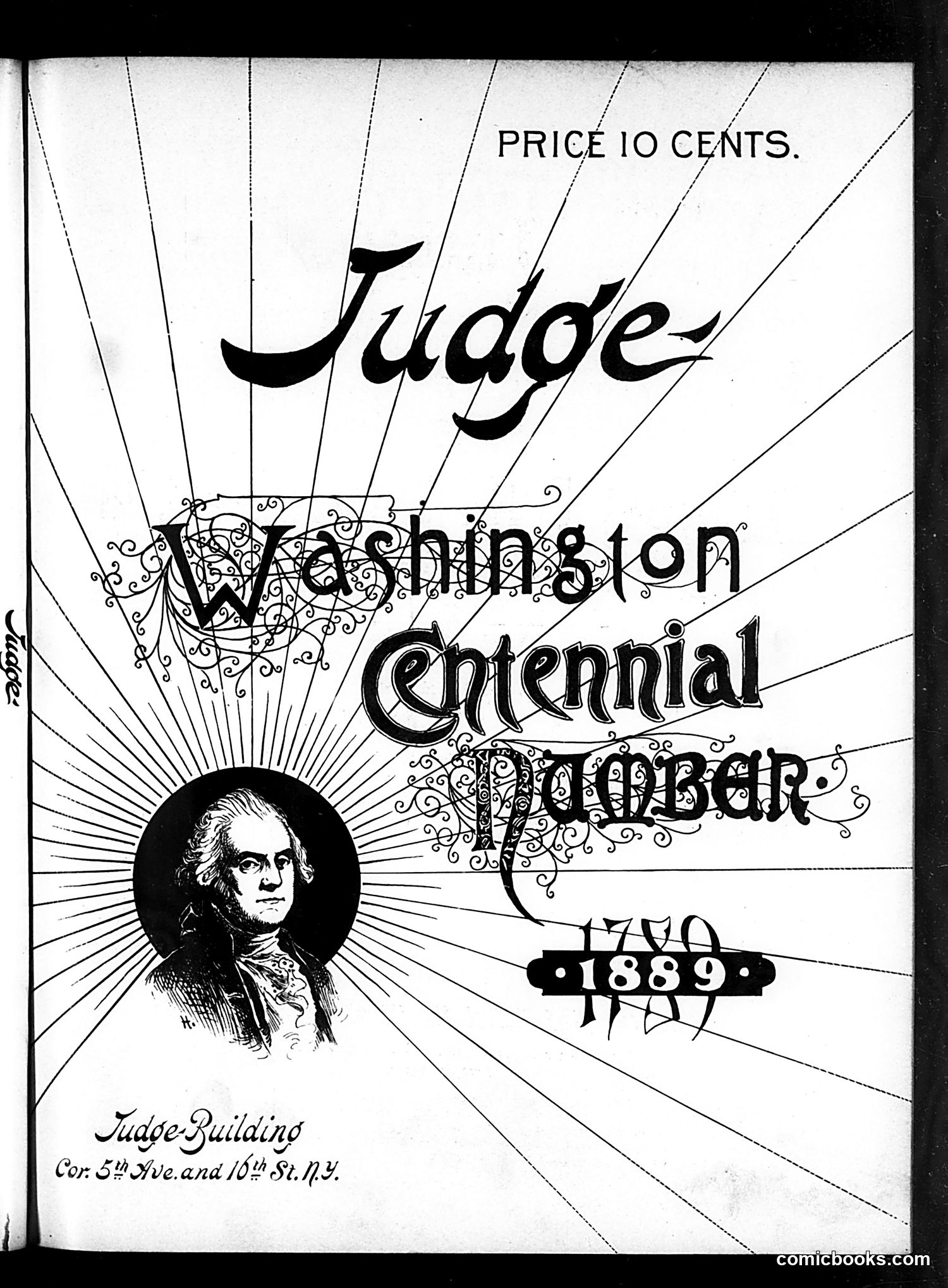
This is a **cover for Judge's special Washington Centennial issue**, commemorating the 100th anniversary of George Washington's presidency (1789-1889). The ornate decorative frame at top contains what appears to be an eagle or heraldic design typical of patriotic imagery. Below it is a portrait of **George Washington** with a radiating halo effect, a common iconographic treatment elevating him to near-saintly status. The text emphasizes this is a commemorative publication marking the centennial, priced at 10 cents. The Judge Building address in New York appears at bottom left. This appears to be primarily a **patriotic special edition** rather than political satire—using Washington's revered image to market the magazine during a significant national anniversary.
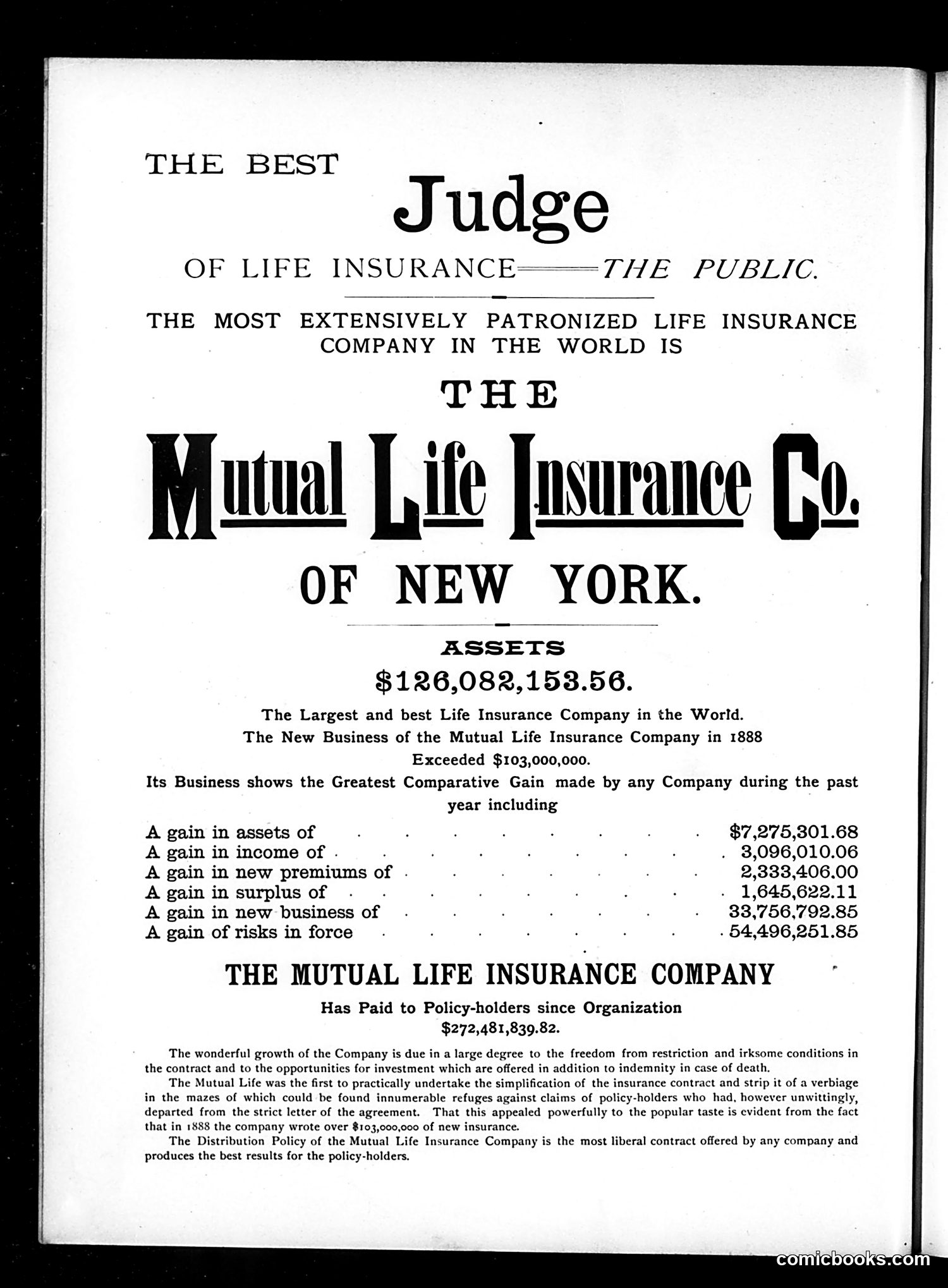
This page is **not a cartoon or satire** — it's a full-page advertisement for the Mutual Life Insurance Company of New York, appearing in *Judge* magazine (likely from 1888-1889, based on the text referencing 1888 business figures). The ad presents financial data to establish credibility: $126 million in assets, $103 million in new business written in 1888, and $272 million paid to policyholders since the company's founding. The copy emphasizes the company's competitive advantages: simplified contracts, investment opportunities, and a "Distribution Policy" offering liberal terms to policyholders. The tone is boastful corporate marketing rather than political commentary — typical of late-19th-century *Judge* advertisements.
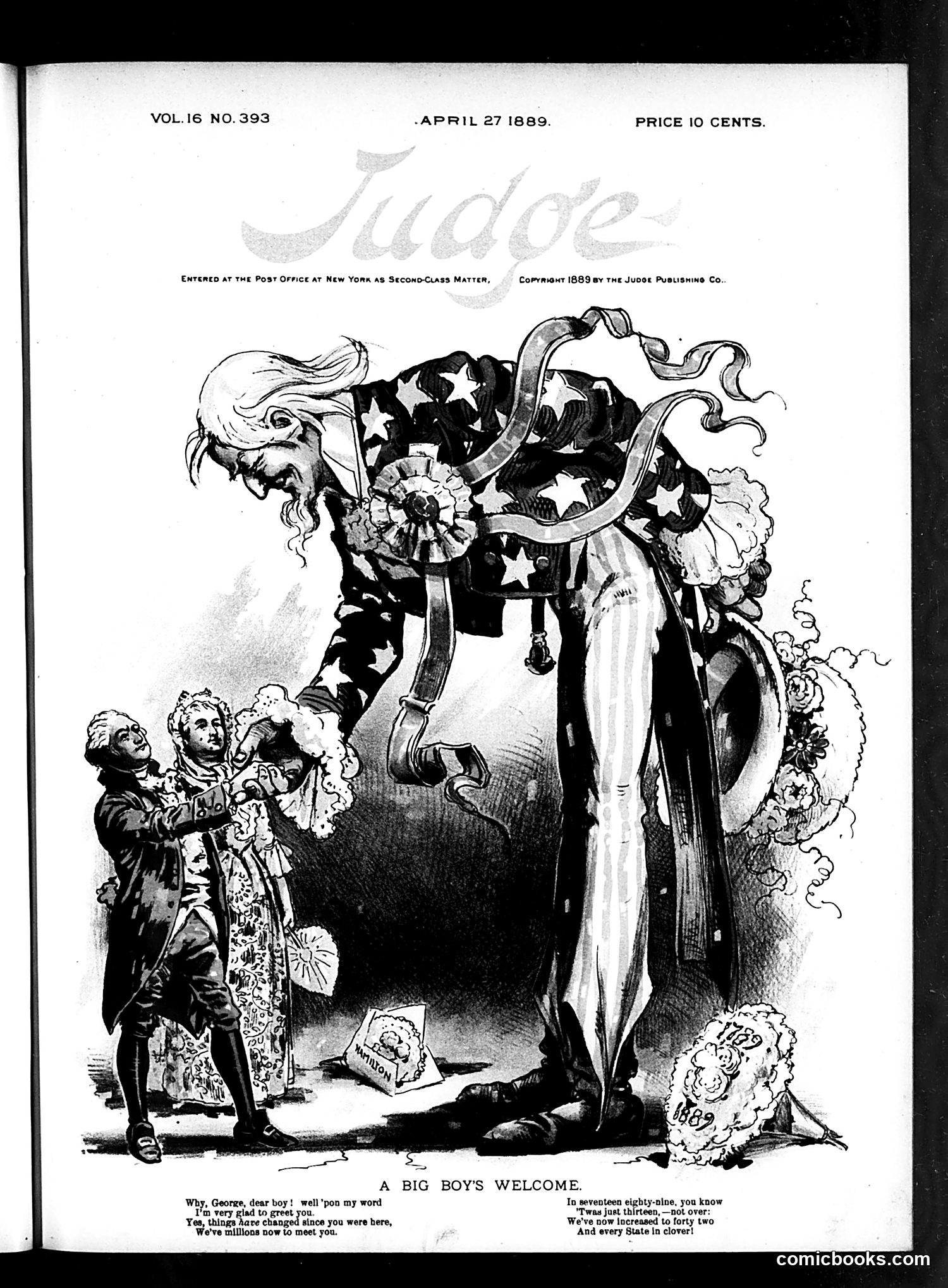
This cartoon celebrates America's centennial of the Constitution (1789-1889). The large figure represents the United States personified as a grown man, welcoming back "George" (George Washington) after a hundred years. The satire contrasts Washington's era with 1889: when Washington led in 1789, the nation was young ("thirteen" states), struggling, and uncertain. Now it has grown to 42 states, gained prosperity ("in clover"), and expanded vastly in population and wealth ("millions now to meet you"). The smaller figures—likely representing citizens or politicians—gaze upward in admiration at America's transformation and growth. The comic point: America has matured magnificently from the uncertain founding into a powerful, prosperous nation that would astound its founders. This reflects the optimistic American boosterism typical of the Gilded Age, celebrating industrial expansion and westward growth.
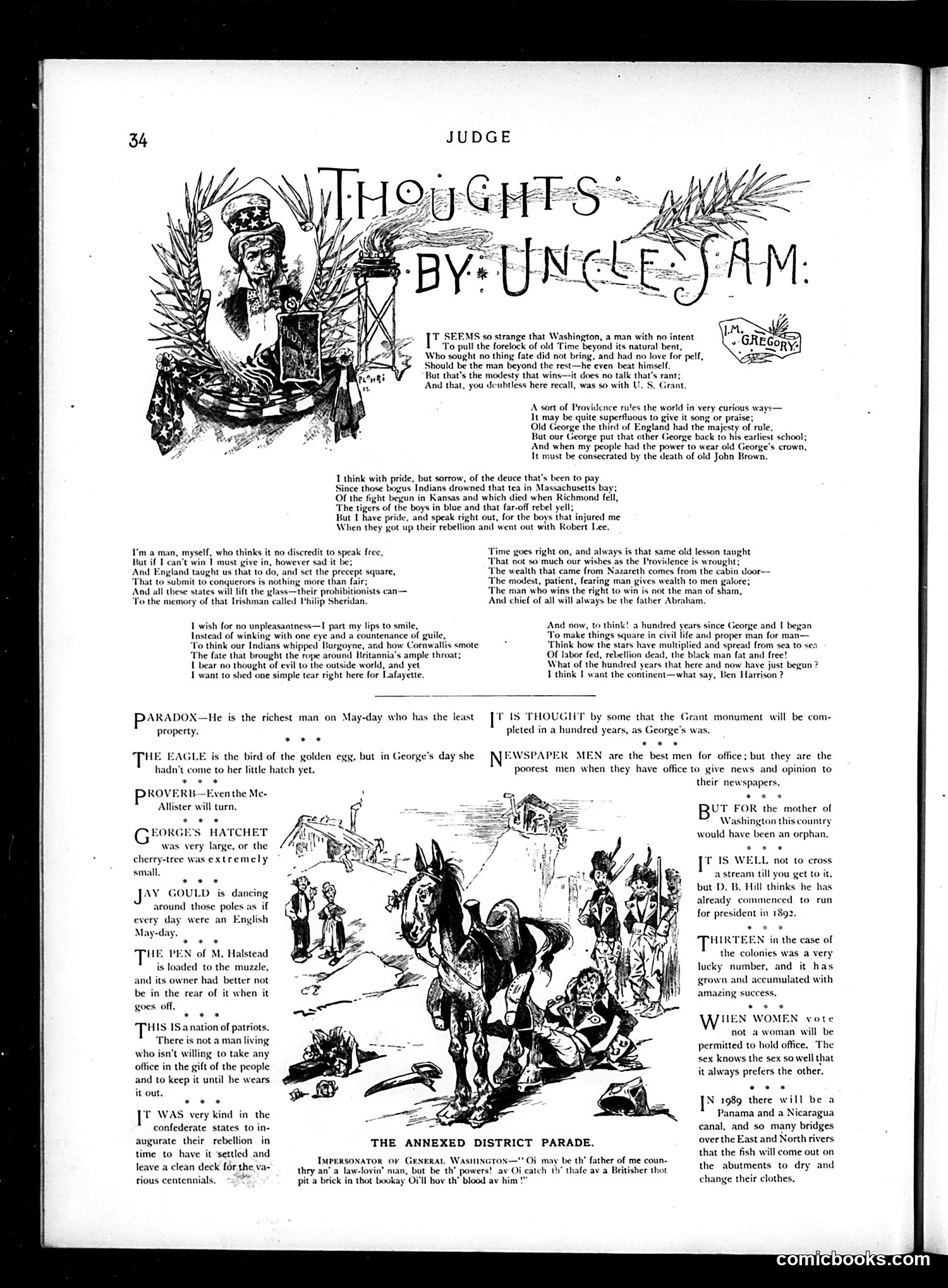
This page celebrates America's centennial (1876), with Uncle Sam reflecting on the nation's first hundred years. The main text praises George Washington's humility, contrasting it favorably with King George III of England. It references major American conflicts: the Boston Tea Party, the Revolutionary War, the Civil War (Richmond, Robert E. Lee), and celebrates figures like Lafayette, Sheridan, and Lincoln ("father Abraham"). The cartoon at bottom depicts an "Annexed District Parade"—likely the District of Columbia—with an Irish immigrant impersonating Washington. The satire mocks both immigrant participation in civic life and the pretense of commemorating Washington through such spectacles. Side aphorisms mock American political culture: paradoxes about wealth, greed for office, and newspaper editors' poverty. The tone is patriotic but cynical about actual American behavior versus ideals.
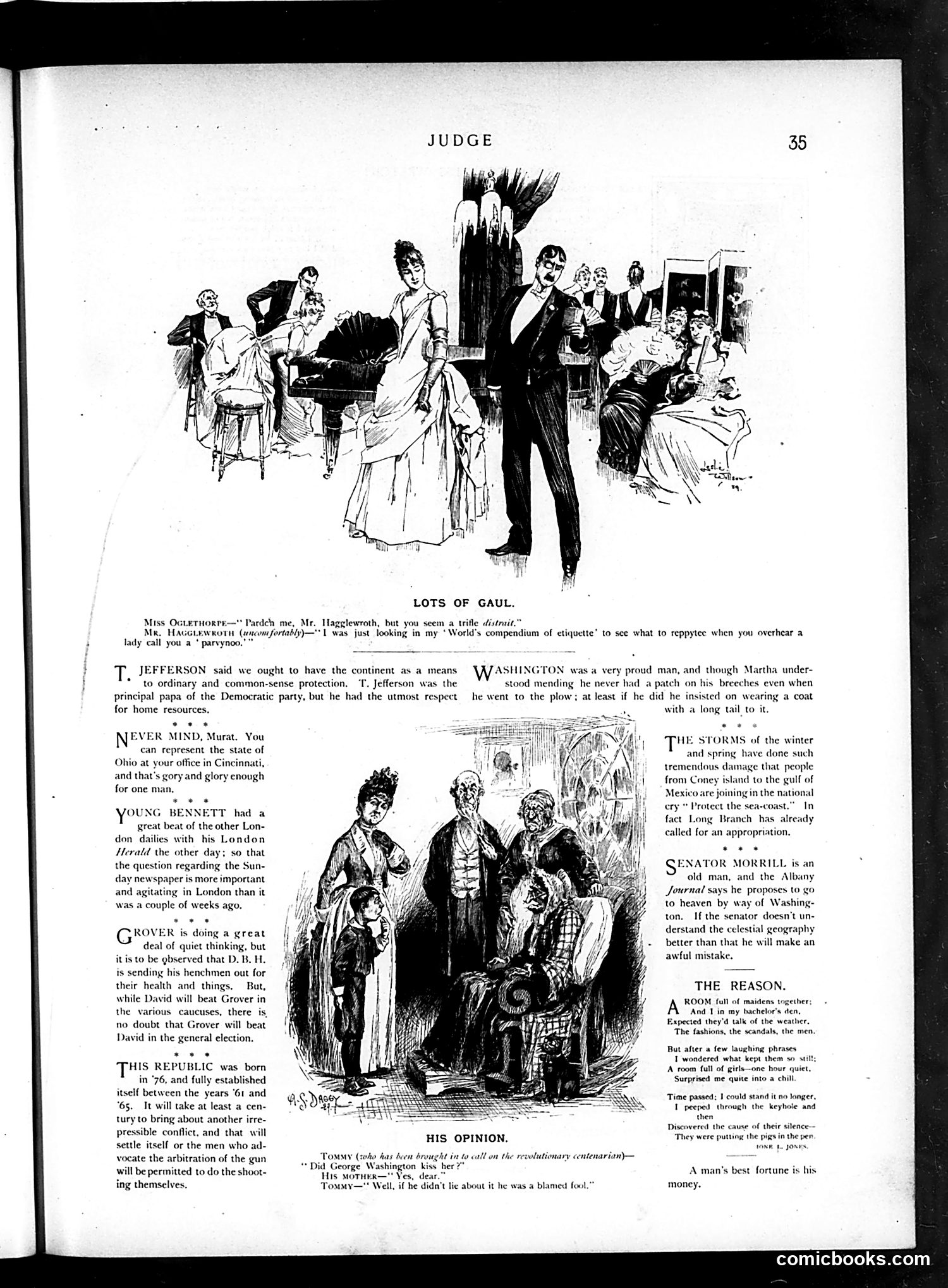
This page contains multiple satirical pieces targeting American political figures and social customs of the Gilded Age era. **"Lots of Gaul"** mocks a socially anxious gentleman consulting etiquette guides, satirizing nouveau riche insecurity about proper behavior. **The political commentary** references Thomas Jefferson and George Washington approvingly while criticizing contemporary figures: "Grover" (likely Cleveland) is portrayed as doing "quiet thinking" while his rival "David" (unclear reference) may win caucuses but will lose the general election. Senator Morrill is ridiculed for his political ambitions. Young Bennett's newspaper success is noted. **"His Opinion"** jokes that Washington was an honest man—implying modern politicians are not—by having a child ask if he kissed a woman, with the answer "yes," followed by criticism that "if he didn't lie about it he was a blamed fool," sarcastically suggesting honesty is foolish. **"The Reason"** is lighter social humor about women mysteriously quiet until discovered putting "pigs in the pen"—a rural/domestic task interrupting socializing. Overall: critique of political hypocrisy, social climbing, and nostalgia for early American virtue.
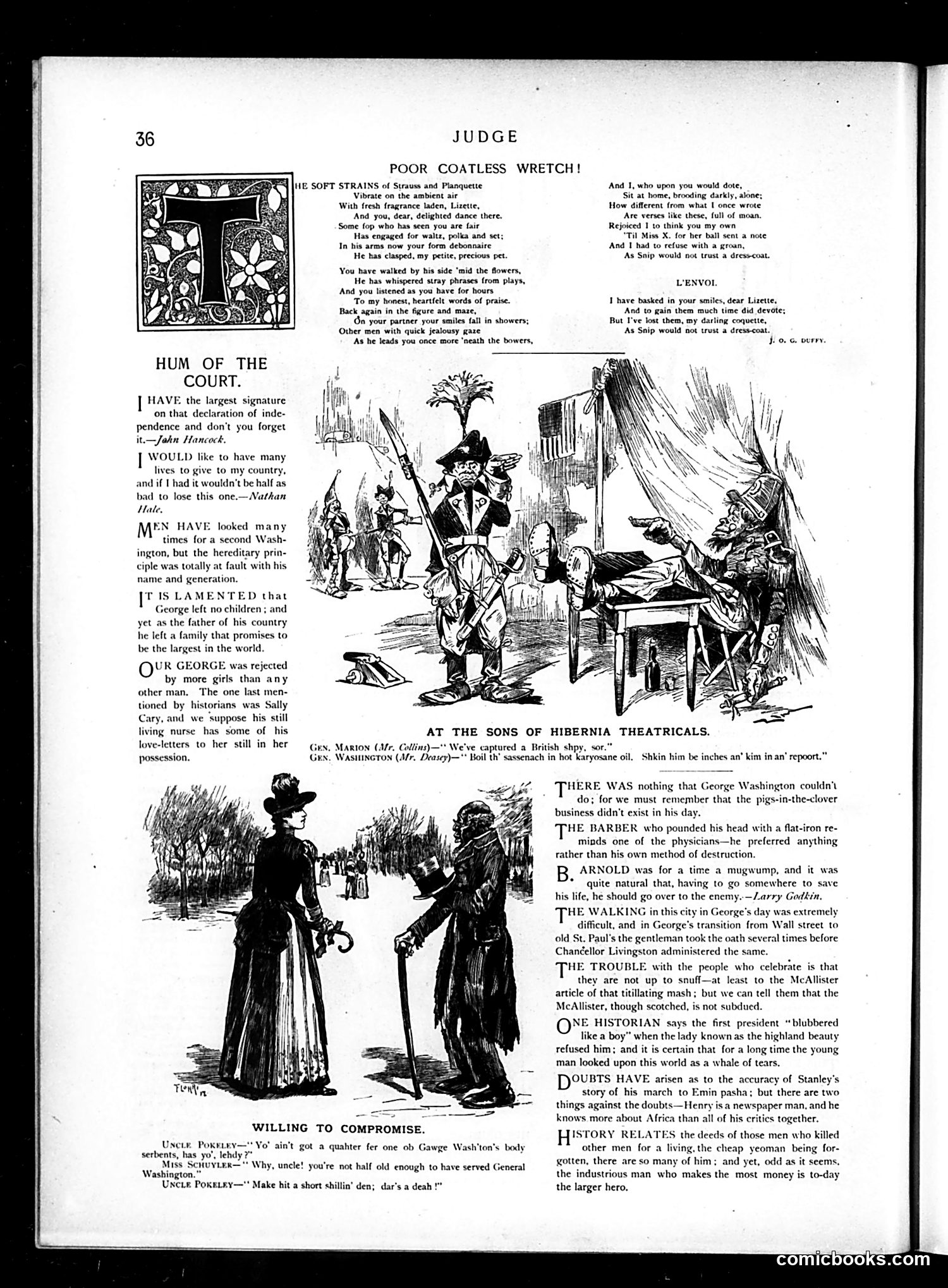
This page mixes romantic poetry with historical humor about George Washington. The "Poor Coatless Wretch" poem satirizes a lovestruck man too poor to afford formal dress (a "dress-coat"), unable to attend balls where his beloved dances with wealthier suitors—a class-commentary wrapped in melodrama. The historical section parodies Washington trivia and American mythology. It mocks his supposed romantic rejections, suggests he had no legitimate heirs (thus "the largest family" through illegitimate children), and makes crude jokes about his physical appearance and methods of destruction. The theatrical cartoon references Irish-American dramatic societies performing patriotic plays, with characters playing Marion and Washington discussing capturing British spies in exaggerated accents—likely mocking both ethnic theatricals and overwrought Revolutionary War drama. The "Willing to Compromise" cartoon shows an elderly African American (Uncle Pokey) attempting to sell his body to science, with a young woman's horrified refusal—dark humor about poverty, race, and exploitation in the post-Civil War era.
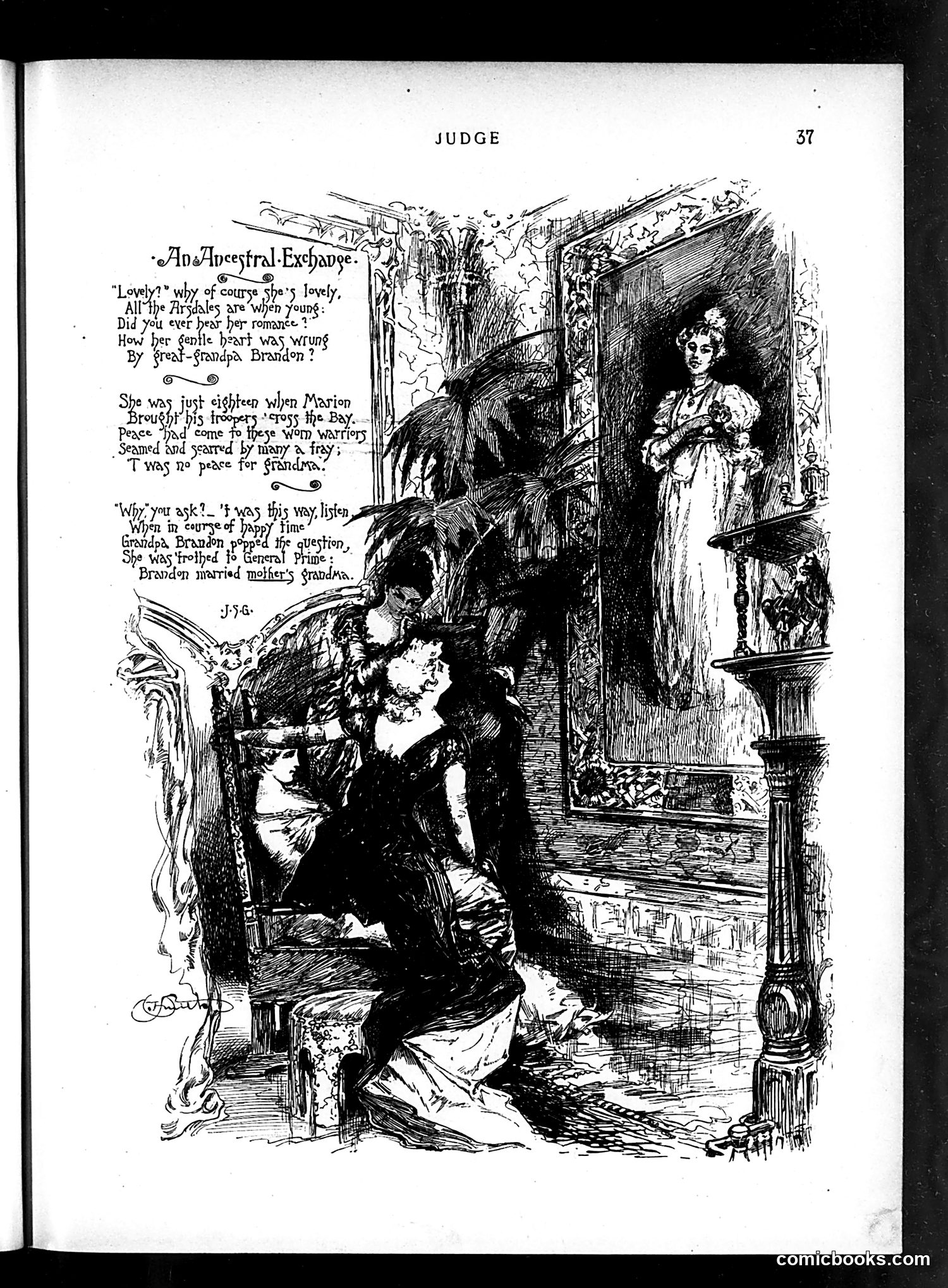
This page depicts a Victorian-era social comedy about genealogy and romantic history. A woman and child (likely a mother and daughter) are being told by an older woman about their family's past. The narrative reveals that the grandmother was eighteen when she was "crossed in love" by "great-grandpa Brandon"—he proposed to her, but she was "betrothed to General Price" instead, whom she ultimately married. The satire appears to mock the tendency of families to romanticize ancestral tales of thwarted romance and dramatic past events. The title "An Ancestral Exchange" suggests the irony of how romantic misadventures become family lore passed down through generations. The artwork's theatrical style and the poem's sentimental tone gently ridicule both Victorian nostalgia for "the old days" and the melodramatic way such stories are retold to younger generations.
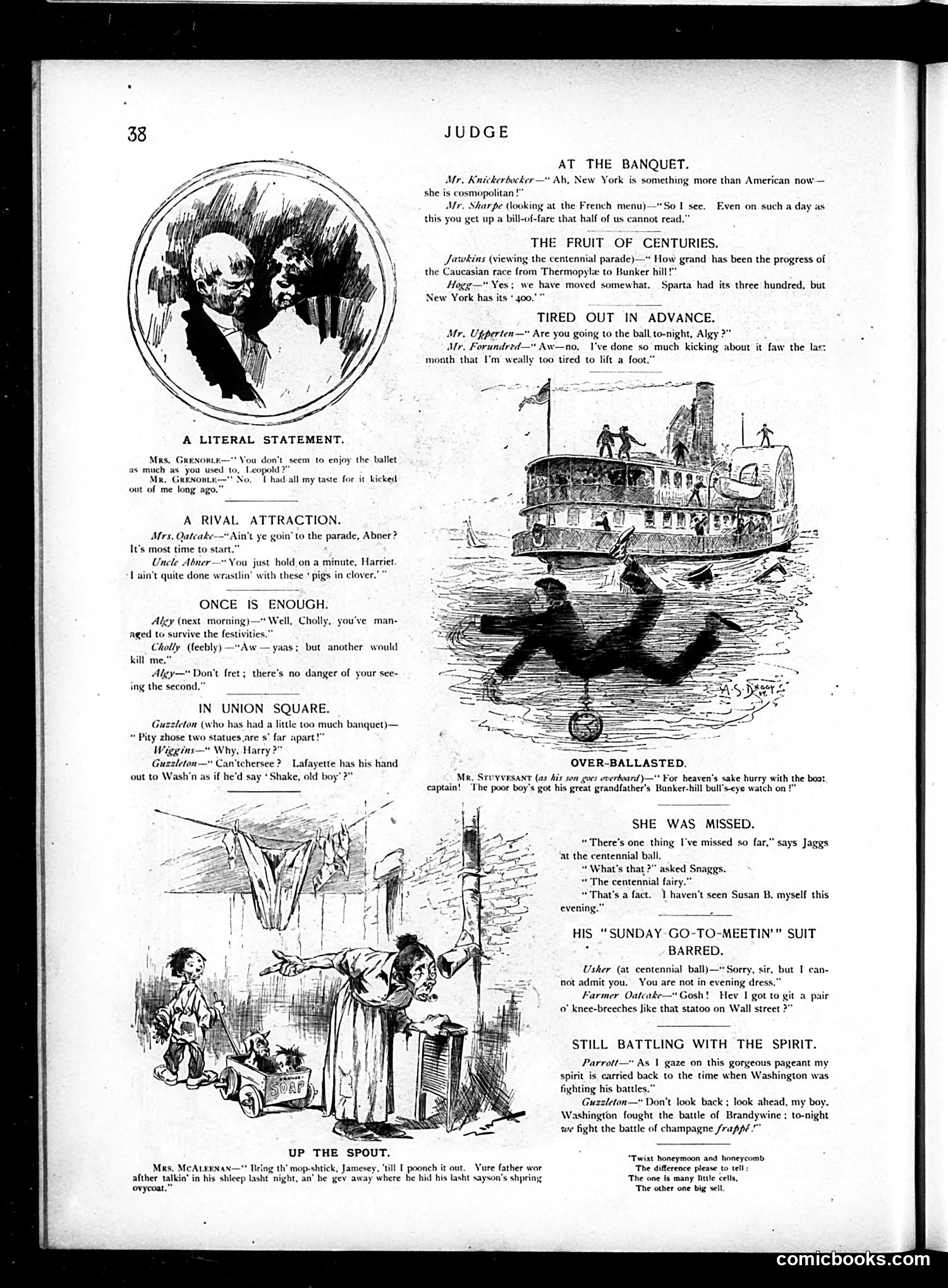
This page from Judge satirizes New York's 1876 Centennial celebrations through multiple vignettes mocking high society pretension and social absurdities. **Key satires include:** - **"The Fruit of Centuries"**: Jawkins boasts about Caucasian racial progress from ancient Thermopylae to Bunker Hill, while Hogg deflates this by noting New York's "400" (the social elite) is far smaller than Sparta's legendary 300—mocking both grandiose historical comparisons and Manhattan's supposedly exclusive upper class. - **Centennial parade scenes**: Various sketches ridicule attendees' exhaustion, inappropriate attire (a farmer barred for lacking "evening dress"), and drunken revelers (Guzzleton) confusing statuary. - **"Susan B." reference**: A subtle jab at feminist Susan B. Anthony, whose absence at the "centennial fairy" suggests contemporary gender exclusions from celebrations. - **Social climbing absurdities**: Characters like "Upperton" and "Forundred" embody shallow pretension about fashionable events. The overall message mocks nouveau riche Manhattan society's hollow patriotism, class snobbery, and performative respectability during America's centennial moment.
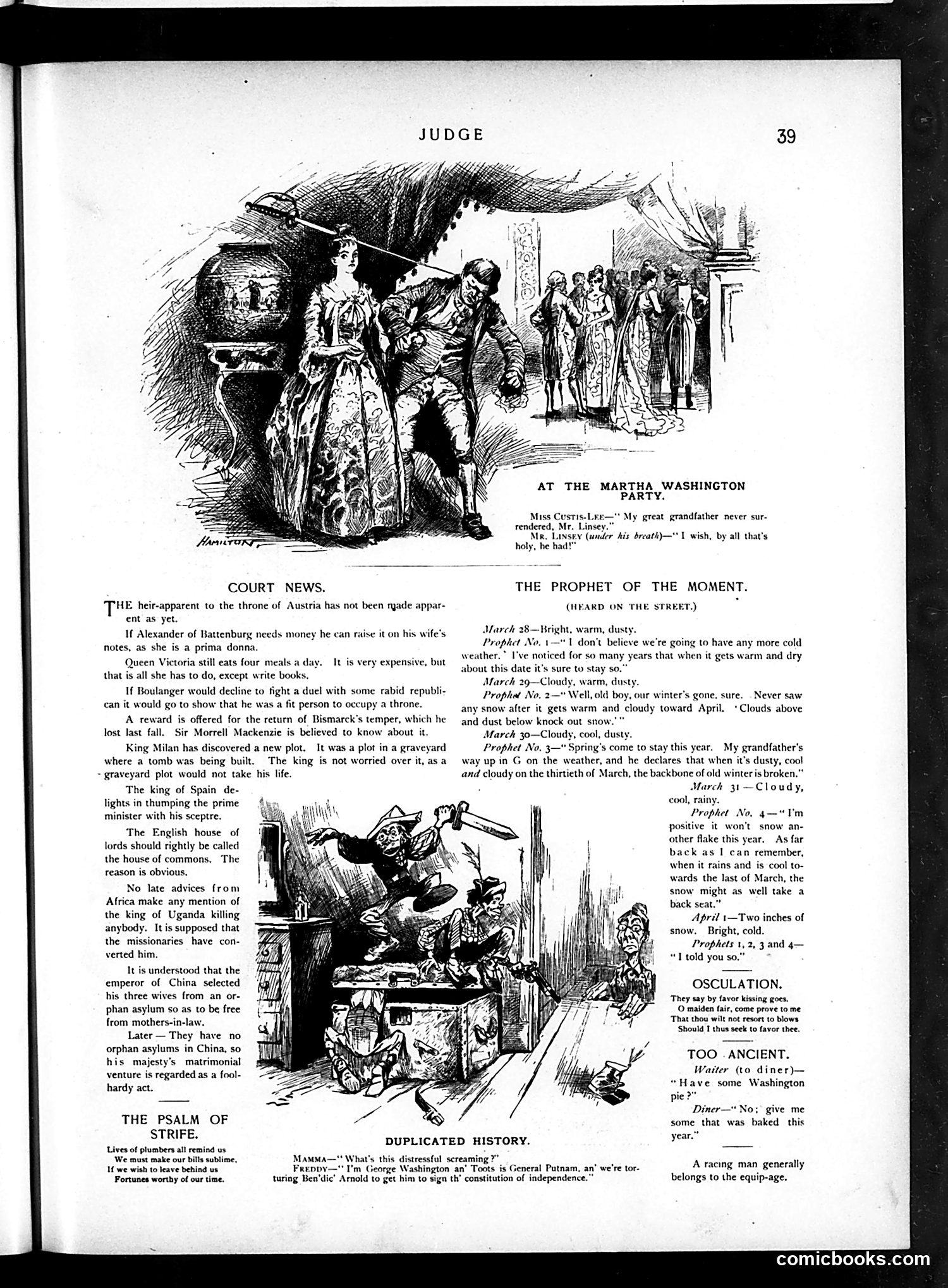
This page contains several satirical pieces mocking contemporary figures and social follies: **"Court News"** offers political zingers about European royalty and leaders—mocking Austria's heir-apparent, General Boulanger (French political figure), Bismarck's temperament, and various monarchs' foolishness. The humor relies on readers' familiarity with 1880s European politics. **"At the Martha Washington Party"** jokes about a guest's boring ancestor, with Mr. Linsey sarcastically wishing the great-grandfather "had" been rendered (killed) in battle rather than survived to bore posterity. **"The Prophet of the Moment"** satirizes weather forecasters who make contradictory predictions throughout late March, each confidently citing folk wisdom—then snow arrives on April 1st, and all four "prophets" claim they predicted it anyway. **Minor pieces** include jokes about plumbers' bills, children reenacting history, and a diner rejecting "Washington pie" as too old-fashioned—likely alluding to the Martha Washington association above. The satire targets charlatans, pompous authority figures, and human self-deception.
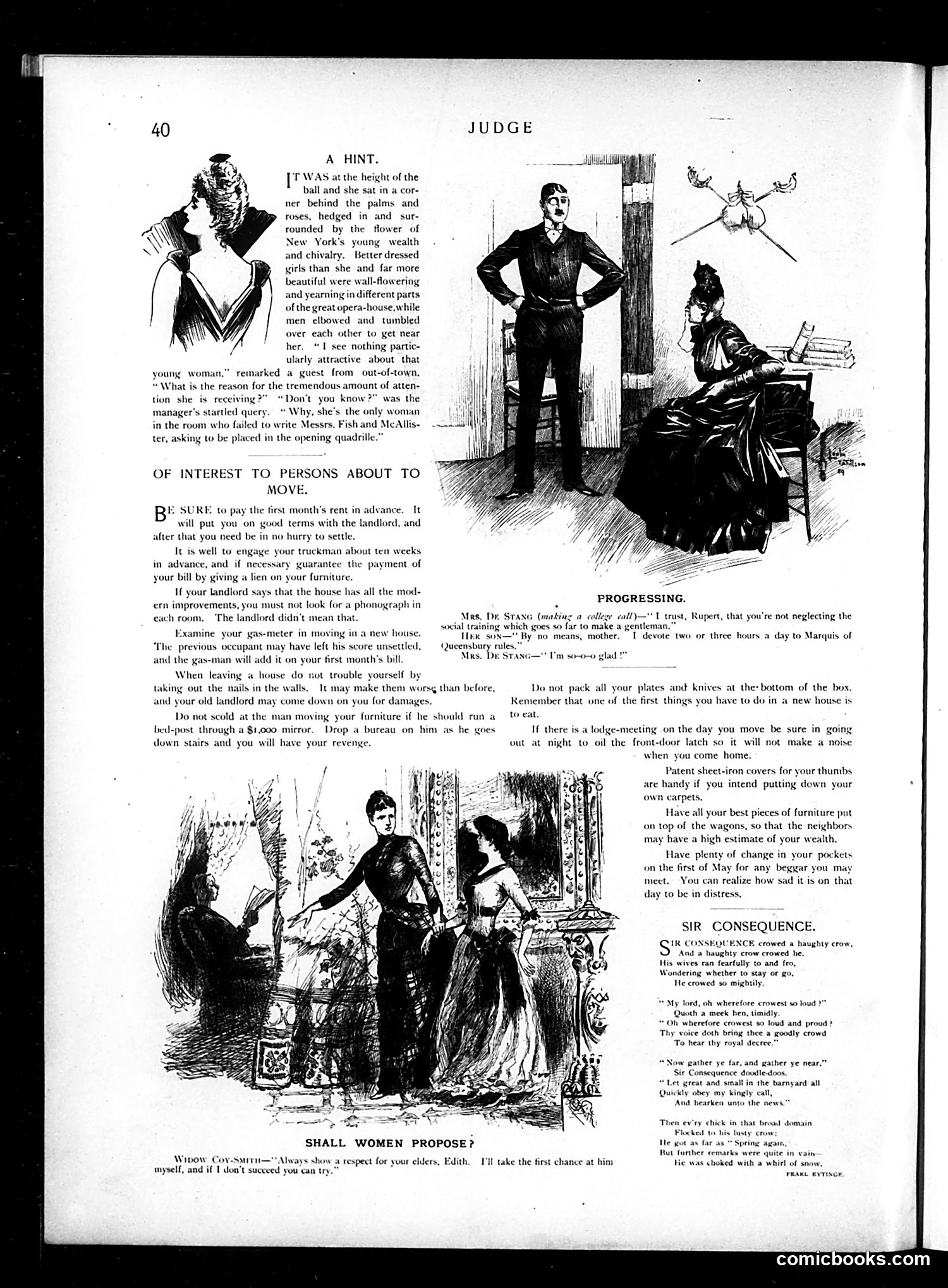
This page contains three distinct pieces of social satire from early 20th-century America: **"A Hint"** mocks New York high society's obsession with social status. A wealthy woman attracts male attention not because of beauty or charm, but because she *hasn't* written to the arbiters of society (Messrs. Fish and McAllister—real figures who controlled NYC's social register). The joke: exclusivity creates desirability. **"Of Interest to Persons About to Move"** offers tongue-in-cheek moving advice with class commentary—suggestions like displaying your best furniture prominently so neighbors think you're wealthy, and having cash on May 1st (moving day) for beggars in distress. **"Sir Consequence"** is a moral fable about an arrogant rooster whose loud crowing attracts a crowd, which he mistakes for reverence rather than curiosity. It satirizes pompous self-importance. **"Shall Women Propose?"** shows a widow instructing a younger woman (Edith) on dating etiquette, suggesting women should pursue men if necessary—relatively progressive for the era, presented humorously. The cartoons collectively mock pretension, social climbing, and rigid conventions.
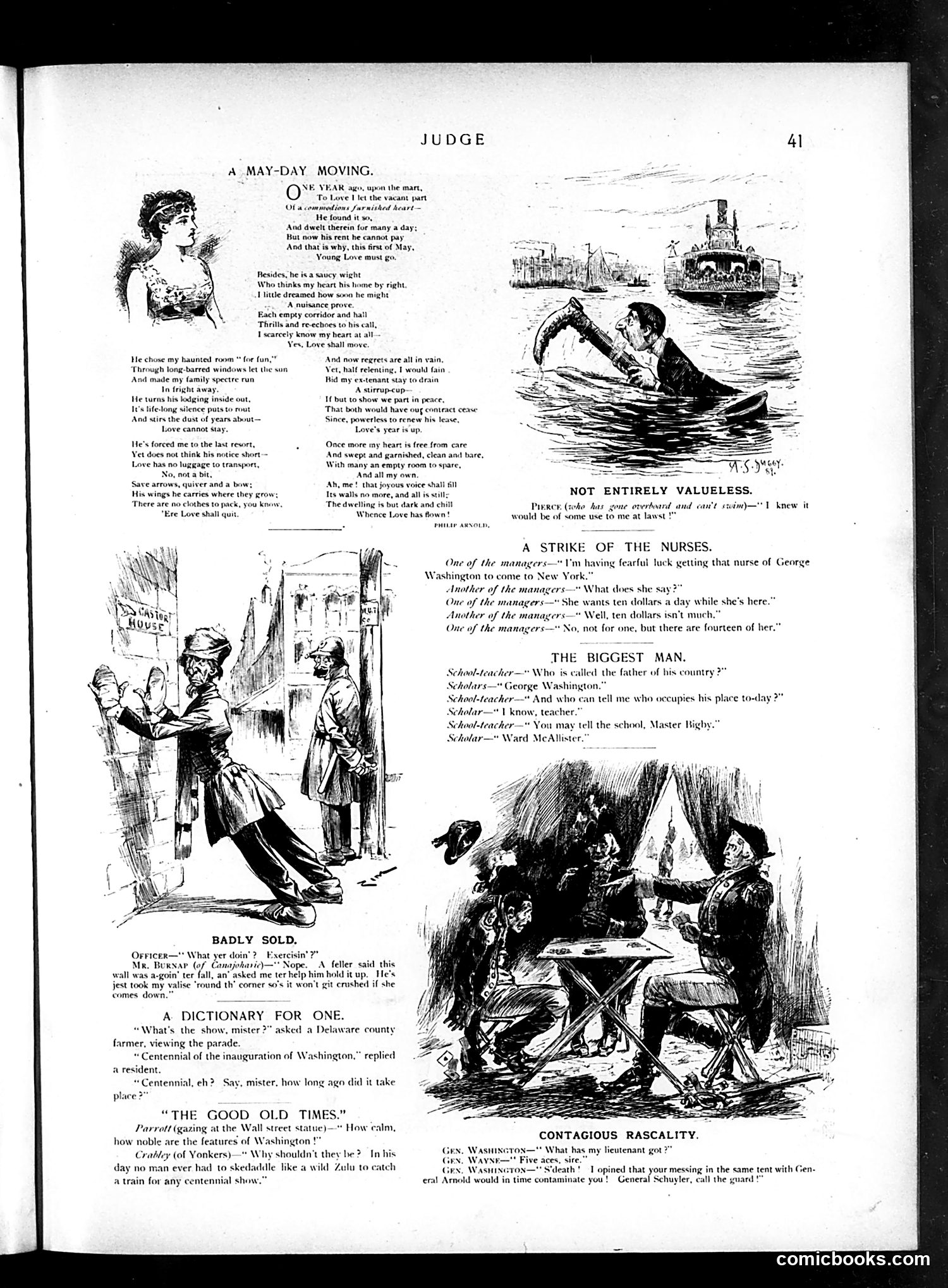
This page from Judge contains multiple satirical pieces marking Washington's centennial celebration. The main content includes: **"A May-Day Moving"** — A poem using the metaphor of Love as a tenant evicted on May 1st (moving day), satirizing romantic disappointment through domestic landlord/tenant language. **"A Strike of the Nurses"** — Managers complain about hiring a nurse for George Washington at ten dollars daily; the joke is that fourteen nurses are needed, making the cost excessive—likely mocking either Washington's poor health or the inflation of service costs. **"The Biggest Man"** — A schoolteacher asks who occupies George Washington's place today; the answer "Ward McAllister" mocks the wealthy socialite as America's current most important figure, satirizing the era's worship of high society over political leadership. **"Contagious Rascality"** — Generals discuss contamination from sharing quarters with a rascally officer, playing on period anxieties about moral corruption. The page satirizes Gilded Age society, centennial patriotism, and social pretension through humor and caricature.
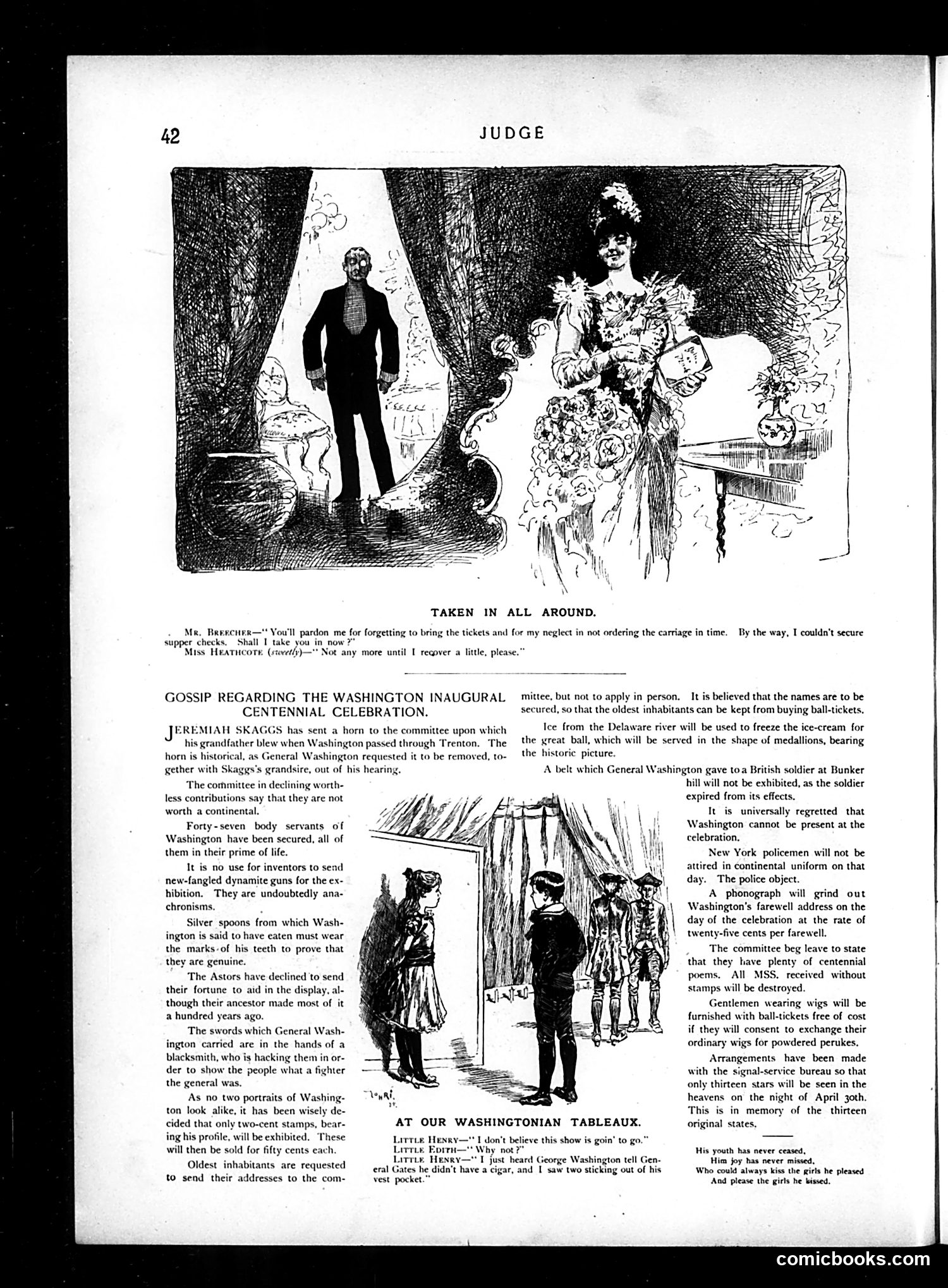
This page satirizes the planning of Washington's Inaugural Centennial celebration (likely 1889). The top cartoon shows a society couple where the woman refuses the man's escort after he forgot tickets and carriage arrangements—mocking upper-class pretension. The main text is a humor column titled "Gossip Regarding the Washington Inaugural Centennial Celebration." It ridicules the committee's mismanagement through absurdist anecdotes: accepting worthless "contributions" (puns on "continental"), employing dubious "body servants," hacking Washington's swords to prove he fought, and selling two-cent stamps at fifty cents each. The satire targets both the committee's incompetence and American greed—the Astors won't donate, New York police refuse colonial uniforms, and everything has a price. The accompanying sketch shows period characters discussing a tableau, with one noting Washington can't attend the celebration—a final jab at the event's fundamental absurdity. The tone is lighthearted ridicule of civic mismanagement and mercenary commemorative excess.
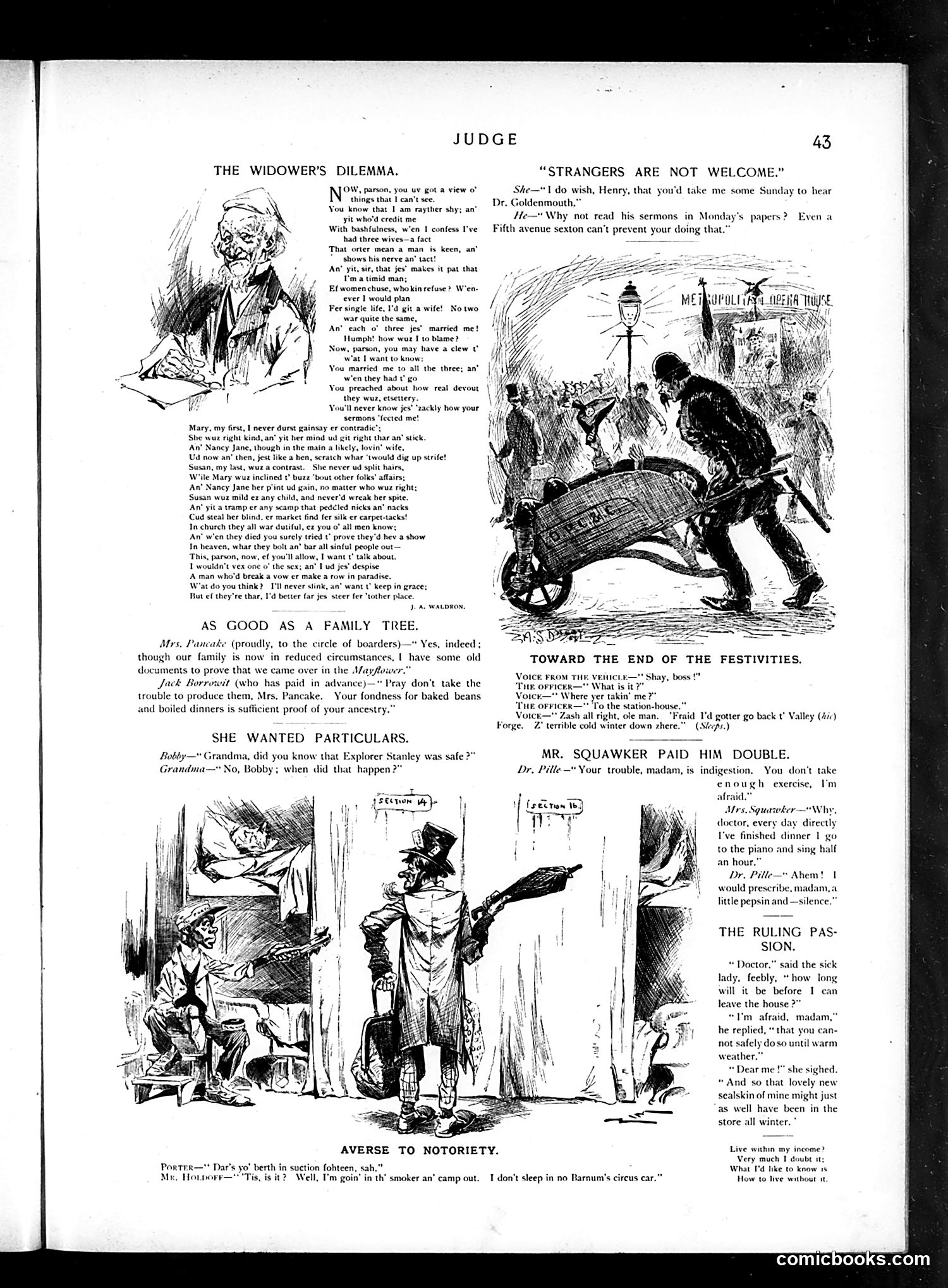
This page contains multiple satirical cartoons and humorous sketches typical of Judge magazine's social commentary. **"The Widower's Dilemma"** features a man confessing to a parson that he's been married three times. The satire mocks both his repeated marriages (suggesting men are passive victims of women's pursuit) and the hypocrisy of church moralizing—he fears his wives are in heaven and worries he'd have to join them there. **"As Good as a Family Tree"** satirizes social pretension: a boarding house owner boasts of Mayflower ancestry while a tenant sarcastically notes her monotonous, cheap meals ("baked beans and boiled dinners") are better proof of humble origins than any documents. **"Averse to Notoriety"** jokes about a porter preferring to sleep in the smoker car rather than in a bed named after P.T. Barnum's circus—mocking both the absurdity of novelty marketing and working-class dignity. Other sketches humorously depict marital dynamics, medical advice about exercise, and a drunk man arrested near Valley Forge, all reflecting turn-of-century American social attitudes and humor.
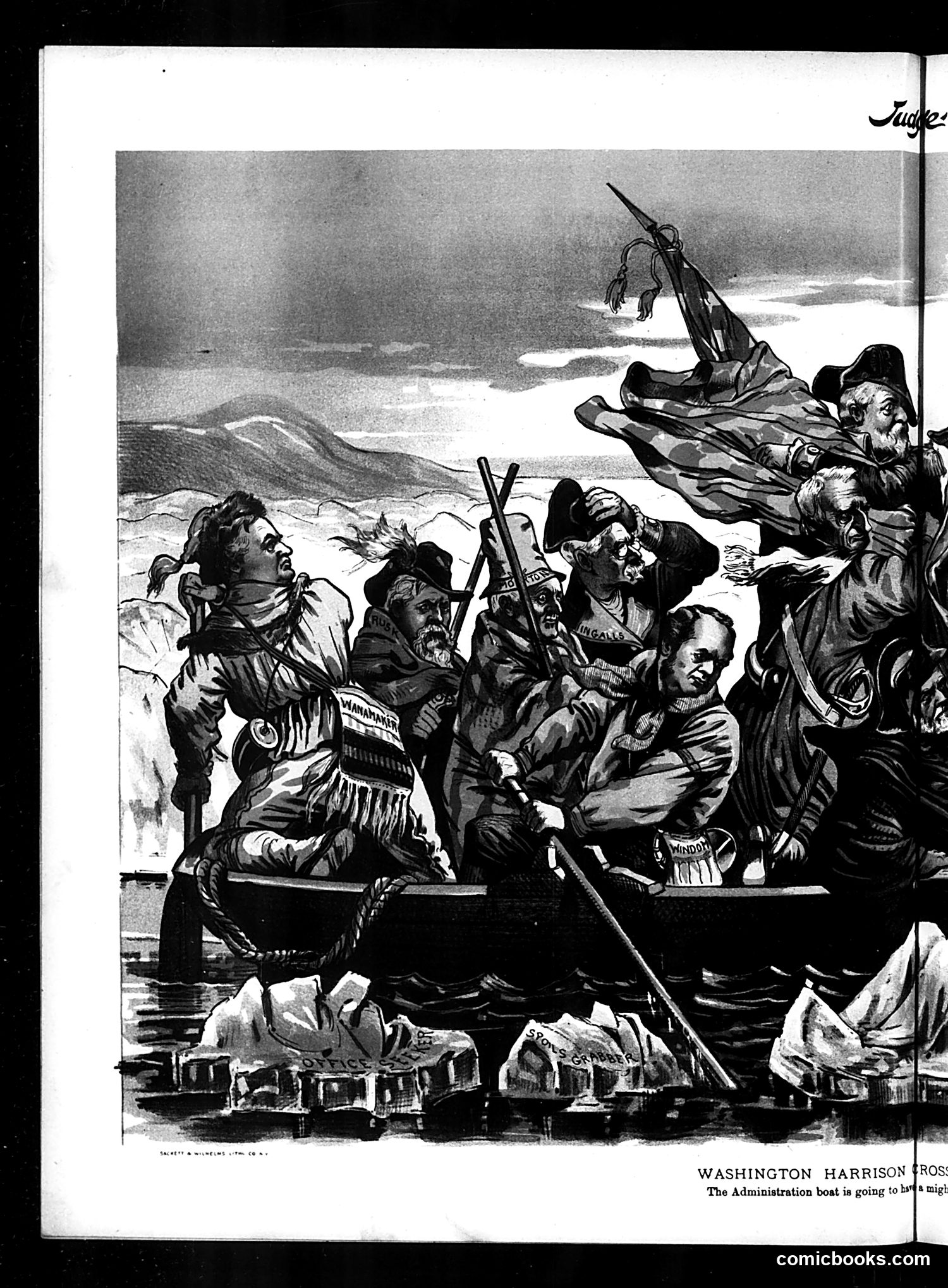
This is a Judge magazine cartoon titled "Washington Harrison Rosy" depicting "The Administration boat is going to hit ® might" (text appears incomplete/unclear in OCR). The image shows a boat filled with caricatured political figures in dramatic distress, appearing to be headed toward disaster. The artistic style and composition suggest an administration is in peril or heading toward failure. The figures display exaggerated features typical of period political cartooning, though specific identities aren't clearly marked. Without the complete caption and given the "Washington Harrison" reference, this likely satirizes either a William Henry Harrison or Benjamin Harrison administration's policies or political situation. The boat metaphor—common in political satire—represents the government "ship of state" in trouble, mocking the administration's direction or competence. The exact historical moment and specific targets remain unclear without fuller context.
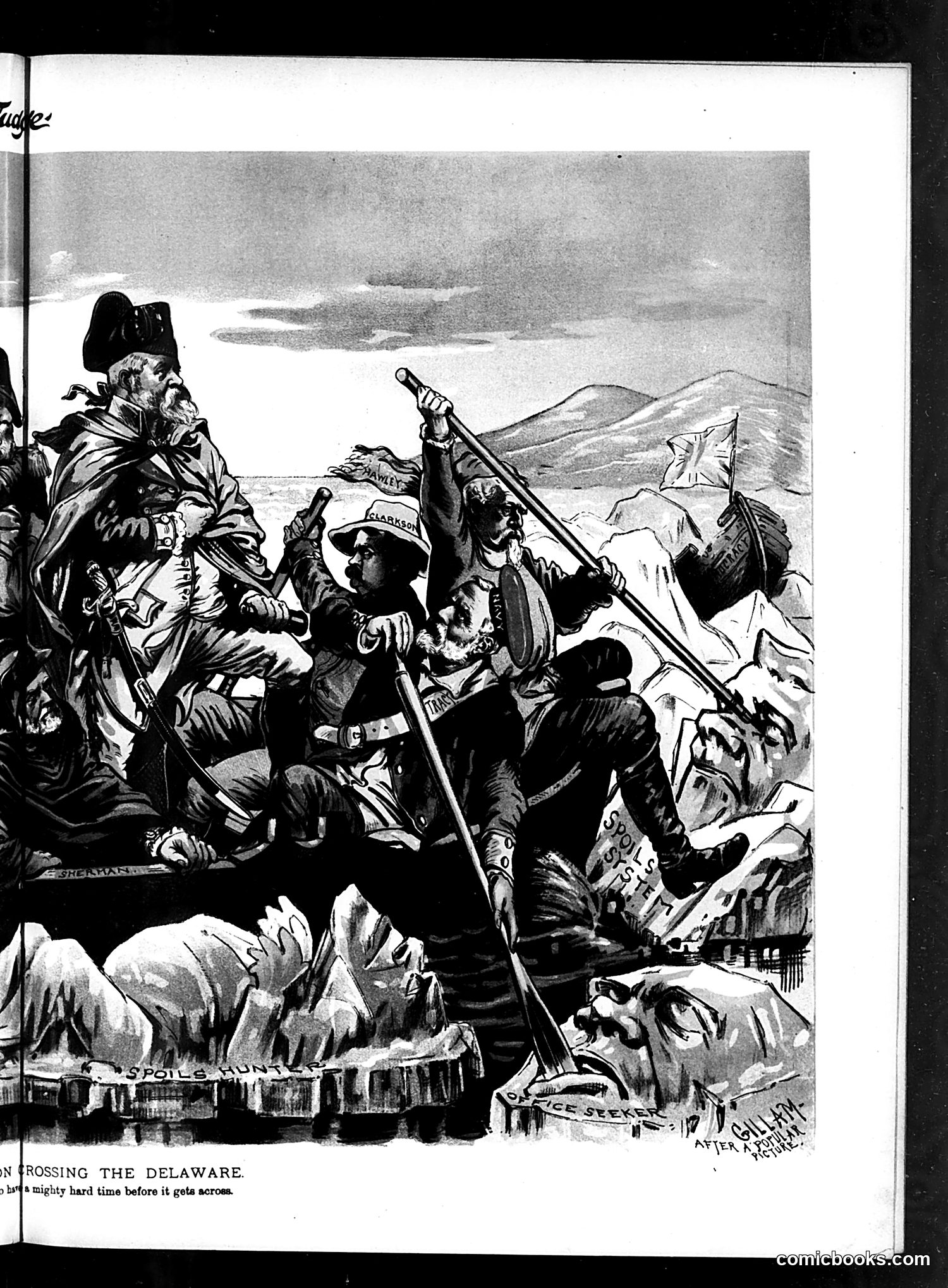
This illustration depicts "Crossing the Delaware," referencing Washington's famous Revolutionary War crossing. The cartoon appears to be satirical commentary on a contemporary political or military situation, repurposing the iconic historical moment. The image shows military figures in a boat crossing an icy river, with flags visible and soldiers in period dress. Labels visible include "SPOILS," "ICE STICKER," and what appears to be references to political patronage or corruption ("spoils" suggests the spoils system of political appointments). Without a clear date or full text, the exact target is uncertain, but Judge magazine used historical parallels to critique contemporary politics—likely mocking political leaders or military decisions by comparing them unfavorably to Revolutionary ideals. The "spoils" reference suggests criticism of corruption or self-interested governance disguised as patriotic action.
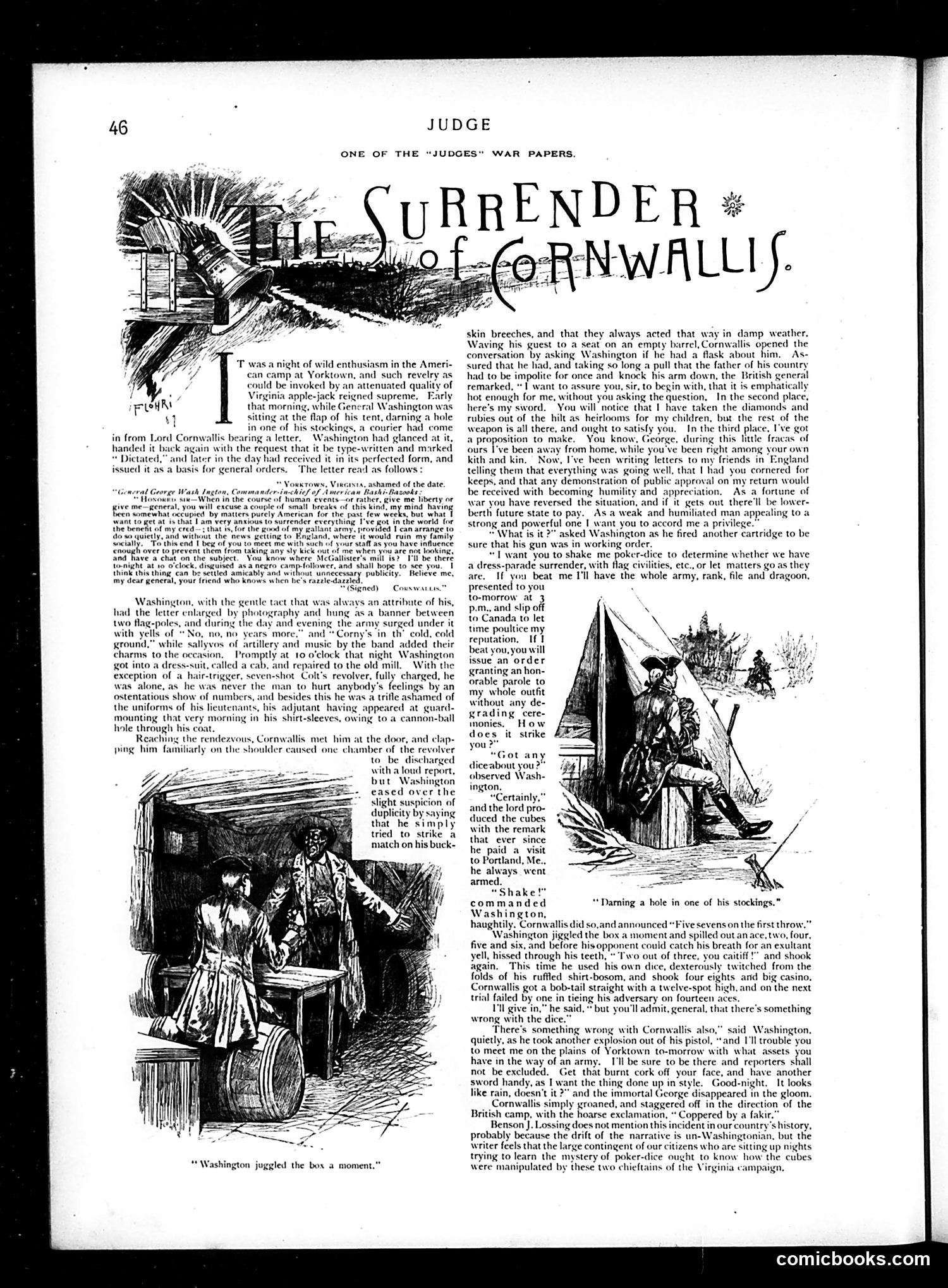
This satirical piece reimagines the 1781 British surrender at Yorktown as a humorous negotiation between General Cornwallis and George Washington. The joke plays on contrasts: Cornwallis, presented as vain and self-pitying, arrives bearing his sword but first removes its jewels as "heirlooms." He proposes that rather than a formal, dignified surrender, they settle the matter by gambling with poker dice—essentially suggesting they leave the outcome to chance. Washington's response (shown in the illustrations) involves practical indignities: darning his stockings, juggling a box, and enlisting his soldiers to mock the letter by enlarging and displaying it as a banner for army-wide ridicule. The satire mocks British aristocratic pretension and self-concern while celebrating American democratic plainness and humor. It celebrates Washington's dignity through his willingness to treat a solemn military surrender as an occasion for irreverent fun—suggesting American superiority through moral clarity and lack of pretense.
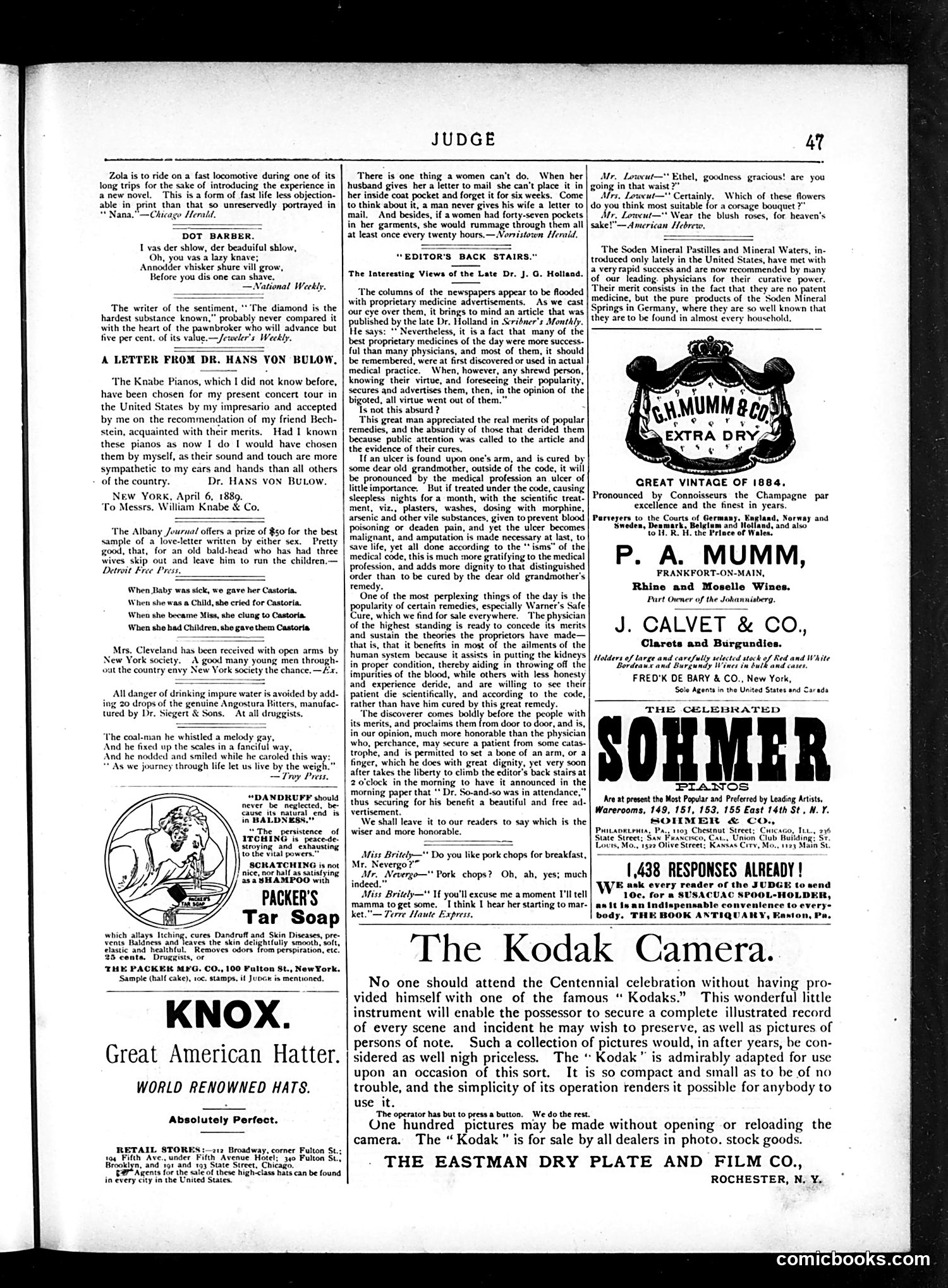
This is primarily an **advertising and filler content page** from Judge magazine (late 1880s), not a political cartoon page. The visible content includes: **Social Satire/Commentary:** - A jab at author Émile Zola's literary realism—mocking his plan to ride a locomotive for authenticity for his novel *Nana* (known for explicit content) - Jokes about marriage dynamics (wives forgetting to mail letters, lazy barbers) - A dig at pawnbrokers' stinginess compared to a diamond's hardness **Advertisements:** The bulk consists of period product ads: Kodak cameras, Knox hats, Packer's Tar Soap (for dandruff/baldness), patent medicines, pianos, and other goods—typical of Judge's revenue model. **Minor Content:** A published letter from conductor Hans von Bülow endorsing Knabe Pianos, likely paid advertising disguised as editorial. The page reflects Judge's mix of light humor, commercial endorsements, and gentle social commentary rather than sharp political satire. Most references are to everyday consumer concerns rather than major events or figures.
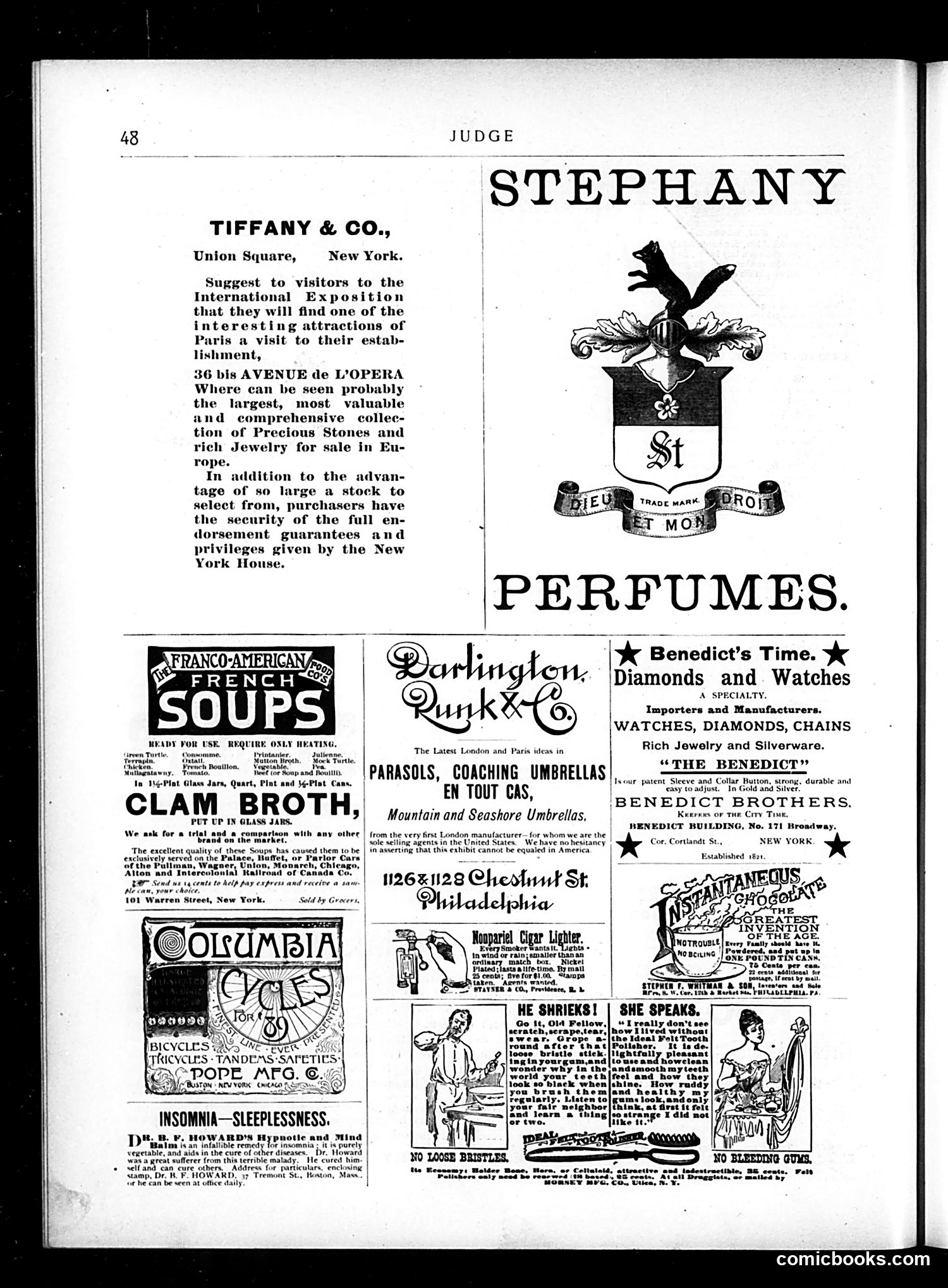
This is primarily an **advertising page** from Judge magazine, not a satirical cartoon. The page showcases luxury goods and patent medicines typical of the era. Notable advertisements include: - **Tiffany & Co.**: Encourages International Exposition visitors to shop at their Paris location for jewelry and precious stones - **Clam Broth**: Canned soup product - **Columbia Bicycles**: Manufactured by Pope MFG Co. - **Darlington Punk & Co.**: Parasols and umbrellas - **Benedict Brothers**: Watches, diamonds, and jewelry - **Dr. B.F. Howard's remedy**: Promises to cure insomnia and sleeplessness - **Patent medicines and novelty items**: Including cigar lighters and chocolate products The bottom illustrations appear to be product demonstrations ("He Shrieks!" and "She Speaks!") but are too small/unclear to identify specifically. The page reflects Gilded Age consumer culture and the era's enthusiasm for patent medicines, often of dubious efficacy.
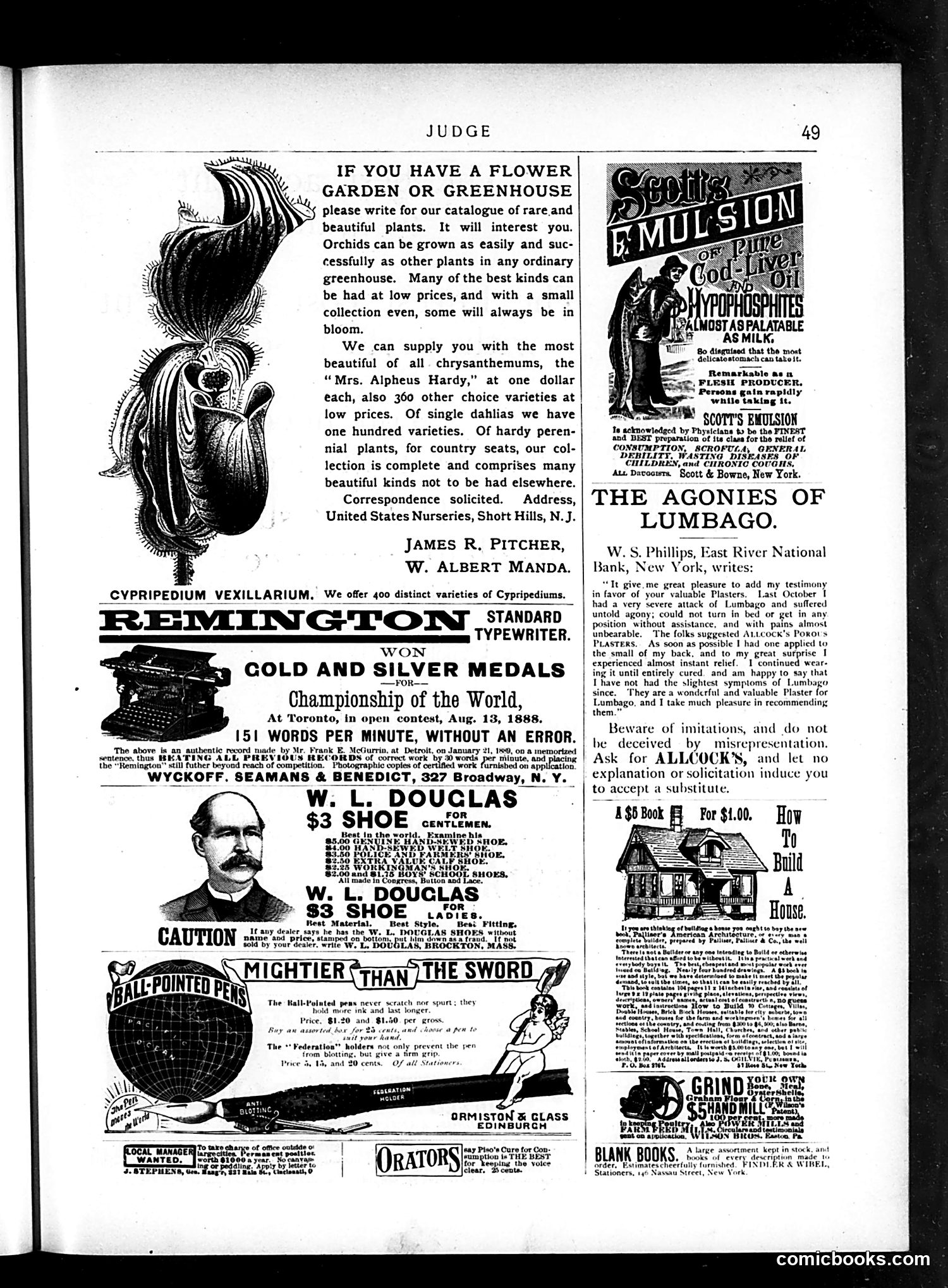
This page is primarily **advertising**, not satirical content. It's a collection of commercial advertisements typical of late 19th-century magazines. Notable ads include: - **W.L. Douglas $3 Shoe**: Features the actual W.L. Douglas with a caution against counterfeits—Douglas was a real shoe manufacturer famous for affordable quality footwear. - **Remington Typewriter**: Advertises a "world championship" speed record (151 words per minute) from 1888, highlighting the novelty of typewriter technology. - **Scott's Emulsion**: A cod liver oil patent medicine claiming to treat consumption, scrofula, and debility—typical of the era's often-dubious health products. - **Allcock's Plasters**: A pain-relief plaster with a testimonial from a New York banker about treating lumbago. - **Ball-Pointed Pens**: Early fountain pens marketed as non-scratching innovations. The page reflects consumer culture of the 1880s: mass-produced goods, medical "remedies," and emerging technologies marketed through testimonials and competitive claims.
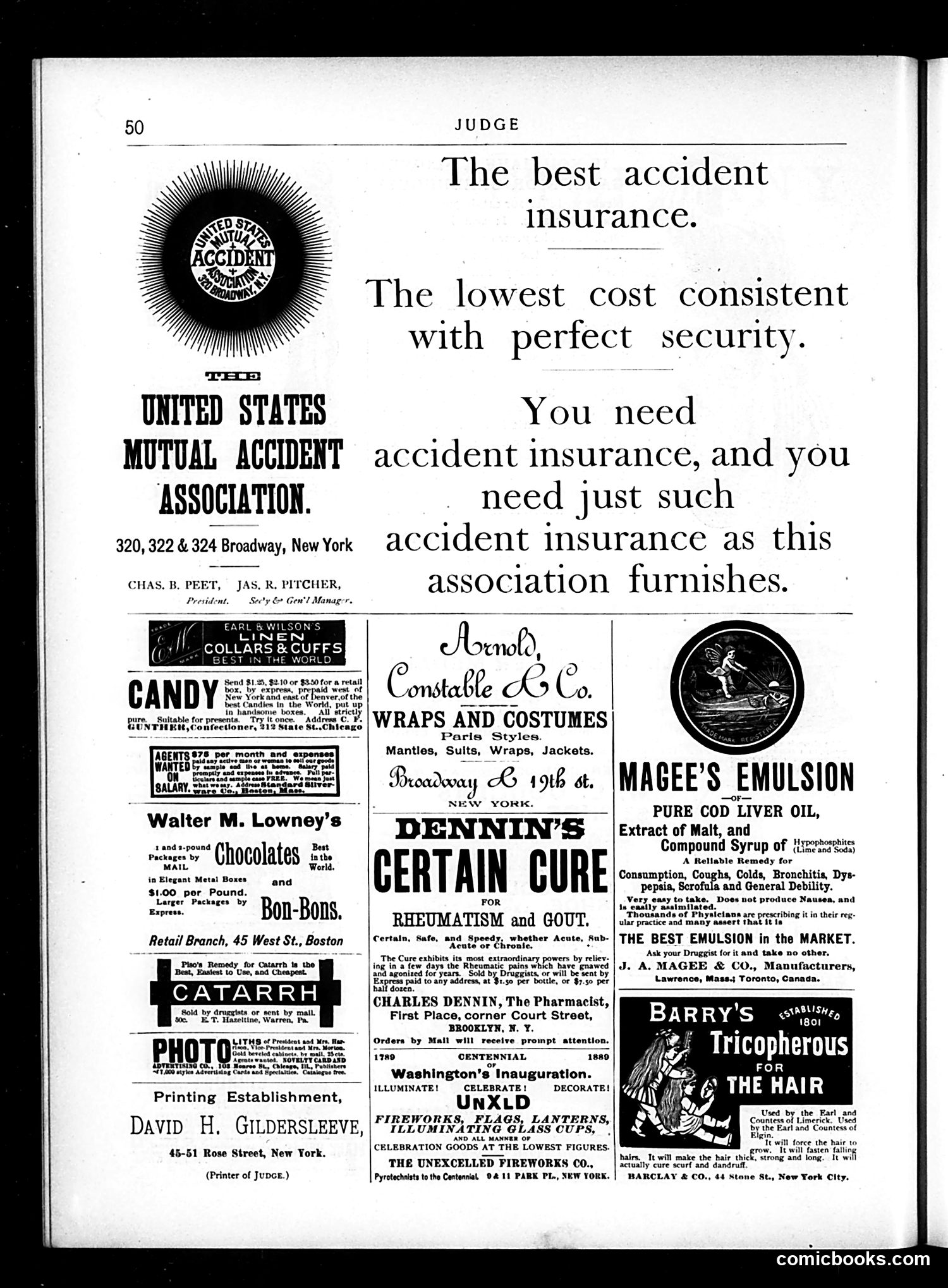
This is primarily an **advertising page** from *Judge* magazine, not a political cartoon or satire page. The page features the magazine's masthead and numerous commercial advertisements for late 19th-century products: accident insurance, candy, chocolates, clothing, patent medicines (for catarrh, rheumatism, gout), hair treatments, and cod liver oil tonics. There's also an advertisement for fireworks celebrating Washington's Inauguration Centennial (1889). **One notable element**: the top advertisement for the United States Mutual Accident Association uses hyperbolic language typical of the era—claiming to offer "the best accident insurance" at "the lowest cost consistent with perfect security," a humorous overstatement characteristic of period advertising. The page also credits **David H. Gildersleeve** as the printer of *Judge*. There are **no identifiable political cartoons or satirical commentary** visible on this page—it is essentially a commercial vehicle for advertisements, which was standard practice for magazines of this period.
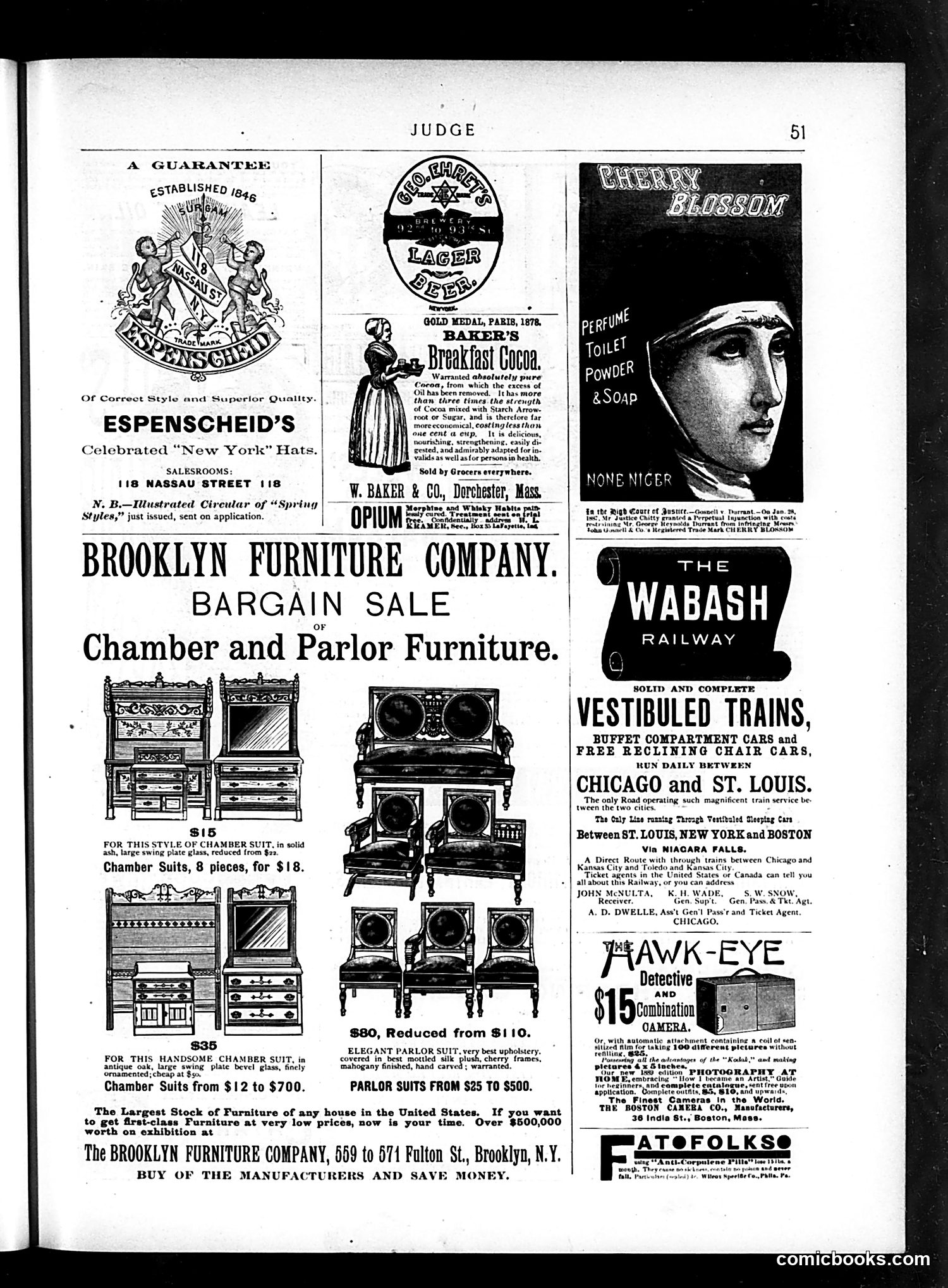
This page consists almost entirely of **late 19th-century advertisements** with no political cartoons or satirical content to analyze. The ads include: - **Espenscheid's hats** (New York styles) - **Baker's Breakfast Cocoa** (emphasizing purity) - **Brooklyn Furniture Company** (bargain sales on chamber and parlor suites) - **Opium and morphine addiction treatments** (reflecting period medical practices) - **The Wabash Railway** (vestibuled trains between Chicago and St. Louis) - **Hawk-Eye Detective Camera** ($15 combination camera) - **Cherry Blossom Perfume and Toilet Powder** The page is primarily a **commercial vehicle**, demonstrating how Judge monetized itself through advertisements. The "Opium" treatment ad is notably striking to modern readers—reflecting the era's casual acceptance of such remedies before regulation. No satire or political messaging is evident on this particular page.
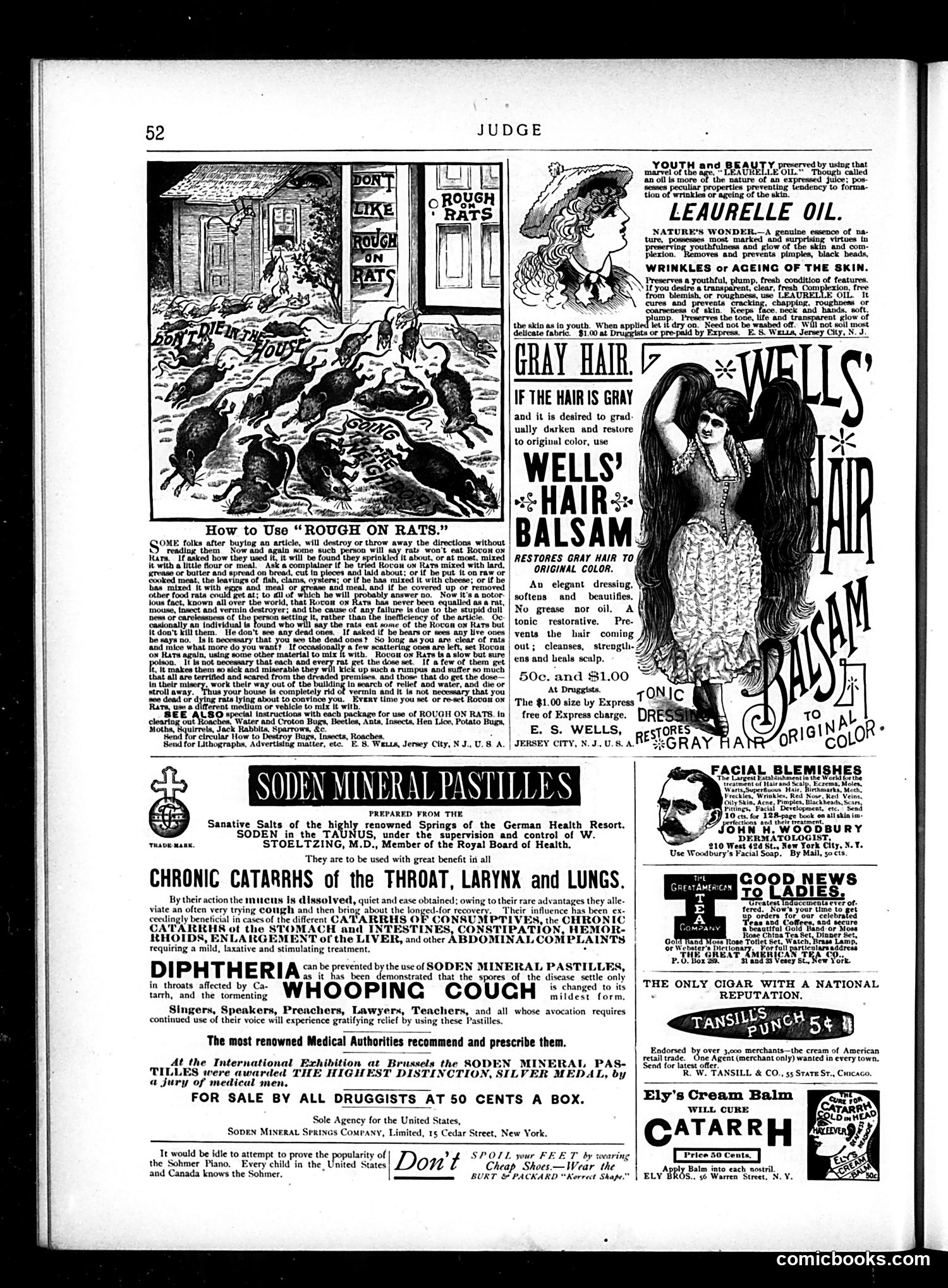
This page is primarily **advertising**, not political satire. It contains vintage product advertisements from early-20th-century Judge magazine, including: **Main content**: A large cartoon (top left) illustrating "Rough on Rats"—a commercial pest poison. The crude woodcut shows rats infesting a house, accompanying text that humorously explains why the product works: rats eating the poison become sick and frightened, spreading panic among other rats, who then flee. This is dark humor presenting pest control as entertaining drama. **Surrounding ads** promote various dubious patent medicines (Laurelle Oil for wrinkles, Wells' Hair Balsam for gray hair, Soden Mineral Pastilles for catarrh) typical of the era—products making exaggerated health claims now recognized as ineffective or harmful. The page reflects an era when Judge mixed satirical content with unregulated commercial advertising, and when such "miracle cure" products were commonplace and largely uncontrolled by consumer protection laws.
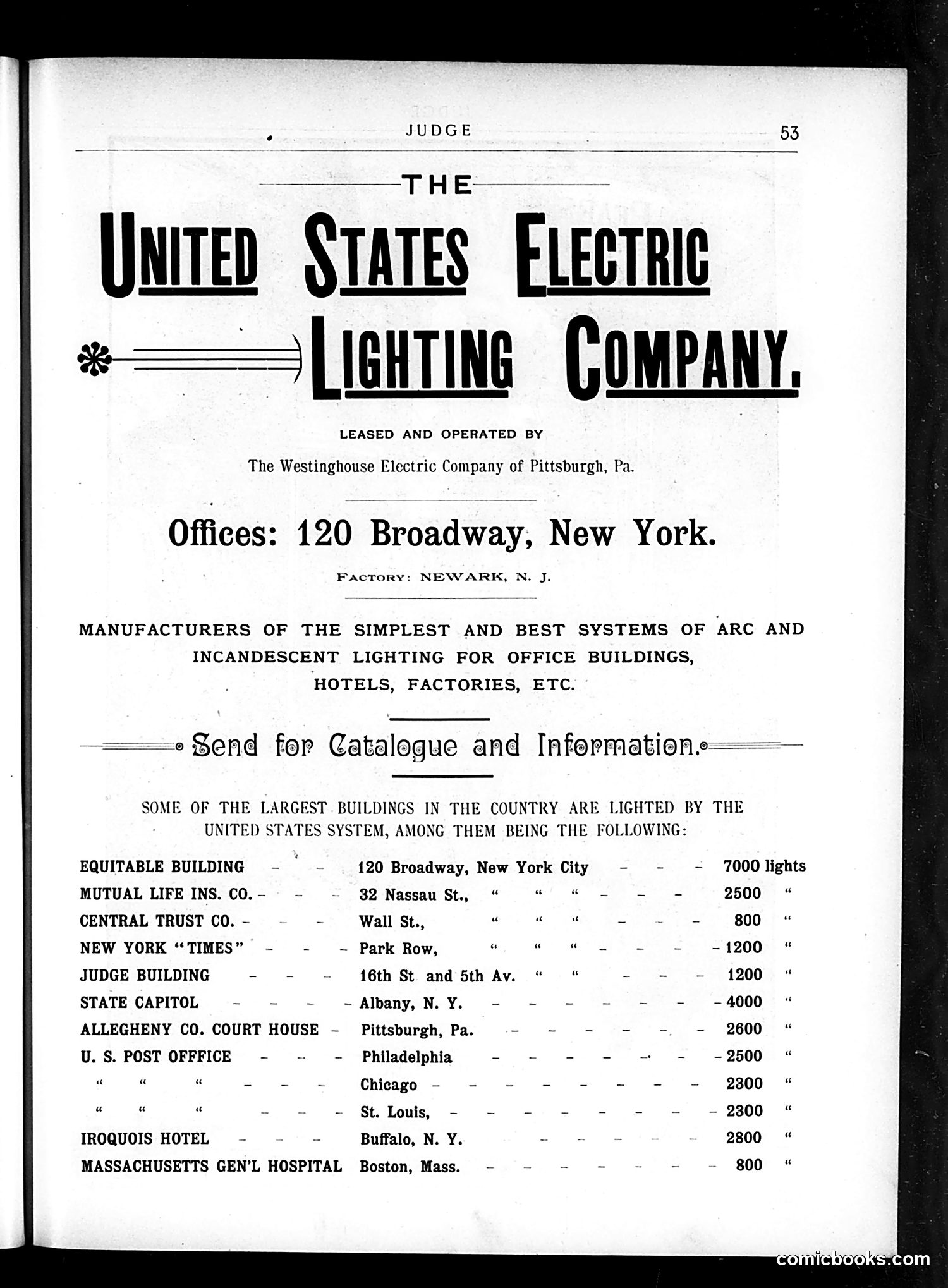
This page is not a cartoon—it's a **full-page advertisement** for the United States Electric Lighting Company, leased and operated by Westinghouse Electric. The ad promotes arc and incandescent lighting systems for commercial and institutional buildings. It establishes credibility by listing major clients, including prominent New York landmarks (Equitable Building with 7,000 lights, the New York Times building, the Judge Building itself) and government facilities (State Capitol, U.S. Post Offices, courthouse). The inclusion of the Judge Building among clients is notable: Judge magazine is advertising in its own pages, using itself as a testimonial to the product's quality. This was common practice—the magazine's own infrastructure served as proof of the technology's reliability for important institutions. There is no political satire or social commentary here; this is straightforward commercial promotion typical of late-19th/early-20th-century trade advertising.
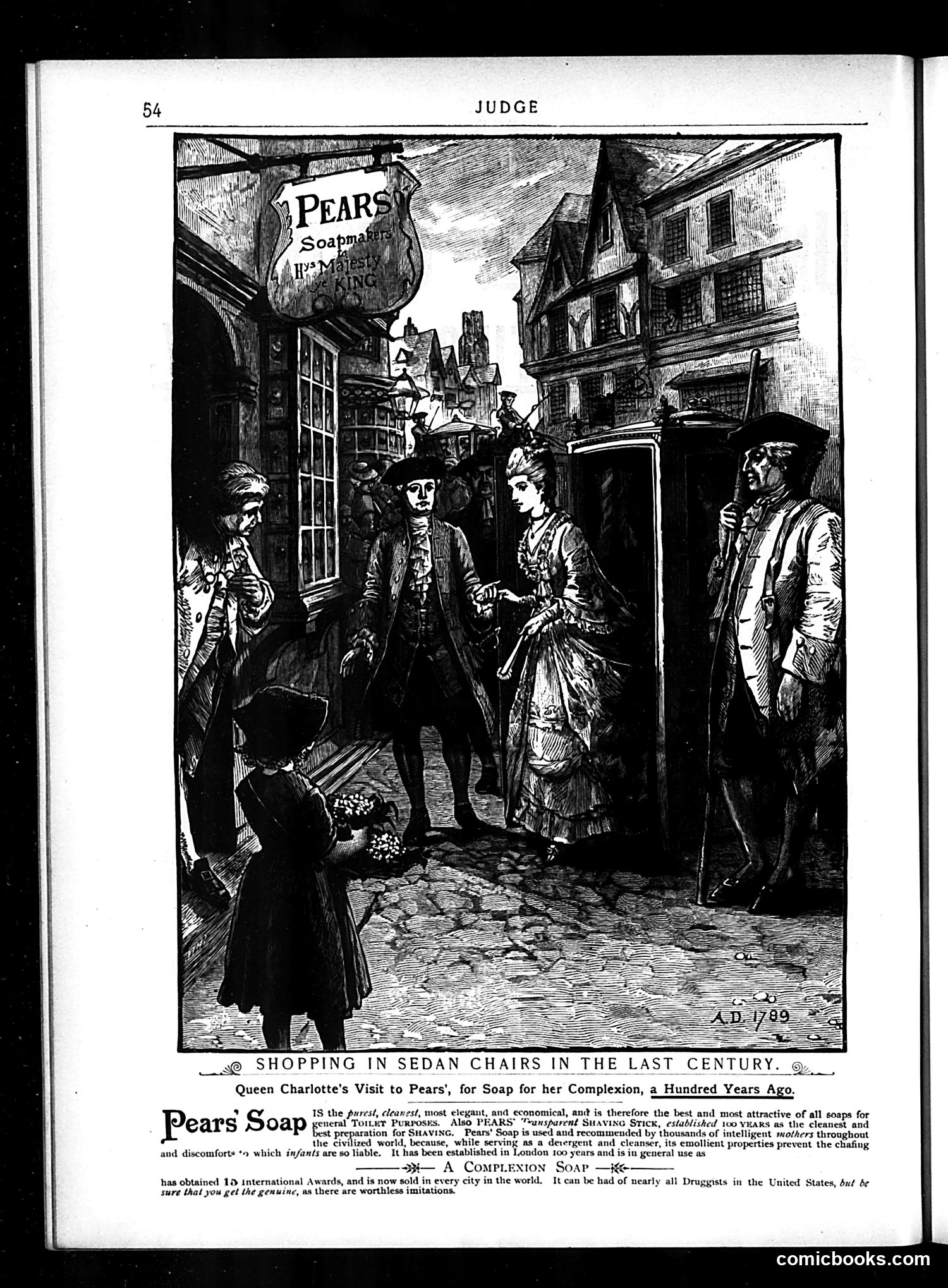
This is primarily a **Pears' Soap advertisement disguised as historical commentary**. The illustration depicts an 18th-century street scene (dated A.D. 1789) with figures in period dress and a sedan chair, captioned as "Queen Charlotte's Visit to Pears'" — referencing the actual British queen consort. The satire is gentle: the ad humorously suggests that even royalty a hundred years prior sought out Pears' soap for complexion care, implying the product's long-standing prestige and efficacy. The "last century" reference creates nostalgic authenticity. The text emphasizes the soap's 100-year history, international awards, and recommendation by "intelligent mothers," while warning against "worthless imitations" — standard advertising claims of the era. **For modern readers**: This reflects late-19th-century marketing tactics using historical prestige and celebrity endorsement (real or implied) to sell beauty products, combined with anxieties about counterfeit goods.
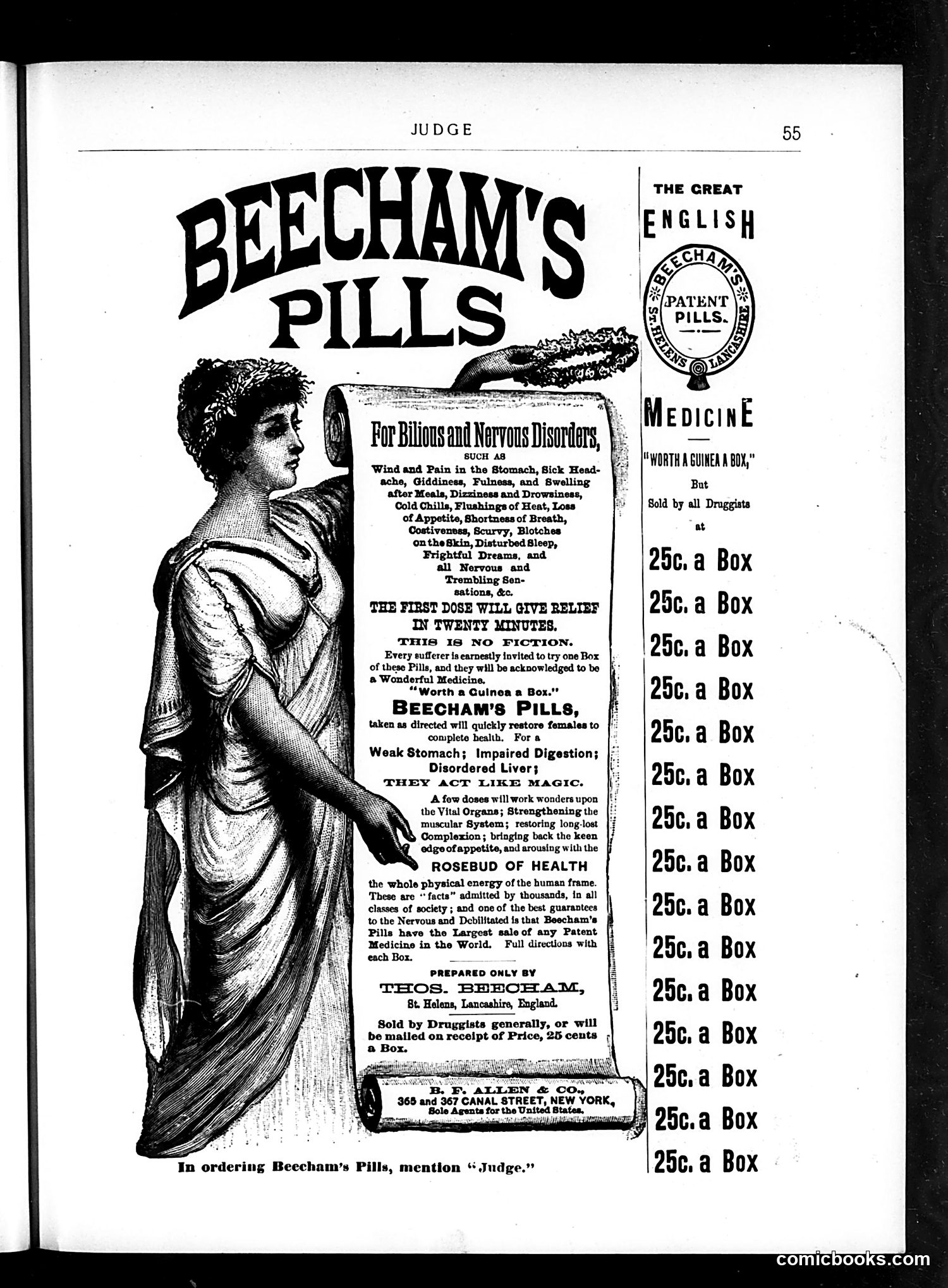
This is primarily a **patent medicine advertisement**, not political satire. The page features an allegorical female figure (representing health or medicine) promoting Beecham's Pills, a British patent remedy. The ad claims the pills cure numerous ailments—stomach problems, headaches, constipation, skin disorders, insomnia—and promises relief "in twenty minutes." It uses hyperbolic language typical of late 19th-century medicine advertising ("acts like magic," "rosebud of health"). The repetitive right column listing "25c. a Box" emphasizes affordability and availability. The phrase "Worth a Guinea a Box" references the original British pricing. **For modern readers**: This represents an era before FDA regulation when unsubstantiated medical claims were common in advertising. These products often contained dubious or harmful ingredients. Judge magazine's inclusion of such ads reflects how mainstream patent medicine marketing was, even in satirical publications.
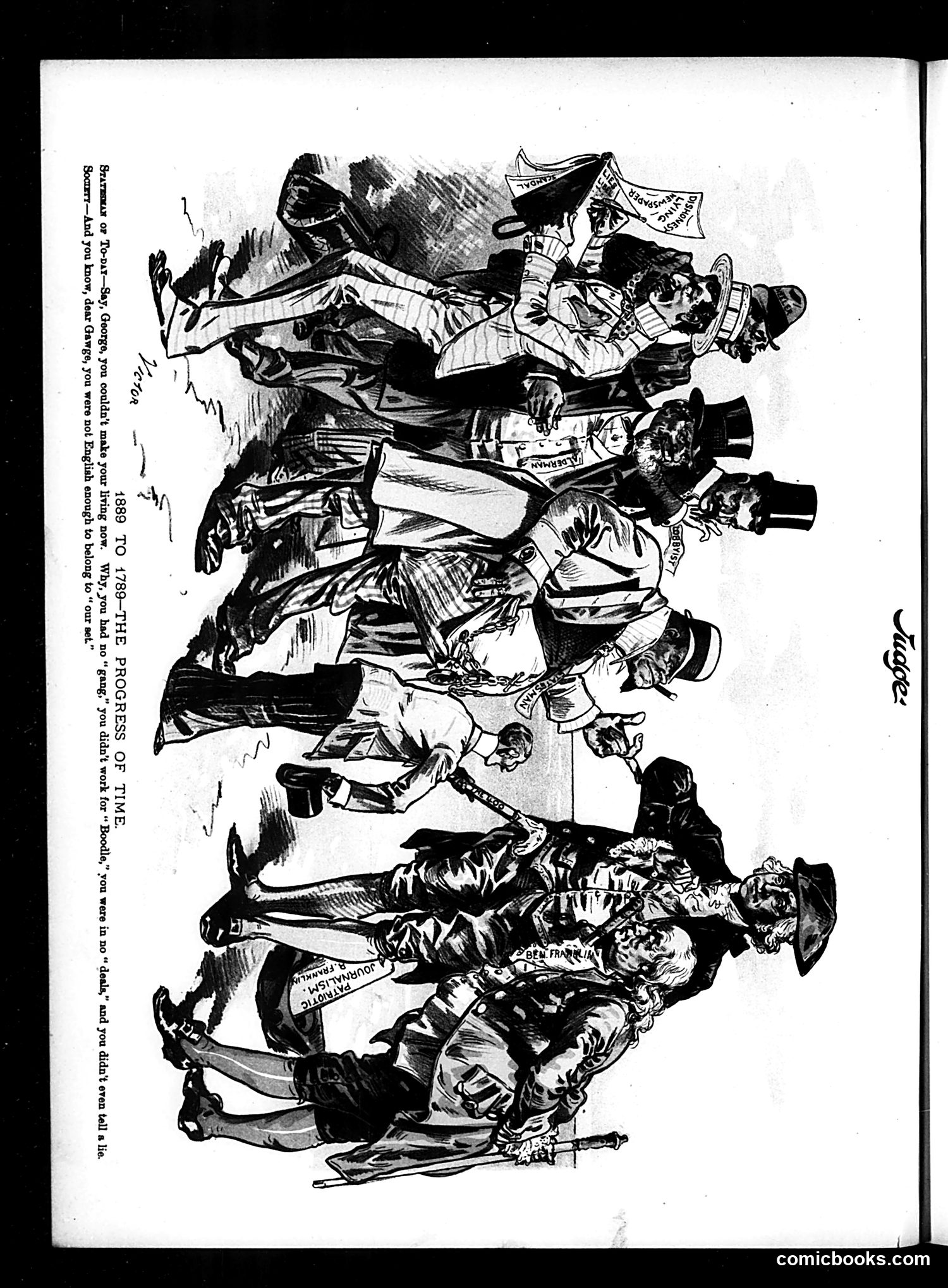
This appears to be a satirical cartoon from Judge magazine critiquing American foreign policy during the era of imperialism (likely 1890s-1900s, based on style). The image depicts Uncle Sam and other American political figures as a tangled mass of bodies and limbs, appearing chaotic and self-destructive. The figures are carrying flags and appear to be engaged in conflicting endeavors simultaneously. The satire likely critiques American interventionism and imperial ambitions—suggesting that the nation's overextension in foreign affairs (possibly referencing conflicts like the Spanish-American War, Philippine-American War, or Caribbean interventions) has created domestic disorder and contradiction. The cartoonist appears to argue that America's pursuit of multiple simultaneous foreign objectives has created confusion and chaos at home. The tangled composition emphasizes the unsustainability and self-defeating nature of these policies. Unfortunately, the OCR text is largely illegible, preventing precise identification of specific political figures or exact historical references.
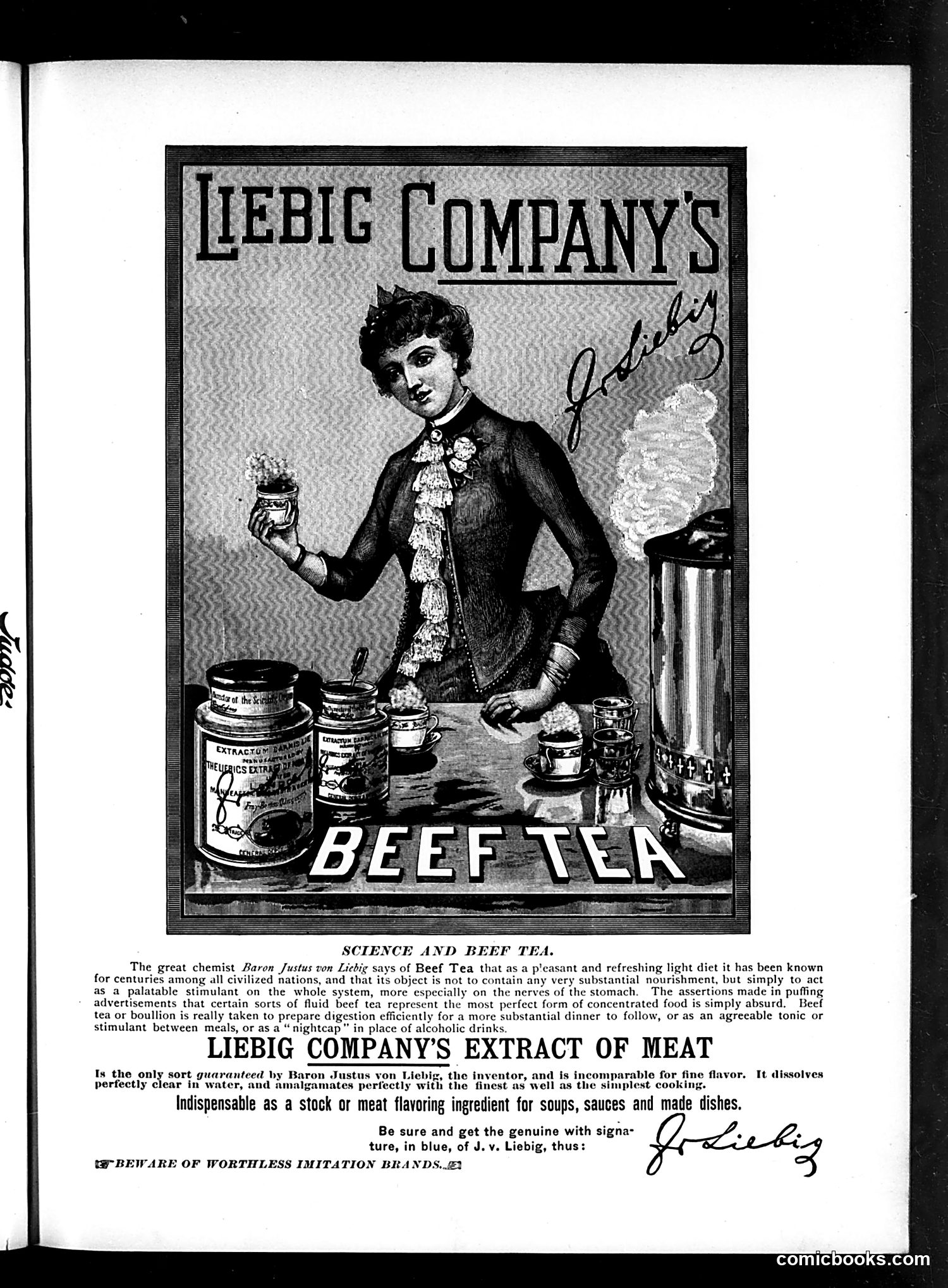
This is primarily a **product advertisement**, not satire. It promotes Liebig Company's Extract of Meat by invoking the authority of Baron Justus von Liebig, a renowned 19th-century chemist. The text quotes Liebig explaining that beef tea is a digestive stimulant and appetite enhancer—not a complete food, contrary to competitors' claims. This serves a dual purpose: it lends scientific credibility while subtly attacking "worthless imitation brands." The illustrated figure appears to be meant to represent Liebig himself, shown as a well-dressed gentleman demonstrating the product's refined use. The advertisement emphasizes that genuine Liebig's extract is superior to inferior competitors, warning readers to verify authenticity through the inventor's blue signature. This reflects the era's marketing strategy: combining scientific authority with brand authentication to combat widespread product counterfeiting.
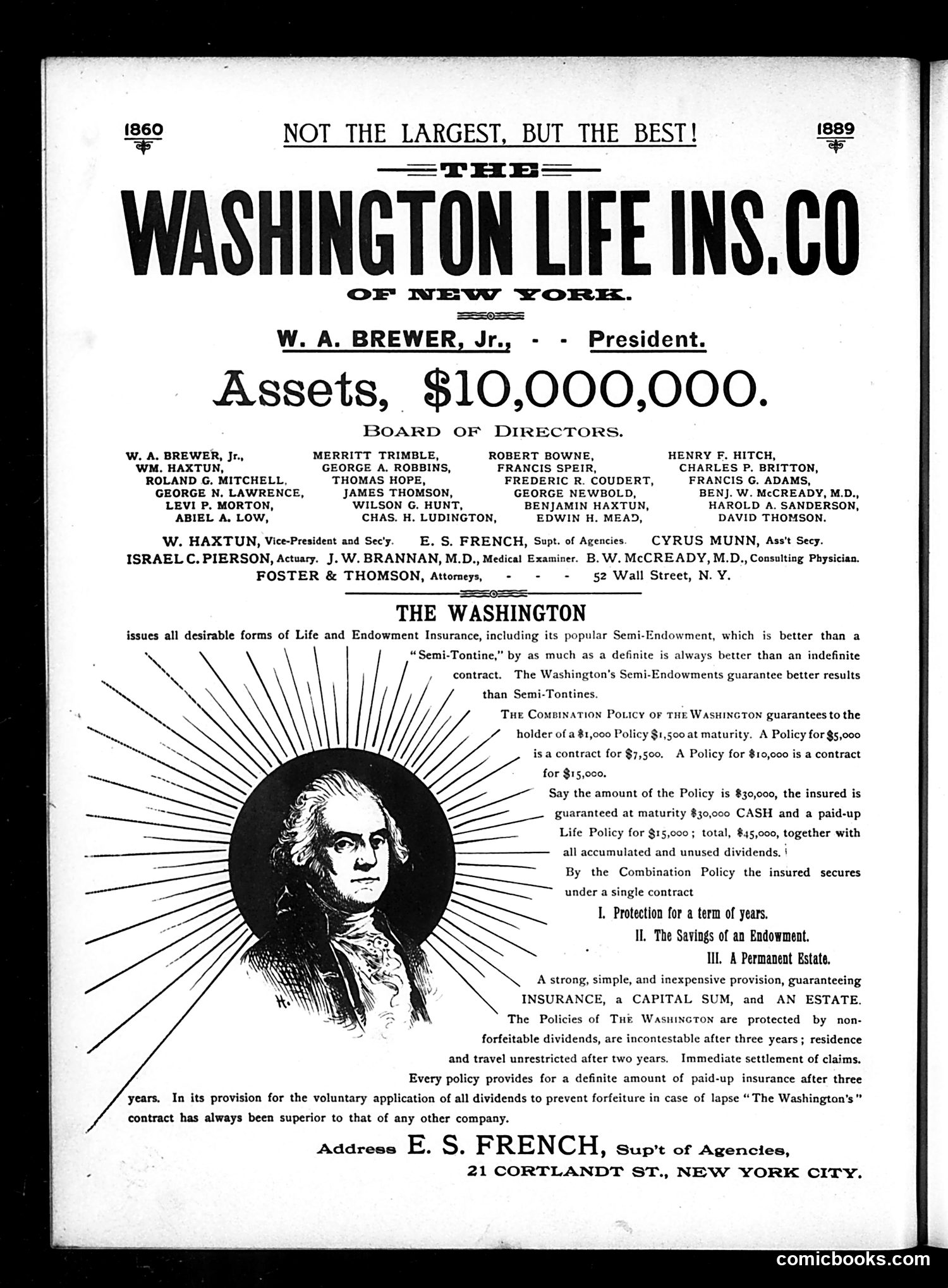
This is primarily an **advertisement**, not a satirical cartoon page. It's a full-page promotion for the Washington Life Insurance Company of New York, appearing in *Judge* magazine around 1889. The only visual element is a **portrait of George Washington** (rendered as a bust with radiating lines, suggesting authority and patriotic reverence) used as a corporate logo and marketing device. The "satire" is subtle and implicit: the ad's tagline—"NOT THE LARGEST, BUT THE BEST!"—ironically positions this insurance company as quality-focused despite having $10 million in assets. The boastful listing of prominent board members (including names like Levi P. Morton, a future Vice President) was meant to convey respectability and trustworthiness during an era when insurance companies faced public skepticism. There is **no political cartoon or joke visible**—this is straightforward commercial advertising leveraging patriotic imagery and elite social credentials to sell life insurance products to wealthy readers.