
Judge, 1889-04-27 · page 2 of 28
Judge — April 27, 1889 — page 2: what you’re looking at
What you’re looking at
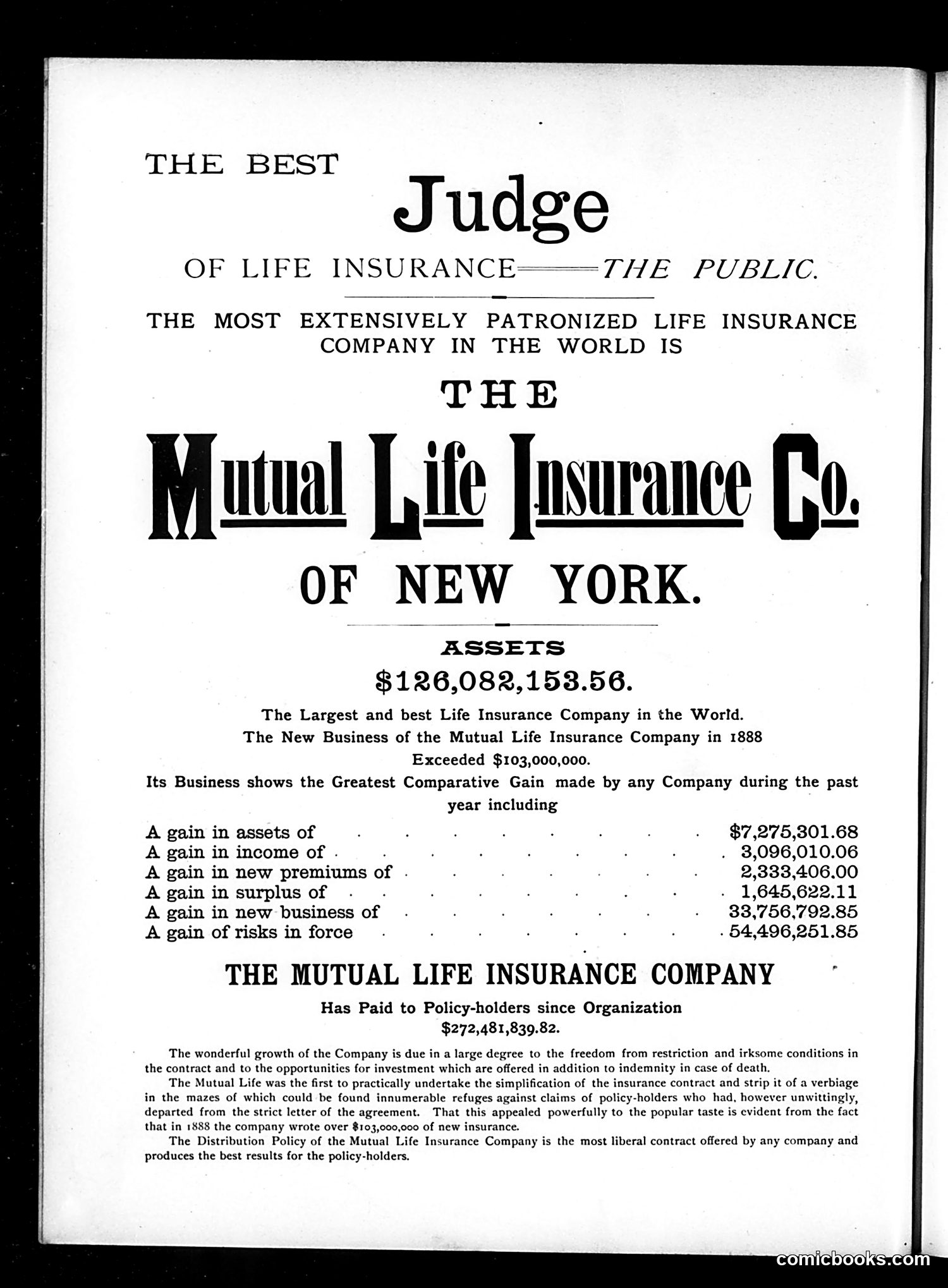
This page is **not a cartoon or satire** — it's a full-page advertisement for the Mutual Life Insurance Company of New York, appearing in *Judge* magazine (likely from 1888-1889, based on the text referencing 1888 business figures). The ad presents financial data to establish credibility: $126 million in assets, $103 million in new business written in 1888, and $272 million paid to policyholders since the company's founding. The copy emphasizes the company's competitive advantages: simplified contracts, investment opportunities, and a "Distribution Policy" offering liberal terms to policyholders. The tone is boastful corporate marketing rather than political commentary — typical of late-19th-century *Judge* advertisements.
📄 Transcribed text from this page (OCR, searchable)
Machine-transcribed from the original scan — historical spelling and the odd misread are preserved.
THE BEST Judge OF LIFE INSURANCE ——7HE PUBLIC. THE MOST EXTENSIVELY PATRONIZED LIFE INSURANCE COMPANY IN THE WORLD IS THE Mutual [,ife Juvurance Bo. OF NEW YORK. ASSETS $126,082,153.56. The Largest and best Life Insurance Company in the World. The New Business of the Mutual Life Insurance Company in 1888 Exceeded $103,000,000. Its Business shows the Greatest Comparative Gain made by any Company during the past year including A gain in assets of . : : ; y 4 : . $7,275,301.68 A gain in income of . ‘ ‘ : : : : : . 3,096,010.06 A gain in new premiums of . : : ‘ : . . 2,333,406.00 Againinsurplusof .. : . . . . : - 1,645,622.11 A gain in new business of . : . : : : - 33,'756,792.85 A gain of risks in force . . . : : : : - 54,496,251.85 THE MUTUAL LIFE INSURANCE COMPANY ‘ Has Paid to Policy-holders since Organization $272,481,839.82. The wonderful growth of the Company is due in a large degree to the freedom from restriction and irksome conditions in the contract and to the opportunities for investment which are offered in addition to indemnity in case of death. The Mutual Life was the first to practically undertake the simplification of the insurance contract and strip it of a verbiage in the mazes of which could be found innumerable refuges against claims of policy-holders who had, however unwittingly, departed from the strict letter of the agreement. That this appealed powerfully to the popular taste is evident from the fact that in 1888 the company wrote over $103,000,000 of new insurance. The Distribution Policy of the Mutual Life Insurance Company is the most liberal contract offered by any company and produces the best results for the policy-holders.