
A complete issue · 45 pages · 1887
Judge — December 1887
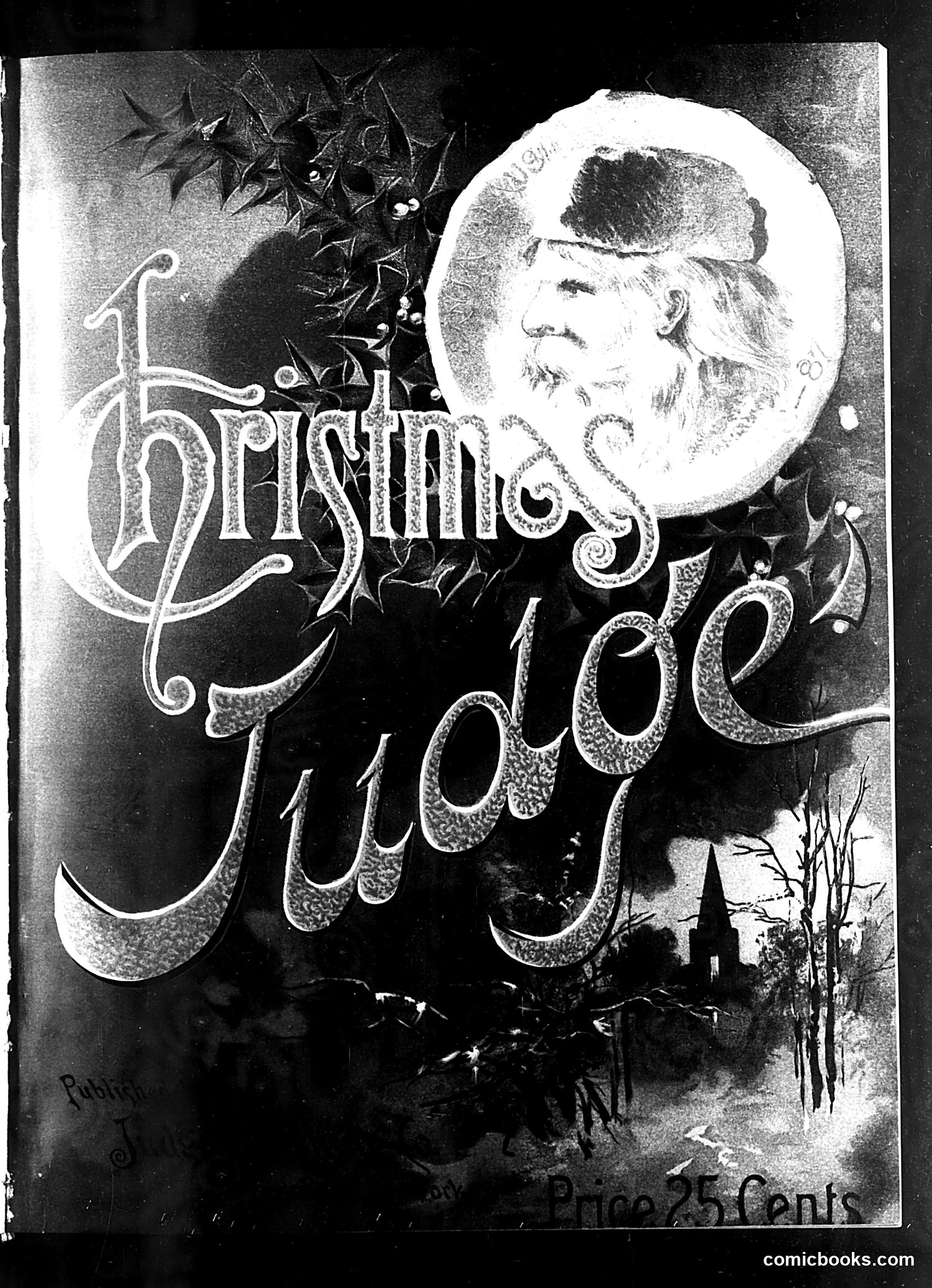
This appears to be a cover or advertisement page from Judge magazine featuring a decorative portrait in an ornate circular frame. The elaborate Art Nouveau-style lettering reads "Brisling's Lilood" (possibly "Brisling's Blood" with OCR error), suggesting this is promoting a patent medicine or commercial product rather than political satire. The image shows a bearded man in profile wearing period clothing, surrounded by decorative botanical elements including holly or thistle plants. The price notation "25 cents" is visible at bottom. Without clearer text or additional context, the specific satirical target remains unclear, though Judge frequently mocked dubious patent medicine claims and commercialism of the era. This appears to be product mockery rather than political commentary.
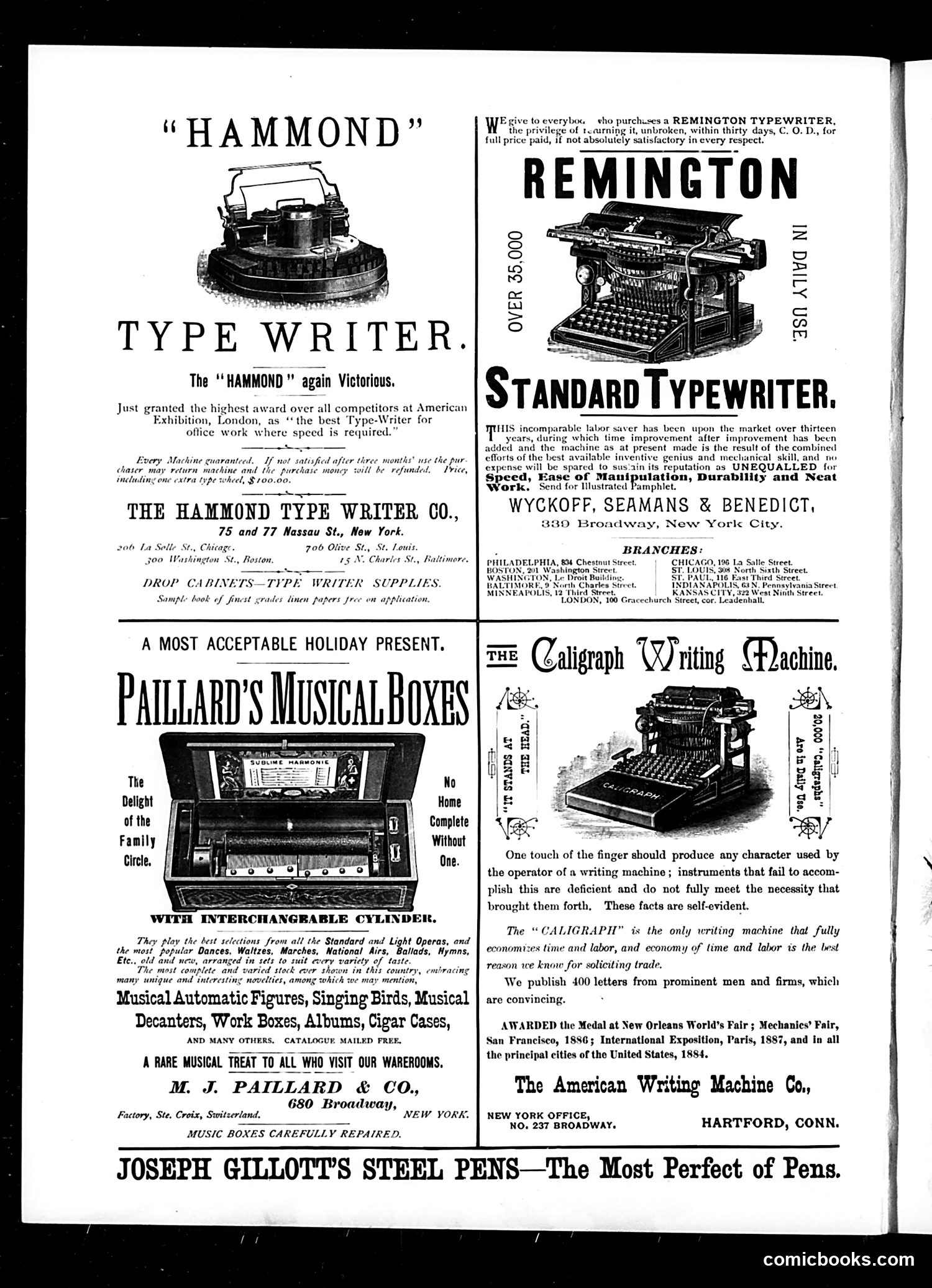
This page is **primarily advertising**, not political satire. It contains five distinct typewriter and office equipment advertisements from the late 19th century: 1. **Hammond Typewriter** - claims a recent award as "best Type-Writer" at an American Exhibition in London 2. **Remington Standard Typewriter** - emphasizes speed, durability, and ease of use 3. **Paillard's Musical Boxes** - marketed as holiday gifts with interchangeable cylinders 4. **Caligraph Writing Machine** - advertises its finger-operated character selection 5. **Joseph Gillott's Steel Pens** - brief text-only ad The competing typewriter ads reflect genuine commercial rivalry during the typewriter industry's competitive early period. There is **no political cartoon or satire present** on this page—it's a straightforward advertising section showcasing contemporary office technology.
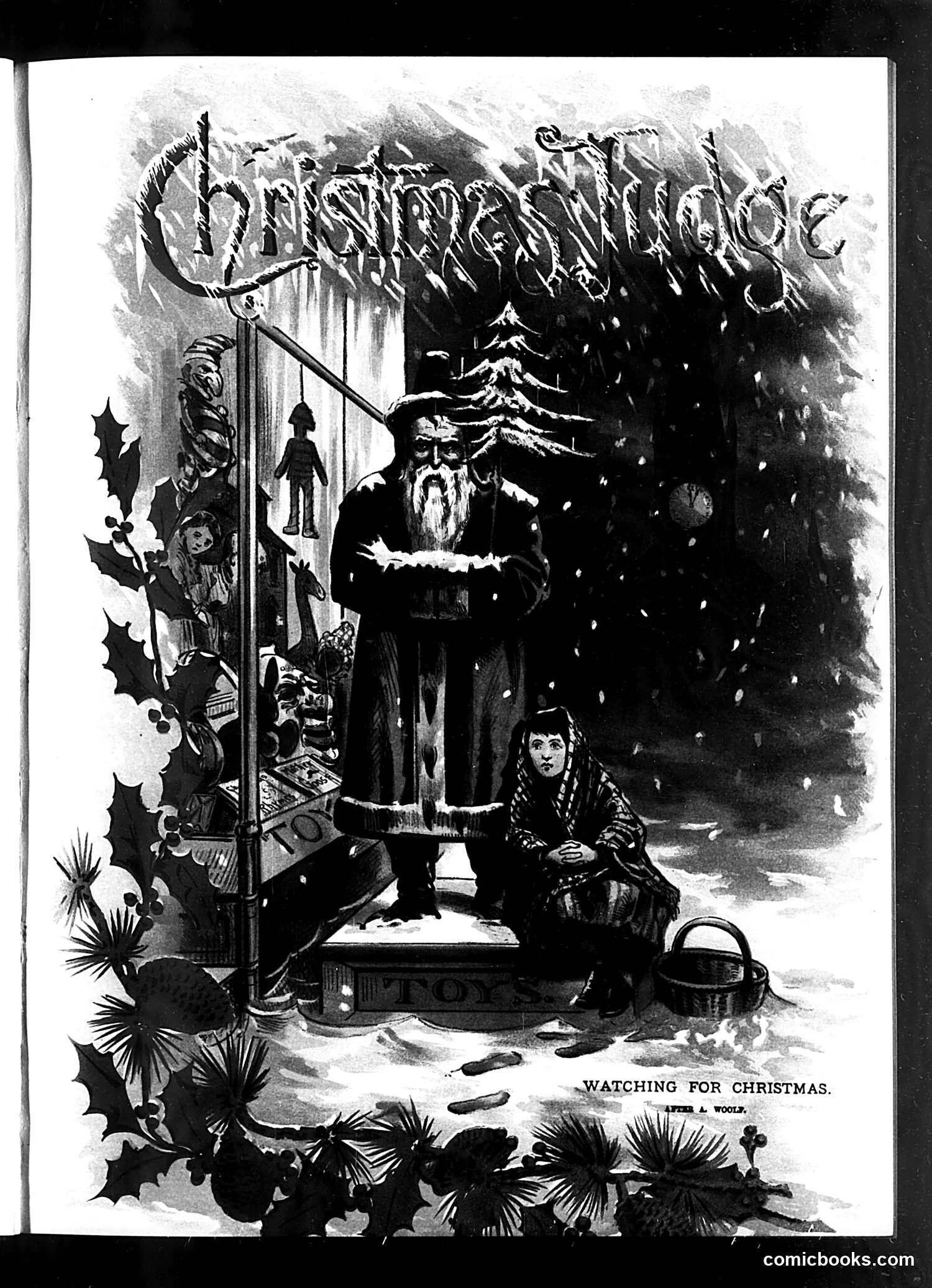
This illustration depicts a Christmas scene with allegorical or fantastical elements. A bearded figure (possibly representing Santa Claus or Father Christmas) stands in a doorway or chimney, while a woman sits below "watching for Christmas." The composition includes winter foliage (holly and evergreens) framing the scene, and snow-covered ground. The satirical point appears to comment on Christmas anticipation or the commercialization of the holiday, though the specific political or social critique isn't entirely clear from the image alone. Judge magazine was known for sharp social commentary, so this likely mocks contemporary attitudes toward Christmas celebrations, expectations, or consumption patterns of the era. Without clearer context about Judge's publication date or specific events referenced, the exact satirical target remains somewhat ambiguous.
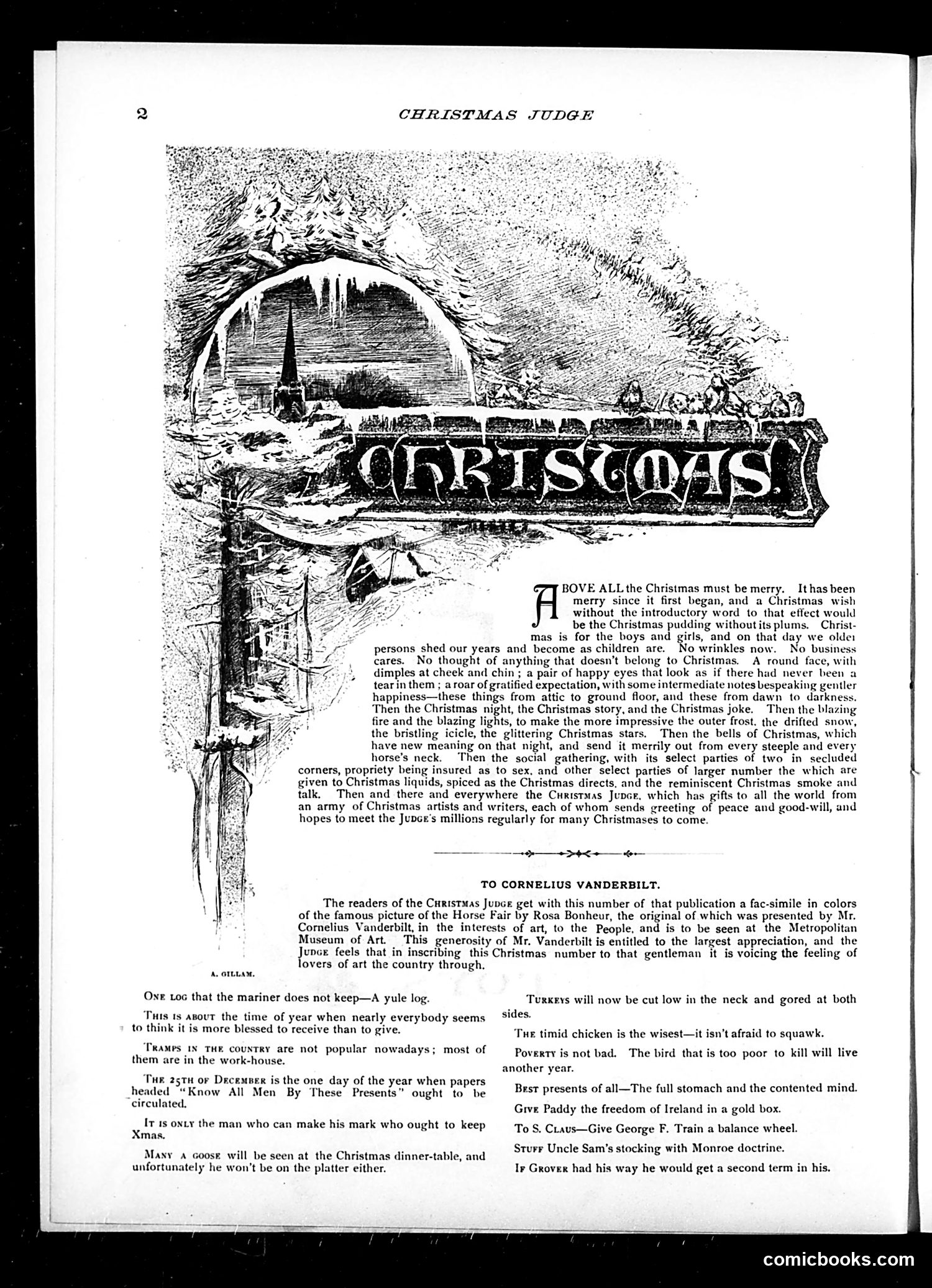
This is primarily a **Christmas editorial and gift presentation**, not a political cartoon. The main illustration is a decorative title page featuring a snowy winter scene with "Christmas" prominently displayed. The text celebrates Christmas traditions—family gatherings, children's joy, festive decorations, and goodwill—in sentimental Victorian prose typical of the era. **Notable elements:** - **Dedication to Cornelius Vanderbilt**: Judge honors the wealthy industrialist for donating Rosa Bonheur's "Horse Fair" painting to the Metropolitan Museum, presenting this issue as a facsimile reproduction. - **Satirical quips at bottom**: Brief one-liners mock contemporary issues: tramps in workhouses, Irish freedom ("Give Paddy the freedom of Ireland"), and political figures. References to "S. Claus," "George F. Train" (a 19th-century eccentric), and "Grover" (likely President Cleveland) suggest period-specific humor now obscure without additional context. The page blends sentimental Christmas sentiment with light social satire typical of Judge's mix.
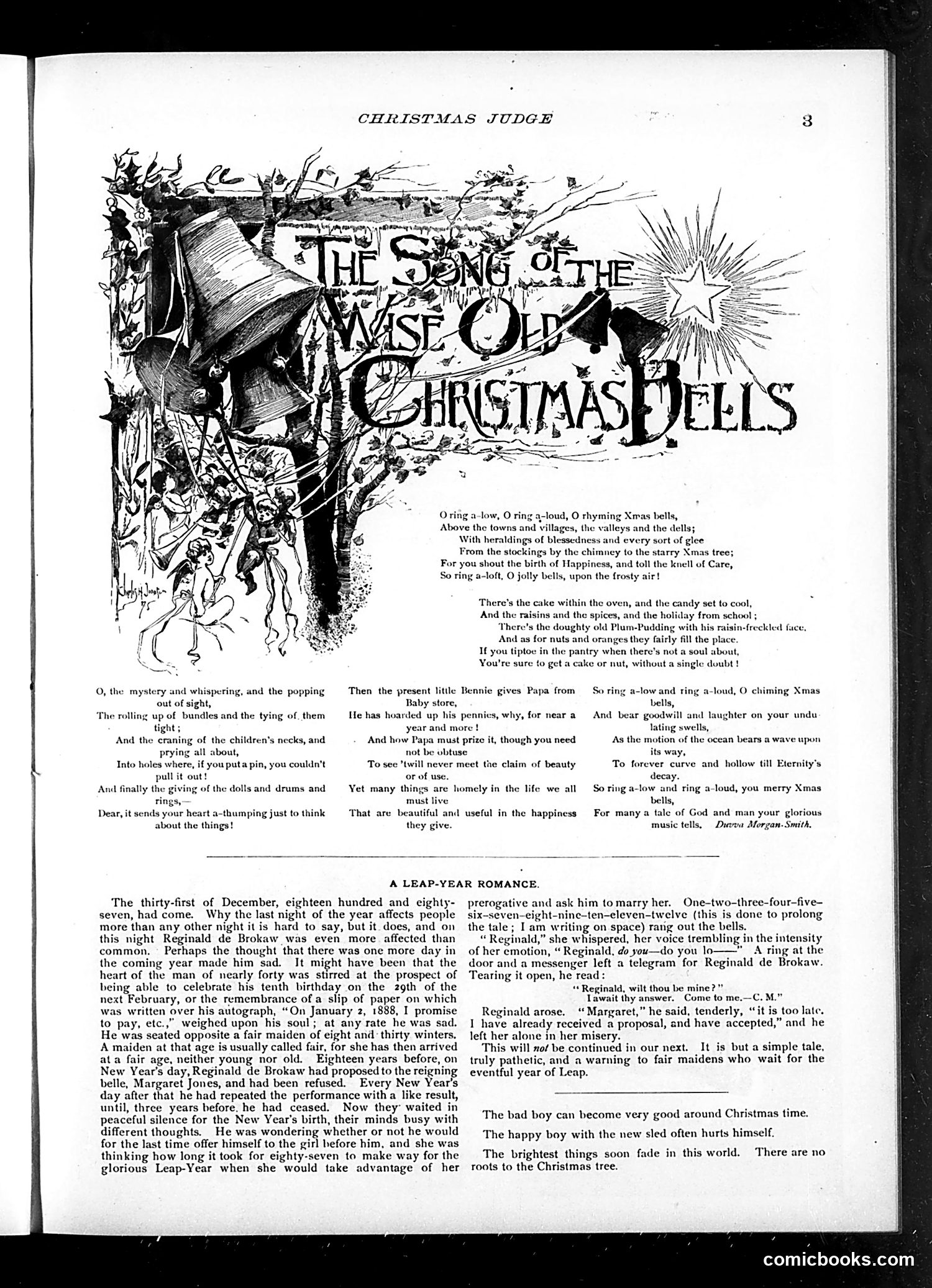
This page contains two unrelated pieces typical of Judge's Christmas issue content: **"The Song of the Maise Old Christmas Bells"** is a sentimental Victorian poem celebrating Christmas domesticity—children's anticipation, homemade treats, small gifts. The ornate illustration features traditional holiday imagery (bells, wreaths, stars). It appeals to nostalgia for simpler, family-centered holidays. **"A Leap-Year Romance"** is a serialized short story about Reginald de Brokaw, a man who has proposed to Margaret Jones every New Year's Day for eighteen years and been rejected. The twist: Margaret has been waiting for a leap year (when women could traditionally propose) to reverse their positions. The story plays on contemporary anxieties about gender roles and marriage customs, using humor about a persistent suitor finally losing agency to a woman seizing her rare opportunity. The "leap year" premise references the actual tradition that February 29 gave women proposal rights. Both pieces reflect late-19th-century concerns: idealized family sentiment and evolving gender dynamics.
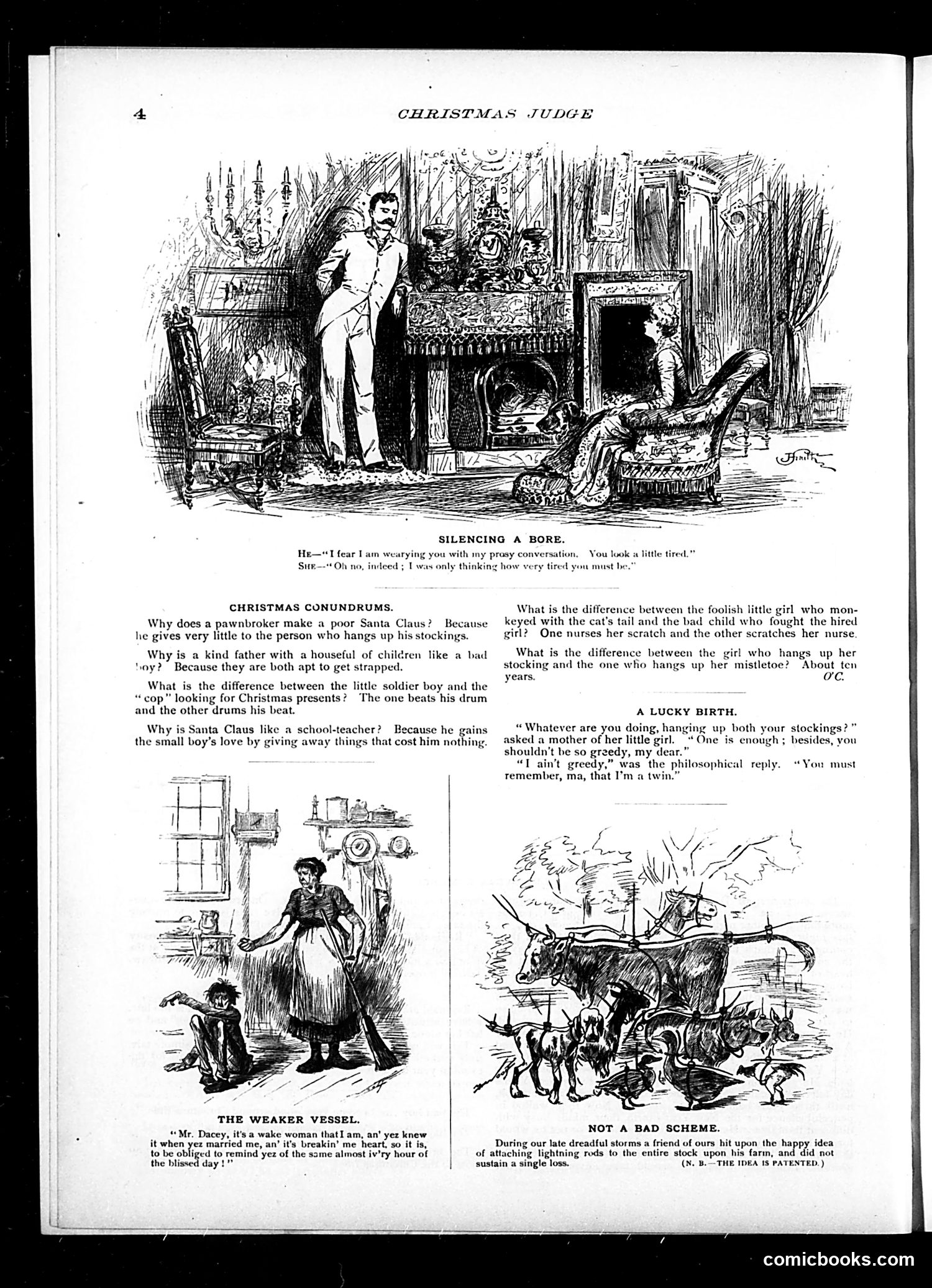
This page from Judge magazine presents holiday-themed humor typical of 19th-century American satire. **Top cartoon "Silencing a Bore"** depicts a domestic scene where a man addresses a woman by the fire, commenting on her tired appearance—she replies she was thinking how tired *he* must be. The joke: a cutting, passive-aggressive retort that shuts down tedious conversation. **"Christmas Conundrums"** offers riddles mocking social types: pawnbrokers (stingy), bad fathers (prone to punishment), cops (corrupt), and teachers (Santa Claus-like, gaining favor cheaply). These target class stereotypes common to Gilded Age satire. **"The Weaker Vessel"** features an Irish immigrant woman ("Dacey") complaining to her husband about his forgetfulness—satirizing both Irish dialect humor and nagging spouse stereotypes. **"A Lucky Birth"** jokes about twins and greed; **"Not a Bad Scheme"** mocks a farmer's absurd idea of protecting livestock with lightning rods. The humor relies on period class/ethnic stereotypes, domestic comedy, and visual slapstick rather than sophisticated satire.
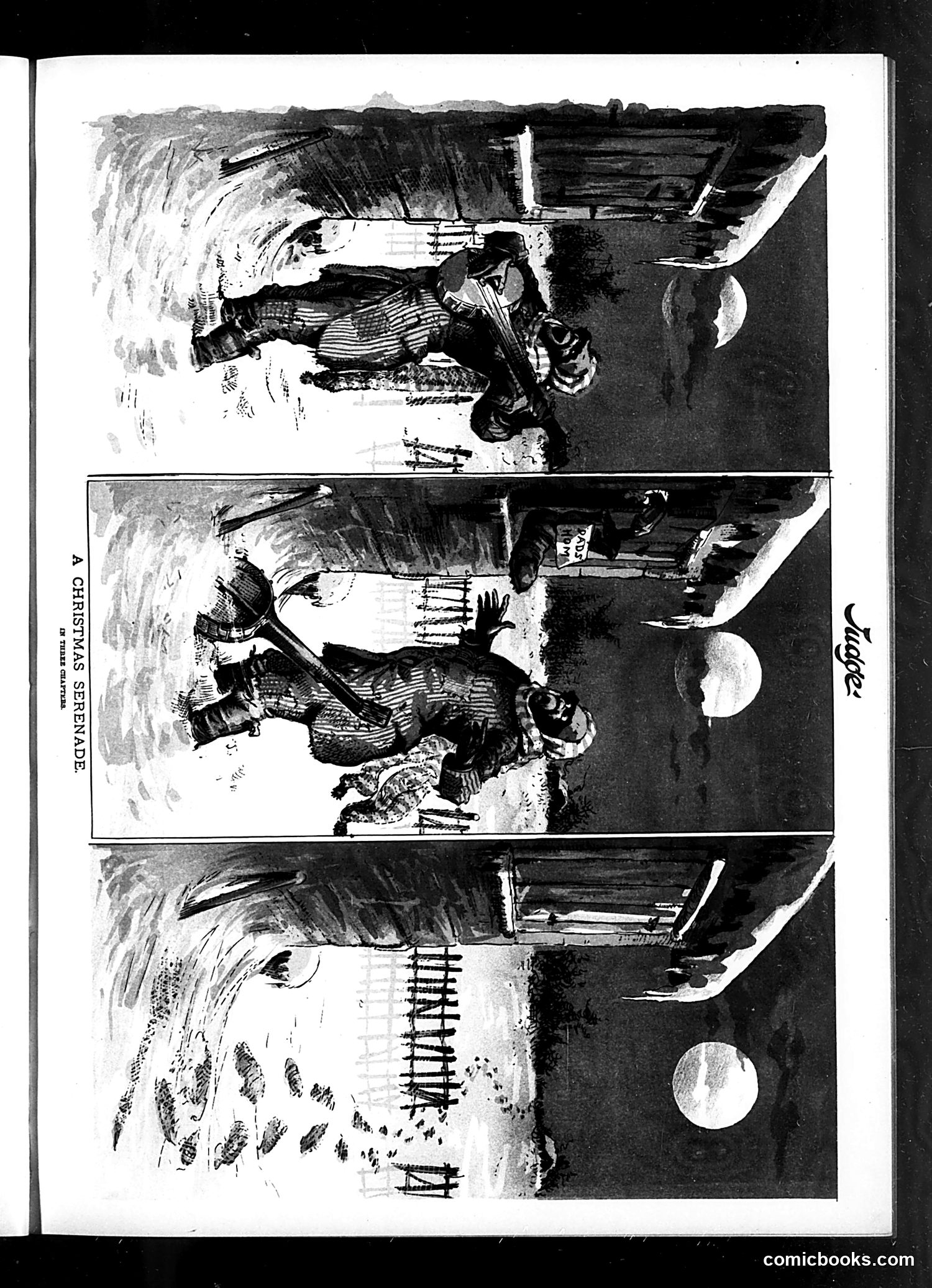
I can see this is a page from *Judge* magazine labeled "A CHRISTMAS SERENADE" with three sequential comic panels showing figures in what appears to be a winter/Christmas scene. However, the image quality and orientation make it difficult to read the specific details clearly or identify the particular figures being caricatured. The panels appear to depict some kind of satirical Christmas-related scenario, likely commenting on social or political issues of the era, but without clearer text or more distinct facial features, I cannot confidently identify which specific public figures or events are being referenced. The comic structure suggests it's making a joke about Christmas customs or social behavior, but the exact meaning remains unclear from this reproduction.
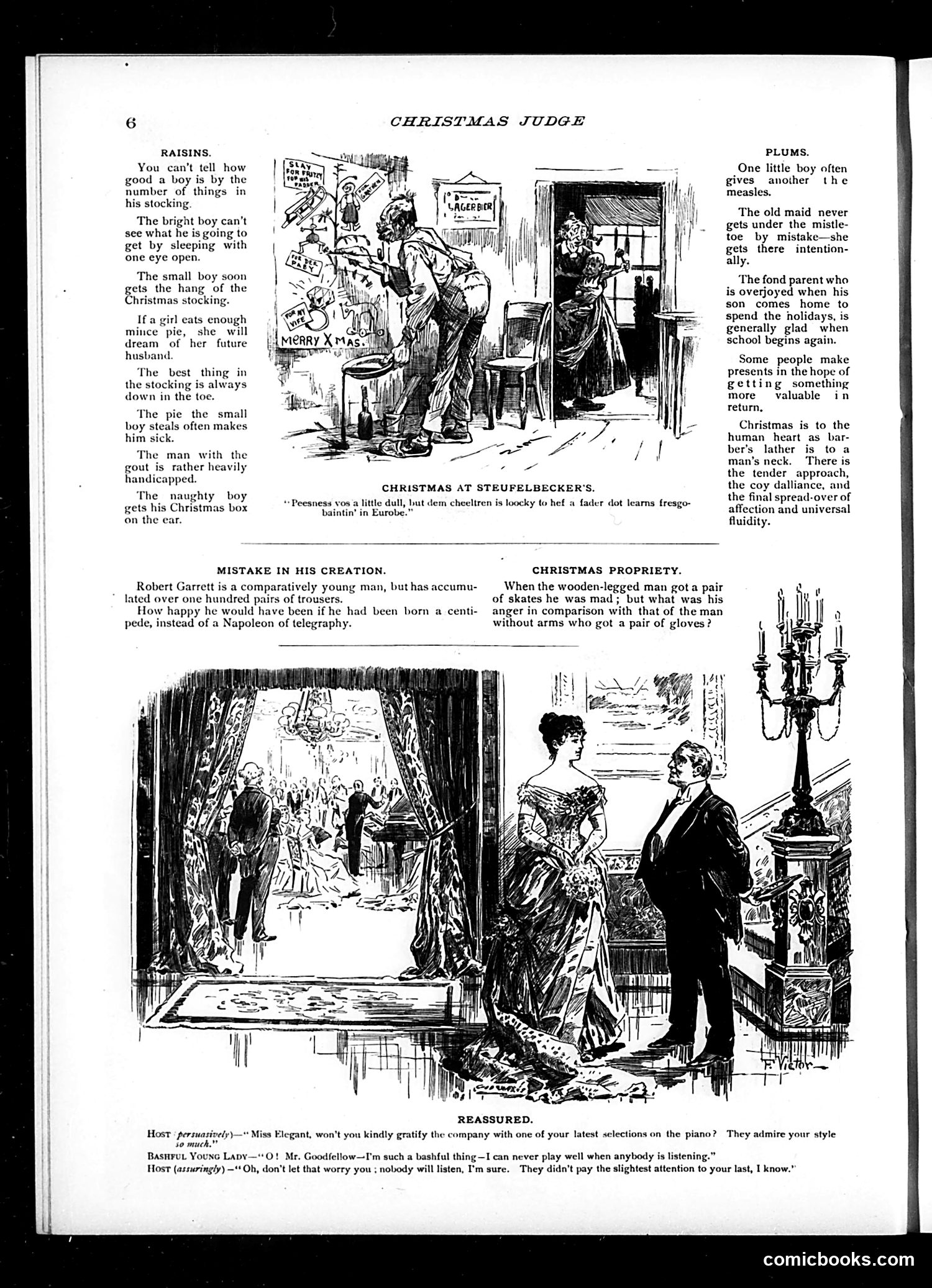
This page from *Judge* (a late-19th-century American satirical magazine) collects holiday-themed humorous observations and cartoons: **Content includes:** - **"Raisins," "Plums," and other brief witticisms** about Christmas behavior—cynical observations on children's gift-giving, old maids, and parental hypocrisy (parents relieved when school resumes). - **"Christmas at Steufelbecker's"** cartoon: depicts a working-class family's modest holiday, with German-accented dialect humor (common for period ethnic comedy). - **"Mistake in His Creation"**: mocks Robert Garrett, apparently a wealthy telegraph magnate who accumulated 100+ pairs of trousers—satirizing nouveau-riche excess and suggesting he'd be happier as a centipede (more legs = more pants). - **"Christmas Propriety"**: dark humor about disabled men receiving inappropriate gifts (wooden-legged man with skates; armless man with gloves). - **"Reassured"**: social satire on a vain young woman's false modesty about piano-playing, with the host's reassurance that nobody will listen anyway. The satire targets class pretension, sentimentality, and social hypocrisy.
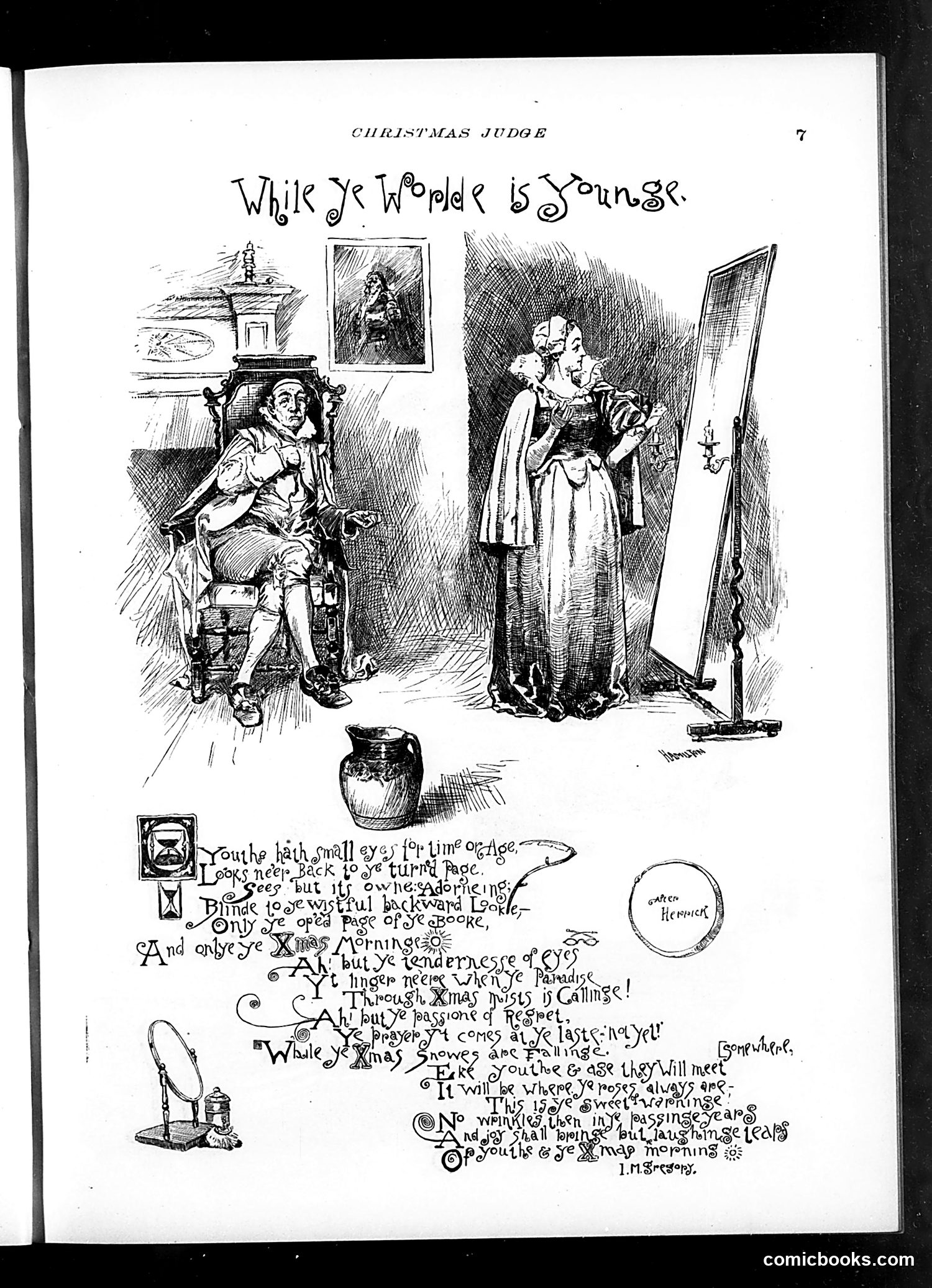
This is a Christmas-themed moral lesson from *Judge* magazine presented as an illustrated poem. The image shows an elderly figure (appears to be Father Time or a sage) seated on the left, addressing two younger people standing on the right, with a mirror visible in the scene. The text is a cautionary verse advising youth to embrace virtue while young—to avoid becoming "backward-looking," "worldly," or spiritually blind as they age. Key themes include warnings against pride, worldliness, and losing one's moral compass. The poem suggests that youth offers a window for moral development before "tenderness of eye" and spiritual awareness fade. This represents *Judge*'s characteristic moralizing tone, mixing Victorian-era sentimentality with social commentary. The work likely reflects turn-of-the-century anxieties about youth morality and the corrupting influences of modern society, a common concern in period satirical magazines.
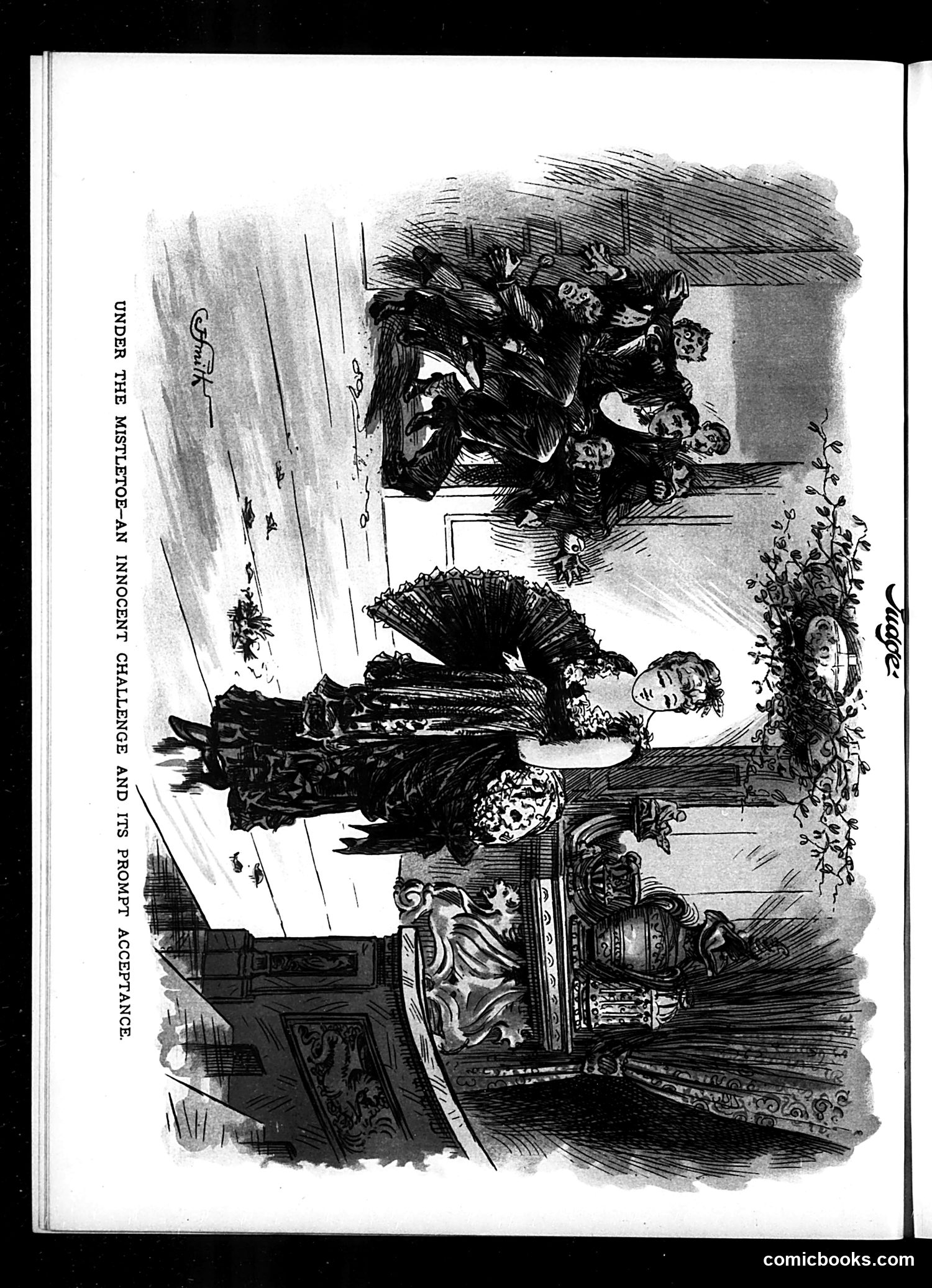
This appears to be a Victorian-era holiday scene depicting a social custom. The cartoon shows a woman in an elaborate dress with a large fan standing beneath mistletoe, while men in the background eagerly approach or crowd around her. The title suggests an "innocent challenge"—likely the woman playfully positioning herself under the mistletoe, inviting the traditional kiss—followed by the "prompt acceptance" of multiple suitors rushing to participate. The satire likely mocks either the overeagerness of men to exploit the mistletoe custom, or perhaps critiques the woman's bold behavior as improper for her era. The crowded, chaotic composition emphasizes the comedic frenzy surrounding this social ritual, making light of holiday romance conventions and gender dynamics of the period.
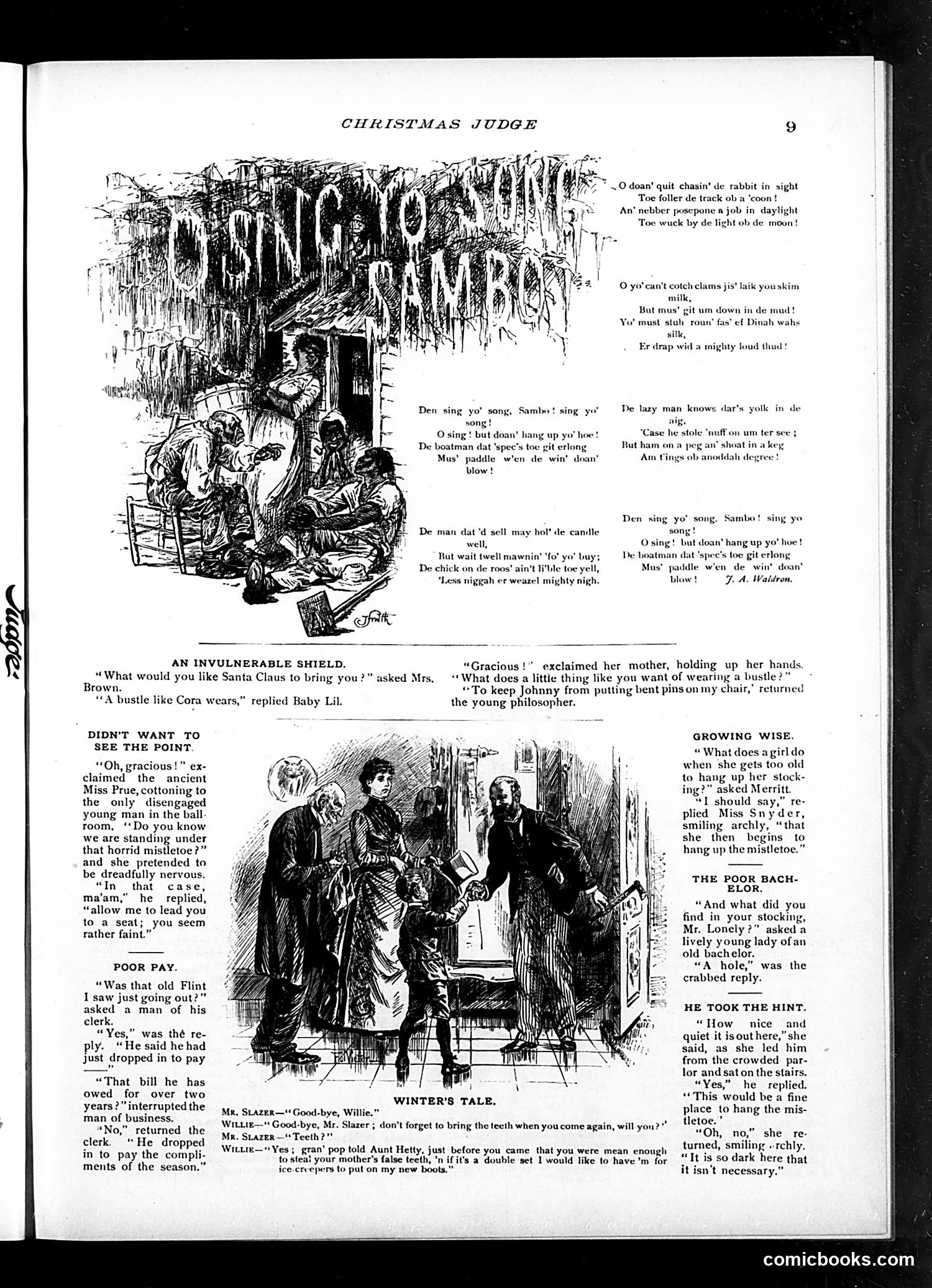
This page contains multiple short humorous sketches typical of Judge magazine's satirical style. The main subjects are: **"An Invulnerable Shield"**: A child wants a bustle (fashionable women's garment) to use as protection against boys putting pins on her chair—satirizing the era's exaggerated fashion trends. **"Didn't Want to See the Point"**: An elderly spinster tries to create a romantic moment under mistletoe with a young man, who deliberately misses her hint and offers her a seat instead—mocking disappointed courtship expectations. **"Winter's Tale"**: Various brief domestic comedies about mistletoe encounters and flirtation, including an old bachelor finding only a hole in his stocking. **"Poor Pay"**: A customer pays an old debt only to settle the bill—poking fun at reluctant debtors. The page also includes a dialect poem ("Den sing yo' song, Sambo!") in offensive period vernacular, reflecting the era's deeply problematic racial stereotyping. The imagery throughout shows Victorian domestic scenes with period clothing and social conventions as the humor's backdrop.
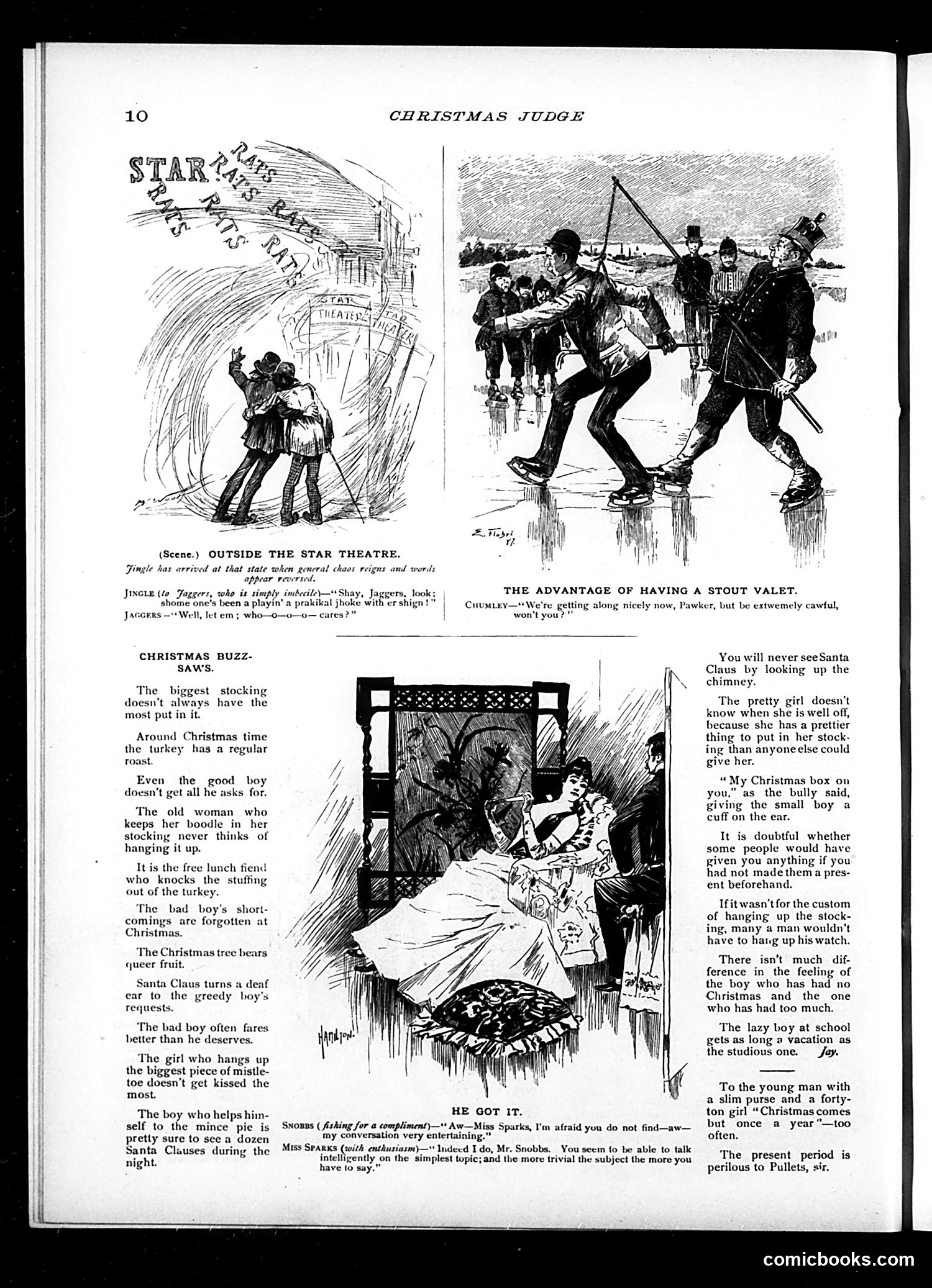
This page contains holiday-themed satirical content from Judge magazine. The top features two illustrated scenes: one outside the Star Theatre showing characters "Jingle" and "Jaggers" in comedic confusion, and another depicting men on frozen ice, captioned about the "advantage of having a stout valet"—a visual joke about using a heavyset servant as ballast for balance. The centerpiece is "HE GOT IT," a dialogue joke mocking pretentious social interaction: Mr. Snobbs seeks compliments, and Miss Sparks delivers cutting praise, sarcastically suggesting he speaks intelligently *only* about trivial matters—the more trivial, the more he talks. "Christmas Buzz-Saws" is a collection of cynical one-liners mocking holiday sentimentality: the expensive stocking may be empty, greedy children go unrewarded, and even morally questionable behavior gets forgiven at Christmas. The humor targets hypocrisy and materialism surrounding the holiday season. The writing suggests Judge's audience appreciated sardonic, class-conscious social commentary typical of Gilded Age satirical journalism.
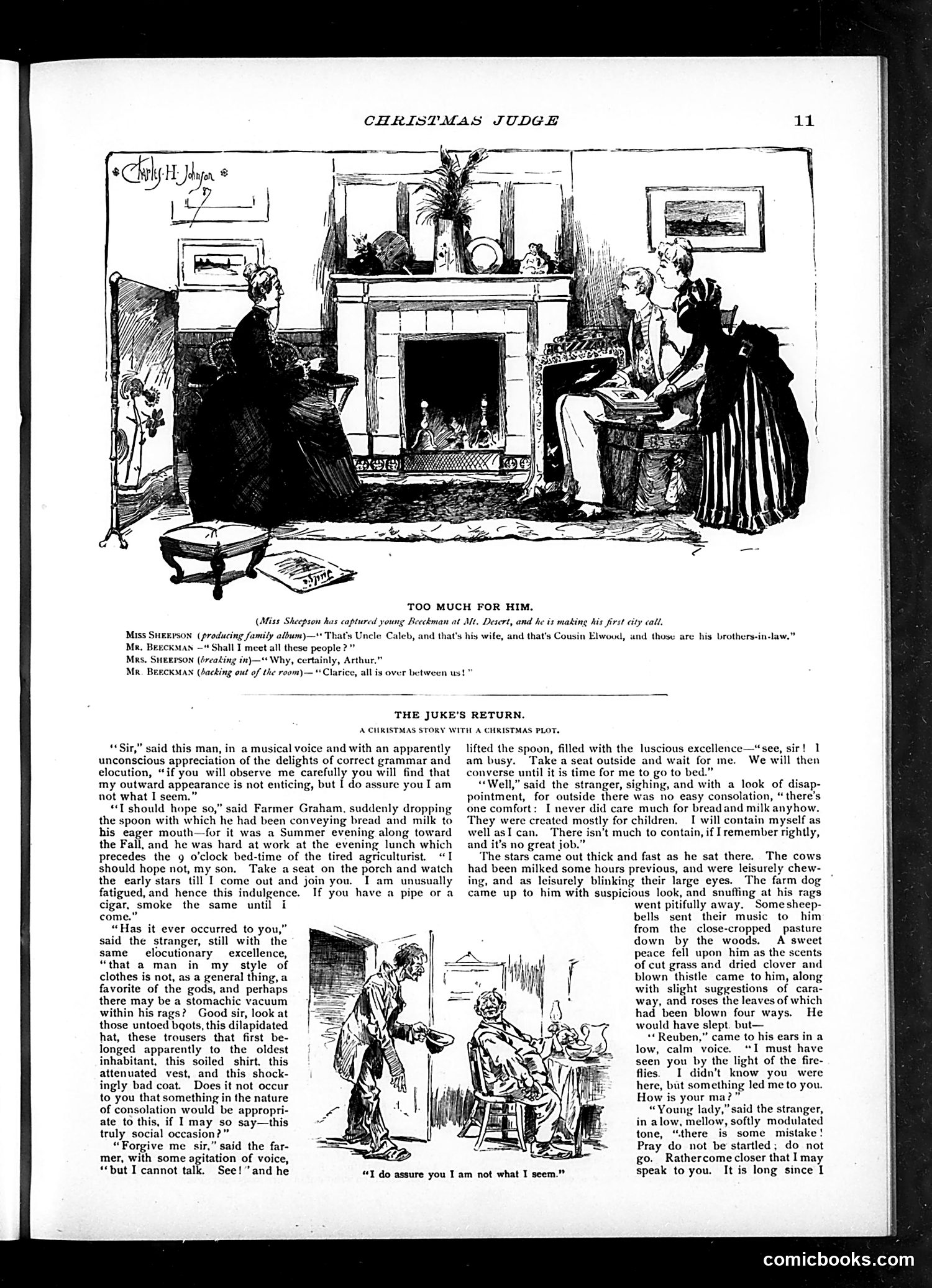
**"Too Much for Him"** depicts a romantic comedy scenario: Young Beeckman, a rural visitor from Mt. Desert, is meeting his girlfriend Miss Sheepson's extended family for the first time in the city. When she reveals he must meet numerous relatives—Uncle Caleb, his wife, Cousin Elwood, and brothers-in-law—he panics and abruptly ends the courtship. The satire mocks small-town men's social anxiety when confronted with urban, bourgeois family complexity. **"The Juke's Return"** begins a serialized story about a well-spoken vagrant who appears at Farmer Graham's home. Despite his ragged appearance, the stranger speaks with refined grammar and elocution, creating comic contrast. He hints at hidden depths ("I am not what I seem"), requesting food and shelter. The farmer, occupied with his evening meal, dismisses him curtly. When a woman's voice calls out "Reuben" in the darkness, suggesting the stranger's true identity involves some past entanglement, the story hints at melodramatic revelation to come. Both stories trade in class anxieties and social pretense common to Gilded Age humor.
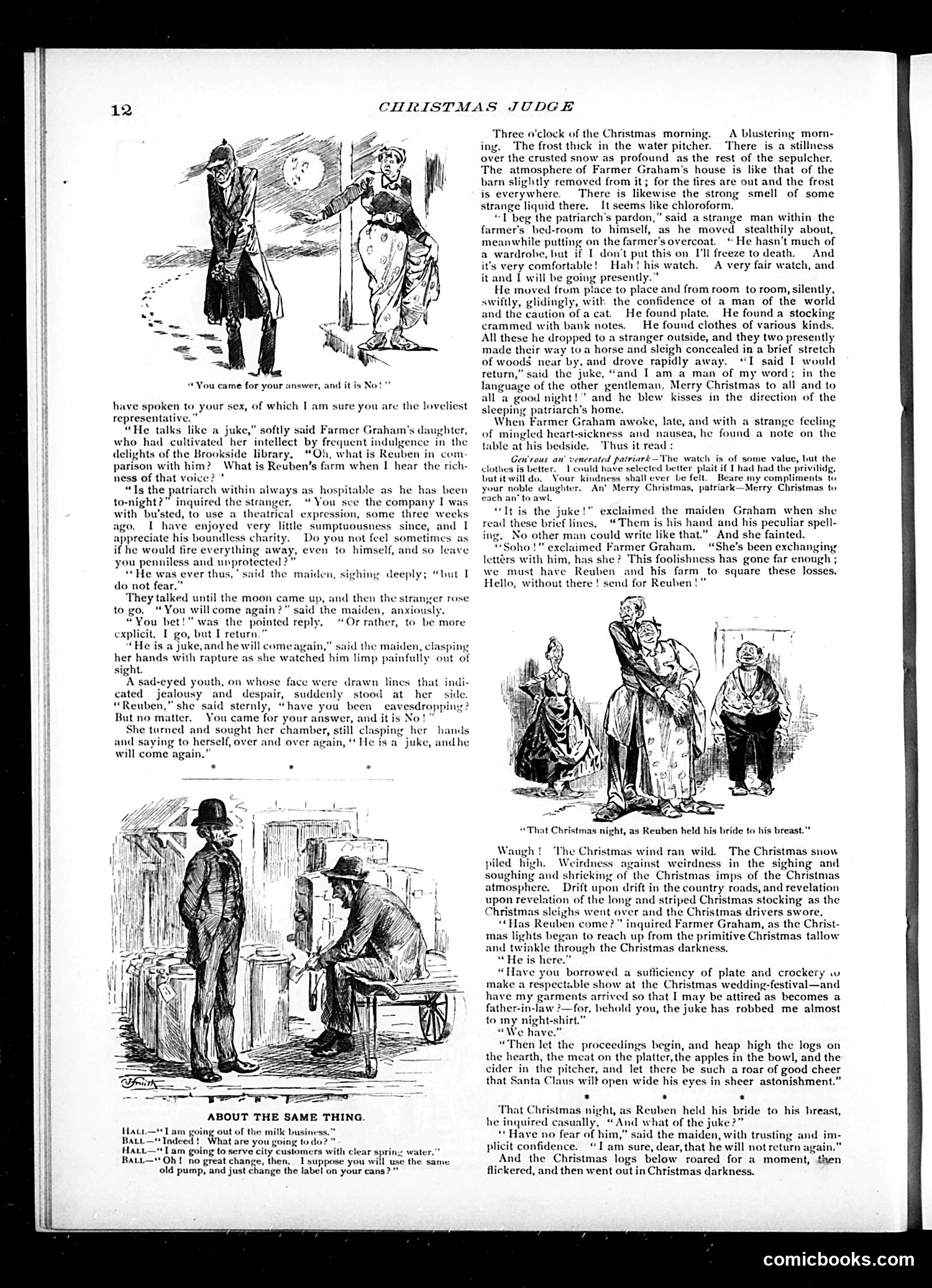
This is a satirical story in *Judge* magazine, not a political cartoon. The narrative mocks rural American courtship and morality through the character "the juke"—a smooth-talking stranger who seduces Farmer Graham's daughter while robbing the household. The satire works on multiple levels: The naive daughter, educated only by "Brookside library" romance fiction, is charmed by the stranger's flowery language ("He talks like a juke"). Her simple suitor, Reuben, cannot compete. The stranger exploits this, steals the family's valuables and cash, then leaves—keeping his word that he'll "come again," but as a thief, not a suitor. The final irony: the daughter romanticizes even the robbery, reading the thief's note as proof of his peculiar charm rather than criminal intent. The bottom cartoon about milk adulteration provides a separate satirical jab at urban food fraud.
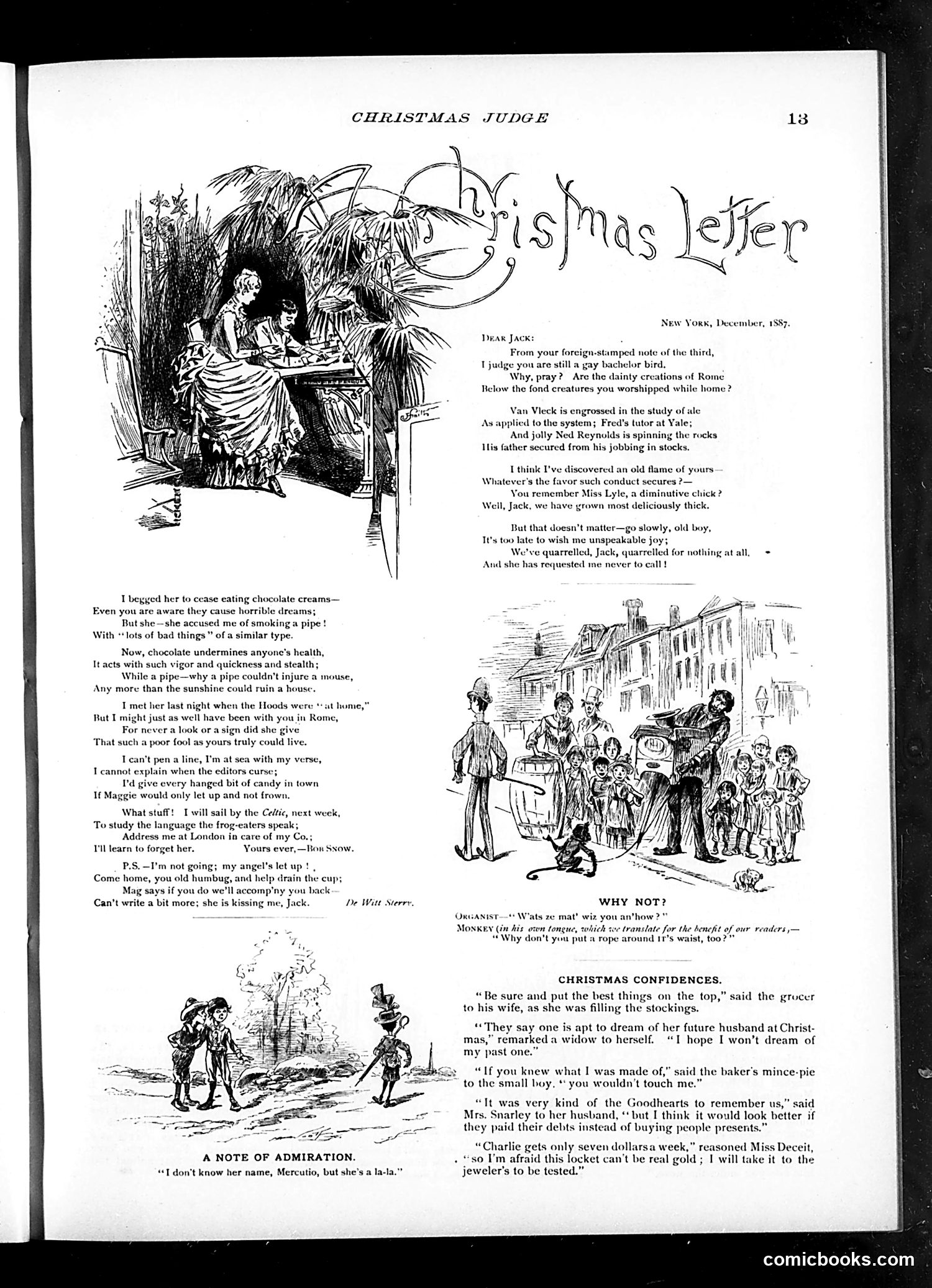
This page contains several humorous pieces satirizing Victorian social life and romantic entanglements. The main feature is a letter from "Bon Snow" describing a lover's quarrel with "Maggie" over competing vices—he defends smoking a pipe while she criticizes his chocolate consumption. The joke mocks their mutual hypocrisy and the trivial nature of domestic disputes. A secondary letter describes the writer's renewed romantic interest in "Miss Lyle," though they've quarreled "for nothing at all." The "Why Not?" cartoon shows an organist and monkey, with a joke about putting a rope around the monkey's waist—appearing to mock pretentious organ-grinders. "Christmas Confidences" presents brief satirical observations: a grocer's wife deceiving customers with inferior stockings, a widow's dark humor about remarriage, a baker's pie warning about unknown ingredients, and a woman suspecting her boyfriend's gift is counterfeit gold. The satire targets Victorian hypocrisy, materialism, and social dishonesty during the Christmas season.
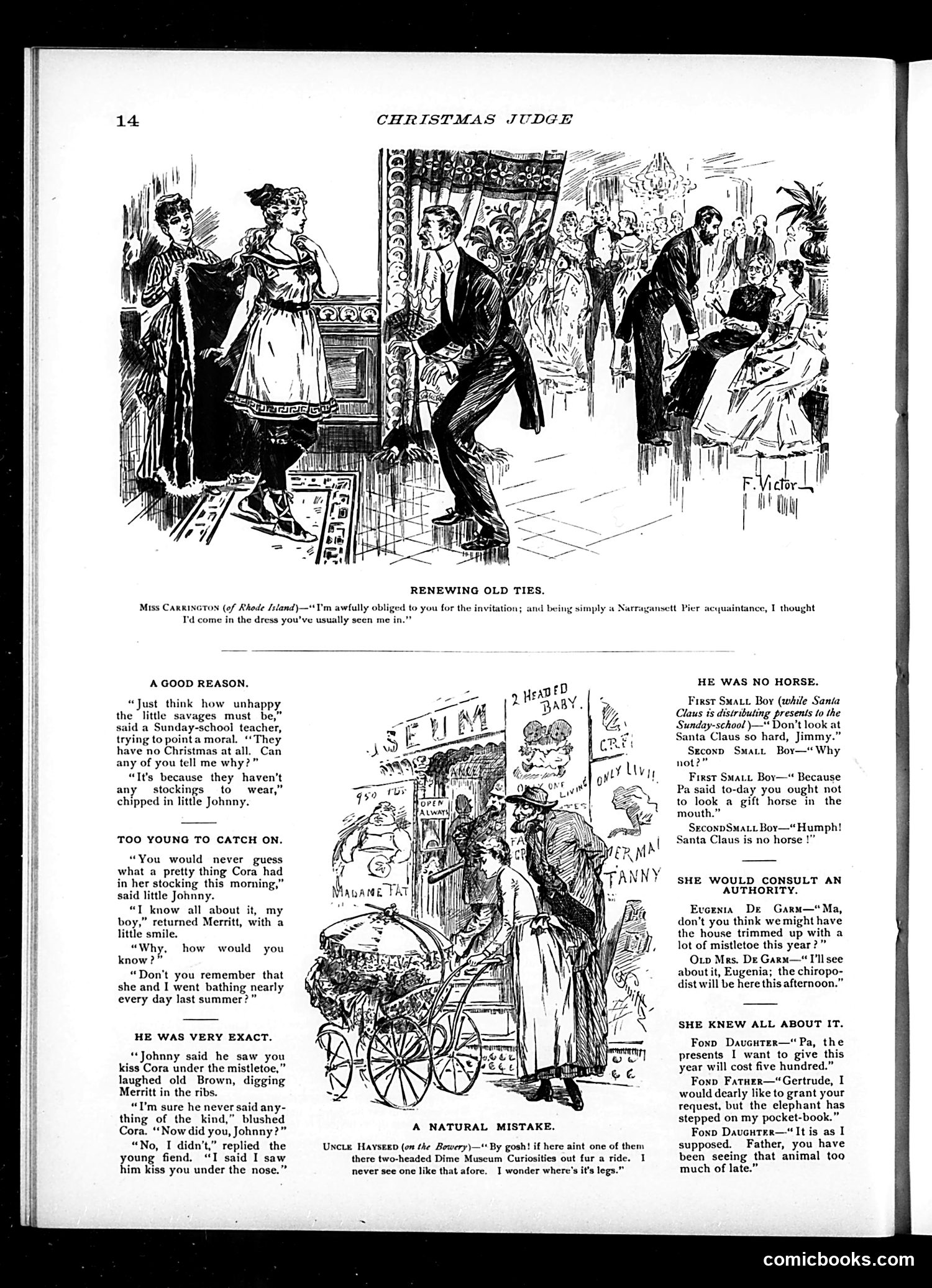
This page collects holiday-themed humor from Judge magazine, featuring multiple brief comic vignettes about Christmas and romance rather than political satire. The main cartoon (top) shows a formal party where "Miss Carrington of Rhode Island" explains her plain dress choice to hosts, satirizing social pretension among the wealthy. The remaining jokes target familiar targets: schoolteachers moralizing about "savages" lacking Christmas; young boys' innocent but embarrassing observations about adults kissing; an uncle confusing a carriage with a "two-headed Dime Museum" creature (referencing popular sideshow attractions); children's literalism about gift horses and mistletoe; and family banter about expensive Christmas presents. The humor relies on wordplay, children's unfiltered honesty, class-consciousness, and period-specific references (bathing as courting, chiropodists, elephants stepping on pocketbooks for comic effect). It's genteel, domestic satire rather than political commentary—typical of Judge's holiday content.
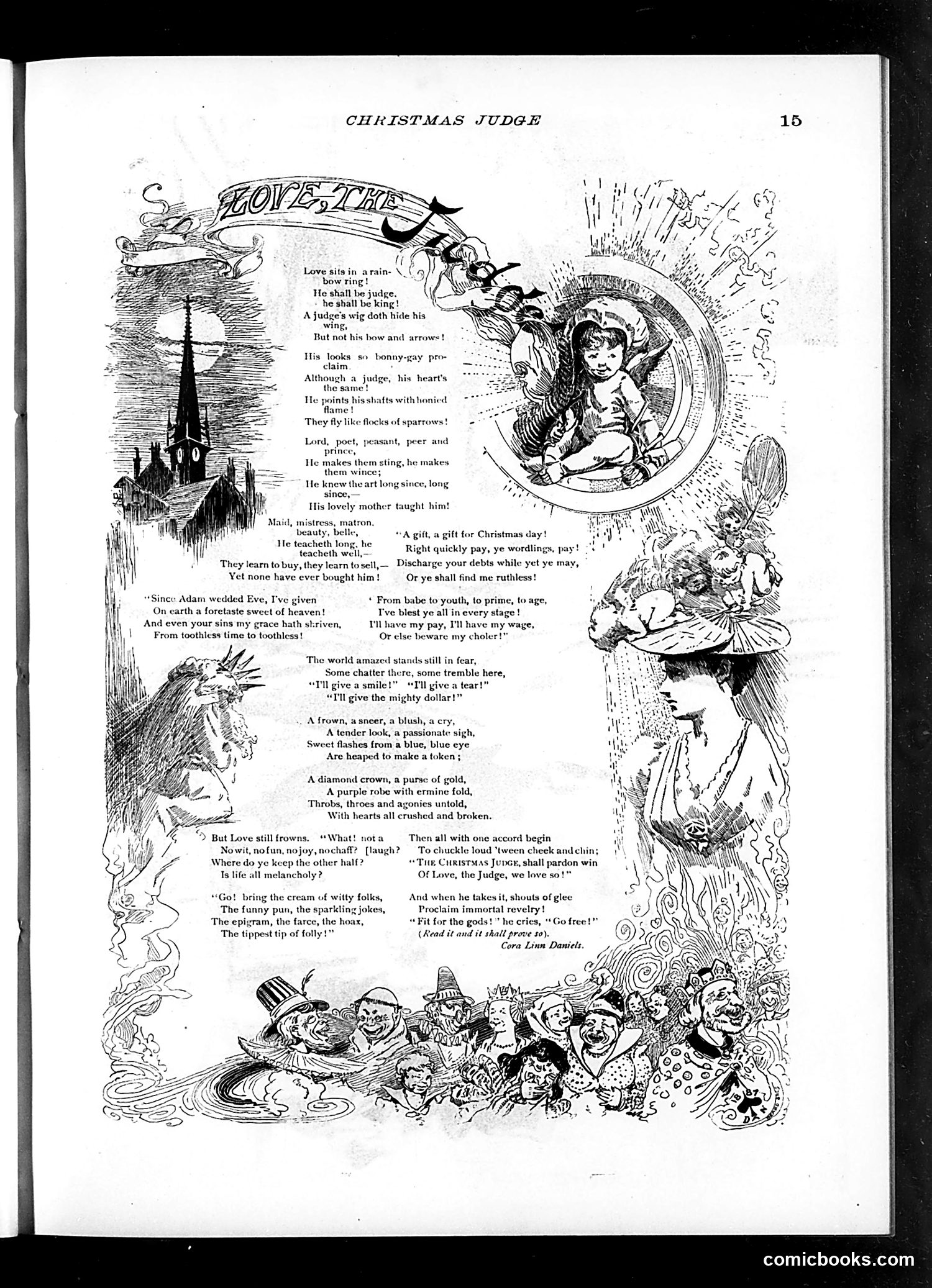
This is a whimsical Christmas poem illustrated with satirical artwork, personifying **Cupid (Love) as a stern judge** who demands payment and obedience from humanity. The central conceit: Love, disguised as a judge in legal robes and wig, wields arrows like a court authority. He grants blessings "from babe to youth, to prime, to age" but *demands repayment*—debts, sacrifices, and emotional vulnerability ("hearts all crushed and broken"). The satire mocks **both romantic love's tyranny and Victorian sentimentality**: humans desperately offer riches, jewels, and tears as tribute to Love, yet he remains unsatisfied until they surrender laughter and joy. The bottom illustration shows common folk and figures submitting to this demand. The poem's message appears gently cynical: Love is less a gift than a relentless creditor extracting payment through emotional investment and social obligation. The "Christmas Judge" both blesses and punishes—a critique of how love (romantic and familial) demands costly performance during the holiday season.
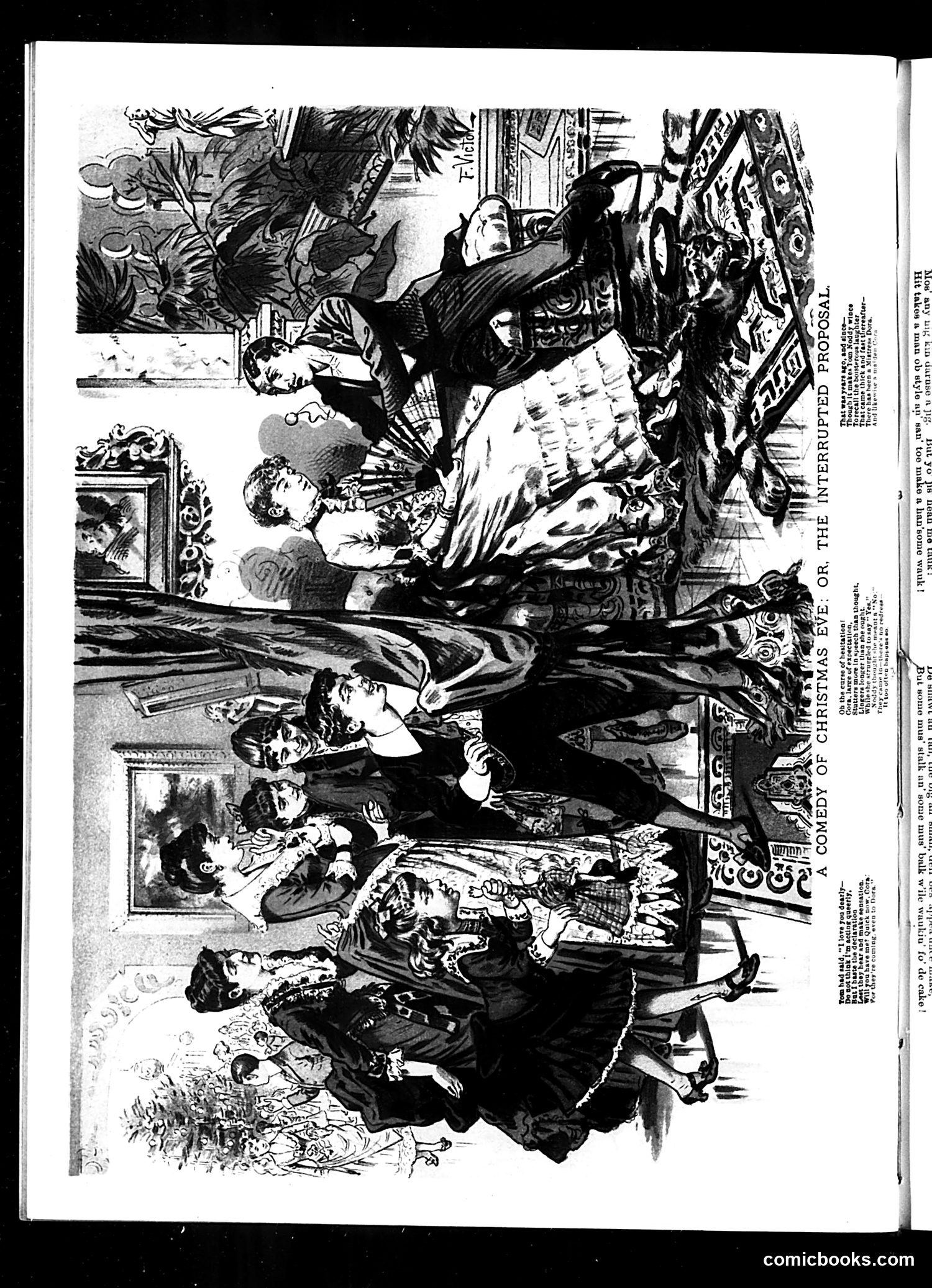
I can see this is a page from *Judge* magazine with what appears to be a Victorian-era satirical illustration, but the OCR text is largely illegible and doesn't provide useful context. The image shows multiple figures in period dress in what seems to be an interior domestic scene. The title text visible on the right margin appears to reference "A COMEDY OF CHERRYVALS EYE" or similar (unclear due to image quality), suggesting this is a comedic narrative illustration rather than a single political cartoon. Without legible text identifying the specific figures, events, or satirical targets, I cannot reliably explain what political or social commentary this piece makes. To accurately interpret this cartoon, I would need either clearer OCR text or additional publication information (date, artist name, issue details) that would help identify its subject matter.
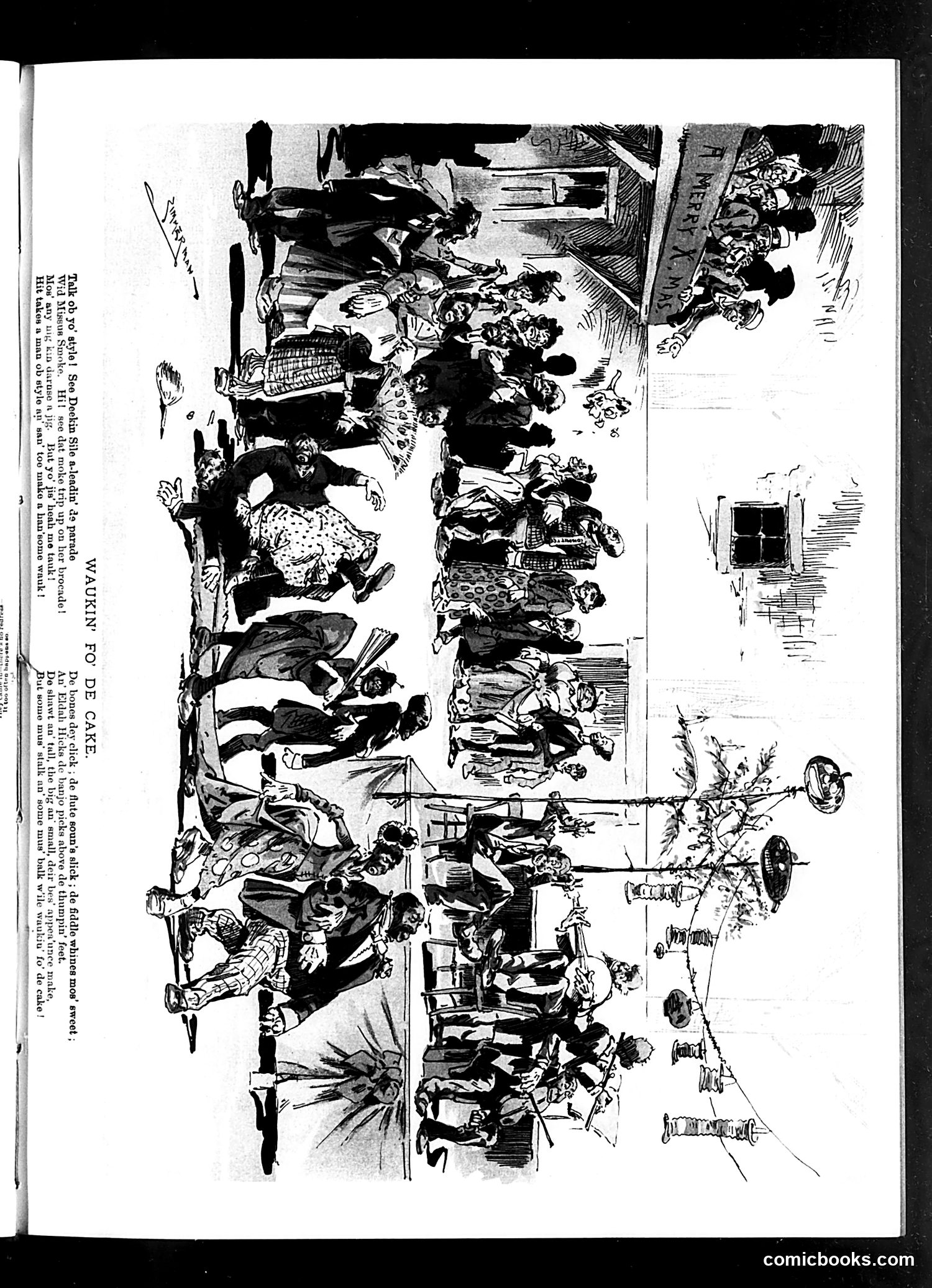
I cannot reliably explain this cartoon because the OCR text is severely corrupted and largely illegible—it appears to be gibberish rather than readable English. While the image itself shows what appears to be a satirical scene with multiple figures in period clothing arranged in a crowded composition typical of Judge magazine's political cartoons, **I cannot identify the specific figures, the historical event being referenced, or the satirical point without legible text or clear visual labels.** To properly interpret this cartoon, I would need either: clearer OCR text, visible captions/labels within the image, or additional context about the publication date and political circumstances. As presented, asserting specific meanings would risk inventing details unsupported by what's actually visible.
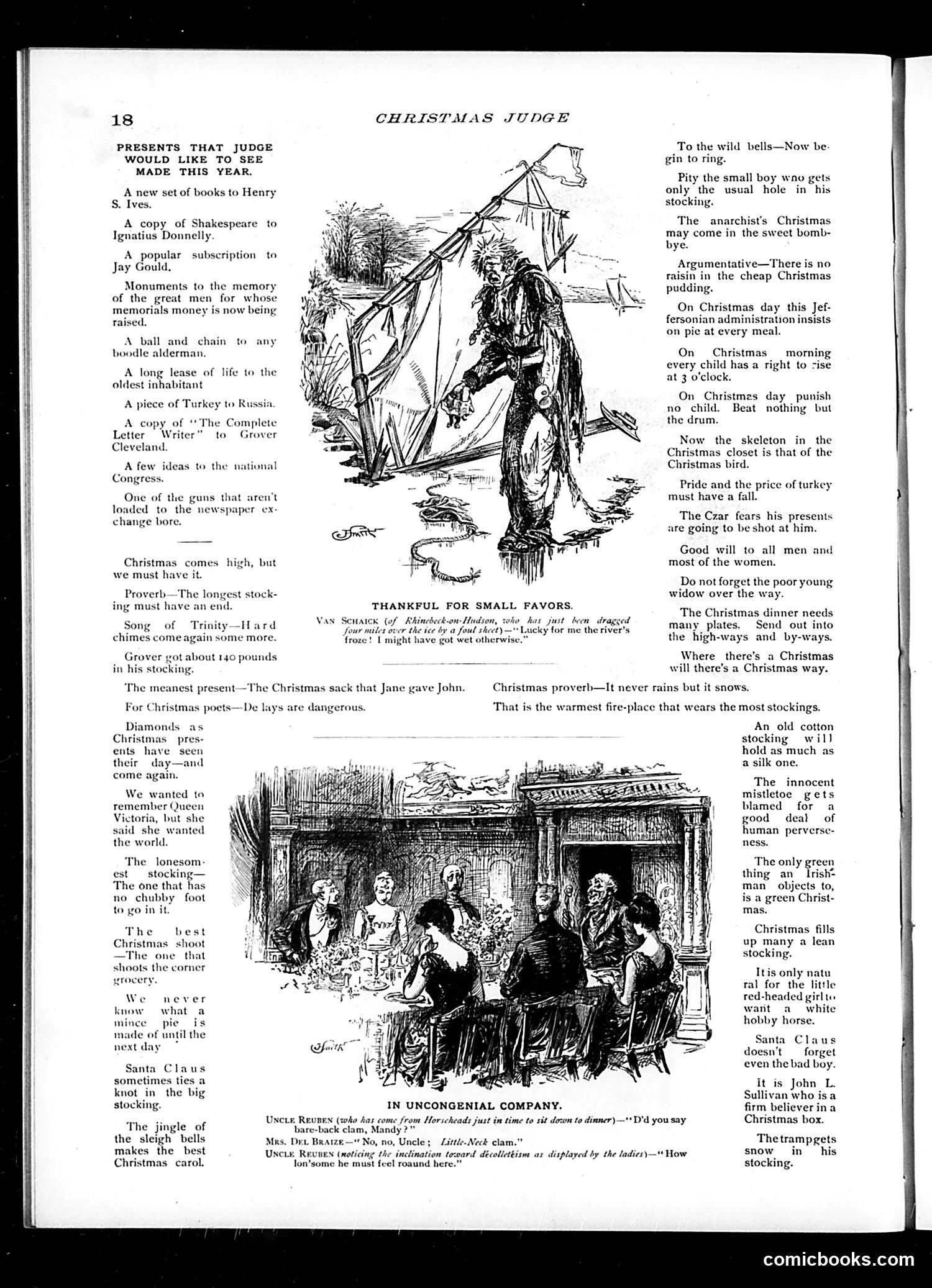
This page from Judge presents a list of satirical gift suggestions mocking prominent 1880s figures and social issues: **Political/Social Targets:** - **Grover Cleveland** receives mockery for his sparse communication ("Complete Letter Writer") - **Jay Gould** (railroad magnate) is criticized for lacking charity - **Ignatius Donnelly** is ridiculed as intellectually deficient - References to "boodle aldermen" target municipal corruption **The Cartoons:** The two illustrations depict awkward social situations—one showing a vagrant approaching what appears to be a well-dressed person, another showing dinner guests in "uncongenial company" where class differences create tension. **Underlying Satire:** Judge uses Christmas gift-giving as a framework to criticize wealth inequality, corruption, and social hypocrisy. The jokes suggest these figures need basic moral qualities (honesty, generosity, intelligence) more than material gifts. The cartoons emphasize class divisions and social discomfort—characteristic Progressive-era satire targeting the Gilded Age's wealthy and corrupt.
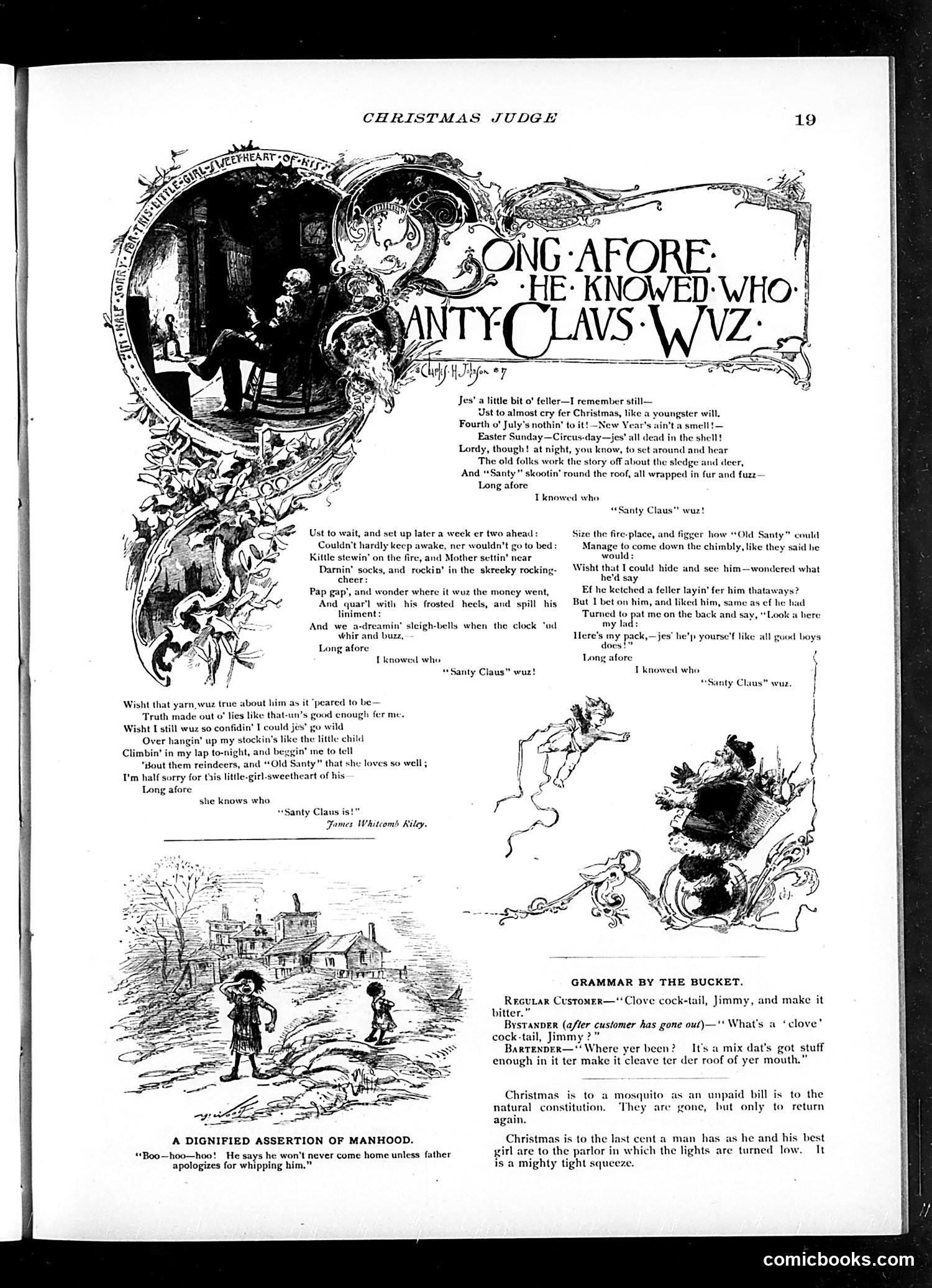
This page features a sentimental poem by James Whitcomb Riley (a popular Hoosier poet of the era) about childhood wonder and the loss of innocence. The narrator nostalgically recalls believing in Santa Claus—staying up late on Christmas Eve, watching the fireplace, listening to parents' stories, and marveling at the magic. The poem's melancholy refrain "Long afore / I knowed who / 'Santy Claus' wuz" emphasizes how adulthood and knowledge have destroyed that childhood faith. The secondary cartoons offer dark humor: one depicts a boy asserting manhood by refusing to come home unless his father apologizes for a whipping—a commentary on stubborn pride masquerading as dignity. The "Grammar by the Bucket" section mocks working-class dialect with crude bar-talk jokes. Overall, the page contrasts nostalgic innocence with harsh adult realities—a typical Judge editorial perspective.
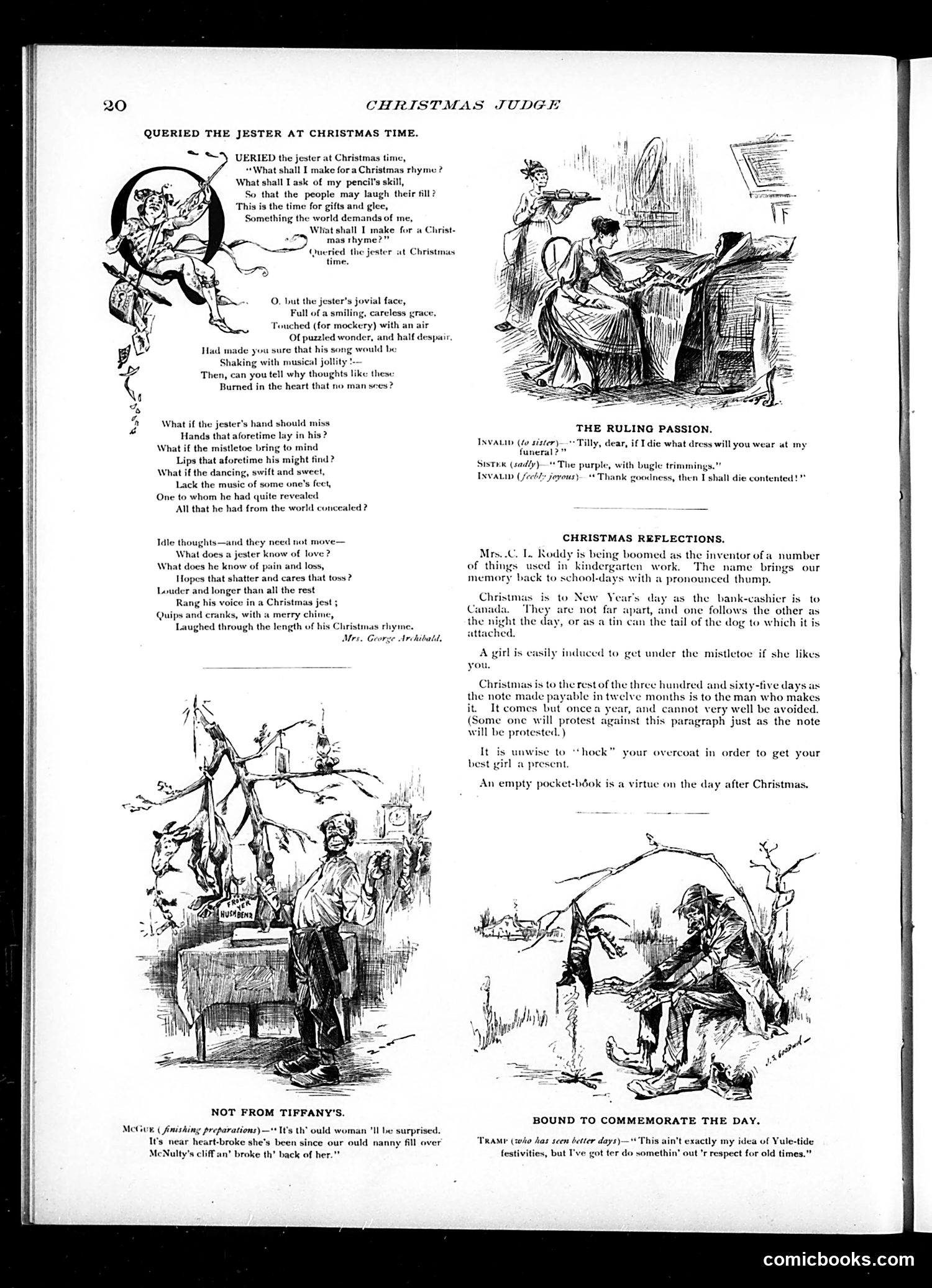
This page contains multiple satirical pieces about Christmas observance. The main poem "Queried the Jester at Christmas Time" presents sentimental irony: a jester performs merry Christmas entertainment while privately grieving absent loved ones—lost hands, lips, and dancing partners he once knew. It's melancholy masked by professional merriment. "The Ruling Passion" satirizes misplaced priorities: a dying invalid, facing his own funeral, is more concerned with fashion than mortality. "Christmas Reflections" offers cynical humor about the holiday's commercialism and inevitability—Christmas is inescapable and expensive, like unpaid promissory notes. References to "hocking" (pawning) overcoats for gifts mock working-class financial strain. The lower cartoons depict modest, struggling people ("Not from Tiffany's," "Bound to Commemorate the Day") attempting Christmas observance despite poverty, their speech rendered in period Irish-working-class dialect. The satire critiques Christmas's emotional and financial demands on common people.
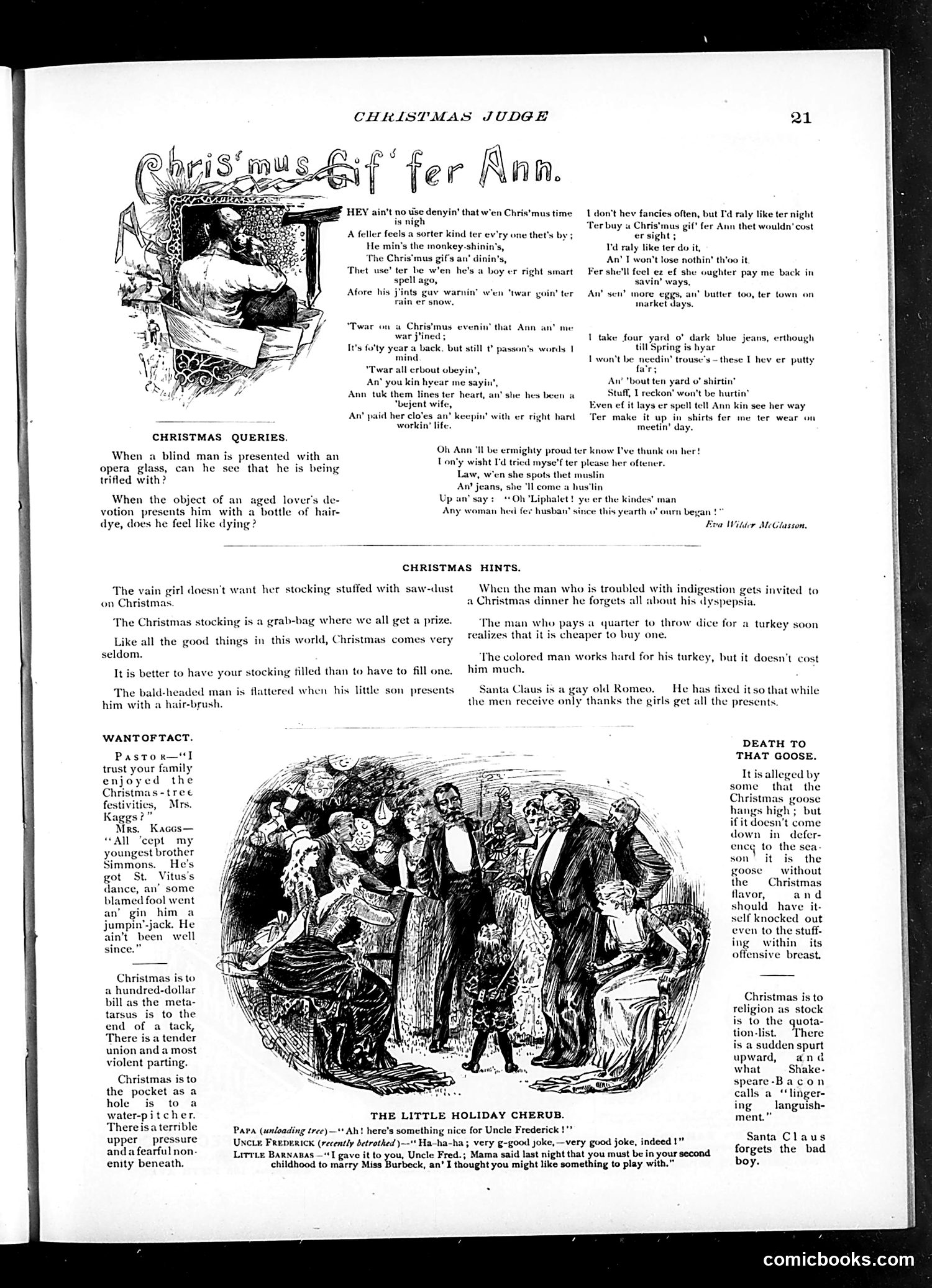
This page from *Judge* magazine presents Christmas-themed humor through dialect poetry, satirical observations, and social commentary typical of late 19th-century American satire. **Main Content:** The featured poem "Chris'mus Gift fer Ann" uses rural dialect to tell of a poor man planning modest Christmas gifts (jeans, shirting) for his hardworking wife—positioning domestic frugality as virtue. The humor derives from the contrast between his humble means and genuine affection. **Satirical Sections:** "Christmas Queries" mocks tactlessness through absurdist logic (presenting a blind man an opera glass as a joke). "Christmas Hints" contains barbed social commentary: mocking vanity, suggesting Christmas stocking-stuffing and gift-giving are exercises in waste, and offering veiled critiques of class pretension. "Want of Tact" ridicules social insensitivity—a woman's brother received a "jumping-jack" toy despite having St. Vitus's dance (involuntary movement disorder), worsening his condition. The "Little Holiday Cherub" cartoon depicts a young girl presenting an elderly bachelor an inappropriate gift (implied sexual innuendo about remarriage). Overall, the page reflects *Judge's* satirical focus on middle-class social awkwardness and economic anxiety during the Gilded Age.
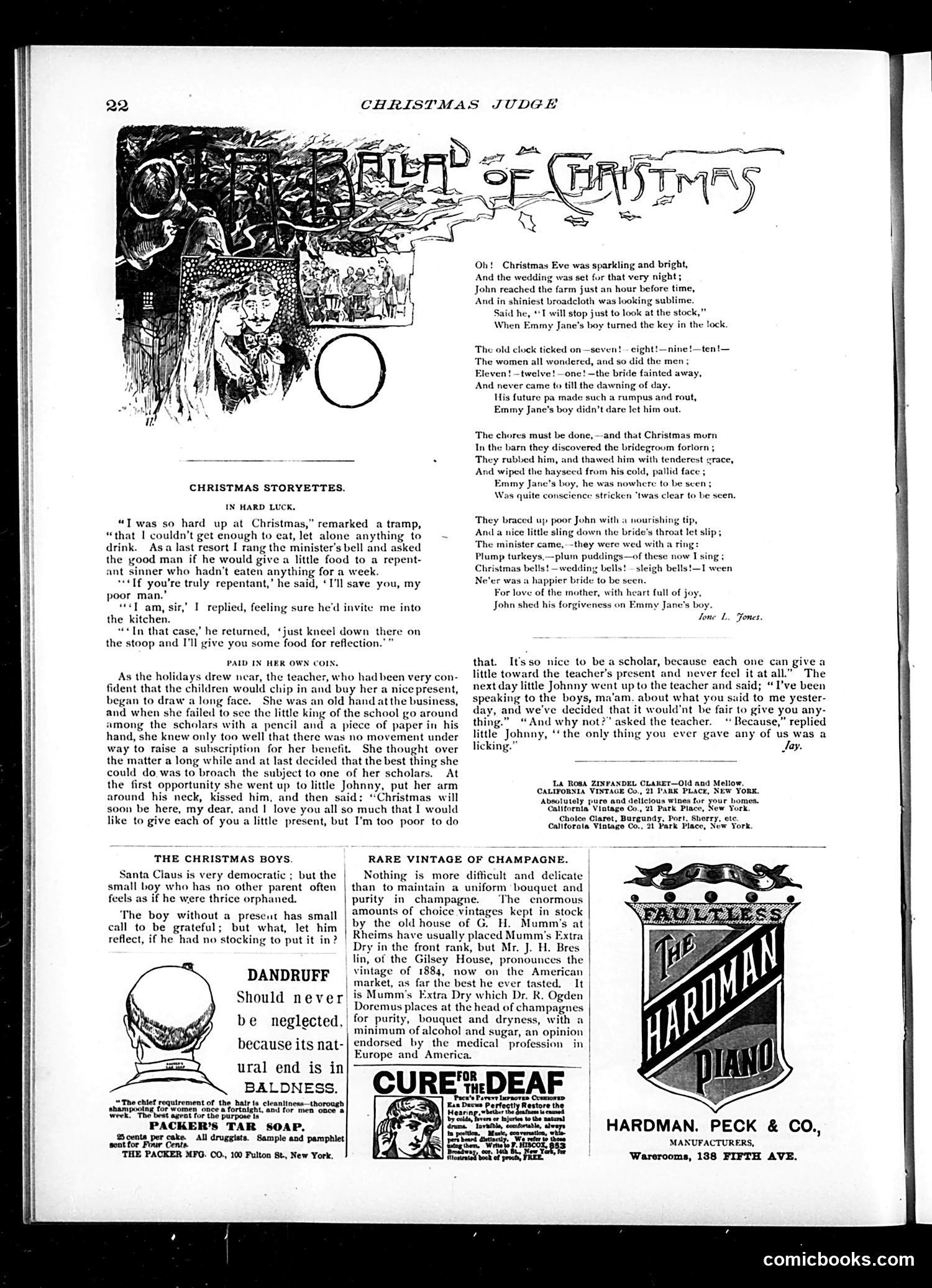
This page contains three short humorous stories ("storyettes") typical of Judge's satirical Christmas content, plus advertisements. The first tale mocks clergy hypocrisy: a minister offers a tramp spiritual "food for reflection" (standing in the cold) rather than actual meals—a dig at religious sanctimony disguised as charity. The second story presents a teacher's comeuppance. After fishing for gifts from poor students by feigning affection, a clever boy (Johnny) exposes her duplicity by pointing out she's never given the students anything but punishment. The satire targets manipulative authority figures and celebrates children's honest skepticism. The third, longer narrative "A Bride of Christmas" describes a comic wedding-day mishap where a groom gets accidentally locked in a barn, leading to his redemption through demonstrated forgiveness—sentimental holiday fare. These pieces reflect Judge's characteristic mockery of hypocrisy among respectable classes (clergy, teachers) while celebrating common-sense wisdom from "ordinary" people and children. The page is primarily editorial content with supporting advertisements for wine and other products.
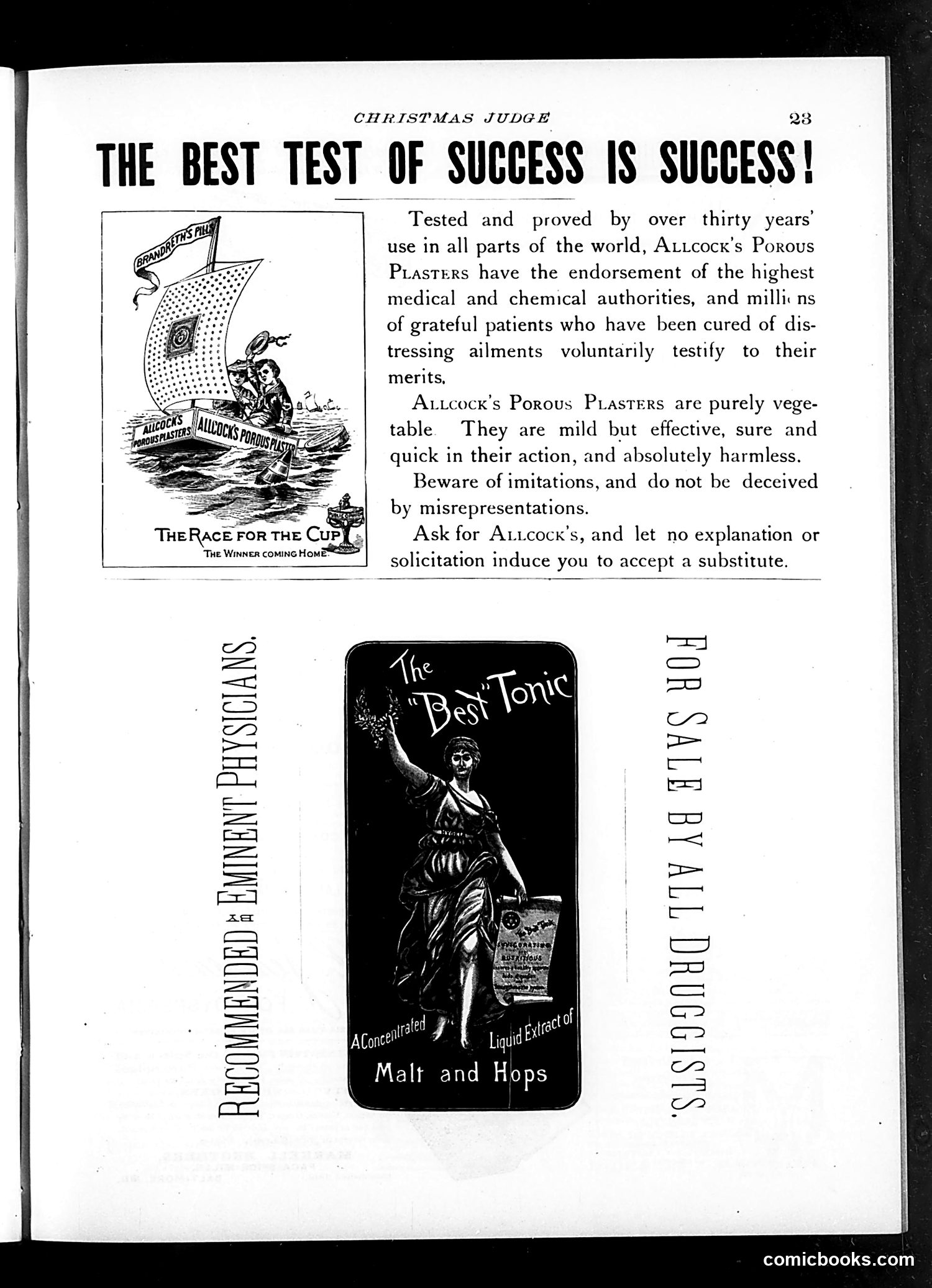
This page contains two unrelated advertisements rather than satirical content: 1. **Allcock's Porous Plasters**: A medical product advertisement claiming thirty years of successful use. The small cartoon shows a horse race labeled "The Race for the Cup" with "The Winner Coming Home"—likely a visual metaphor suggesting Allcock's plasters are the winning choice among competing remedies. The ad emphasizes the product is vegetable-based, harmless, and warns against imitations. 2. **"The Best Tonic"**: A beverage advertisement for a malt and hops extract, positioned as a health tonic "recommended by eminent physicians." It features a classical female figure (Britannia-style) holding the product. Both ads use the common Victorian/Edwardian advertising strategy of claiming medical endorsements and warning against inferior substitutes—standard marketing language for patent medicines of the era, when such products made broad health claims with minimal regulation.
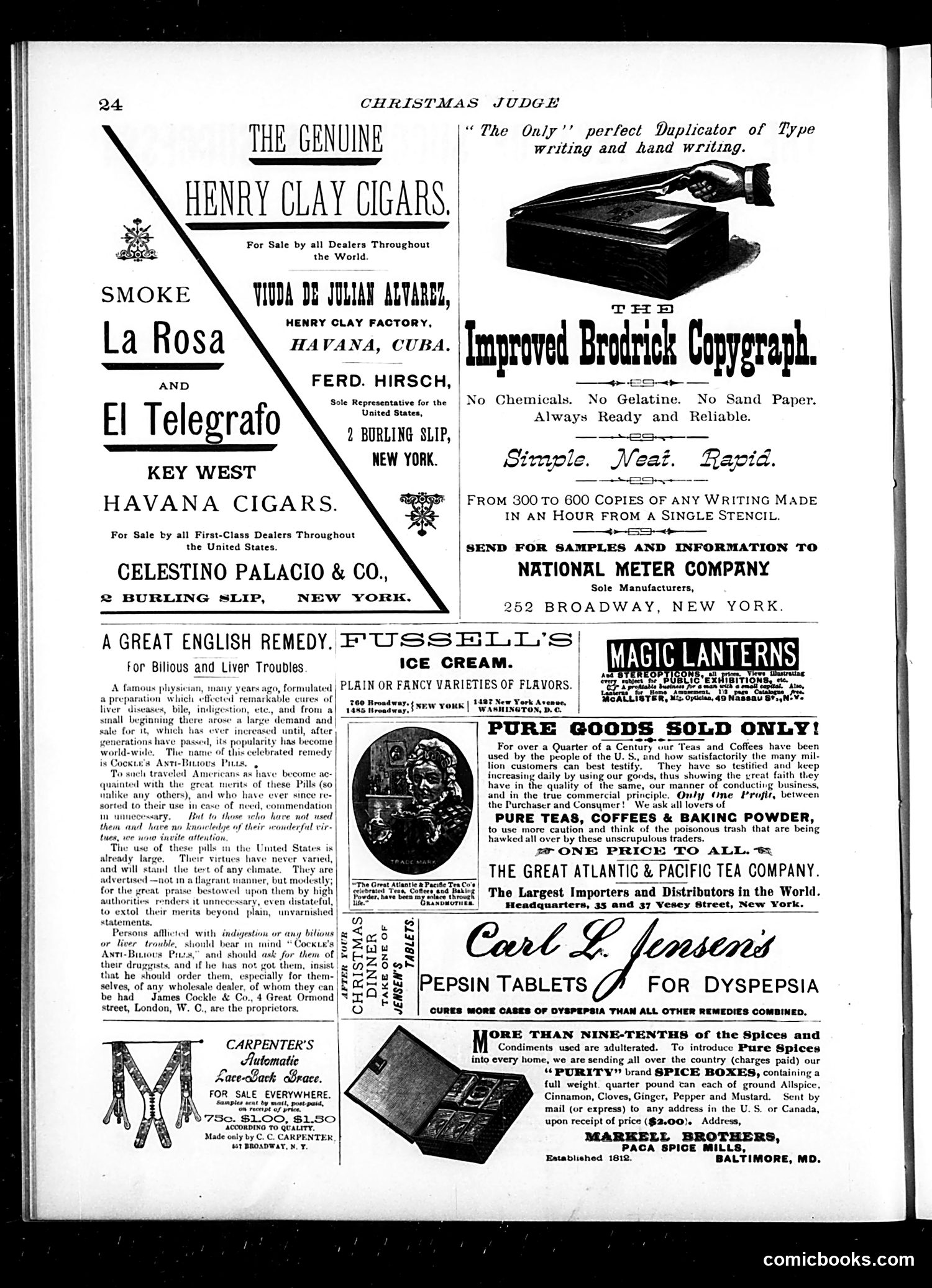
This is primarily an **advertising page** from Judge's Christmas edition, not a satirical cartoon. The page contains various commercial advertisements typical of late 19th-century American magazines. Notable products advertised include: - **Henry Clay Cigars** from Havana, Cuba - **Fussell's Ice Cream** - **Cock's Anti-Bilious Pills** — a patent medicine claiming to cure liver troubles and indigestion - **The Improved Brodrick Copyograph** — an early copying machine (predecessor to photocopiers) - **Magic Lanterns** for projection - **Carl L. Jensen's Pepsin Tablets** for dyspepsia (indigestion) - **The Great Atlantic & Pacific Tea Company** (early A&P) - **Markell Brothers Spice boxes** The advertising reflects the era's patent medicine market and early office technology. There is no discernible satire or political commentary on this particular page—it represents standard commercial content filling magazine space between editorial matter.
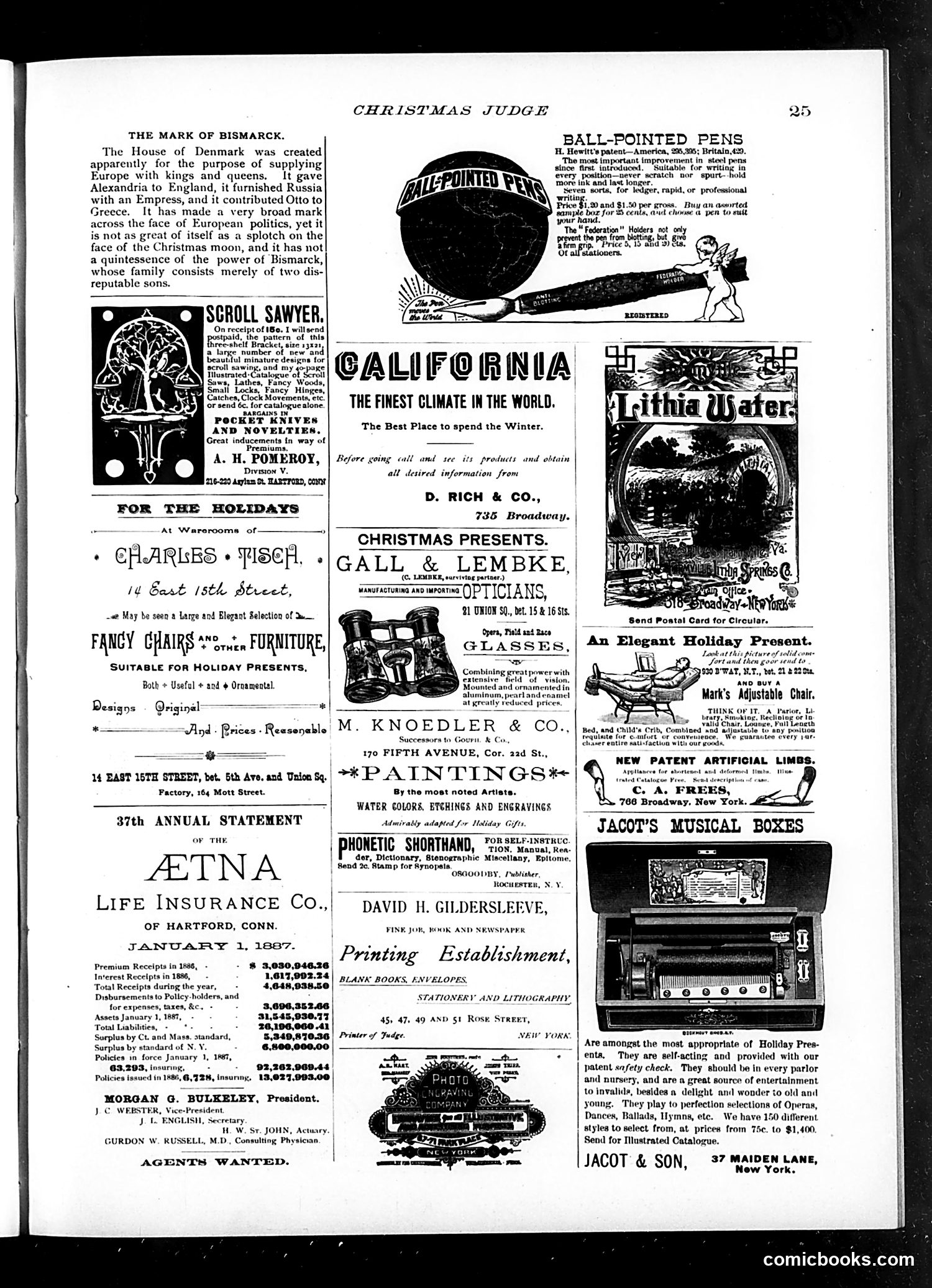
This article critiques the House of Denmark's political importance in European royalty. The author argues that while the Danish royal house has supplied numerous kings and queens across Europe (giving Alexandra to England, an Empress to Russia, Otto to Greece), its actual power is negligible—"not as great of itself as a splotch on the Christmas moon." The comparison to Bismarck is pointed: the German Chancellor's family may consist of merely two disreputable sons, yet Bismarck himself wielded far greater political influence than the entire Danish dynasty. The satire mocks the pretensions of hereditary nobility, suggesting that individual genius (Bismarck) matters more than prestigious but ultimately weak royal lineages. This reflects late-19th-century skepticism toward European monarchical authority in an age of rising nation-states and powerful individual leaders.
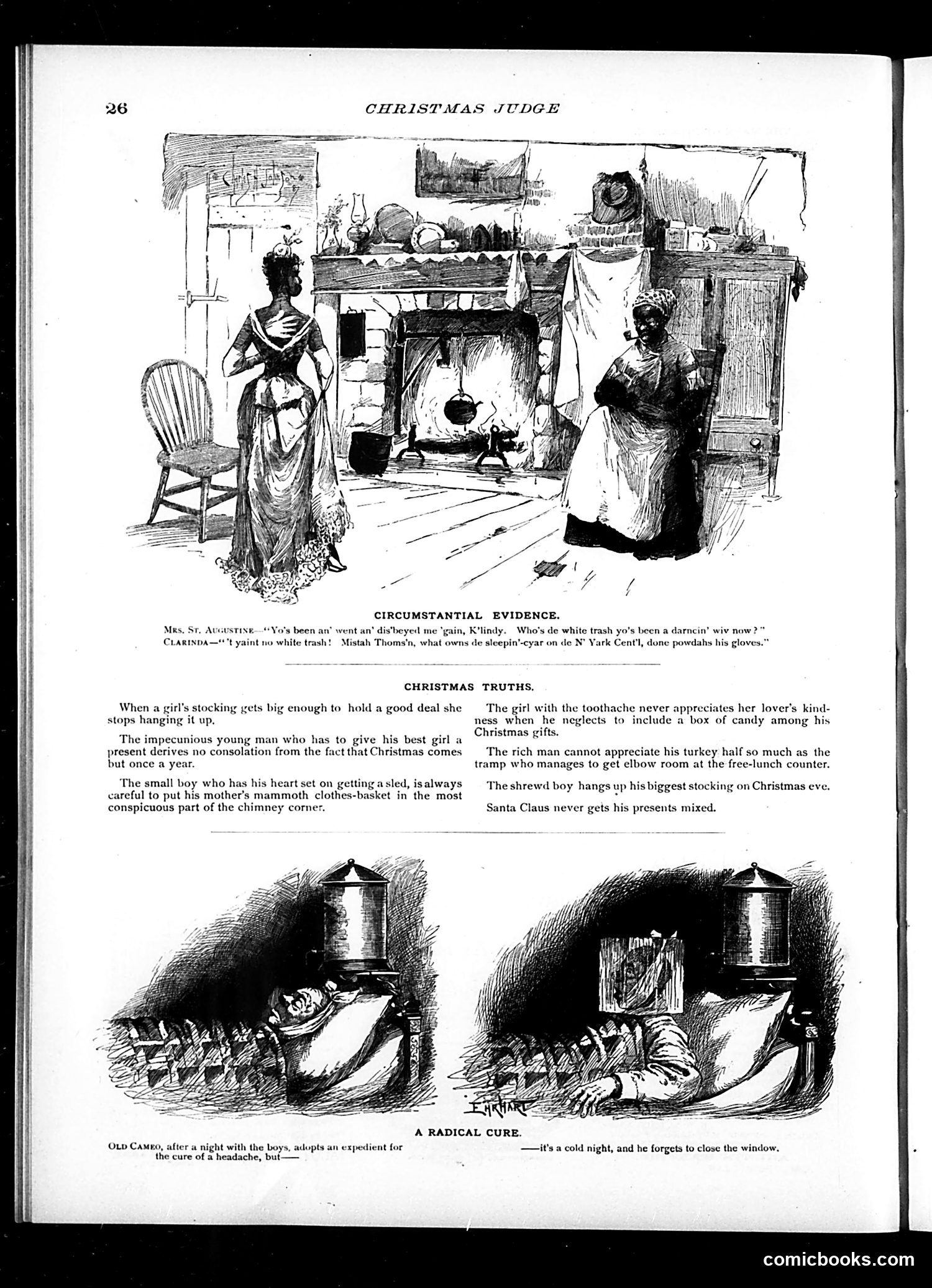
This page contains three separate satirical pieces from Judge magazine's Christmas issue. **"Circumstantial Evidence"** depicts two Black domestic servants discussing a third person. Mrs. Augustine accuses "K'lindy" of consorting with a man of lower status, implying moral judgment through class distinctions. The humor relies on racist dialect and stereotypical servant characterization common to the era. **"Christmas Truths"** offers cynical observations about Christmas behavior across social classes—from children's scheming to the poor man's greater appreciation of free meals than the wealthy man's turkey. This social commentary critiques materialism and hypocrisy. **"A Radical Cure"** shows a hungover man ("Old Cameo") attempting to cure his headache by opening a window, only to forget in the cold—a joke about impaired judgment and ironic self-defeat. The page reflects late-19th/early-20th-century American attitudes: class consciousness, racial stereotyping presented as comedy, and gentle satire of holiday excess and human folly.
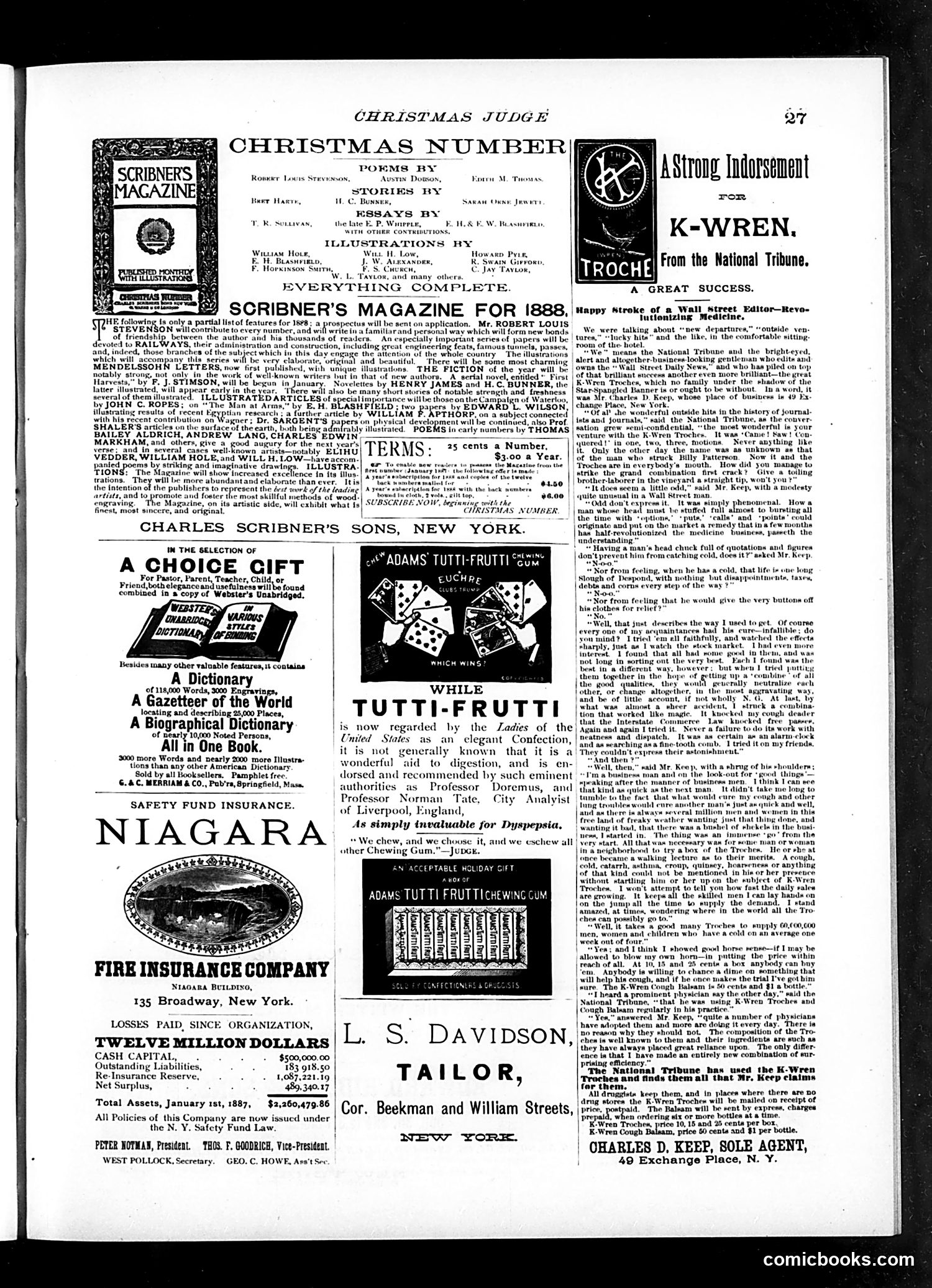
This is primarily a title/contents page for Judge magazine's Christmas issue, with extensive advertising. The main visual content appears to be advertisements for Scribner's Magazine, Webster's Dictionary, and Tutti-Frutti chewing gum (with an illustration showing competing candy brands). The featured story is titled "A Strong Indorsement for K-Wren" from the National Tribune. The brief article describes a Wall Street editor's anecdote about K-Wren Troches becoming a medicinal success story—presented as a "lucky hit" that revolutionized medicine. The text suggests these throat lozenges were promoted through newspaper endorsement, claiming they solved digestive and health problems. The Tutti-Frutti advertisement ironically asks "WHICH WINS?"—playfully competing with other confections for consumer attention. The page is characteristic of late-Victorian magazine culture: mixing quality literary content (Stevenson, James, Howells) with aggressive consumer advertising, while using journalistic testimonials to promote patent medicines and commercial products.
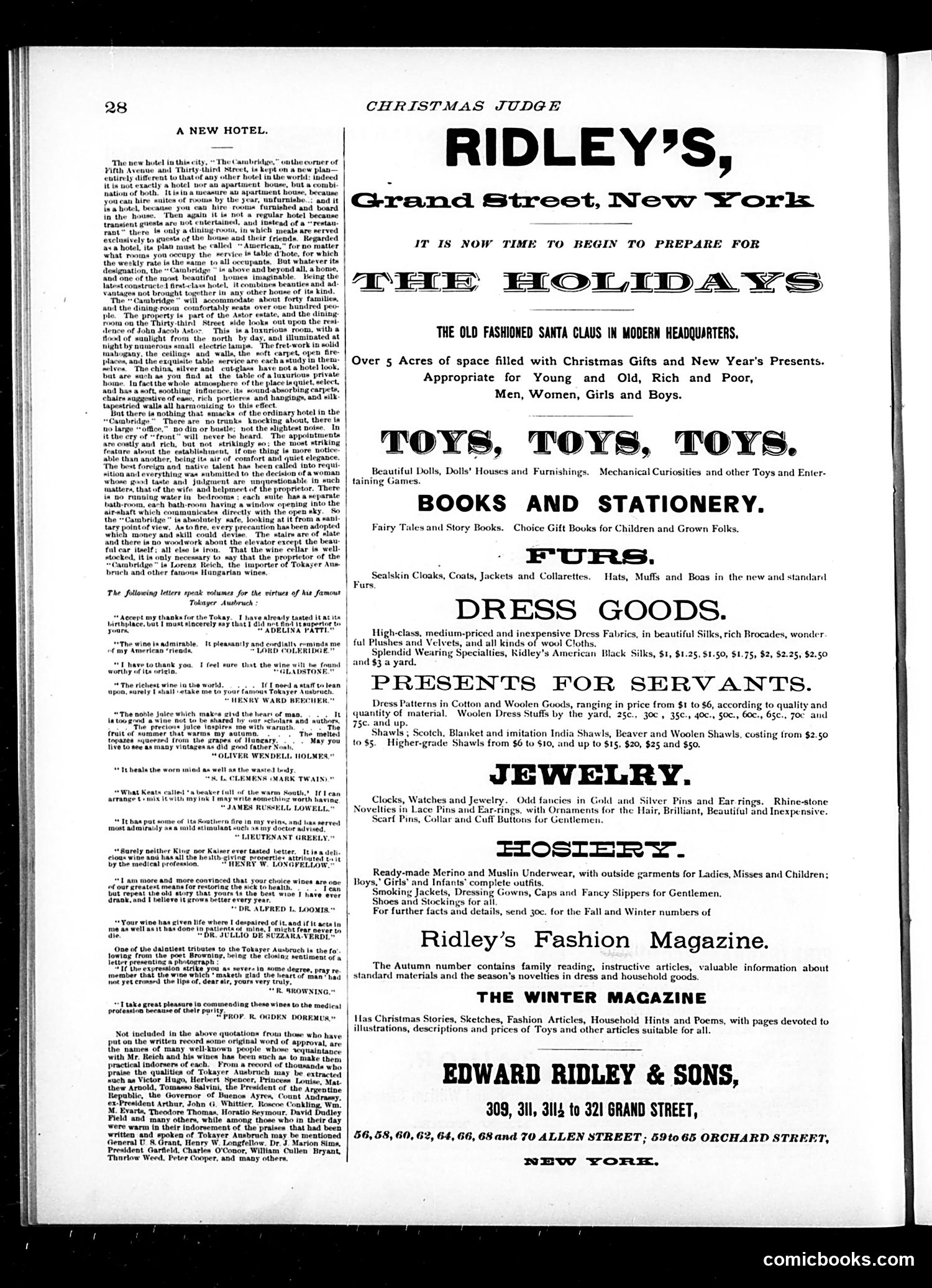
This page is primarily **advertising**, not satirical content. The left column contains a brief article praising "The Cambridge," a new hybrid hotel-apartment building on Fifth Avenue at 33rd Street in New York. It describes the property's luxurious amenities and notes it's part of the Astor estate. The bulk of the page advertises **Ridley's department store** on Grand Street, listing holiday gift categories (toys, books, furs, dress goods, jewelry, hosiery). Notably, the article includes testimonial letters from famous 19th-century figures (Adelina Patti, Mark Twain, Longfellow, James Russell Lowell) endorsing the hotel proprietor's **Tokayer Ausbruch wine**—a premium Hungarian vintage. These celebrity endorsements were common advertising tactics of the era. **No political satire or caricatures appear on this page.** It represents typical Judge content: mixing legitimate journalism with promotional material through celebrity testimonials and product advertising.
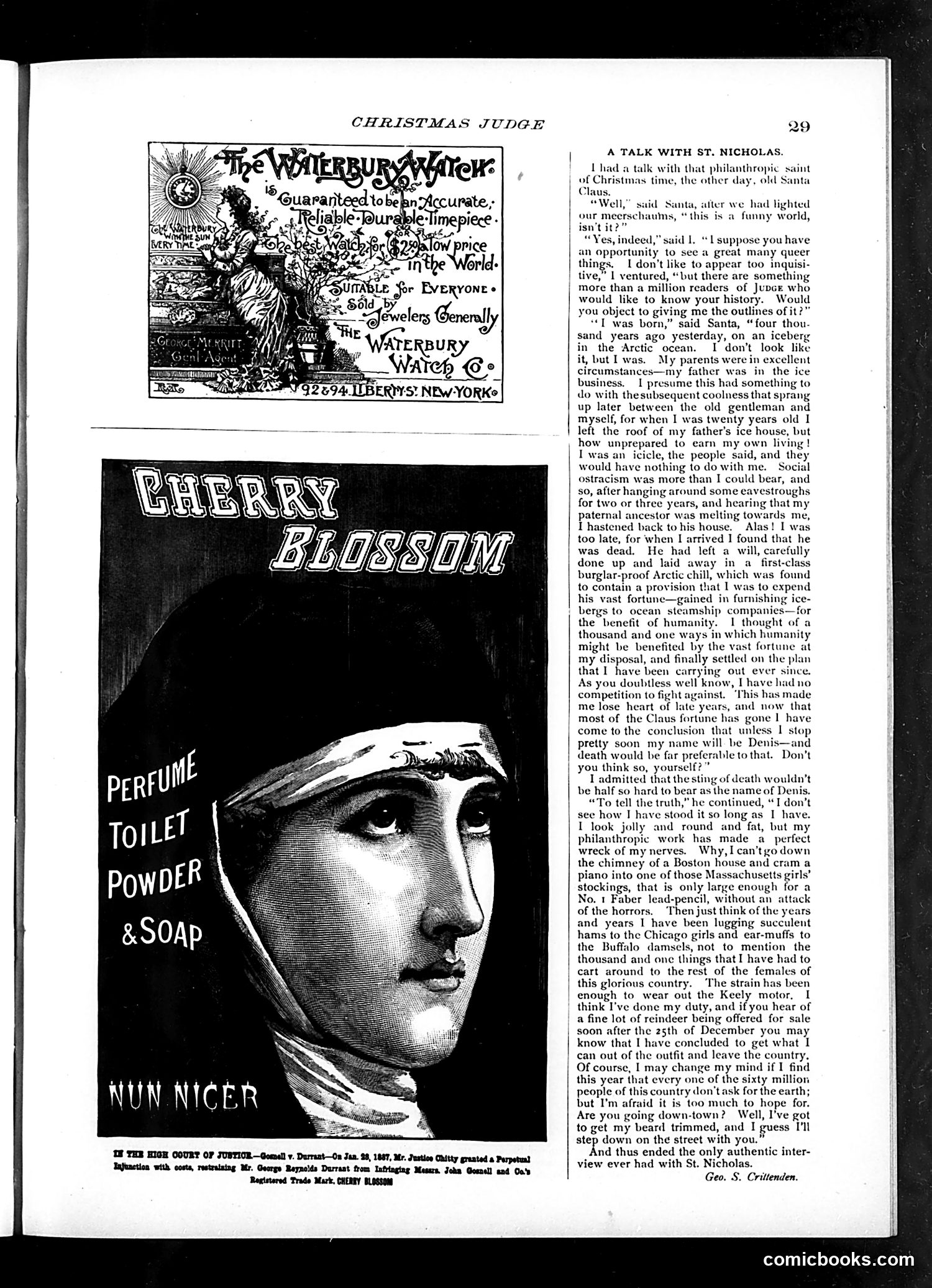
This page contains a satirical Christmas interview between the magazine's narrator and Santa Claus (St. Nicholas). Santa presents a humorous fictional autobiography: born 4,000 years ago on an Arctic iceberg to an ice-business family, he became a social outcast as a young "icicle," then inherited his father's vast fortune with instructions to use it for humanity's benefit. The satire mocks Santa's exhaustion from gift-giving to America's demanding consumers—he complains about stuffing pianos into Boston girls' stockings and delivering luxuries to Chicago and Buffalo women. The joke is that despite his philanthropic mission, Santa is burned out and considering retirement, selling off his reindeer after Christmas. This reflects Gilded Age anxieties about commercialized Christmas and consumer excess. The accompanying advertisements (Waterbury Watch, Cherry Blossom Perfume) emphasize the period's materialistic gift-buying culture—precisely what the satire critiques through Santa's desperation.
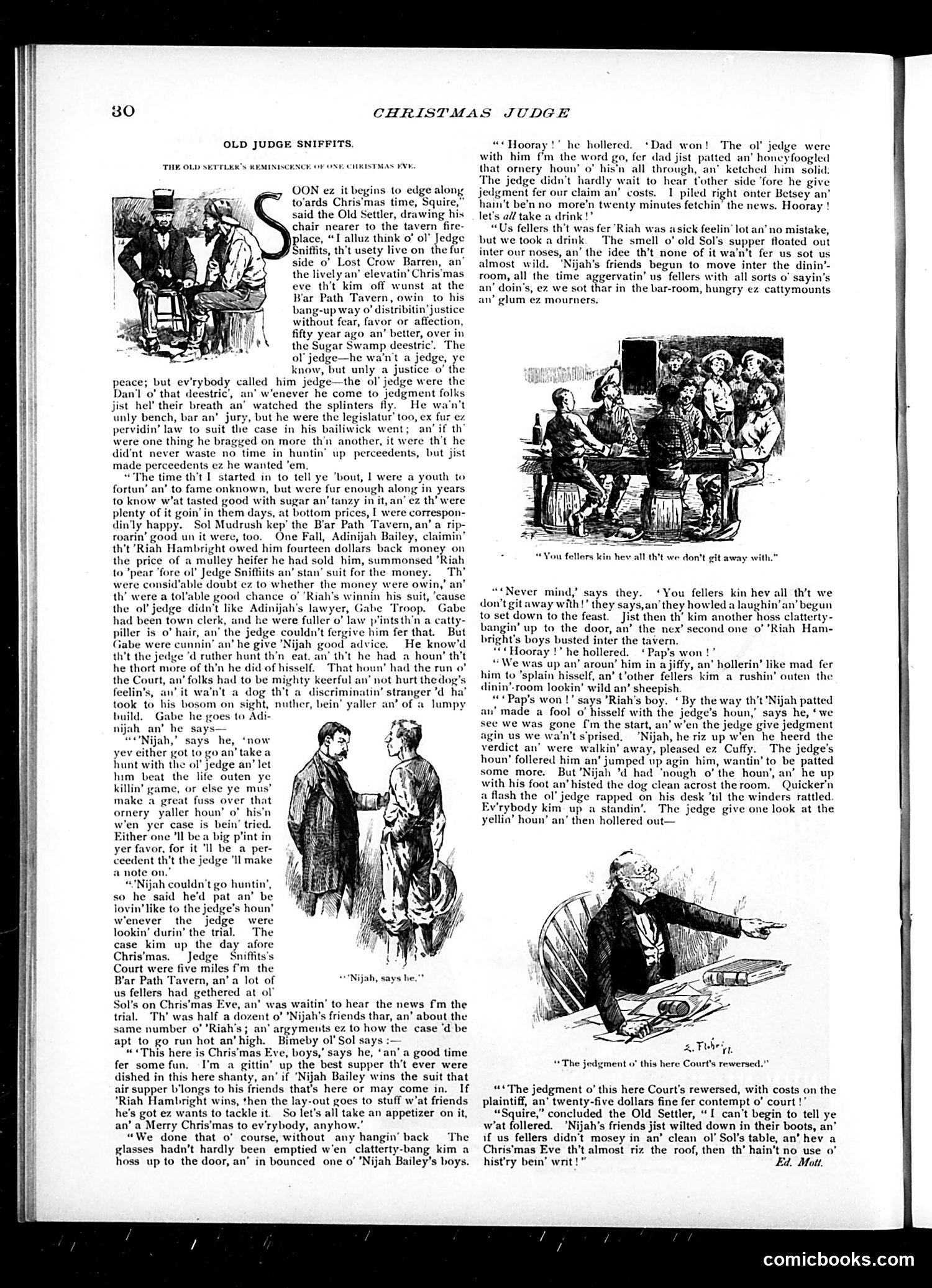
This is a humorous tall tale from *Judge* magazine depicting a frontier justice system. The story concerns Judge Sniffits, an informal justice of the peace in "Sugar Swamp district" who makes arbitrary legal decisions based on personal preference rather than law. The central plot involves a lawsuit over a debt: Adinijah Bailey sues Riah Hambright for money owed on a cow. The lawyer Gabe Troop advises Bailey to either join the Judge on a hunting trip or befriend the Judge's ugly yellow dog during trial—either action being a "precedent" the Judge will favor. The satire mocks frontier jurisprudence: judges who are hunters first and legal scholars never, who create law as they go, and whose rulings depend entirely on personal whims rather than precedent or principle. The dog-petting strategy exemplifies how frontier justice rewarded personal connection over legal merit. The Christmas Eve tavern setting adds folksy Americana atmosphere to this critique of ad-hoc, personality-driven law.
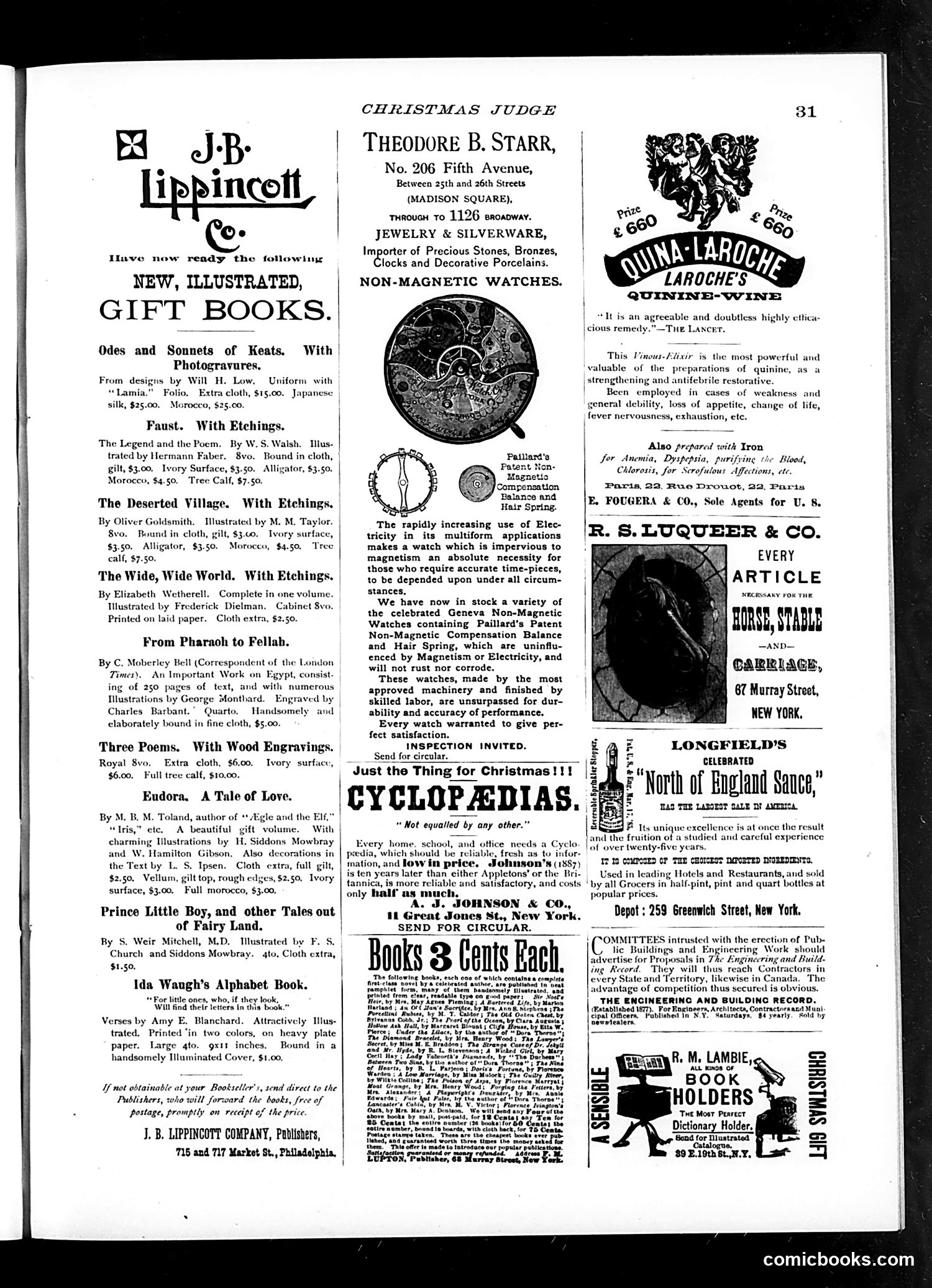
This page is primarily **advertising**, not satirical content. It appears from a Christmas issue of *Judge* magazine (likely late 19th century, given the typography and product offerings). The advertisements include: - **J.B. Lippincott Company**: luxury illustrated gift books (classical literature like *Faust*, *Keats*, *Eudora*) - **Theodore B. Starr**: jewelry, silverware, and notably "non-magnetic watches" — a direct response to the era's growing use of electricity, which could damage traditional timepieces - **Quinine-wine**: marketed as a tonic for weakness and fever (common "patent medicine" of the period) - **Cyclopedias** and **book holders**: practical gifts - **R.M. Lambie**: book accessories The non-magnetic watches advertisement is the most historically interesting—it reflects genuine concerns about electricity's effects on mechanical devices during the industrial revolution. Otherwise, this is standard commercial holiday promotional material.
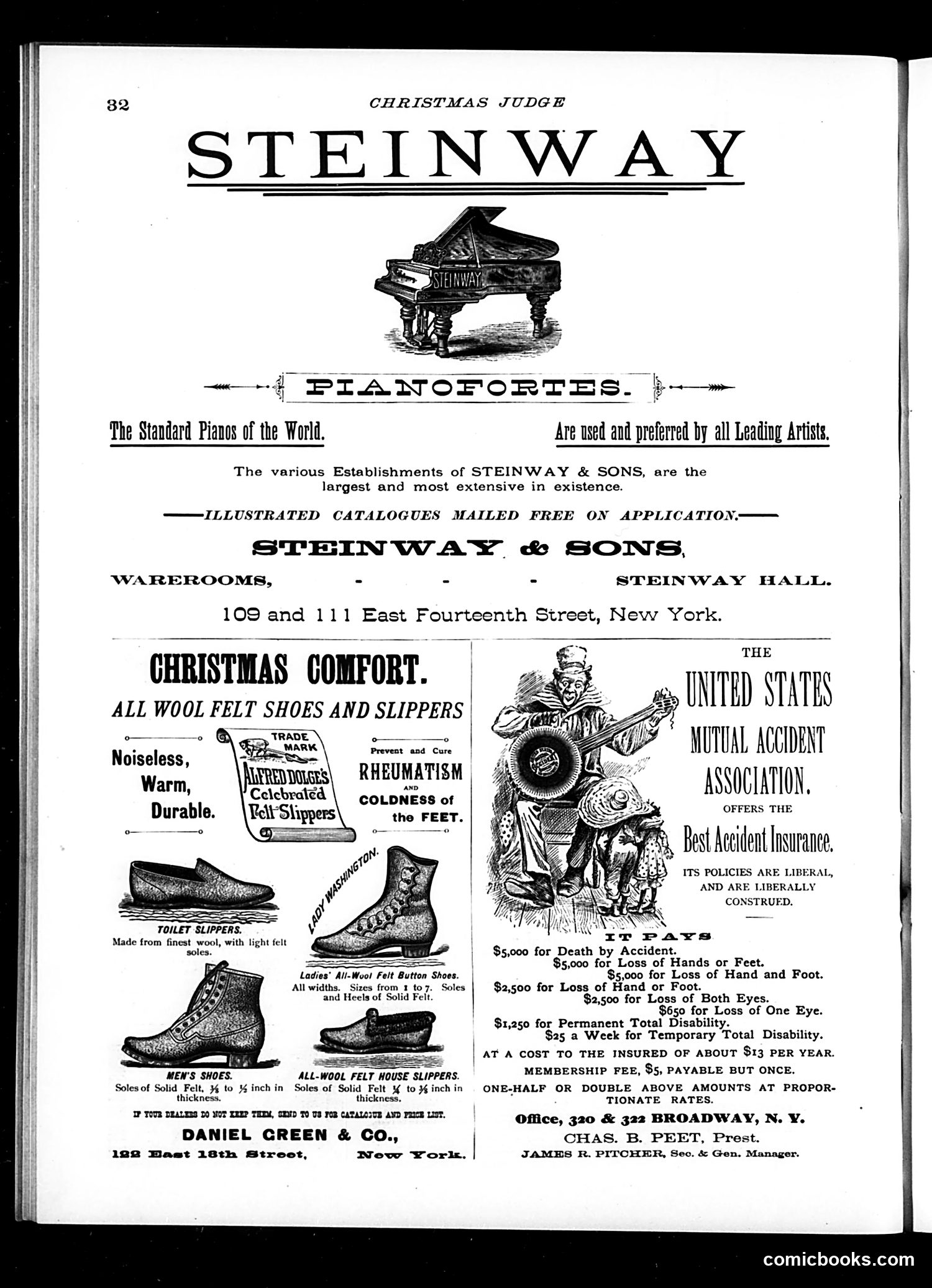
This page is primarily **advertising**, not satire or political commentary. It contains three distinct commercial advertisements: 1. **Steinway Pianos** — promoting their grand pianos as "standard pianos of the world," used by leading artists, with showrooms at 109-111 East 14th Street, New York. 2. **Daniel Green & Co. Felt Shoes** — Christmas-themed ads for wool felt slippers and shoes, emphasizing warmth and comfort for winter, positioned as holiday gift items. 3. **United States Mutual Accident Association** — an insurance company offering accident coverage with specific payouts ($5,000 for death, scaled amounts for limb loss, etc.) at $13/year membership. The page reflects late-19th-century consumer culture, with these three unrelated businesses sharing ad space. There are no political cartoons or satirical commentary visible—Judge's editorial content appears elsewhere in the issue.
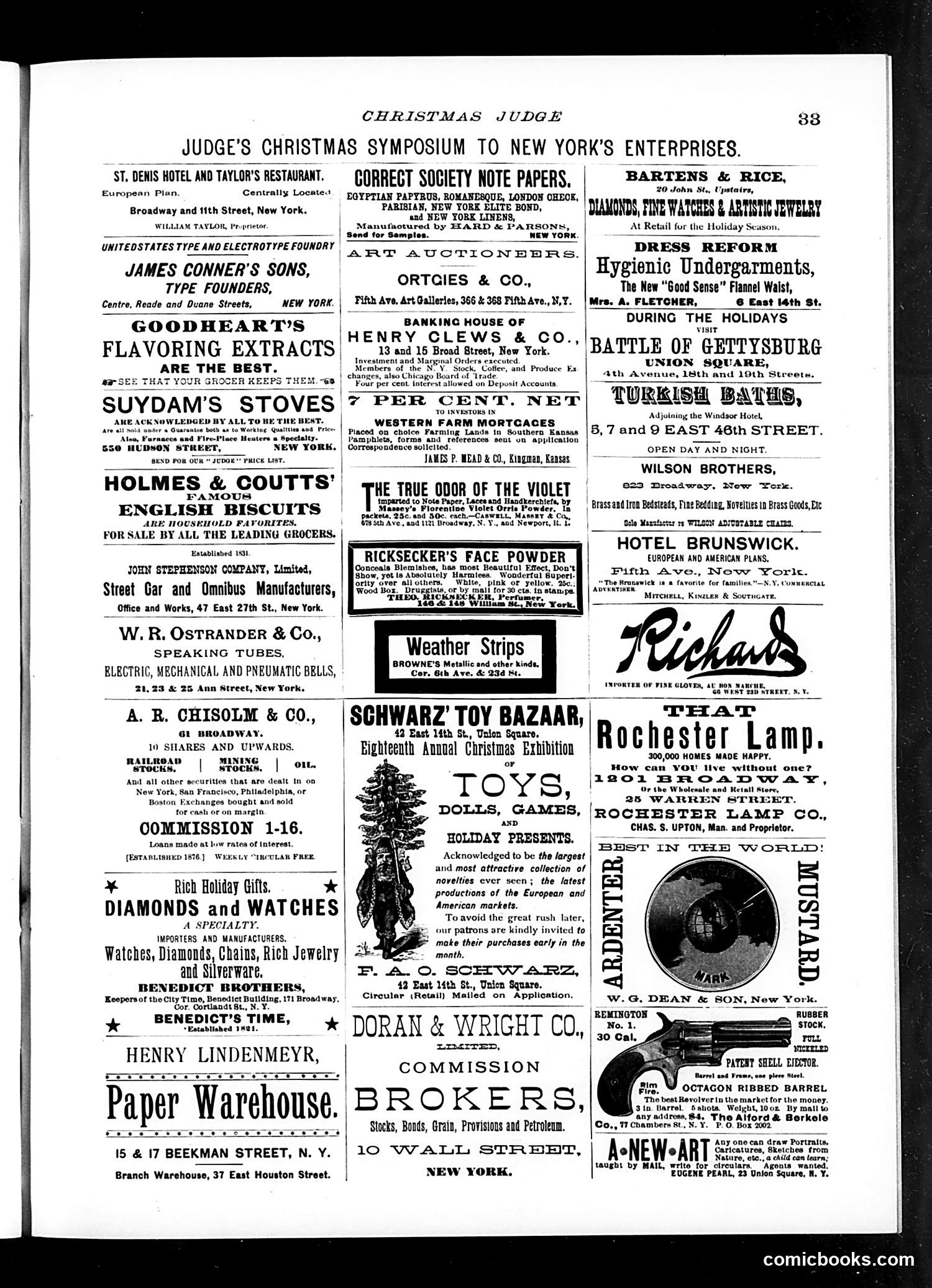
This page is primarily **advertising**, not satirical content. It's a Christmas-themed commercial directory from Judge magazine featuring New York businesses circa the 1880s-1890s. The ads showcase period consumer culture: jewelry stores (Bartens & Rice, Benedict Brothers), hotels (St. Denis, Hotel Brunswick), household goods (Suydam's stoves, Holmes & Coutts biscuits), banking services (Henry Clews & Co.), and novelty items (Schwarz' Toy Bazaar). Notable for modern readers: the "Battle of Gettysburg" entry refers to a **diorama or exhibition** at Union Square—a popular tourist attraction recreating the Civil War battle. The "Dress Reform" section advertises "hygienic undergarments," reflecting late-19th-century debates about women's clothing health. The page demonstrates how Judge blended editorial content with paid advertising to reach wealthy New York consumers during the holiday season.
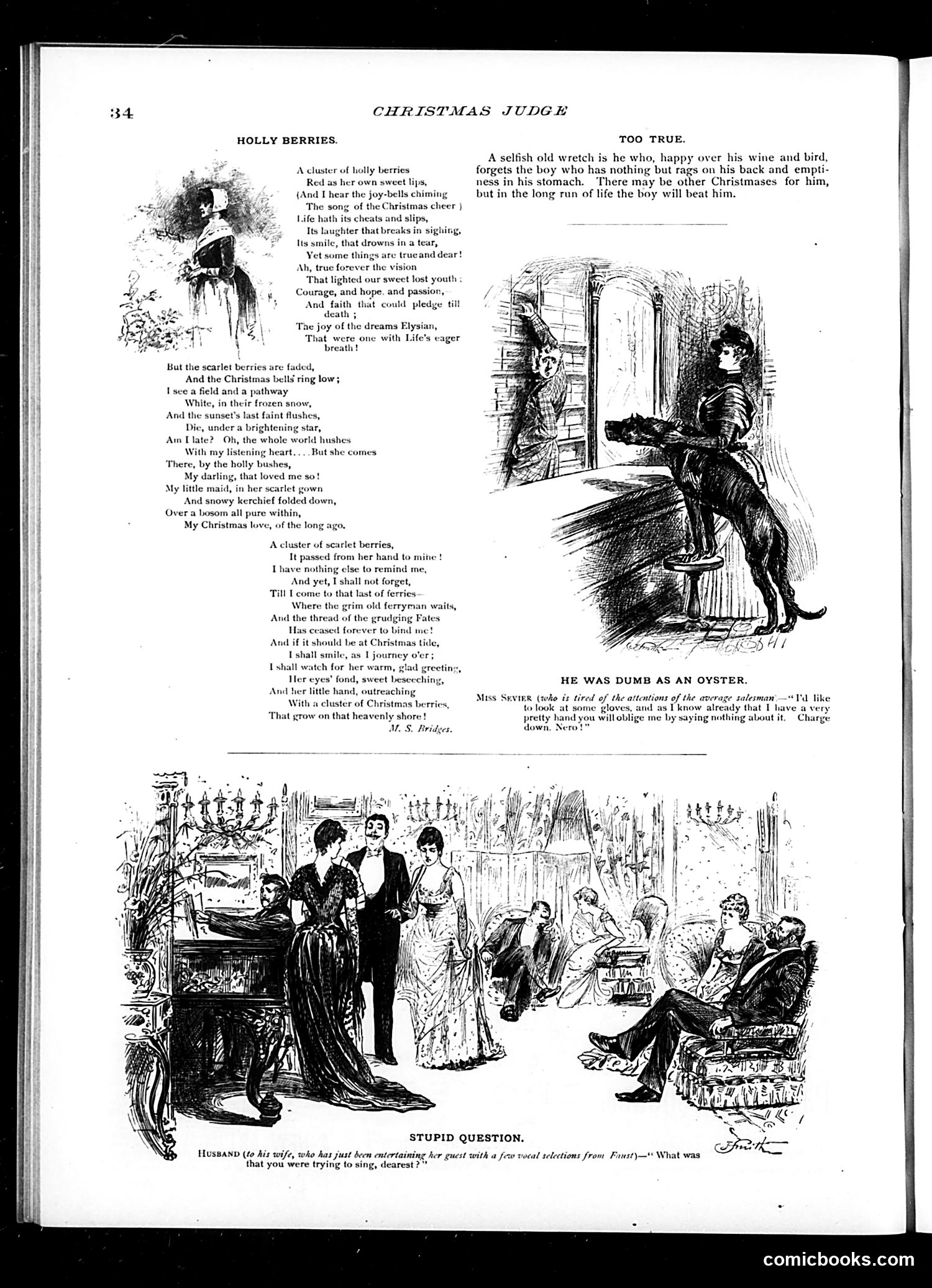
This Christmas-themed page contains three distinct pieces of social satire: **"Holly Berries"** (poem, left): A sentimental meditation on memory and loss, contrasting a wealthy man's indulgent Christmas with a poor boy's suffering. The moral message—that the poor boy will ultimately "beat" the selfish rich man—reflects Victorian concern for class inequality. **"He Was Dumb as an Oyster"** (center): A brief joke where Miss Sevier, tired of salesmen's flattery about her hands, sarcastically tells one to stop talking ("Nero" reference unclear). The humor targets obsequious retail behavior. **"Stupid Question"** (bottom): A domestic comedy where a husband asks his wife what she was "trying to sing" after she performed selections from *Faust*—implying her performance was so poor it was unrecognizable. This mocks both amateur domestic performances and husbandly tactlessness. All three pieces use humor and sentiment to satirize social manners and class attitudes of the period.
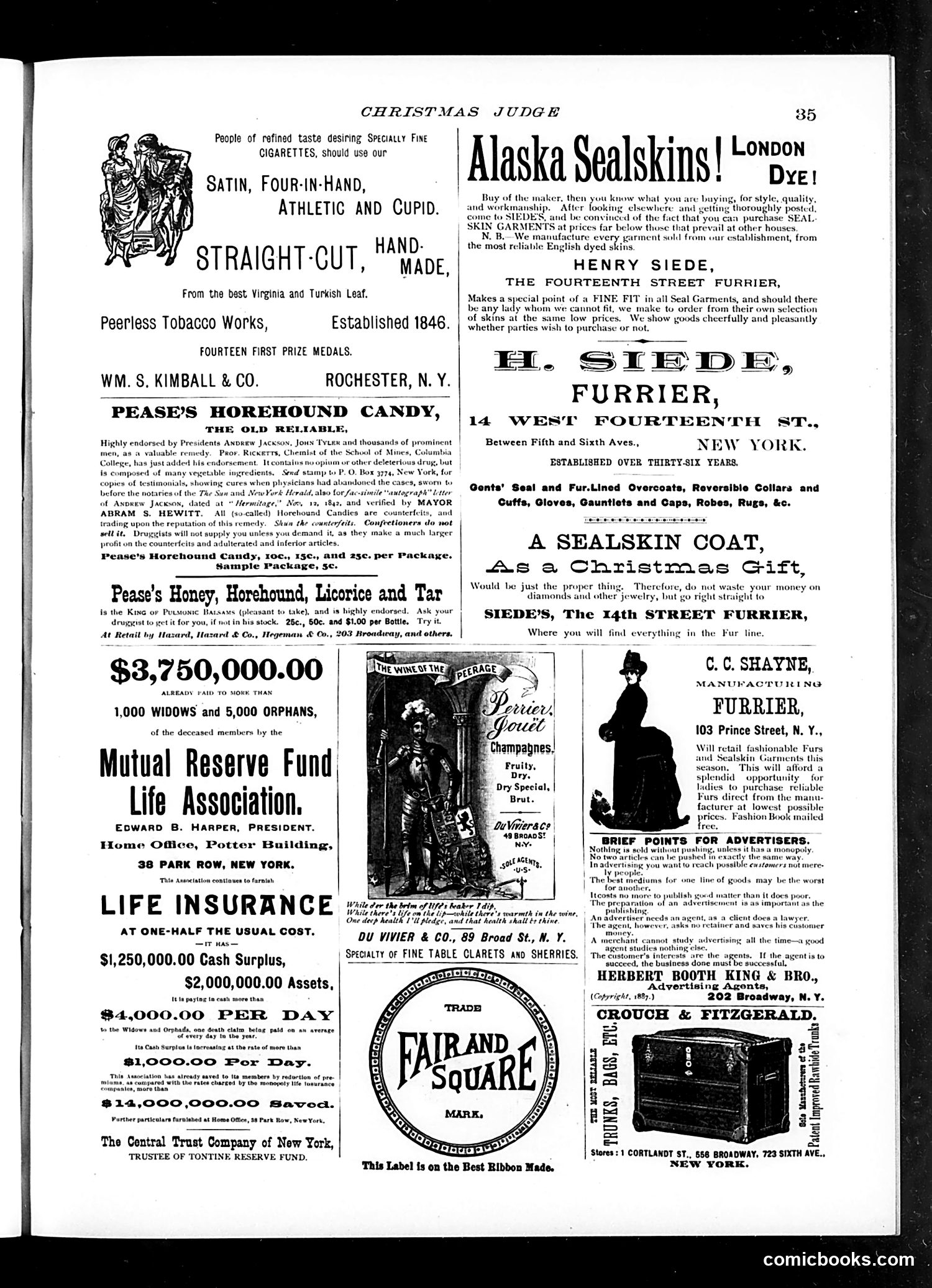
This is primarily an **advertising page** from Judge magazine's Christmas issue, containing no political cartoons or satirical content. Instead, it features numerous commercial advertisements typical of 1880s publications. Notable ads include: - **Alaska Sealskins**: Furriers (Siede, Shayne, C.C. Shayne) advertising fashionable fur garments as luxury Christmas gifts - **Tobacco and candy**: Peerless Tobacco Works and Pease's Horehound Candy emphasizing quality and authenticity (warning against counterfeits) - **Life insurance**: Mutual Reserve Fund Life Association promoting affordable coverage for widows and orphans - **Luxury goods**: Champagne, trunks, and other upscale items The page reflects Gilded Age consumer culture and advertising conventions. The repeated furrier advertisements suggest seal pelts were extremely fashionable among wealthy women at this time. The insurance ads target middle-class anxieties about family financial security—a common advertising strategy of the era.
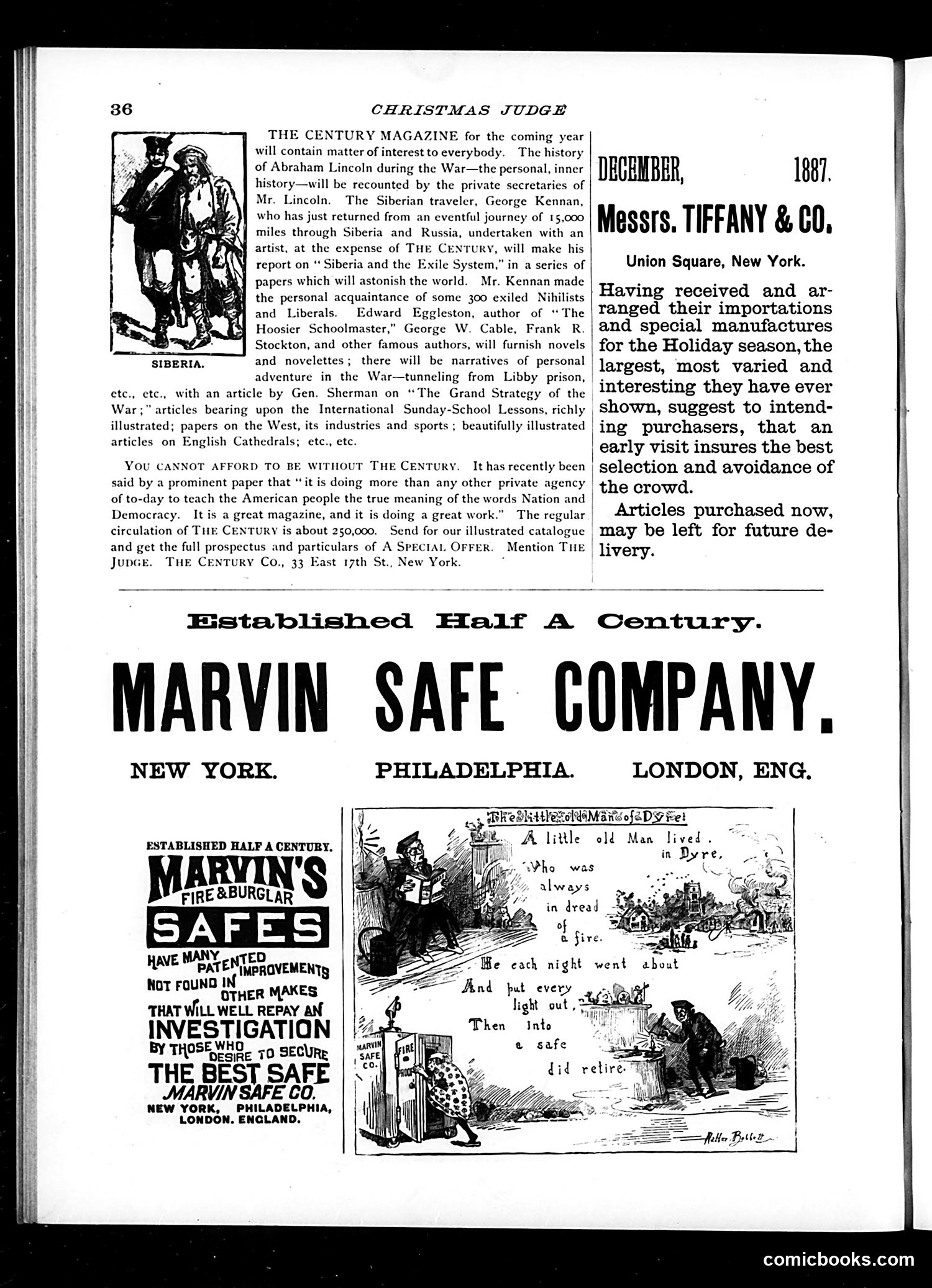
This page is primarily **advertising and promotion** rather than satirical content. The top section promotes *The Century Magazine's* upcoming content, including Abraham Lincoln war histories and George Kennan's exposé on Siberia's exile system—presented as serious, important journalism. Below that, **Tiffany & Co.** advertises holiday merchandise, urging early shopping to avoid crowds. The main illustrated content is a **Marvin Safe Company advertisement** featuring a small cartoon narrative (artist signed "Kille Bates"). The story depicts an elderly man obsessed with fire risk who nightly extinguishes lights and retreats to his safe for security—a humorous cautionary tale designed to sell safes by playing on Victorian anxieties about fire danger and property loss. This is fundamentally a **commercial page**: three separate ads using different appeals (intellectual prestige, luxury shopping, security/fear) to target affluent *Judge* readers during the 1887 holiday season.
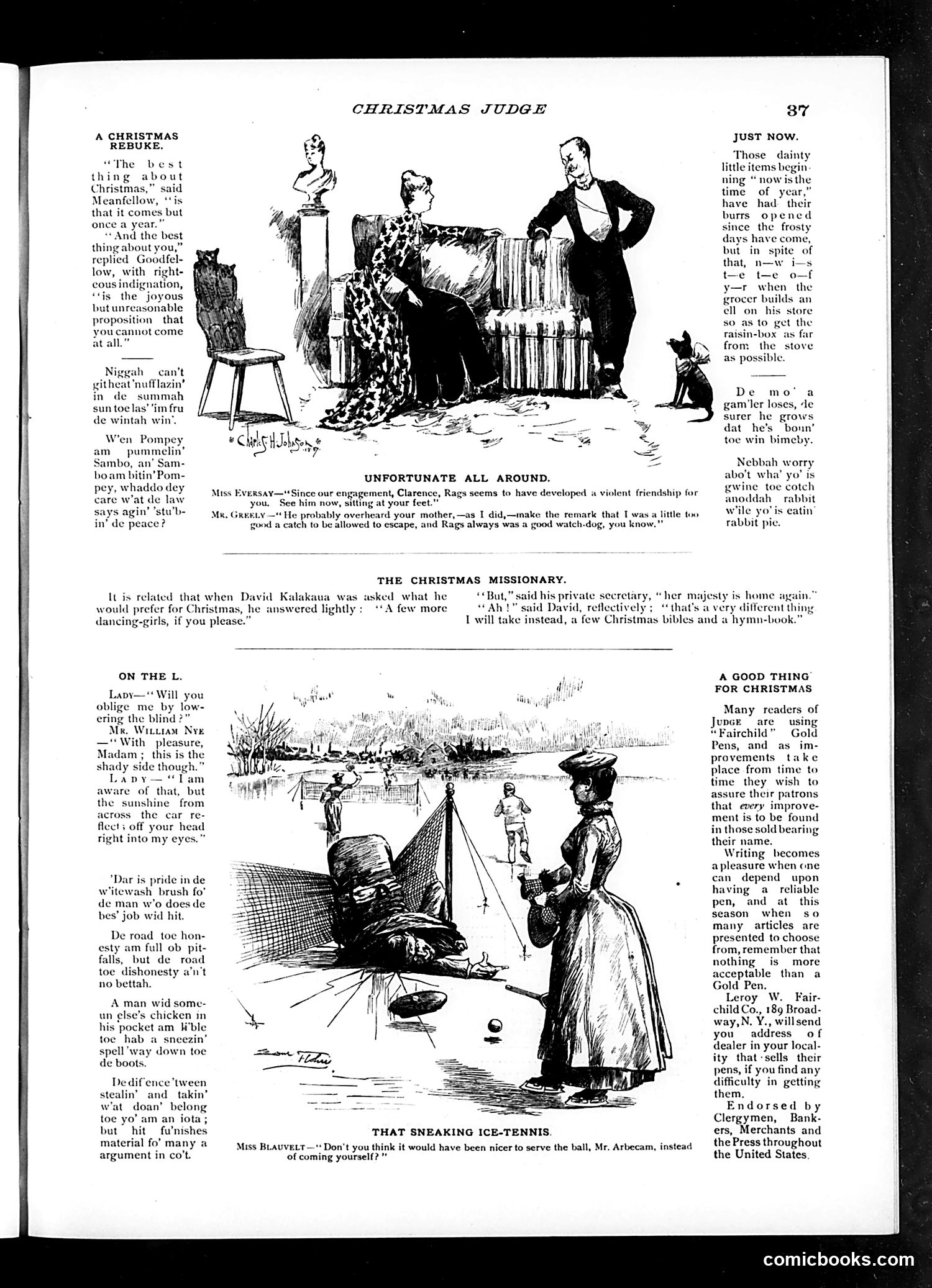
This page contains multiple cartoons and humor pieces typical of late-19th-century American satire: **"Unfortunate All Around"** depicts a couple with their dog Rags between them. The joke hinges on the woman's concern that the dog dislikes her fiancé, but the man reveals the dog overheard the woman's mother say he was "too good a catch to escape"—so the dog guards him protectively, treating him as valuable property to watch. **"The Christmas Missionary"** references Hawaiian King David Kalakaua, playing on American attitudes toward foreign royalty and Christian missionary work in the Pacific. **"On the L"** and the other brief comic exchanges use dialect humor and wordplay common to the era, including problematic racial stereotypes in phonetic "dialect" writing that was standard in period humor. **"That Sneaking Ice-Tennis"** jokes about improper behavior during a lawn tennis match—the man apparently charged at the woman rather than properly serving the ball. The page also includes an advertisement for Leroy W. Fairchild Co.'s Gold Pens, marketed as reliable Christmas gifts.
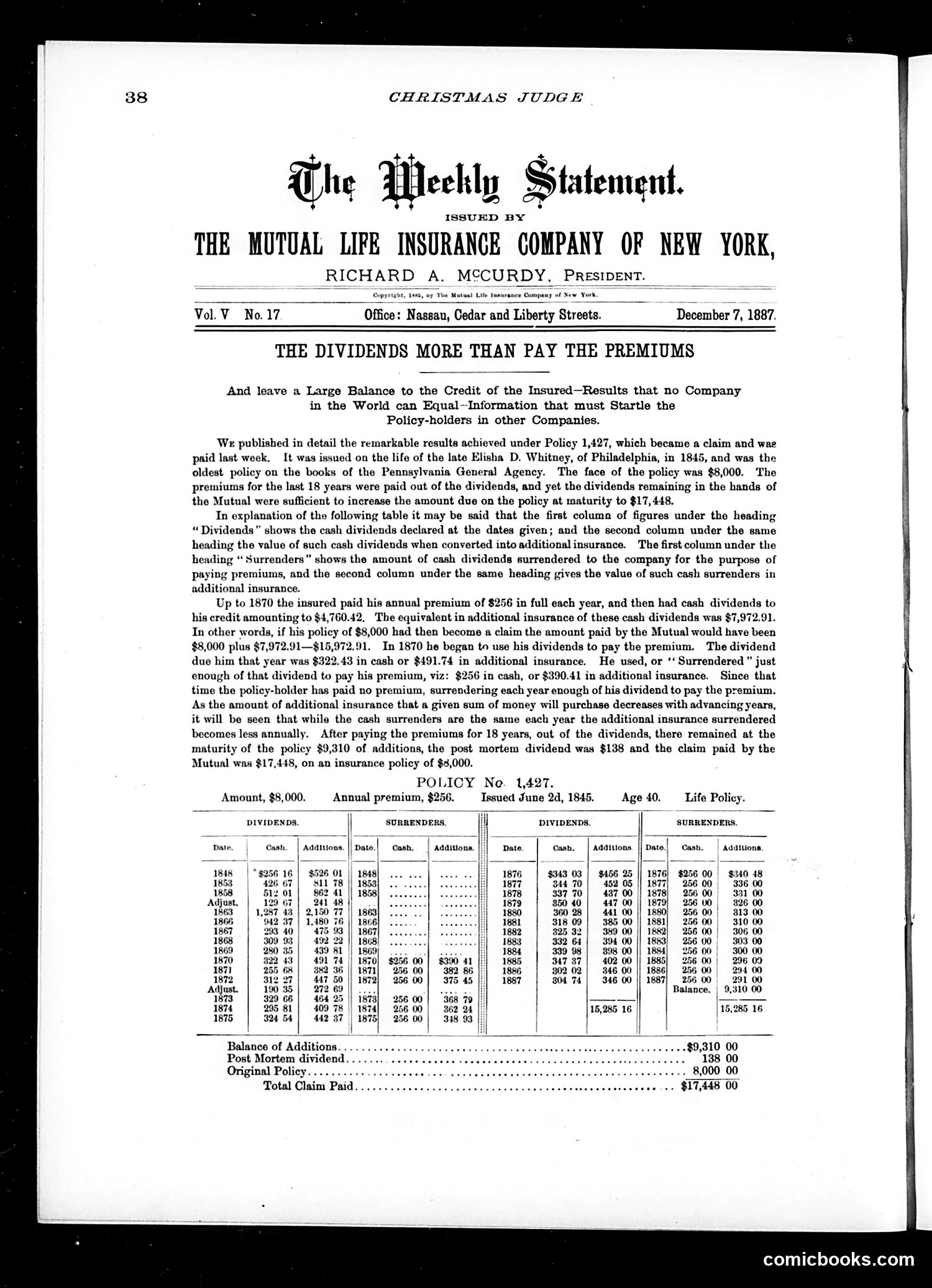
This is **not a cartoon or satire**—it's a paid advertisement disguised as editorial content in Judge magazine. The Mutual Life Insurance Company of New York used the Christmas issue to promote their products by publishing detailed financial records of Policy No. 1,427. The advertisement showcases a specific policyholder (Elisha D. Whitney, deceased) whose $8,000 life insurance policy matured at $17,448—more than double the original amount. The pitch: dividends were so generous they paid the premiums themselves after 1870, leaving the insured with a massive final payout. The satire here is subtle: Judge's editors are essentially calling out how insurance companies used such "remarkable results" as marketing tools to attract customers, while implying other companies couldn't match these claims. For 1887 readers, this represented aggressive financial advertising dressed up as news—a practice that would eventually lead to insurance industry regulation.
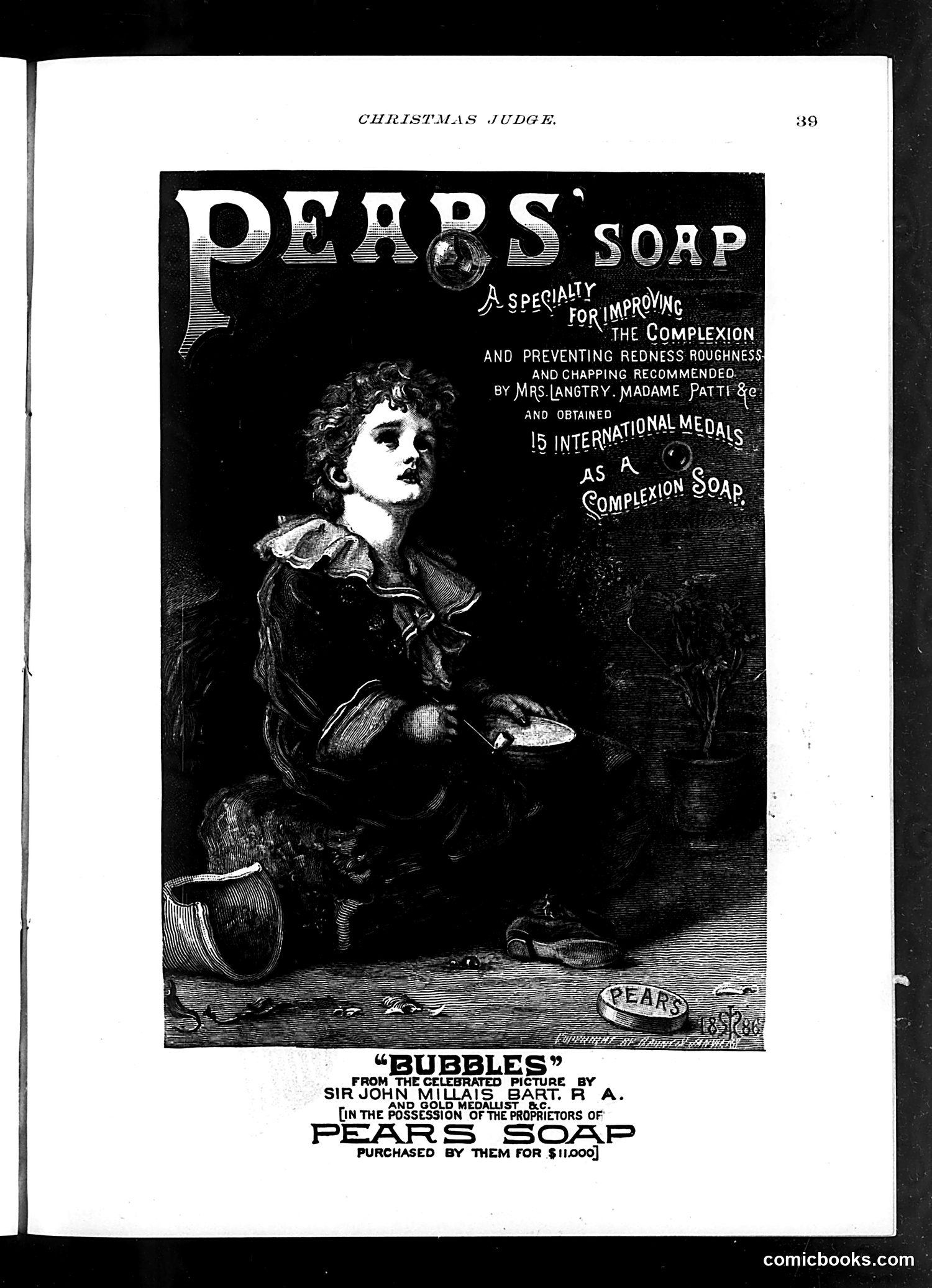
This is a **Pears Soap advertisement**, not political satire. The page reproduces "Bubbles," a famous painting by Sir John Millais, R.A., which Pears Soap's proprietors purchased for $11,000. The ad claims the soap improves complexion and prevents roughness and chapping, endorsed by Mrs. Langtry and Madame Patti (both celebrities of the era). The advertisement leverages the painting's cultural prestige to sell soap—a common Victorian marketing strategy of associating luxury products with fine art. This appears in *Judge* magazine as paid advertising rather than editorial content.
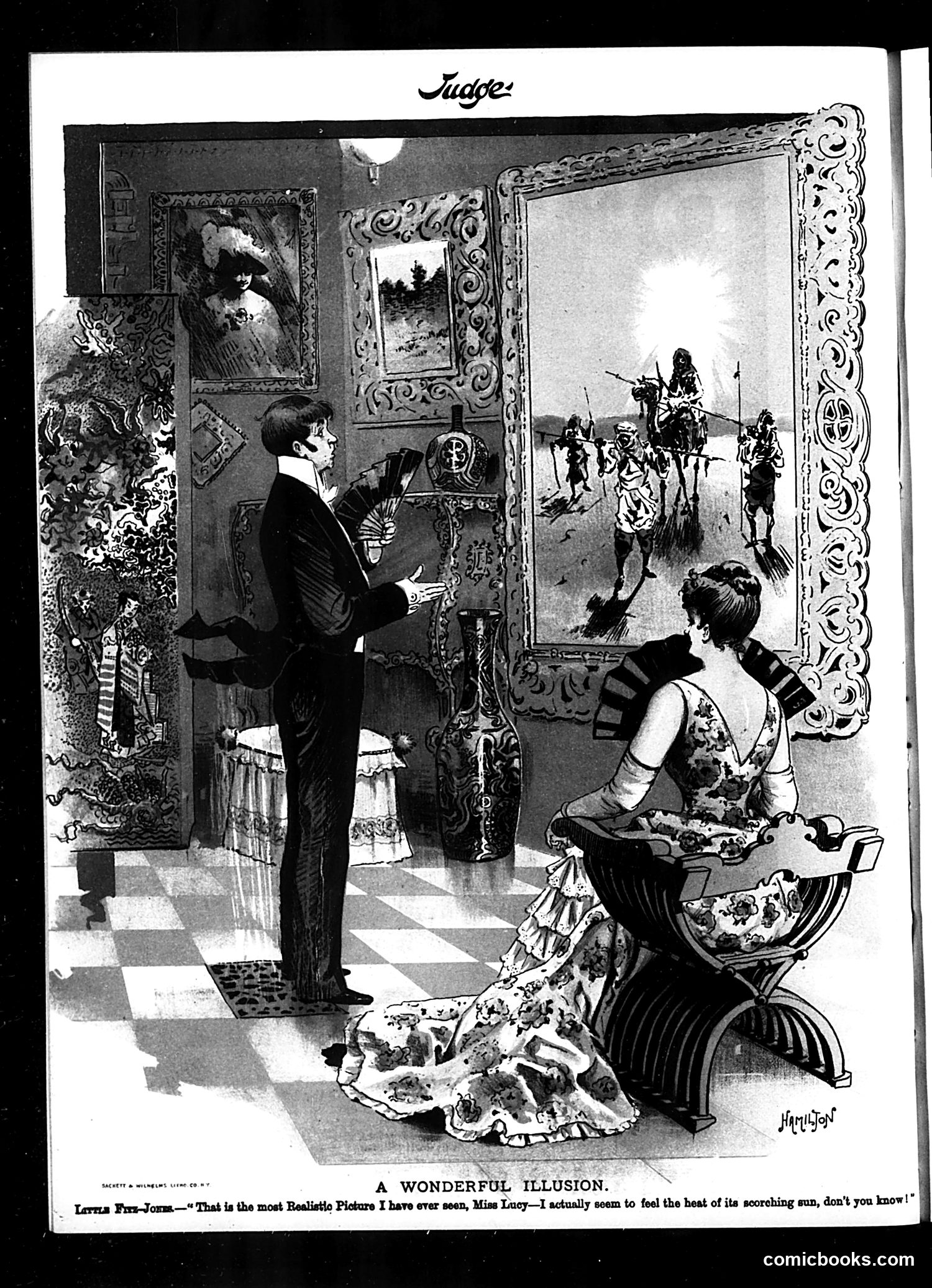
This cartoon depicts a man in formal attire admiring a large framed painting of what appears to be a desert or military scene with figures and horses. A woman sits nearby with a fan. The caption attributes the dialogue to "Lord Fitz-Jones," suggesting an aristocratic British character marveling at the painting's realism—claiming he can "feel the heat of its scorching sun." The satire targets wealthy, pretentious art patrons who are easily fooled by artwork, confusing theatrical illusion with genuine experience. The gentleman's affected amazement ("don't you know!") at a mere painting's ability to simulate heat ridicules upper-class affectation and suggests gullibility among the elite who fetishize exotic scenes. The cartoon mocks both artistic pretension and the snobbery of those who claim profound emotional reactions to fashionable art.
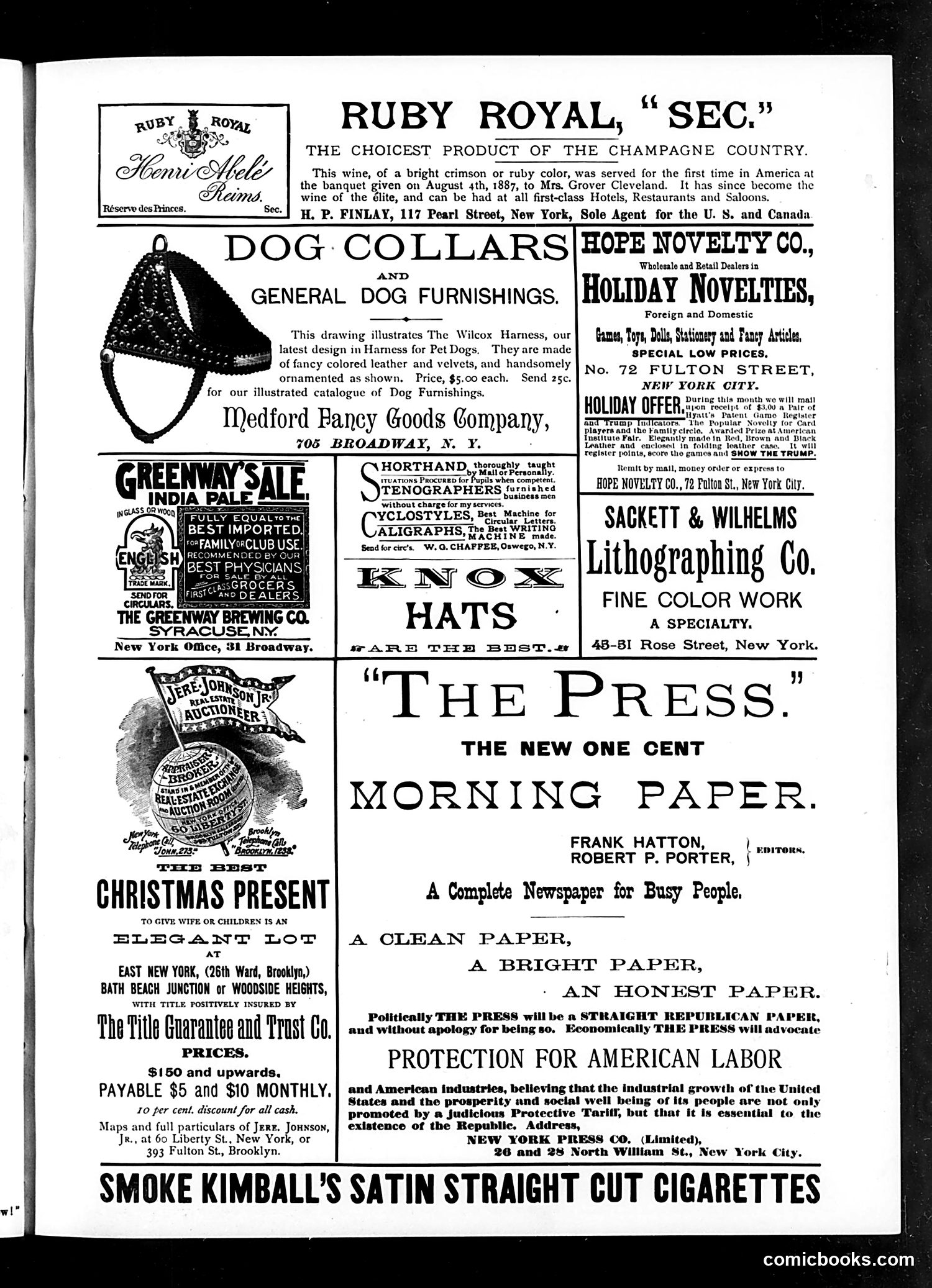
This page is primarily **advertising**, not political satire. It's a advertisements section from *Judge* magazine featuring various 1880s products and services: **Key advertisements:** - **Ruby Royal wine** — positioned as elite, served at Mrs. Grover Cleveland's 1887 banquet - **Dog collars and harnesses** — luxury pet furnishings - **Holiday novelties** — games, toys, dolls - **Real estate** — Brooklyn land sales with monthly payment plans - **The Press newspaper** — a new one-cent morning paper emphasizing Republican politics, protective tariffs, and "American labor" **Notable context:** *The Press* advertisement explicitly states it will be a "STRAIGHT REPUBLICAN PAPER" advocating protective tariffs—reflecting the pro-business, protectionist Republican platform of the 1880s-90s. The page reflects the advertising landscape and consumer culture of the Gilded Age, targeting affluent readers with luxury goods while promoting emerging mass-market products like the penny newspaper.
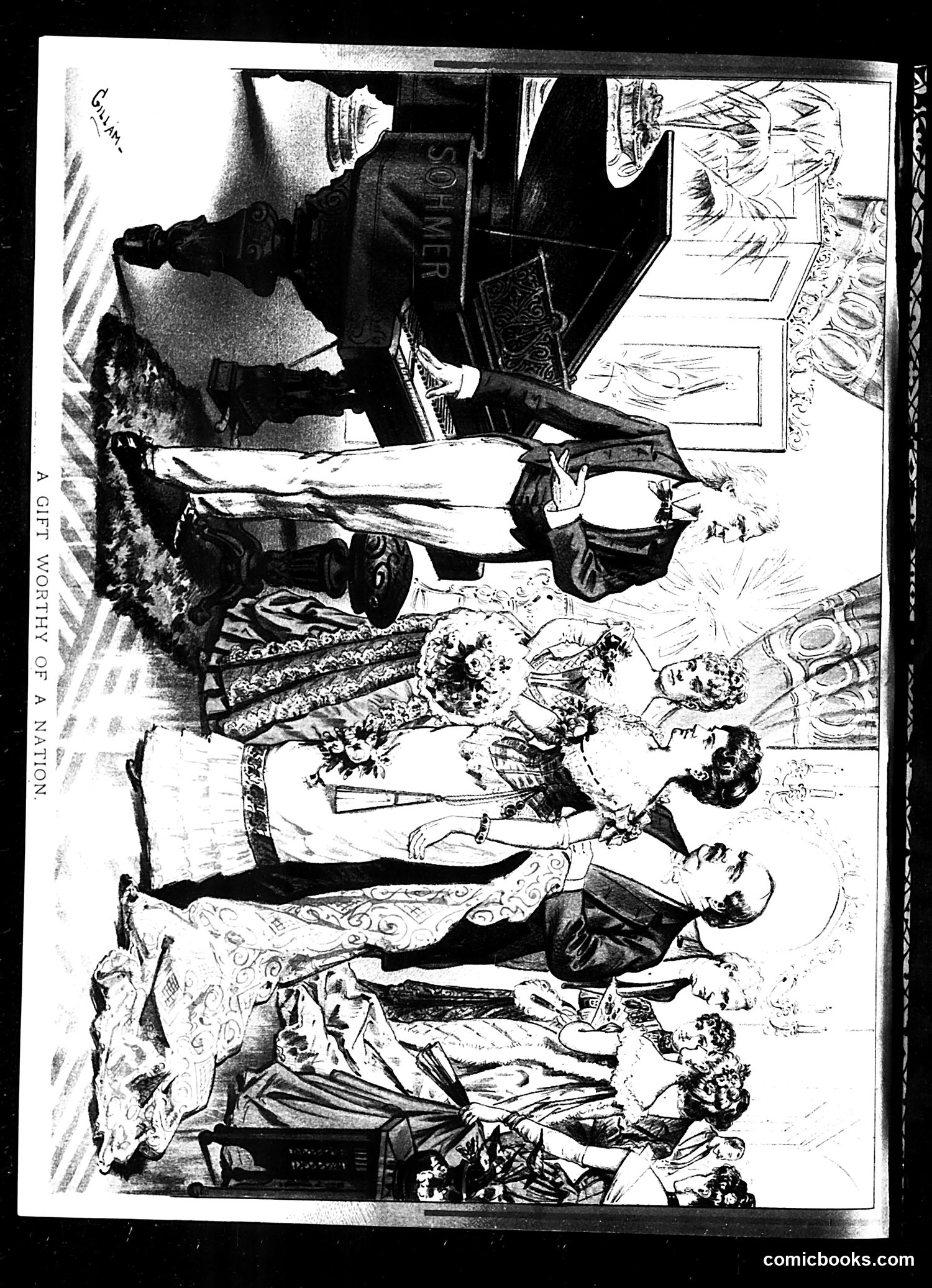
This appears to be a satirical illustration titled "A Gift Worthy of a Nation," though the specific political context is difficult to determine from the image alone. The cartoon depicts what seems to be a formal ceremony or presentation scene, with multiple figures in period dress (appearing to be late 19th or early 20th century) arranged around a central figure or object. The composition suggests commentary on national pride, patriotism, or possibly the presentation of a monument, artwork, or significant gift. The formal gathering and the title's ironic tone indicate Judge magazine is likely satirizing some contemporary political or social event—possibly mocking pretentious nationalism, wasteful government spending, or an absurd public ceremony. Without clearer visibility of specific caricatured faces or additional context clues, the exact target and full satirical meaning remain unclear from this reproduction alone.

I cannot reliably read the content of this image. The page appears to be almost entirely black or heavily degraded, with only a small portion of text visible along the left margin and "comicbooks.com" watermarked at the bottom right. While the OCR text is provided, I cannot match it to visible cartoon imagery or identify specific figures, caricatures, or satirical elements on the page itself. To properly explain this Judge magazine content to a modern reader, I would need a clearer, higher-contrast image where the actual cartoon(s) and their details are legible. I cannot responsibly speculate about political or social references without being able to see what is actually depicted.