
A complete issue · 16 pages · 1886
Judge — January 2, 1886
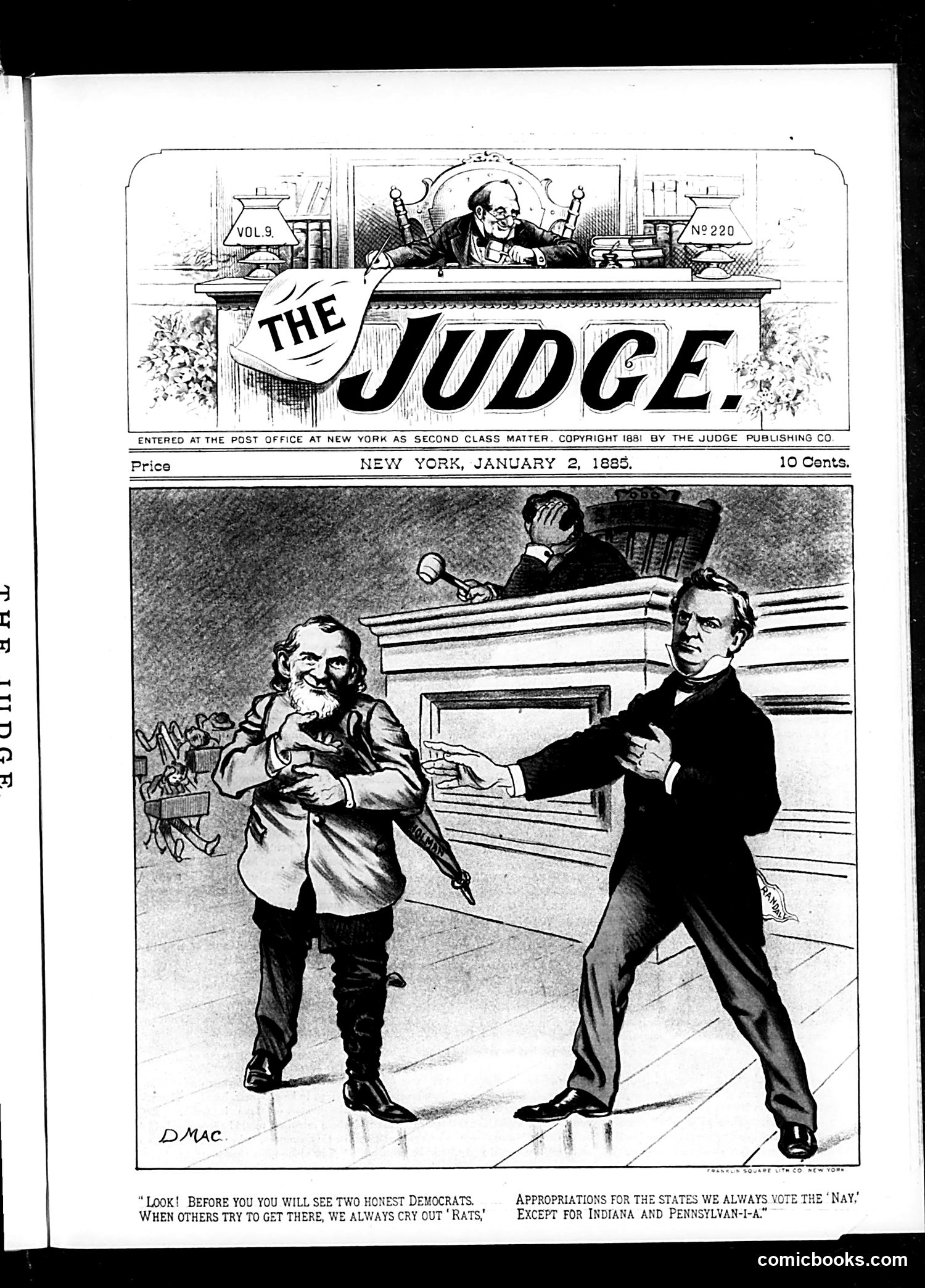
This political cartoon satirizes Democratic Party hypocrisy regarding federal spending. Two figures—labeled "honest Democrats"—argue before a judge about state appropriations. The caption mocks their selective morality: they claim to always vote "nay" on appropriations to cut costs, **except** for Indiana and Pennsylvania. The satire points out that these Democrats made exceptions for states they politically favored, contradicting their stated principle of fiscal restraint. The judge presiding suggests accountability for this inconsistency. The cartoon reflects Gilded Age partisan politics, when both parties criticized wasteful "pork barrel" spending while protecting funds benefiting their own constituencies—a practice the cartoonist suggests Democrats were particularly guilty of hypocritically.
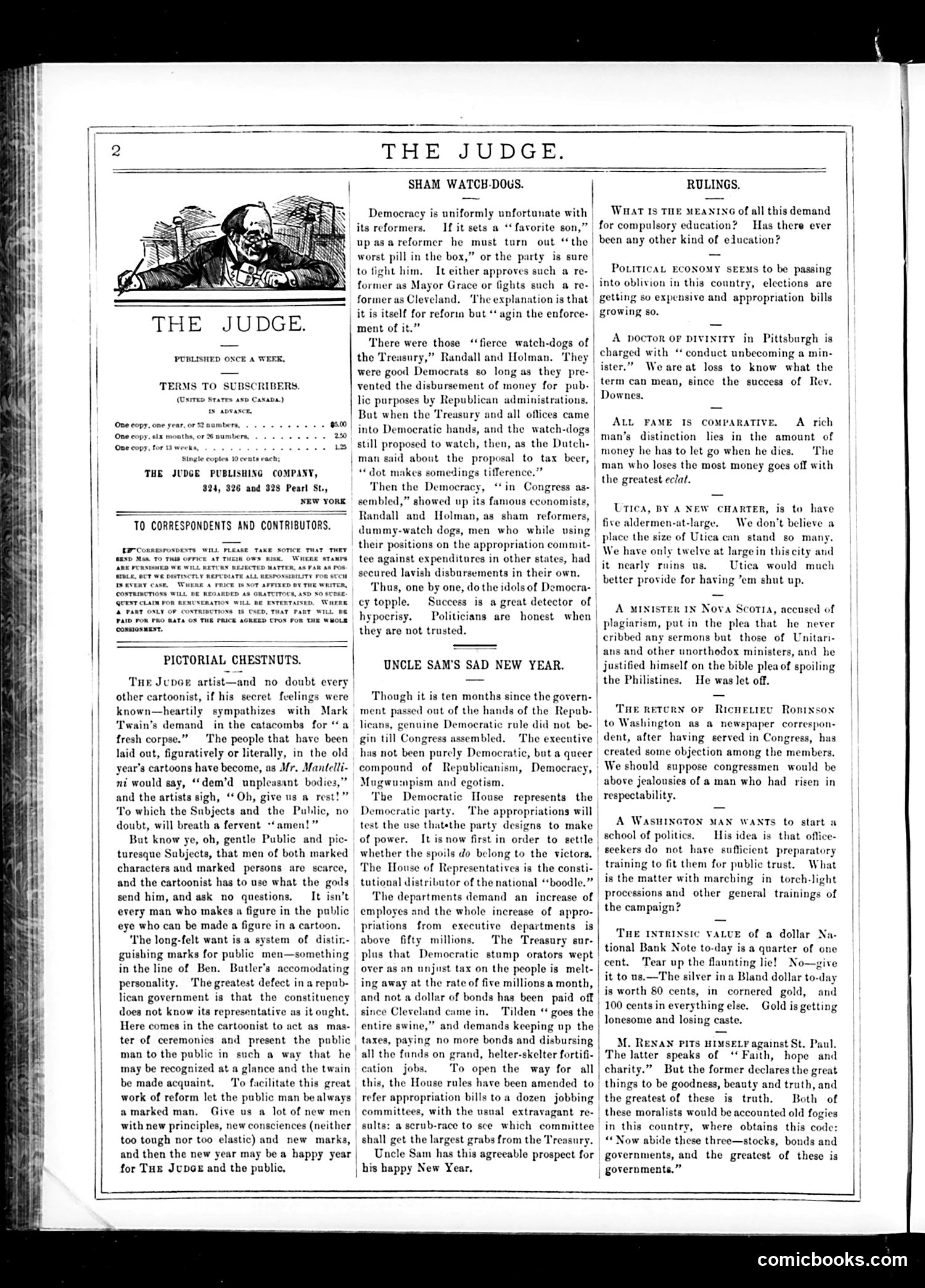
This page from *Judge* contains political commentary and satirical columns rather than illustrated cartoons. The main piece, "Sham Watch Dogs," criticizes Democratic Party reformers as hypocritical. The author argues that Democrats who campaign against corruption ("watch-dogs of the Treasury") actually enable waste when in power—comparing them to the fictional Treasury guardians Randall and Holman who failed to prevent extravagant spending. The columns labeled "Rulings" present brief satirical observations on contemporary issues: compulsory education, political economy, wealth inequality, and various minor political controversies. The tone is conservative, mocking Democratic governance and reform efforts as ineffective or self-serving. Without clearer illustrations or dated references, the specific figures and events remain general critiques of 1880s-era Democratic politics rather than commentary on identifiable individuals.
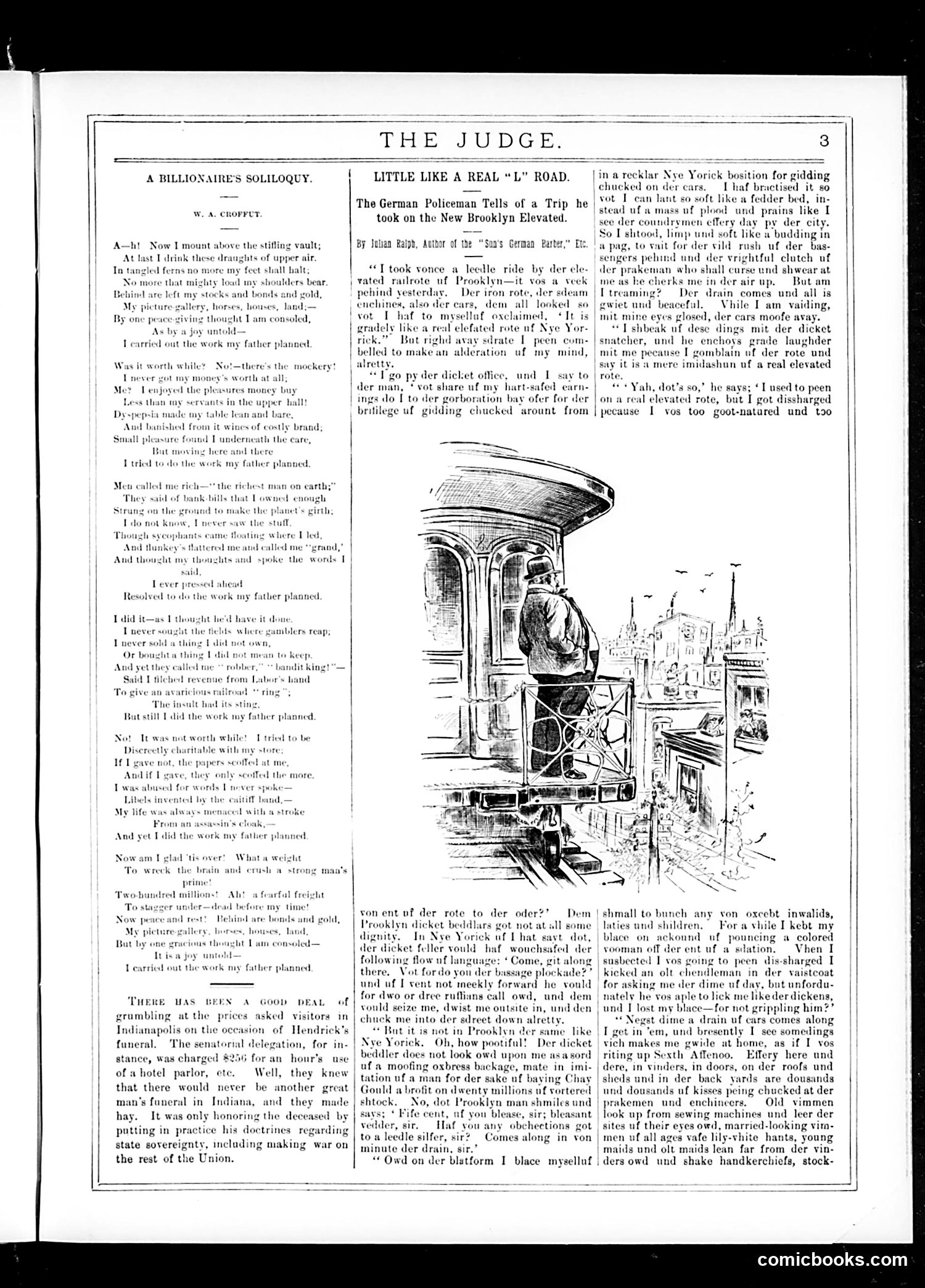
This page contains two satirical pieces from *Judge* magazine: **"A Billionaire's Soliloquy"** (left): A wealthy industrialist reflects on his life. Despite accumulating vast wealth and "doing the work my father planned," he finds himself despised—called a "bandit king" and threatened with assassination. The satire mocks the Gilded Age tycoon who, despite ruthless business practices, expects moral validation. His final consolation is simply that he's "glad it's over," suggesting the emptiness of wealth-without-virtue. **"Little Like a Real 'L' Road"** (right): A German immigrant describes riding Brooklyn's elevated railway. The humor lies in his heavily accented English and his comparison of Brooklyn's polite ticket-sellers to what he imagines would happen in New York—where he'd be violently thrown off by profit-seeking conductors. It satirizes both immigrant stereotypes and contrasts between New York's ruthless commercialism and Brooklyn's relative civility. Both pieces critique American wealth inequality and business ethics of the era.
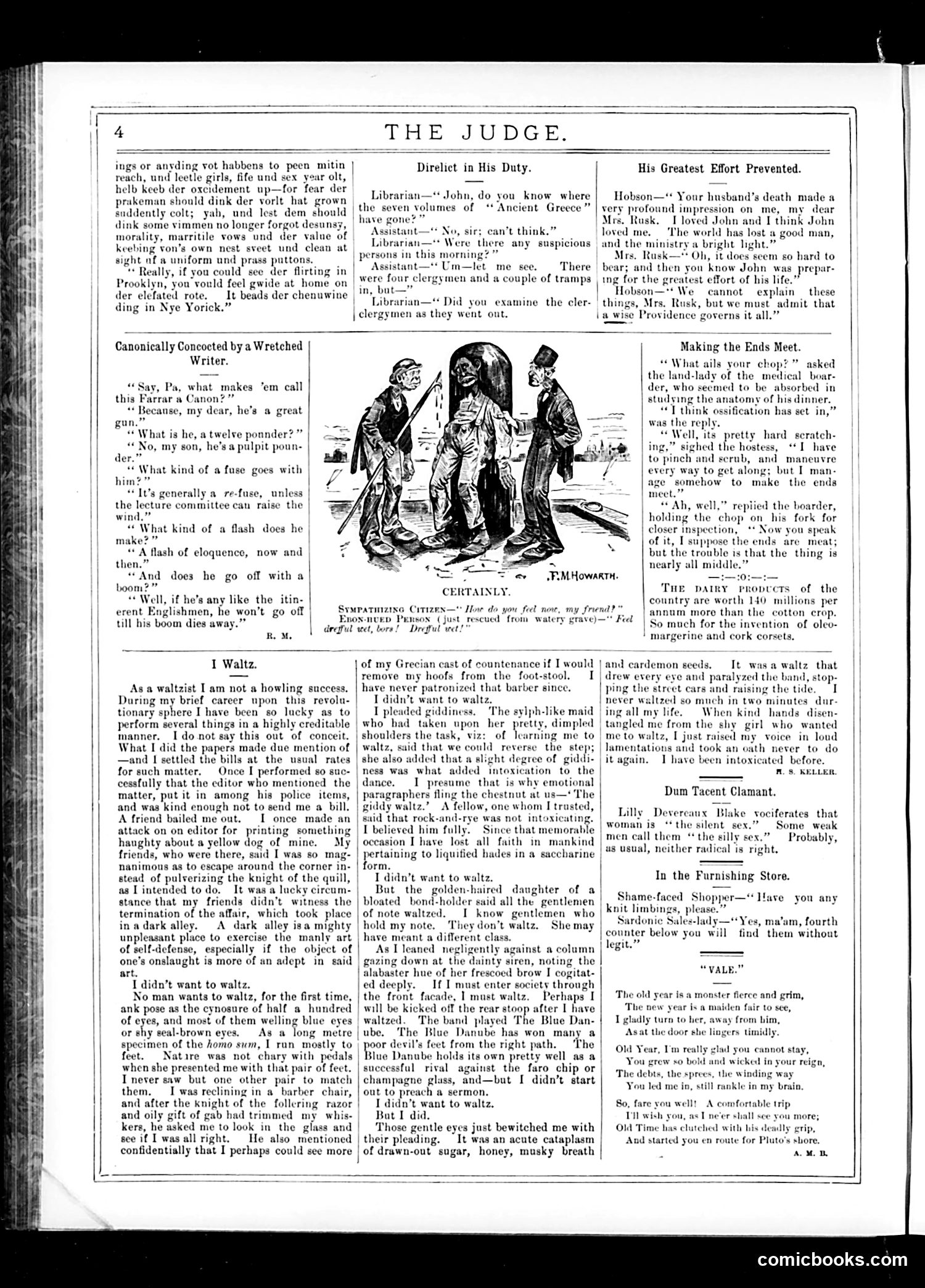
This page from the satirical magazine Judge contains several humor pieces but no single prominent political cartoon. **The main cartoon** (showing three robed figures) is titled "Certainly" and appears to be a social satire about gentlemen's intoxication and inappropriate behavior at social gatherings. The caption suggests embarrassment at public drunkenness. **The other items are primarily humorous short stories and jokes:** - **"Canonically Concocted"** mocks clergymen through puns about "pulpit pounder" sermons - **"I Waltz"** is a first-person narrative humorously describing the author's clumsiness at social dancing - Various brief satirical pieces mock immigrant speech patterns, professional incompetence, and social pretension The page reflects Judge's characteristic approach: gentle social satire targeting American manners, class distinctions, ethnic stereotypes, and professional absurdities rather than hard-hitting political commentary. The satire is whimsical rather than pointed.
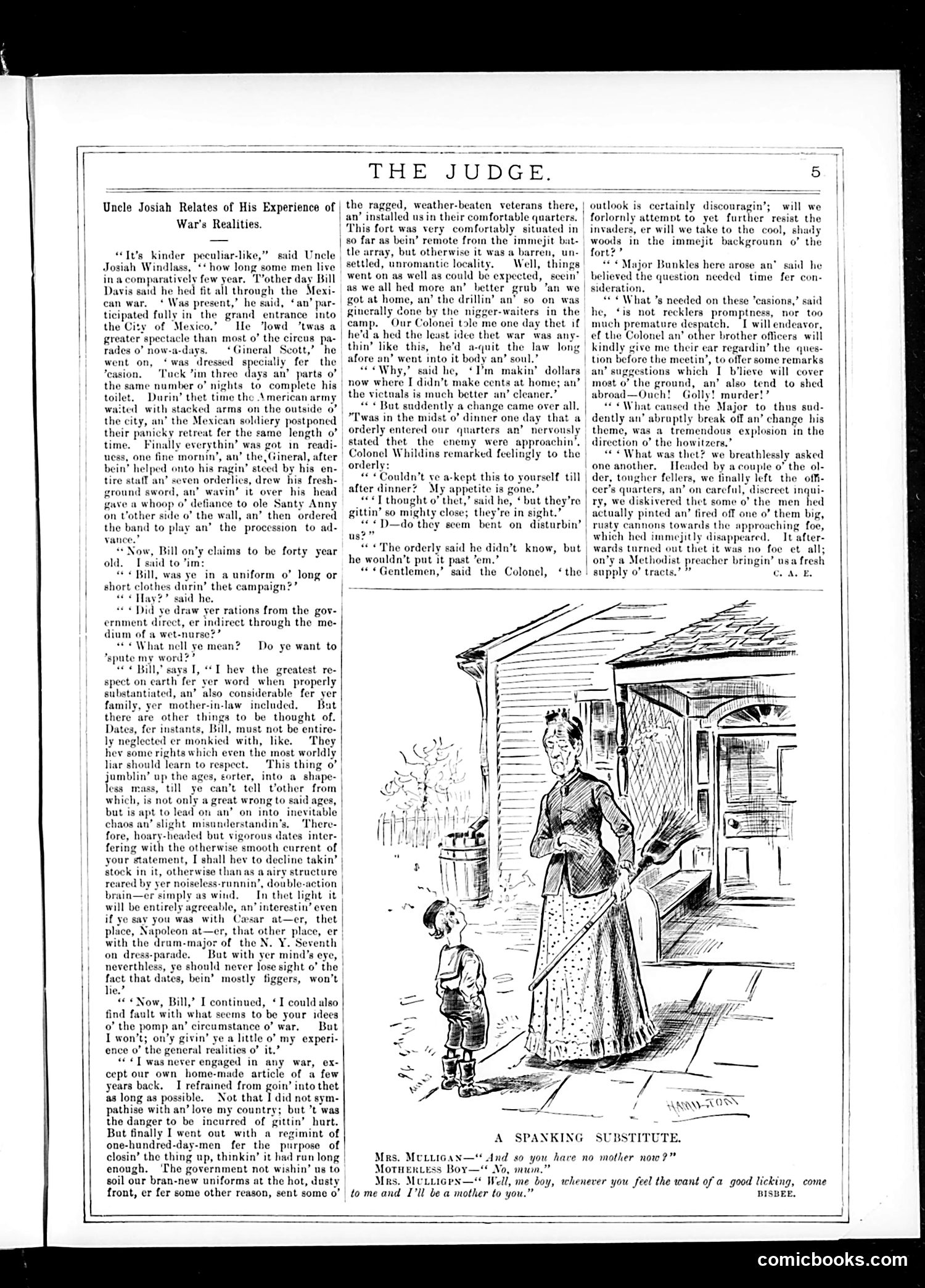
This page contains a long anecdotal story by "Uncle Josiah Windlass" satirizing exaggerated war stories and unreliable historical narratives. The humor targets men like "Bill Davis" who claim implausibly extensive military service—in this case, fighting throughout the entire Mexican-American War (1846-1848) while being young enough to only be "forty years old" at the time of publication. The satire mocks: 1. **Inflated war narratives**: Soldiers embellishing their roles and experiences 2. **Chronological impossibilities**: The absurd timeline of Bill's claimed service 3. **Loose relationship with facts**: Uncle Josiah's humorous critique of how dates and facts get "jumblin' up" in popular retellings The accompanying cartoon illustrates a domestic scene (captioned "A Spanking Substitute") where a woman threatens a misbehaving boy with calling his mother—a lighter joke about discipline. The piece reflects Judge magazine's satirical skepticism toward inflated military memoirs and the romanticization of warfare that was common in post-war American culture.
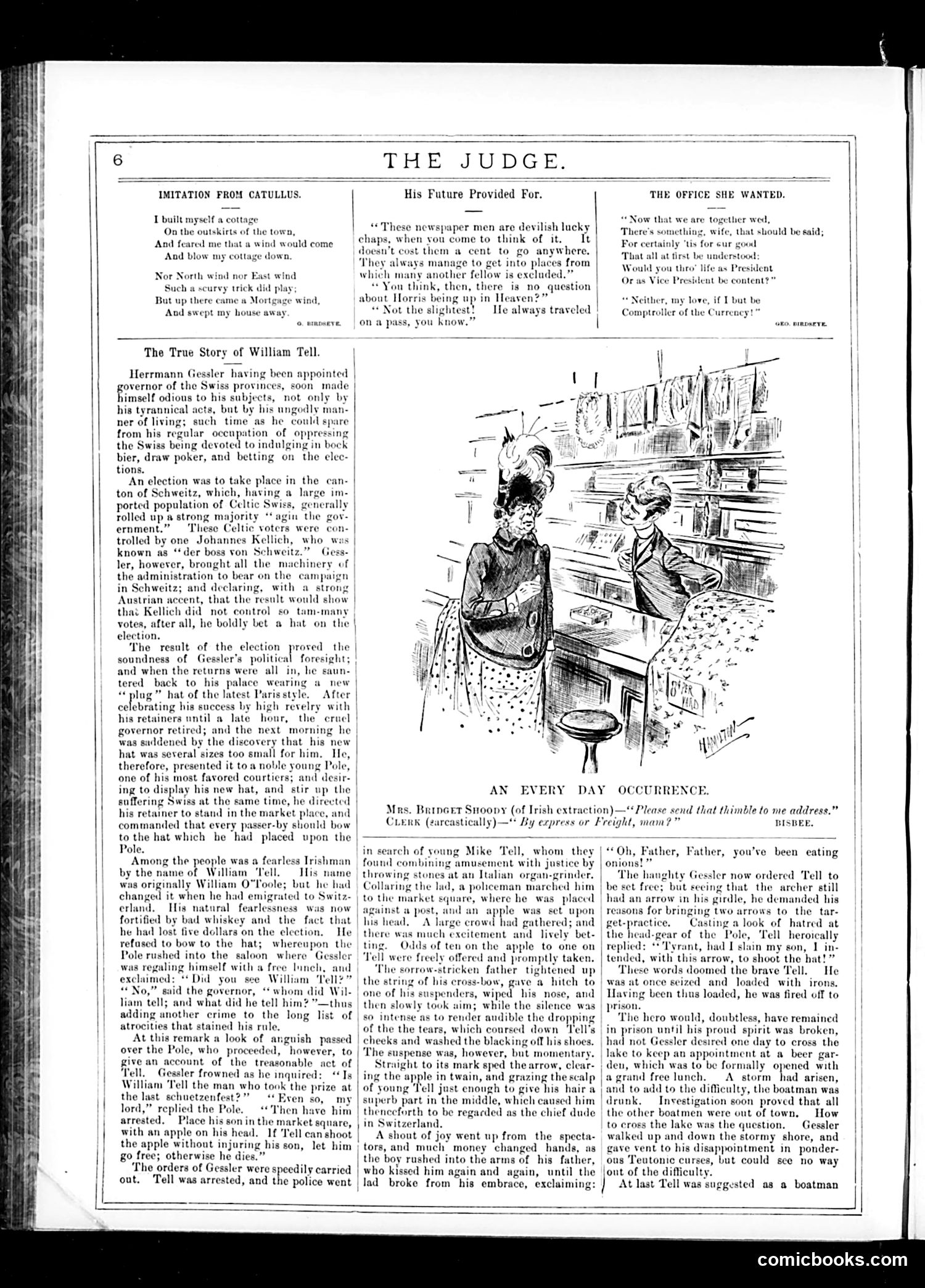
This page satirizes late 19th-century American politics through three pieces: **"Imitation from Catullus"**: A comic poem mocking working-class vulnerability—a man builds a cottage only to lose it to a mortgage. The joke targets economic precarity for ordinary citizens. **"The True Story of William Tell"**: A lengthy historical parody that transplants the Swiss legend into contemporary American electoral politics. It mocks: - Corrupt foreign governors (Gessler) using election machinery - Boss politics and ethnic voter control (the "boss von Schweit" controlling Celtic voters) - Bribery and favoritism in administration - An Irish-American protagonist (Tell/O'Toole) who challenges authority and loses financially ("lost five dollars on the election") The satire suggests American democratic systems are as corrupt and tyrannical as historical European despotism. **"An Every Day Occurrence"**: A brief sketch about a woman and clerk, apparently depicting routine urban life or commerce (text is partially cut off). The overall message critiques machine politics, corruption, and the powerlessness of ordinary citizens within rigged systems.
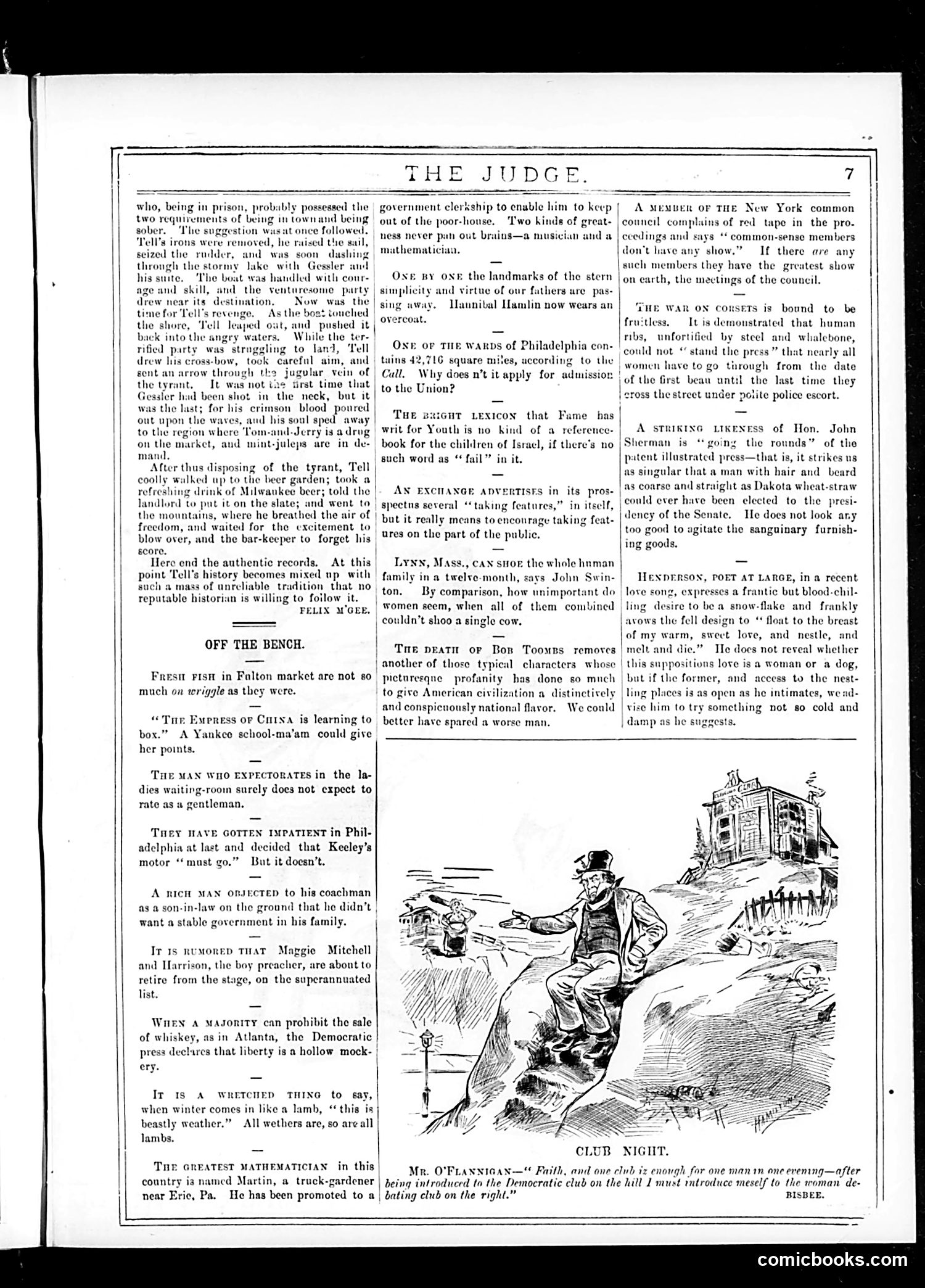
This satirical page from Judge magazine contains several unrelated editorial quips and a political cartoon titled "Club Night." The cartoon depicts a gentleman in formal attire gesturing toward what appears to be a dilapidated building, speaking to a woman. The caption attributes the quote to "Mr. O'Flanagan," who boasts that "Fifty, and one club is enough for one man in one evening—after being introduced to the Democratic club on the hill I must introduce myself to the woman debating club on the right." **The satire:** This mocks New York's proliferation of clubs and Democratic party politics of the era. The joke implies that joining the "Democratic club" was so exhausting or unpleasant an experience that the gentleman needs recovery time before attending social clubs with women. The page's other content comprises brief satirical observations on contemporary topics: references to Hannibal Hamlin (a Republican politician), Philadelphia's wards, youth and fame, and small-town matters—typical of Judge's format of quick jabs at politics, society, and public figures.
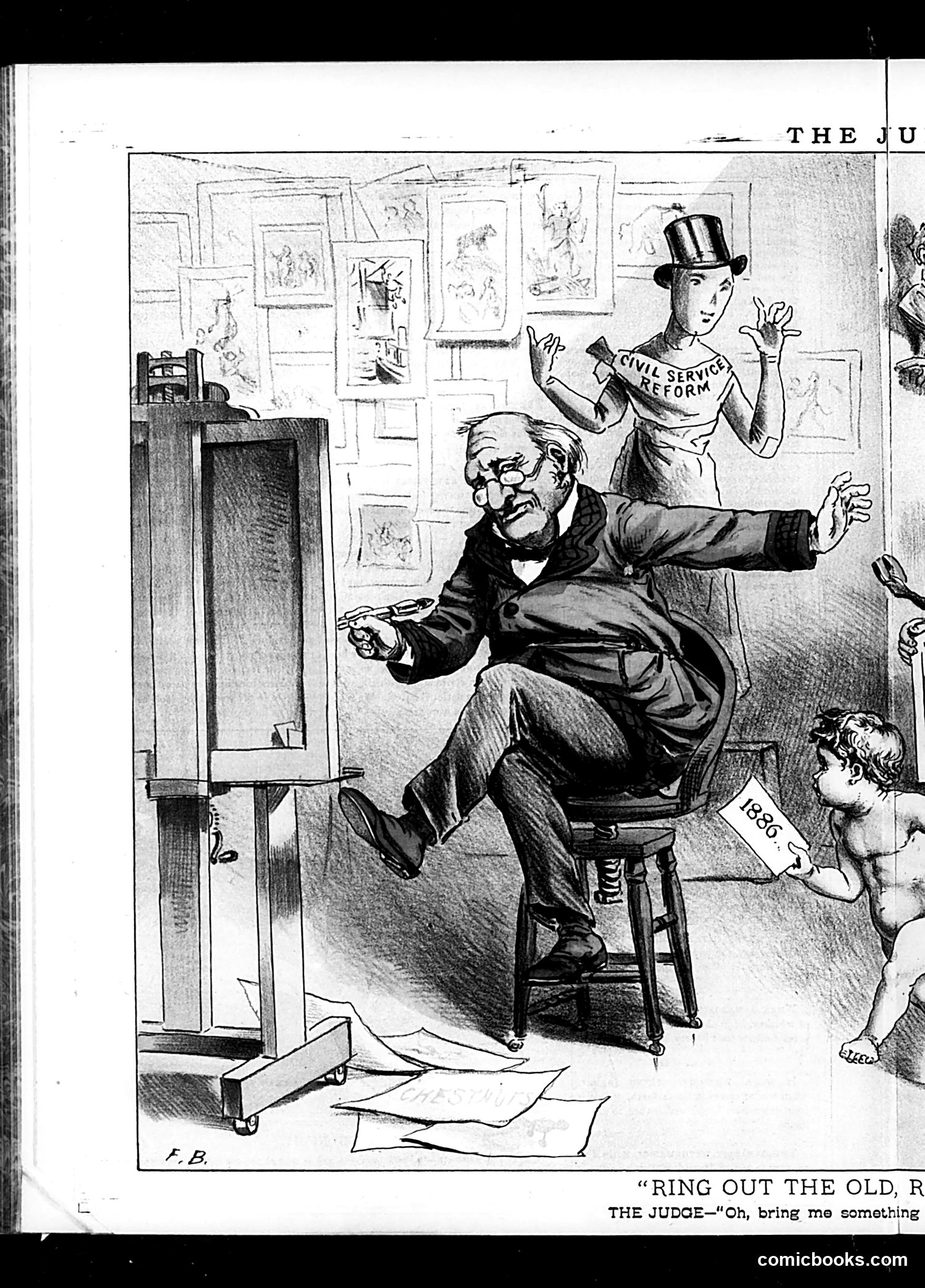
This Judge magazine cartoon satirizes civil service reform efforts. A disheveled older man sits painting at an easel labeled "1856," while a figure in a top hat (labeled "Civil Service Reform") stands behind him gesturing dramatically. The caption reads "Ring Out the Old, Ring in the New," with "The Judge" responding "Oh, bring me something better." The cartoon mocks reform advocates by suggesting they're merely recycling old ideas from 1856 rather than offering genuinely new solutions. The painter represents outdated political thinking; the well-dressed reform figure appears ineffectual or hypocritical. The satire criticizes civil service reformers as superficial modernizers unable to deliver substantive change—a common critique of Progressive Era reform movements that promised transformation but delivered incremental adjustments.
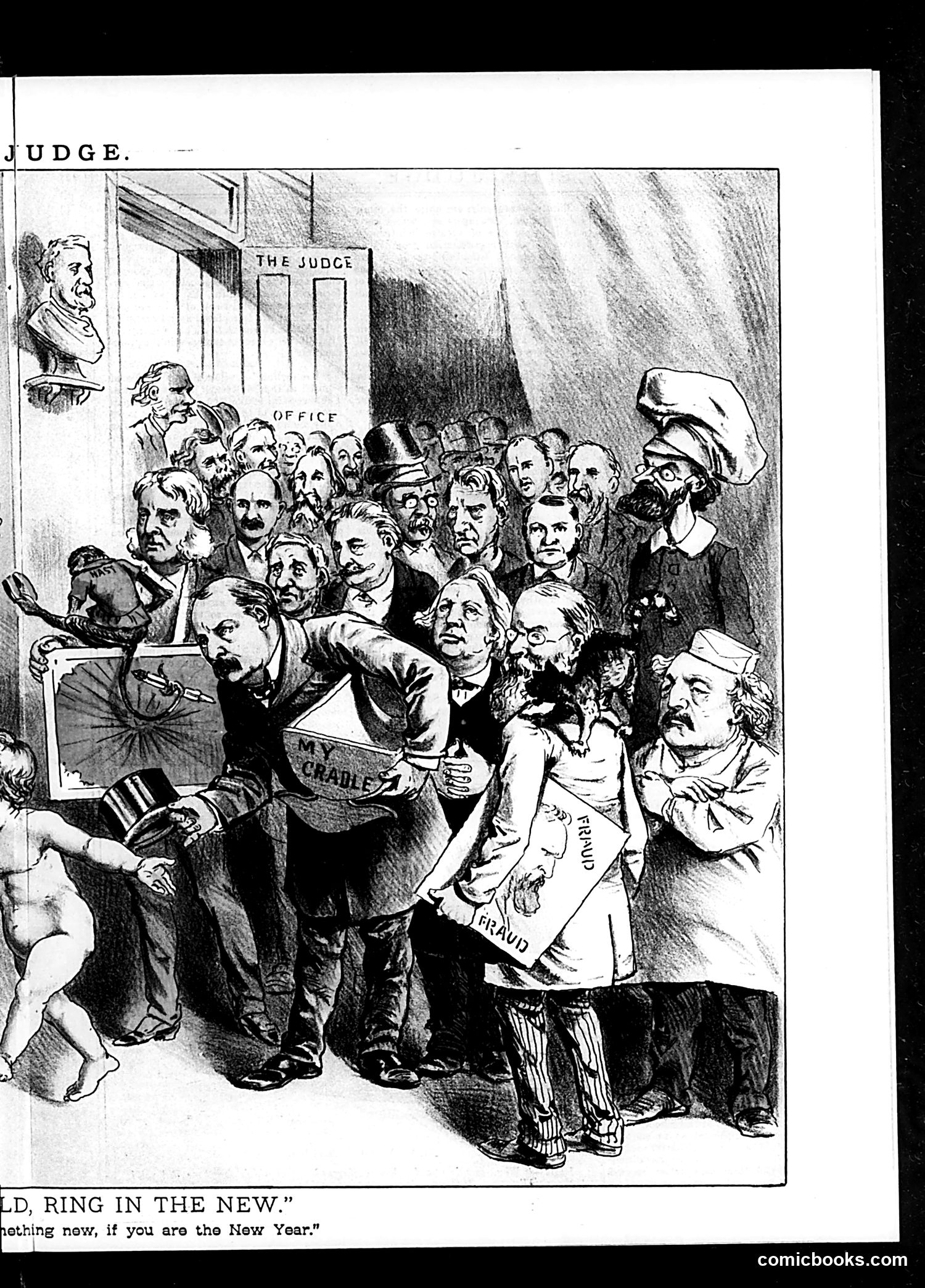
This political cartoon depicts a crowded scene outside "The Judge" office, with various figures carrying papers labeled "FRAUD" waiting to see the judge. The title references "ring in the new," suggesting commentary on the arrival of a new year or new administration. The satire appears to criticize widespread fraud or corruption—possibly involving politicians, businessmen, or public figures of the era—all seeking judicial attention simultaneously. The visual metaphor of a queue at the judge's office suggests systemic corruption requiring legal intervention. The cartoon's exact historical moment is unclear from this excerpt, but it typifies Judge magazine's role satirizing American political and social scandals through crowded, allegorical scenes. The specific frauds referenced remain uncertain without additional context.
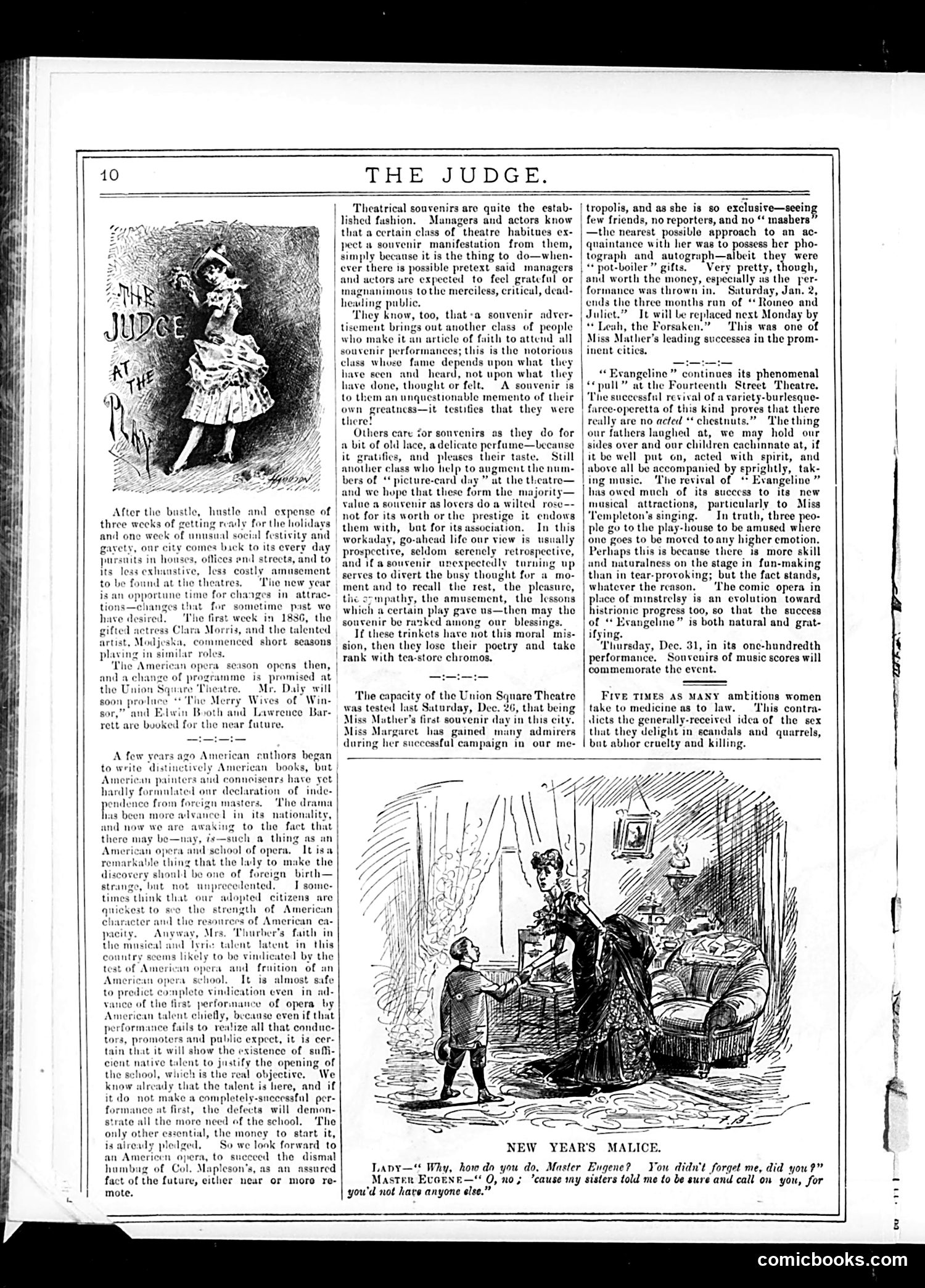
This page from *Judge* magazine contains theatrical commentary and a cartoon titled "New Year's Malice." **Main Content:** The lengthy article discusses theatrical souvenirs—programs, photographs, and trinkets distributed at performances. The writer satirizes different audience types: social climbers who attend solely to say they were there; people seeking tangible "proof" of their cultural participation; and genuinely nostalgic patrons. The piece mocks the "merciless, critical, dead-heading public" (free ticket holders) who expect theaters to provide souvenirs as gratitude. **The Cartoon:** The small illustration titled "New Year's Malice" depicts a scene between a lady and "Master Eugene." The lady asks if he forgot her, feigning hurt. Eugene responds that his sisters told him to be "sure and call on you, for you'd not have anyone else." This is a cruel New Year's joke—the implication is that the lady has no other callers, making her so undesirable that even children were told to visit her out of pity. **Satire Target:** Social pretension and the superficiality of theater culture; also gentle mockery of social embarrassment and New Year's courtesies.
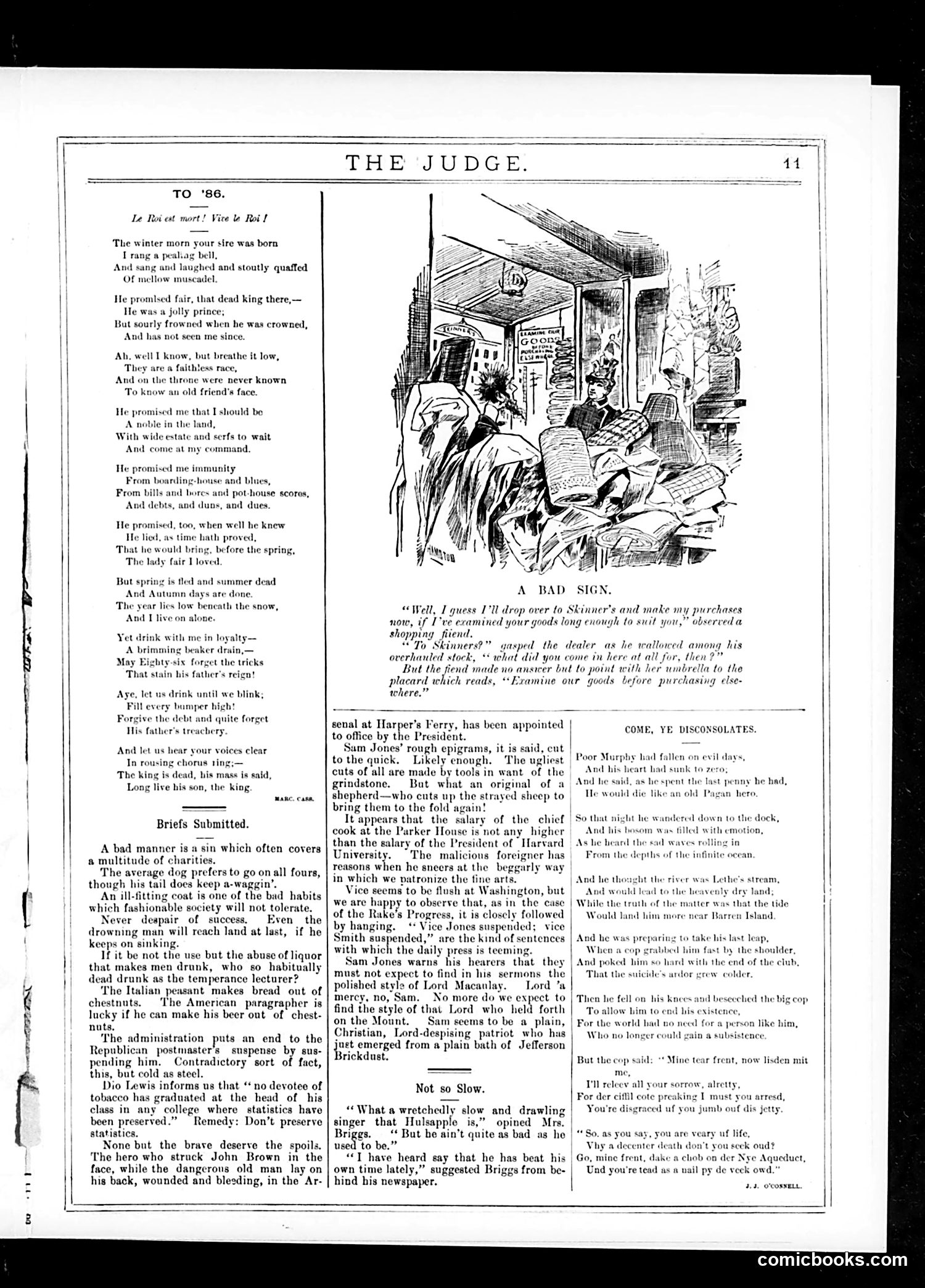
This page from Judge magazine (likely 1880s, based on "TO '86" reference) contains multiple satirical pieces: **Main Cartoon ("A Bad Sign"):** A shopkeeper sarcastically questions a customer who examines goods extensively before purchasing elsewhere—mocking those who waste merchants' time without buying. **Political References:** - "Sam Jones" appointment to Harper's Ferry position by the President—likely satirizing patronage politics and an unqualified appointee - Commentary on salary disparities (Parker House cook vs. Harvard president's salary) - References to "John Brown" suggest Civil War-era tensions still relevant to 1880s discourse **"Briefs Submitted":** Short satirical quips on various social topics—bad manners, temperance hypocrisy, Italian immigrants, tobacco use, and political appointments. **Poetry Sections:** Romantic verses about broken promises from a deceased ruler to a loyal follower, and another about a fallen man named Murphy. The page exemplifies Judge's typical format: biting social/political commentary mixed with lighter humor targeting contemporary American society, morals, and politics.
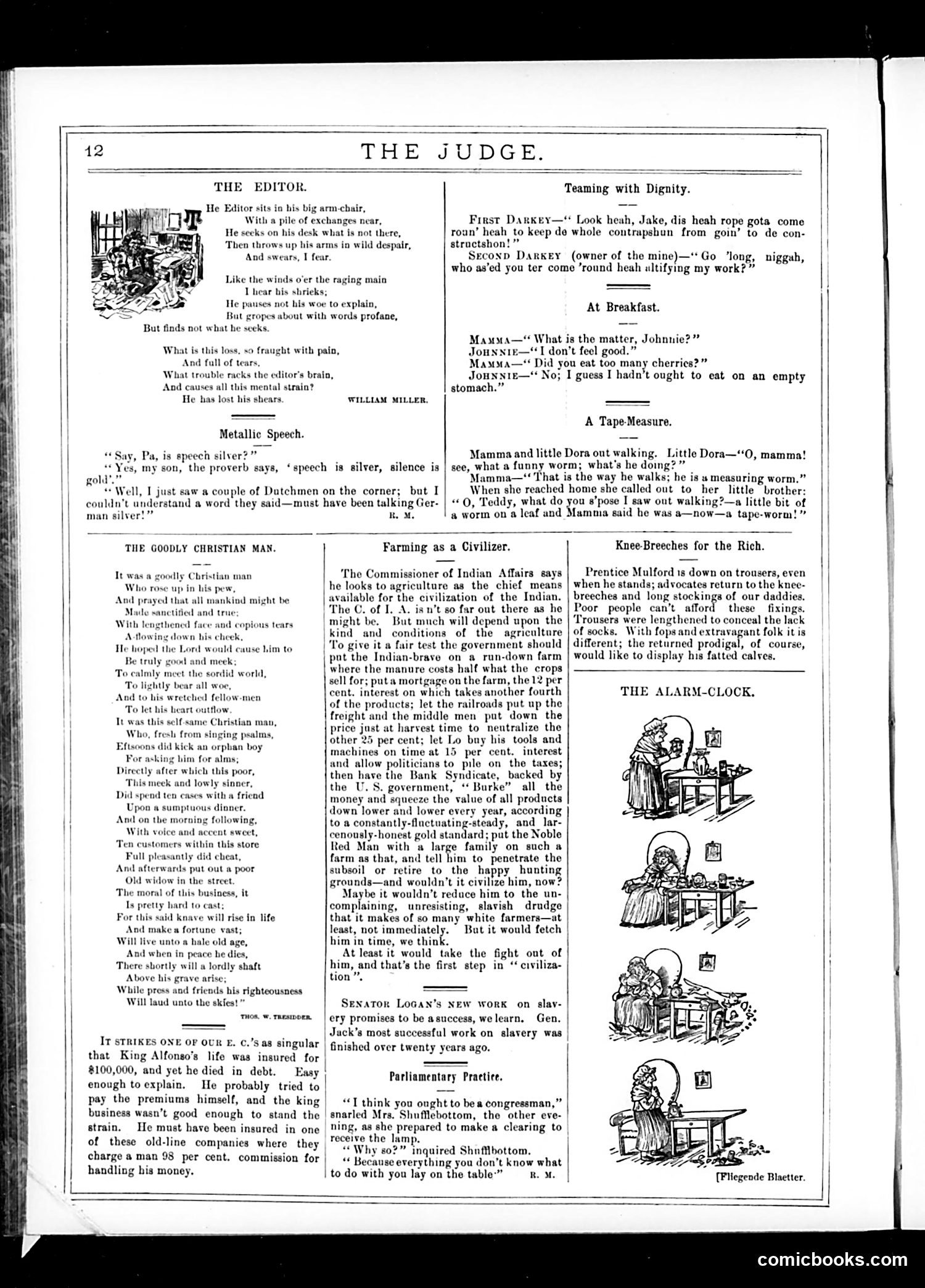
This page contains several humorous short pieces typical of 1880s-90s satirical magazines: **"The Editor"** mocks the chaos of editorial work through verse about a frantic editor who's lost his scissors. **"Metallic Speech"** is a pun joke: a child misunderstands the proverb "speech is silver, silence is gold" by calling incomprehensible German "German silver." **"Teaming with Dignity"** and **"At Breakfast"** are brief domestic humor pieces with no clear political content. **"The Goodly Christian Man"** is social satire attacking hypocrisy—contrasting a wealthy man's pious church prayers with his actual cruelty to the poor and orphans, ending with dark irony that such hypocrites prosper anyway. **"Farming as a Civilizer"** critiques government Indian policy, sarcastically suggesting the Commissioner's agricultural plan would only work if Native Americans weren't subjected to exploitative debt and mortgage conditions. The page also includes illustrations of an alarm clock and several small satirical vignettes. Overall, it reflects Judge's focus on social hypocrisy and government policy criticism.
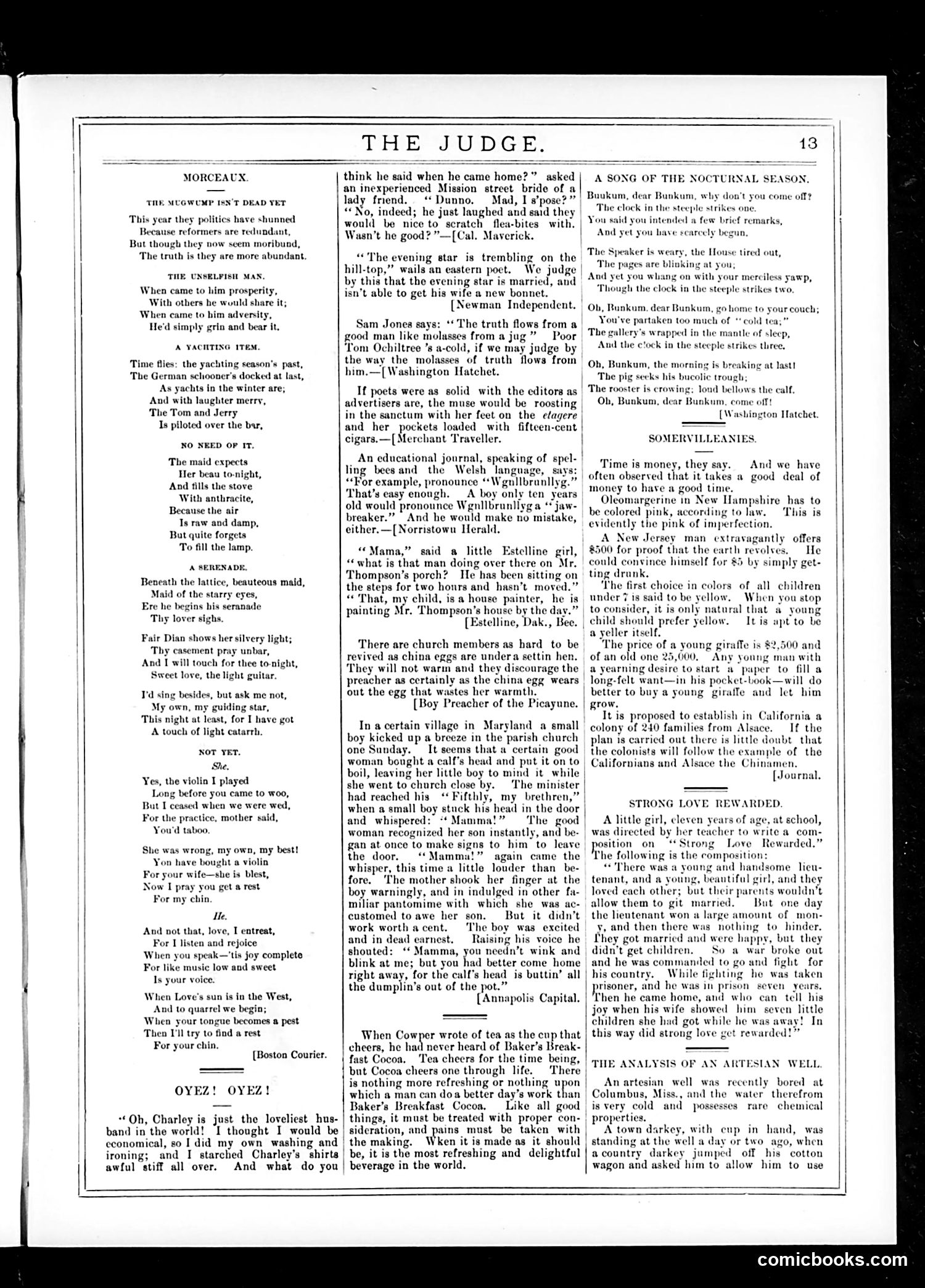
This page from **Judge** (a late 19th-century American satirical weekly) contains primarily **humorous verse and short comic pieces** rather than visual cartoons. Key items include: **"The Mugwump Isn't Dead Yet"** — A jab at **Mugwumps** (reform-minded Republicans who broke party ranks), suggesting they claim moral superiority while remaining politically irrelevant. **"Oyez! Oyez!"** — A domestic humor piece about a newlywed's naive mistake starching her husband's shirts stiffly, showing era-typical attitudes toward housewives and marriage. **Various satirical quips** mock: Eastern poets' pretentious romanticism, preacher Sam Jones's moralism, Welsh language pronunciation, and hypocritical church members. The **tone is lighthearted mockery** of contemporary social types—reformers, newlyweds, clergymen, and pretentious writers. These were Judge's stock subjects for middle-class readers seeking gentle ridicule of society's foibles and absurdities.
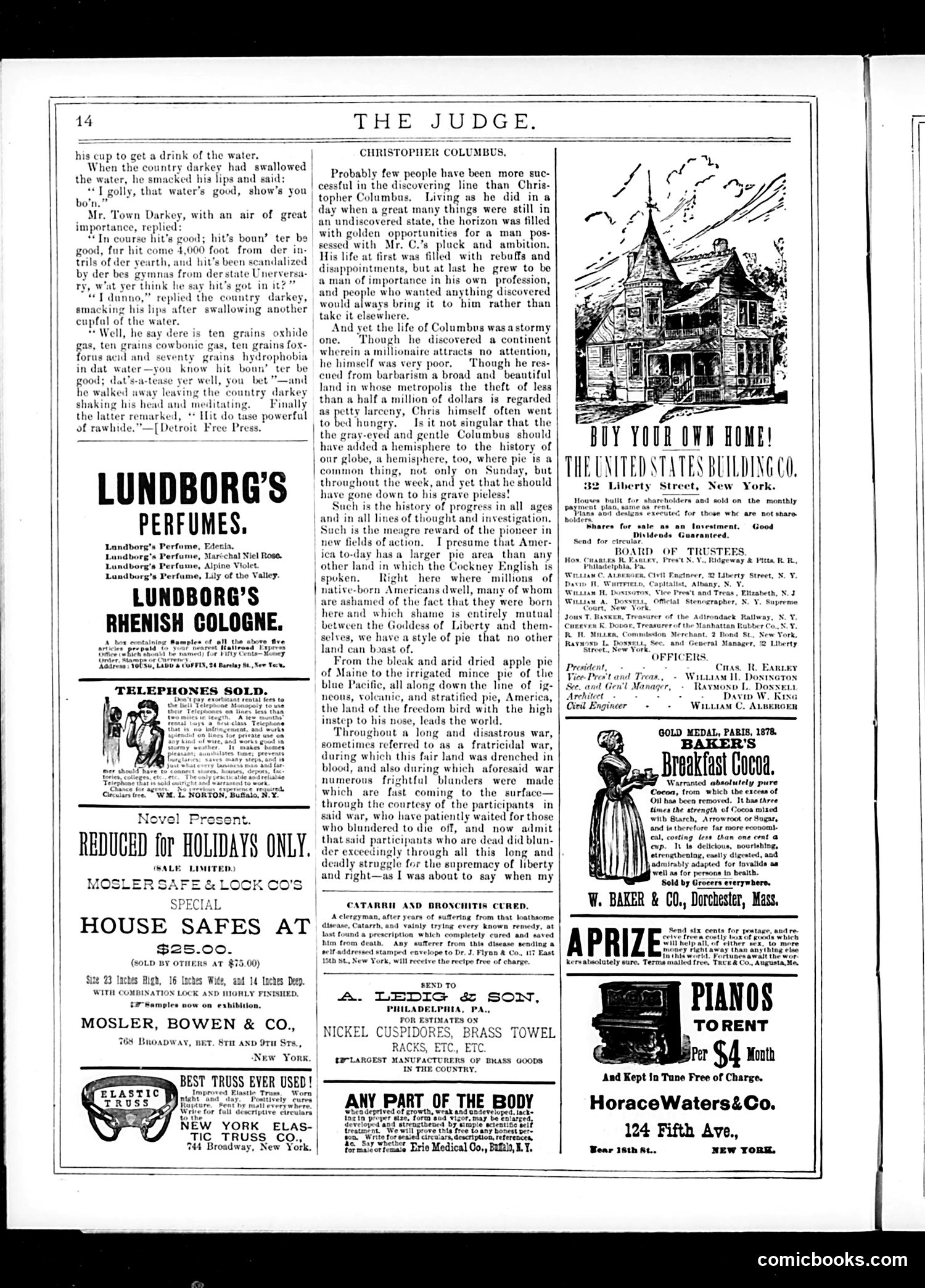
This page is primarily **advertisements with one satirical article** about Christopher Columbus. The main content is a humorous essay titled "CHRISTOPHER COLUMBUS" that ironically praises Columbus for his "discovering" talents, then pivots to mock American materialism and excess. The joke: Columbus discovered a continent and died poor, yet America—the land he "discovered"—is obsessed with pie. The author sarcastically catalogs American pie varieties ("dried apple pie," "mince pie") as evidence of national abundance and freedom, suggesting Americans' priorities are absurdly focused on consumption rather than honoring history. The piece also references a recent "fratricidal war" (likely the Civil War) and governmental "blunders" being exposed post-war, mocking both American politics and American smugness about superiority. The bulk of the page consists of period advertisements for perfumes, safes, trusses, pianos, and other products—typical of Judge's revenue model. A short anecdote about a "country darkey" dialect joke appears at the top (reflecting era-typical racial humor standards).
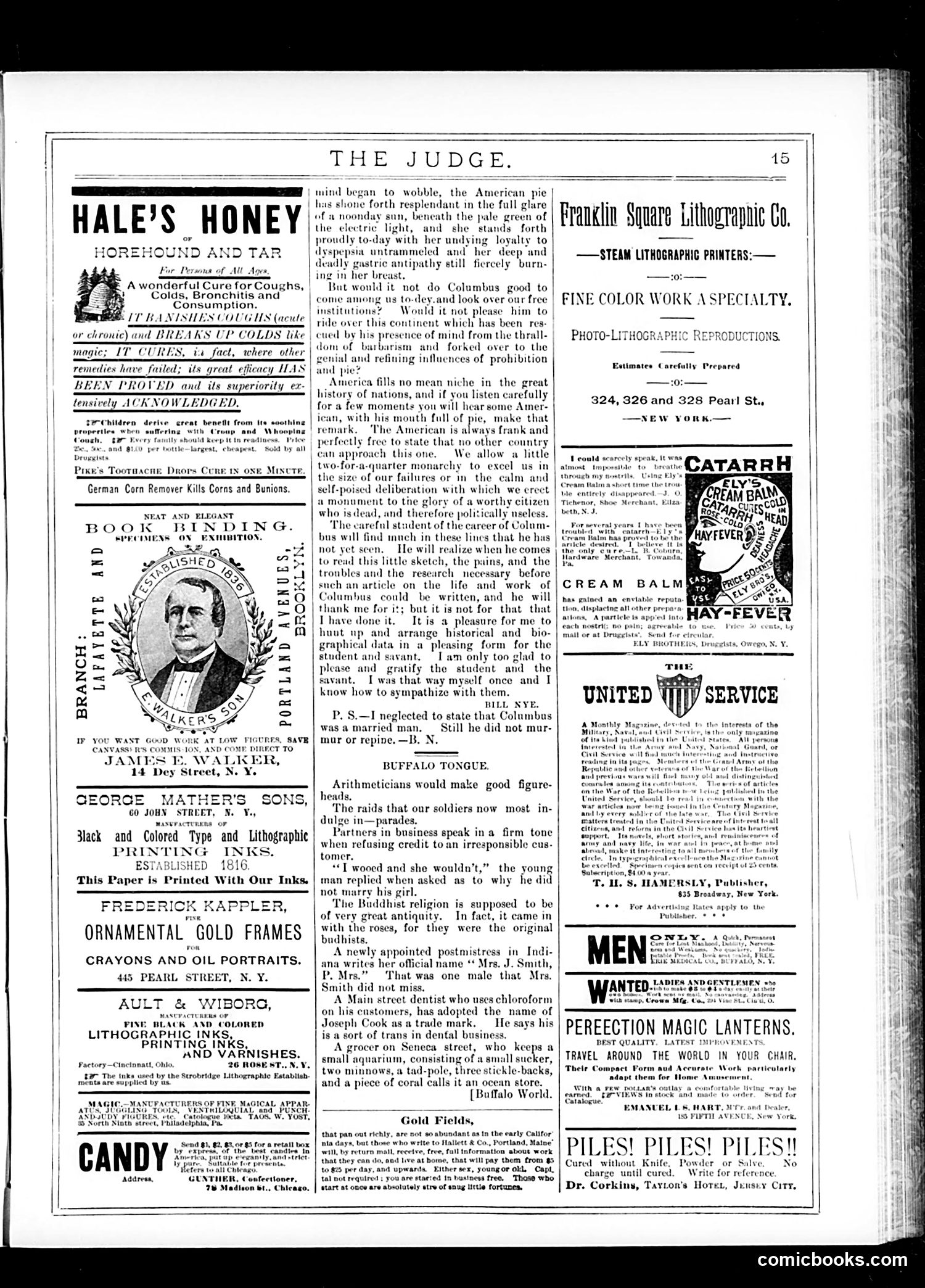
This is primarily an **advertising page** from Judge magazine, with minimal editorial cartoon content. The main text visible is a humorous essay by **Bill Nye** (a popular 19th-century satirist and humorist) titled "The Judge," celebrating Columbus and America's superiority—praising the nation's "free institutions" and the American character's frank patriotism. The piece satirizes American boastfulness: Nye jokes that Americans constantly tout their country's excellence while eating pie, and that Columbus would be pleased seeing how "barbarism" has been replaced by "prohibition and pie" (referencing contemporary temperance debates). The essay includes Nye's characteristic light-hearted humor: puns about soldiers' "raids" (parades), wordplay about business partners speaking in "firm" tones, and observations about American life. The page is otherwise dominated by period **product advertisements** (Hale's Honey cough remedy, printing supplies, candy, optical devices)—typical for Judge's revenue model.
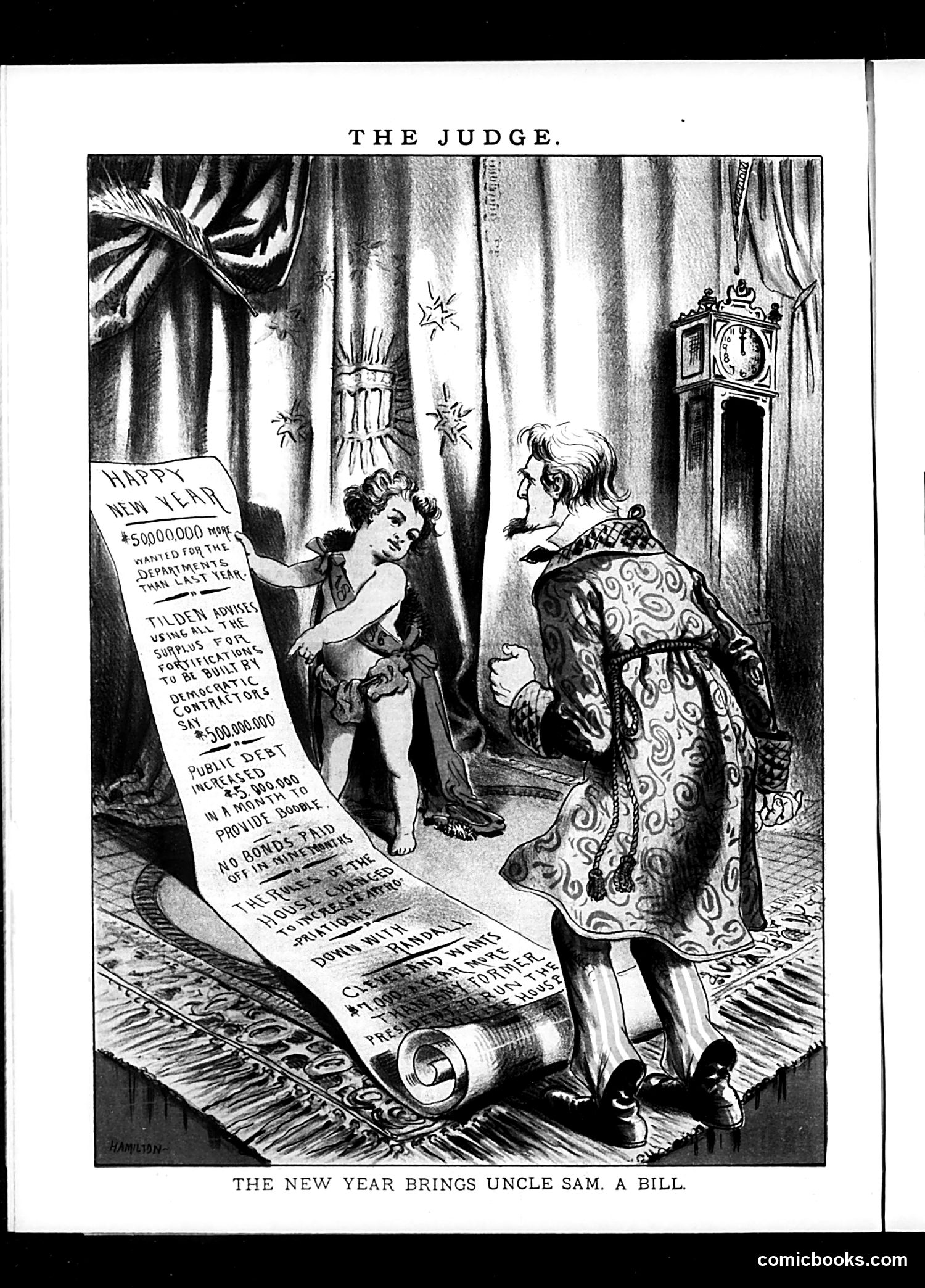
This political cartoon satirizes government spending and fiscal irresponsibility. "Uncle Sam" (the personified U.S. government, shown as an elderly man in a patterned coat) receives a massive bill from a winged figure representing the New Year. The scroll-like bill lists various government expenditures including "$5,000,000" for departments, "Tilden advised on the surplus," "$10,000,000" in public debt increases, bonds, and other financial obligations. The satire criticizes accumulated government spending and debt as the new year arrives—suggesting Uncle Sam must face mounting bills and fiscal problems. The imagery of a judge figure (matching the magazine's title) delivering judgment implies moral condemnation of wasteful spending. The cartoon likely dates to the Gilded Age, when government debt and spending were frequent targets of political humor.