
Judge, 1886-01-02 · page 12 of 16
Judge — January 2, 1886 — page 12: what you’re looking at
What you’re looking at
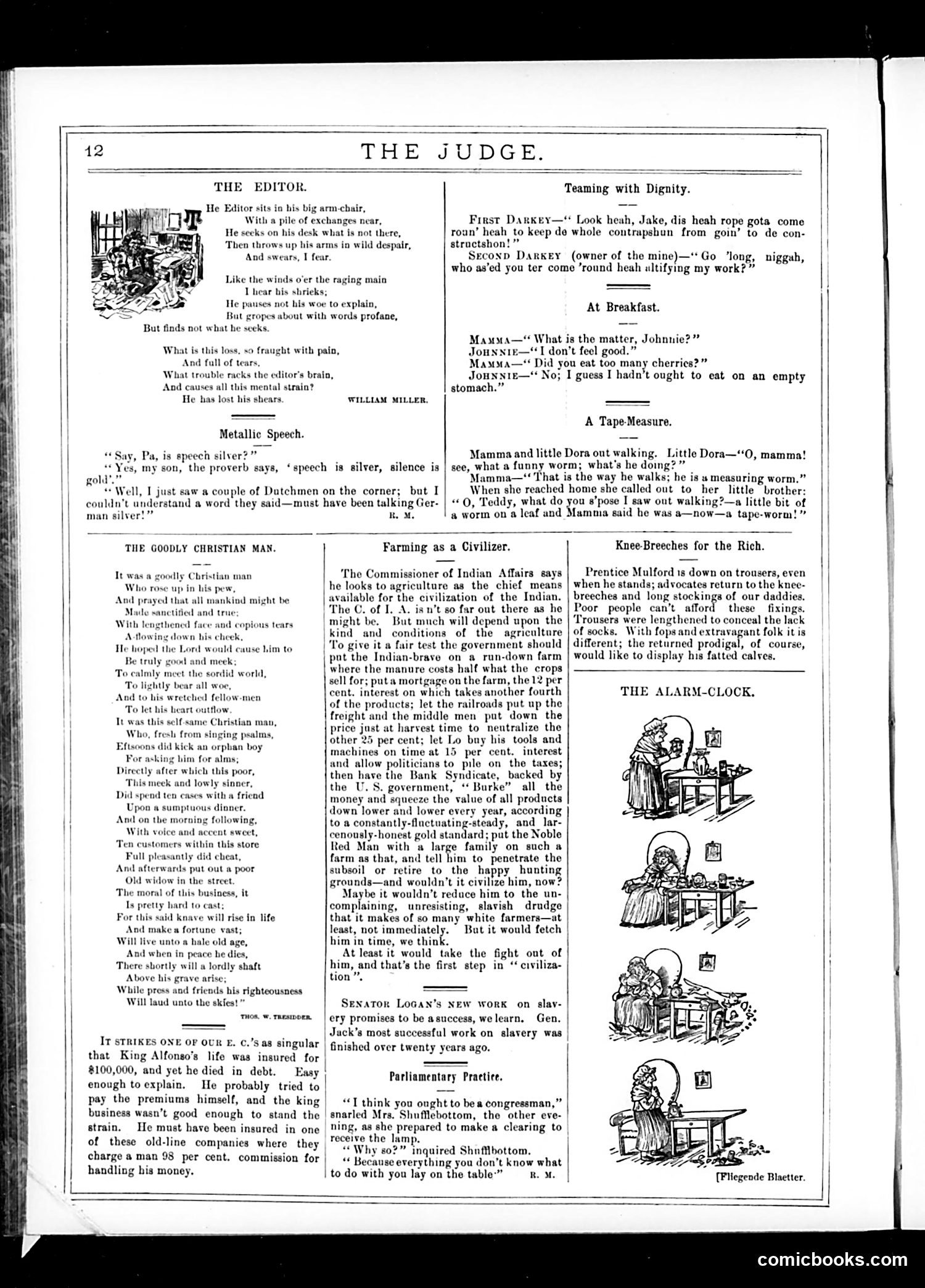
This page contains several humorous short pieces typical of 1880s-90s satirical magazines: **"The Editor"** mocks the chaos of editorial work through verse about a frantic editor who's lost his scissors. **"Metallic Speech"** is a pun joke: a child misunderstands the proverb "speech is silver, silence is gold" by calling incomprehensible German "German silver." **"Teaming with Dignity"** and **"At Breakfast"** are brief domestic humor pieces with no clear political content. **"The Goodly Christian Man"** is social satire attacking hypocrisy—contrasting a wealthy man's pious church prayers with his actual cruelty to the poor and orphans, ending with dark irony that such hypocrites prosper anyway. **"Farming as a Civilizer"** critiques government Indian policy, sarcastically suggesting the Commissioner's agricultural plan would only work if Native Americans weren't subjected to exploitative debt and mortgage conditions. The page also includes illustrations of an alarm clock and several small satirical vignettes. Overall, it reflects Judge's focus on social hypocrisy and government policy criticism.
📄 Transcribed text from this page (OCR, searchable)
Machine-transcribed from the original scan — historical spelling and the odd misread are preserved.
12 THE JUDGE. THE EDITOR. He Editor sits in his big arm-chair, With a pile of exchanges near, He seeks on his desk what is not there, Then throws up his arms in wild despair, And swears, I fear. Like the winds o'er the raging main I hear bis shrieks; He pauses not his woe to explain, But gropes about with words profane, But finds not what he seeks. What is this loss, so fi And full of tears, What trouble racks the editor's brain, And causes all this mental strain? He has lost his shears. t with pain, WILLIAM MILLER, Metallic Speech. say, Pa, is speech silver , Yes, my son, the proverb says, ‘speech is silver, silence is gold’.”” Vell, I just saw a couple of Dutchmen on the corner; but I couldn't understand a word they said—must have been talking Ger- man silver!” RM. Teaming with Dignity. First Darkey—* Look heah, Jake, dis heah rope gota come roun’ heah to keep de whole contrapshun from goin’ to de con- structshon! ” Seconp Darkey (owner of the mine)—‘* Go ‘long, nigguh, who as’ed you ter come ’round heah ultifying my work?” At Breakfast. Masuma—‘ What is the matter, Johnnie?” Jounnie—“ I don’t feel good.” Mamsaa—*‘ Did you eat too many cherries?” Jounnte—* No; I guess I hadn’t ought to eat on an empty stomach.” A Tape-Measure. Mamma and little Dora out walking. Little Dora—‘O, mamma! see, what a funny worm; what's he doing?” ‘Mamma—‘ That is the way he walks; he is « measuring worm.” When she reached home she called out to her little brother: «0, Teddy, what do you s’pose I saw out walking?—a little bit of a worm on a leaf and Mamma said he was a—now—a tape-worm! ” THE GOODLY CHRISTIAN MAN. ndly Christian man rose up in his pew, And prayed that all mankind might be Maile sanct With le A.tlowing nd trie: and copious tears cheek, He hoped the Lord would ¢ T. y bear all woe, And to his wretched fellow-men ‘To let his heart outflow It was this self-same Christian man, Who, fresh from singing psalms, Eftsoons did kick an orphan boy For asking him for alms; Directly after which this poor, This meck and lowly sinner, Did spend ten cases with a friend Upon a sumptuous dionet And on the morning lowing, With voice and ace Ten customers with Full pleasantly did ch And afterwards put out a poor Old widow in the street. ‘The moral of this business, it Is pretty hard to cast; For this said knave will rise in life And make a fortune vast; Will live unto a hale old age, And when in peace he dies, There shortly will a lordly shaft Above his grave arise While press and friends his righteousness Will laud unto the skies!” ‘Mos, w. TRESIDOER It STRIKES ONE OF OUR ‘Sas singular that King Alfonso’s life was insured for | | might be. | ‘ ery promises to be a success, we learn, £100,000, and yet he died in debt. Easy | enough toexplain. He probably tried to pay the premiums himself, and the king business wasn’t good enough to stand the strain. He must have been insured in one of these old-line companies where they charge a man 98 per cent. commission for | handling his money. | Farming as a Civilizer. ‘The Commissioner of Indian Affairs says he looks to agriculture as the chief means available for the civilization of the Indian. ‘The C. of I. A. isn’t so far out there as he But much will depend upon the kind and conditions of the agriculture ‘To give it a fair test the government should pot the Indian-brave on a run-down farm where the manure costs half what the crops sell for; puta mortgage on the farm, the 12 per cent. interest on which takes another fourth of the products; let the railroads put up the freight and the middle men put down the price just at harvest time to neutralize the other 25 per cent; let Lo bay his tools and machines on time at 15 per cent. interest and allow politicians to pile on the taxes; then have the Bank Syndicate, backed by the U.S. government, ‘ Burke” all. the money and squeeze the value of all products down lower and lower every year, according to a constantly-fluctuating-steady, and_lar- cenously-honest gold standard; put the Noble Red Man with a large family on such a farm as that, and tell fim to penetrate the subsoil or retire to the happy hunting grounds—and wouldn't it civilize him, now? Maybe it wouldn’t reduce him to the un- complaining, unresisting, slavish dradge that it makes of so many white farmers—at least, not immediately. © But it would fetch him in time, we think. At least it would take the fight out of him, and that’s the first step in’ civiliza- tion”. NEW WORK on slay- Gen, Jack’s most successful work on slavery was finished over twenty years ago. Parliamentary Practice. “I think you ought to be a congressman,” snarled Mrs. Shuflebottom, the other eve- ning, as she prepared to make a clearing to receive the lamp. “Why so?” inquired Shnfflbottom. “ Because everything you don’t know what to do with you lay on the table” RM. Knee-Breeches for the Rich. Prentice Mulford 1s down on trousers, even when he stands; advocates return to the kne breeches and long stockings of our daddies, Poor people can’t afford these fixings. ‘Trousers were lengthened to conceal the lack of socks. With fops and extravagant folk itis different; the returned prodigal, of course, would like to display his fatted calves. THE ALARM-CLOCK. | comicbooks.com