
Judge, 1886-01-02 · page 10 of 16
Judge — January 2, 1886 — page 10: what you’re looking at
What you’re looking at
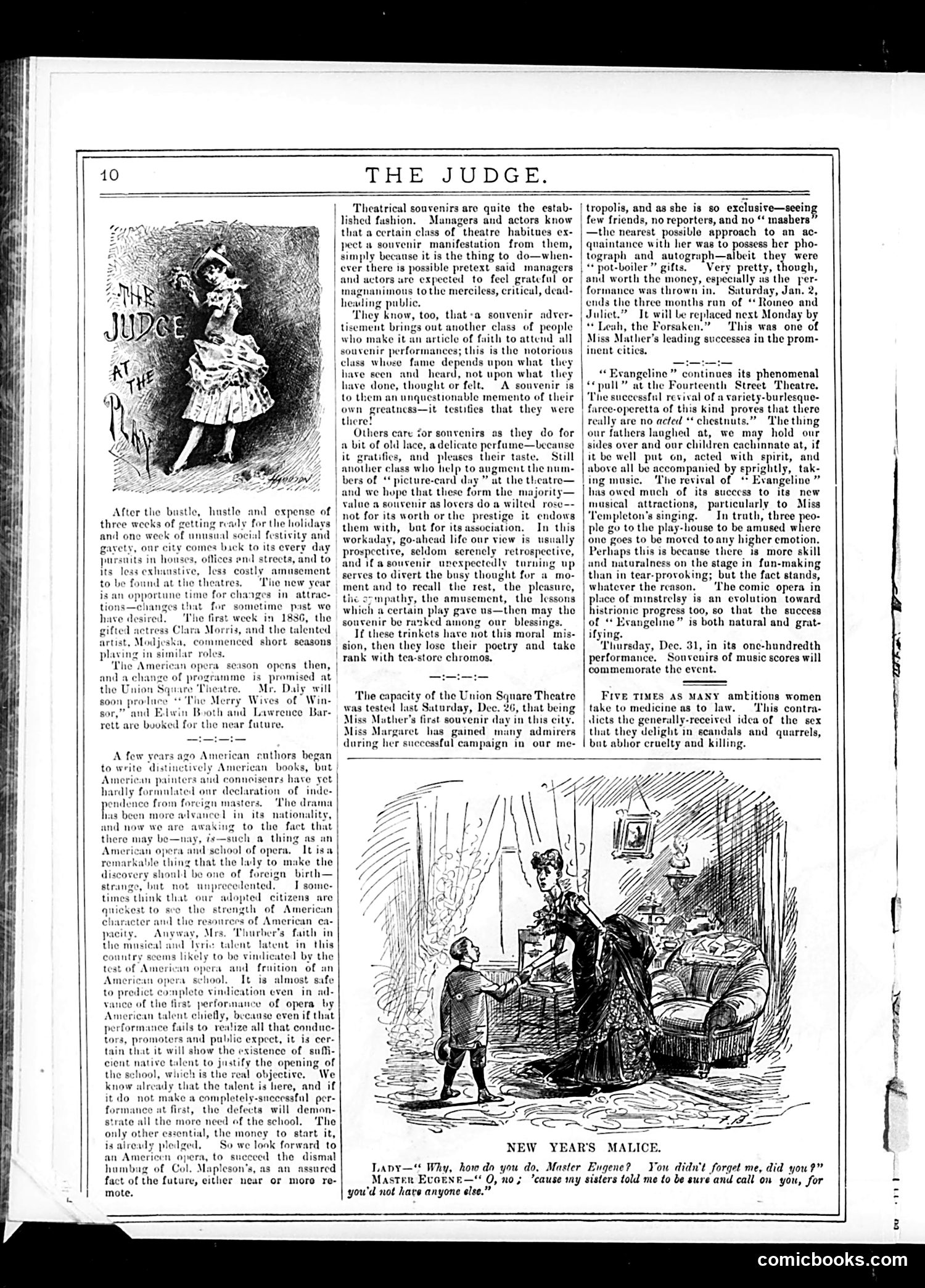
This page from *Judge* magazine contains theatrical commentary and a cartoon titled "New Year's Malice." **Main Content:** The lengthy article discusses theatrical souvenirs—programs, photographs, and trinkets distributed at performances. The writer satirizes different audience types: social climbers who attend solely to say they were there; people seeking tangible "proof" of their cultural participation; and genuinely nostalgic patrons. The piece mocks the "merciless, critical, dead-heading public" (free ticket holders) who expect theaters to provide souvenirs as gratitude. **The Cartoon:** The small illustration titled "New Year's Malice" depicts a scene between a lady and "Master Eugene." The lady asks if he forgot her, feigning hurt. Eugene responds that his sisters told him to be "sure and call on you, for you'd not have anyone else." This is a cruel New Year's joke—the implication is that the lady has no other callers, making her so undesirable that even children were told to visit her out of pity. **Satire Target:** Social pretension and the superficiality of theater culture; also gentle mockery of social embarrassment and New Year's courtesies.
📄 Transcribed text from this page (OCR, searchable)
Machine-transcribed from the original scan — historical spelling and the odd misread are preserved.
THE JUDGE. After the bustle, 1 oxpense of | _ Theatrical souvenirs are quite the estab- lished fashion. Managers and actors know that a certain class of theatre habitues ex- pect a souvenir manifestation from them, simply because it is the thing to do—when- ever there is possible pretext said managers and actors are expected to feel grateful or magnanimous tothe merciless, criticul, dead- heading public. They know, too, that-a souvenir adver- | tisement brings out another class of people who make it an article of faith to attend all souvenir performances; this is the notorious class whose fame depends upon what they ave seen and heard, not upon what they ive done, thought or felt. A souvenir is to them an unquestionable memento of their (own greatness—it testifies that they were there! Others care for sonvenirs as they do for a bit of old lace, a delicate perfume—becanse it gratifies, and pleases their taste. Still | another class who help to augment the num- | bers of ** picture-card day ” ut the theatre— | and we hope that these form the majority— value a souvenir as lovers do a wilted ros not for its worth or the prestige it endows three weeks of getting ready for the holidays | them with, bnt for its association, In this and o1 yu Its le. to be found at the theatres. is an opportune tions—changes t have ¢ gifted actre and a change of pro: the Union soon produ and E rett are booked for the ne sor,” A few years to write d Am hardly pende hus been more and now we there ni Am di American to predict vance of the first | can talent chiefly performance fails to realize 3, promote tain that it will show the ex cient native talent to justify the opening of cht is the real objective. that the talent is here, and if completely-snecessfal per- ts will demon- The An to the school, w know alread it do not make formance Il the more need of the school. ntial, the money to start it, So we look forward to the dismal an assured Lany—‘* Wh is already pledged, an Americ hambag of C weck of unusual social festivity and gayety, onr city comes bick to its every day suits in houses, oflices end strects, and to stive, less costly musement The new year ages in attrac: | thy, pmetime past we week in 1836, the and the talented 1 short seasons a’ season opens then, | amme is promised at d Lawrence Bar- an books, but d connoisenrs have yet ated our declaration of inde- cign masters. ‘The drama that | king to the fa such a thing It is elwly to make the honk be one of foreign birth— T some- nted citizens are of American markable thi ove strange, but not un es think that our a est to seo the stre: er and the resonrees of American ca- faith in s tilent latent in’ this oly to be vindicated by the opera and fruition of an It is almost safe ication even formance of opera nse even if th it conduc. nd public expect, it is ce tence of suffi- ‘ol. Mapleson’s, fact of the future, either near or moro re- mote. workaday, go-ahead life our view is usu rospective, scldom serenely retrospective, and ifa souvenir upexpectedly turning up serves to divert the busy thought for a mo- ment and to recall the rest, the pleasure, pathy, the amusement, the lessons which a certain play gave us—then may the souvenir be ranked among our blessings. If these trinkets have not this moral mis- sion, then they lose their poetry and take | rank with tea-store chromos, ly ee Oe ithe capacity of the Union Square Theatre that being Y in this city Miss Margaret has gained many admirers during her successful campaign in our me- was tested last Saturday, De Miss Mather’s first souvenir d puthors began i — | tropolis, and as she is so exclusive—seeing few friends, no reporters, and no “ mashers” —the nearest possible approach to an ac- | qvaintance with her was to possess her pho- tograph and autogruph—albeit they were |‘ pot-boiler” gifts. Very pretty, though, and worth the money, especially as the per- formance was thrown in, Saturday, Jan. 2, ends the three months ran of ‘Romeo and Julict.” It will Le replaced next Monday by * Leah, the Forsaken.” This was one of | Miss Mather’s leading successes in the prom- inent cities, “Evangeline” continues its phenomenal “pull” at the Fourteenth Street Theatre. ‘The successful revival of a variety-burlesque- farce-operetta of this kind proves that there really are no acted ** chestnuts.” ‘The thing our fathers langhed at, we may hold our sides over and our children cachinnate at, if it be well put on, acted with spirit, and above all be accompanied by eprightly, tak- ing music. ‘The revival of ‘* Evangeline ” has owed much of its success to its new musical attractions, particularly to Miss ‘Yempleton’s singing. In truth, three peo- ple go to the play-lhouse to be amused where one goes to be moved to any higher emotion. Perhaps this is because there is_ more skill und naturalness on the stage in fun-making than in tear-provoking; but the fact stands, | whatever the reason. ‘The comic opera in | place of minstrelsy is an evolution toward histrionic progress too, so that the success of ‘ Evangeline” is both natural and grat- ifying. ‘Thursday, Dec. 31, in its one-hundredth performance. Souvenirs of music scores will commemorate the event. Five TIMES AS MANY amtitions women take to medicine as to law. — This contra- | dicts the generully-received idea of the sex | that they delight in scandals and quarrels, but abhor cruelty and killing. d- We Master Evo you'd not have anyone else.” NEW YEARS MALICE. how da you do, Master Eugene? Yon didn't forget me, did you?” —0, no; ‘cause my sisters told me to be sure and call on you, for os comicbooks.com