
A complete issue · 16 pages · 1884
Judge — March 22, 1884
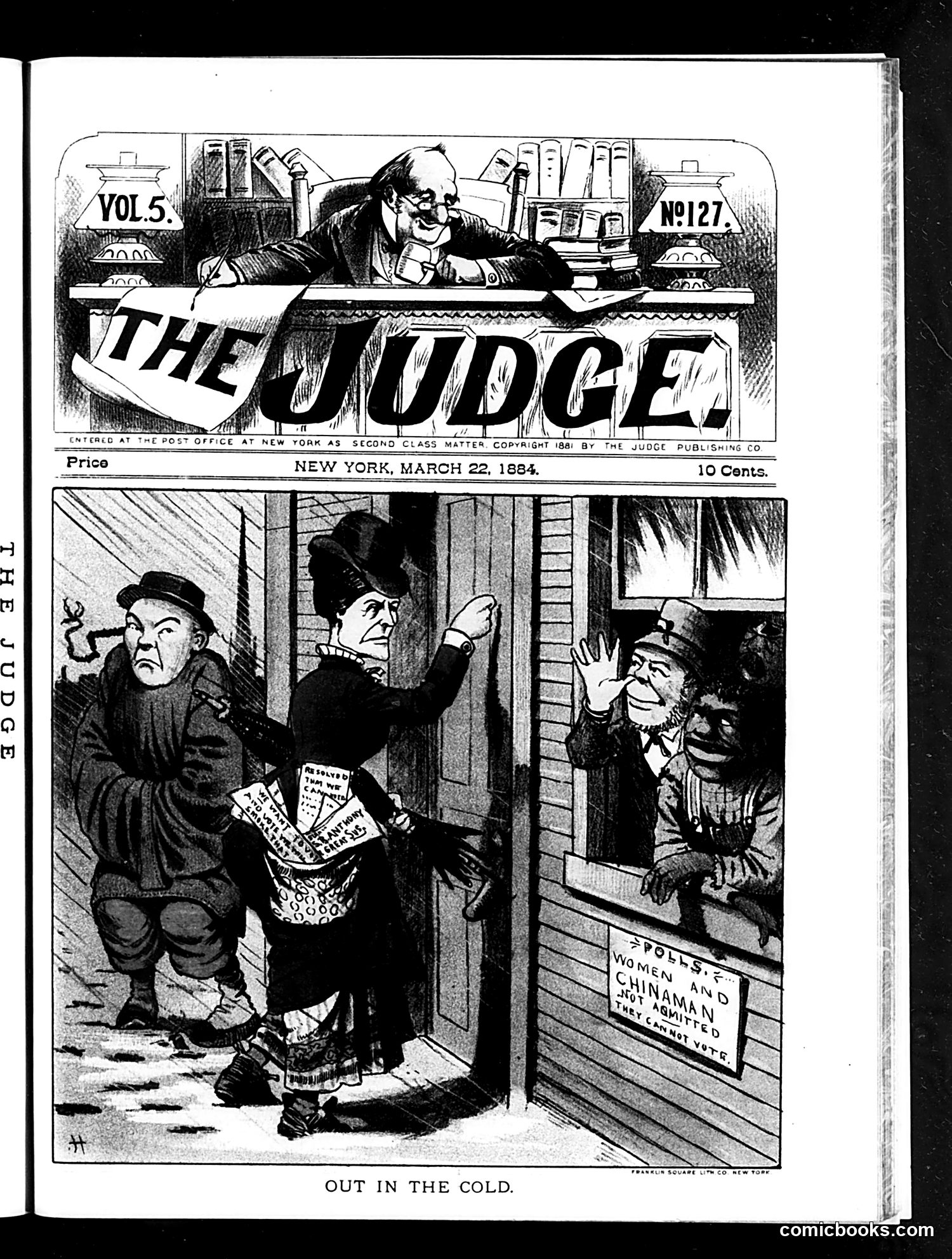
This cartoon satirizes the exclusion of Chinese immigrants from American society. The title and image show figures being turned away from a building with a sign reading "POLL ST. WOMEN AND CHINAMAN NOT ADMITTED—BY ORDER OF THE COMMITTEE." The scene depicts Chinese people (rendered in the offensive caricature style common to 1880s American media) barred from entry alongside a woman, suggesting this references contemporary debates over both Chinese immigration restrictions and women's political participation. This likely relates to the Chinese Exclusion Act period (implemented 1882) when anti-Chinese sentiment was widespread. The cartoon appears to criticize such discriminatory exclusions, though the specific political angle—whether supporting or mocking the exclusions—remains unclear from the image alone.
**The Main Cartoon:** The illustration shows a caricatured figure (appears to be President Chester Arthur, implied by text references to "President Arthur") attempting to control an unruly, mismatched team of horses—a metaphor for the fractured Republican Party. **The Political Context:** The article "A Restive Team" discusses the Republican Party's internal conflict between two factions: the "Stalwarts" (traditional conservatives) and the "Half-breeds" (reformers). These groups despise each other but must unite for the 1884 presidential election. Arthur, as sitting president, currently "holds the ribbons" controlling both factions, but the satirist questions whether he has the strength to keep them together through the campaign. **The Satire:** Judge mocks the Republicans' dysfunction, suggesting their unity is forced and temporary—held together only by electoral necessity, not genuine accord. The "restive team" metaphor implies the horses will bolt apart once the election pressure passes, revealing fundamental incompatibility between party wings.
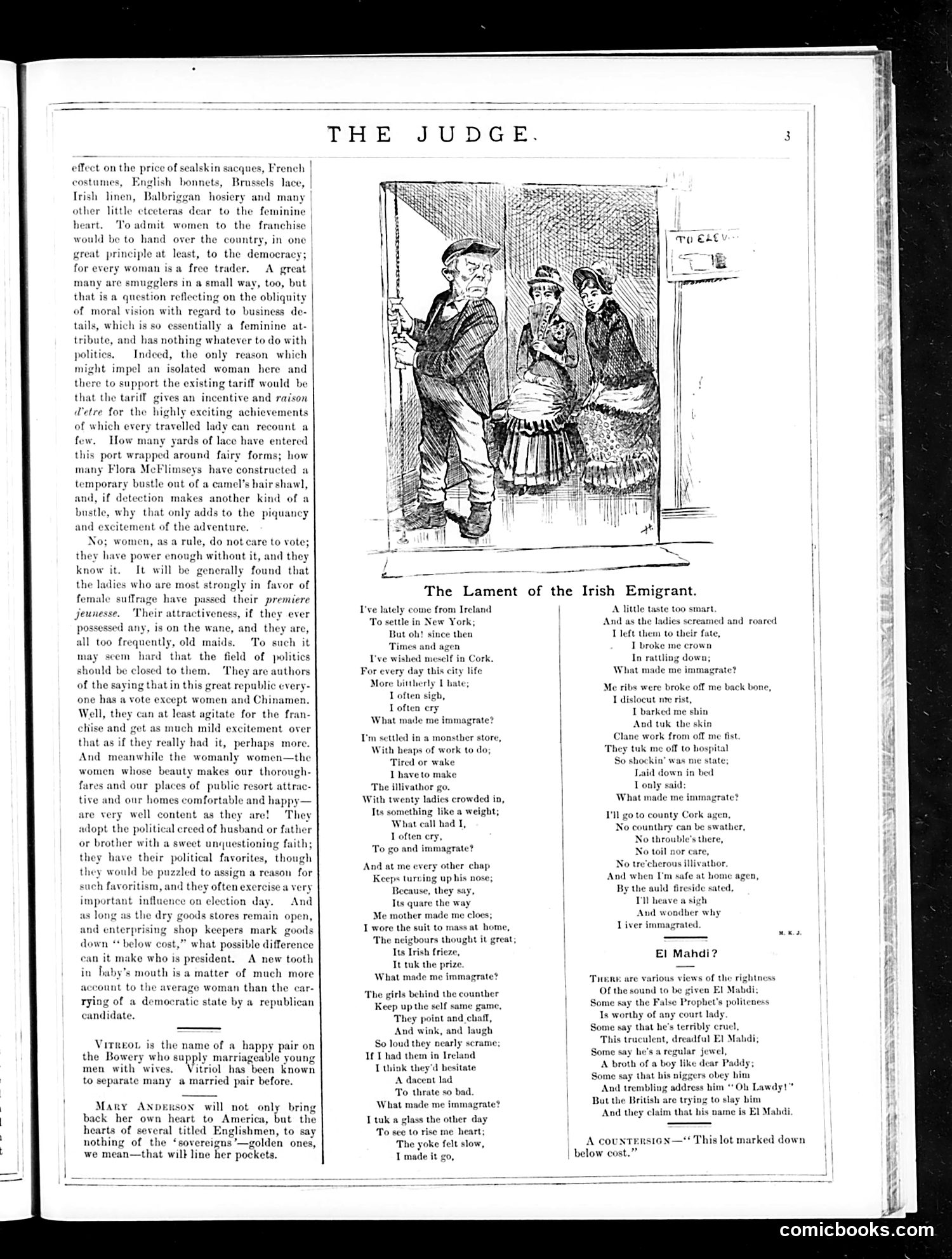
This page satirizes Irish immigration to America, specifically the culture clash experienced by Irish workers in New York City. The illustrated poem—a monologue by an Irish immigrant—depicts a man struggling with his transition from rural Ireland to urban American factory work. The satire centers on the immigrant's bewilderment at American customs and mockery he faces. He laments leaving Cork, describes exhausting retail work with crowds of demanding female customers, and recounts being ridiculed for wearing his old Irish suit to church. The poem emphasizes the Irish worker's alienation, homesickness, and the harsh treatment he receives from Americans (particularly Irish-American women who seem to look down on him as "fresh off the boat"). Judge's satire appears directed at both the immigrant's naïveté and American society's treatment of newcomers. The adjoining political text mocking female suffrage and women's consumer power provides additional context about the magazine's conservative editorial stance.
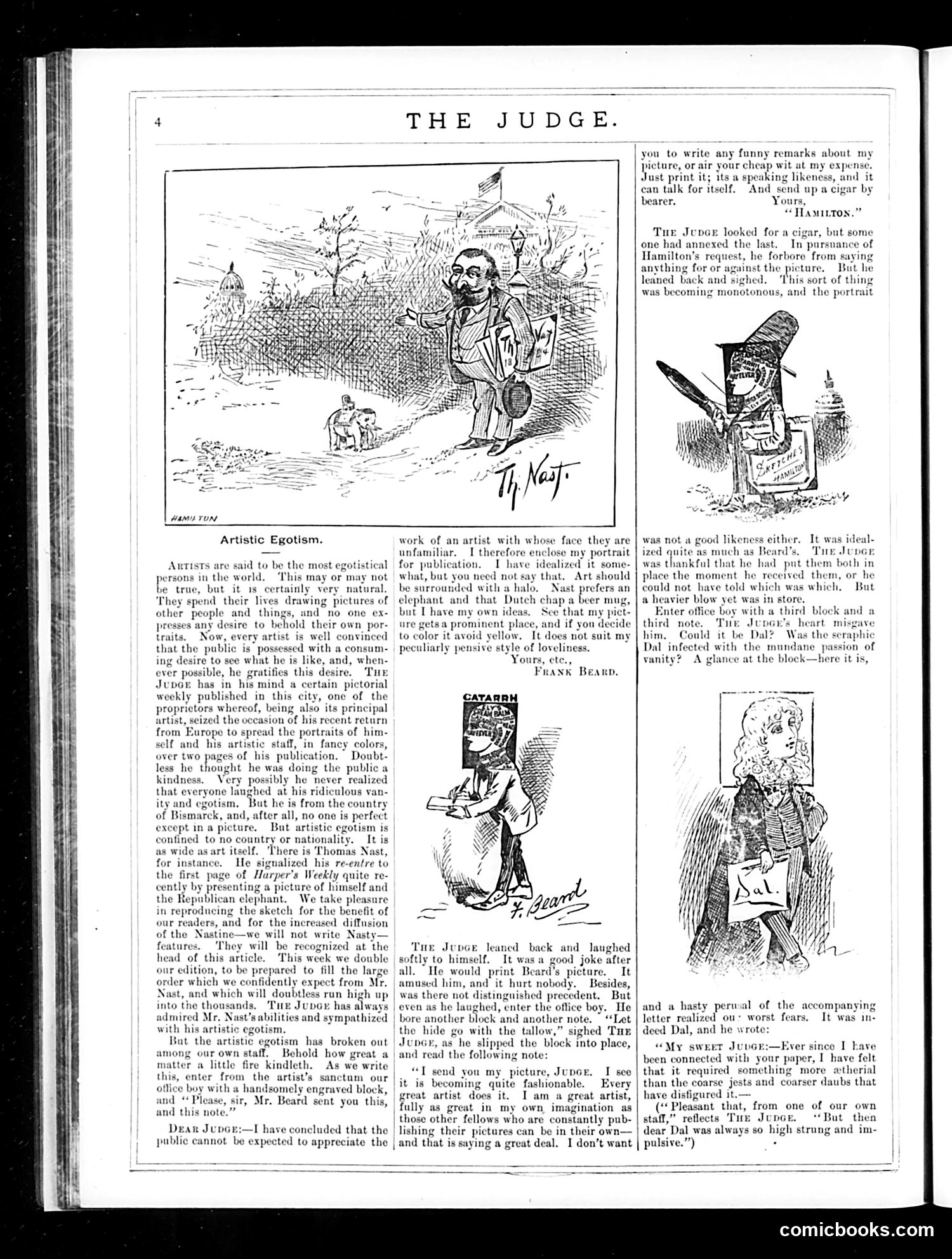
This page satirizes vanity among prominent artists of the era, particularly their self-promotion through self-portraits. **The targets:** - Thomas Nast, the famous cartoonist, recently returned to Harper's Weekly and published a large self-portrait alongside a Republican elephant - An unnamed artist "Beard" who similarly submitted an idealized self-portrait to Judge - A third artist "Hamilton" who sent another self-portrait with an arrogant note **The joke:** Judge mocks the "artistic egotism" of these illustrators who demand prominent publication of flattering portraits of themselves, claiming the public desperately wants to see their faces. The editor's exasperation—receiving multiple self-portrait submissions—underscores the absurdity. The satire suggests these artists mistake their professional importance for genuine public interest in their personal vanity. The piece gently ridicules a specific professional vanity while acknowledging Nast's genuine talent, treating the phenomenon as both amusing and slightly ridiculous.
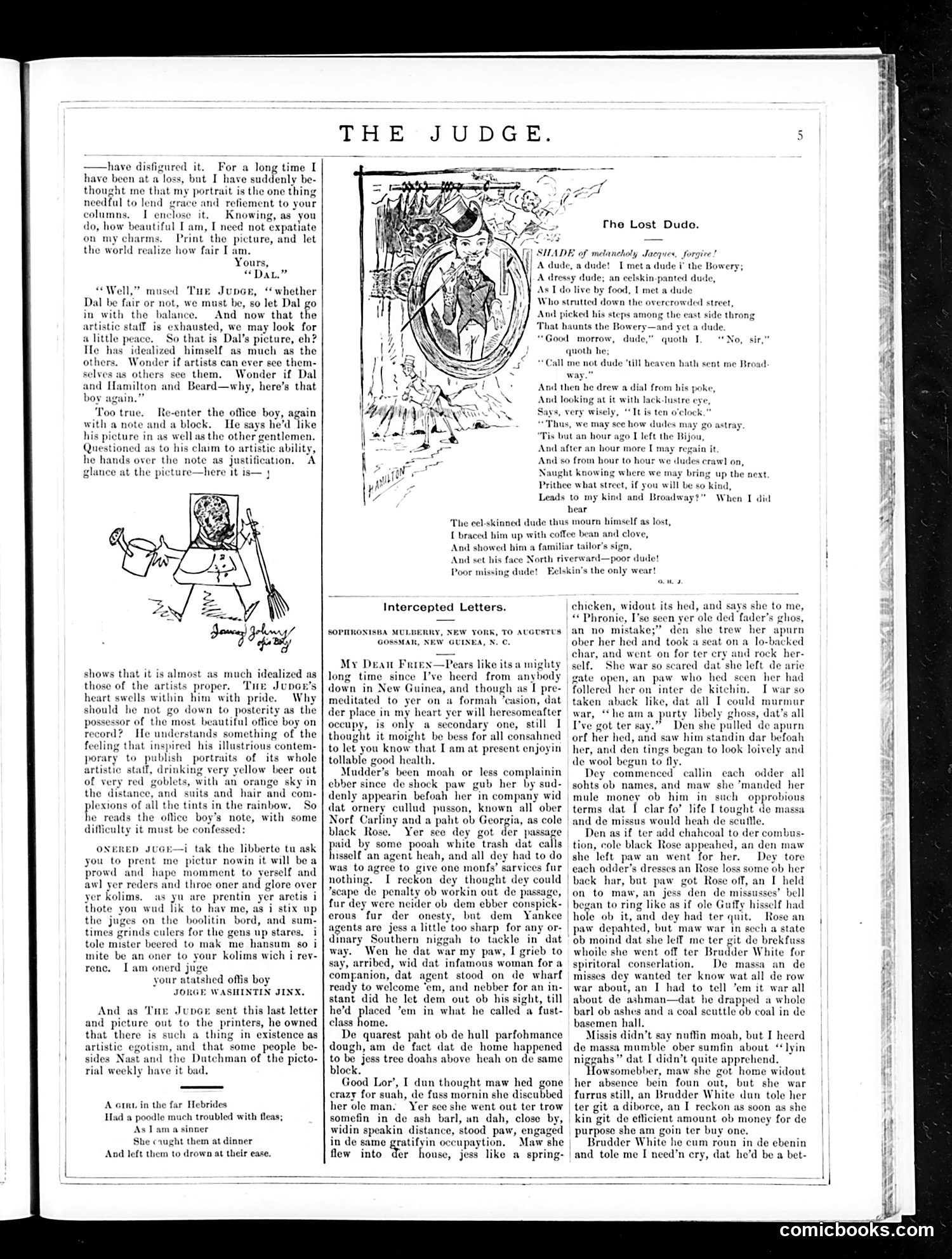
This page satirizes the vanity of illustrators and office workers through interconnected pieces: **Main Cartoon**: The editorial staff of *The Judge* magazine receive increasingly absurd portrait submissions. An office boy named "Jorge Washington Jinx" sends a hilariously misspelled note requesting his portrait be published alongside the artists' work. The joke critiques artistic ego—the staff happily publishes their own idealized portraits in yellow beer advertisements, then hypocritically considers publishing the office boy's equally self-aggrandizing submission. It's satire on professional pomposity and the delusion that everyone deserves immortalization. **"The Lost Dude"**: A poem mocking a fashionable young man ("dude") who gets lost in the Bowery after leaving a theater, living moment-to-moment without direction or purpose—stereotyping the era's idle, well-dressed urban youth as vapid wanderers. **"Intercepted Letters"**: A gossip column format satirizing correspondence from a Southern woman to someone in New Guinea, likely poking fun at provincial American attitudes and social pretension through affected dialect. The page exemplifies *Judge's* approach: punching down at working-class speech while mocking middle-class self-importance.
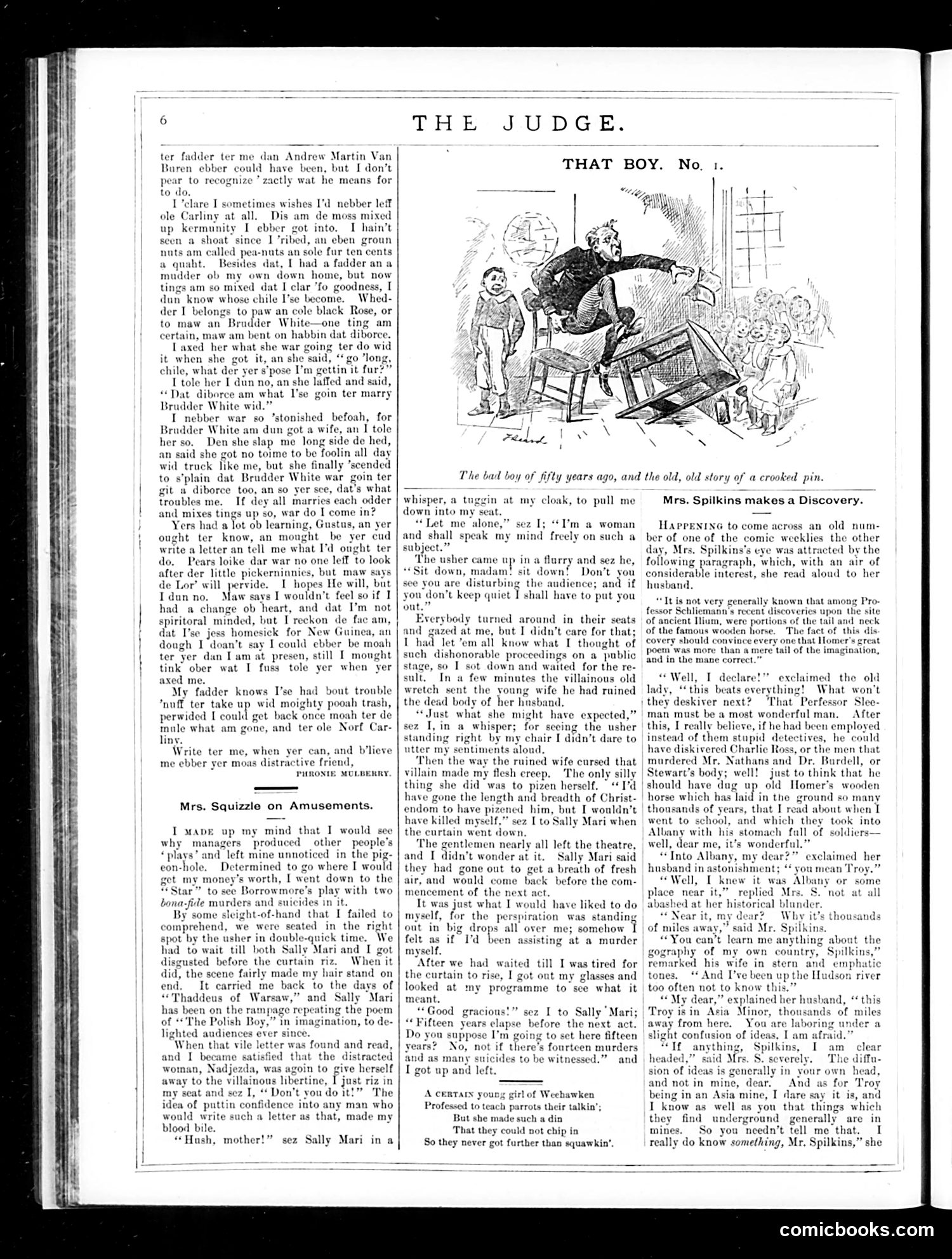
This cartoon satirizes **the "bad boy" figure and parental discipline**, a recurring theme in late 19th-century American humor. The illustration shows an older man (likely a father or authority figure) seated with several mischievous children around him, capturing a moment of domestic chaos or misbehavior. The caption—"The bad boy of fifty years ago, and the old, old story of a crooked pin"—suggests nostalgia for earlier generations' "bad boys" while implying that childhood mischief is timeless. The "crooked pin" reference likely alludes to a specific prank or troublemaking device. The accompanying text features dialectal speech from "Phronie Mulberry," discussing domestic confusion and marital troubles, reflecting Judge's typical use of vernacular humor and social commentary on American domestic life and marriage customs of the period.
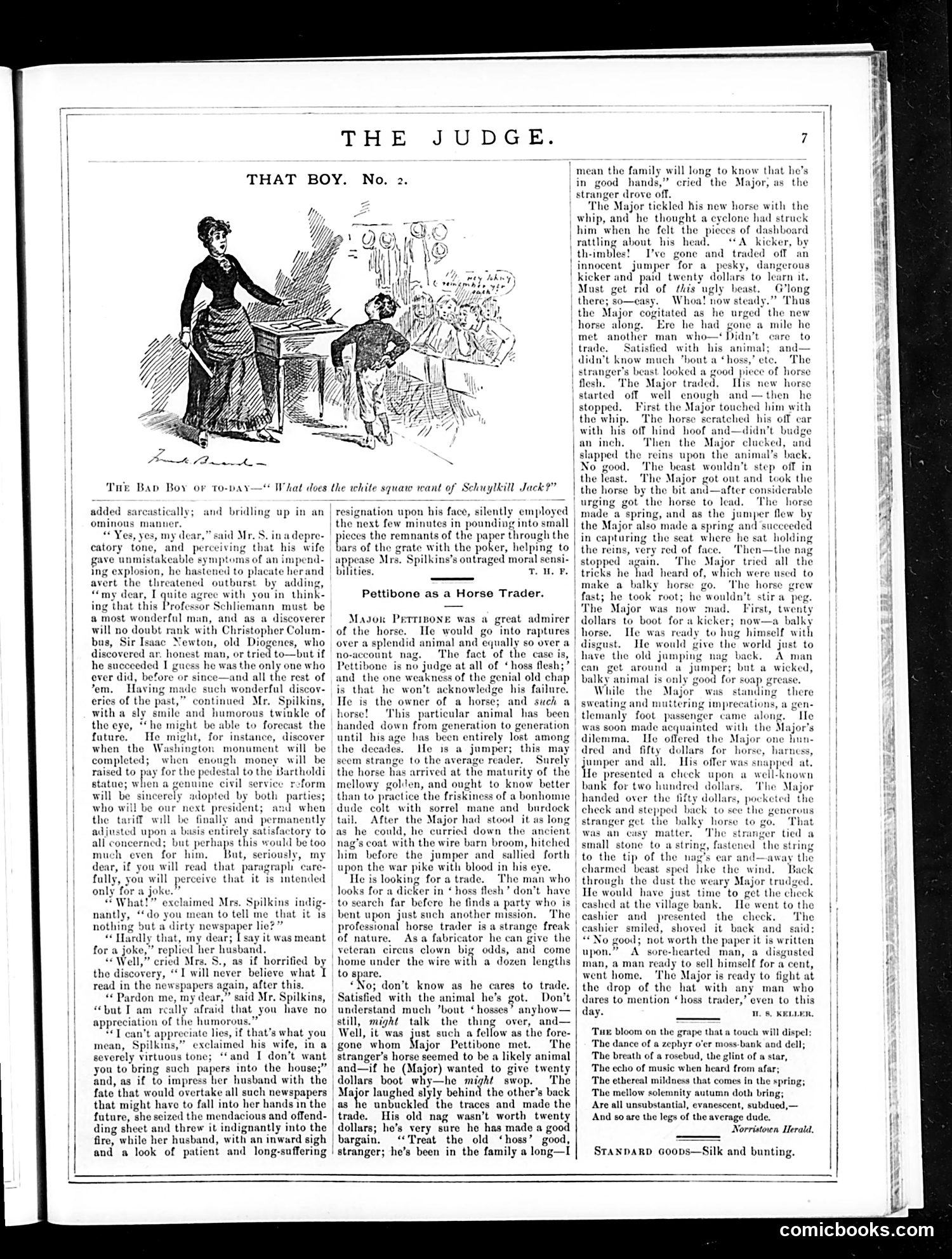
This page contains two satirical pieces typical of late 19th-century American humor magazines. **"That Boy No. 2"** (top): A domestic comedy where Mrs. Spilkins confronts her husband about a newspaper article. The satire targets gullible readers who simultaneously claim newspapers are full of lies yet become morally outraged by them. Mrs. Spilkins's righteous indignation at "dirty newspaper lies" — while her husband points out the article was obviously meant as a joke — mocks the selective credulity and sanctimoniousness of the reading public. **"Pettibone as a Horse Trader"** (bottom): A longer narrative satirizing Major Pettibone's delusions about horseflesh. The ancient, decrepit jumper he owns is presented as ridiculous, yet Pettibone refuses to acknowledge his poor judgment. The piece humorously skewers both his pride and the culture of horse-trading deception — where professional traders are fabricators comparable to circus clowns. Both pieces employ genteel domestic scenarios to mock Victorian hypocrisy and self-deception.
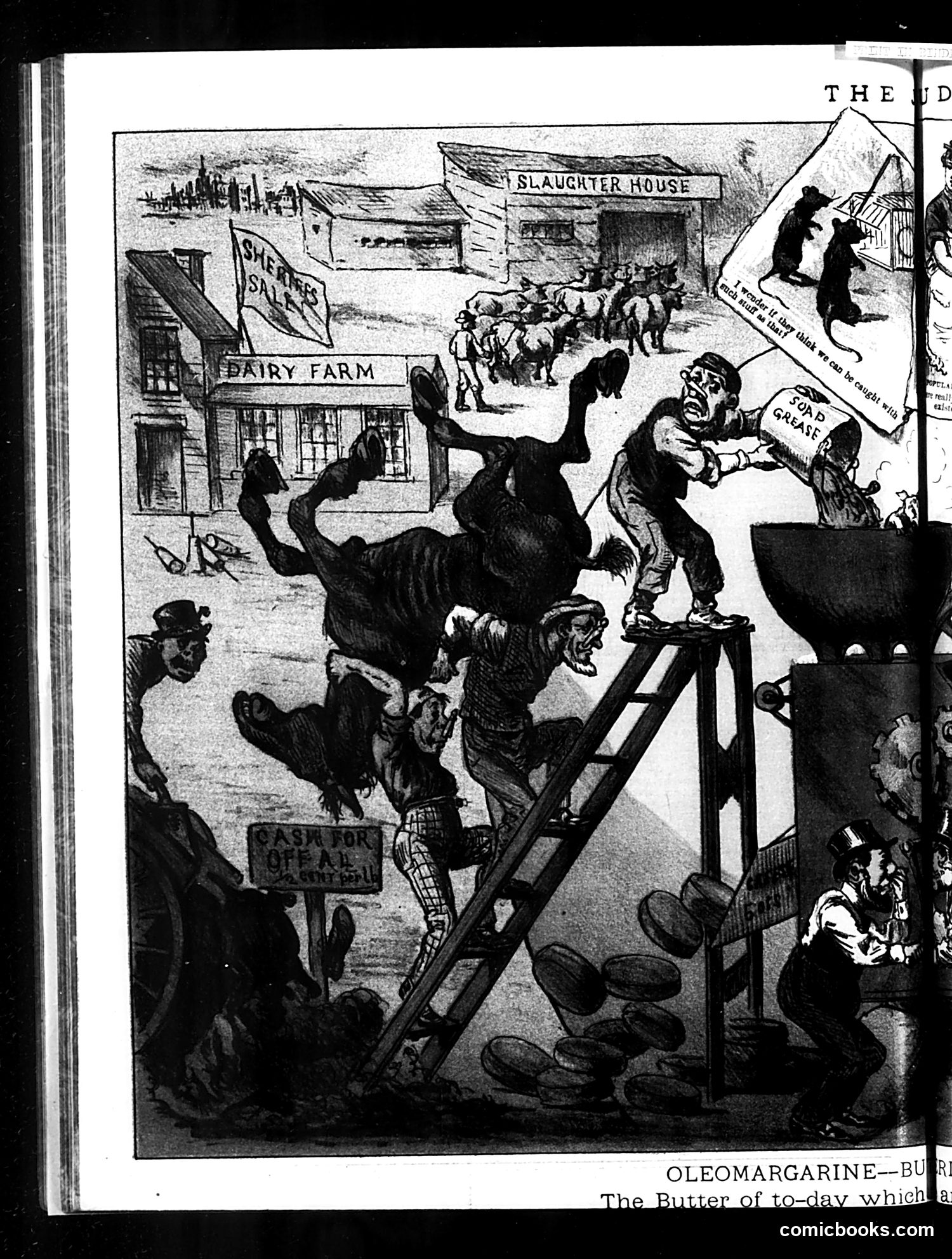
This satirical cartoon critiques oleomargarine (margarine) as a dangerous food substitute for butter. The central scene depicts chaos at a cauldron labeled "SON OF GREASE"—suggesting margarine is an inferior, greasy concoction. Exaggerated figures with ape-like features are shown manufacturing or handling the product near buildings labeled "Dairy Farm" and "Slaughter House," implying margarine comes from questionable, unsavory sources. The satire attacks margarine as: - Fraudulent food (deception replacing genuine butter) - Unhygienic/dangerous to consumers - Made from dubious animal byproducts The cartoonist defends dairy interests against margarine's market expansion. This reflects late 19th/early 20th-century food safety anxieties and the butter industry's resistance to this new competitor. The degrading caricatures and chaotic imagery emphasize margarine as a threat to both health and honest commerce.
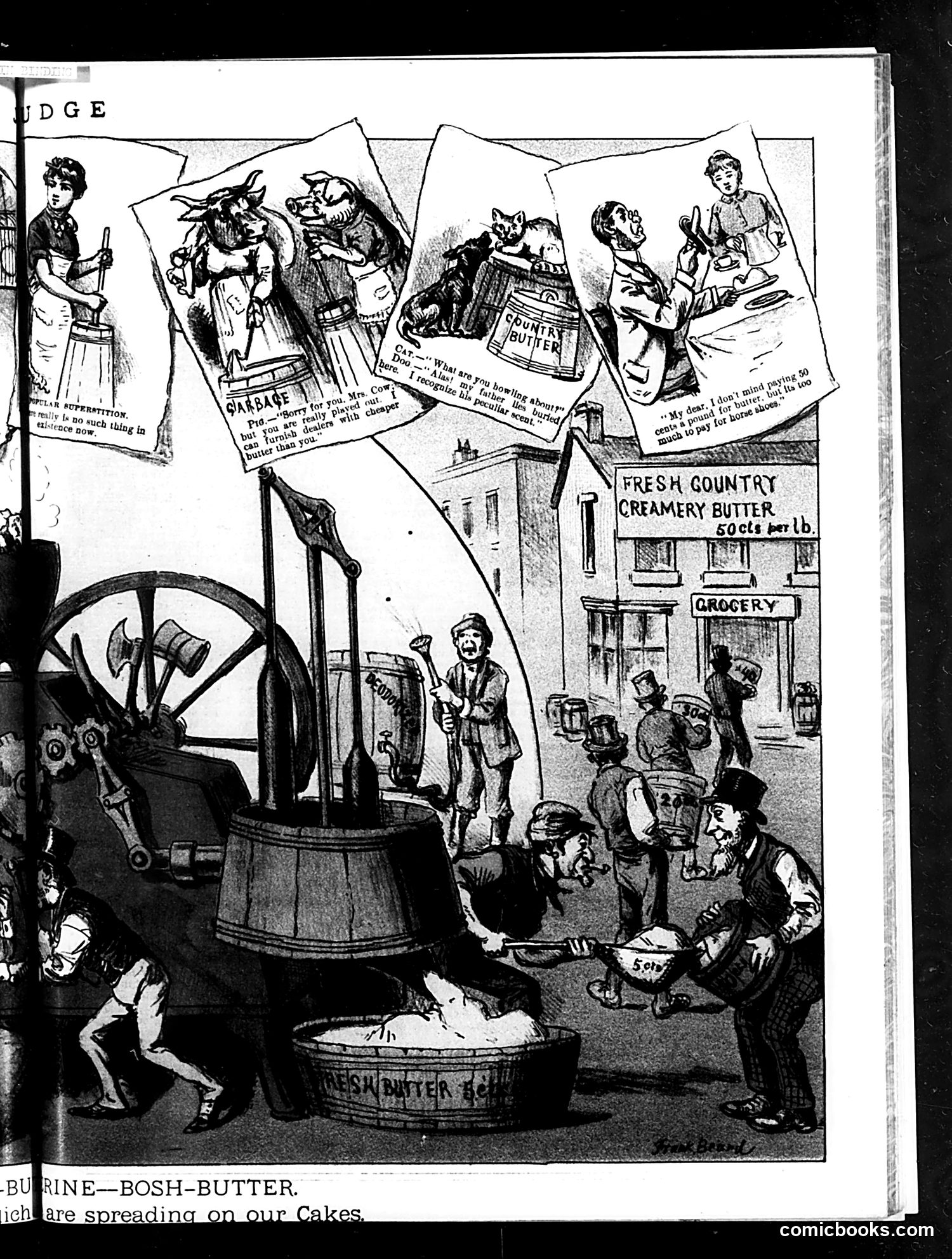
This Judge magazine cartoon satirizes adultered butter products being sold to consumers. The main scene depicts street vendors and a grocery store selling "Fresh Country Creamery Butter" while the overhead panels show various deceptive practices—likely depicting different inferior or fake butter substitutes being passed off as quality product. The title appears to mock artificial butter alternatives (the exact term "riburine" is unclear, but "bosh" means nonsense). The cartoon criticizes food fraud and misleading advertising practices common in the era. The vendor characters and small figures examining the dubious products suggest public concern about food safety and honest labeling—issues that drove early American consumer protection movements and food regulation laws.
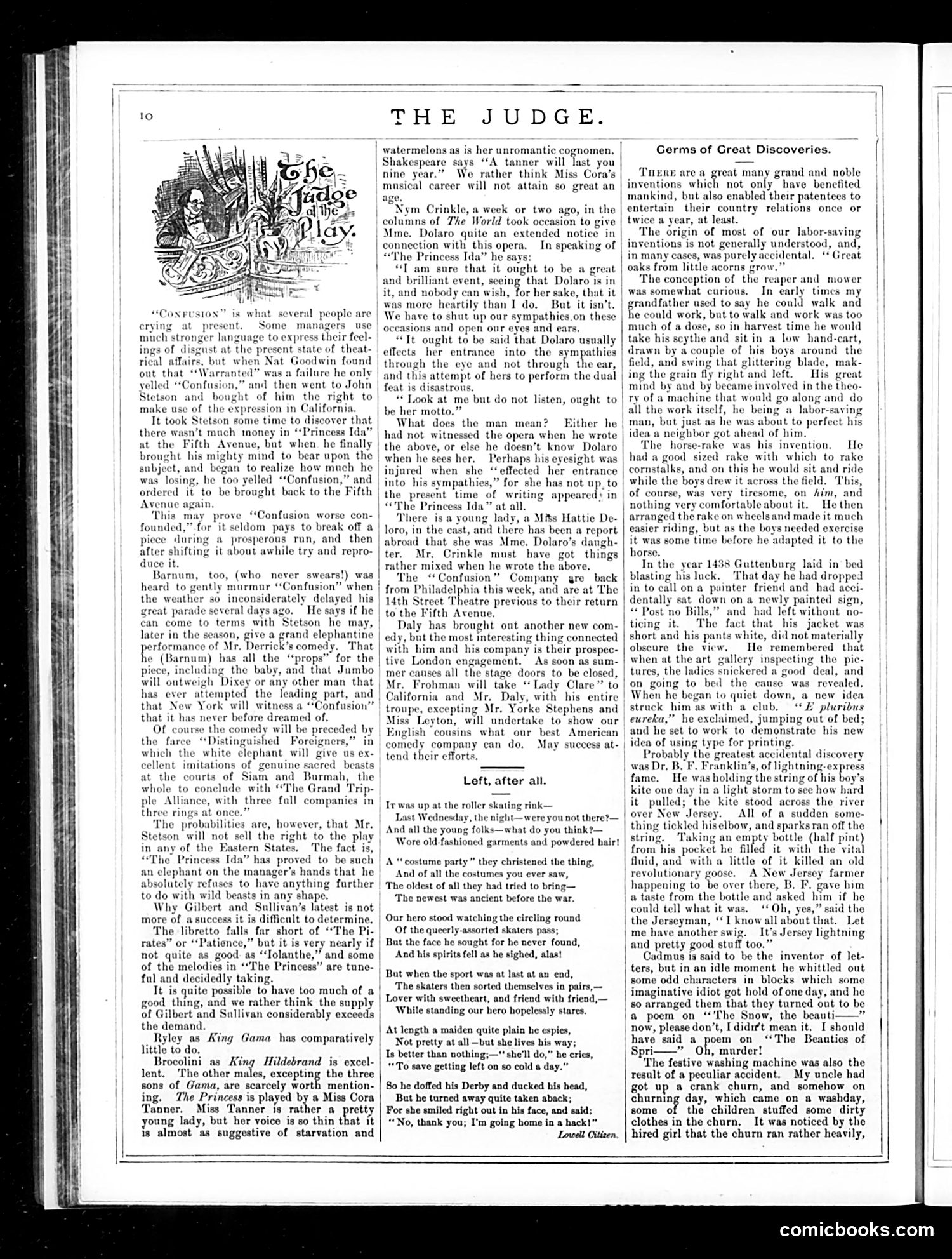
This page from **Judge** magazine critiques Gilbert and Sullivan's opera **"The Princess Ida"** and theatrical trends of the era (appears to be 1880s). The main satire targets: 1. **Theater managers' desperation**: The term "Confusion" (likely referencing a failed play) becomes a running joke—when shows flop, managers desperately recycle and relocate them rather than accepting failure. 2. **"The Princess Ida" as a money-loser**: Despite being by celebrated composers Gilbert and Sullivan, the opera is depicted as an "elephant on the manager's hands"—expensive, burdensome, and unprofitable. 3. **Miss Cora Tanner's weak voice**: The critic mocks her thin, undernourished-sounding soprano, comparing it unfavorably to watermelons (apparently her surname). 4. **Oversaturation**: The piece argues audiences have simply had too much Gilbert and Sullivan—supply exceeds demand. The tone is witty and dismissive of both theatrical management decisions and contemporary opera's decline in appeal.
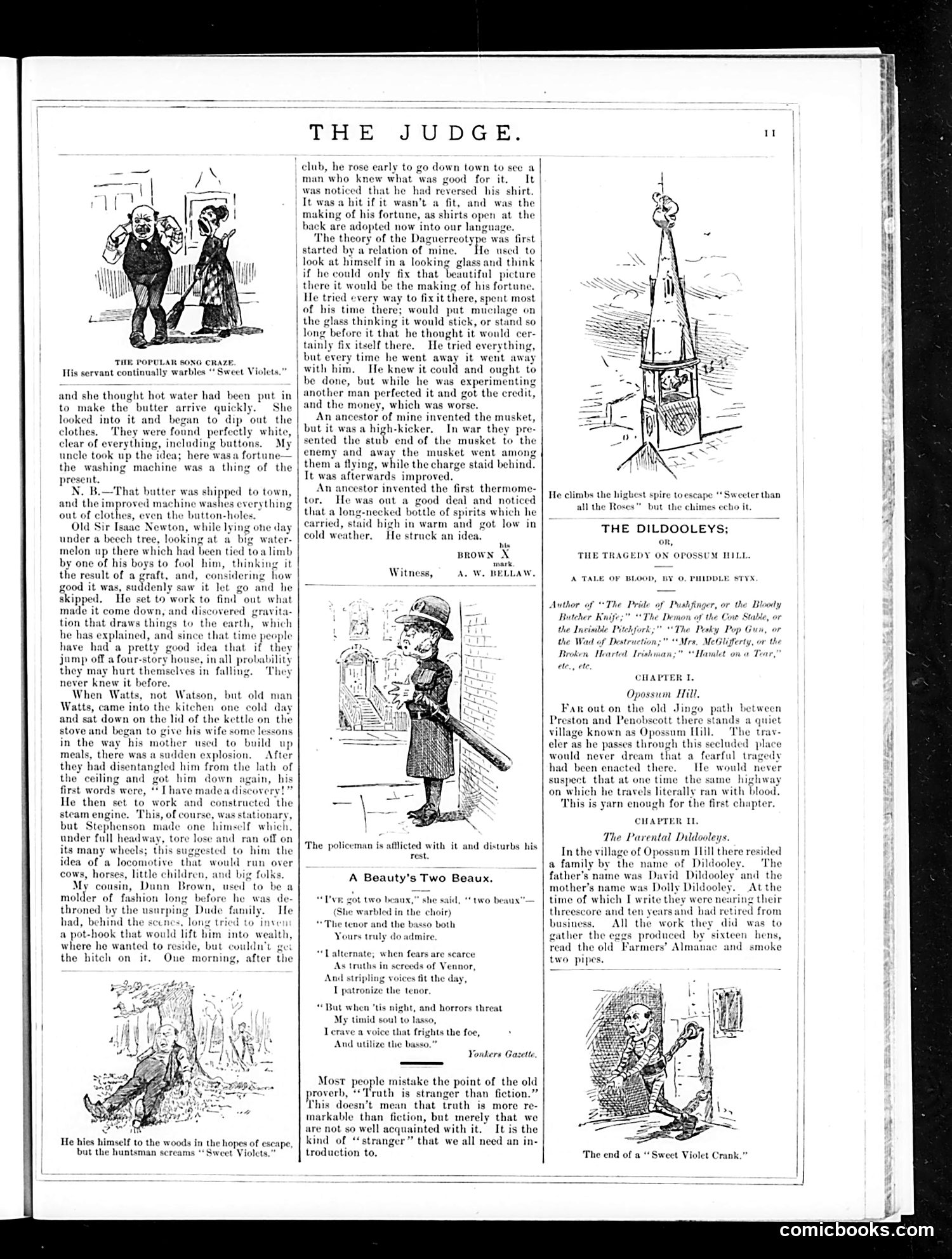
This page from *Judge* magazine contains two main satirical pieces: **"The Judge" (top/left):** A humorous narrative about how great inventions arose from accidents and observations. The author traces inventions—the washing machine, steam engine, daguerreotype, musket, and thermometer—to his relatives' mishaps and experiments. The satire mocks Victorian-era pretension by suggesting that major technological advances were stumbled upon rather than engineered through genius, and that credit often goes to someone else while the real inventor remains obscure. **"The Diddledays; or, The Tread on Diddloy's Hill" (right column):** The beginning of a serial story set in a village called Opossium Hill, mentioning a family named Diddloody. This appears to be lighthearted serialized fiction rather than political satire. The various illustrations throughout support these narratives with period-appropriate Victorian comic drawings showing domestic scenes and characters. The humor relies on Victorian-era attitudes about invention, class, and domesticity that modern readers would find charmingly quaint rather than sharp satire.
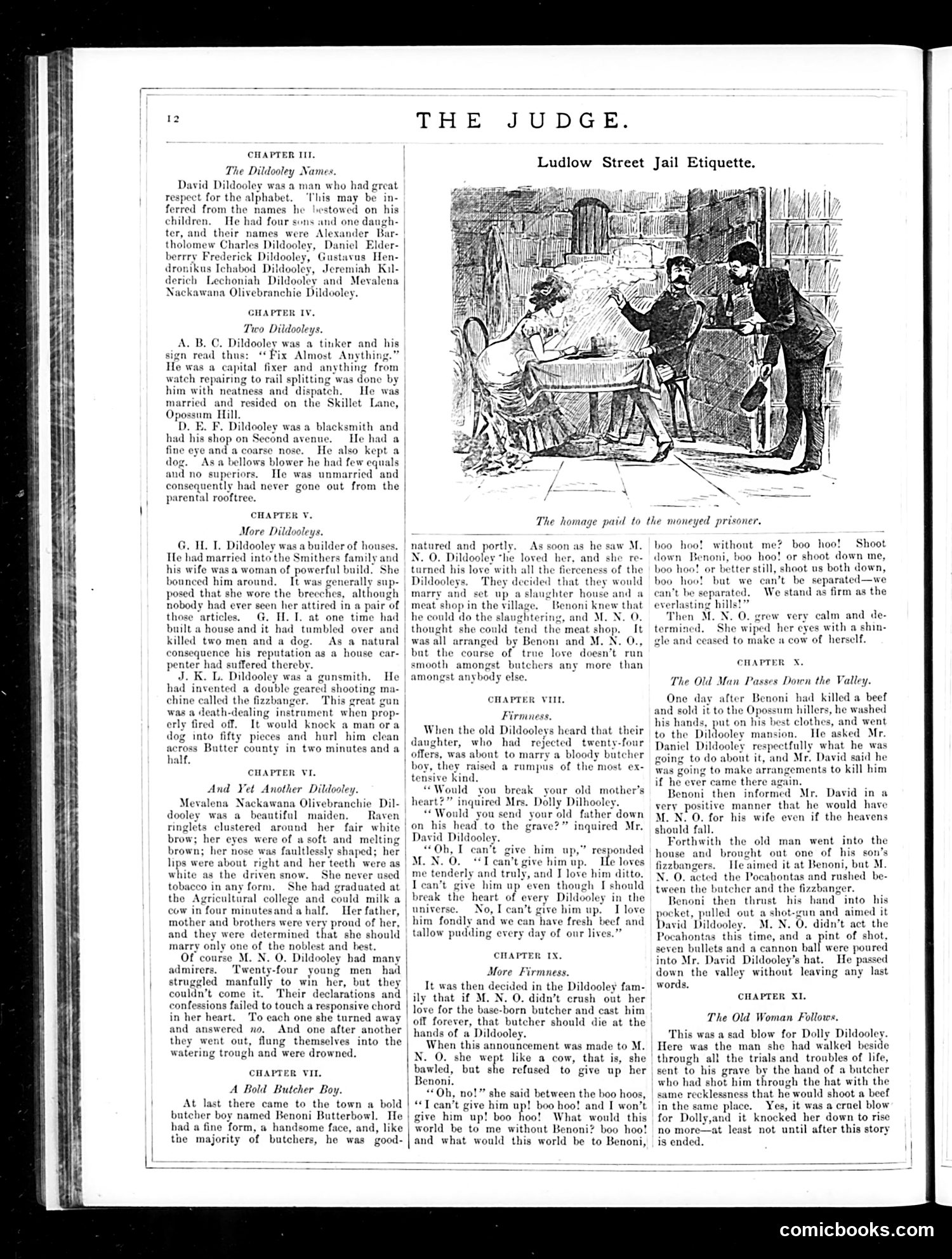
This page from *Judge* magazine contains two distinct pieces: **Left side:** A serialized satirical story called "The Dildooley" series, mocking rural/working-class American family life. The joke is that the Dildooley children have absurdly long, pretentious names (Alexander Bartholomew Charles, etc.) despite their father's illiteracy—satirizing the gap between pretension and reality. The chapters then introduce various Dildooley family members with comic exaggeration: incompetent tradesmen, a domineering wife, a destructive builder, and a beautiful daughter rejecting suitors. The humor targets rural lower-class stereotypes. **Right side:** A cartoon captioned "Ludlow Street Jail Etiquette" showing a well-dressed prisoner receiving deference (a guard appears to be serving him). The accompanying text ("The homage paid to the moneyed prisoner") satirizes how wealthy prisoners received special treatment in jail, implying justice was unequal—the rich literally bought preferential treatment while incarcerated. Both pieces are classic *Judge* fare: mocking social pretension, class absurdities, and institutional corruption.
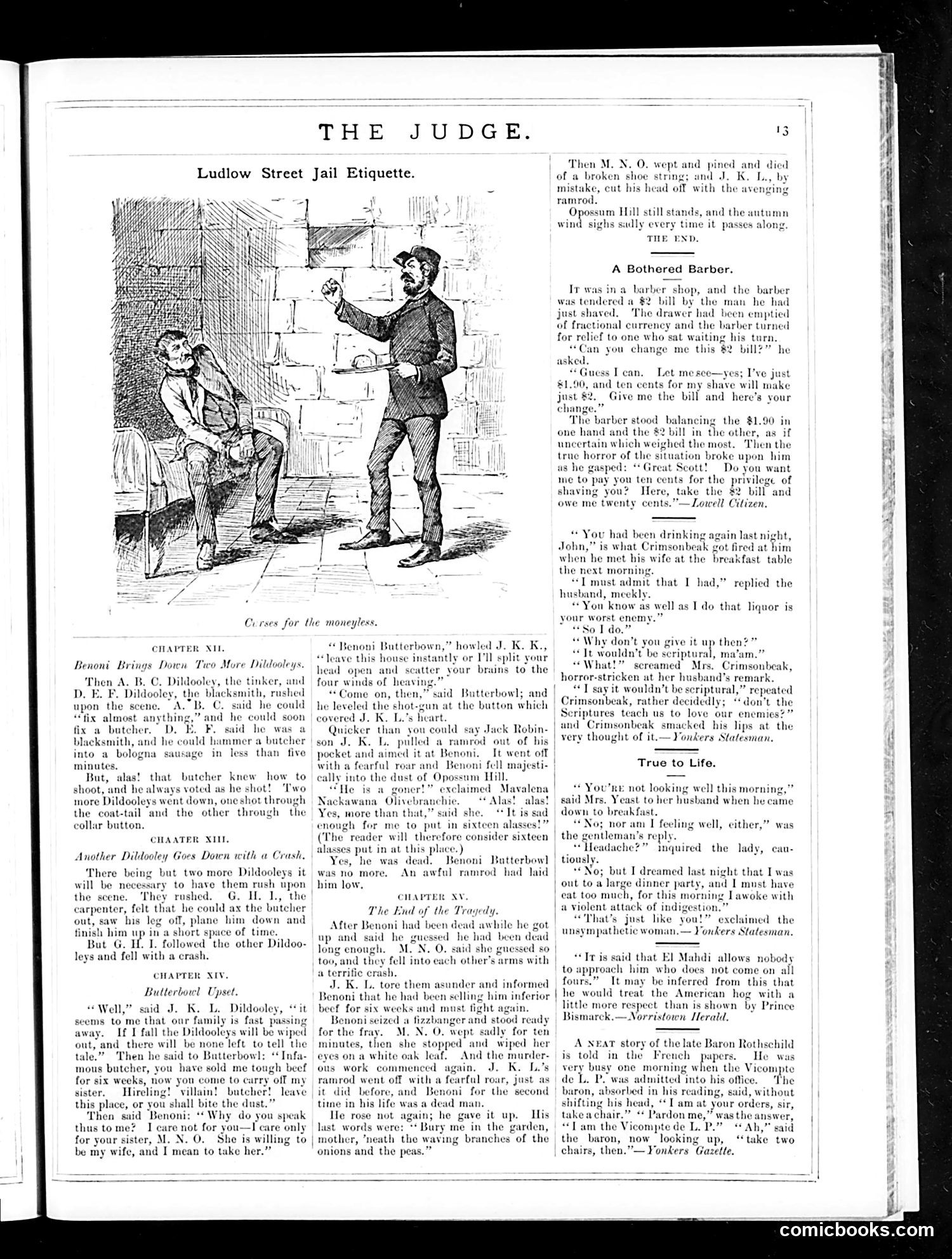
This page contains serialized comic fiction rather than a single cartoon. The main story, "Benoni Brings Down Two More Dildooleys," is a absurdist melodrama set in Opossum Hill featuring characters with repeated surnames (multiple Dildooleys, plus Benoni Butterbowl). The narrative involves a butcher, competing tradesmen (tinker, blacksmith, carpenter), romantic rivalry over a woman named M.N.O., and repeated deaths by ramrod—all rendered in deliberately ridiculous, overwrought language. It appears to parody sensational penny-dreadful fiction popular at the time. The page also includes shorter humor pieces like "A Bothered Barber" (about currency confusion) and domestic comedy sketches. The wood-engraved illustration shows a confrontation in what appears to be a jail cell. The satire mocks melodramatic storytelling conventions rather than targeting specific political figures or events.
This page from *Judge* magazine contains satirical humor pieces typical of the publication's style. The main content includes: **"Things a Woman Can Do"** — A humorous essay listing contradictory female behaviors (saying "no" while meaning "yes," shopping without stopping, enduring abuse, attending multiple social events). The satire mocks both women's supposed inconsistency and men's lack of understanding of women, ending with the joke that women can do everything except climb a tree. **"He Didn't Smoke"** — A comedic anecdote about a drunk man who mistakes a wooden cigar-store Indian statue for a real woman, apologizes for bumping into her, attempts to kiss her, and insists he "never smokes" (a non-sequitur punchline playing on slurred speech). **Brief quips** mocking marriage, wealth, and political figures (including references to an Afghan prince and Congress). The right side contains period advertisements for breweries, candy, and patent medicines. The humor relies on contemporary social assumptions about gender roles and drinking culture rather than sophisticated satire.
This page is primarily filled with **advertisements and brief satirical snippets** rather than full political cartoons. The prominent image is the "Cuticura Remedies" testimonial featuring a young woman—common patent medicine marketing of the era, not satire. The text content consists of **short humorous observations** republished from various newspapers, touching on: - Pennsylvania's marriage statistics and political corruption - Matthew Arnold's criticism of American scale - Businessmen's pretensions (Governor English, the Lowell storekeeper) - Weather complaints and dog-control problems - A man advertising for a "son-in-law position"—absurdist humor - Mockery of excessive religious devotion These are **light social jokes** rather than partisan political satire: they mock human follies, regional stereotypes, and contemporary absurdities through irony and deadpan delivery. The humor assumes 1880s readers' familiarity with named towns and contemporary figures. Most require contextual knowledge now lost to identify specific targets beyond the general subjects (corruption, pretension, superstition). This represents Judge's **filler content**—humor that entertained without demanding detailed political engagement.
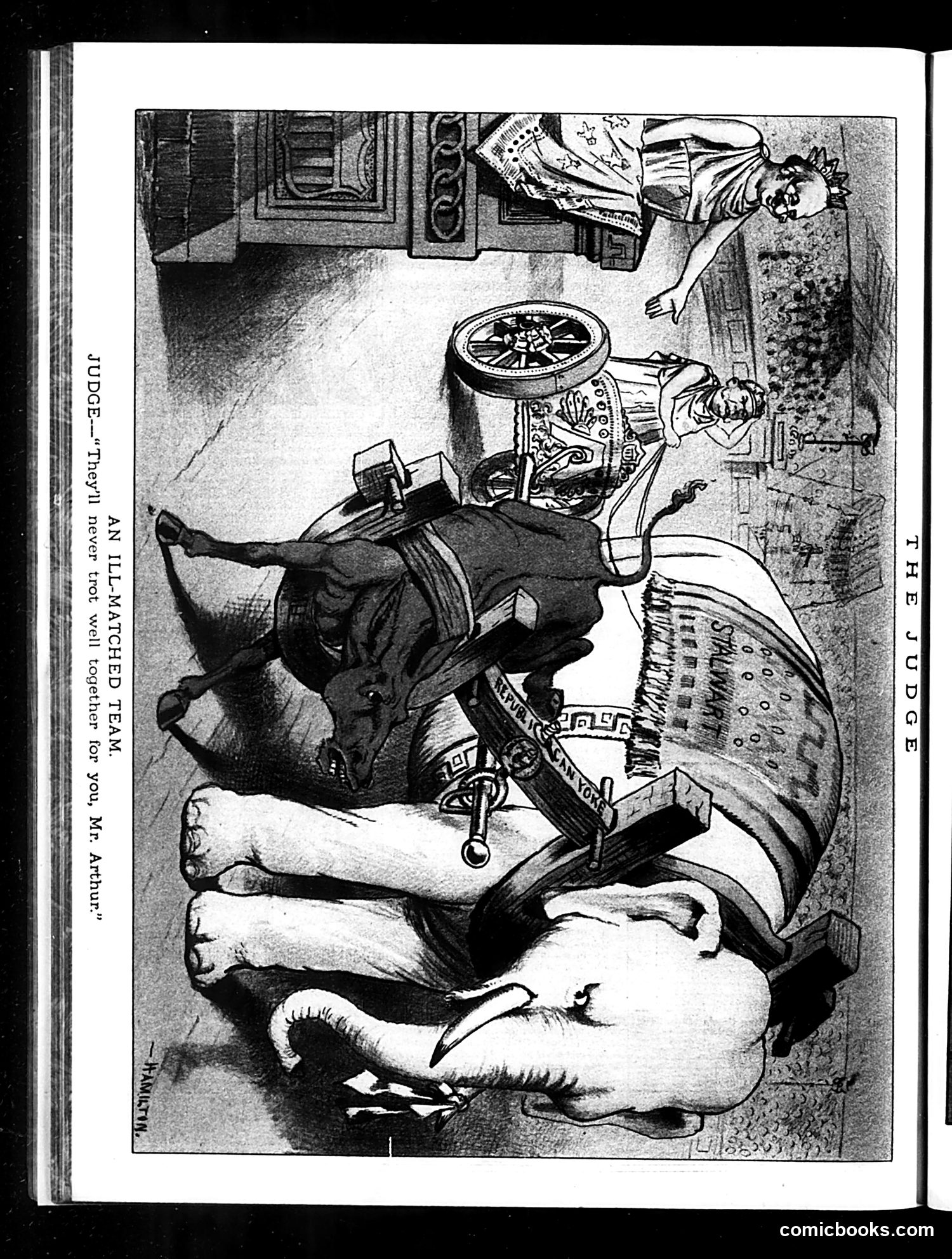
This political cartoon depicts a man (labeled "Mr. Arthur," likely President Chester Arthur) attempting to control two horses pulling in opposite directions. The horses appear to represent conflicting factions or interests within his administration or the Republican Party during his presidency (1881-1885). The caption—"They'll never trot well together for you, Mr. Arthur"—suggests Arthur faced irreconcilable opposing forces he couldn't harmonize. This likely references the Republican Party's internal divisions between the reformist "Half-Breeds" and the patronage-supporting "Stalwarts," competing factions that plagued Arthur's presidency. The satire criticizes Arthur's inability to unite or control these opposing political forces, portraying his leadership as fundamentally compromised by competing interests pulling in different directions.