
Judge, 1884-03-22 · page 10 of 16
Judge — March 22, 1884 — page 10: what you’re looking at
What you’re looking at
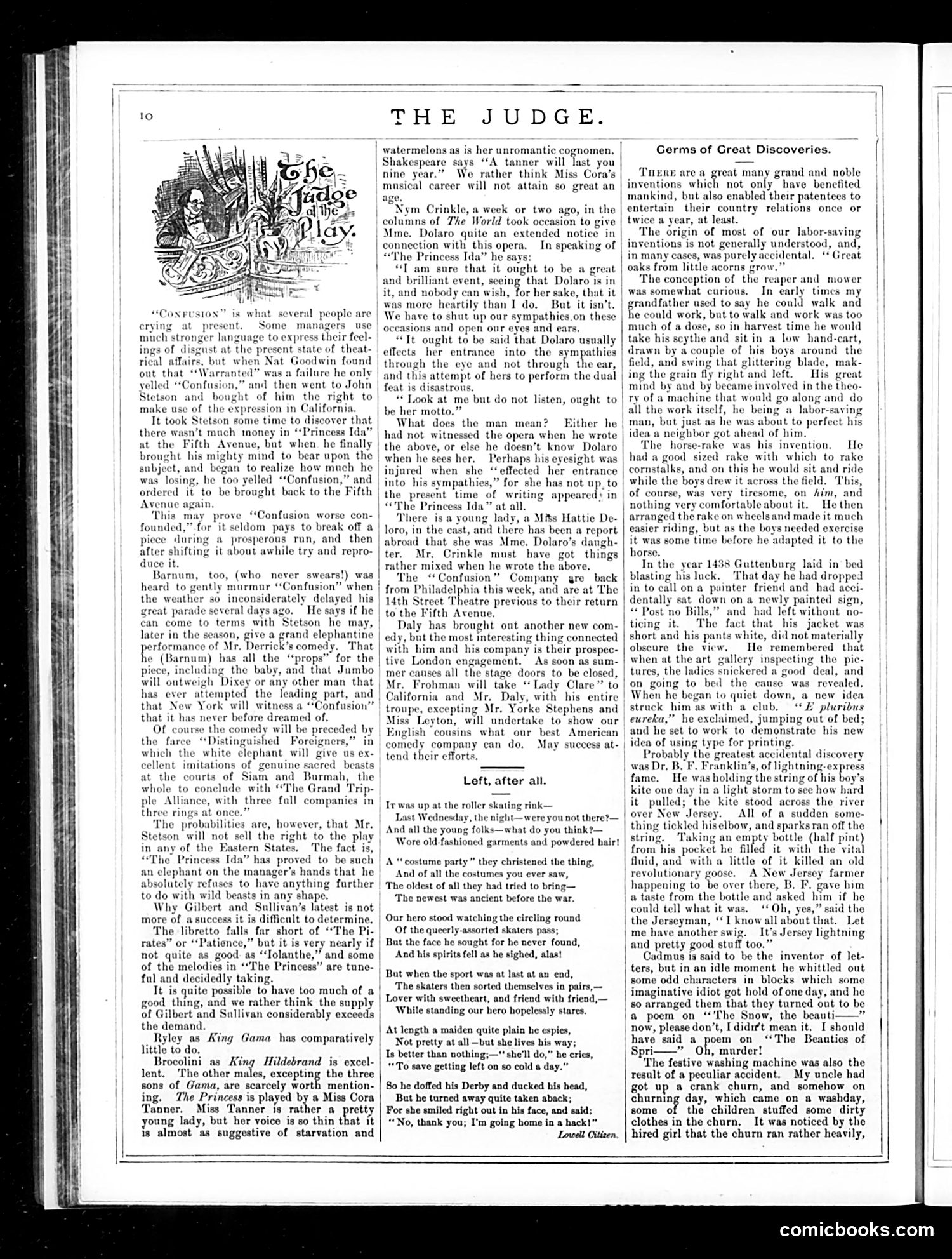
This page from **Judge** magazine critiques Gilbert and Sullivan's opera **"The Princess Ida"** and theatrical trends of the era (appears to be 1880s). The main satire targets: 1. **Theater managers' desperation**: The term "Confusion" (likely referencing a failed play) becomes a running joke—when shows flop, managers desperately recycle and relocate them rather than accepting failure. 2. **"The Princess Ida" as a money-loser**: Despite being by celebrated composers Gilbert and Sullivan, the opera is depicted as an "elephant on the manager's hands"—expensive, burdensome, and unprofitable. 3. **Miss Cora Tanner's weak voice**: The critic mocks her thin, undernourished-sounding soprano, comparing it unfavorably to watermelons (apparently her surname). 4. **Oversaturation**: The piece argues audiences have simply had too much Gilbert and Sullivan—supply exceeds demand. The tone is witty and dismissive of both theatrical management decisions and contemporary opera's decline in appeal.
📄 Transcribed text from this page (OCR, searchable)
Machine-transcribed from the original scan — historical spelling and the odd misread are preserved.
“Coxruston” is what several people are Some managers use e to express their feel- ast at the present state of theat- but wher at Goodwin found Jarranted” was a failure he only yelled “Confusi and then went to John Stetson and it of him the right to make use of the expression in California. It took Stetson some time to discover that there wasn’t much money in ‘Princess Ida” at the Fifth Avenue, but when he finally brought his mighty mind to bear upon the subject, and began to realize how much he was losing, he too yelled ‘Confusion,” and ordered it to be brought back to the Fifth Avenue again. This may prove ng at much stron; out that nu) “Confusion worse con- founded,” for it seldom pays to break off a piece during a prosperous run, and then after shifting it about awhile try and repro- duce it. Barnum, too, (who heard to gently murmur the weather so inco great parade several da ” when ed his s if he etson he m season, give a grand elephantin erformance of Mr. Derrick’s comedy. That he (Barnum) has all the “props” for the piece, including the baby, and that Jumbo will outweigh Dixey or any other man that has ever attempted the leading part, and that New York will witness a ‘‘Confusion” that it has never before dreamed of. Of course the comedy will be preceded by the farce ‘Distinguished Foreigners,” in which the white elephant will give us ex- cellent imitations of genuine sacred beasts at the courts of Siam and Burmah, the whole to conclude with “The Grand Trip- ple Alliance, with three fall companies in | three rings at onc The probabilities are, however, that Mr. etson will not sell the right to the p! any of the Eastern § . The fact i: The Princess Ida” has proved to be such an clephant on the manager’s hands that he absolutely refuses to have anything further to do with wild beast ny shap Why Gilbert and Sullivan’s latest is not more of a success it is difficult to determine. The libretto falls far short of “The Pi rates” or ‘Pati but it is very nearly if not quite a s “Tolanthe,”” and some of the melodies in ‘“The Princess” are tune- fal and decidedly taking. It is quite possible to have too much of a good thing, and we rather think the supply of Gilbert and Sullivan considerably exceeds the demand. Ryley as King Gama has comparati little to do, Brocolini as King Hildebrand is excel- lent. ‘The other males, excepting the three sons of Gama, are scarcely worth mention- ing. The Princess is played by a Miss Cora Tanner. Miss Tanner is rather a pretty young lady, but her voice is so thin that it is almost as suggestive of starvation and in THE JUDGE. watermelons as is her unromantic cognomen. | Shakesp. “A tanner will We rather think Miss Cora’s | eer will not attain so great “Nym Crinkle, a week or two ago, in the columns of The World took occasion to give Mme. Dolaro quite an extended notice in | connection with this opera. In speaking of “The Princess Ida” he says: | “Tam sure that it ought to be a great | and brilliant event, that Dolaro is in it, and nobod sh, for her sake, that it was more heartily than I do. But it isn We have to shut up our sympathi oceasions and open our eyes and ears. “Tt ought to be said that Dolaro usually | effects her entrance into the sympathies through the and not through the ar, and this attempt of hers to perform the dual feat is disastrous. | ** Look at me but do not listen, ought to be her motto.” What does the man mean? Either he had not witnessed the opera when he wrote the above, or else he doesn’t know Dolaro when he sees her. Perhaps his eyesight was injured when she ‘effected her entrance into his sympathies,” for she has not up_to the present time of writing a areds in “The Princess Ida’ M. There isa young lady, a Mis Hattie De- | loro, in the cast, and there has been a report abroad that she was Mme. Dolaro’s daugh- ter. Mr. Crinkle must have got things | rather mixed when he wrote the above. | “The “Confusion” Company gre back from Philadelphia this w and are at The 14th Street Theatre previous to their return to the Fifth Avenue, Daly has brought out another new com- edy, but the most interesting thing connected | with him and his company is their prospec- | tive London engagement. As soon as sum- | the stage doors to be closed, n will take “Lady Clare” to | Mr. Daly, with his entire ° Mr. Yorke Stephens and Miss Leyton, will undertake to show our English cousins what our best American | comedy company can do. May success at- tend their efforts. Left, after all. Ir was up at the roller skating rink— it—were you not theret— And all the young folks—what do you think?— Wore old-fashioned garments and powdered hair! | A “‘costume party” they christened the thing, | And of all the costumes you ever saw, The oldest of all they had tried to bring— | The newest was ancient before the war. Our hero stood watching the circling round | | Of the qucerly-assorted skaters pass; | | But the face he sought for he never found, And his spirits fell as he sighed, alas! But when the sport was at last at au end, | ‘The skaters then sorted themselves in patrs,— Lover with sweetheart, and friend with friend, While standing our hero hopelessly stares. | At length a maiden quite plain he espies, Not pretty at all —but she lives his way; Is better than nothing;—* she'll do,” he cries, “To save getting left on $0 cold a day.” | So he doffed his Derby and ducked his head, But he turned away quite taken aback; For she smiled right out in his face, and said: “No, thank you; I'm going home in a hack!" Loedll Citizen. | was Dr. B. | a taste from th Germs of Great Discoveries. pare a great many grand and noble inventions which not only have benefited mankind, but also enabled their patentees to entert, their country relations once or twi year, at least. The origin of most of our labor-saving inven' not generally understood, and, i y cases, Was purely accidental. ‘* Great oaks from little acorns grow.” The conception of the reaper and mower s somewhat curious, In early times my grandfather used to say he could walk and he could work, but to walk and work was too | much of a dose, so in harvest time he would take his scythe and sit in a low hand-cart, drawn by couple of his boys around the field, and swing t glittering the grain fly right and left. — His mind by and by became involved in the theo- ry of a machine that would go along and do wing st. as he was about to perfect his hbor got ahead of him. he rake was his invention. He had a good ed rake with which to rake cornstalks, and on this he would sit and while the boys drew it across the field. ‘T’ of course, was very tiresome, on him, and nothing very comfortable about it. He then arranged the rake on wheels and made it much sier riding, but as the boys needed exercise it was some time before he adapted it to the horse, In the year 1 blasting his luc in to all the work itself, he being a labor: Guttenburg laid in bed That day he had droppe allona puinter friend and had ace | dentally sat down ona newly painted sign, “Post no Bills,” and had left without no- ticing it. The fact that his jacket wi short and his pants white, did not materially obscure the view He remembered that when at the art gallery inspecting the pic- tures, the ladies snickered a good deal, and on going to bed the cau revealed. When he began to quiet down, a new idea struck him as with a club. ‘2 pluribus eureka,” he exclaimed, jumping out of bed; and he set to work to demonstrate his new idea of using type for printing. Probably th accidental discovery nklin’s, of lightning-express He was holding the string of his boy’s kite one in a light storm to see how hard it pulled; the kite stood across the river over New Jersey. All of a sudden some- thing tickled his elbow, and sparks ran off the string. Taking an empty bottle (half pint) from his pocket he filled it with the vital fluid, and witha little of it killed an old revolutionary goose. A New Jersey farmer happening to be over there, B. F. gave him bottle and asked him if he could tell wi it “Oh, yes,” said the the Jerseyman, ‘I knowall about that. Let me have another swig. It’s Jersey lightning and pretty good stuff too.” Cadmus is said to be the inventor of let- ters, but in an idle moment he whittled out some odd characters in blocks which some imaginative idiot got hold of one day, and he so arranged them that they turned out to be a poem on “'The Snow, the beautim” now, please don’t, I didi’'t mean it. I should have said a poem on ‘The Beauties of Spri—””_ Oh, murder! ‘The festive washing machine was also the result of a peculiar accident. My uncle had got up a crank churn, and somehow on churning day, which came on a washday, some of the children stuffed some dirty clothes in the churn, It was noticed by the hired girl that the churn ran rather heavily, fame. comicbooks.com