
Judge, 1884-03-22 · page 4 of 16
Judge — March 22, 1884 — page 4: what you’re looking at
What you’re looking at
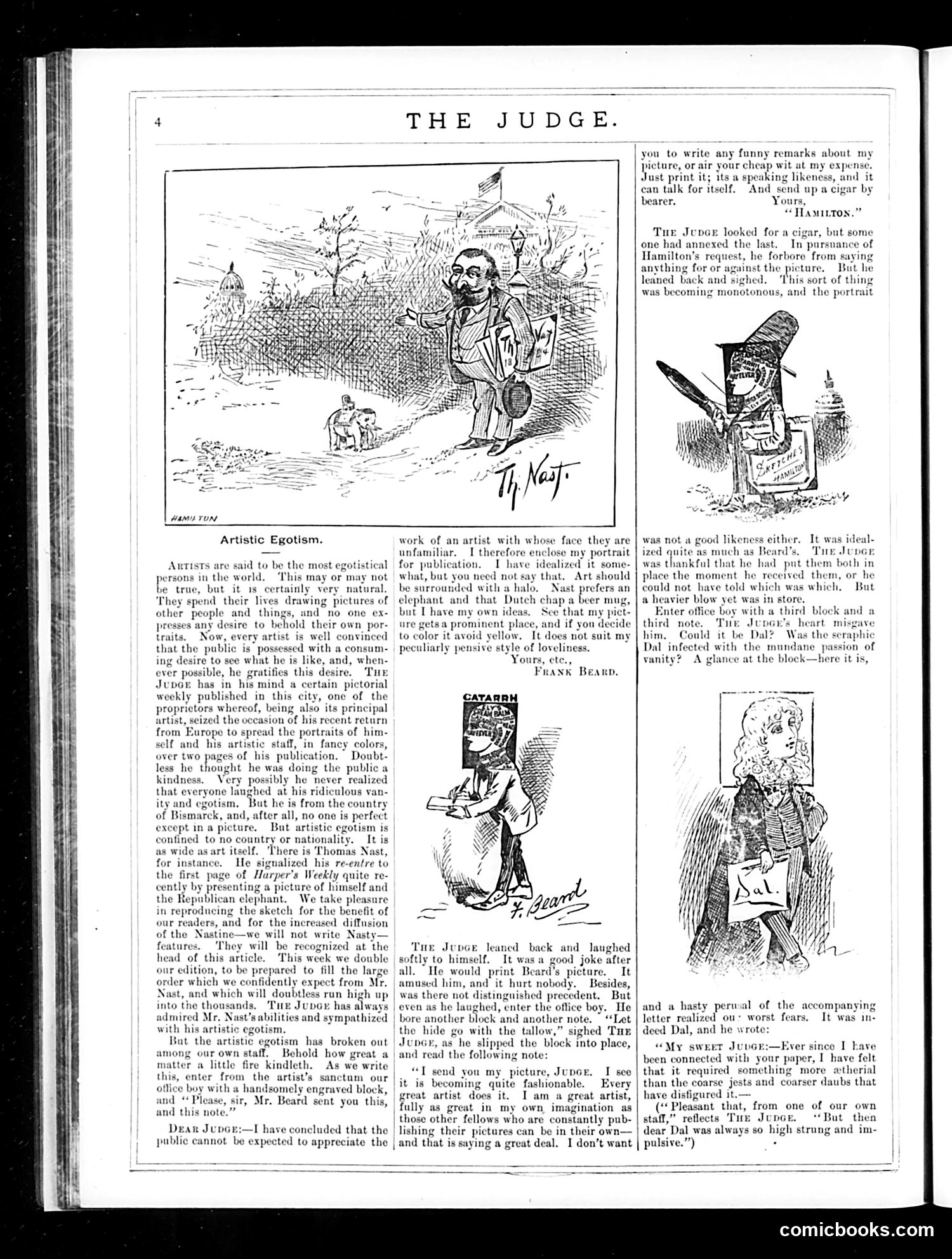
This page satirizes vanity among prominent artists of the era, particularly their self-promotion through self-portraits. **The targets:** - Thomas Nast, the famous cartoonist, recently returned to Harper's Weekly and published a large self-portrait alongside a Republican elephant - An unnamed artist "Beard" who similarly submitted an idealized self-portrait to Judge - A third artist "Hamilton" who sent another self-portrait with an arrogant note **The joke:** Judge mocks the "artistic egotism" of these illustrators who demand prominent publication of flattering portraits of themselves, claiming the public desperately wants to see their faces. The editor's exasperation—receiving multiple self-portrait submissions—underscores the absurdity. The satire suggests these artists mistake their professional importance for genuine public interest in their personal vanity. The piece gently ridicules a specific professional vanity while acknowledging Nast's genuine talent, treating the phenomenon as both amusing and slightly ridiculous.
📄 Transcribed text from this page (OCR, searchable)
Machine-transcribed from the original scan — historical spelling and the odd misread are preserved.
THE JUDGE. HAMILTON Artistic Egotism. AnTists are said to be the m istical persons in the world. ‘This may or may not be true, but it 1s certainly very natu They spend their lives drawing pictures of other people and things, und no one ex- presses any desire to behold their own. por- traits. Now, every artist is well convinc that the public is’ possessed with a consum- ing desire to see what he is like, and, when- i he gratifies this desire. Ture has in his mind a certain pictorial weekly published in this city, one of the proprietors whereof, being also its principal zed thi jon of his recent return from E ad the portraits of him- self and his artistic staff, in fancy colors, over two pages of his publication. Doubt- less he thought he was doing the public a kindness, Very possibly he never realized that everyone laughed at his ridiculous van- r tism. But he is from the country of Bismarck, and, after all, no one is perfect except ina picture, But artistic egotism is confined to no country or nationality. It is sart itself. There is Thomas Nast, He signalized his re-entre to of Harper’s Weekly quite re- presenting a picture of himself and blican elephant. We take ph in reproducing the sketch for the benefit of our readers, and for the increased diffusion of the Ni e—we will not write Nasty— features. will be recognized at the head of this article. This week we double our edition, to be prepared to fill the large order which we confidently expect from Mr. Nast, and which will doubtless run high up into the thousands. Tue Jupor has always admired Mr, Nast’s abilities and sympathized with his artistic egotism. Bat the artistic egotism has broken out among our own staff. Behold how great a matter a little fire kindleth. As we write this, enter from the artist’s sanctum our with a handsomely engraved block, and “Please, sir, Mr. Beard sent you this, and this note.” —I have concluded that the public cannot be expected to appreciate the work of an artist with whose face they are unfamiliar. I therefore enclose my portrait for publication. I have idealized it some- what, but you need not say that. Art should urrounded with a halo. Nast prefers an elephant and that Dutch chap a beer mug, but [have my own ideas. Sce that my pic prominent place, and if you decide to color it avoid yellow. It does not suit my style of loveliness. « Bearn, Tur Jupce leaned softly to himself. It ws I. “He would print Beard amused him, and it hurt nobody. Besides, was there not distinguished precedent, But even as he laughed, enter the office boy. He bore another block and another note. | “Let the hide go with the tallow,” sighed THE JunGE, as he slipped the block into place, and read the following note: back and laughed ood joke after picture. It “T send you my_ picture, June it is becoming quite fashionable great artist does it. I am a fully as great in my own, imag' those other fellows who are constantly pub- lishing their pictures can be in their own— | and that is saying a great deal. I don’t want | you to write any funny rem: | picture, or air your cheap wit Just print it; its a speaking likeness, and it can talk for itself. And send up a cigar by bearer. Yours, “TAMILTON.” ‘ks about my t my expense. gar, but some t. In pursuance of forbore from saying inst the picture, But he This sort of thing Hamilton's request, anything for or a; leaned back and vas becoming monotonous, and the portrait was not a good likeness It was ides ized quite as much as Be: . The Jupce thankful that he had put them both in place the moment he received them, or he could not have told which was which, But J ‘as in store. Snter office boy with a third block and a third note. Tue JupGe’s heart misgave him, Could it be Dal? Was the seraphic Dal infected with the mundane passion of vanity? A glance at the block—here it is, and a hasty perusal of the letter realized ou: worst fes deed Dal, and he wrote: ‘companying Tt was in- “My sweet JuvGe:—Ever since I have been connected with your paper, I have felt that it required something more atherial than the coarse jests and coarser daubs that have disfigured it.— (‘Pleasant that, from one of our own staff,” reflects Tue Jupoe. ‘But then dear Dal was always so high strung and im- pulsive.”) comicbooks.com