
Judge, 1884-03-22 · page 3 of 16
Judge — March 22, 1884 — page 3: what you’re looking at
What you’re looking at
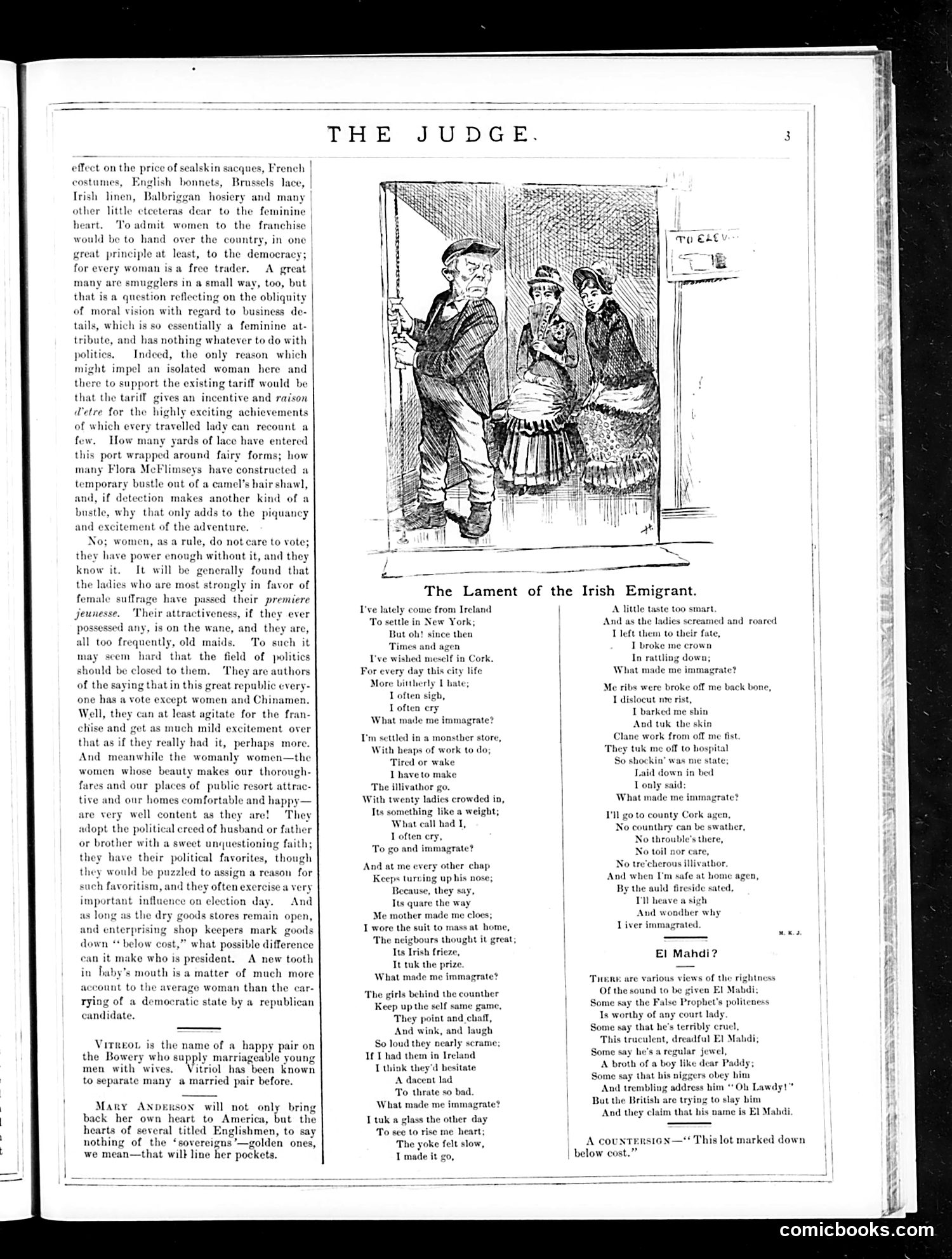
This page satirizes Irish immigration to America, specifically the culture clash experienced by Irish workers in New York City. The illustrated poem—a monologue by an Irish immigrant—depicts a man struggling with his transition from rural Ireland to urban American factory work. The satire centers on the immigrant's bewilderment at American customs and mockery he faces. He laments leaving Cork, describes exhausting retail work with crowds of demanding female customers, and recounts being ridiculed for wearing his old Irish suit to church. The poem emphasizes the Irish worker's alienation, homesickness, and the harsh treatment he receives from Americans (particularly Irish-American women who seem to look down on him as "fresh off the boat"). Judge's satire appears directed at both the immigrant's naïveté and American society's treatment of newcomers. The adjoining political text mocking female suffrage and women's consumer power provides additional context about the magazine's conservative editorial stance.
📄 Transcribed text from this page (OCR, searchable)
Machine-transcribed from the original scan — historical spelling and the odd misread are preserved.
effect on the price of sealskin sacques, French costumes, English bonnets Irish linen, Balbriggan ho: Brussels lace, ery and many other little etecteras dear to the feminine heart. To admit women to the franchise would be to hand over the country, in one great principle at least, to the democracy; for every woman is a free trade! many are smugglers in a small v that isa quest A great , too, but n reflecting on the obliquity of moral vision with regard to business de- tails, which is so essentially a feminine at- tribute, and has nothing wi polit Indeed, the only reason which might impel an isolated woman here and there to support the existing tariff would be that the tariff ever to do with ives an incentive and raison etre for the highly exciting achievements of which every travelled lady can recount a few. Low many yards of lace have entered port wrapped around fairy forms; how many Flora McFlimseys have constructed a temporary bustle out of a camel's hair shawl, and, if detection makes another kind of a bustle, why that only adds to the piquancy and excitement of the adventure. No; wome a rule, do not care to vote; they have power enough without it, and they know it. It will be generally found that ies who are most strongly in favor of » suffrage have jeunesse. sed their premiere ‘Their attractiveness, if they ever possessed any, is on the war all too frequently, old maids, To such it may seem hard that the field of politics should be closed to them. ‘They are authors of the saying that in this great republic every- one has a vote except women and Chinamen. Well, they can ate for the fri chise and get as much mild excitement over that as if they really had it, perhaps more. And meanwhile the womanly women—the women whose beauty make least a; our thorough- fares and our places of public resort attra tive and our homes comfortable and happy— are very well content as they are! The adopt the political creed of husband or father or brother with a sweet unqu they have their political favorites, though they would be puzzled to assign a re such favoritism, and they often exere! important influence on election di as long as the dry and enterprisin tioning fait nods stores remain open, shop keepers mark ” what possible difference can it make who is president. A new tooth in baby’s mouth isa matter of much more account to the average woman than the car- rying of a democratic state bi candidate. down ** below co: a republican Virreor is the name of a happy pair on the Bowery who supply marriageable young men with wives. Vitriol has been known to separate many a married pair before. Many ANpeERSON will not only bring back her own heart to America, but the hearts of several titled Englishmen, to say nothing of the ‘sovereigns’—golden ones, we mean—that wilt line her pockets. aa The Lament I’ve lately come from Ireland To settle in New York; But ob! since then Times and I've wished meself in Cork, For every day this city life More bittherly [ hate; I'm settled in a monsther store, With heaps of work to do; Tired or wake Thaveton The illivathor go. With twenty ladies crowded in, Its something like a wei What call had I, And at me Keeps tur Its quare the wa Me mother made me I wore the suit to mass at hon It tuk the p What made m They point and chaff, And wink, and | So loud they nearly scrame; If I had them in Ireland IT think th 1 hesitate A dacent lad To thrate so What made me in T tuk a glass the other day ‘To sec to rise me heart; The yoke felt slow, T made it of the Irish Emigrant. A little taste too smart And as the ladies sei I left them to their fat I broke In rat What made me im ned and roared Me ribs were broke off me back bone, I dislocut nte rist, I barked me shin And tuk the skin Clane work from off me fist. They tuk me off to pital So shockin’ was Laid down in bed Tonly said: What made me immagrate? I'll goto county Cork agen, No be swat No toil nor car No tre'cherous illiv And when I'm safe at home agen, By the auld fireside sated, Ti heave a sigh And wondber why Liver im ted. El Mahdi? ‘Tnere are various views of the ri Of the sound to be given El Mahdi: Some say the False Prophet's politen Is worthy of any court lady Some say that he’s terribly cruel, This truculent, dreadful El Mahdi; Some say | gular jewel, A broth of a boy like dear Paddy Some say that his ni; ‘And trembling address him ‘Ob Lawdy!” But the British are trying to slay And they claim that his name is ers obey him Mahdi. OUNTERSIGN—*‘ This lot marked down comicbooks.com