
A complete issue · 71 pages · 1924
Captain Billy's Whiz Bang #67
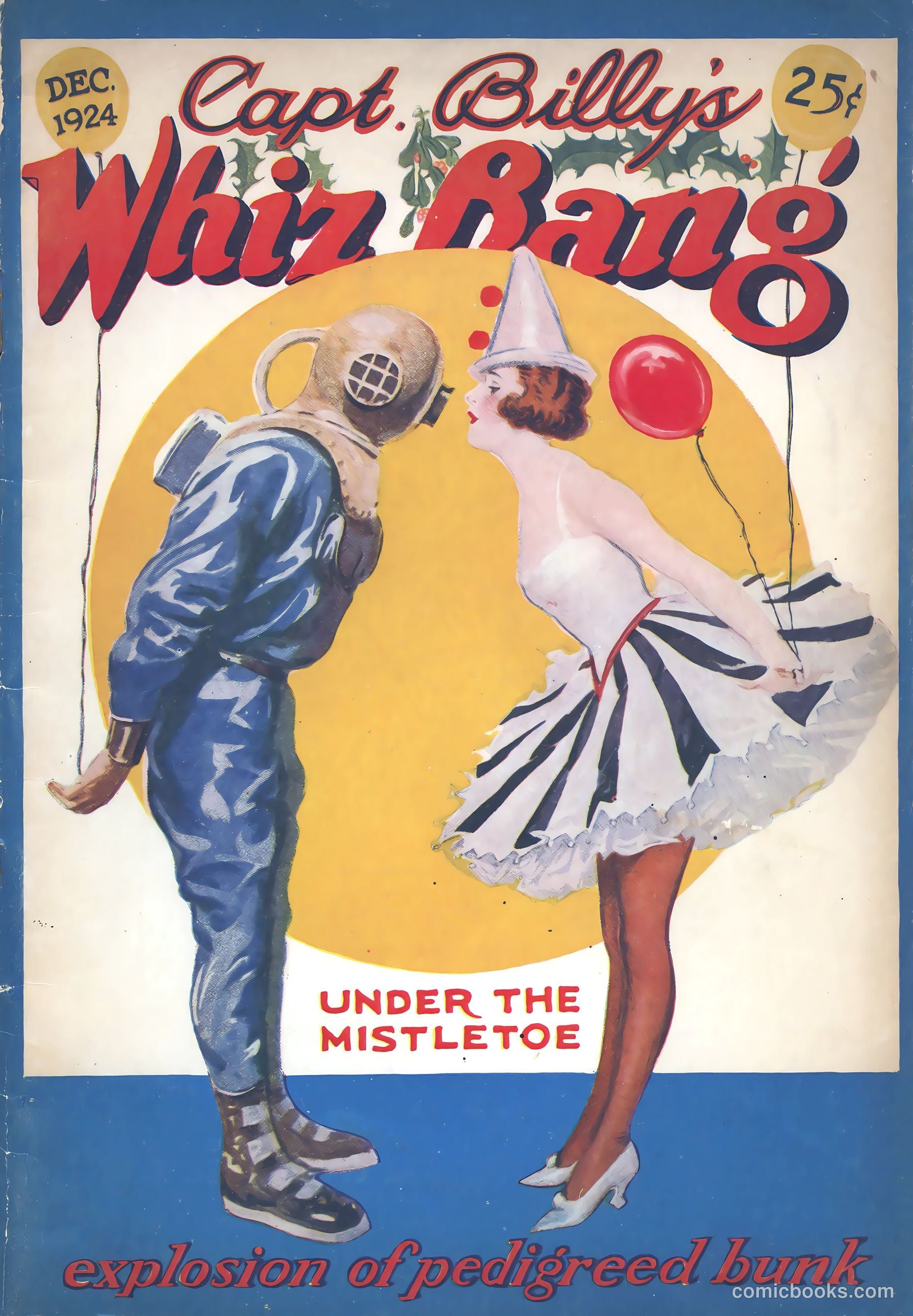
This December 1924 cover from *Capt. Billy's Whiz Bang* satirizes romantic holiday encounters. The illustration shows a couple under mistletoe: a man in a blue diving suit (absurdly formal for romance) confronting a woman in a festive party dress holding a red balloon. The joke appears to be about awkward or mismatched romantic situations during Christmas celebrations—the diving suit suggests something ridiculous or out-of-place about the would-be suitor. The subtitle "explosion of pedigreed bunk" indicates the magazine is mocking sentimental holiday romance as pretentious nonsense. *Whiz Bang* was known for irreverent humor targeting post-WWI American culture, and this cover typifies its satirical approach to holiday sentimentality and courtship conventions of the era.
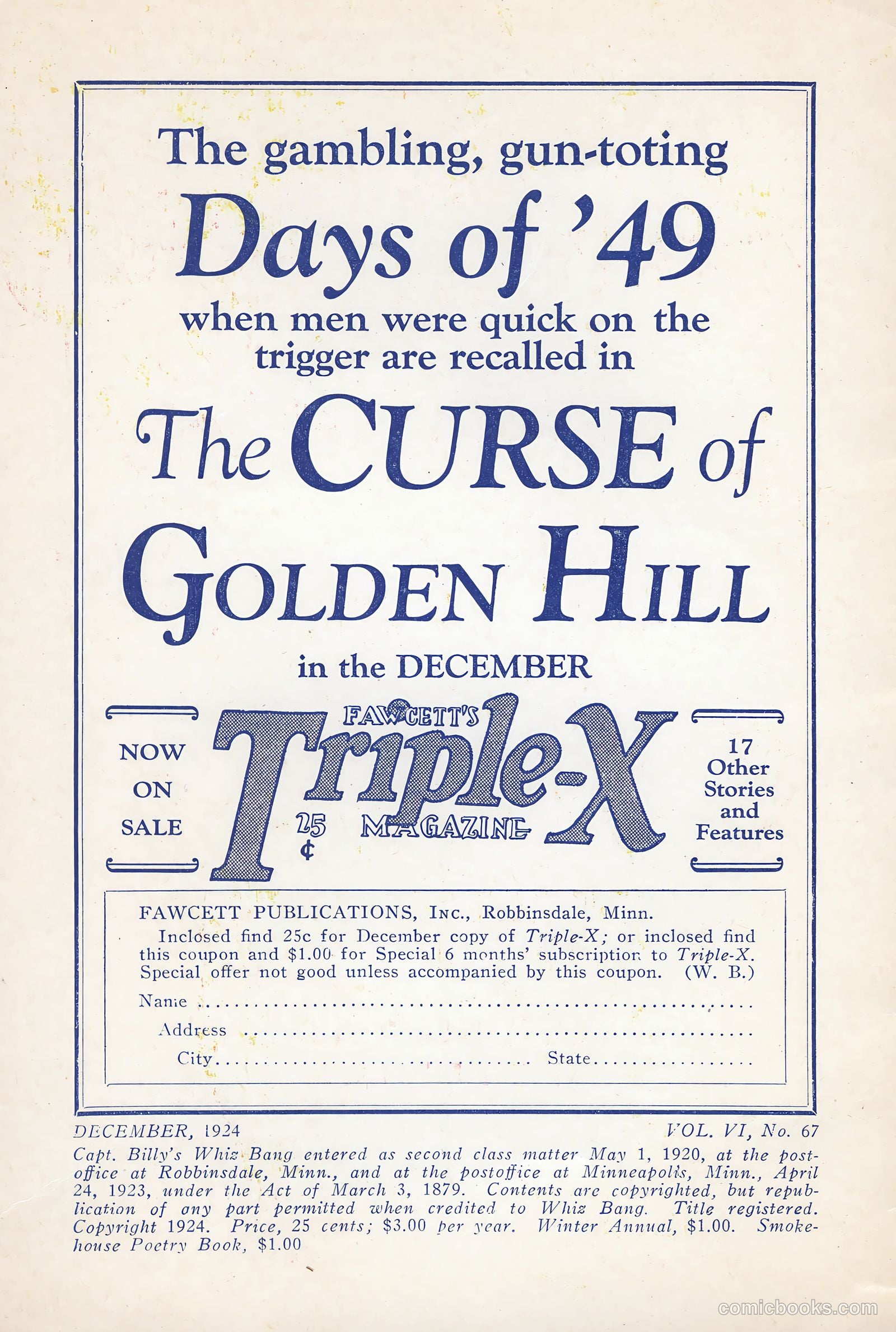
This is primarily an **advertisement page**, not a cartoon. It promotes the December issue of *Triple-X* magazine (25¢), published by Fawcett Publications in Robbinsdale, Minnesota. The ad announces a serialized story titled "The Curse of Golden Hill," which appears to be a Western adventure tale referencing the California Gold Rush era ("Days of '49"). The narrative promises themes of gambling, gunfighting, and frontier violence—typical pulp fiction elements of the 1920s. The page includes a subscription offer: 25¢ for the December issue, or $1.00 for six months' subscription. The bottom contains publication details indicating this is from *Whiz Bang*, a satirical magazine published in December 1924 (Volume VI, No. 67), with a price of 25¢. No specific political satire or caricatures are evident on this page—it's essentially a magazine cover advertisement.
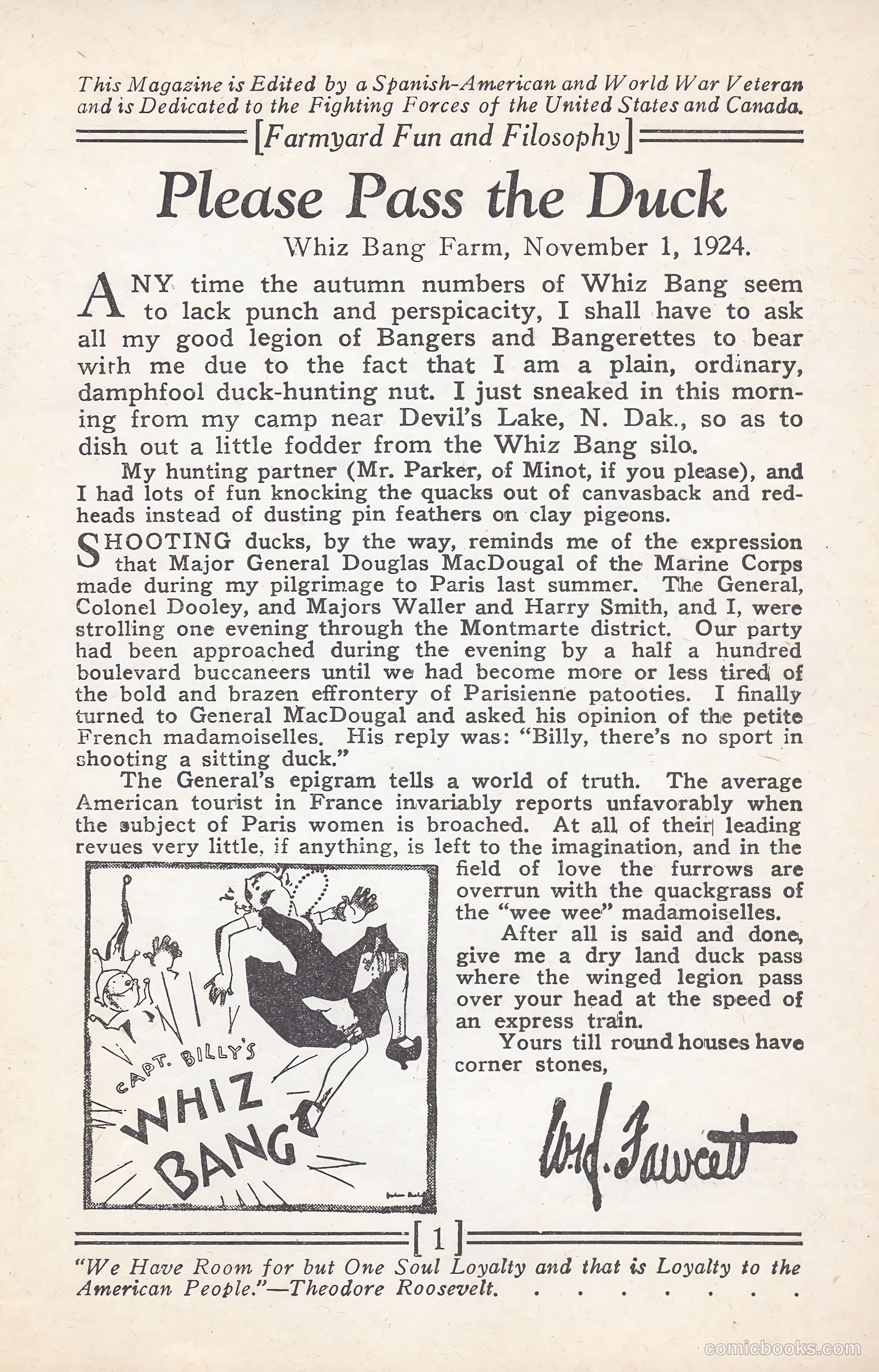
This is a humorous farmyard column from *Whiz Bang*, a post-WWI satirical magazine. The author—identifying himself as a duck-hunting enthusiast—apologizes for the autumn issue's quality, explaining he's been preoccupied with hunting near Devil's Lake, North Dakota. The piece includes an anecdote about Major General Douglas MacDougal of the Marine Corps dismissing Parisian women as unworthy subjects, joking that "there's no sport in shooting a sitting duck"—a double entendre comparing passive targets to the city's women. The unsigned illustration (likely by the editor) shows a cartoonish figure labeled "Capt. Billy's Whiz Bang," depicting the magazine's irreverent, bawdy humor typical of 1920s veteran publications. The tone is self-aware and lighthearted, positioning the magazine as speaking to a masculine readership comfortable with crude jokes and hunting references.
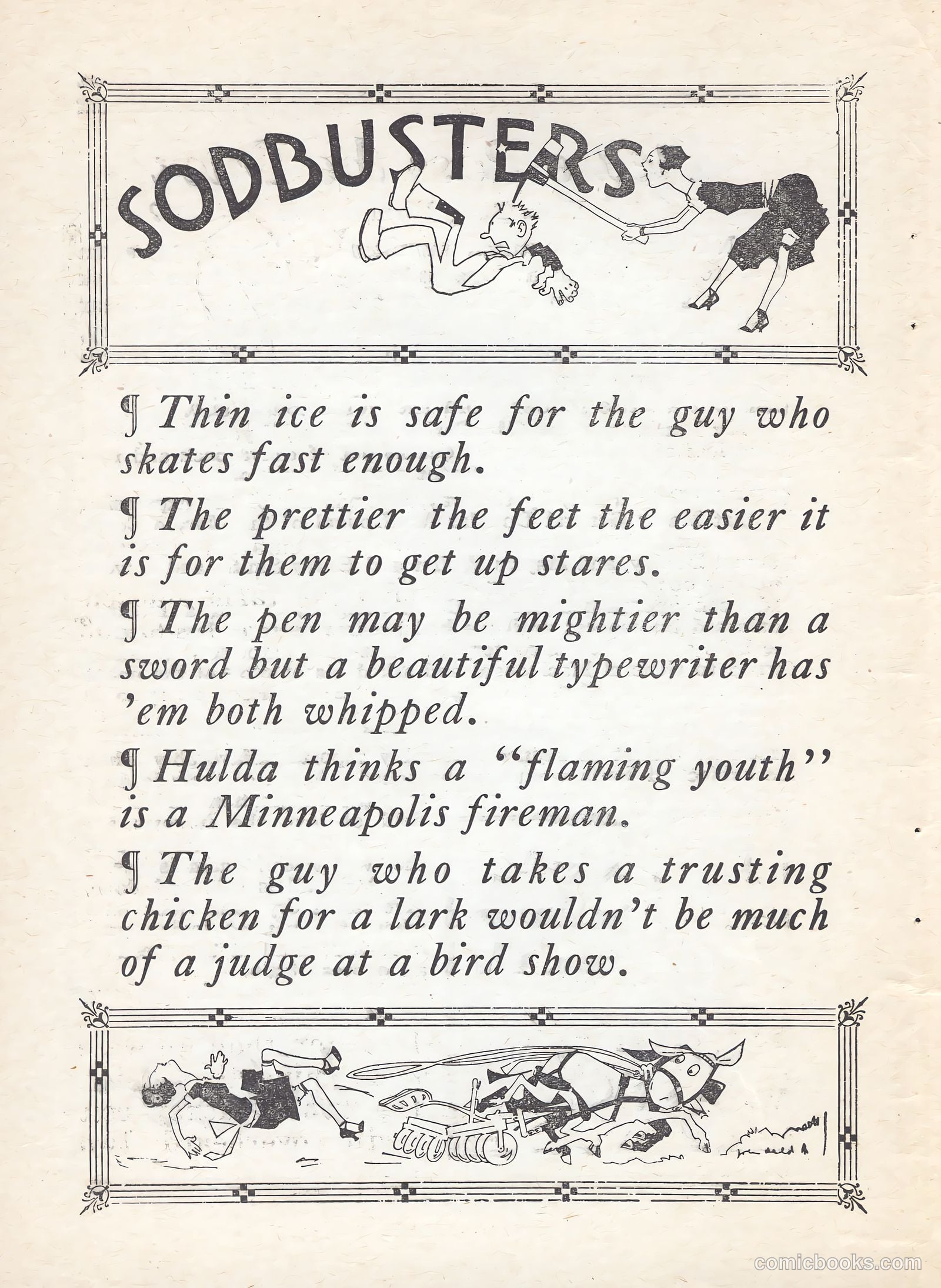
This page from *Whiz-Bang* presents humorous "sodbusters"—rural wisecracks mocking small-town and farm life. The cartoons feature exaggerated slapstick scenes of pratfalls and chaos. The text offers dry, sardonic observations: skating on thin ice as a metaphor for risky behavior; commentary on physical attractiveness ("prettier feet"); a joke about typewriters replacing martial prowess; mockery of rural Midwesterners (Hulda misidentifying youth culture as firefighters); and skepticism about someone's judgment with animals. These sketches represent 1920s urban humor directed at rural Americans—portraying farmers and small-town folk as simple, unsophisticated, and prone to foolish mistakes. The satire assumes a cosmopolitan reader laughing at rural naïveté and outdated values.
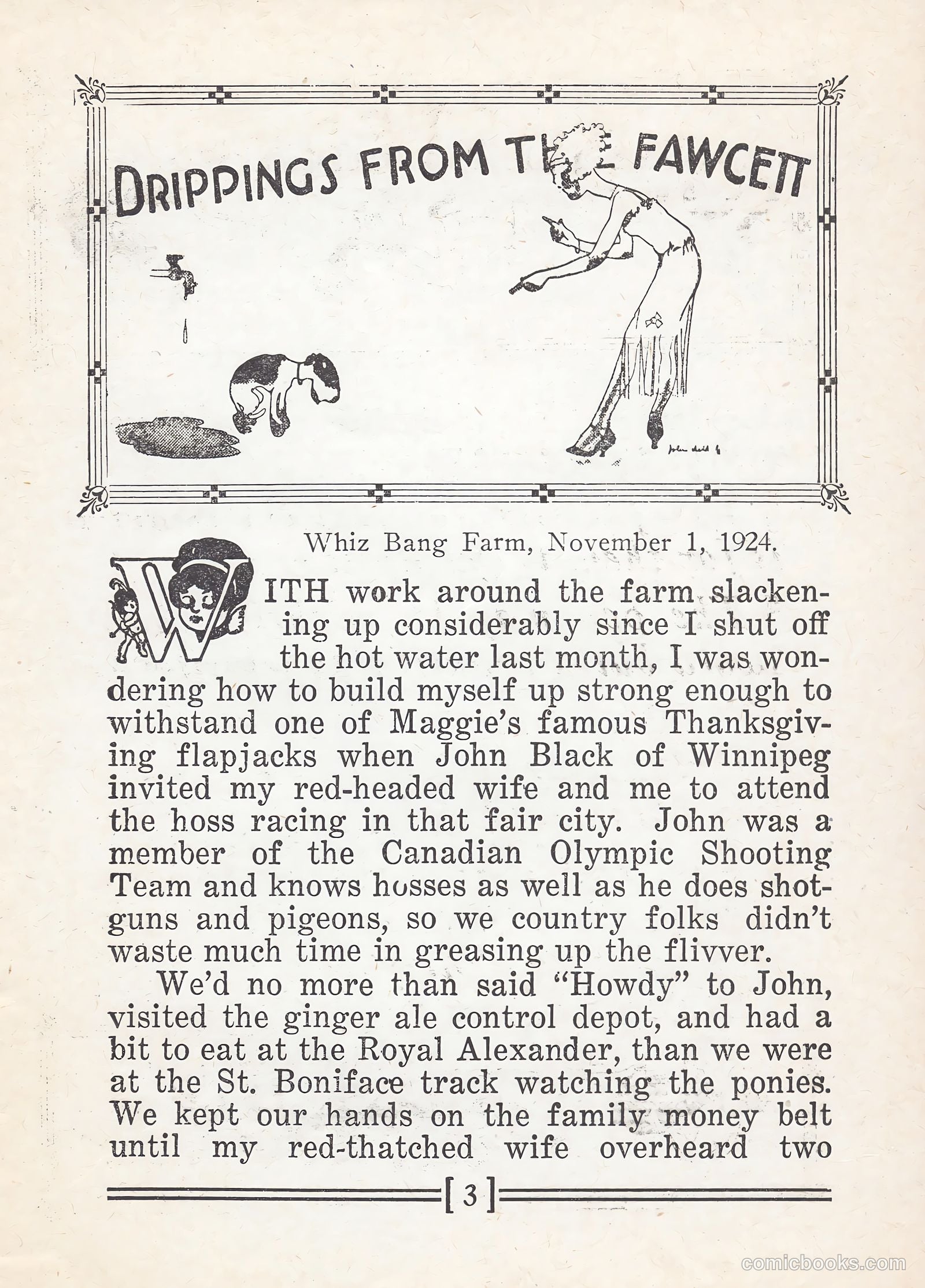
This is a humorous column from *Whiz Bang*, a satirical magazine popular in the 1920s. The cartoon header depicts a woman scolding a dog—illustrating the rural/domestic humor to follow. The narrative satirizes small-town life and Prohibition-era hypocrisy. A farmer describes visiting Winnipeg with his wife for horse racing. Key satirical points: - **"Hot water"** and the **"ginger ale control depot"** are thinly veiled references to alcohol (likely bootleg whiskey), mocking Prohibition enforcement and casual lawbreaking. - The phrase **"family money belt"** suggests marital financial control—a common comedy trope. - References to Thanksgiving "flapjacks" and a Canadian Olympic shooter add folksy, period-specific color. - The humor targets both rural naiveté and urban sophistication, while implying casual drinking during Prohibition. The column appears to continue beyond this page, cutting off mid-sentence.
This page from the satirical magazine contains a humorous tall tale about horse racing. A young jockey brags about riding "the fastest horse in the world," claiming it performed impossibly—passing eight horses, stopping mid-race, giving birth to a colt, winning anyway, with the newborn colt finishing second. A gullible farmer ("hay-shaker") believes this obvious fabrication and bets money on the jockey, who immediately falls off after 30 yards, exposing the lie. The satire mocks both credulous people susceptible to outlandish boasts and the culture of horse racing gambling. The closing quip—calling racing the "Sport of Kings—Queens—and the Joker"—suggests the sport attracts foolish bettors. The page also notes Winnipeg's jockey club success and Manitoba's legalized alcohol ("wet...under government control"), presenting these as signs of general contentment.
This page from *Whiz Bang* (a satirical magazine known for irreverent humor) contains three brief jokes: 1. **The opening poem** is a reader's complaint using animal puns ("fowl literature," "BULLEtin," "Stable Corporation") to mock the magazine's name and its request for donations—suggesting *Whiz Bang* isn't worthy of financial support. 2. **Hulda's story** is a simple joke about misunderstanding: a singer who performed well at a harvest festival cries when asked to repeat, interpreting the encore request as criticism rather than praise. 3. **Chester's revelation** is a children's humor bit: a young boy witnesses a chicken laying an egg for the first time and decides he can no longer eat fried eggs, having now connected the food to its biological source. The page exemplifies *Whiz Bang's* mix of wordplay, domestic humor, and gentle satire targeting rural/farmyard life and middle-class sensibilities.
This page contains two distinct pieces from an early 20th-century American humor magazine. The first is "Captain Billy's Whiz Bang," a comic anecdote about Larry Soule, who mistakes a woman's foot for a baby's toes while aboard a Pullman train car. He recites the nursery rhyme "This Little Pig" to what he believes is an infant, only to be interrupted by an indignant adult woman demanding he release her foot. The humor derives from the embarrassing misidentification and the absurdity of the situation. The second section shifts tone entirely—it's philosophical verse about hope and love, particularly seasonal and holiday-themed, referencing Santa Claus and children's joy. This appears to be inspirational filler content rather than satire. The contrast between the bawdy humor of the first piece and the sentimental moralizing of the second is typical of *Whiz Bang's* mixed content approach, which blended risqué jokes with uplifting sentiment to appeal to broad audiences.
This page contains two distinct sections: **Top Section**: A philosophical essay on Hope, presented as inspirational verse. It's sentimental rather than satirical—celebrating Hope's power to unite young and old, combat despair, and inspire ambition. This reflects early 20th-century optimistic rhetoric about perseverance. **Bottom Section**: A humorous anecdote about "Deacon Miller," a farmer who sells potatoes at a Minneapolis cooperative. The joke: he buys new clothes to surprise his wife, hides them in his buggy, strips off his old clothes at a river, then discovers the new outfit is gone (likely stolen). His resigned final comment—"we'll surprise her anyhow" (arriving home naked or nearly so)—is the punchline. The humor targets rural/farm life stereotypes and the ironic misfortune of a well-intentioned plan. The "Deacon" title suggests a religious man, adding mild irony to his predicament. This appears to be gentle, family-friendly comedic content typical of early satirical agricultural magazines.
This page contains three humorous anecdotes with no political content or caricatures—just ethnic humor and wordplay typical of 1920s American magazines. The first story jokes about a Finnish hired girl who can neither cook nor wash but claims she can "milk the reindeer"—implying stereotypical Scandinavian/arctic associations. The second anecdote describes a traveling man's witty insult ("I love my dog, but oh, you pup!") directed at Lizzie Callahan, presented as clever comeback humor. The third mocks a butcher's attempt at modern marketing by mimicking the "Milk from Contented Cows" advertising slogan with "Sausages from Pigs that Died Happy"—satirizing commercialized feel-good messaging. No identifiable historical figures appear. The humor relies on ethnic stereotypes and wordplay rather than political satire.
This page from *Whiz-Bang* presents two pieces of satirical social commentary: **First essay:** A sarcastic commentary on gender double standards. It describes the traditional domestic ideal—women as virtuous homemakers who reform men through example and patience, while men enjoy freedoms women don't have. The satire's bite comes in the final twist: when women adopt "vices" like smoking, drinking, and gambling, the home supposedly faces "destruction" because women are "not designed for such things." The piece mocks the hypocrisy of expecting women to maintain virtue while tolerating male vice. **Second piece:** A humorous student essay that cynically summarizes human life's "phases"—youth as anticipation of wrongdoing, manhood as enacting those wrongs ("prime of life"), and old age as regret. The joke satirizes the human tendency toward vice and the futility of moral improvement. Both pieces critique contemporary morality and gender expectations through ironic exaggeration rather than direct argument.
This page contains three brief humorous anecdotes typical of 1920s American comic magazines: 1. **Bicycle vs. Cow**: A salesman tries convincing a rural farmer to buy a bicycle instead of a cow. The joke plays on practical absurdity—the farmer's retort that he couldn't milk a bicycle is a witty deflation of the salesman's pitch. 2. **"Dragon" on Hennepin Avenue**: A child asks her mother what a dragon is while walking in Minneapolis. The mother's confused response ("don't scare me again") suggests she mistook the question for a reference to something frightening nearby—likely the child pointing at an unfamiliar urban sight, possibly an exotic advertisement or storefront. 3. **Deacon Miller's Comeuppance**: A husband teases his wife by suggesting braying mules are her relatives. She delivers a sharp retort: they're relatives "by marriage"—implying *his* family resembles the mules, turning his insult back on him. All three jokes rely on rural/urban contrasts and wordplay typical of early 20th-century American humor.
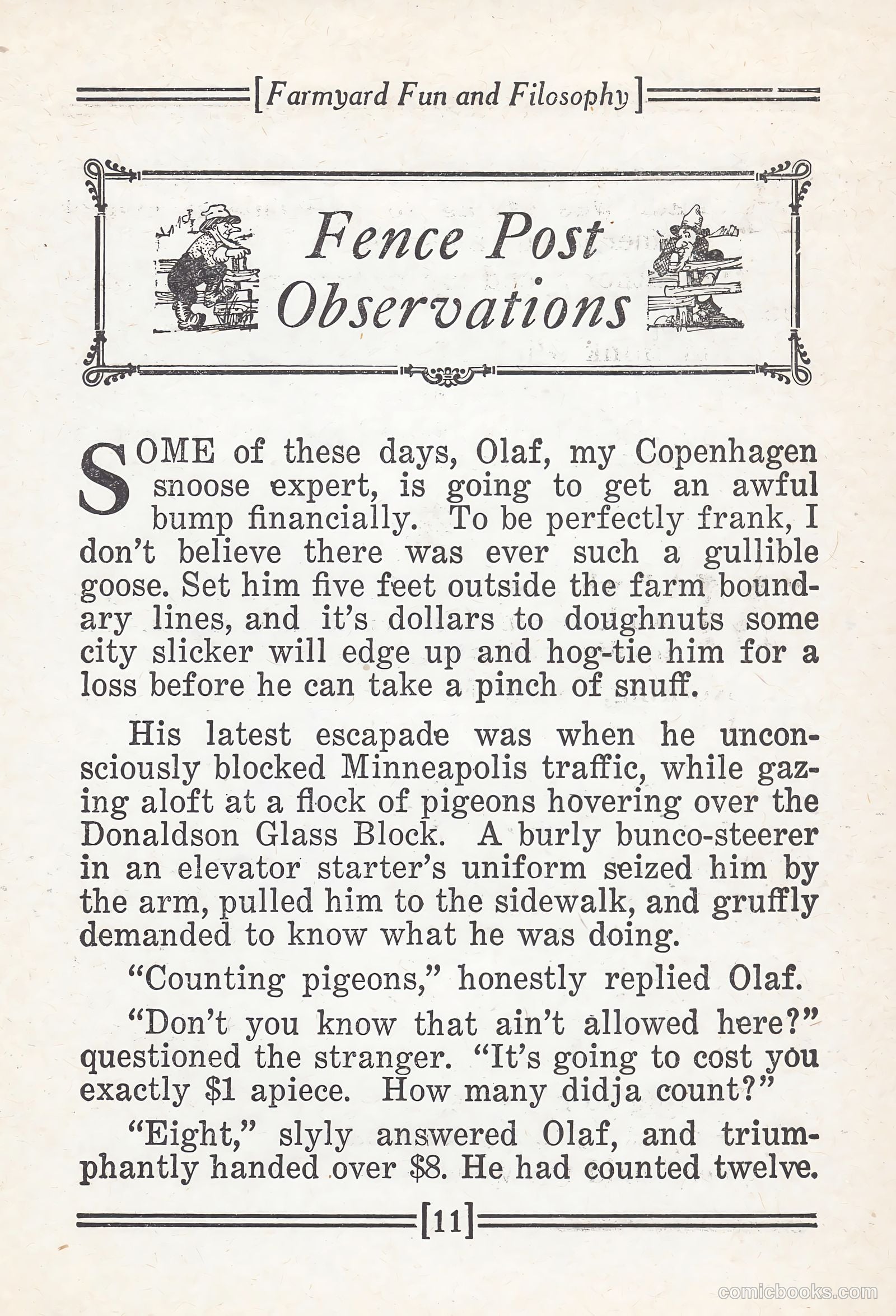
This is a humorous rural-versus-urban anecdote featuring Olaf, a naive Danish immigrant ("Copenhagen snoose expert"—snoose being moist snuff tobacco). The joke illustrates the stereotype of the gullible country bumpkin easily conned by city slickers. The con: A fake authority figure (posing as an "elevator starter") claims pigeon-counting is illegal in Minneapolis and charges $1 per bird. Olaf deliberately undercounts (reporting 8 when he counted 12) to avoid paying the full fine—but the real joke is he pays at all for something obviously fake. The satire targets both figures: Olaf's blind trust in urban authority and his clumsy attempt at cunning, and the con artist's brazen confidence-scheme tactics. The piece reflects early 20th-century American anxieties about rural people's vulnerability in modernizing cities, while gently mocking immigrant naiveté and urban deception.
This page from the satirical magazine contains four separate humorous anecdotes mocking various subjects: 1. **Lieutenant-Governor Collins**: Ridicules a Minnesota politician's poor golf swing at a course opening—he hits six inches behind the ball while formally "declaring" the links open, suggesting incompetence masked by ceremony. 2. **Prohibition enforcement**: Satirizes Prohibition-era corruption. A federal prohibition agent sent Monday to investigate a bar doesn't return until Saturday, implying he spent the week at that very bar instead of shutting it down. 3. **Married men's club**: A joke about unhappy marriages. A club for "unhappily married men" near Paris has poor attendance—one member missed the first meeting by getting the date wrong, suggesting even miserable husbands prefer avoiding such gatherings. 4. **Gus's hat**: A brief joke about a worn-out hat being "exchanged" (lost) at a restaurant, humorously reframing carelessness as practicality. The page reflects 1920s American humor: political corruption, Prohibition-era hypocrisy, marital discord, and everyday absurdities.
This is a humor column titled "Farmyard Fun and Philosophy" featuring four brief, unrelated jokes typical of 1920s rural American satire. The first anecdote mocks a character named Aggie for thinking she's clever—she believes she "fooled" a cafeteria by eating without washing dishes, apparently not understanding that's standard practice. The second joke presents Deacon Miller as hypocritical: he claims to follow a principle of saying nothing unkind, then delivers a brutal insult about a woman's appearance and intelligence. The third is a child's joke based on wordplay—the mother says she's "twenty-four summers" old, and the child innocently asks about "falls" (implying "winters/falls"), which the father humorously suggests means she never ages because she avoids falling down. The final item is a joke title about Gus playing an unrefined bugle "sonata" about spitting in corners—crude humor typical of the era's lower-brow comedy magazines. The page exemplifies Whiz Bang's rustic, folksy humor aimed at rural readers.
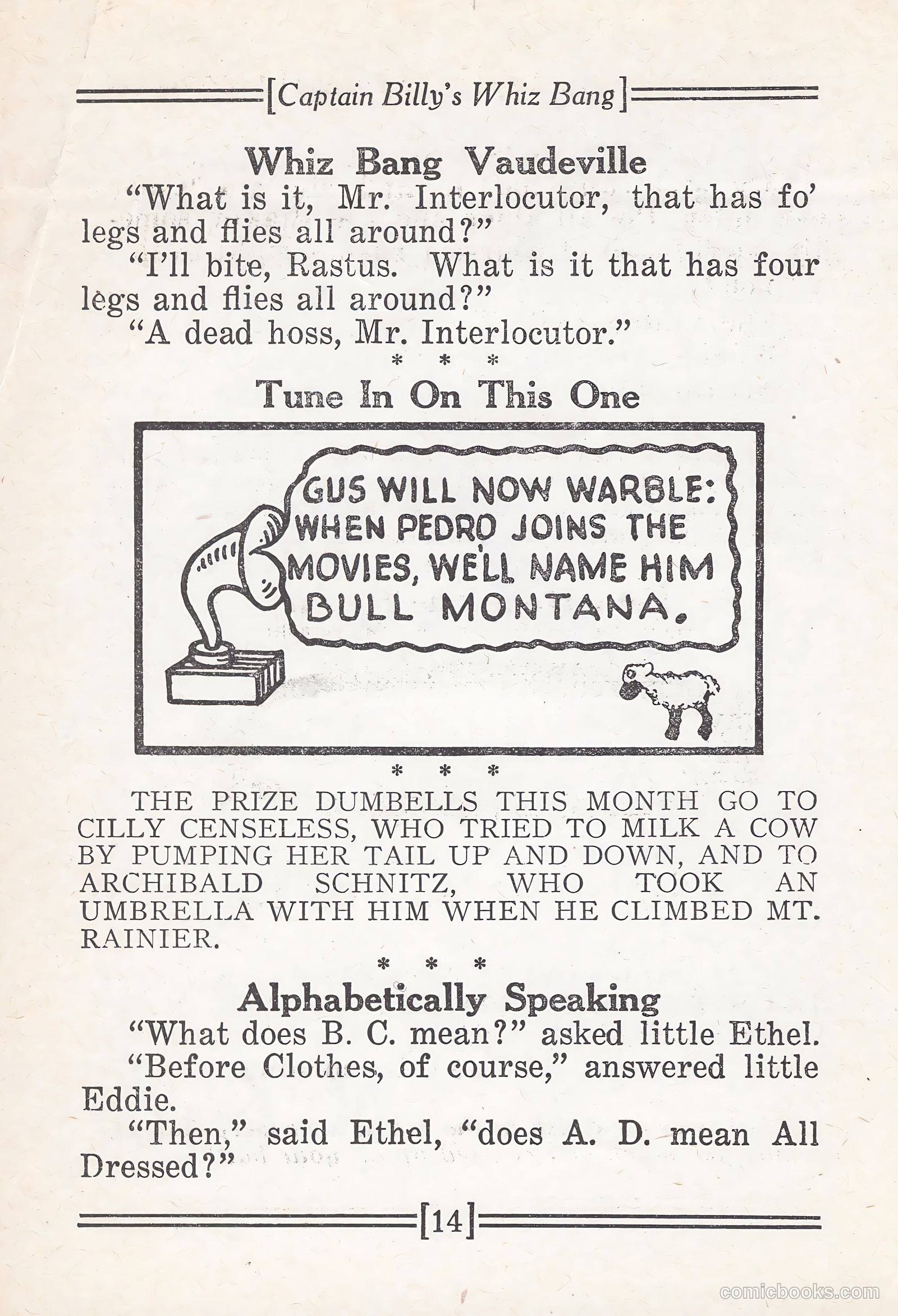
This page from *Captain Billy's Whiz Bang*, a 1920s humor magazine, contains several joke formats typical of the era: **Vaudeville joke**: A racist minstrel-show style riddle ("What has four legs and flies?") featuring "Rastus" and "Mr. Interlocutor"—stock characters from blackface entertainment, reflecting period entertainment conventions. **Movie joke**: References "Bull Montana," likely a silent-film actor, joking that an actor named Pedro would be rebranded with an Americanized stage name. **"Prize Dumbells"**: Humorous anecdotes about foolish people (milking a cow by its tail, taking an umbrella up a mountain). **"Alphabetically Speaking"**: A children's joke playing on abbreviations—B.C. ("Before Clothes") and A.D. ("All Dressed")—the humor lying in reinterpreting religious/historical abbreviations as clothing references. The page represents typical early-20th-century American satirical humor: crude, often relying on ethnic stereotypes and slapstick-adjacent absurdism now largely considered offensive or dated.
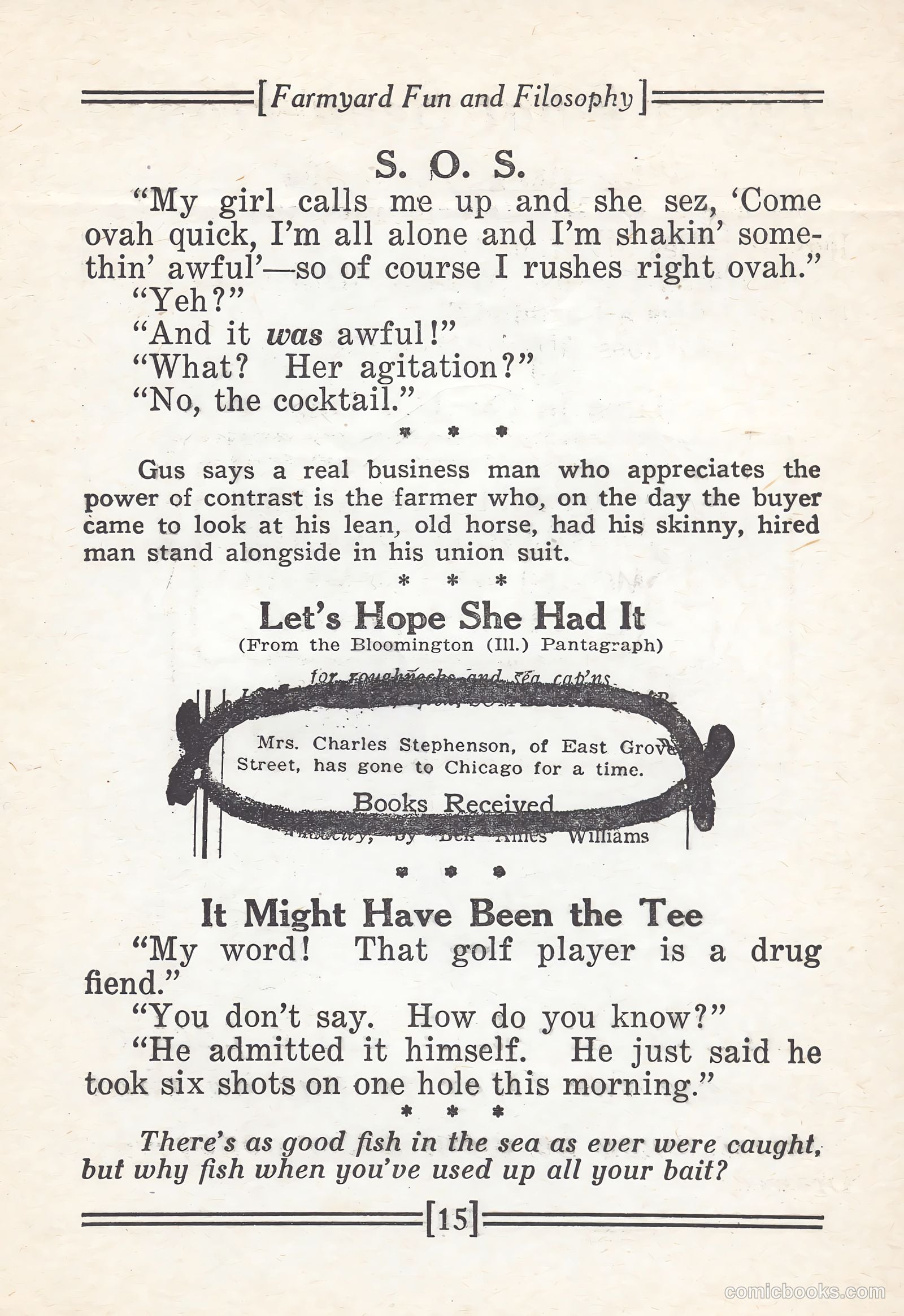
This page contains three unrelated humorous anecdotes mocking early 20th-century American social types: **"S.O.S."** jokes about a young man rushing to his girlfriend's aid, only to discover her distress was caused by a poorly-made cocktail—satirizing both romantic melodrama and Prohibition-era drinking culture. **The farmer anecdote** celebrates practical deception: a shrewd seller creates visual contrast by positioning his skinny hired man next to a lean horse, making the animal appear healthier by comparison. It mocks both rural cunning and commercial dishonesty. **"It Might Have Been the Tee"** uses golf terminology as a double meaning: taking "six shots on one hole" could imply drug use, but actually means poor golfing. The joke satirizes both golf culture and drug-use hysteria of the era. The final aphorism is a fishing metaphor about romantic pursuit. All three sections employ working-class vernacular and situational humor typical of 1920s satirical magazines.
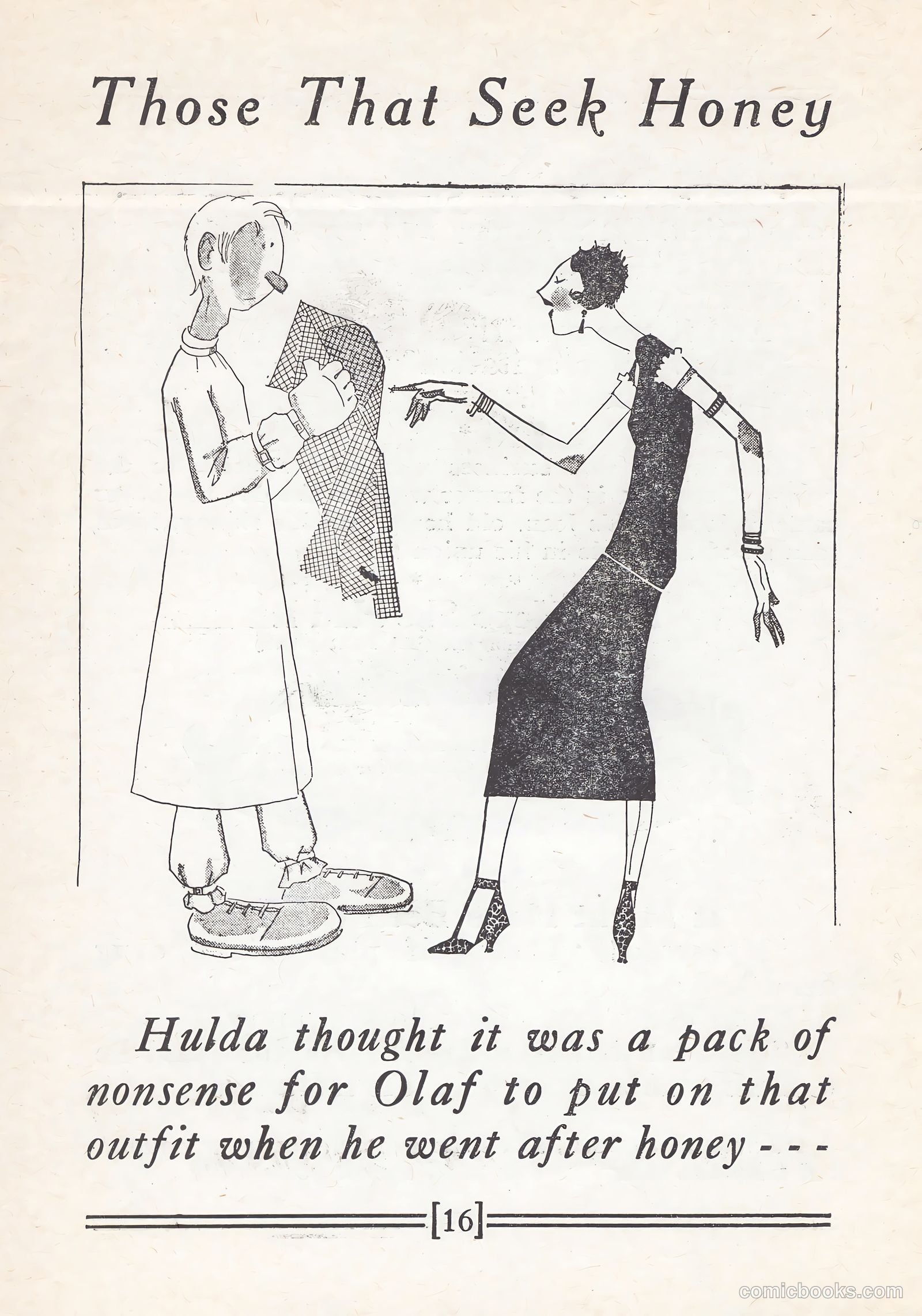
This appears to be a humorous domestic scene from an early-to-mid 20th century American satirical magazine. Two figures identified as "Hulda" and "Olaf"—likely Scandinavian names suggesting ethnic humor—are shown. Hulda (left, plainly dressed) disapproves of Olaf's (right) formal outfit: he's wearing an elaborate checked jacket and dark suit to go collect honey, presumably from bees. The joke plays on the absurdity of dressing formally for a messy, potentially dangerous task. Hulda considers it ridiculous—"nonsense"—to wear such fancy clothes while risking bee stings. The humor relies on the contrast between Olaf's pretentiousness and the practical nature of beekeeping, poking fun at either immigrant culture or general male vanity about appearance.
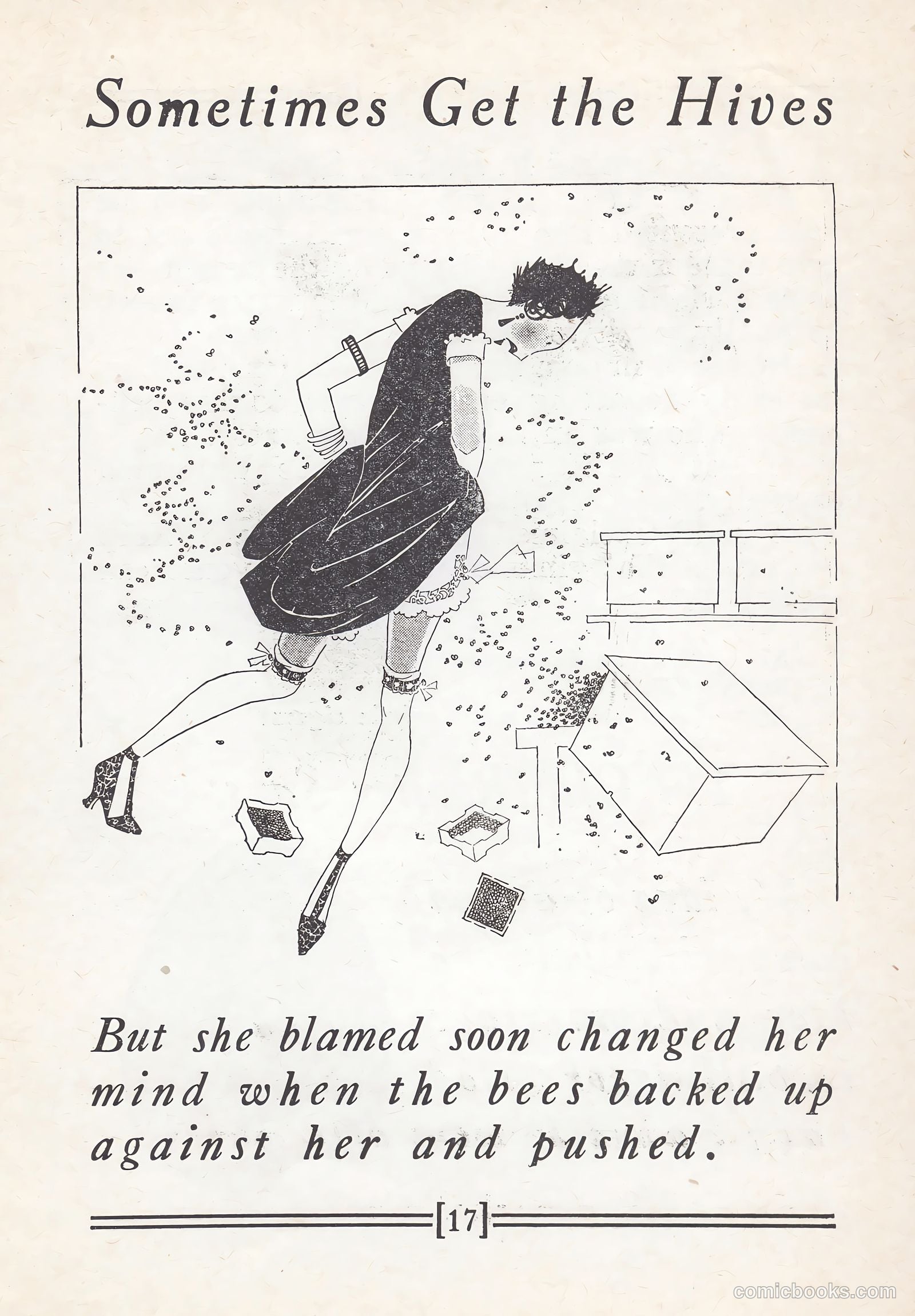
This is a humorous illustrated joke about a woman who becomes itchy (gets hives) while managing beehives. The cartoon shows her scratching frantically while surrounded by scattered boxes and swarming bees depicted as small dots. The punchline plays on a double meaning: she blamed her hives (the skin condition) on her beekeeping, but changed her mind when the actual bees physically pushed against her. The humor derives from the literal collision between the woman and her bee colonies—she realizes the real problem isn't an allergic reaction but rather aggressive bees literally backing into and shoving her. It's a straightforward visual gag relying on wordplay between "hives" (skin condition) and "hives" (beekeeping structures), typical of early 20th-century magazine humor.
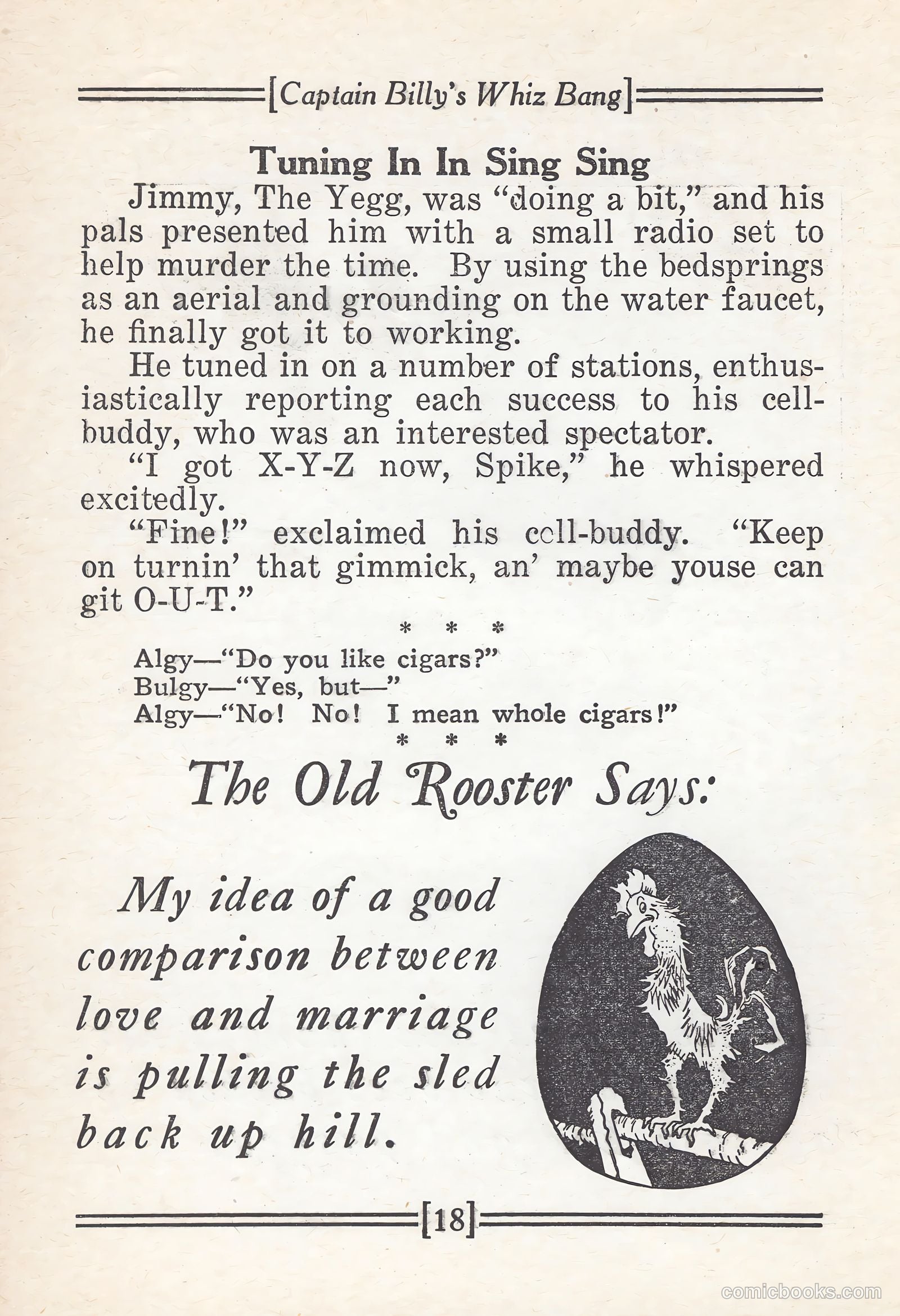
This page contains three separate humorous items from an early 20th-century American satirical magazine. **"Tuning In In Sing Sing"** jokes about an inmate ("Jimmy, The Yegg"—slang for burglar) in Sing Sing prison who receives a radio. The humor lies in the inmates' makeshift ingenuity (using bedsprings as antenna, water faucet as ground) and the cell-buddy's darkly ironic hope that tuning the radio might somehow help him escape ("git O-U-T"). **The Algy/Bulgy exchange** is a simple pun: Algy assumes "Bulgy" smokes cigar *butts* (cigarette scraps), but clarifies he means whole cigars—implying Bulgy is poor or miserly. **"The Old Rooster Says"** offers cynical relationship commentary: the comparison between love's initial romance and marriage's ongoing effort is like the easy downhill sled ride versus the exhausting uphill return—suggesting marriage requires constant labor. The rooster illustration is a traditional mascot for rustic wisdom in period humor publications.
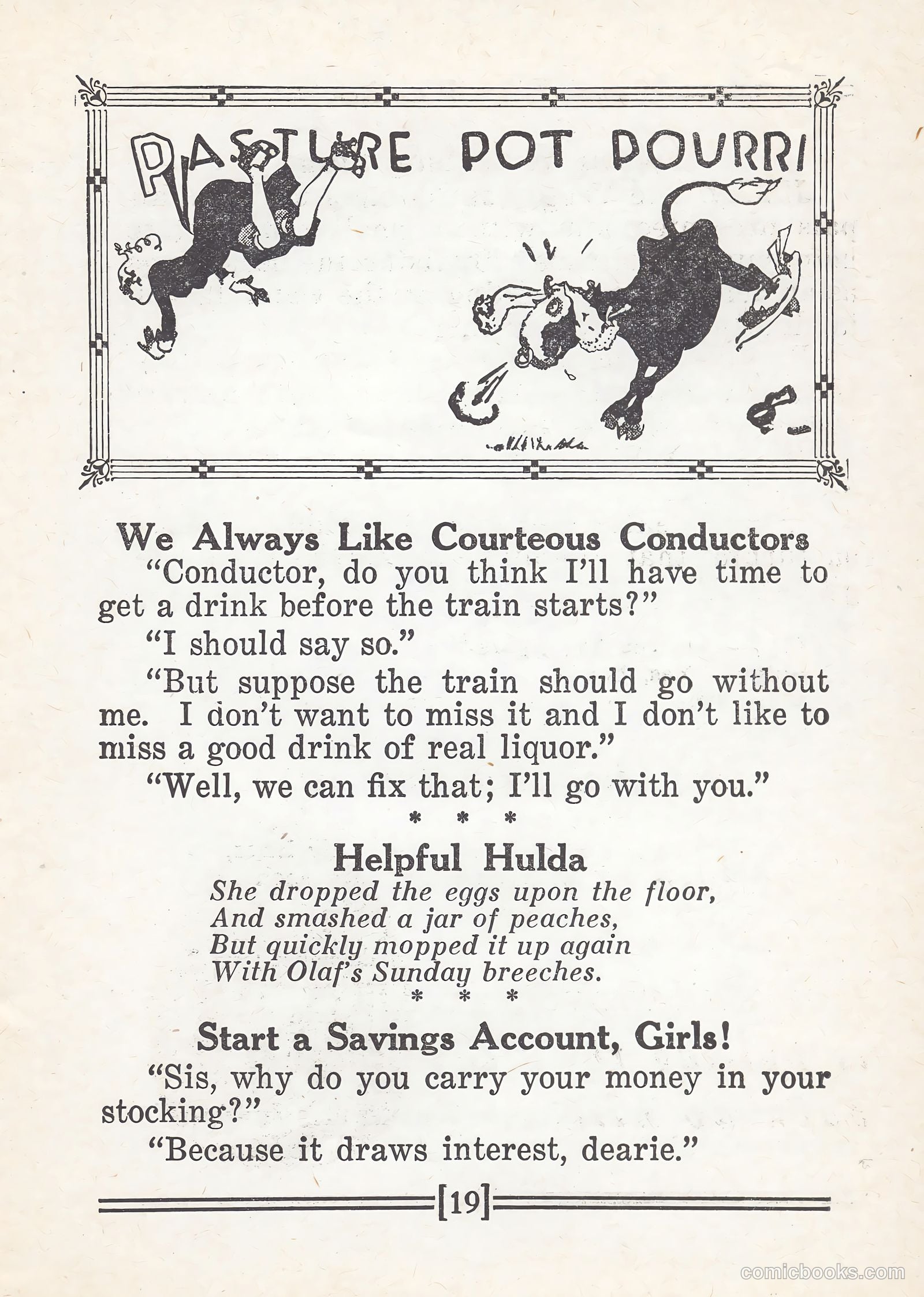
This page collects three brief humorous pieces typical of 1920s American satire magazines: **"Pasture Pot Pourri"** (top): A cartoon showing two figures in chaotic motion, accompanying a joke about a train conductor who agrees to abandon his duty to join a passenger for a drink—satirizing both poor work ethic and the casual attitude toward alcohol during Prohibition. **"Helpful Hulda"**: A verse mocking a clumsy housemaid who drops eggs and peaches, then uses her employer's (Olaf's) Sunday clothes to clean up—poking fun at domestic servants' incompetence and wastefulness. **"Start a Savings Account, Girls!"**: A pun-based joke where a girl's explanation that money in stockings "draws interest" conflates financial interest with the physical act of drawing/pulling—mild satire on women's financial naiveté. The humor is gentle, slapstick-oriented, and reflects early 20th-century attitudes toward work, class, and gender roles.
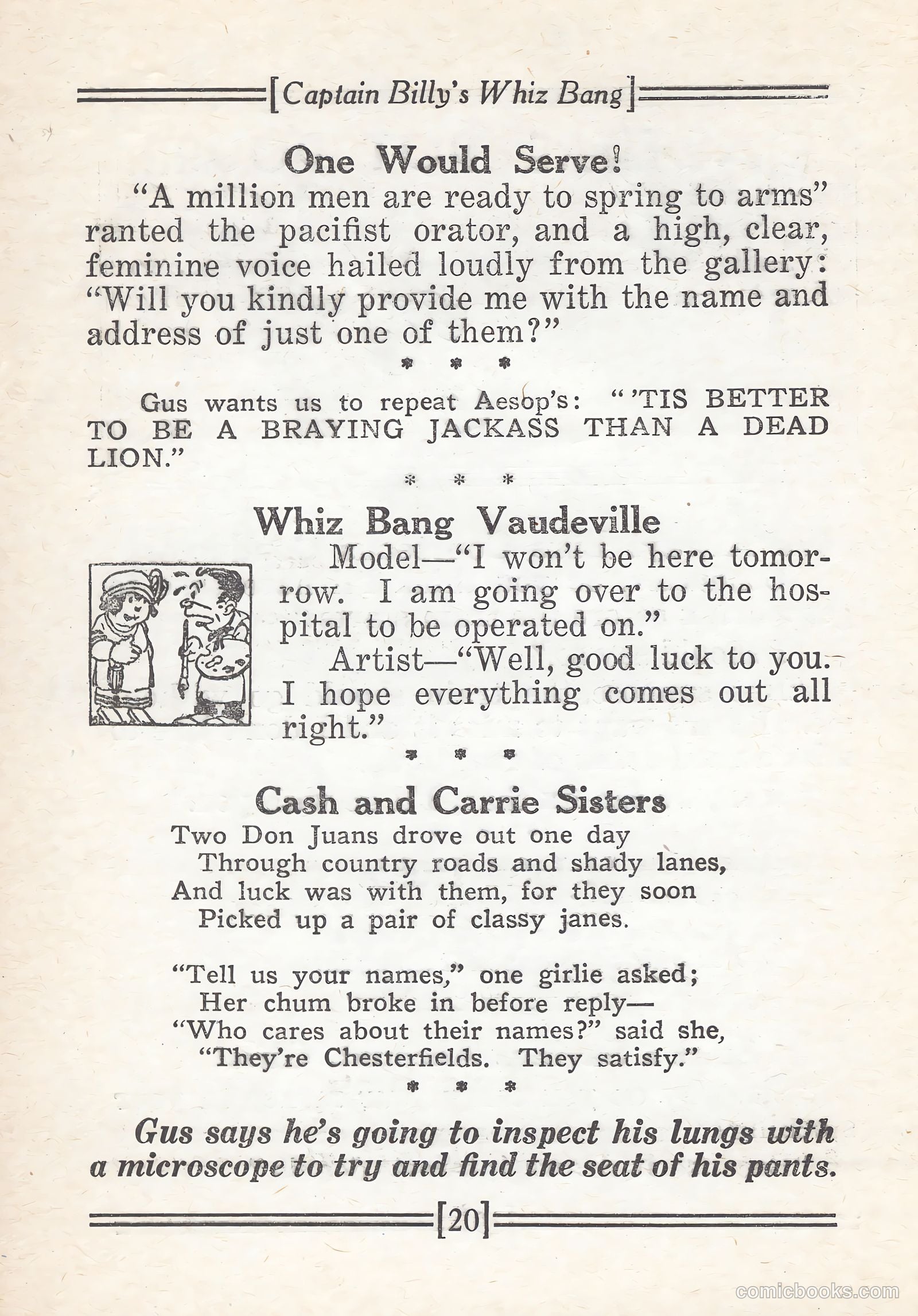
This page from the satirical magazine contains several brief jokes targeting early 1920s social attitudes: **"One Would Serve"** mocks pacifist rhetoric by having a woman challenge an anti-war speaker to name even one person willing to fight—implying pacifists make grand claims without conviction. **"Whiz Bang Vaudeville"** is a pun: a model leaving for surgery jokes with an artist about hoping "everything comes out all right"—dark humor about medical procedures. **"Cash and Carrie Sisters"** advertises Chesterfield cigarettes through a suggestive joke about two women picked up by men. When asked their names, one woman deflects by saying they're "Chesterfields"—conflating the women with the brand and its advertising slogan "They satisfy," implying sexual availability. The final "Gus" line is absurdist nonsense typical of the magazine's crude humor style.
This page collects brief humor pieces typical of 1920s satirical magazines, targeting rural and working-class American life: **"Deacon Miller" anecdote**: A Robbinsdale (Minnesota) man exploits a bartender's sarcasm by taking him literally—ordering a full beer glass of whisky at single-drink price. The joke mocks both the customer's opportunism and the bartender's failed verbal trap. **"Olaf Tries Poetry"**: Ethnic humor featuring a Scandinavian character. The poem sentimentalizes a woman's embrace in deliberately overwrought terms, poking fun at romantic pretension and ethnic stereotyping common to the era. **Rural school joke**: Dark humor suggesting a butcher would react to danger (a bear) with appetite rather than fear. **Proverb/domestic dialogue**: Plays on "two heads are better than one" by substituting "warmed" (bodies). The final exchange depicts a maid's mistress unknowingly giving away a nightgown the maid's husband prefers—lowbrow humor about marital dynamics and class relations. **Plumber hint**: Practical wordplay about tools. The page reflects 1920s working-class humor: ethnic stereotyping, sexual innuendo, and small-town anecdotes.
This page from *Captain Billy's Whiz Bang* (a humor magazine) contains three short jokes: 1. **"Perverted Anatomy Lesson"**: A child jokes that their nose and feet work backward—a mild absurdist gag with no deeper meaning. 2. **"White Elephant Party"**: A satirical jab at marriage. The joke is that 19 of 20 women brought their husbands to a party where guests were supposed to bring unwanted items they nonetheless found useful—implying husbands are burdensome yet necessary. This reflects early 20th-century marital humor stereotyping wives as reluctant spouses. 3. **Advertisement**: The page promotes an upcoming *True Confessions* article supposedly by Rudolph Valentino (the famous silent film star) about his romantic exploits. This appears to be either satirical or a genuine advertisement capitalizing on Valentino's celebrity and romantic image. The page is primarily comedic commentary on domestic life and celebrity culture, typical of 1920s-era American humor magazines.
This page contains five separate humorous vignettes rather than cartoons, showcasing early 20th-century American humor: 1. **"Yes, Indeed!"** — A child's joke about Alaska's largest town being "Nome," playing on the phonetic similarity to "no, ma'am." 2. **"Improving Omar"** — Parodies Omar Khayyam's famous hedonistic poetry, but replaces wine and companionship with a silent wife who tolerates smoking. 3. **"Things We Never Expect to See"** — References Leopold and Loeb (likely the notorious 1924 Chicago murderers), sarcastically suggesting they'd never engage in innocent Christmas activities. The Tinney/Wilson reference is unclear without additional context. 4. **"Speaking of Paradise"** — A parson unwittingly reveals lower-class gambling locations while teaching Sunday School morality—ironic social commentary on hypocrisy. 5. **Ship Radio joke** — A child confuses ventilation funnels with "loud speakers," demonstrating innocent ignorance about modern maritime technology. The humor targets social pretension, hypocrisy, outdated morality, and emerging technology confusion.
This is a humor page from an early 20th-century American satirical magazine featuring multiple short jokes and quips typical of the era's "joke magazine" format. **Key content:** - "Southern Technicalities": A pun joke where "Alabama dancer" means a dancer from Mobile (a city in Alabama) - "Liz Knows Her Biz": A flapper-era poem about a woman who entertains at parties - "The Poor Little Jigger": A joke playing on "backbone" (moral character vs. dancing ability) - "Our Office Vamp Sez": References the 1920s trend of women bobbing their hair, comparing it to Samson's famous locks - Two dialect jokes using "Rastus" and "Mandy"—stereotypical African American characters speaking in exaggerated dialect, discussing dating and entertainment - A final conundrum making a sexist joke about women's time management The humor reflects 1920s attitudes toward modern women (flappers, bobbed hair), courtship, and relies heavily on period stereotypes and casual sexism/racism now considered offensive.
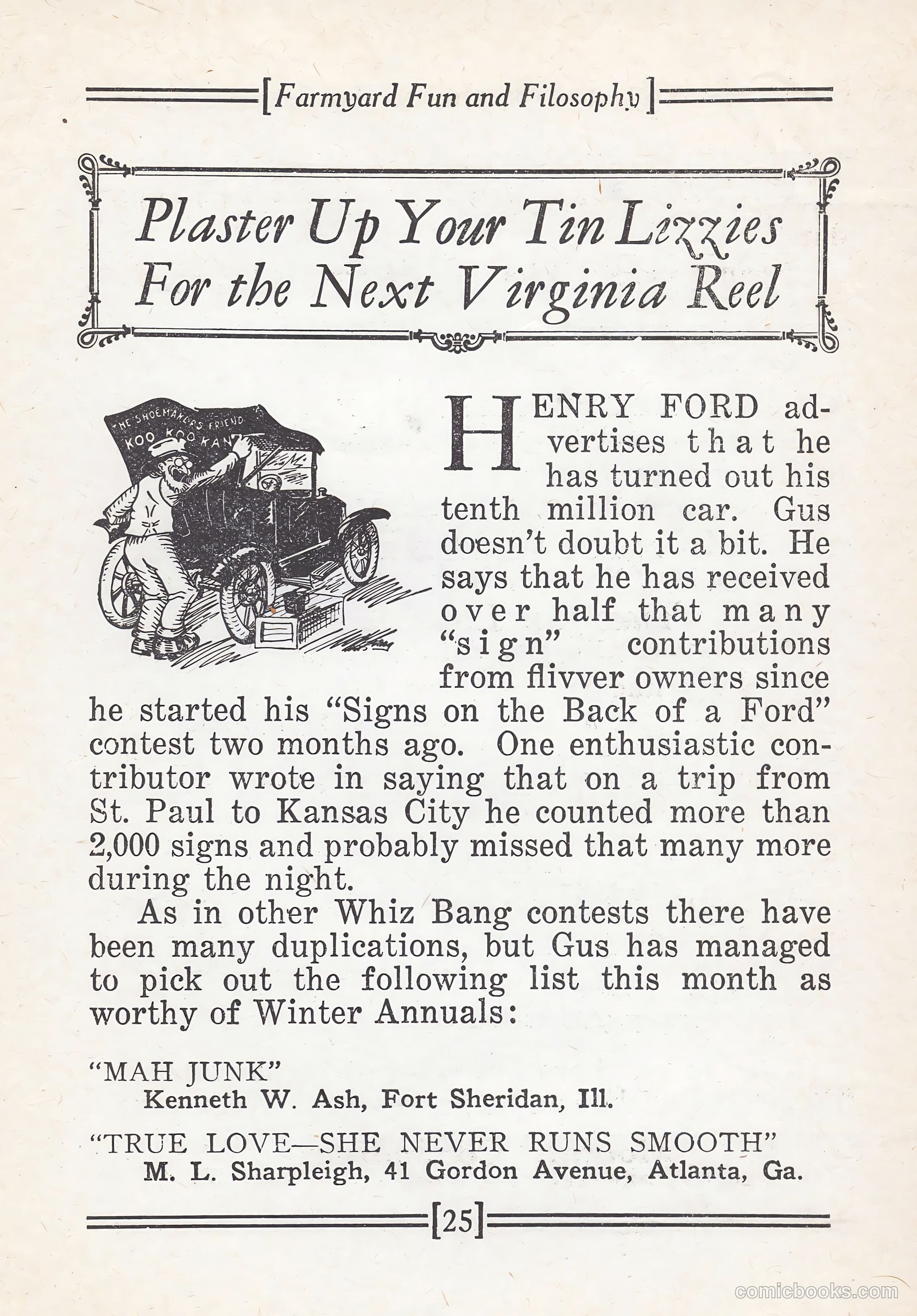
This page satirizes Henry Ford's mass production milestone and a related *Whiz Bang* magazine contest. "Tin Lizzies" is period slang for Ford Model Ts—affordable, mass-produced cars that democratized automobile ownership in the 1920s. The satire targets Ford's claim of producing ten million vehicles by noting that contest entries—humorous written signs posted on car backs—have flooded in at such volume (over 5 million submissions claimed) that they rival Ford's own production numbers. The joke is absurdist: the magazine's audience participation has become as prolific as Ford's manufacturing. The winning entries provided ("Mah Junk," "True Love—She Never Runs Smooth") are puns mocking the Model T's unreliability and humble status. The cartoon illustration shows a shabby Ford, reinforcing this satirical contrast between Ford's grandiose production claims and the vehicle's actual mediocre reputation among owners. A "Virginia Reel" reference in the title plays on the car's physical rattling and bouncing.
This page showcases humorous, satirical signs submitted by readers to *Captain Billy's Whiz Bang*, a satirical magazine popular in the 1920s-30s. The "jokes" are witty or absurd captions imagining what real warning/informational signs might humorously say. Examples include: "Danger! This Car Contains Gas" (playing on both exhaust fumes and the Prohibition-era bootlegging); "Mama Goes When Papa Goes or Lizzie Don't Go Out" (poking fun at domestic power dynamics and car culture); "Holly Wood and Dyna Mite" (likely referencing Hollywood's explosive growth and scandal). The publication invites readers to submit similar clever sign ideas they've spotted "wandering around without a home." This reflects a participatory, grassroots humor culture where ordinary Americans contributed satirical observations about modern life—automobiles, danger warnings, domestic relations, and social absurdities.
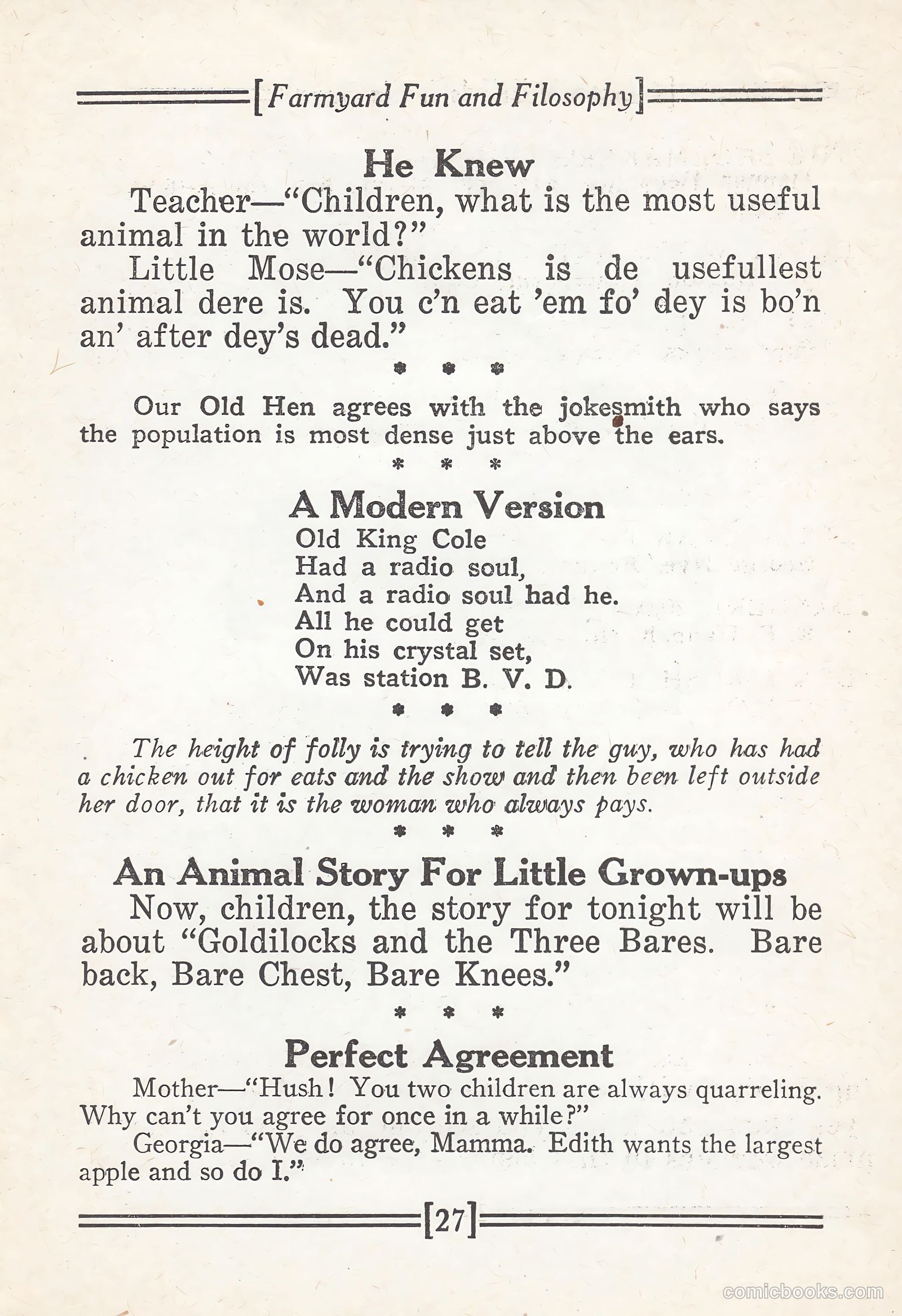
This page collects brief satirical jokes and quips typical of 1920s American humor magazines. **"He Knew"** uses dialect humor (common but now considered offensive) to joke that chickens are useful both alive and dead—a practical if morbid observation. **"Our Old Hen"** is a mild insult suggesting people lack intelligence ("population most dense just above the ears"—implying empty heads). **"A Modern Version"** satirizes the 1920s radio craze by parodying "Old King Cole," joking that someone's radio can only pick up "B.V.D." (a underwear brand), mocking both radio reception and commercialism. **The dating joke** assumes readers understand 1920s courtship customs: a man who takes a woman to dinner and a show expects she'll pay him back romantically; the joke's point appears to be that the woman actually profits from the arrangement. **"Goldilocks and the Three Bares"** is a risqué pun substituting "bares" (nude/exposed) for "bears"—suggesting immodest women, likely referencing 1920s "flapper" culture anxieties. **"Perfect Agreement"** presents simple child logic: both girls want the largest apple, so they "agree."
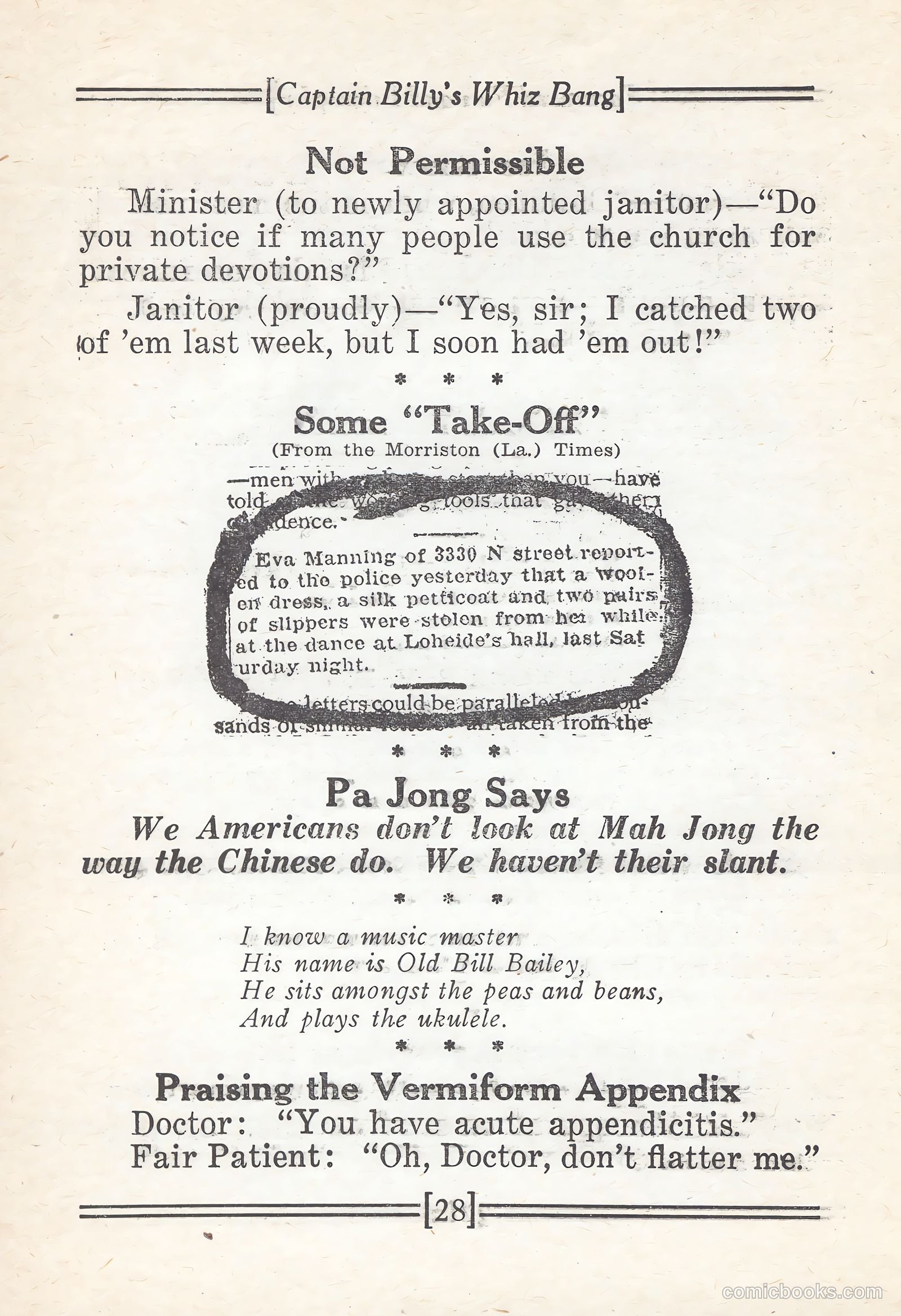
This page from *Captain Billy's Whiz Bang* contains several brief humorous items: **"Not Permissible"** is a joke about a church janitor who has caught couples using the church for private romantic encounters. The janitor's proud admission that he "had 'em out" suggests he aggressively evicts people, which the minister finds inappropriate. **"Some 'Take-Off'"** appears to reference a theft report from a Morrison, Louisiana newspaper about stolen clothing at a dance. **"Pa Jong Says"** makes a casual ethnic joke contrasting American and Chinese perspectives on the game Mah Jong. **"I know a music master"** is a humorous verse about "Old Bill Bailey" playing ukulele. **"Praising the Vermiform Appendix"** is a brief doctor-patient joke playing on medical terminology ("acute appendicitis" versus flattery). The magazine emphasizes bawdy humor, local crime reports, and ethnic jokes typical of 1920s American satirical publications.
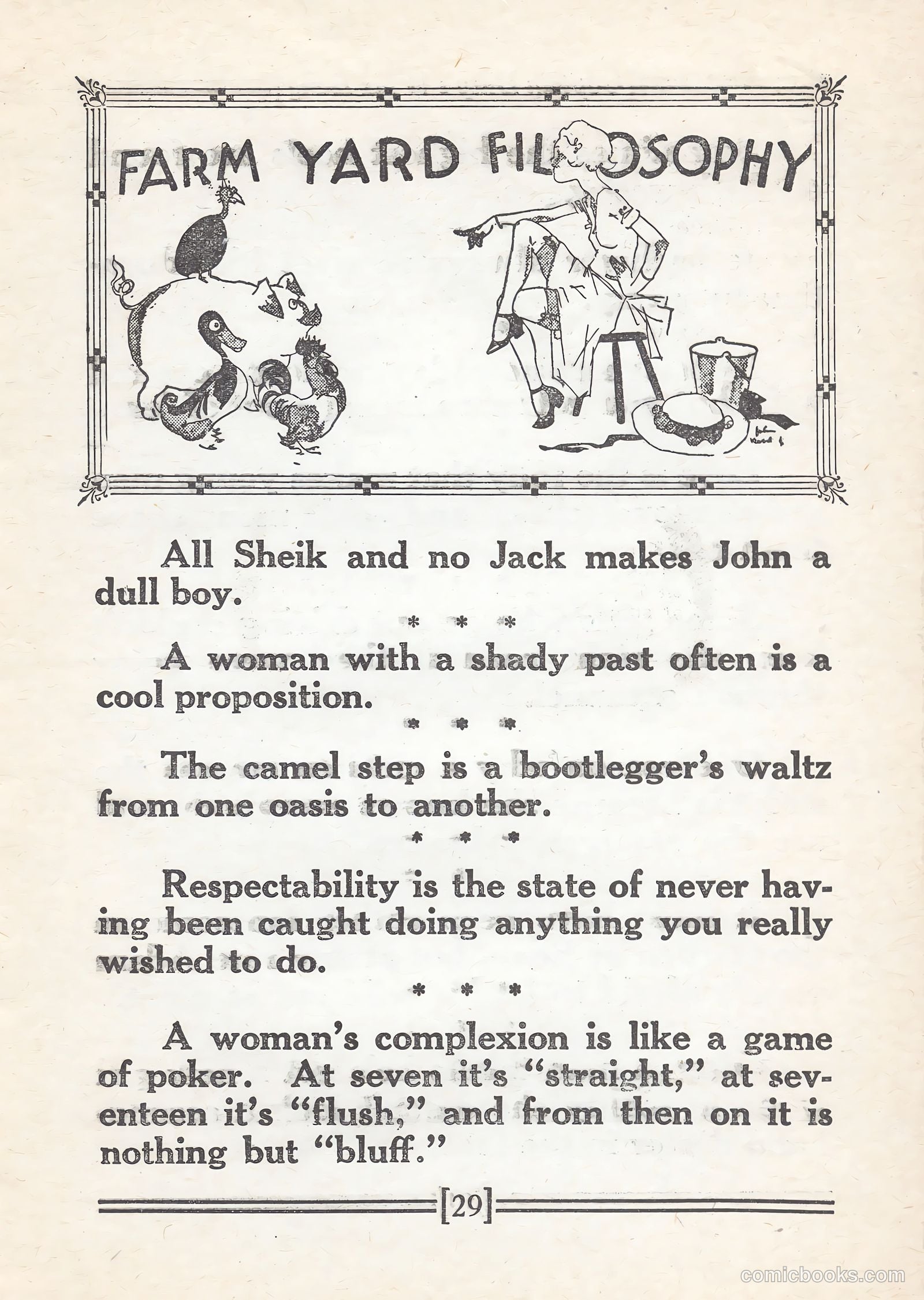
This page presents satirical aphorisms under the "Farm Yard Philosophy" banner, accompanying an illustration of a woman with farm animals. The humor targets early 1920s social attitudes and Prohibition-era culture. **Key References:** - **"Sheik and Jack"**: References to 1920s male archetypes—the exotic "Sheik" (popularized by Rudolph Valentino films) versus the ordinary "Jack," suggesting modern women prefer dangerous excitement over dull respectability. - **"Bootlegger's waltz"**: References Prohibition (1920-1933), where "camels" likely denotes smuggling routes or illicit operations. - **Poker terminology for women's aging**: Uses card-game language ("straight," "flush," "bluff") to mockingly describe how women's appearance changes from youth through adulthood, suggesting cosmetics increasingly compensate for fading natural beauty. The overall tone is cynical about respectability, romance, and female aging—typical of 1920s satirical magazines that critiqued both Victorian prudishness and modern excess.
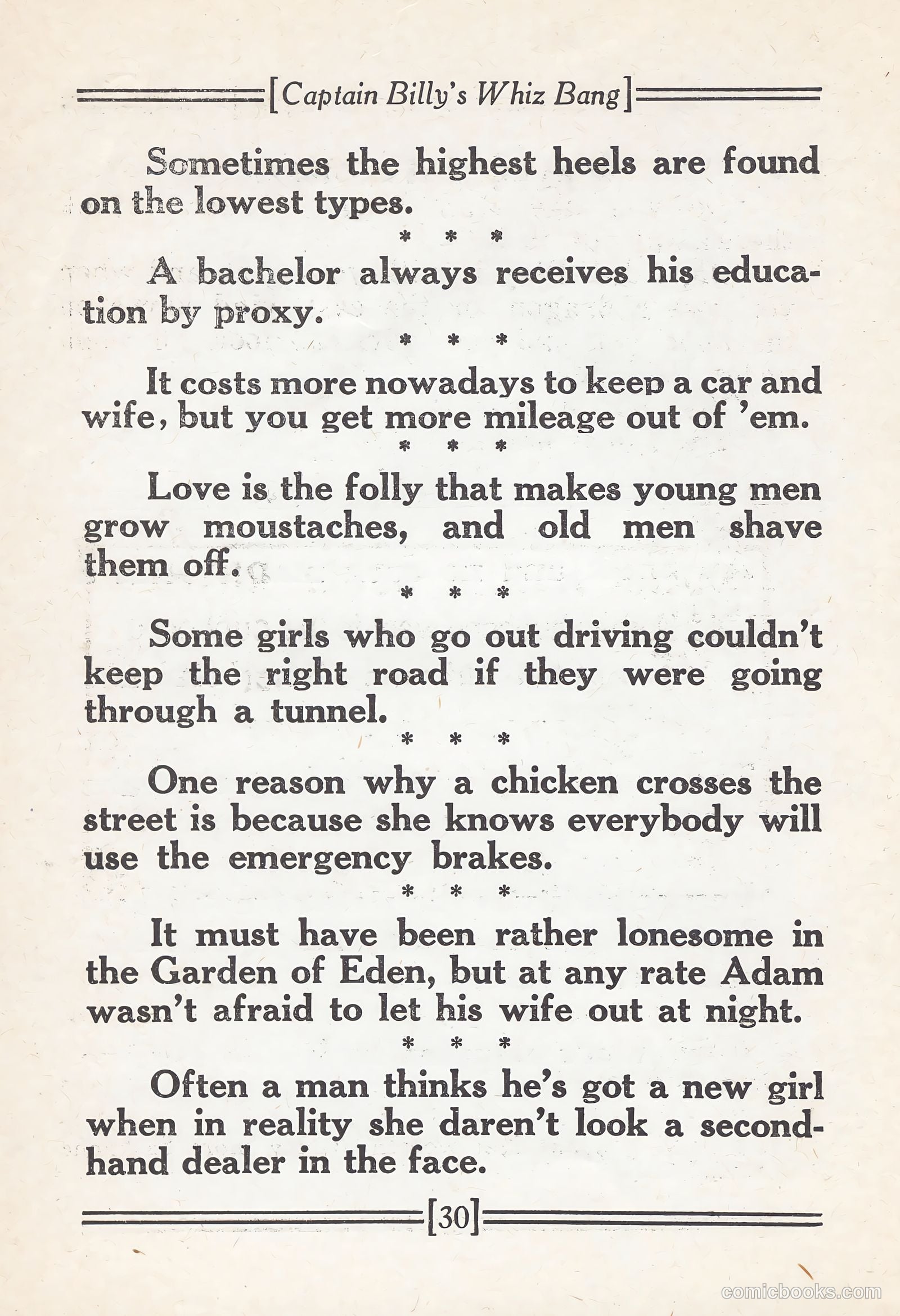
This page contains no cartoons—only satirical one-liners and brief jokes typical of *Whiz Bang*, a popular humor magazine of the 1920s-30s. The content targets social attitudes of the era: **Key themes:** - **Gender and appearance**: Women's fashion (high heels) linked to moral character; women as poor drivers - **Marriage satire**: Bachelors learning through experience; wives compared to cars in cost-benefit analysis - **Dating/courtship**: Men's facial hair choices driven by romantic interest; men deceived about girlfriends' financial status - **Period sexism**: References to controlling women's movements; assumptions about female driving abilities The humor relies on stereotypes—particularly about women's competence and fidelity—common to pre-WWII American popular culture. The Adam and Eve joke suggests anxiety about wives' independence. These jokes reflect 1920s-30s social anxieties about changing gender roles during the post-suffrage era.
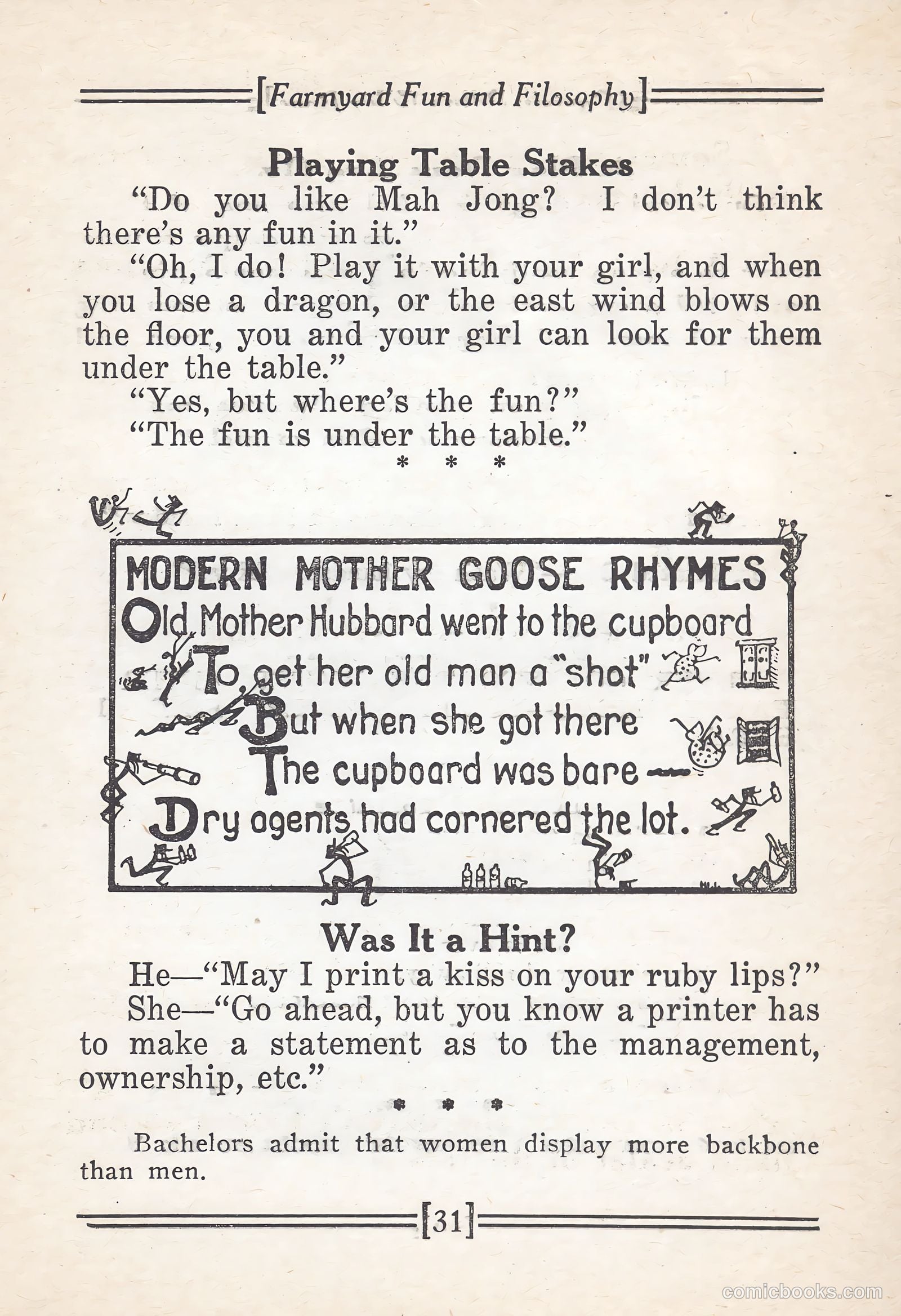
This page contains three pieces of early 20th-century American humor: **"Playing Table Stakes"** is a innuendo-laden joke about Mah Jong (a Chinese tile game popular in the 1920s). The humor relies on a double meaning: losing game pieces under the table becomes an excuse for couples to be physically close while searching. **"Modern Mother Goose Rhymes"** satirizes Prohibition (the alcohol ban 1920-1933). "Old Mother Hubbard" parodies the nursery rhyme, but her cupboard is bare because "dry agents" (federal Prohibition enforcement officers) have confiscated alcohol. This mocks the unpopular enforcement of Prohibition. **"Was It a Hint?"** jokes about printing terminology. The man's romantic request to "print a kiss" prompts the woman to sarcastically demand formal disclosure statements about "management, ownership, etc."—applying bureaucratic/legal language absurdly to physical affection. The final line about bachelors and women's "backbone" suggests women showed more moral courage or independence than men. All three jokes reflect 1920s American social attitudes and anxieties.
This page from *Captain Billy's Whiz Bang*, a popular American humor magazine, contains several brief jokes targeting different audiences: **"His Play Days Are Over"** mocks officious women organizing shipboard activities, using the punchline that the man is "seasick"—implying he's too ill to participate, subverting expectations of marital status. **The laundry joke** plays on drunken speech patterns ("Shay," "handsh") for comedic effect. **"Hints to Beach-nuts"** is a dark joke: don't swim after eating or you'll drown and won't be found. **"Rural Pastimes"** appears to reference men (possibly with ethnic names) marking up a smokehouse wall—likely in boredom or mischief—creating permanent damage that survives weather. **The choir joke** is a pun: the woman chose the "tenor" (higher voice) because he's "high-toned" (socially refined/snobbish). The humor is broad, relying on puns, drunkenness, ethnic stereotypes, and physical comedy typical of 1920s-30s American popular humor.
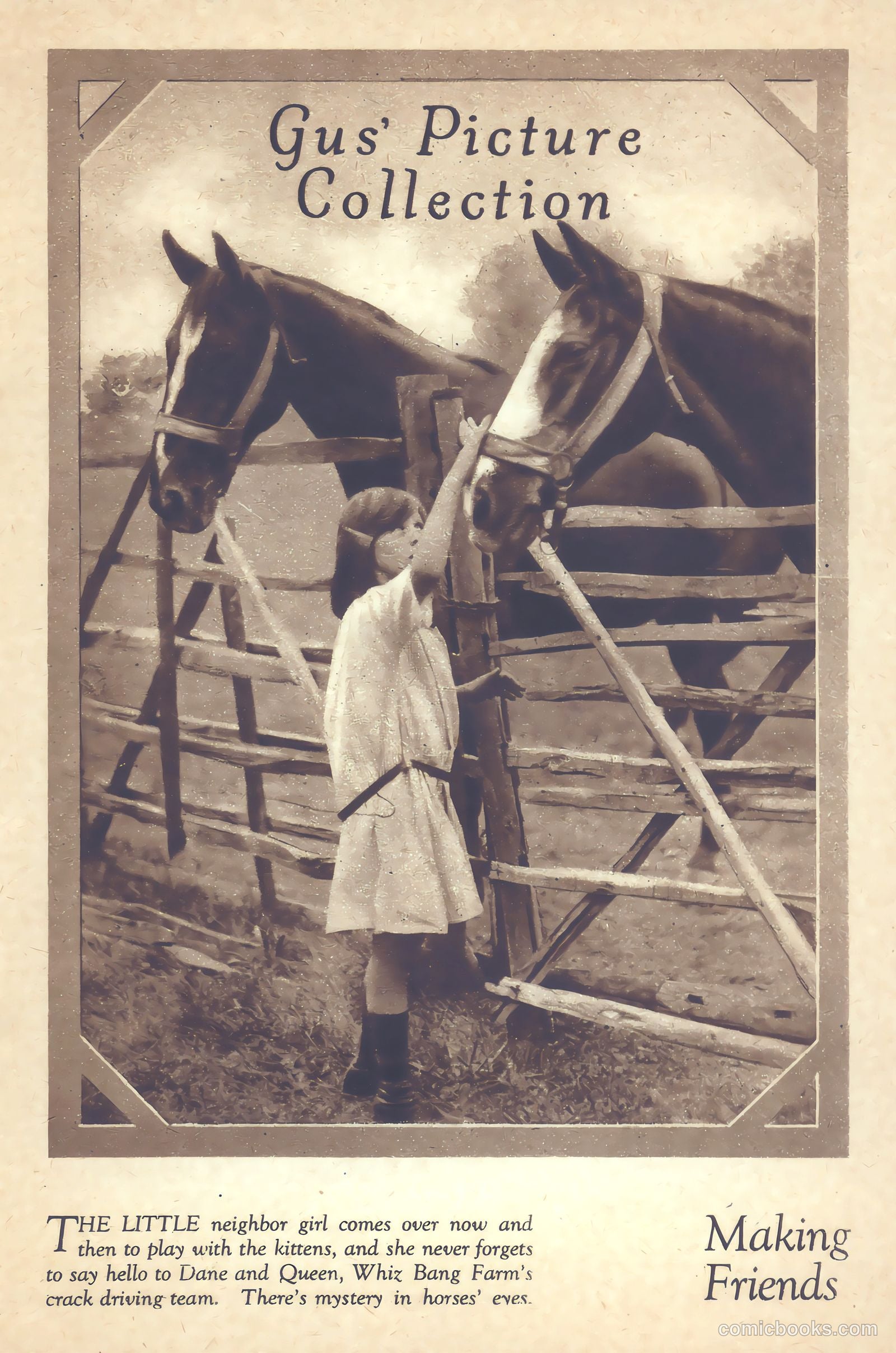
This page from *Whiz Bang* magazine presents a wholesome, non-satirical image titled "Making Friends." It shows a young girl in a light dress greeting two harnessed horses at a wooden fence, labeled as "Dane and Queen" from Whiz Bang Farm's "crack driving team." The accompanying text sentimentalizes the scene, describing the girl's regular visits to play with kittens and greet the horses, concluding with a romantic observation about "mystery in horses' eyes." This appears to be a straightforward nostalgic piece celebrating rural childhood and human-animal bonds rather than political satire. It reflects early 20th-century American idealization of farm life and innocent interspecies friendships, with no apparent satirical intent or social commentary.
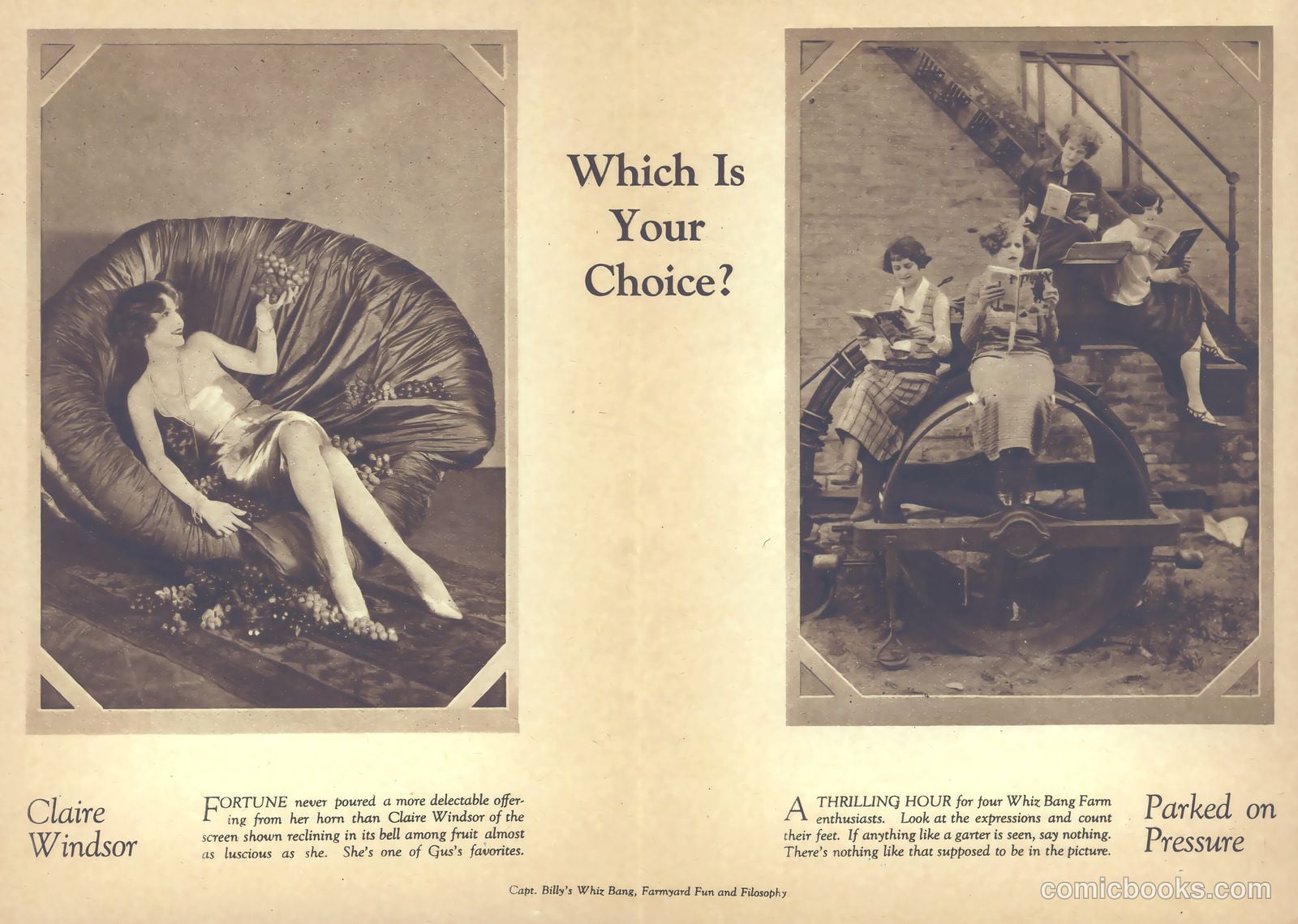
This page presents a satirical contrast between two lifestyle options. The left image shows **Claire Windsor**, a silent-film actress, reclining luxuriously among fruit—representing leisure, glamour, and sensual pleasure. The caption sarcastically notes she's "one of Gus's favorites," implying wealthy patronage. The right image depicts four farm workers in cramped, unglamorous conditions—representing labor and agricultural toil. The satire mocks the stark class divide of the era: wealth and beauty versus manual work and drudgery. The knowing wink about "garter" visibility and "count their feet" suggests crude humor about the farm workers' undignified positioning. *Whiz Bang* was a humor magazine mixing agricultural content with irreverent social commentary, targeting rural audiences while poking fun at both rural life and urban glamour.
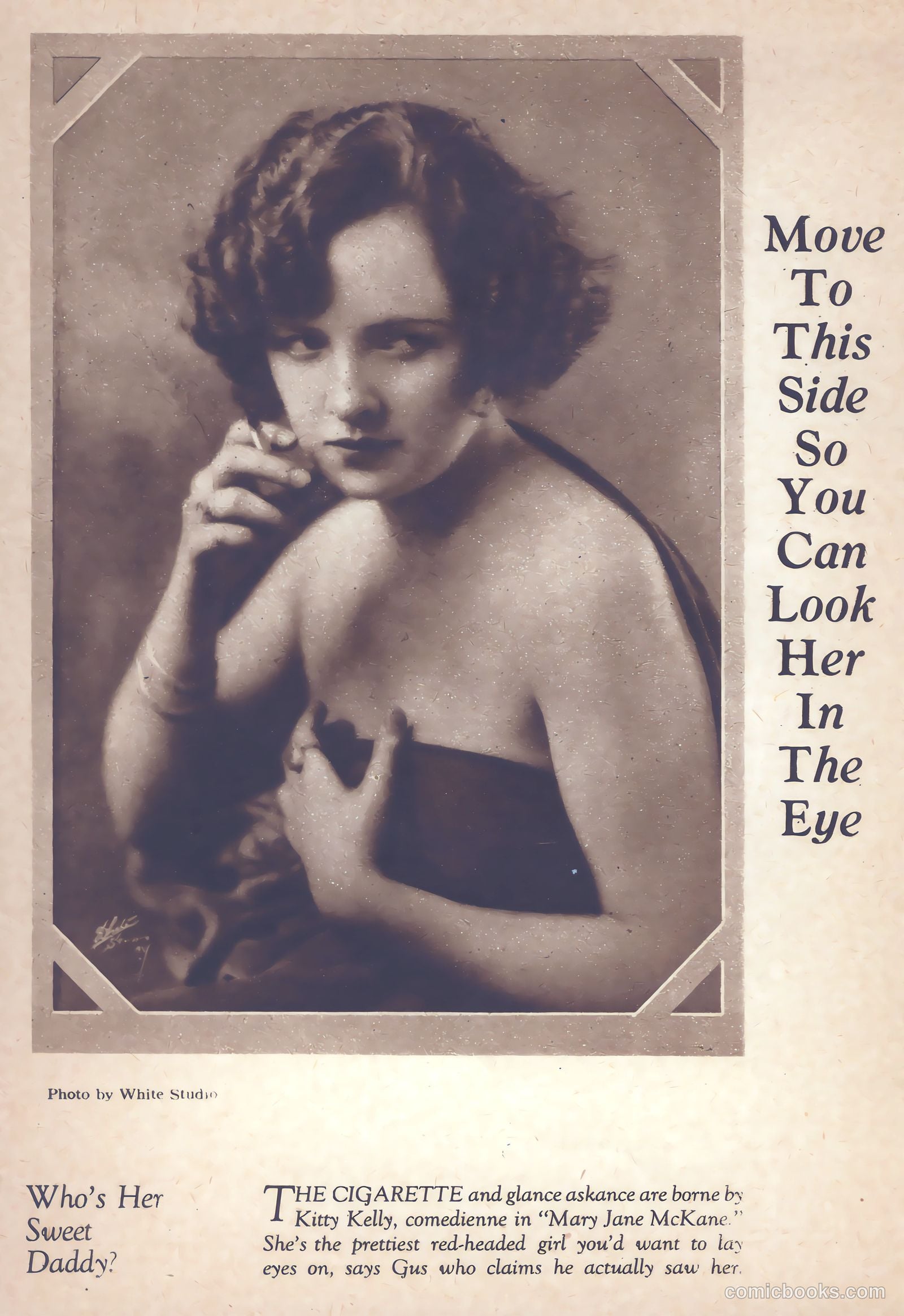
This is primarily **promotional material**, not satire. It advertises actress **Kitty Kelly**, who appeared in the theatrical production "Mary Jane McKane." The layout uses playful instruction ("Move to This Side So You Can Look Her In The Eye") to engage readers with a glamorous photograph. The text humorously references "Gus" claiming to have seen her in person, suggesting her celebrity appeal. The "Who's Her Sweet Daddy?" headline uses period slang for a romantic interest, playing on her on-stage persona. The cigarette and "glance askance" reference her character's theatrical mannerisms. This represents typical **early 20th-century entertainment advertising**, blending cheekiness with star promotion rather than political commentary.
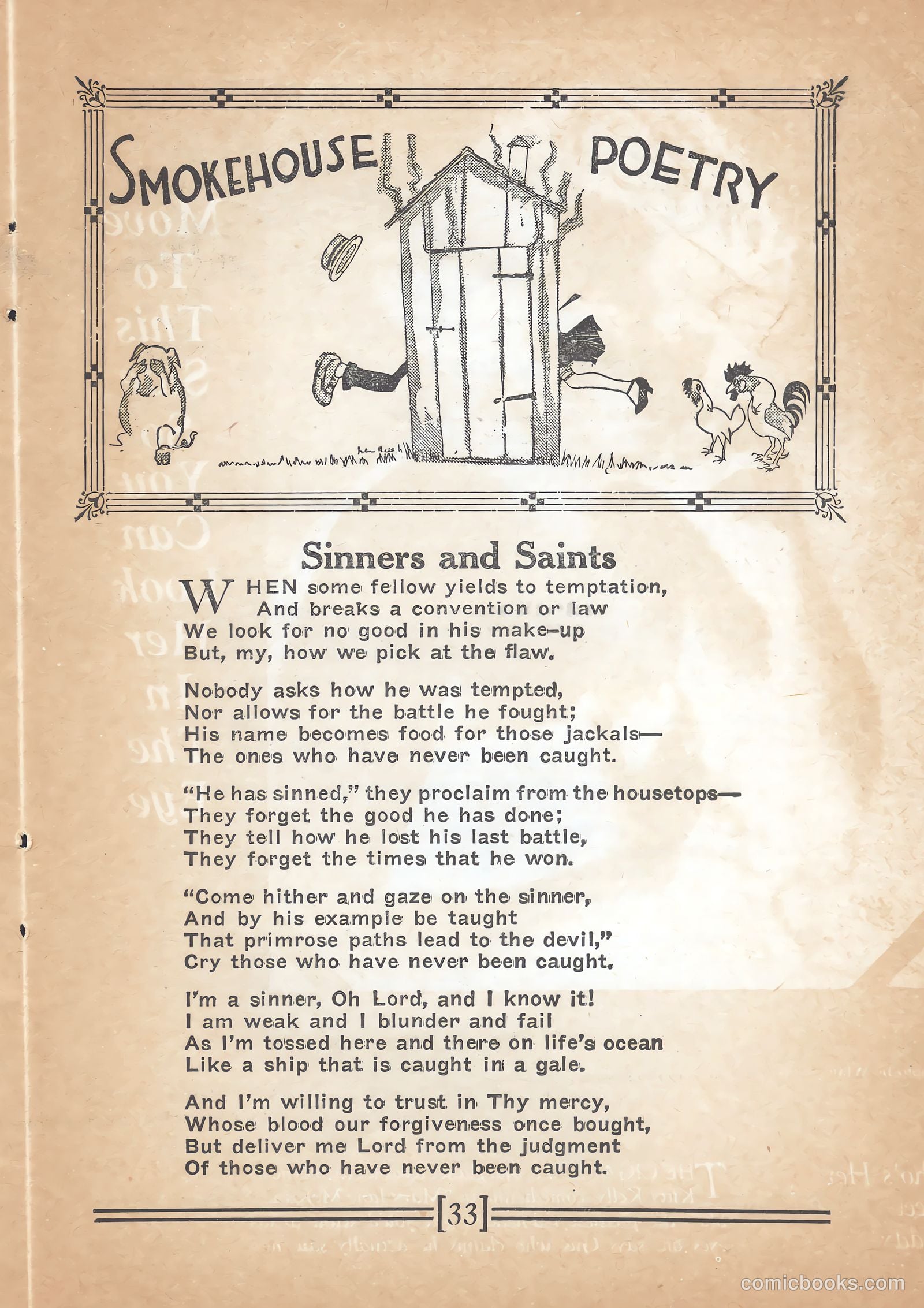
This poem satirizes moral hypocrisy and self-righteous judgment. The illustrated smokehouse (a humble, working-class structure) frames rustic commentary on human nature. The piece critiques how society harshly condemns those who fail morally while ignoring the struggles that led to their failings. It contrasts the "jackals"—people who publicly denounce sinners from positions of assumed moral superiority—with the speaker, who honestly acknowledges his own weakness. The central irony: those "who have never been caught" are the harshest judges, yet this merely means they haven't been *exposed*, not that they're virtuous. The poem argues for compassion and humility, suggesting that everyone struggles and stumbles; the real moral failing lies in judging others without acknowledging one's own capacity for sin. This reflects early 20th-century American attitudes about class, morality, and Christian mercy versus Pharisaic judgment.
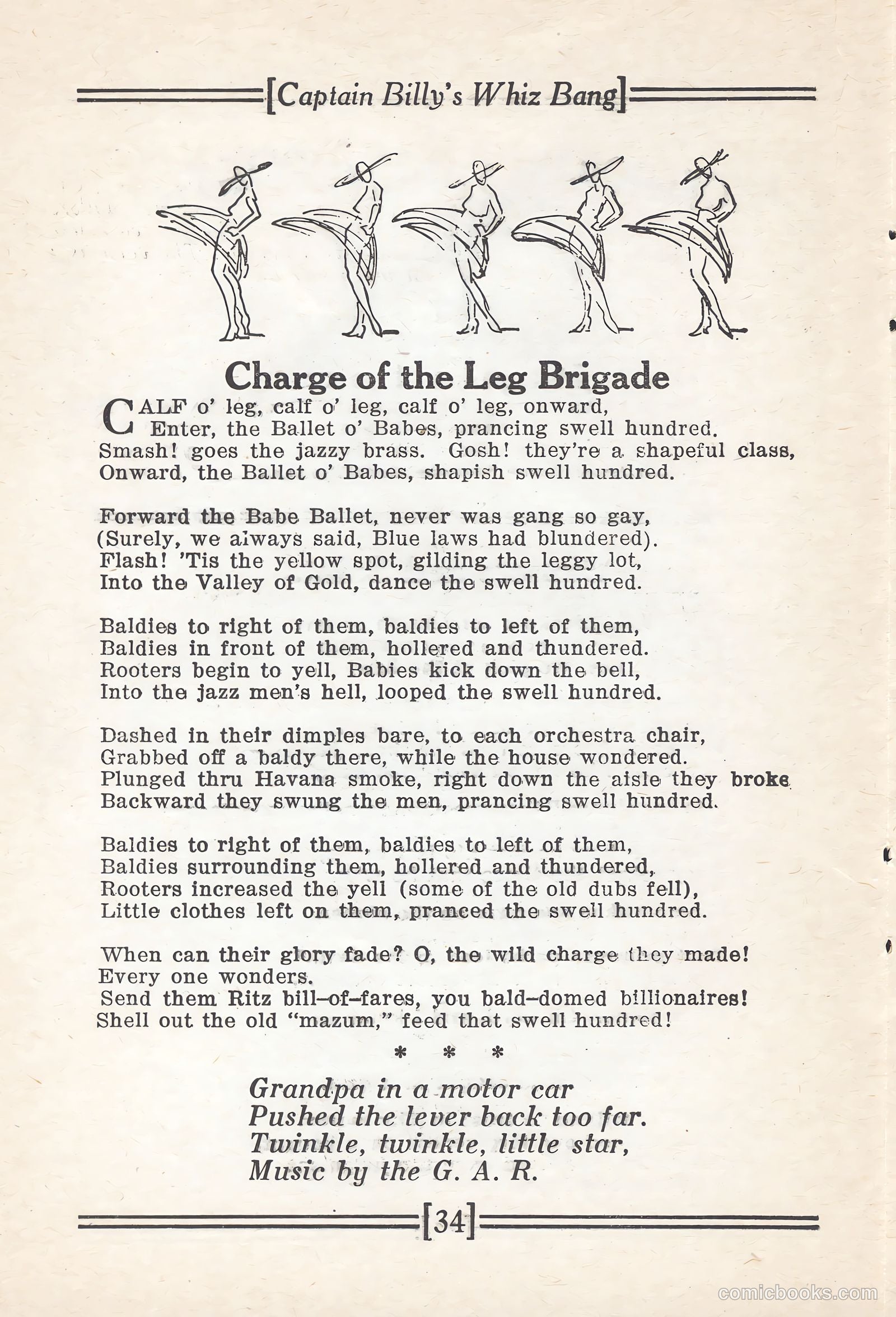
This is a bawdy parody of Tennyson's "Charge of the Light Brigade," mocking Jazz Age entertainment and sexual permissiveness. The poem celebrates a chorus line of scantily-dressed young women ("the Ballet o' Babes") performing for an audience of older, wealthy men ("baldies," "bald-domed billionaires"). The satire targets multiple things: the spectacle and moral concern surrounding 1920s cabaret dancing; the older generation's disapproval mixed with eager patronage ("Surely, we always said, Blue laws had blundered"); and the transactional nature of entertainment ("Send them Ritz bill-of-fares"). The final couplet about "Grandpa in a motor car" reinforces the theme of aging men behaving recklessly in the modern era. It's mocking both the dancers' exploitation and bourgeois hypocrisy about vice.
This is a nostalgic poem with no political content—it's sentimental material from *Whiz Bang*, a humor magazine that mixed satire with popular culture. The main poem, attributed to "Captain Billy," is a classic 19th-century song about aging. The speaker revisits childhood haunts with "Maggie," lamenting that the landscape has changed (the green grove is gone, replaced by a city), yet insists his affection for her remains unchanged by time. The chorus emphasizes lost youth and mortality. The brief coda below the asterisks is comedic commentary on aging, using contemporary 1920s imagery: the speaker's "wind is gone" and he "wobbles on / Just like a punctured tire"—a modern joke about becoming defective, like worn automobile equipment. The page appeals to "old-timers" with nostalgia while the tire gag updates the sentiment for contemporary readers.
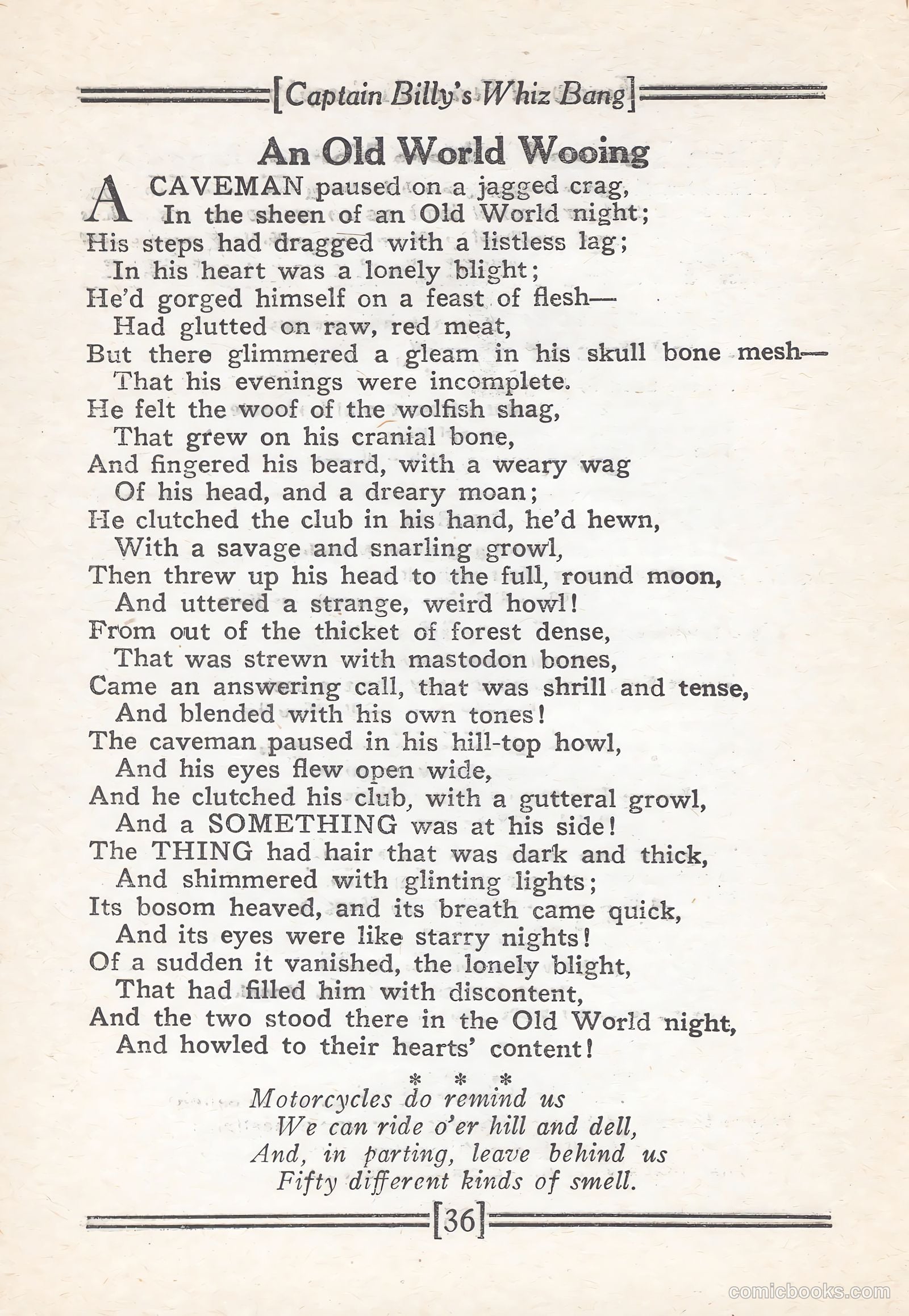
This is a humorous poem from *Captain Billy's Whiz Bang*, a satirical magazine popular in the 1920s. The piece uses prehistoric caveman imagery as a comedic metaphor for male loneliness and romantic yearning. The narrative depicts a lonely caveman whose material needs (food) are satisfied, but who feels emotionally incomplete. He howls to the moon in existential frustration—a romantic gesture even in primitive times. Miraculously, a female creature answers his call, appearing with supernatural beauty ("starry nights" for eyes). Their meeting instantly resolves his melancholy. The satire mocks sentimental romantic conventions by literalizing them in crude prehistoric settings, suggesting that romantic longing is primal and timeless. The short motorcycle joke appended below undercuts any earnestness, typical of *Whiz Bang*'s irreverent tone. The piece reflects 1920s humor: combining faux-poetic language with crude subjects, and using evolutionary/primitive framing as comedy.
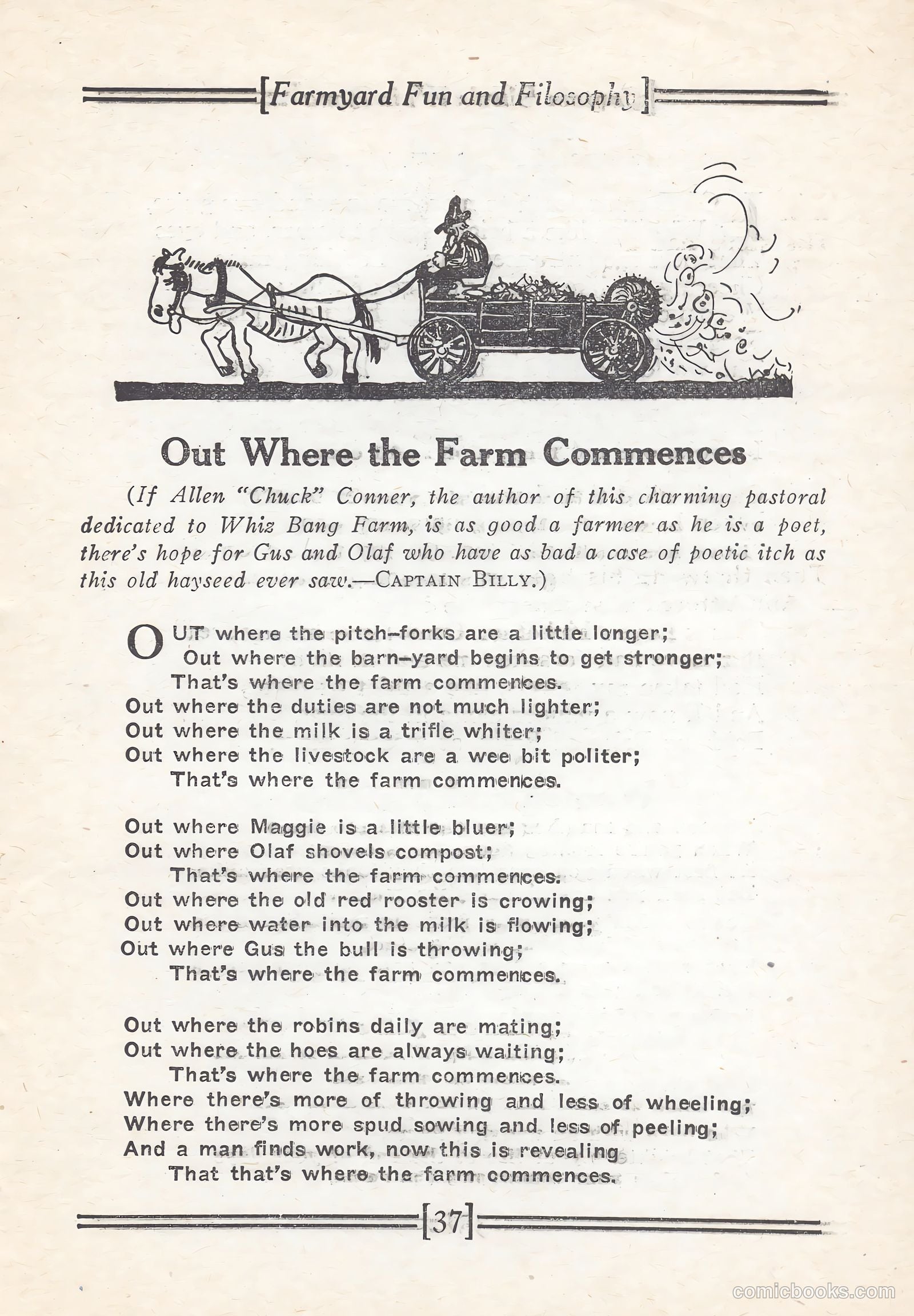
This is a humorous poem by Allen "Chuck" Conner, published in *Whiz Bang*, a satirical magazine. The editor (Captain Billy) frames it as gently mocking Conner's farming abilities while praising his poetry. The poem uses repetitive structure to humorously describe farm life's realities through named characters—Maggie, Olaf, and Gus the bull—suggesting these are real farmworkers or animals. The humor comes from the contradictions: milk being "whiter" but literally diluted with water; livestock being "politer" than usual; and the general chaos of farm labor (bulls throwing, roosters crowing, constant hoeing). The final stanza's reveal—that hard farm work is where "a man finds work"—suggests the satire's point: romanticized pastoral poetry ignores farming's grueling reality. The illustration of a horse-drawn wagon loaded with hay reinforces this theme of actual agricultural labor, not poetic fantasy.
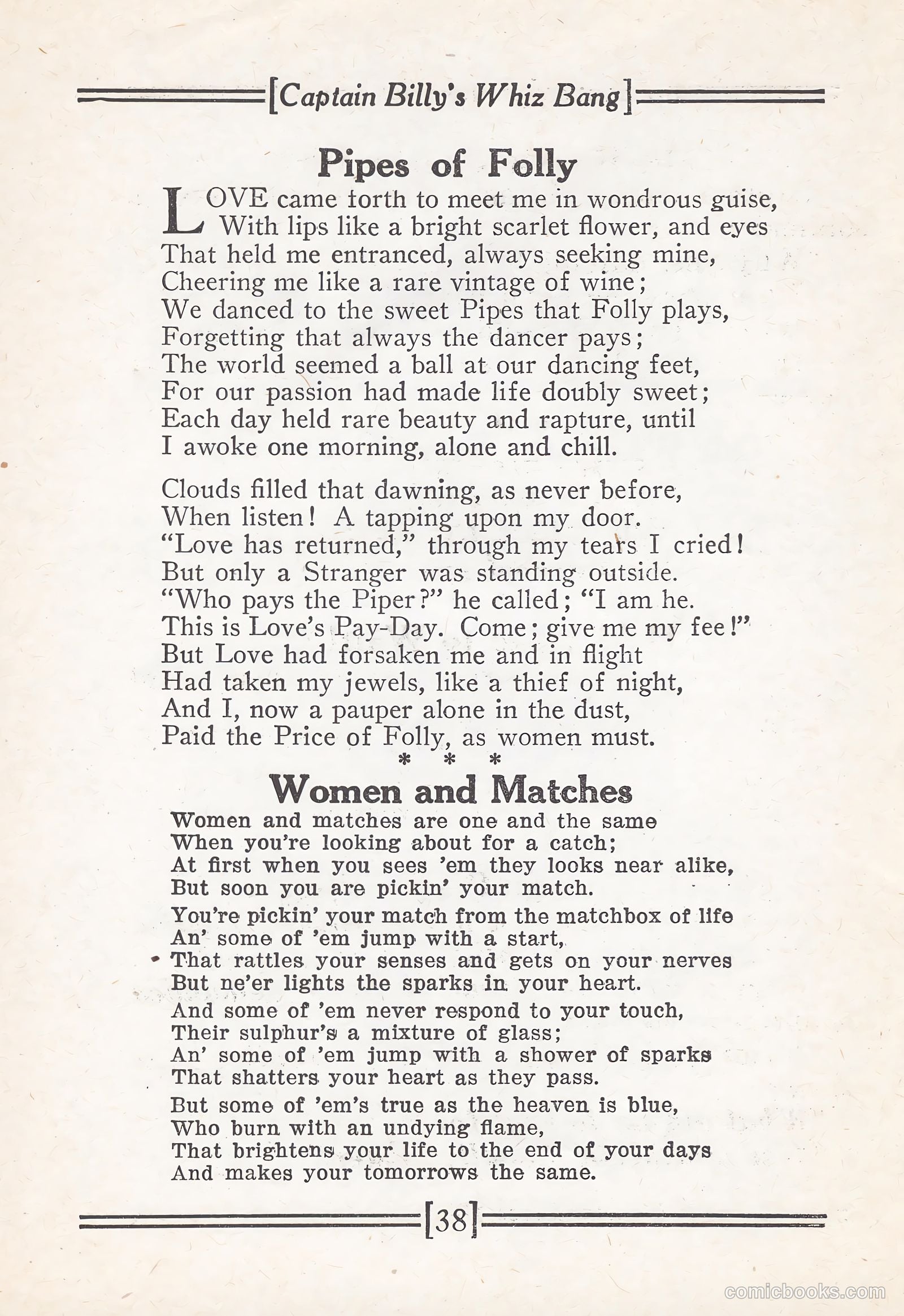
This page contains two humorous poems from *Captain Billy's Whiz Bang*, a satirical magazine known for ribald humor and cautionary tales. **"Pipes of Folly"** is a cautionary narrative poem about romantic deception. A man falls for a woman who appears loving but abandons him, stealing his valuables. A stranger then arrives demanding payment as "Love's Piper"—a metaphorical debt collector. The moral: romantic passion leads to financial and emotional ruin, and "women" must "pay the Price of Folly." This reflects period misogyny, blaming women for men's romantic mistakes. **"Women and Matches"** extends the metaphor, comparing women to matchsticks: some fail to ignite passion, some burn dangerously (destroying the heart), and rare ones provide steadfast, reliable warmth. The poem uses working-class dialect ("sees 'em") for populist appeal. Both poems present cynical, gendered views typical of 1920s humor magazines—warning men against women while simultaneously mocking romantic idealism. The satire targets male gullibility rather than defending women's agency.
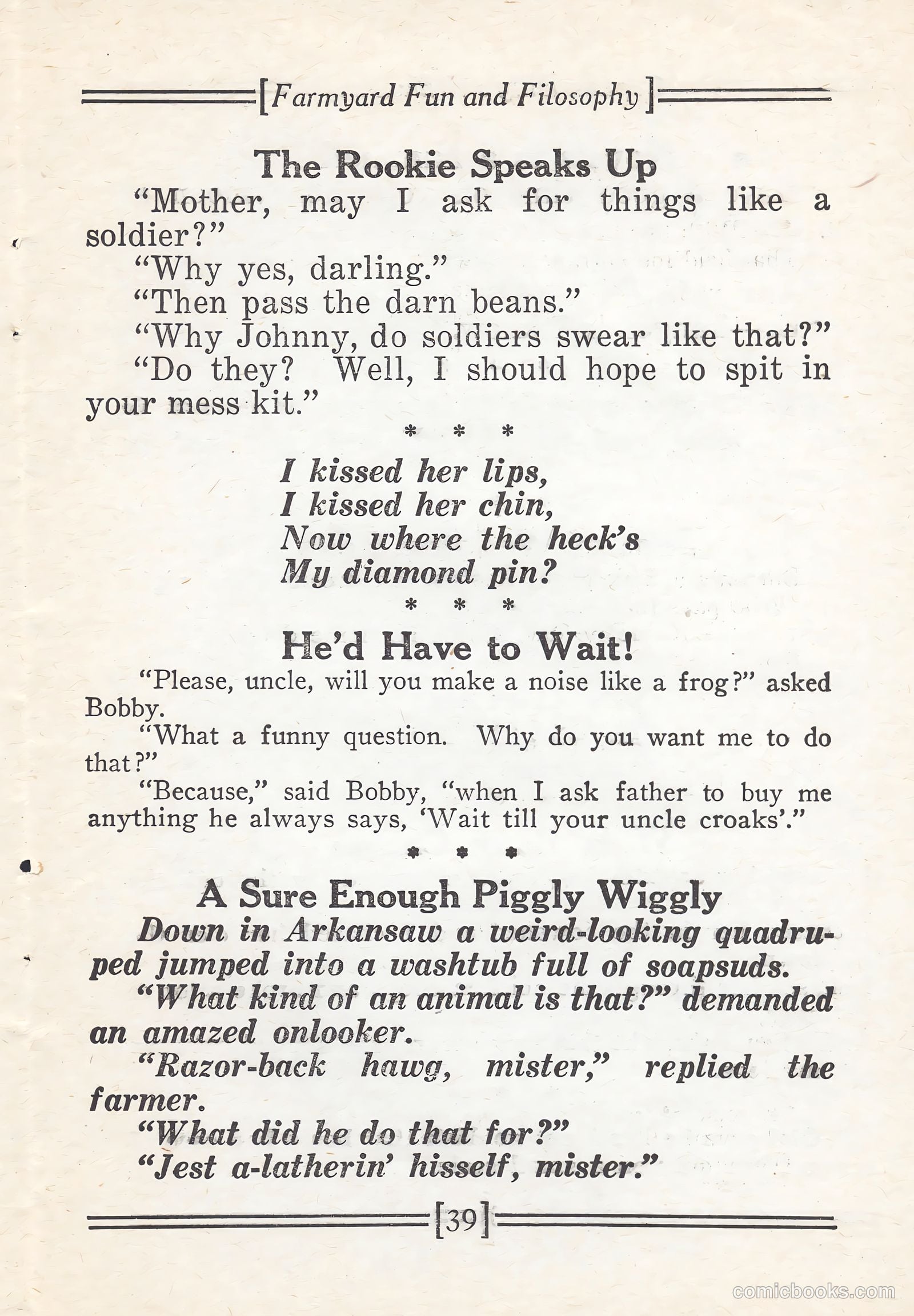
This page from *Whiz-Bang* contains four separate humorous anecdotes under the "Farmyard Fun and Philosophy" heading, typical of early-20th-century American humor magazines. **The jokes rely on:** 1. **"The Rookie Speaks Up"**: A child mimics soldiers' coarse language and manners, satirizing how military culture corrupts youth innocence. 2. **"I kissed her lips..."**: A brief romantic complaint—a man lost his diamond pin after kissing a woman, implying she stole it or he was careless. 3. **"He'd Have to Wait"**: Dark humor about a child misunderstanding his father's phrase "wait till your uncle croaks" as meaning the uncle will literally die soon, so he asks the uncle to make frog sounds to speed this along. 4. **"A Sure Enough Piggly Wiggly"**: Wordplay on the grocery chain; a Arkansas razor-back hog jumps into soapsuds, supposedly "lathering itself"—rural humor playing on dialect and animal behavior. The content is genteel, family-friendly satire targeting military propriety, romance, filial obedience, and rural life—standard magazine filler of the era.
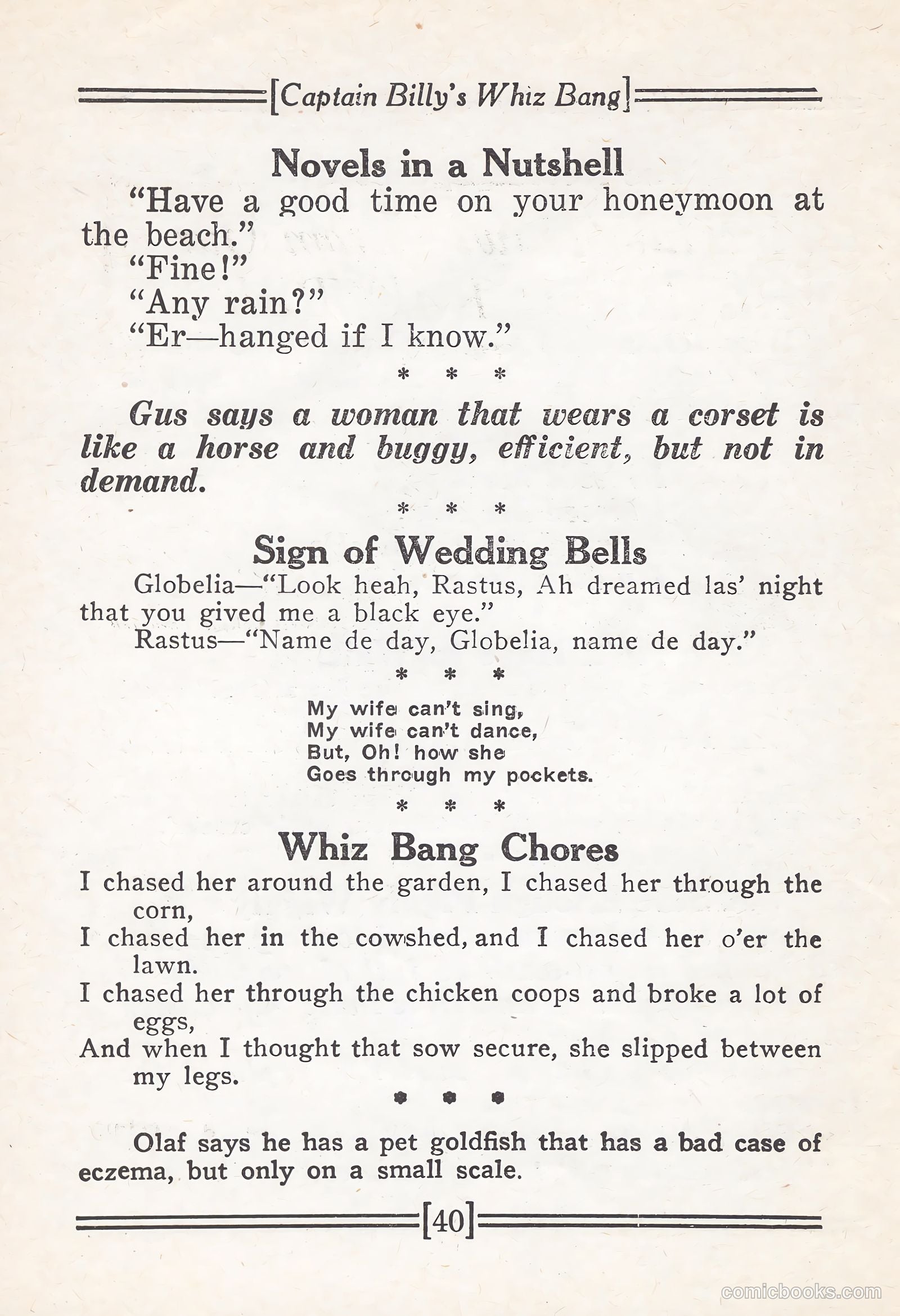
This page from the satirical magazine *Captain Billy's Whiz Bang* contains brief humorous sketches and jokes typical of 1920s American humor. The "Novels in a Nutshell" section mocks honeymoon small-talk. "Gus says" contains a dated comparison criticizing women in corsets as outdated and undesirable. The "Sign of Wedding Bells" dialogue uses racist dialect stereotypes (African American characters "Globelia" and "Rastus") to joke about a proposal following a domestic violence dream—presenting abuse as romantic prelude. "My wife" jokes center on a wife's spending habits—a common domestic humor trope of the era. "Whiz Bang Chores" humorously describes chasing a woman through various farm locations with double entendre ("slipped between my legs"). The final joke about Olaf's goldfish's eczema is a pun ("small scale"). Throughout, the humor relies on dated stereotypes, casual domestic violence references, and rural/slapstick comedy typical of early 20th-century men's magazines.
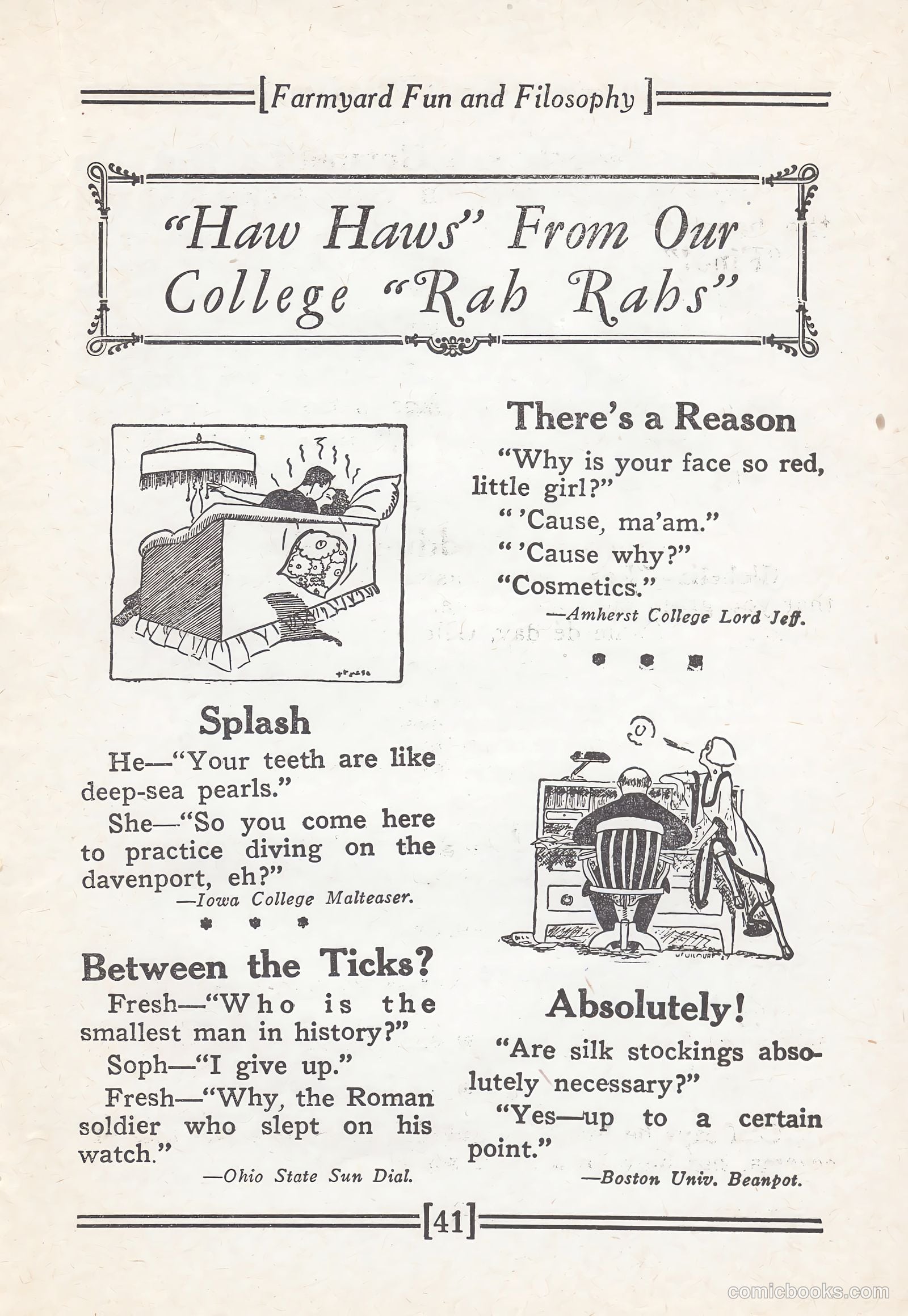
This page collects humorous jokes and puns from college humor magazines of the early 20th century. The content satirizes college student dating culture and academic life: **"There's a Reason"**: A child's innocent misunderstanding—when asked why her face is red, she attributes it to cosmetics rather than embarrassment, poking fun at women's vanity. **"Splash"**: A flirtation joke where a young man's compliment about teeth leads to an awkward revelation that he's using the opportunity for physical contact on the couch (the "davenport"). **"Between the Ticks"**: A pun-based joke playing on "watch" (timepiece vs. surveillance), typical of era humor. **"Absolutely!"**: A suggestive double entendre about silk stockings being "necessary" only to a certain height on the leg, implying more risqué content. The cartoons accompanying these jokes use simple line drawings to illustrate the scenarios. Overall, the page exemplifies college humor's preoccupation with dating, flirtation, and mild innuendo typical of 1920s-era publications.
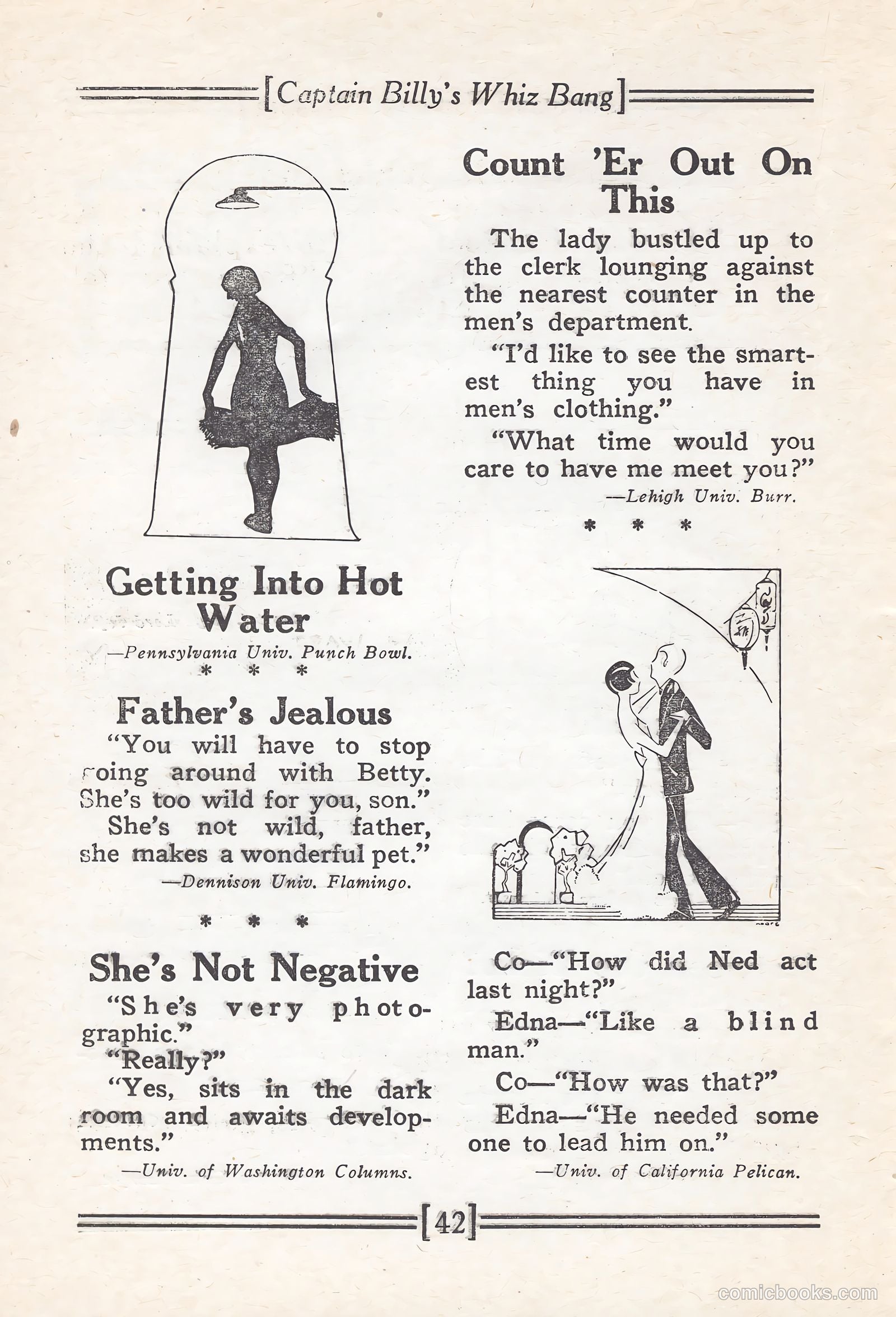
This page collects five brief jokes from college humor magazines, typical of 1920s-era student publications. The humor relies on double entendres and wordplay: **"Count 'Er Out On This"**: A clerk flirts with a woman shopping in men's clothing, suggesting a romantic meeting rather than helping her shop. **"Father's Jealous"**: A father warns against dating "wild" Betty; the son reframes her as a "pet," implying controllability or lesser status. **"She's Not Negative"**: Photographic darkroom wordplay—she "awaits developments," suggesting romantic or sexual potential. **"Getting Into Hot Water" and final joke**: Both use mild innuendo about leading someone on. The illustration shows a man being pulled upward on a rope by a woman and children, visually pun-ning "hot water" trouble. These jokes reflect period attitudes toward gender relations, with women portrayed as either flirtatious, controllable, or needing male guidance—typical of early-20th-century college humor conventions.
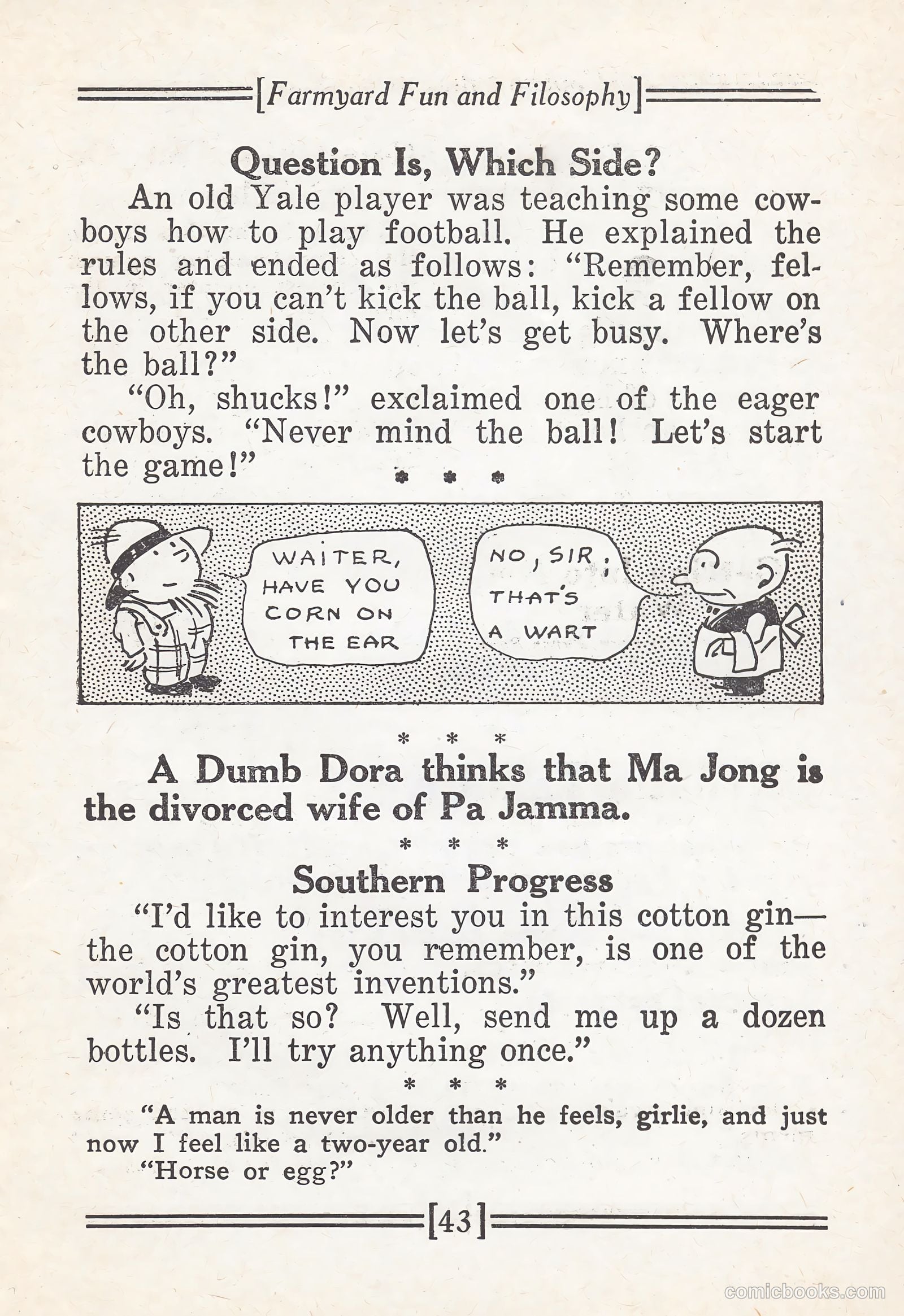
This page collects brief comedic sketches typical of 1920s satirical magazines: **"Question Is, Which Side?"** mocks naive cowboys who misunderstand football rules, prioritizing violence over the actual game—a joke about rural simplicity. **The cartoon** shows a waiter's confusion: a customer asks about "corn on the ear" (a food), but the waiter misidentifies it as a wart, playing on the homophone "ear/err." **"Dumb Dora"** references a popular comic strip character known for stupidity. The joke relies on readers recognizing that "Ma Jong" (the game) and "Pa Jamma" (pajamas) are puns, not real people. **"Southern Progress"** satirizes both aggressive salesmanship and rural gullibility—someone pitches a cotton gin as a great invention, and the prospect assumes "gin" means alcohol and wants bottles. **The final joke** uses innuendo: a man claims youth because he "feels like a two-year old," and when asked "horse or egg?" (implying he's acting like an animal or is simple-minded), the humor derives from double entendre about masculine virility.
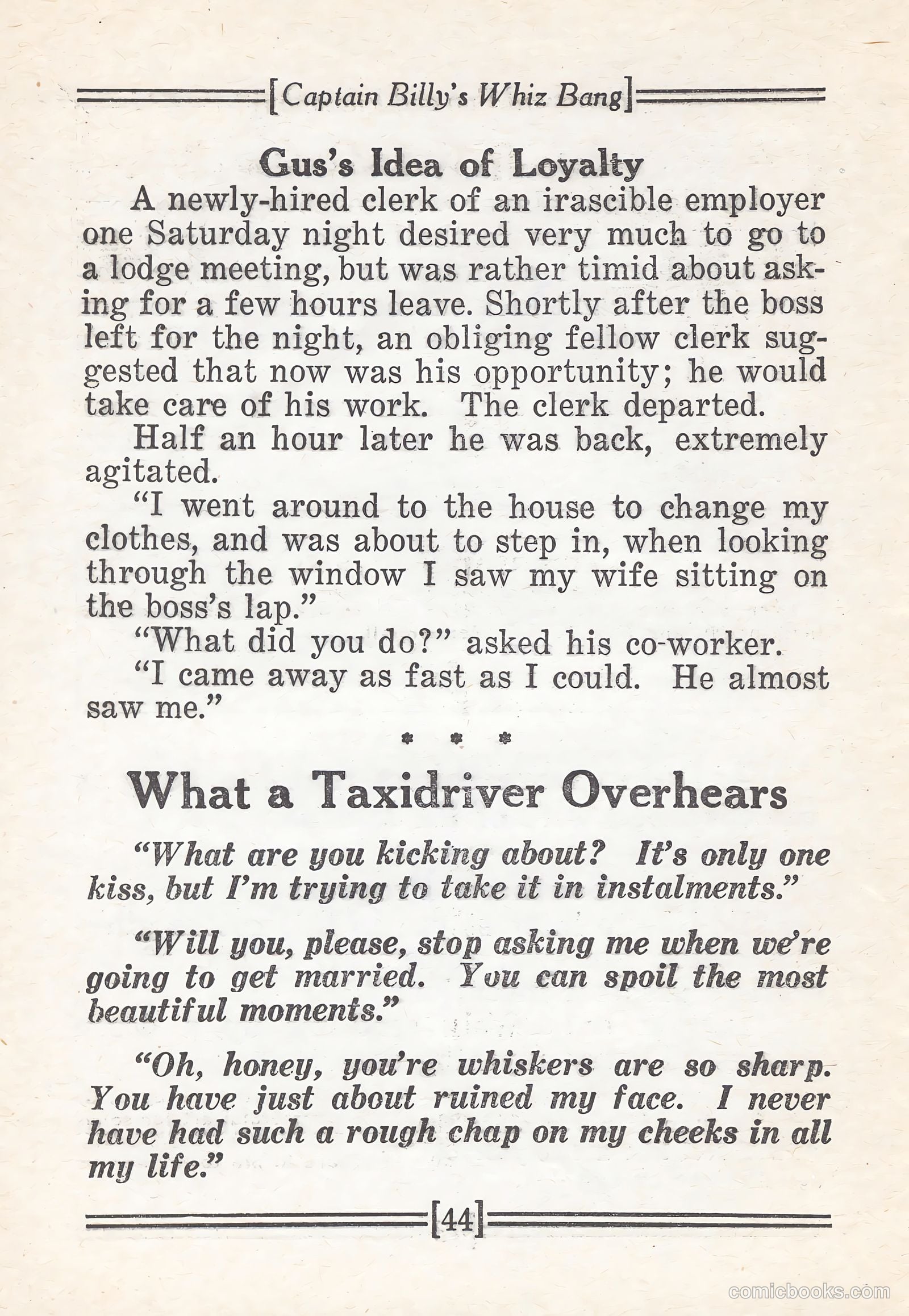
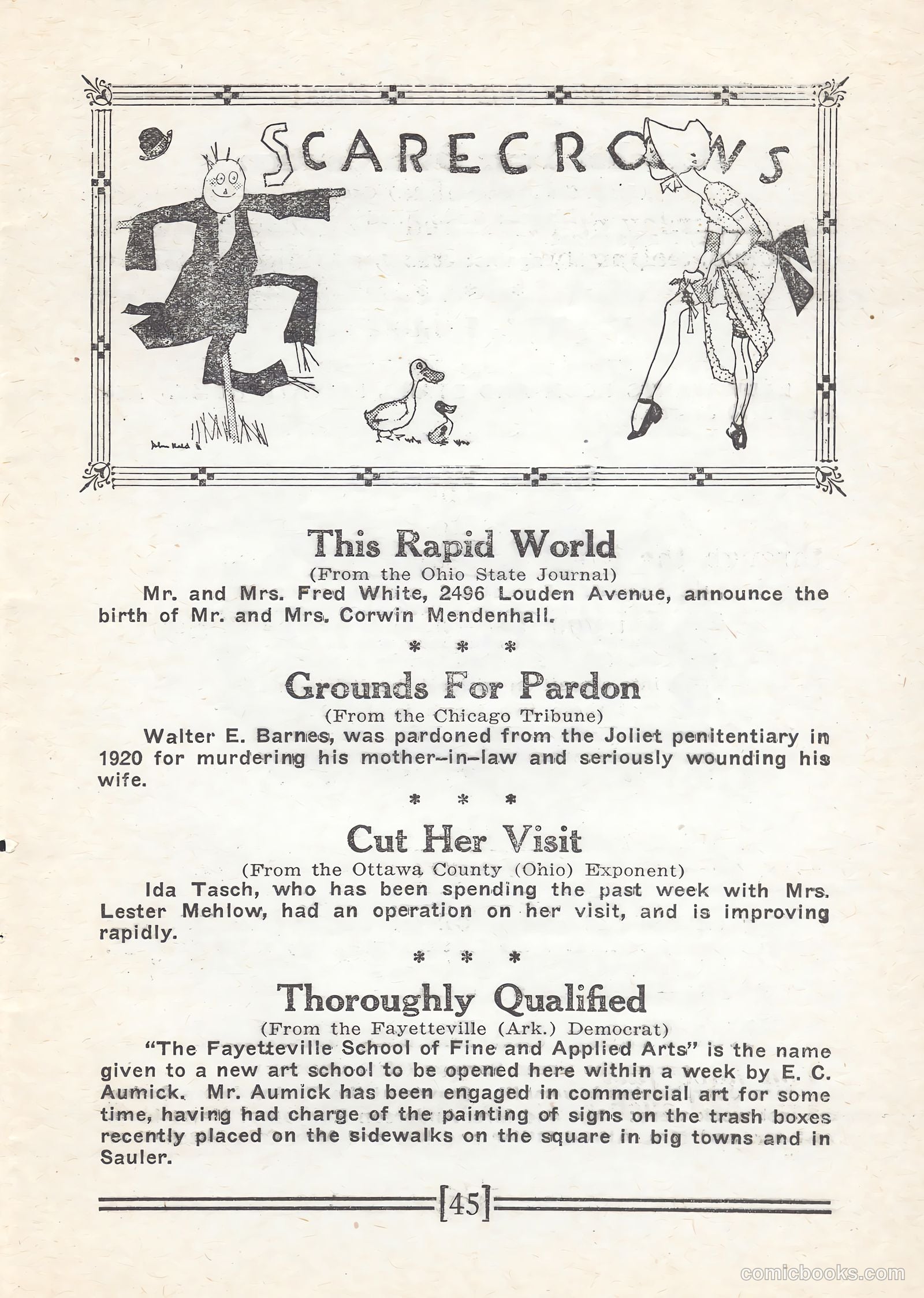
This page features humorous newspaper reprints—a common Whiz-Bang format—highlighting absurd or unintentionally funny news items from regional papers. The scarecrow illustration serves as a thematic header. The jokes exploit **awkward phrasing and unintended implications**: - "This Rapid World" mocks an announcement's confusing wording (announcing a birth "of Mr. and Mrs." rather than "to"). - "Grounds For Pardon" darkly notes a man pardoned for murdering his mother-in-law and wounding his wife—presenting the absurdity that such crimes warrant pardon. - "Cut Her Visit" plays on the ambiguous phrase "had an operation on her visit" (implying surgery occurred *during* the visit). - "Thoroughly Qualified" satirizes someone opening an art school whose only credential is painting signs on trash boxes. These represent **journalistic blunders**—unintentional humor created by poor word choice or dubious qualifications. The satire targets newspapers' careless reporting rather than specific individuals or politics.
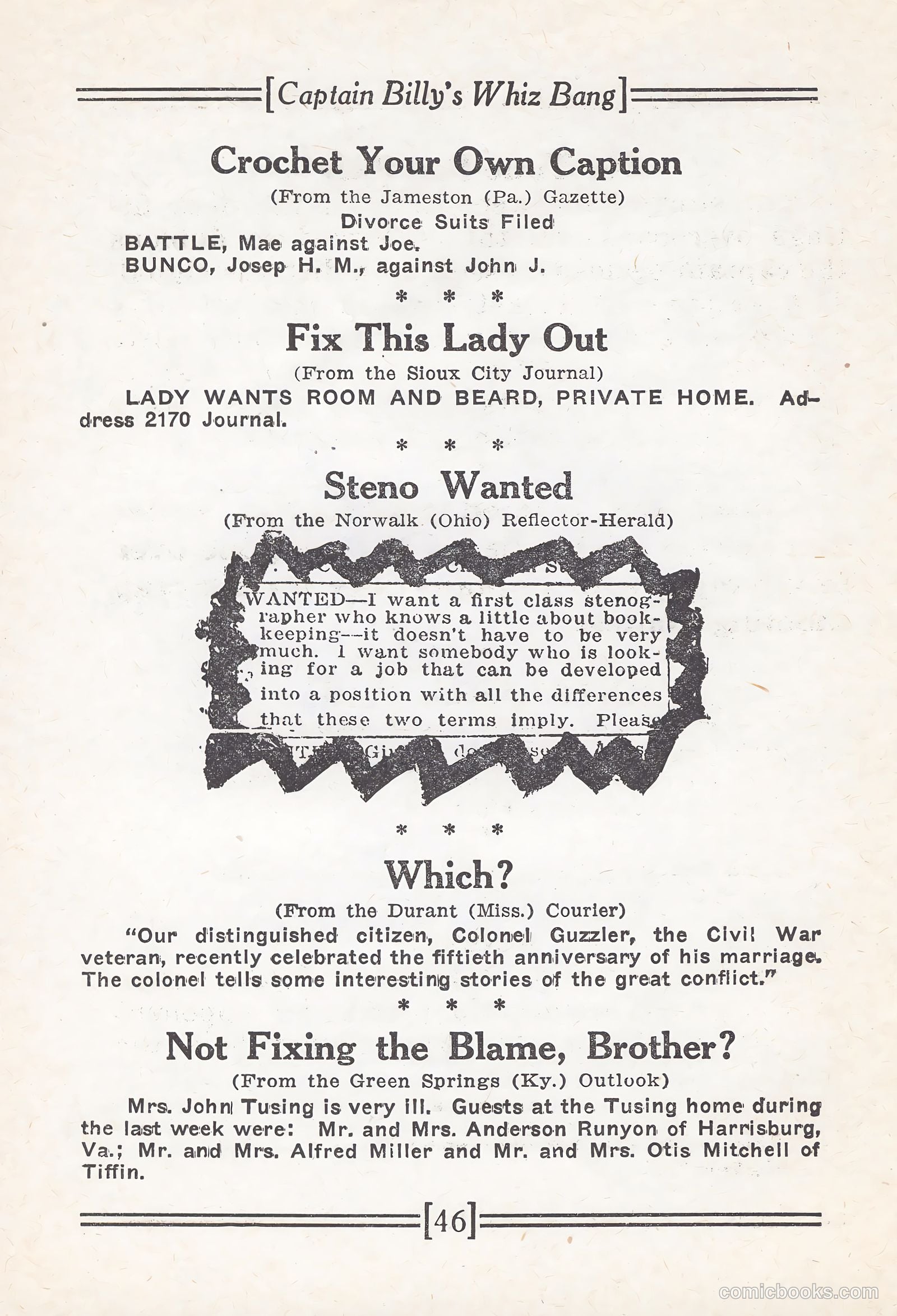
This page from the satirical magazine collects humorous classified ads and newspaper clippings from small-town American papers, mocking unintentional comedy in public notices. **Key jokes:** - "Fix This Lady Out": A woman's ad requesting "room and beard" (likely a typo for "board") becomes absurd - "Steno Wanted": An employer's verbose job posting ironically exemplifies poor communication skills - "Which?": The humor is unclear from text alone, but likely mocks Colonel Guzzler's claim about marriage anniversary while discussing Civil War stories (possibly suggesting senility or misplaced priorities) - "Not Fixing the Blame, Brother?": Lists Mrs. Tusing's recent guests before mentioning she's now very ill—implying the guests brought illness, with the title sarcastically asking if anyone's taking responsibility The magazine's format, "Crochet Your Own Caption," invites readers to supply their own humorous interpretations of these real classified ads, celebrating the unintentional absurdities of provincial American newspapers.
This page contains several brief humorous pieces typical of early 20th-century American satirical magazines: **"No Time For Play"** is a joke about a ship in distress sending distress signals (fireworks/rockets), which a passenger mistakes for celebration—the humor lies in his obliviousness to danger. **The "Mose" item** references a recurring "colored contributor" character, using period-appropriate but now-offensive terminology. It jokes about Mose wishing to attend a crap-shooting (dice gambling) contest with "Captain Billy"—likely a reference to Captain Billy Fawcett, the magazine's founder. **"The Maiden's Wail"** is sentimental light verse about romantic regret, playing on circular logic where kissing leads to love which leads to loss. **"Action"** presents a dark joke: a poker game in Montana where a tenderfoot with four aces is shot by his opponent with an automatic weapon, requiring a coroner's inquest. The final joke is a simple riddle: "What are the five senses?" "Nickels"—a pun on "cents/sense."
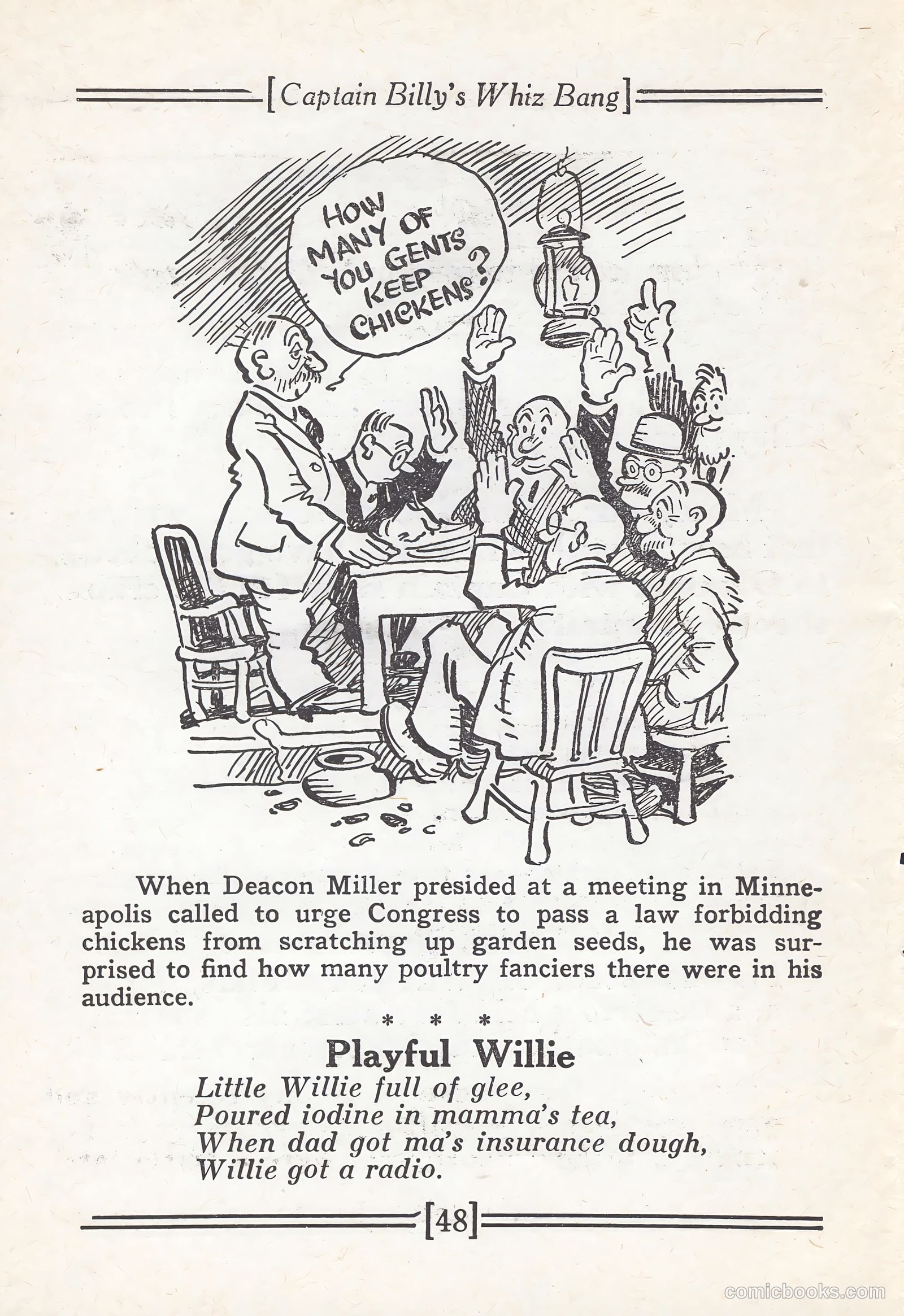
**The Main Cartoon**: A "Deacon Miller" calls a meeting in Minneapolis to lobby Congress for legislation against chickens scratching up garden seeds—a absurdly trivial concern. His shock at discovering numerous poultry enthusiasts in the audience satirizes how niche interests can unexpectedly mobilize, and mocks earnest activists pursuing petty causes while bigger issues exist. **"Playful Willie"**: This dark-humor poem satirizes both childhood mischief and insurance fraud. The joke: Willie poisons his mother with iodine, his father collects her life insurance, and Willie gets rewarded with a radio. It cynically suggests parents exploit tragedy for profit while indulging misbehaving children—reflecting post-WWI American anxieties about morality, greed, and family breakdown. Both pieces use exaggeration to mock social behaviors typical of 1920s America.
This is a gossip column from *Whiz-Bang* (November 1, 1924) chronicling Hollywood scandals. It contains no cartoon—just text reporting on silent film stars' romantic entanglements. The column documents love triangles among actors: Claire Windsor and Bert Lytell's relationship troubles (complicated by Lytell's escort of French dancer "Peaches" Chalfonte); Fritzi Ridgeway's mysterious disappearance with an unnamed Russian lover; and the beginning of an anecdote about actress Pola Negri. The satire targets Hollywood's shallow celebrity culture and the public's appetite for scandalous gossip. References to "joy palaces" and romantic drama emphasize the era's association of Hollywood with moral permissiveness. The gossipy, breathless tone itself mocks both the subjects and readers' fascination with their private lives. This reflects 1920s anxieties about cinema's influence on morality and celebrity worship.
This page from the satirical magazine contains three celebrity gossip items targeting silent film and theater figures of the 1920s. The first item mocks actress Pola Negri, apparently a famous guest at a dinner who was embarrassed when introduced to someone else (Dudley Field Malone) after receiving elaborate praise—the joke being she wasn't the actual subject of honor. The second briefly notes actress Agnes Ayres's secret two-month marriage to a Mexican diplomat. The third targets Nina Potter Vesci, a would-be playwright and socialite (daughter of a Santa Barbara hotel owner). It satirizes her failed engagement to renowned playwright Eugene O'Neill, suggesting she lacks his genius but caught the writing bug from him—the misspelling "drammar" emphasizing her pretensions. The humor is typical 1920s gossip-column satire: mocking celebrity vanity, broken engagements, and social climbing among the Hollywood and theater set.
This is a celebrity gossip column from an early 20th-century satirical magazine. It contains four brief items: 1. **Theda Bara** (silent film vamp actress) rented a mansion at Long Beach where the owner inexplicably placed nude female statues on the lawn—the joke is that Bara, known for playing seductive roles, doesn't need such "corrupting" influences at home. 2. A brief note about two studio publicists' quiet wedding. 3. **Rex Ingram** and **Alice Terry** (film director and actress couple) faced divorce rumors when Terry came west for a film, but reconciled when she returned to New York. The item reveals Ingram is actually leaving Hollywood due to lung disease, planning treatment in Tunis. 4. The final item jokes that Hollywood was so busy trying to reunite **King Vidor** and **Florence Vidor** (divorced filmmakers) that nobody noticed **King** and **Eleanor Boardman** (another actress) were spending considerable time together—implying a new romantic pairing. The satire targets Hollywood's obsession with romance and marital drama among entertainment figures.
This page contains celebrity gossip from what appears to be a 1920s satirical magazine. The column mocks Hollywood figures and their personal dramas: **Elliott Bandini**: A wealthy Los Angeles heir whose expensive divorce forced him to enter filmmaking to recover losses—satirizing wealthy dilettantes pursuing show business. **Sam Rork and Mary McLaren**: Gossip about a producer-actress relationship, with hints he'll "launch" her career as he did her sister. **Larry Semon and Dorothy Dwan**: The satire targets their engagement, mocking Dwan's apparent immaturity (described as "just emerging from eighth grade," having a "dolly expression"). The joke suggests she's intellectually beneath him. **Gladys Hulette and William Parke**: A woman using newspaper publicity to locate her missing husband for divorce proceedings—satirizing how Hollywood scandals become public spectacle. The overall tone mocks Hollywood excess, failed marriages, and the industry's willingness to exploit personal drama for publicity.
This page contains gossip about silent-film celebrities, not political cartoons. The section mocks Hollywood's divorce epidemic, naming actors like Mary Miles Minter, Creighton Hale, and Leatrice Joy. The satire targets the film industry's romantic instability—multiple divorces are reported casually, with the tone suggesting this upheaval is routine ("the divorce mill...continues to grind"). The jokes rely on readers' familiarity with these now-obscure stars and their personal scandals. References like Minter "managing somehow to shorten" a jail sentence hint at using connections; the Dr. Mixsell item suggests romantic fickleness; the Marjorie Rambeau item implies a relationship has dissolved. The overall message: Hollywood's moral looseness and romantic chaos are absurd and deserving ridicule. Modern readers would need period context identifying these actors and the era's general disapproval of celebrity divorces.
This is a celebrity gossip column from an early 20th-century satirical magazine. It reports on the private lives and romantic entanglements of silent film stars and entertainers, including: - **Alan Forrest and Lottie Pickford**: rumored divorce due to Forrest's frequent absences - **Fatty Arbuckle**: noted for religious conversion and significant weight loss (75 pounds) - **Barbara La Marr**: her romantic involvement with actor-author Leon Gordon, who will co-star in her film "Sandra" - **Other entertainment figures**: Buster Collier's apparent melancholy, wealthy industrialist Reese Taylor's nightclub appearances with actress Constance Talmadge The column's tone is gossipy and insinuating rather than explicitly scandalous. It reflects the public's fascination with Hollywood's romantic scandals during the silent film era, when stars' personal lives were tabloid fodder. The humor relies on readers' familiarity with these celebrities and entertainment industry gossip.
This page contains five separate short jokes typical of early 20th-century American humor magazines, presented under a "Farmyard Fun and Philosophy" heading. The jokes target various social stereotypes: a child's literalism about spitting (a doctor's sample), women's roles as either romantic interests or domestic labor, infidelity and mistaken-identity violence in hotels, unmarried women's sexuality (the hammock/broom as signals of sexual experience), and finally, a man's financial ruin from courting an actress. The humor relies on wordplay, double meanings, and exaggeration. The most darkly comedic piece—about shooting the wrong couple in a hotel room—reflects period attitudes treating violent jealousy as suitable comic material. The "actress" joke perpetuates stereotypes about women entertainers as financially predatory. These are not political cartoons but rather collected quips reflecting casual social prejudices common to early 20th-century American popular entertainment, with no specific historical events referenced.
This page contains four separate humor items from an early 20th-century satirical magazine: 1. **"Capable Catering"**: A racist joke playing on dialect. A Black cook named Hannah says she's now "capering for a Congressman"—a pun suggesting congressmen are foolish or that working for them is absurd/undignified work. 2. **"A Comeback For This Generation"**: A reprinted local news item about social visits, with a section redacted/blacked out. The visible text notes two women were college roommates, suggesting the joke (now illegible) concerned their reunion or changed circumstances. 3. **"Whiz Bang Weather Signal"**: A pun: "buoys will be buoys" (boys will be boys), commenting on buoys breaking loose during bad weather. 4. **Real Estate Humor**: A salesman's absurd sales pitch to a "Deacon"—showing a single brick as proof a house is good, suggesting gullible customers or dishonest salesmanship. The page reflects period attitudes: casual racism, small-town gossip framed as humor, and cynicism toward salespeople and politicians.
This page contains several brief satirical sketches typical of 1920s humor magazines: 1. **"Republished By Request"**: An ant drinks whiskey near a dead horse and attempts to move the carcass, treating it with false bravado. The joke relies on physical comedy—the tiny ant's absurd ambition versus reality. 2. **"One of Benny's Daily Dozen"**: A crude joke about a child having a seizure, presented as beneficial. This reflects deeply offensive early-20th-century attitudes toward disability. 3. **"A lady voter"**: A satirical jab at women's suffrage (recently granted in 1920), mocking female voters' political knowledge. 4. **"Red Skins"**: A racist stereotype joke about Native Americans and hygiene. The page exemplifies period prejudices against women, people with disabilities, and Indigenous peoples.
This page from the satirical magazine *Captain Billy's Whiz Bang* contains several short humorous anecdotes typical of early 20th-century American humor: **"Now She Rolls Her Own"**: A young man gives his romantic interest Bull Durham tobacco (used for rolling cigarettes) after she repeatedly feigned garter problems to gain his attention—a crude joke about her manipulative behavior and his obliviousness. **Groundhog joke**: A simple pun where a schoolboy answers "Sausage" instead of the animal, playing on the edible nature of the word. **"Deuces Wild"**: A pun where telling a woman she'll "play the deuce" (cause trouble) if married becomes literal when she has twins (two of something). **"Dairy Farm Classic"**: A pun-based poem where a farmer names his daughter "Olemargarine" because he "hadn't any but her"—wordplay on margarine being butter substitute. **Final quip**: Observational humor about a working man losing appetite for his meals (provided as part of his wage). The humor is primarily pun-based and relies on double meanings rather than political satire.
This page presents five short, standalone jokes satirizing common social hypocrisies and domestic situations of the early 20th century. Each "remark" punctures pretense through absurd lies or manipulations: 1. A husband stops a clock at 3 AM to hide his late arrival from his wife 2. A salesman offers dubious "bonded" liquor with insincere customer service 3. A woman accompanies a man to dinner but won't eat, only watching him 4. A "grass widow" (separated woman) claims innocence while fishing for risqué stories 5. A man wants to bring his wife to an all-night poker game because she "comforts" him while losing The humor targets male deception, false chivalry, female manipulation, and the gap between what people claim and what they actually do. The title "Bully Remarks" suggests these are bold-faced (if transparent) lies people tell themselves and others. It's domestic comedy reflecting period anxieties about marriage, infidelity, and social propriety.
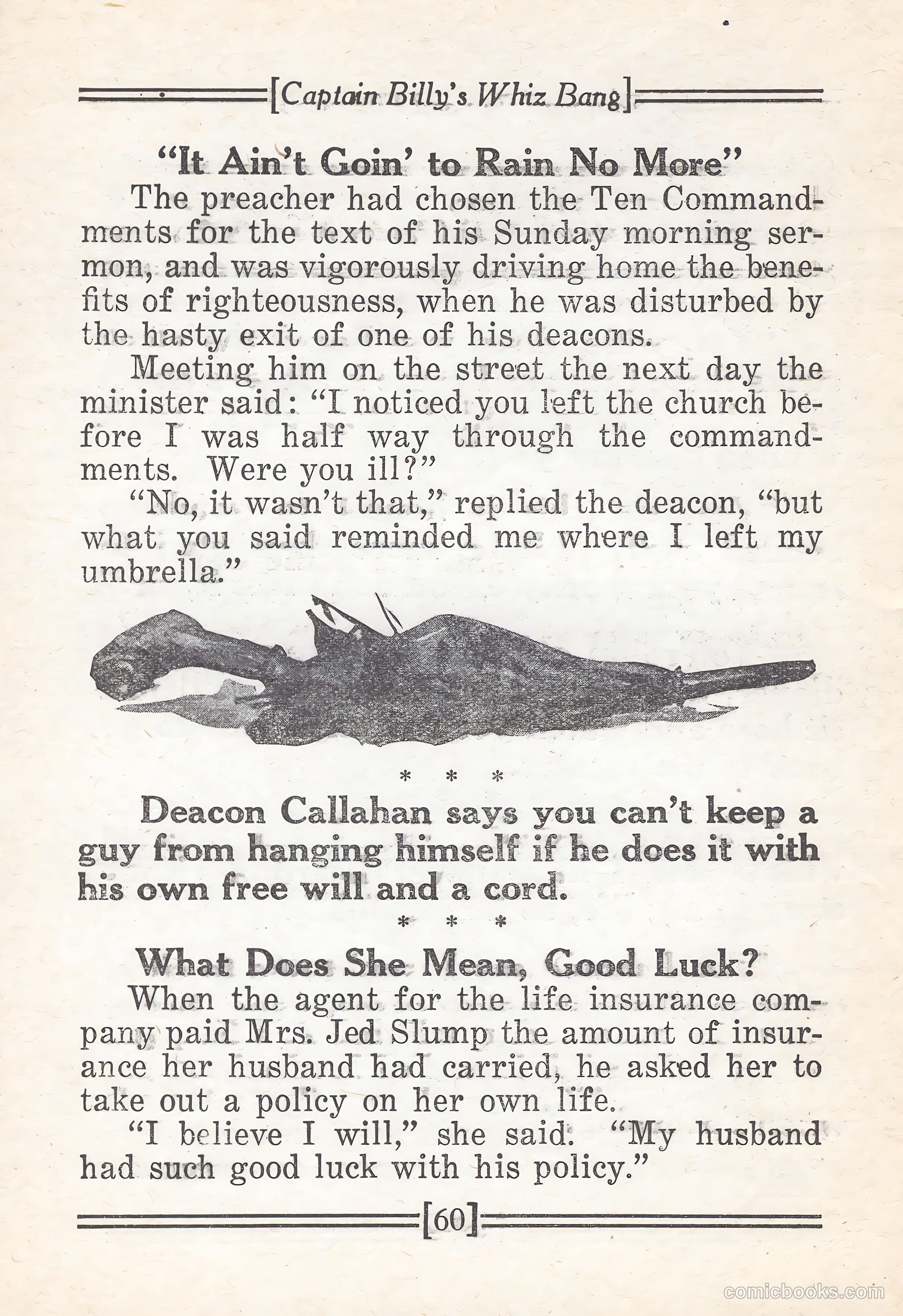
This page contains three brief humorous anecdotes typical of 1920s American satirical magazines: 1. **"It Ain't Goin' to Rain No More"**: A deacon leaves church during the Ten Commandments sermon. When asked why, he claims the preacher's words reminded him where he'd left his umbrella—a joke about the deacon's absent-mindedness and indifference to religious instruction. 2. **Deacon Callahan quote**: A dark quip about suicide, suggesting free will makes prevention impossible. Typical of era's edgy humor. 3. **"What Does She Mean, Good Luck?"**: An insurance agent urges a widow to buy life insurance. She agrees because her late husband "had such good luck with his policy"—implying she hopes to die and collect, darkly suggesting the husband's death was suspicious or suicide. These jokes reflect contemporary concerns about mortality, insurance fraud, and religious hypocrisy, delivered in the irreverent style characteristic of *Captain Billy's Whiz Bang*, a popular men's humor magazine of the period.
This is a humor column mixing satirical song parodies, absurdist jokes, and romantic banter typical of 1920s American comedy magazines. **Context and References:** - References to "flappers," "the Sheik" (likely Rudolph Valentino), and "jitney" (cheap taxi) reflect 1920s youth culture - "French dressing" and similar puns target contemporary slang and fashion - The "professor" absent-mindedness joke plays on a common stock character **Satirical Points:** - Song titles mock popular romance and flirtation trends among young people - The Dannie/Fannie beach dialogue is pure wordplay humor—meaningless but playfully confusing - The final exchange satirizes gender relations, suggesting men and women discuss each other in equally trivial ways, which the woman finds "horrid" **Overall:** This represents mainstream American humor aimed at general audiences during the Jazz Age, blending topical references with timeless absurdist comedy and gentle mockery of courtship customs.
This page from *Whiz Bang*, a 1920s-era humor magazine, collects six brief jokes with minimal visual elements—mostly text-based comedy. The opening "Slight Mistake" is a pun joke: Deacon Miller forgets his church sign specifications and asks his wife to wire them. A clerk, unaware of context, receives a wire saying a child will be "6 feet long and 2 feet wide"—absurdly describing a newborn's dimensions as if it were furniture, causing her to faint. "Some One Ought to Lick 'Er" is wordplay on "Virginia reel" (a dance) mixed with innuendo about a woman named Virginia and hard cider. The remaining jokes are brief one-liners: a cynical marriage joke, observations about competition and inevitability, and cat humor playing on the phrase "that kind of cat" (meaning behavior type). These represent typical lowbrow humor of the era—puns, double entendre, and simple observational comedy aimed at working-class readers.
This page collects brief jokes and verses typical of *Whiz Bang*, a humor magazine popular after WWI. The content reflects 1920s social attitudes: **"Whiz Bang Vaudeville"** presents a marital joke: a man chases a stranger's hat blown away—the punchline being his wife observes him doing so, creating comedic suspicion. **The kissing aphorism** is a play on relative popularity: kissing as an "art form" has more enthusiasts than music itself. **"Tune Sounds a Little Flat"** is a skating-rink pun: girls skate to song titles that sound like roller-rink movements ("East Slide, West Slide"). **"The Artist"** satirizes the "flapper"—the modern young woman of the 1920s—specifically her makeup practices. The verse acknowledges she's not literally a painter but *performs* artistry through cosmetics. "Carmen" (carmine/red) makeup was fashionable. The humor accepts women's makeup as entertainingly deceptive but harmless. These pieces target contemporary social anxieties about changing gender roles, courtship, and women's independence with lighthearted ridicule rather than serious critique.
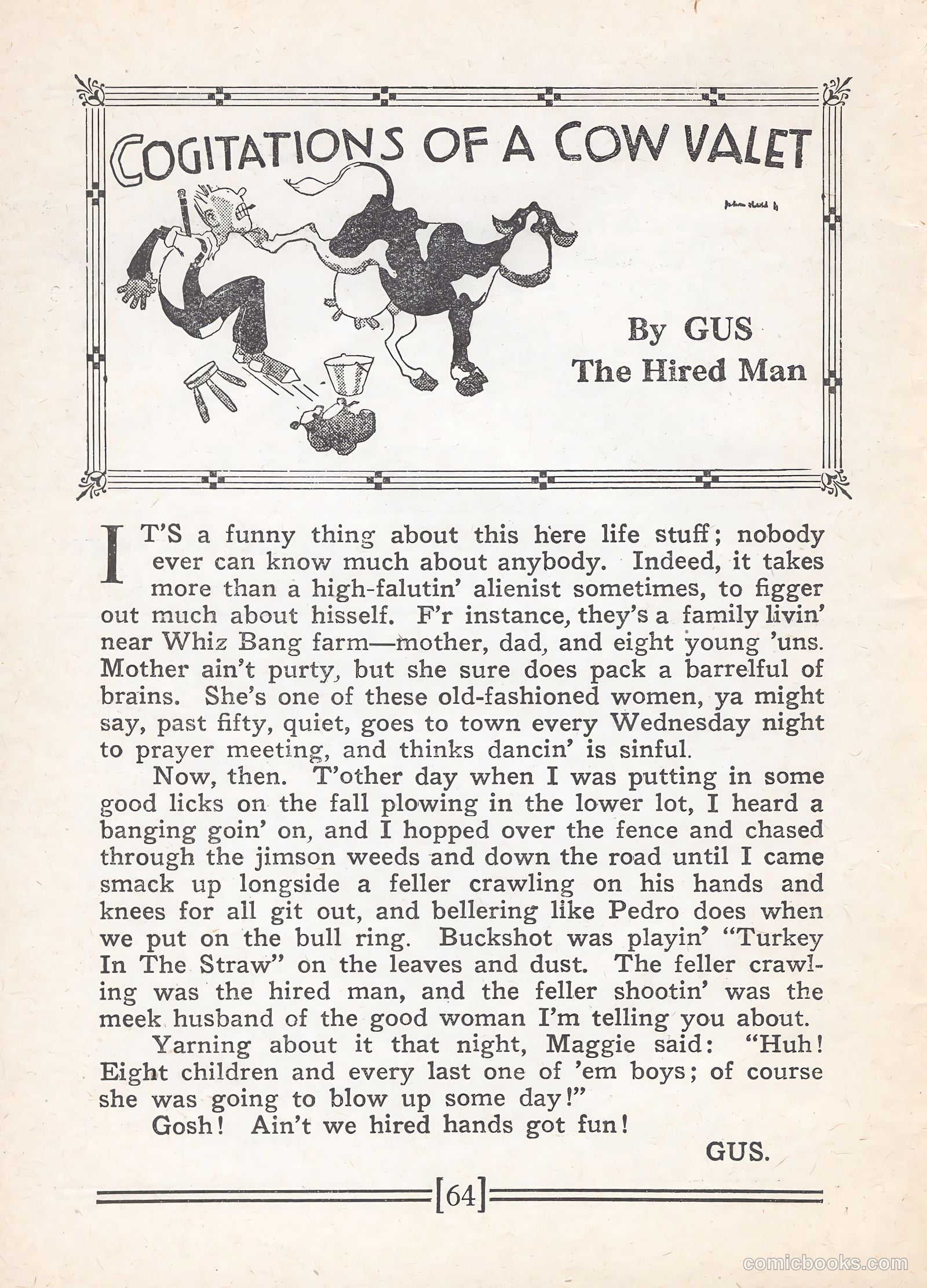
This is a humorous rural anecdote by Gus, the farm narrator. The illustration shows a cow-valet character observing the chaos below. The joke centers on domestic frustration: a meek, quiet husband finally snaps and shoots at his hired man while playing "Turkey In The Straw"—a rowdy folk tune. The punchline suggests the wife's pious, controlled demeanor (prayer meetings, disapproving of dancing) masked simmering tension. Maggie's comment implies that raising eight boys alone would naturally drive anyone to an outburst. The satire gently mocks both rural domesticity and gender dynamics—portraying the quiet, religious wife as potentially formidable and the "meek husband" as having hidden volatility. The hired man's bemused perspective adds ironic distance to the chaos. The humor relies on period-specific rural stereotypes and the surprise inversion of expected gender roles in farm life.
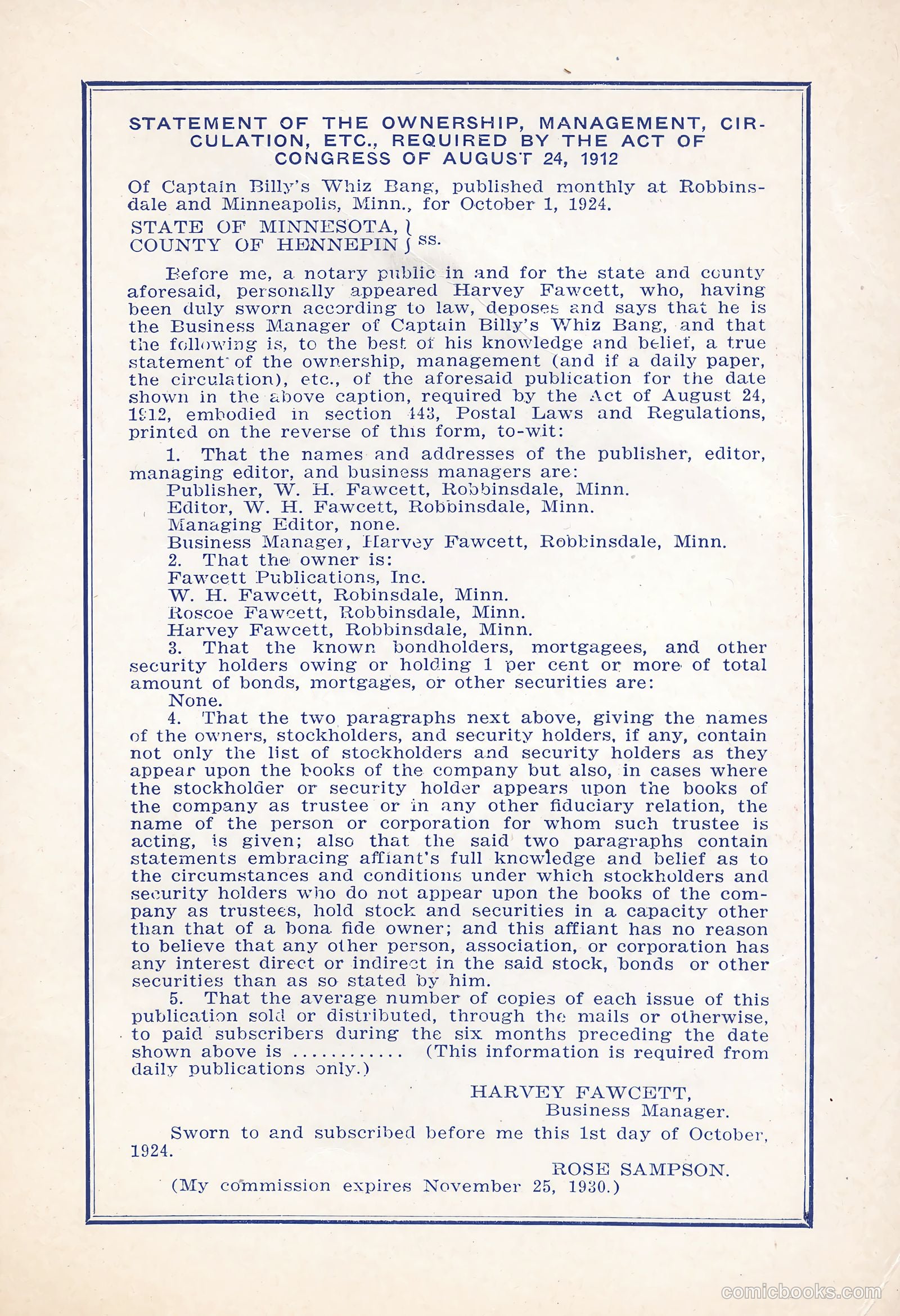
This page is a legal ownership and management statement, not a cartoon or satirical content. It's a required federal disclosure form documenting that Captain Billy's Whiz Bang magazine—published monthly in Minneapolis, Minnesota—was owned by Fawcett Publications, Inc., with W.H. Fawcett as publisher and Harvey Fawcett as business manager. The statement, signed October 1, 1924, lists ownership details and confirms the magazine had no significant bondholders. This type of declaration was mandated by the August 24, 1912 Congressional act governing magazine circulation disclosures. The page contains administrative information only.
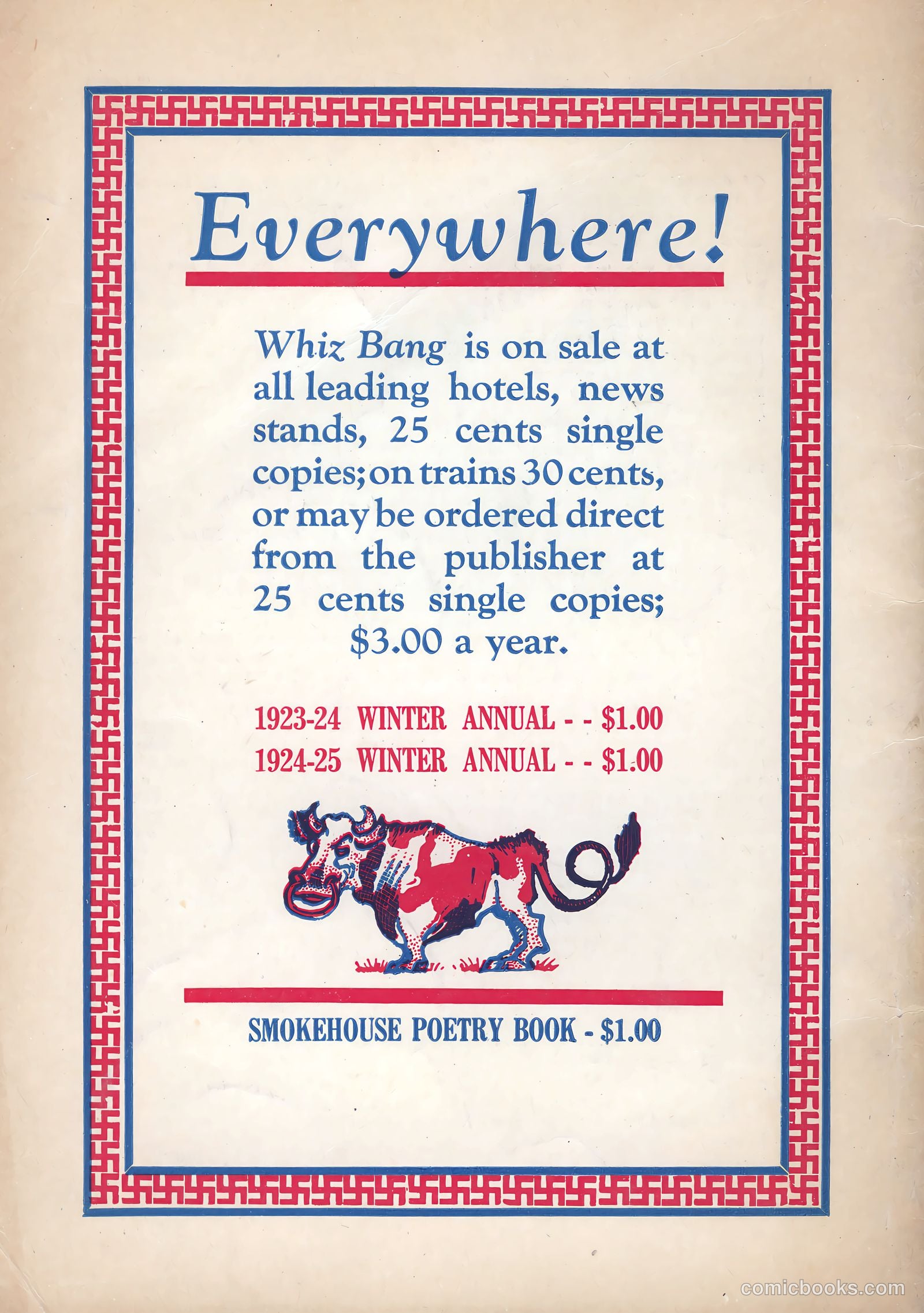
This is primarily an **advertisement page**, not editorial content. It promotes *Whiz Bang* magazine and related publications. The page announces distribution channels (hotels, newsstands, trains) and pricing for the magazine (25-30 cents per issue; $3/year). It advertises two Winter Annuals (1923-24 and 1924-25, each $1.00) and a *Smokehouse Poetry Book* ($1.00). The illustration shows a decorative cow or bull figure in red, white, and blue—likely a publisher's mascot or branding element. The ornate geometric border suggests Art Deco styling popular in the 1920s. This is essentially a circulation/sales announcement with no political or satirical content to analyze—just period magazine marketing.