
Captain Billy's Whiz Bang, December 1924 · page 52 of 71
Captain Billy's Whiz Bang #67 — page 52: what you’re looking at
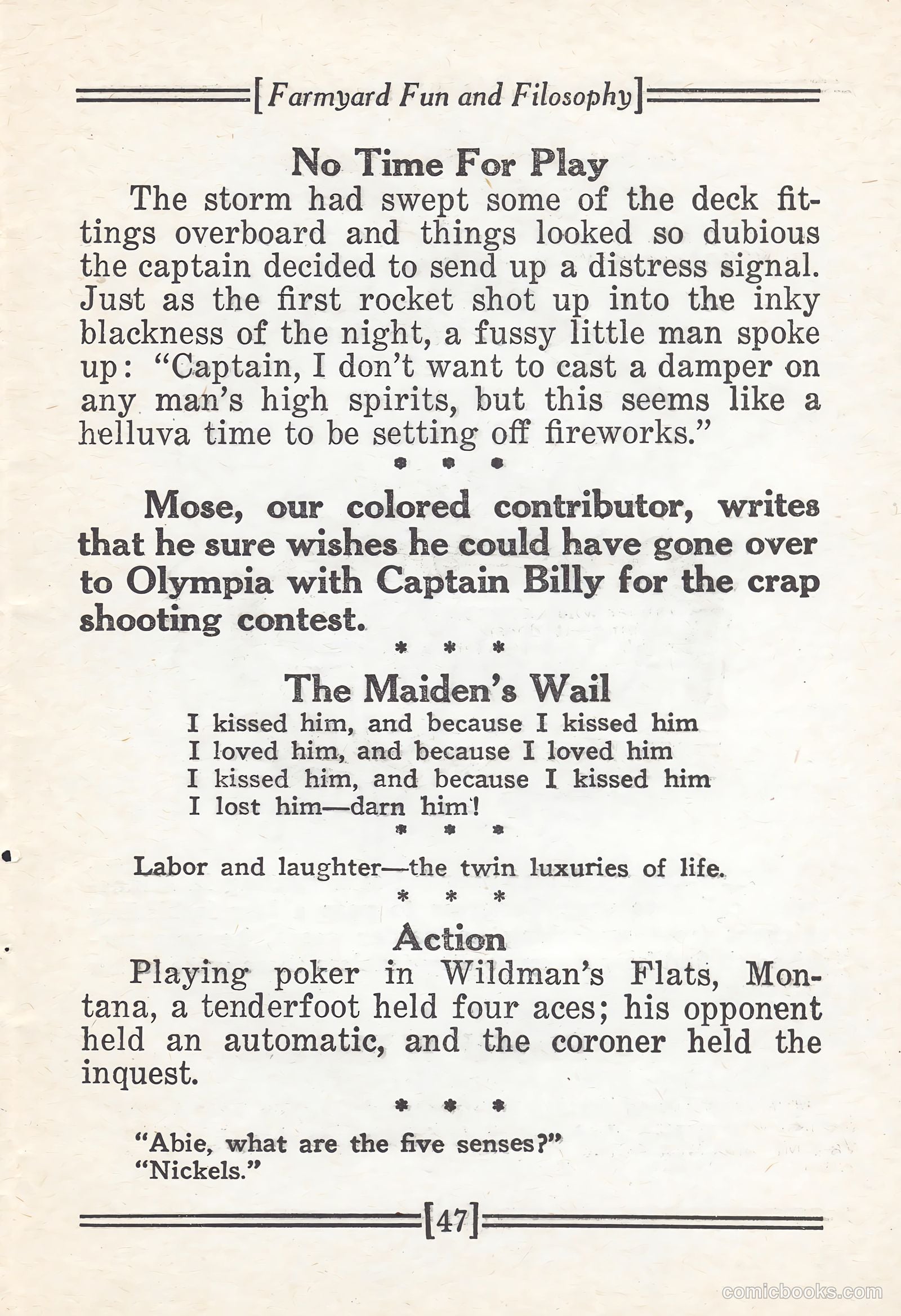
What you’re looking at
This page contains several brief humorous pieces typical of early 20th-century American satirical magazines: **"No Time For Play"** is a joke about a ship in distress sending distress signals (fireworks/rockets), which a passenger mistakes for celebration—the humor lies in his obliviousness to danger. **The "Mose" item** references a recurring "colored contributor" character, using period-appropriate but now-offensive terminology. It jokes about Mose wishing to attend a crap-shooting (dice gambling) contest with "Captain Billy"—likely a reference to Captain Billy Fawcett, the magazine's founder. **"The Maiden's Wail"** is sentimental light verse about romantic regret, playing on circular logic where kissing leads to love which leads to loss. **"Action"** presents a dark joke: a poker game in Montana where a tenderfoot with four aces is shot by his opponent with an automatic weapon, requiring a coroner's inquest. The final joke is a simple riddle: "What are the five senses?" "Nickels"—a pun on "cents/sense."
📄 Transcribed text from this page (OCR, searchable)
Machine-transcribed from the original scan — historical spelling and the odd misread are preserved.
=[Farmyard Fun and Filosophy]= No Time For Play The storm had swept some of the deck fit- tings overboard and things looked so dubious the captain decided to send up a distress signal. Just as the first rocket shot up into the inky blackness of the night, a fussy little man spoke up: “Captain, I don’t want to cast a damper on any man’s high spirits, but this seems like a helluva time to be setting off fireworks.” ... Mose, our colored contributor, writes that he sure wishes he could have gone over to Olympia with Captain Billy for the crap shooting contest. * * * The Maiden’s Wail I kissed him, and because I kissed him I loved him, and because I loved him I kissed him, and because I kissed him I lost him—darn him! * * * Labor and laughter—the twin luxuries of life. *