
Captain Billy's Whiz Bang, December 1924 · page 47 of 71
Captain Billy's Whiz Bang #67 — page 47: what you’re looking at
What you’re looking at
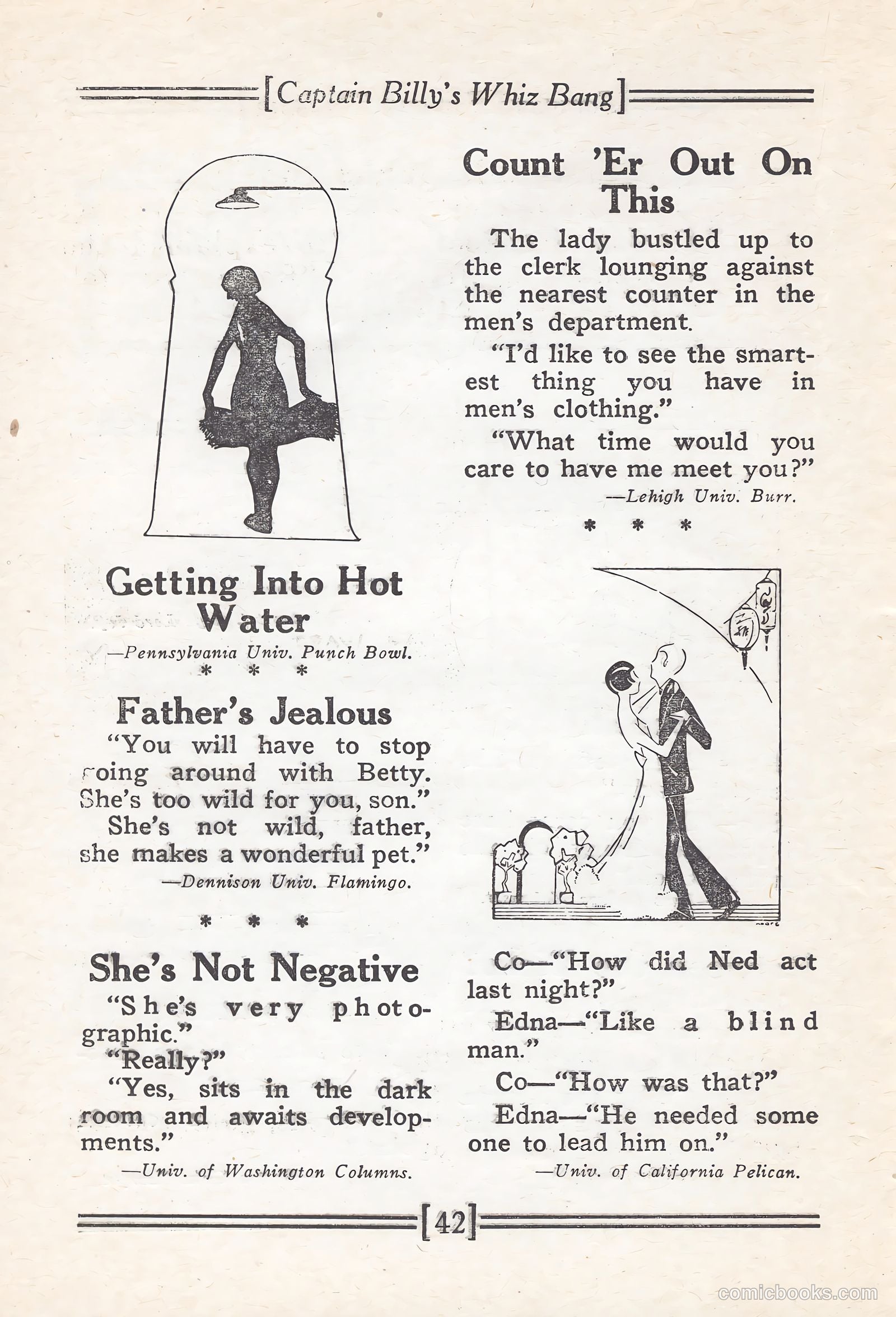
This page collects five brief jokes from college humor magazines, typical of 1920s-era student publications. The humor relies on double entendres and wordplay: **"Count 'Er Out On This"**: A clerk flirts with a woman shopping in men's clothing, suggesting a romantic meeting rather than helping her shop. **"Father's Jealous"**: A father warns against dating "wild" Betty; the son reframes her as a "pet," implying controllability or lesser status. **"She's Not Negative"**: Photographic darkroom wordplay—she "awaits developments," suggesting romantic or sexual potential. **"Getting Into Hot Water" and final joke**: Both use mild innuendo about leading someone on. The illustration shows a man being pulled upward on a rope by a woman and children, visually pun-ning "hot water" trouble. These jokes reflect period attitudes toward gender relations, with women portrayed as either flirtatious, controllable, or needing male guidance—typical of early-20th-century college humor conventions.
📄 Transcribed text from this page (OCR, searchable)
Machine-transcribed from the original scan — historical spelling and the odd misread are preserved.
[Captain Billy's Whiz Bang] Count 'Er Out On This The lady bustled up to the clerk lounging against the nearest counter in the men's department. "I'd like to see the smart- est thing you have in men's clothing." "What time would you care to have me meet you?" —Lehigh Univ. Burr. * * * Getting Into Hot Water —Pennsylvania Univ. Punch Bowl. * * * Father's Jealous "You will have to stop going around with Betty. She's too wild for you, son." She's not wild, father, she makes a wonderful pet." —Dennison Univ. Flamingo. * * * She's Not Negative "She's very photo- graphic." "Really?" "Yes, sits in the dark room and awaits develop- ments." —Univ. of Washington Columns. Co—"How did Ned act last night?" Edna—"Like a blind man." Co—"How was that?" Edna—"He needed some one to lead him on." —Univ. of California Pelican. [42]