
Captain Billy's Whiz Bang, December 1924 · page 8 of 71
Captain Billy's Whiz Bang #67 — page 8: what you’re looking at
What you’re looking at
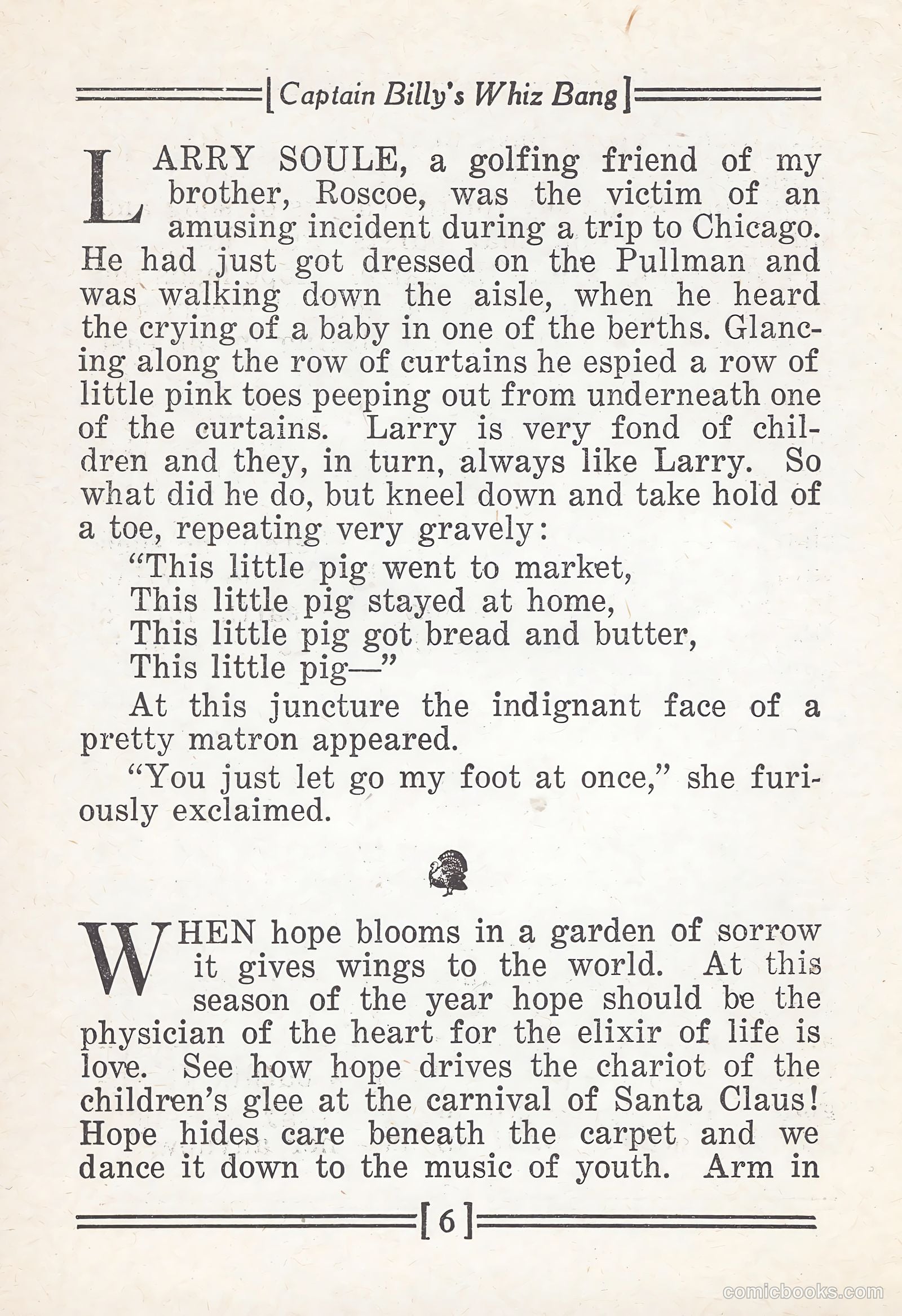
This page contains two distinct pieces from an early 20th-century American humor magazine. The first is "Captain Billy's Whiz Bang," a comic anecdote about Larry Soule, who mistakes a woman's foot for a baby's toes while aboard a Pullman train car. He recites the nursery rhyme "This Little Pig" to what he believes is an infant, only to be interrupted by an indignant adult woman demanding he release her foot. The humor derives from the embarrassing misidentification and the absurdity of the situation. The second section shifts tone entirely—it's philosophical verse about hope and love, particularly seasonal and holiday-themed, referencing Santa Claus and children's joy. This appears to be inspirational filler content rather than satire. The contrast between the bawdy humor of the first piece and the sentimental moralizing of the second is typical of *Whiz Bang's* mixed content approach, which blended risqué jokes with uplifting sentiment to appeal to broad audiences.
📄 Transcribed text from this page (OCR, searchable)
Machine-transcribed from the original scan — historical spelling and the odd misread are preserved.
Captain Billy's Whiz Bang LARRY SOULE, a golfing friend of my brother, Roscoe, was the victim of an amusing incident during a trip to Chicago. He had just got dressed on the Pullman and was walking down the aisle, when he heard the crying of a baby in one of the berths. Glancing along the row of curtains he espied a row of little pink toes peeping out from underneath one of the curtains. Larry is very fond of children and they, in turn, always like Larry. So what did he do, but kneel down and take hold of a toe, repeating very gravely: “This little pig went to market, This little pig stayed at home, This little pig got bread and butter, This little pig—” At this juncture the indignant face of a pretty matron appeared. “You just let go my foot at once,” she furiously exclaimed. WHEN hope blooms in a garden of sorrow it gives wings to the world. At this season of the year hope should be the physician of the heart for the elixir of life is love. See how hope drives the chariot of the children’s glee at the carnival of Santa Claus! Hope hides care beneath the carpet and we dance it down to the music of youth. Arm in [ 6 ]