
Captain Billy's Whiz Bang, December 1924 · page 7 of 71
Captain Billy's Whiz Bang #67 — page 7: what you’re looking at
What you’re looking at
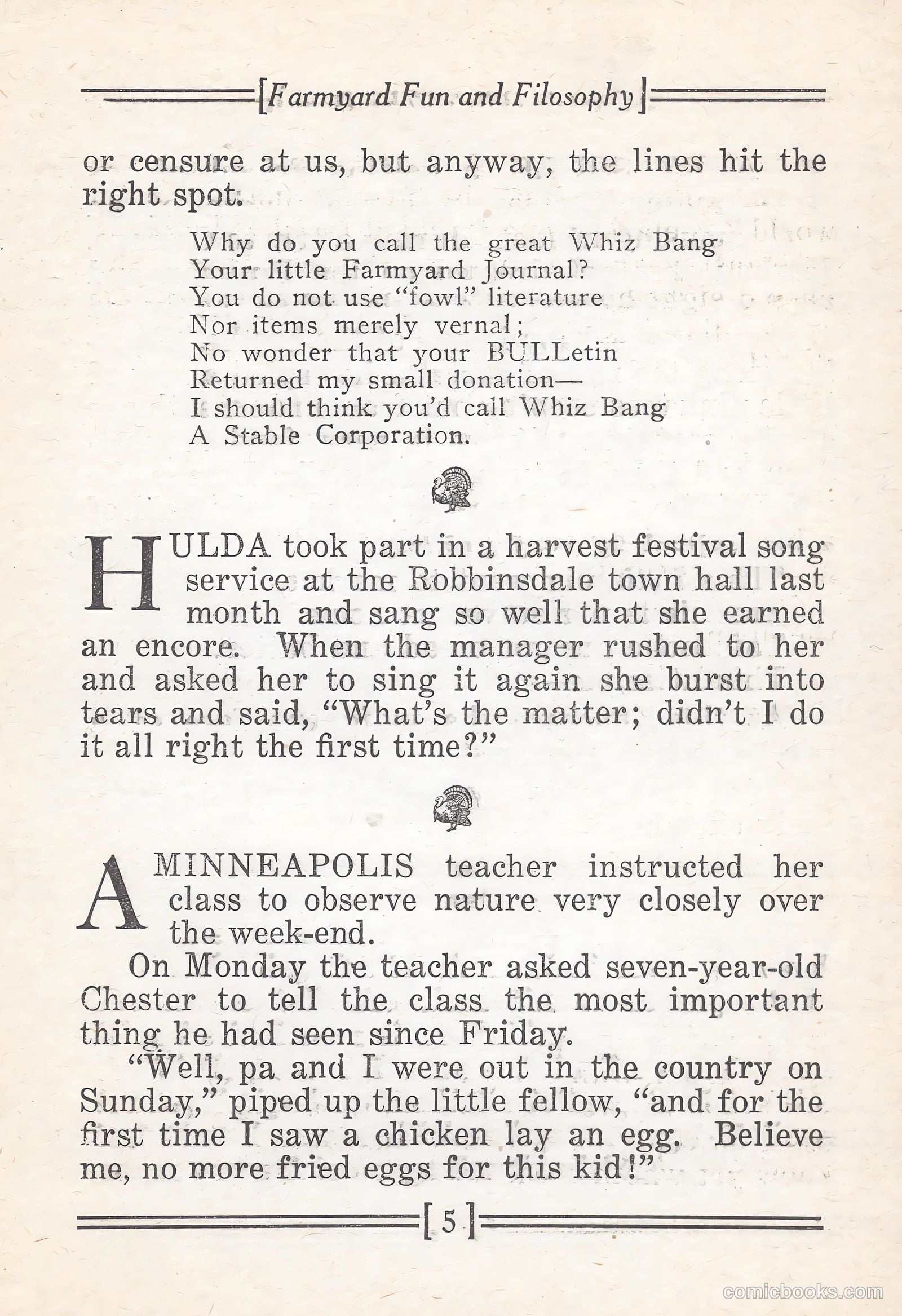
This page from *Whiz Bang* (a satirical magazine known for irreverent humor) contains three brief jokes: 1. **The opening poem** is a reader's complaint using animal puns ("fowl literature," "BULLEtin," "Stable Corporation") to mock the magazine's name and its request for donations—suggesting *Whiz Bang* isn't worthy of financial support. 2. **Hulda's story** is a simple joke about misunderstanding: a singer who performed well at a harvest festival cries when asked to repeat, interpreting the encore request as criticism rather than praise. 3. **Chester's revelation** is a children's humor bit: a young boy witnesses a chicken laying an egg for the first time and decides he can no longer eat fried eggs, having now connected the food to its biological source. The page exemplifies *Whiz Bang's* mix of wordplay, domestic humor, and gentle satire targeting rural/farmyard life and middle-class sensibilities.
📄 Transcribed text from this page (OCR, searchable)
Machine-transcribed from the original scan — historical spelling and the odd misread are preserved.
[Farmyard Fun and Filosofy] or censure at us, but anyway, the lines hit the right spot. Why do you call the great Whiz Bang Your little Farmyard Journal? You do not use “fowl” literature Nor items merely vernal; No wonder that your BULLEtin Returned my small donation— I should think you’d call Whiz Bang A Stable Corporation. HULDA took part in a harvest festival song service at the Robbinsdale town hall last month and sang so well that she earned an encore. When the manager rushed to her and asked her to sing it again she burst into tears and said, “What’s the matter; didn’t I do it all right the first time?” A MINNEAPOLIS teacher instructed her class to observe nature very closely over the week-end. On Monday the teacher asked seven-year-old Chester to tell the class the most important thing he had seen since Friday. “Well, pa and I were out in the country on Sunday,” piped up the little fellow, “and for the first time I saw a chicken lay an egg. Believe me, no more fried eggs for this kid!” =[5]=