
Captain Billy's Whiz Bang, December 1924 · page 65 of 71
Captain Billy's Whiz Bang #67 — page 65: what you’re looking at
What you’re looking at
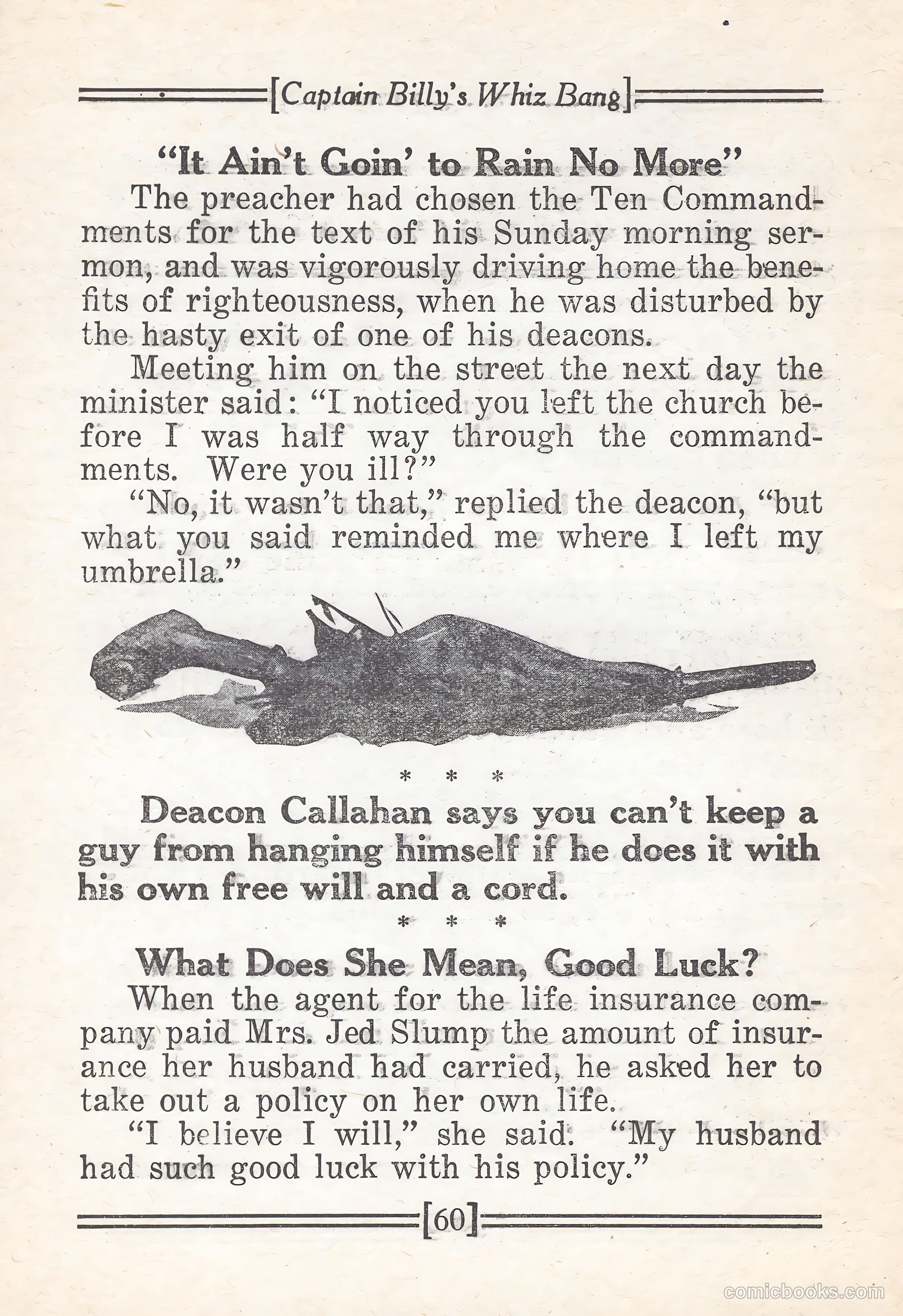
This page contains three brief humorous anecdotes typical of 1920s American satirical magazines: 1. **"It Ain't Goin' to Rain No More"**: A deacon leaves church during the Ten Commandments sermon. When asked why, he claims the preacher's words reminded him where he'd left his umbrella—a joke about the deacon's absent-mindedness and indifference to religious instruction. 2. **Deacon Callahan quote**: A dark quip about suicide, suggesting free will makes prevention impossible. Typical of era's edgy humor. 3. **"What Does She Mean, Good Luck?"**: An insurance agent urges a widow to buy life insurance. She agrees because her late husband "had such good luck with his policy"—implying she hopes to die and collect, darkly suggesting the husband's death was suspicious or suicide. These jokes reflect contemporary concerns about mortality, insurance fraud, and religious hypocrisy, delivered in the irreverent style characteristic of *Captain Billy's Whiz Bang*, a popular men's humor magazine of the period.
📄 Transcribed text from this page (OCR, searchable)
Machine-transcribed from the original scan — historical spelling and the odd misread are preserved.
=[Captain Billy's Whiz Bang]= "It Ain't Goin' to Rain No More" The preacher had chosen the Ten Command- ments for the text of his Sunday morning ser- mon, and was vigorously driving home the bene- fits of righteousness, when he was disturbed by the hasty exit of one of his deacons. Meeting him on the street the next day the minister said: “I noticed you left the church be- fore I was half way through the command- ments. Were you ill?” “No, it wasn't that,” replied the deacon, “but what you said reminded me where I left my umbrella.” * * * Deacon Callahan says you can't keep a guy from hanging himself if he does it with his own free will and a cord. * * * What Does She Mean, Good Luck? When the agent for the life insurance com- pany paid Mrs. Jed Slump the amount of insur- ance her husband had carried, he asked her to take out a policy on her own life. “I believe I will,” she said. “My husband had such good luck with his policy.” =[60]=