
Captain Billy's Whiz Bang, December 1924 · page 32 of 71
Captain Billy's Whiz Bang #67 — page 32: what you’re looking at
What you’re looking at
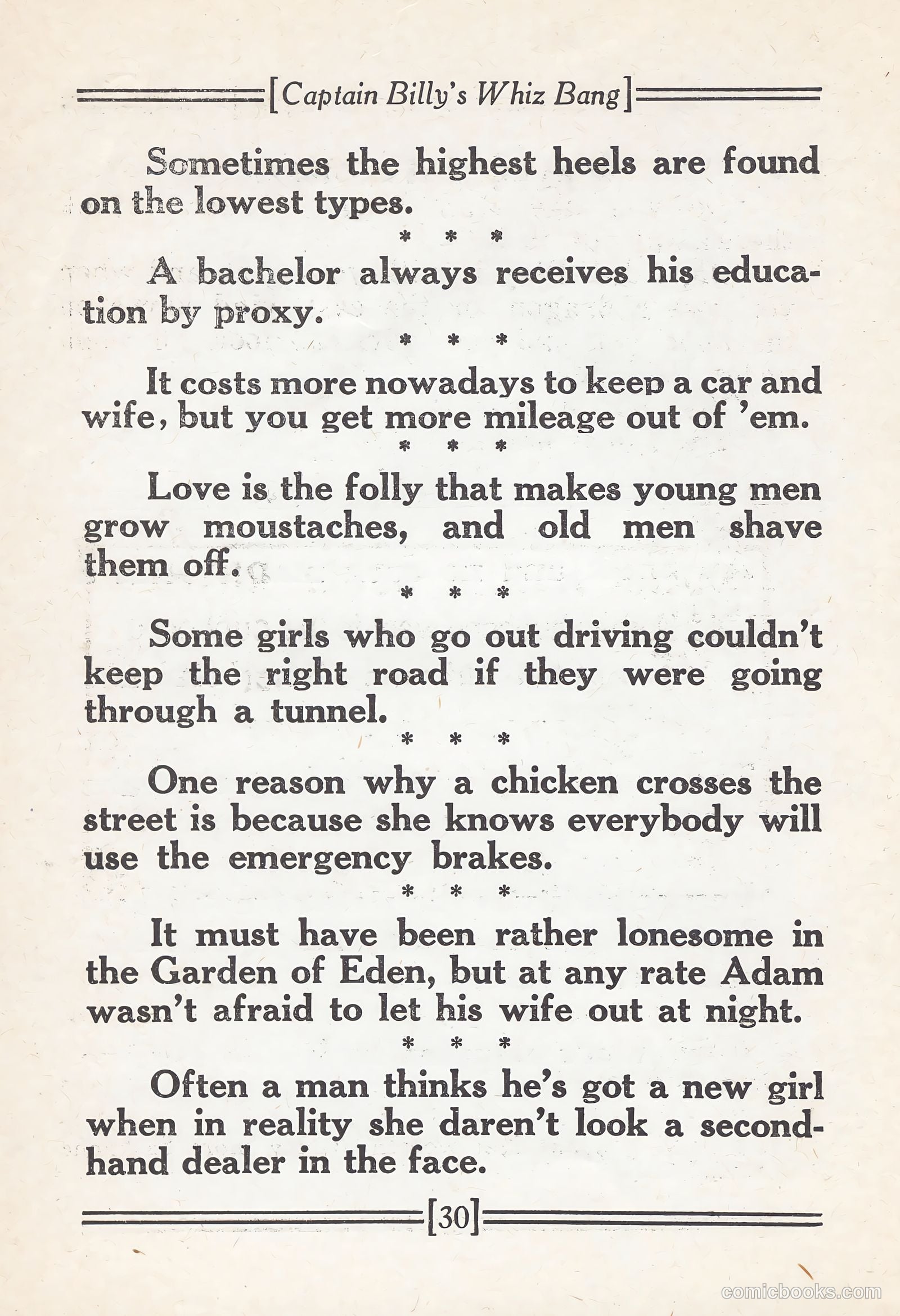
This page contains no cartoons—only satirical one-liners and brief jokes typical of *Whiz Bang*, a popular humor magazine of the 1920s-30s. The content targets social attitudes of the era: **Key themes:** - **Gender and appearance**: Women's fashion (high heels) linked to moral character; women as poor drivers - **Marriage satire**: Bachelors learning through experience; wives compared to cars in cost-benefit analysis - **Dating/courtship**: Men's facial hair choices driven by romantic interest; men deceived about girlfriends' financial status - **Period sexism**: References to controlling women's movements; assumptions about female driving abilities The humor relies on stereotypes—particularly about women's competence and fidelity—common to pre-WWII American popular culture. The Adam and Eve joke suggests anxiety about wives' independence. These jokes reflect 1920s-30s social anxieties about changing gender roles during the post-suffrage era.
📄 Transcribed text from this page (OCR, searchable)
Machine-transcribed from the original scan — historical spelling and the odd misread are preserved.
[Captain Billy's Whiz Bang] Sometimes the highest heels are found on the lowest types. * * * A bachelor always receives his educa- tion by proxy. * * * It costs more nowadays to keep a car and wife, but you get more mileage out of 'em. * * * Love is the folly that makes young men grow moustaches, and old men shave them off. * * * Some girls who go out driving couldn't keep the right road if they were going through a tunnel. * * * One reason why a chicken crosses the street is because she knows everybody will use the emergency brakes. * * * It must have been rather lonesome in the Garden of Eden, but at any rate Adam wasn't afraid to let his wife out at night. * * * Often a man thinks he's got a new girl when in reality she daren't look a second- hand dealer in the face. [30]