
Captain Billy's Whiz Bang, December 1924 · page 11 of 71
Captain Billy's Whiz Bang #67 — page 11: what you’re looking at
What you’re looking at
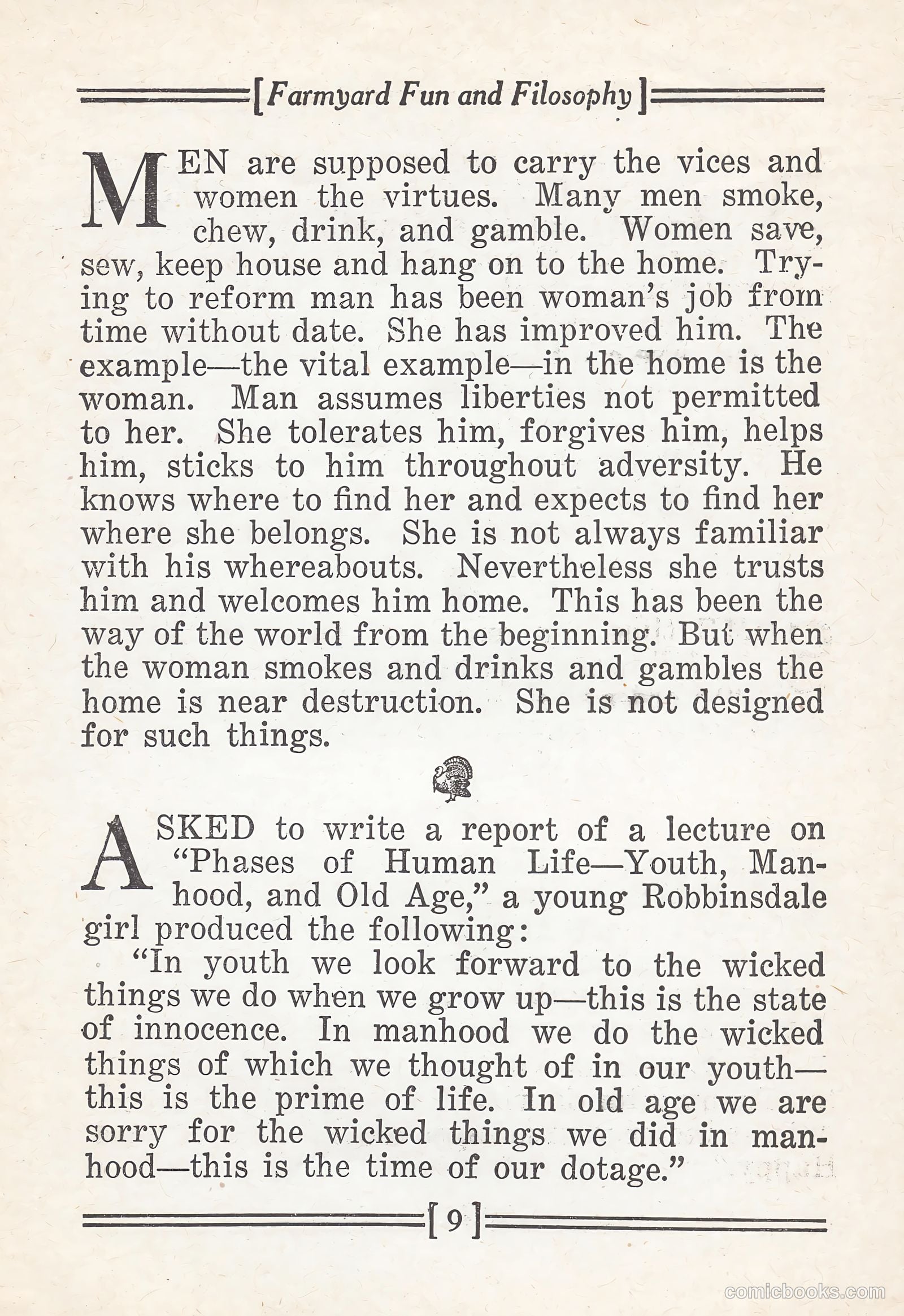
This page from *Whiz-Bang* presents two pieces of satirical social commentary: **First essay:** A sarcastic commentary on gender double standards. It describes the traditional domestic ideal—women as virtuous homemakers who reform men through example and patience, while men enjoy freedoms women don't have. The satire's bite comes in the final twist: when women adopt "vices" like smoking, drinking, and gambling, the home supposedly faces "destruction" because women are "not designed for such things." The piece mocks the hypocrisy of expecting women to maintain virtue while tolerating male vice. **Second piece:** A humorous student essay that cynically summarizes human life's "phases"—youth as anticipation of wrongdoing, manhood as enacting those wrongs ("prime of life"), and old age as regret. The joke satirizes the human tendency toward vice and the futility of moral improvement. Both pieces critique contemporary morality and gender expectations through ironic exaggeration rather than direct argument.
📄 Transcribed text from this page (OCR, searchable)
Machine-transcribed from the original scan — historical spelling and the odd misread are preserved.
=[Farmyard Fun and Filosophy]= MEN are supposed to carry the vices and women the virtues. Many men smoke, chew, drink, and gamble. Women save, sew, keep house and hang on to the home. Trying to reform man has been woman's job from time without date. She has improved him. The example—the vital example—in the home is the woman. Man assumes liberties not permitted to her. She tolerates him, forgives him, helps him, sticks to him throughout adversity. He knows where to find her and expects to find her where she belongs. She is not always familiar with his whereabouts. Nevertheless she trusts him and welcomes him home. This has been the way of the world from the beginning. But when the woman smokes and drinks and gambles the home is near destruction. She is not designed for such things. ASKED to write a report of a lecture on “Phases of Human Life—Youth, Manhood, and Old Age,” a young Robbinsdale girl produced the following: “In youth we look forward to the wicked things we do when we grow up—this is the state of innocence. In manhood we do the wicked things of which we thought of in our youth—this is the prime of life. In old age we are sorry for the wicked things we did in manhood—this is the time of our dotage.” =[9]=