
A complete issue · 67 pages · 1921
Captain Billy's Whiz Bang #21
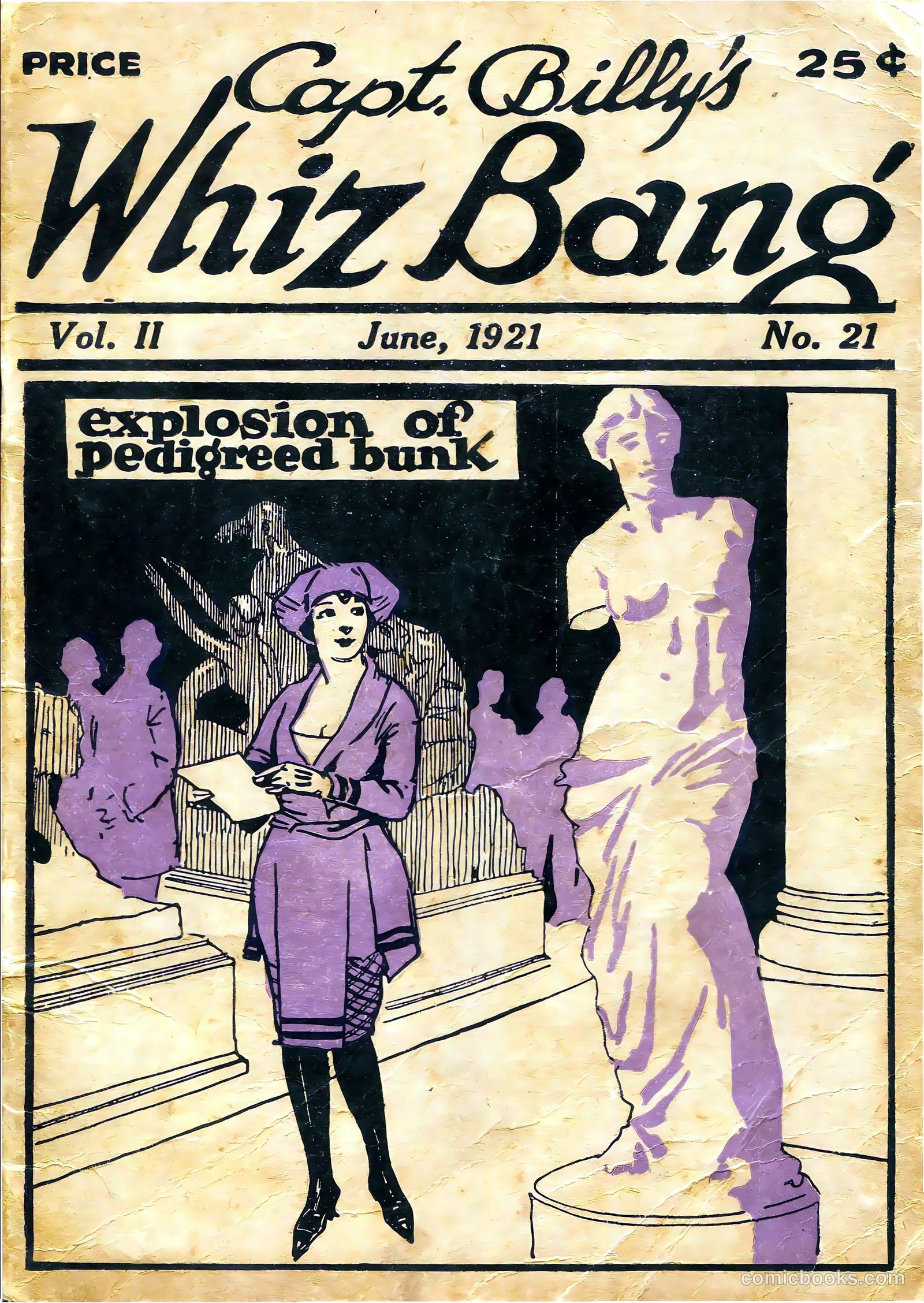
This June 1921 *Whiz Bang* cover satirizes pretension and fraud, likely referencing post-WWI social anxieties about fake sophistication. The illustration shows a woman in fashionable dress examining what appears to be a classical statue that's literally crumbling or "exploding"—suggesting exposure of false claims. The term "pedigreed bunk" refers to elaborate lies dressed up as legitimate or high-class. The cartoon's central joke: prestigious-sounding claims or products are revealed as worthless fraud. This fits *Whiz Bang*'s satirical mission mocking humbug in 1920s American society—from patent medicines to social climbers to dubious business schemes—all common targets of the era's skeptical humor magazines.
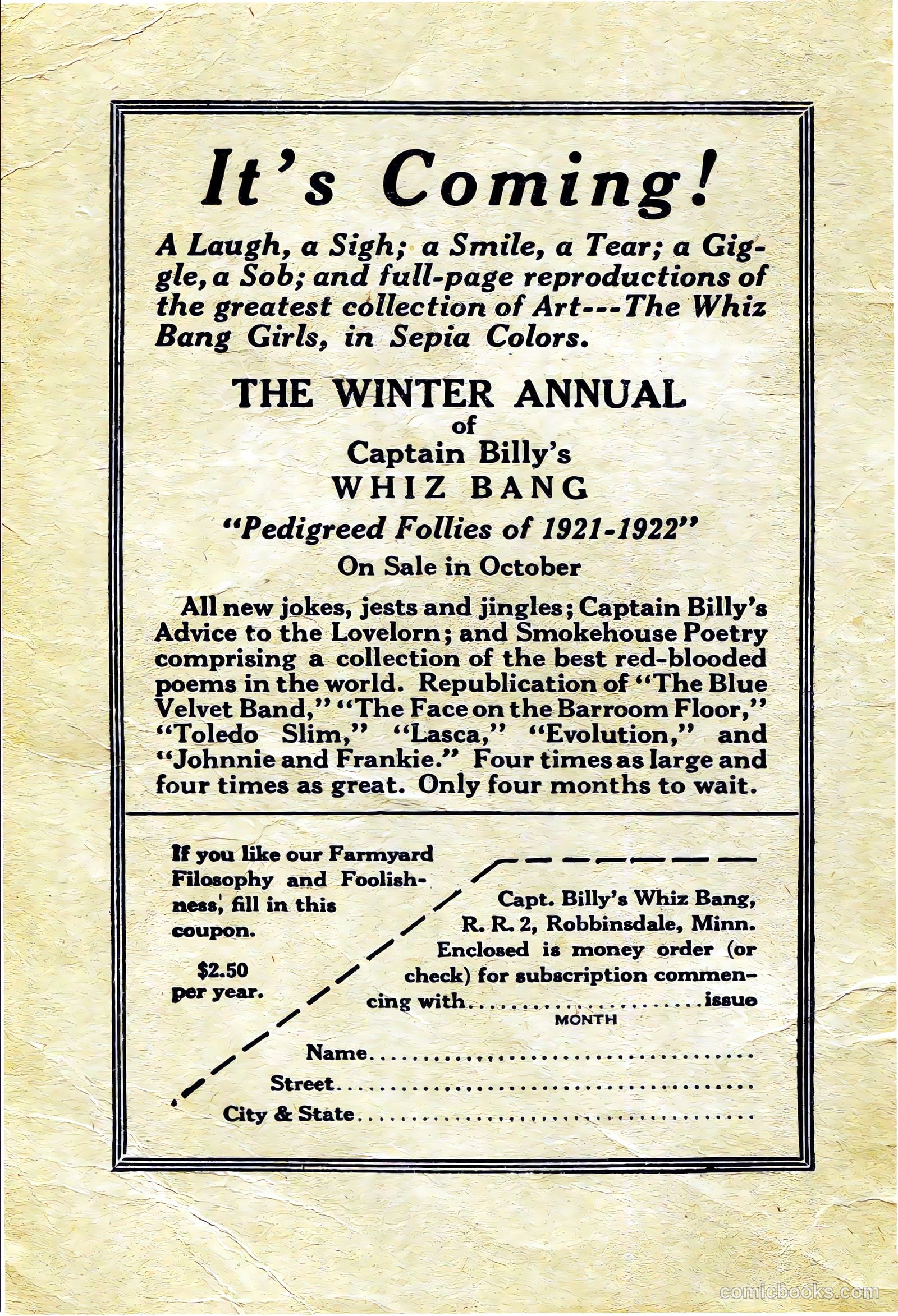
This is primarily a **subscription advertisement** for "Captain Billy's Whiz Bang," a satirical magazine. Rather than containing cartoons, it promotes the Winter Annual (1921-1922 issue) launching in October. The ad emphasizes the publication's irreverent humor: it promises "jokes, jests and jingles," "Captain Billy's Advice to the Lovelorn," and "Smokehouse Poetry"—described as "red-blooded poems." It references reprinting popular pieces like "The Blue Velvet Band" and "Toledo Slim." The tone reflects early 1920s attitudes: brash, masculine-oriented humor marketed as bold and unrestrained. The $2.50 annual subscription cost and Robbinsdale, Minnesota address suggest this was a populist publication aimed at rural and working-class American readers seeking irreverent, bawdy entertainment.
This is a title page from *Whiz-Bang*, a 1921 satirical magazine edited by W. H. Fawcett (identified as a Spanish-American War and World War I veteran). The Roosevelt quote at the top emphasizes singular American patriotic loyalty—likely a reference to post-WWI anxieties about immigrant communities, radical ideologies, or "hyphenated Americans" divided between U.S. and foreign loyalties. This was a common nationalist political argument during the "Red Scare" period following the Russian Revolution and WWI. The page's dedication to U.S. fighting forces reinforces patriotic framing. The printer's union label indicates working-class production values typical of small magazines from this era.
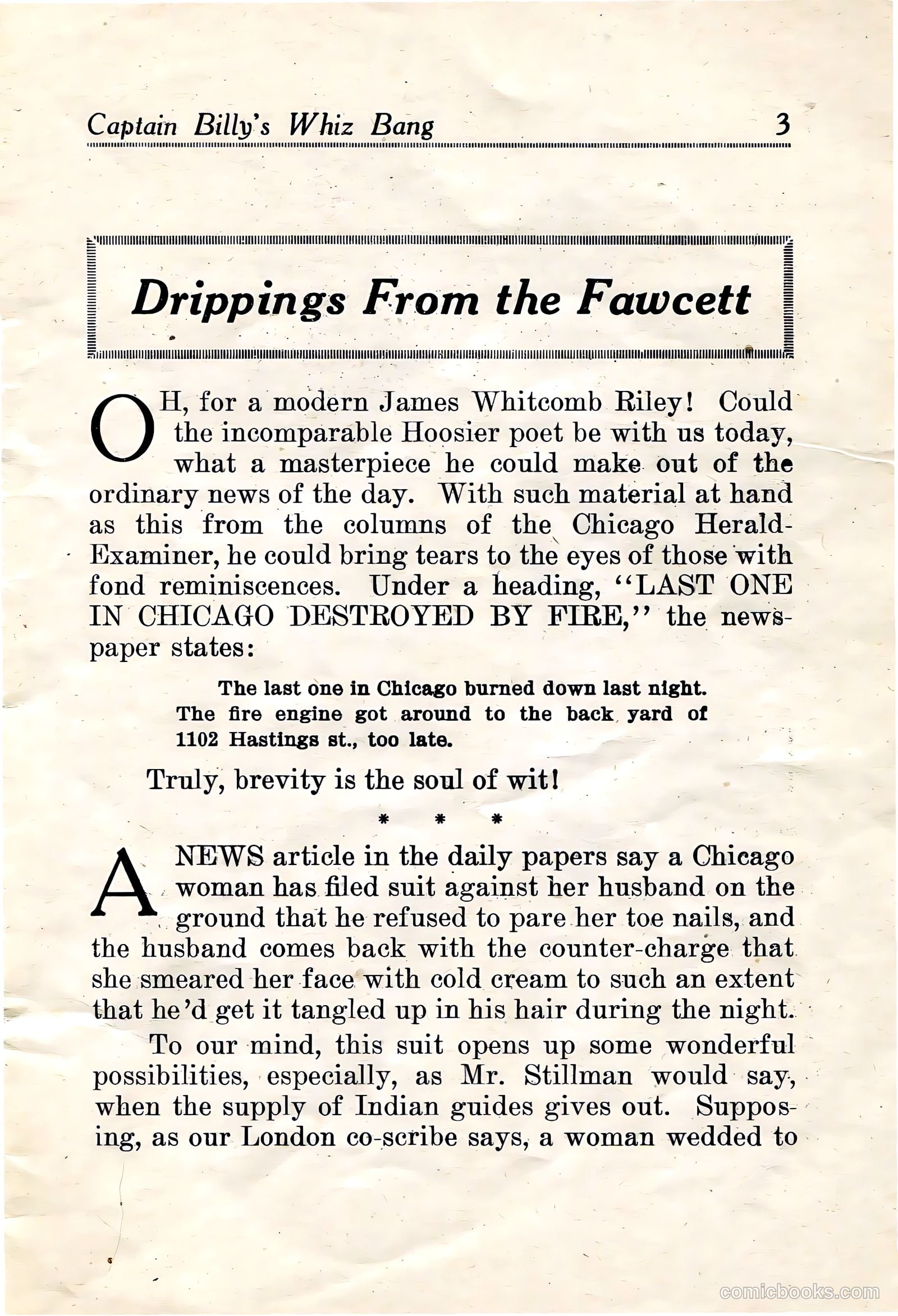
This satirical column mocks contemporary Chicago newspaper stories. The first item jokes about a fire-department's delayed response to a house fire, presented with intentional brevity to highlight journalistic oversimplification—the "wit" is in the terseness itself. The second anecdote ridicules a marital lawsuit where the wife sued for her husband refusing to trim her toenails, and he countered that she smeared cold cream on her face, tangling it in his hair at night. The writer suggests this opens absurd legal possibilities, sarcastically referencing both "Mr. Stillman" (likely a contemporary divorce case) and "Indian guides," implying such petty disputes could spawn endless litigation. The humor targets both marital discord and sensationalist newspaper reporting of domestic conflicts.
This page contains humorous domestic advice columns rather than cartoons. The satire targets marriage troubles and incompatible spouses through absurdist scenarios: 1. **The Highland divorce case**: A woman whose husband refuses to shave his calves—presented as legitimate grounds for divorce in Chicago courts. 2. **The bath-singing husband**: A man who sings unbearable WWI-era songs ("Mademoiselle from Armentieres") while bathing near his wife's bedroom—another divorce justification. 3. **"The Pedigreed Persian Cat"**: A reprinted story about infidelity (a cat claiming a traveling man fathered her kittens). The page invites readers to submit poems defending the "traveling man" against such accusations. The humor targets both marital discord and post-WWI social anxieties about masculinity and fidelity.
This page presents two satirical pieces: 1. **A "corrective" poem about a Persian cat**: An unnamed writer defends his profession against accusations by presenting an alternative version of a poem that originally portrayed a female cat negatively. His "true version" reframes the cat as deliberately manipulative—seducing a tom cat, stealing his valuables (watch and diamond pin), then abandoning him. The satire mocks both the original poem (presented as propaganda defending a disreputable woman) and the author's self-righteous insistence on setting the record straight. 2. **A brief anecdote about hiring**: The narrator discusses a hired man named Gus who hoped to work as a guide at a Minnesota resort. Gus is disappointed because the narrator has hired "a real half breed Indian" instead—implying Gus expected the position based on false pretenses, satirizing employment discrimination and authenticity claims. The overall tone is irreverent 1920s American humor.
This page contains two humorous anecdotes rather than political cartoons. The first story mocks rural social pretension: a cow from Deacon Miller's pasture breaks through a fence, enters the narrator's house, inspects pictures and checks its horns in a mirror—behaving with absurd politeness—then leaves a calling card before departing. The joke satirizes the Deacon for raising overly "lady-like" cattle, implying excessive refinement is ridiculous even in livestock. The second story is a poker-game anecdote involving Canadian Englishmen using unfamiliar currency terminology ("pounds" for five-dollar bills), which confuses an intoxicated bootlegger. He raises their bet by claiming "three tons," then takes the pot. The humor derives from Prohibition-era bootlegging and linguistic confusion between American and Canadian speakers. Both pieces target rural/frontier manners and culture.
This is a gossip column about 1920s Hollywood celebrities and scandals. The main target is **Elinor Glyn**, a British novelist and screenwriter famous for her novel "Three Weeks." The satire mocks how gossip columnists are pursuing her, supposedly trying to catch her flirting—implying scandalous behavior. The column references other Hollywood figures in courtship drama: **Mary and Doug** (likely Douglas Fairbanks), **Bennie Ziedman** and **Marjorie Daw**, **Rudolph Valentino** and his separation from **Jane Acker**, and **Bill Hart** and **Jane Novak**. The humor plays on wartime absurdity—women dancing while husbands dodged combat ("Whiz Bangs") in France—suggesting celebrity gossip is equally frivolous. Glyn's famous novel is called "her worst personal faux pas," satirizing how scandal overshadows artistic work.
This page contains gossip column text rather than cartoons. It discusses Mrs. Glyn (likely Elinor Glyn, a prominent writer/socialite of the 1920s) attending a Navy ball at the Ambassador Hotel, where she reportedly avoided dancing with many officers. The main content describes a rumored new story Mrs. Glyn is writing for the Lasky film company—a melodrama about a half-Russian, half-American girl who becomes "wild" after a snakebite, which a heroic hero heroically treats by sucking out poison. The final item gossips that "Mary and Doug" (likely Mary Pickford and Douglas Fairbanks, famous married actors) have become matchmakers, currently working on pairing Marjorie Daw with someone. The tone is playfully irreverent, typical of Whiz Bang's celebrity gossip style.
This page contains gossip about Hollywood personalities and romantic entanglements, not a political cartoon. The text discusses: **Key figures mentioned:** - Marcel De Sano (Universal director) - infatuated with "Marjorie" - Marjorie (appears to be an actress being pursued) - Bennie Ziedman (business manager for "Doug") - Doug Fairbanks (implied, given the Santa Barbara real estate subplot and "famous family" reference) **The satire:** The piece mocks matchmaking efforts by Mary and Doug to pair Marjorie with the shy, unaffected Bennie instead of the exotic De Sano. The joke involves using a fake home-purchase trip to throw the two together, while Bennie's chronic shyness and blushing suggest the scheme's comedic complications. This is celebrity gossip humor typical of 1920s scandal magazines.
This page from *Whiz Bang* contains gossip about Hollywood celebrities rather than political cartoons. The text discusses **Rudolph Valentino**, the famous Italian actor, and his marriage to **Jane Acker**, who also acted in films. The piece describes how Valentino was heartbroken after their separation about a year prior, while Acker received numerous film offers and seemed indifferent to reconciliation. However, the tables have turned: Valentino became a major star in a Metro film adaptation of a bestselling novel and can now command high salaries, while Acker's career has stalled as production offers have dried up. The satire suggests Acker may now regret losing Valentino and hopes for reconciliation, while Valentino appears indifferent—reversing their previous power dynamic in the relationship.
This page contains gossip columns rather than cartoons. The first item discusses Bill Hart (likely actor William S. Hart), reporting rumors of his engagement to actress Jane Novak following his announced retirement from films on April 2. The piece describes his Hacienda Park mansion being renovated with separate wings for husband and wife—presenting this as modern and progressive marital planning. The second section announces the upcoming "Winter Annual" publication, promoting it as four times larger than regular monthly issues, featuring poems with titles like "The Blue Velvet Band" and "Johnnie and Frankie." The note that last year's annual sold out in thirty days suggests strong publication popularity among contemporary readers.
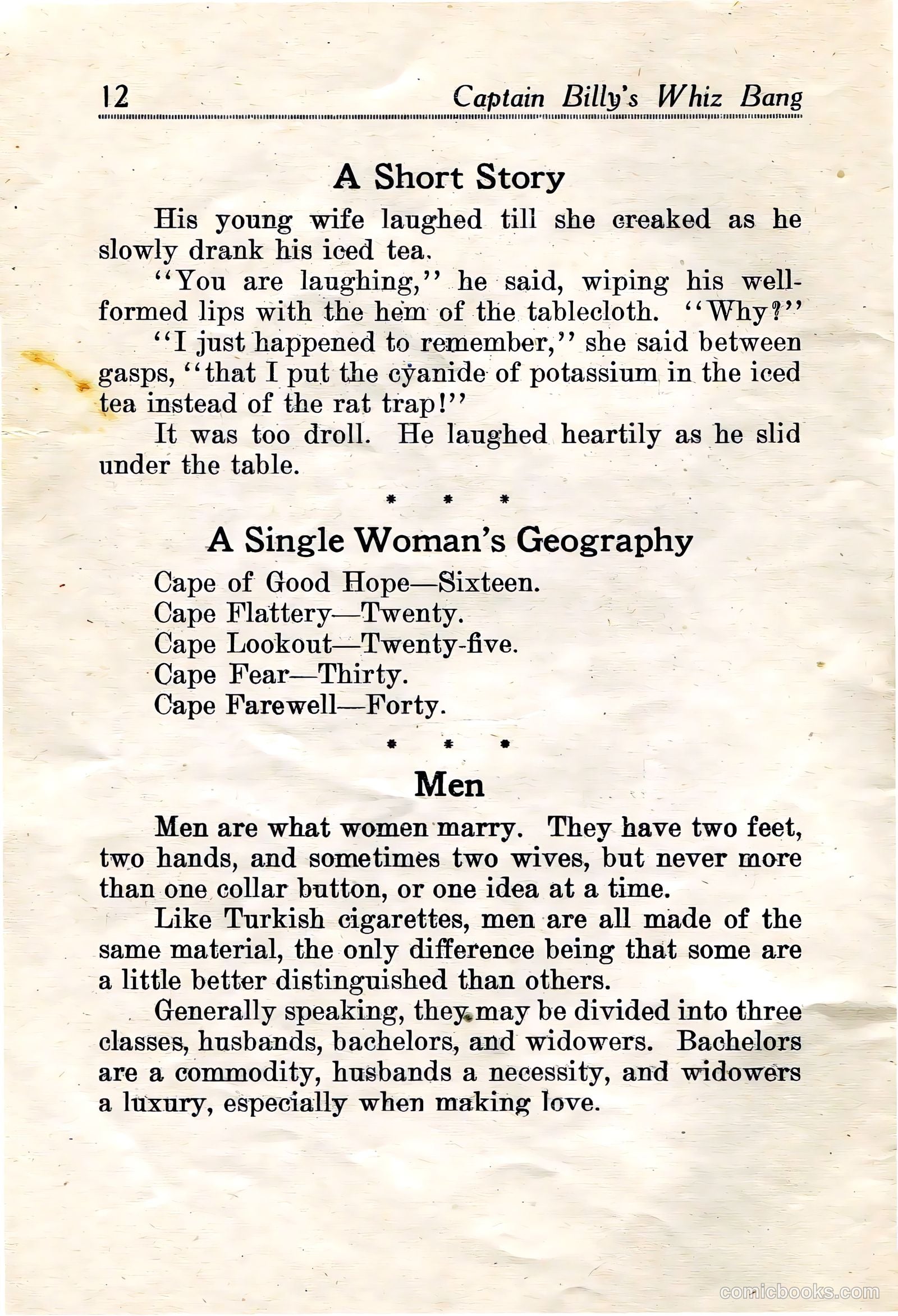
This page contains three short satirical pieces rather than traditional cartoons: 1. **"A Short Story"**: A darkly comedic piece about a wife who accidentally put cyanide of potassium in her husband's iced tea instead of rat poison. The humor relies on the absurd premise of attempted murder treated casually. 2. **"A Single Woman's Geography"**: Uses geographic "capes" (Cape Good Hope, Cape Fear, etc.) as metaphors for a woman's life stages from age 16 to 40, suggesting life progressively worsens with age. 3. **"Men"**: Satirizes men as uniform commodities, comparing them to Turkish cigarettes. It classifies men into three categories (husbands, bachelors, widowers), offering cynical commentary on their usefulness and value to women. The humor is distinctly early 20th-century, relying on misogynistic and dark comedic tropes typical of the era.
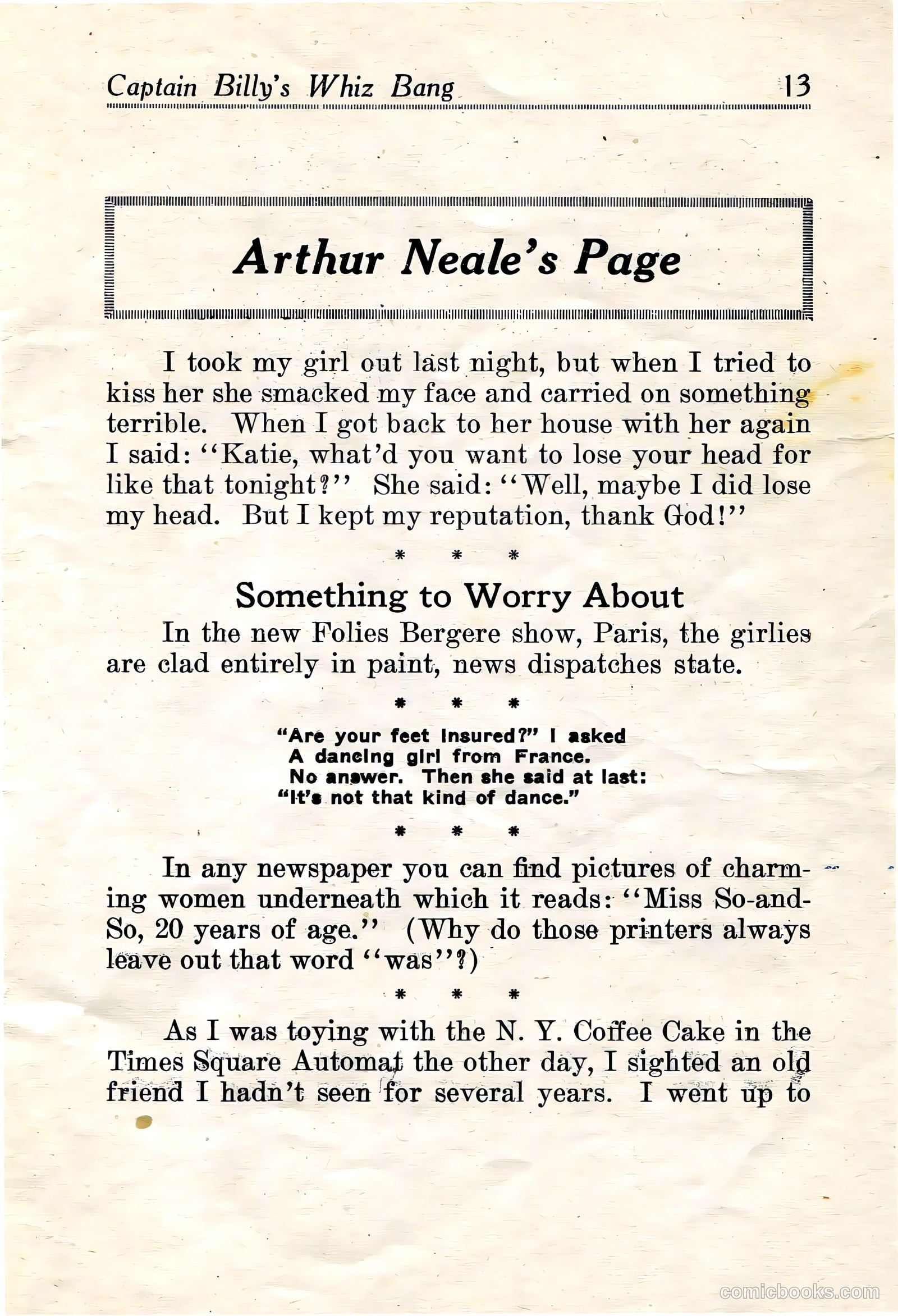
This page contains humorous anecdotes rather than political cartoons. The content includes: 1. **A dating joke** where a man's attempted kiss results in a slap, but the woman says she "kept my reputation" — implying the man's reputation (as a failed kisser) suffered instead. 2. **"Something to Worry About"** references the Folies Bergère in Paris, where performers wore only body paint rather than clothing — presented as scandalous news. 3. **A joke about insurance** with a French dancer, playing on the double meaning of "insured feet." 4. **A newspaper caption joke** about how photo captions say women are "20 years of age" rather than "was 20" — suggesting these women are no longer that age. The humor is lighthearted, focused on dating, fashion, and journalism conventions of the era.
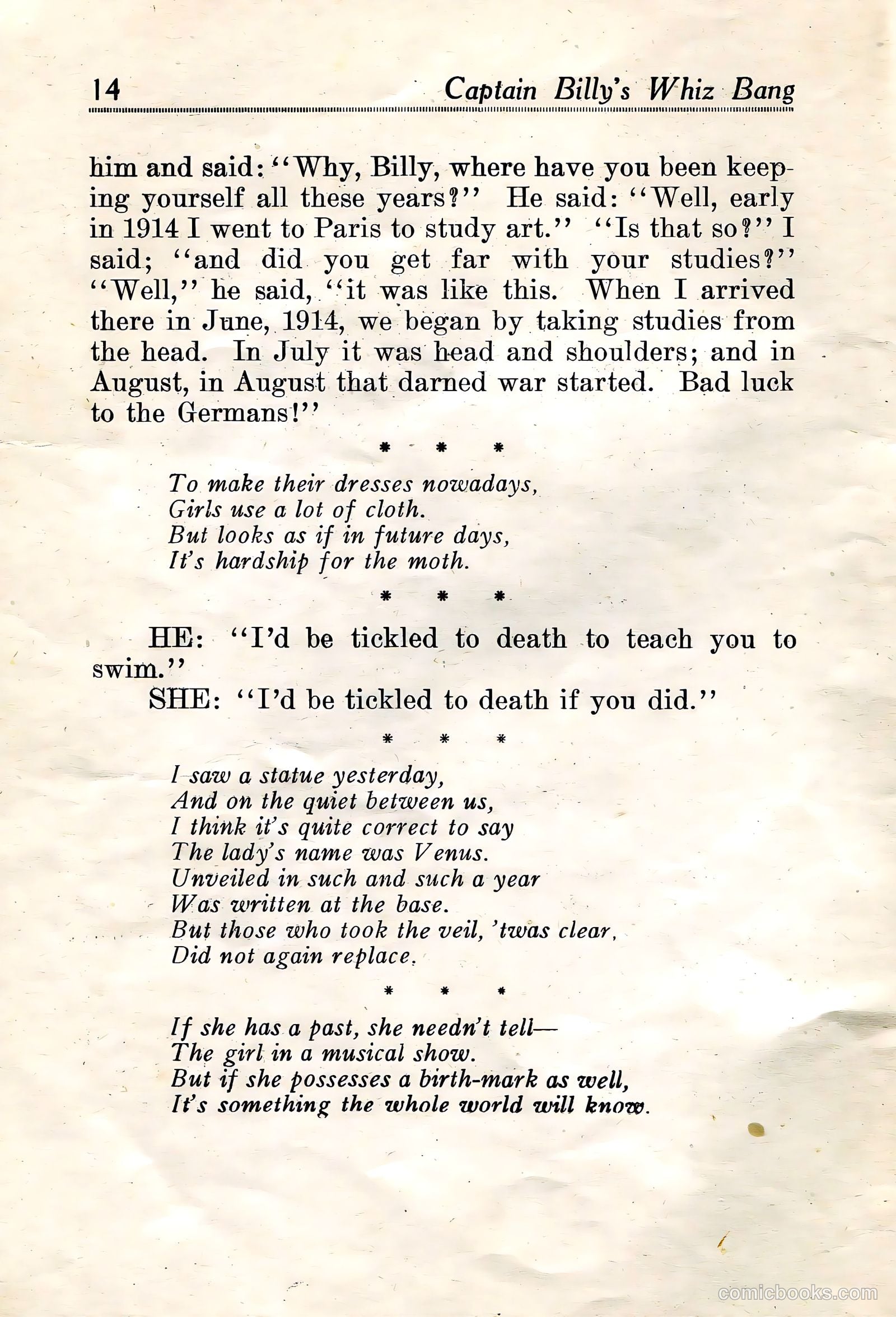
This page contains humorous anecdotes and jokes rather than political cartoons. The content includes: 1. **A conversation about WWI** - Someone recalls meeting a man who went to Paris in June 1914 to study art but was interrupted by the war's outbreak in August. The joke plays on bad timing. 2. **Gendered humor** - Brief jokes about clothing, swimming lessons, and women's appearance, reflecting period attitudes typical of 1920s satirical magazines. 3. **A statue joke** - References an unveiled statue of "Venus," with innuendo about what the veil concealed. 4. **Entertainment gossip** - The final joke contrasts stage performers' ability to hide their past with the permanence of physical birthmarks, suggesting scandal consciousness. The humor reflects typical Whiz Bang content: topical references, mild sexual innuendo, and social observation aimed at urban audiences.
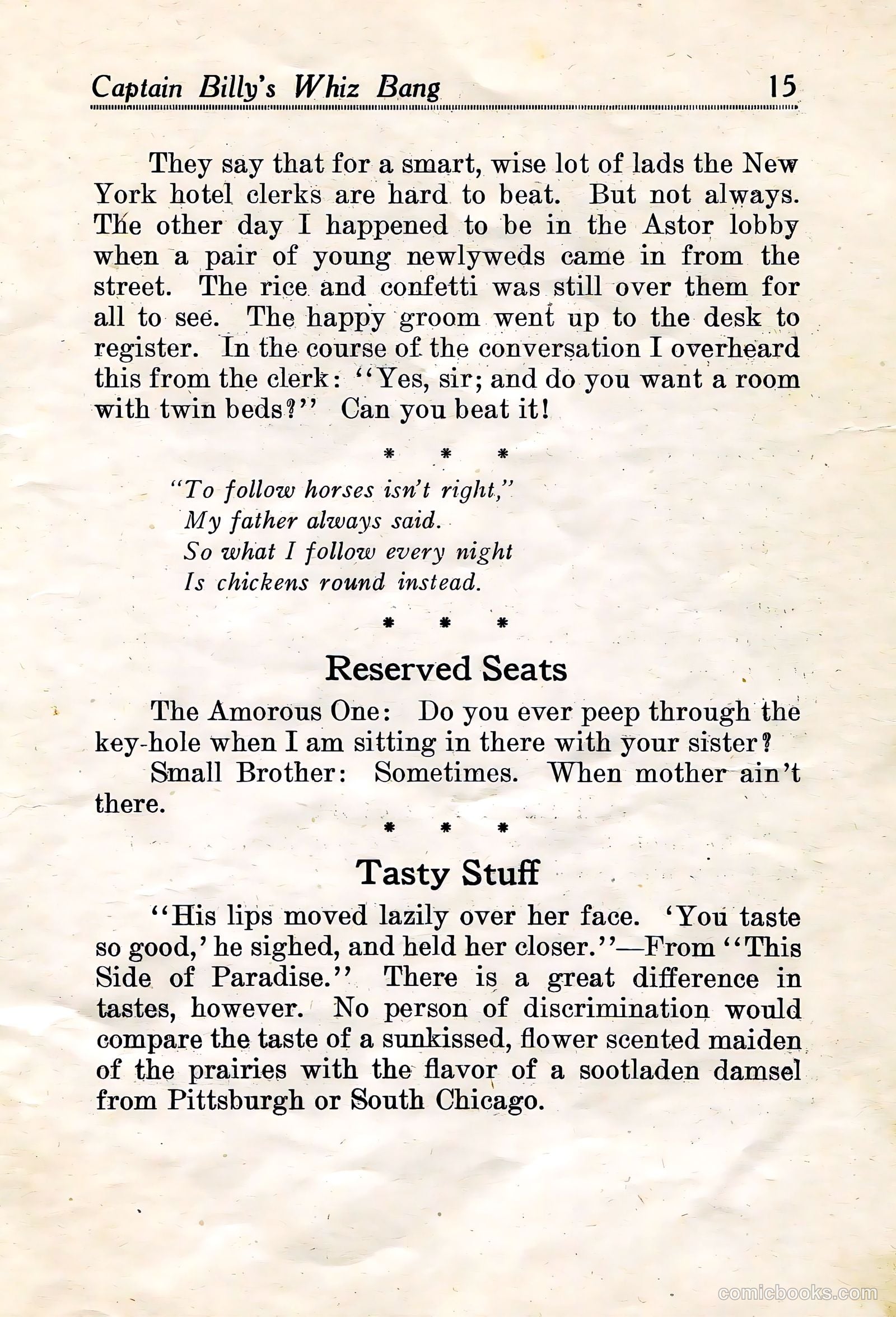
This page contains three unrelated humorous anecdotes rather than political cartoons: 1. **Hotel Clerk's Gaffe**: A story mocking a New York hotel clerk's tactless question to newlyweds about wanting "twin beds" instead of a double bed—implying the couple might not want to share a bed on their wedding night. 2. **Following Chickens**: A brief verse about someone following chickens instead of horses, playing on the saying "to follow horses isn't right." 3. **Reserved Seats & Tasty Stuff**: A joke about peeping through keyholes, and a literary excerpt contrasting the taste of a prairie maiden with industrial-city women (Pittsburgh, South Chicago)—likely satirizing regional stereotypes about attractiveness and refinement. The humor is domestic, bawdy, and relies on era-specific social conventions rather than political commentary.
This page contains three humorous short pieces with no illustrations: 1. **"Musings of a Bachelor"**: Satirizes gender differences and relationship dynamics—women imagining themselves as men, men imagining themselves as women. Includes a dark joke about a drunk who drowned in moonshine mash, and advice to women on recognizing genuine male affection through physical behavior rather than words. 2. **"A Telephone Retort"**: A brief joke mocking flirtation—a man offers a kiss to a telephone operator for a number; she replies she's already standing on the receiver (implying he should perform sex acts on the phone). 3. **"High Explosive"**: An anecdotal joke about a reckless New Orleans newspaperman who drinks bootleg whiskey and provokes a mule, suggesting foolish behavior. The page is satirical humor typical of 1920s-era men's magazines.
This page contains a tall tale—a humorous narrative in heavy dialect—rather than a cartoon. The story, written as a letter to "Uncle Billy," describes Sven's absurd misadventures working on a Hollywood film set in Montana. The satire targets 1920s film production: incompetent directors, dangerous stunts, and massive budgets ($670,000) wasted on chaos. Sven's thick Scandinavian-dialect speech (mixing English with phonetic dialect) is period comedy, though offensive by modern standards. The "bull calf" electrocuted by faulty wiring and the slapstick injuries mock both workplace safety and Hollywood's reckless extravagance during the silent film era. The joke: filmmaking is comically dangerous and wasteful.
This page contains a humorous first-person narrative in deliberate dialect/slang, styled as a character's account of life in "Loose Angels" (Los Angeles). The satire targets: - **Hollywood opportunism**: Characters seeking quick wealth through screenwriting and film work - **Social climbing**: References to meeting minor actors, working on studio sets at Universal City - **Exploitation**: A nurse character stealing hospital alcohol; a laundry worker making minimal wages - **Get-rich-quick schemes**: The narrator paying $75 for a "screenplay school" course The dialect-heavy style itself is part of the humor—mocking the narrator's pretensions while claiming sophistication about Hollywood's underbelly. The reference to "Viking Carlson, the Snus King from Stockholm" and various character names suggests broad ethnic/immigrant humor typical of 1920s American magazines. The overall point: Hollywood attracts dreamers and hustlers, all seeking easy fortunes through dubious means.
This page contains a letter from "Svens Peterson" describing the economic struggles of actors during Hollywood's early years. The satirical content mocks: **The situation:** Actors facing wage cuts, expensive room rentals, and poor working conditions in what appears to be a film production town (likely Hollywood or a similar hub). **The humor:** Peterson's deliberately misspelled, phonetically-written dialect (representing a Scandinavian accent—"skol," "Ay," "bane") contrasts with complaints about respectable professions. The letter satirizes both struggling actors' desperation and small-town conditions that exploit them. **The punchline:** A crude joke about women follows, suggesting alternative ways to earn income through "natural assets"—typical of this magazine's bawdy humor. The satire targets early Hollywood's economic chaos and the precarious actor's life circa 1920s.
This page contains three separate humorous anecdotes rather than political cartoons: 1. **"His Wires Were Crossed"**: A joke about miscommunication. A hard-of-hearing Sunday school superintendent misunderstands the minister's announcement about child baptisms, thinking instead that he's advertising books for sale at discounted prices. 2. **"He gorged himself with sausages..."**: A brief poem about overeating causing digestive distress. 3. **"Kisses a la Carte"**: A joke about a boy who negotiates payment from his father for witnessing kissing incidents—first the sister, then the maid—escalating the "payment" from a quarter to five dollars. 4. A final quip comparing how dogs respond to fleas versus humans to abstract complaints. These are typical lowbrow humor pieces from this era's satirical magazine.
This is the opening page of a satirical story by Rev. "Golightly" Morrill about Havana, Cuba during Prohibition-era America. The text mocks travelers seeking exotic experiences in Havana, which had become a popular destination for Americans wanting to drink alcohol illegally during the 1920s-30s ban. The satire targets: - **Havana's appeal** as a booze-soaked "Fountain of Youth" - **Exorbitant bar prices** exploiting thirsty Americans - **Corrupt management** dismissing customer complaints - **Prohibition hypocrisy**, implying Americans would travel abroad to circumvent domestic law The author contrasts Havana unfavorably with French West Indies alternatives offering better value. The religious author's tone is moralistic disapproval wrapped in wry humor about American excess and desperation during Prohibition.
This page contains text (no visible cartoon), a critical essay about Havana, Cuba as a tourist destination. The author attacks American travelers and Cuban society with harsh stereotypes: **Social References:** - Compares Cuba to a "hammer-headed shark" — suggesting it's dangerous and predatory - References cheap alcohol prices and vice (gambling, saloons, race-tracks) - Criticizes American men ("crooks," "drunks," "toughs") who frequent Havana - Employs period stereotypes about Cuban women's appearance and morality **The Satire:** The piece mocks both American tourists seeking vice and Cuban culture itself, presenting Havana as a refuge for disreputable Americans rather than a legitimate travel destination. It's xenophobic and misogynistic by modern standards, reflecting early 20th-century American attitudes toward Latin America and immigration. The tone suggests *Whiz-Bang* targeted readers who enjoyed irreverent social commentary.
This page from *Captain Billy's Whiz Bang* (page 23) is primarily text rather than cartoons—it's satirical social commentary about Havana, Cuba, likely from the 1920s Prohibition era. The author mockingly describes Havana as a haven for moral vices: bars, brothels, and women of loose reputation. He contrasts modern Havana unfavorably with romanticized ancient courtesans, quoting Flaubert's lament about the decline of the *fille de joie* (prostitute). The satire targets both Cuban society and American hypocrisy—while Americans faced Prohibition at home, they traveled to nearby Havana for uninhibited pleasures. The piece uses classical references and period French terminology to add ironic sophistication to what is essentially crude social criticism about sex work and American escapism.
This page contains satirical prose commentary rather than cartoons. It describes Havana's underworld during what appears to be Prohibition-era Cuba (likely 1920s-30s): **Key targets of satire:** - A casino ten miles outside town modeled on Monte Carlo, where visitors face murder and robbery - Corrupt horse racing at the Havana Oriental track, where races were allegedly fixed for highest bribers - Diplomatic corruption: U.S. officials supposedly more easily found at the casino at night than their offices during the day **The satire's point:** Havana represented lawlessness, vice, and American complicity through diplomatic negligence. The tone is cynical about American involvement in Cuban corruption, portraying it as both dangerous and endemic to the system.
This page contains satirical commentary on 1920s Havana, Cuba—not a cartoon. The author criticizes Cuban society's contradictions: despite declaring financial crisis, Cubans spend lavishly on carnivals (witnessed throwing away $75,000), gambling, and dancing rather than paying debts or addressing economic hardship. The piece mocks Havana's carnival as inferior to European versions (Nice, Venice), describing it as merely a "fashion show" lacking spontaneity. The author also disparages Cuban youth as "dissipated," criticizing their public behavior—strutting on plazas, staring, and accosting women disrespectfully. The satire targets perceived moral hypocrisy and fiscal irresponsibility during economic crisis, reflecting American attitudes toward Cuban culture and economics of that era.
This page contains two distinct pieces: a brief concluding section about Cuba and Havana, followed by a humorous essay titled "The Garter." **The Cuba Section**: The text criticizes Cuban moral character, describing the nation as corrupted by vice (gambling, cockfighting, prostitution). The author frames Cuba as a paradise ("Pearl of the Antilles") ruined by human depravity, concluding with a play on words: "Vanity, vanity, all is Havanaty." **"The Garter" Essay**: This is a mock-serious tribute to the garter as a practical garment. It employs extended metaphor, praising the garter's humble functionality—holding up stockings without complaint or ostentation. The essay treats this everyday item with absurdly grandiose language, creating humor through incongruity. The closing line, "All the world knocks a knocker," appears unrelated, suggesting possible page layout issues in the original publication.
This is a humor advice column where readers submit questions to "Captain Billy." The jokes rely on puns and wordplay typical of 1920s satirical magazines: 1. **Army scenario title**: Captain Billy suggests "Rumors From the Seventh Pew"—a pun playing on "Seventh Regiment" with church imagery. 2. **The sign location**: A reader asks where a merry-go-round sign appears; Captain Billy jokes it appeared on a "Robbinsdale trolley," likely a local Seattle reference. 3. **The shimmy dance**: Captain Billy's answer uses rapid movement instructions as a pun ("walk fast; stop quick"). 4. **Rolled stockings**: The final joke about girls rolling their stockings and teddy bears chewing the tops is a period joke about 1920s fashion (rolled stockings were trendy) combined with innuendo about stuffed animals. The humor is lighthearted, community-focused, and relies on local knowledge.
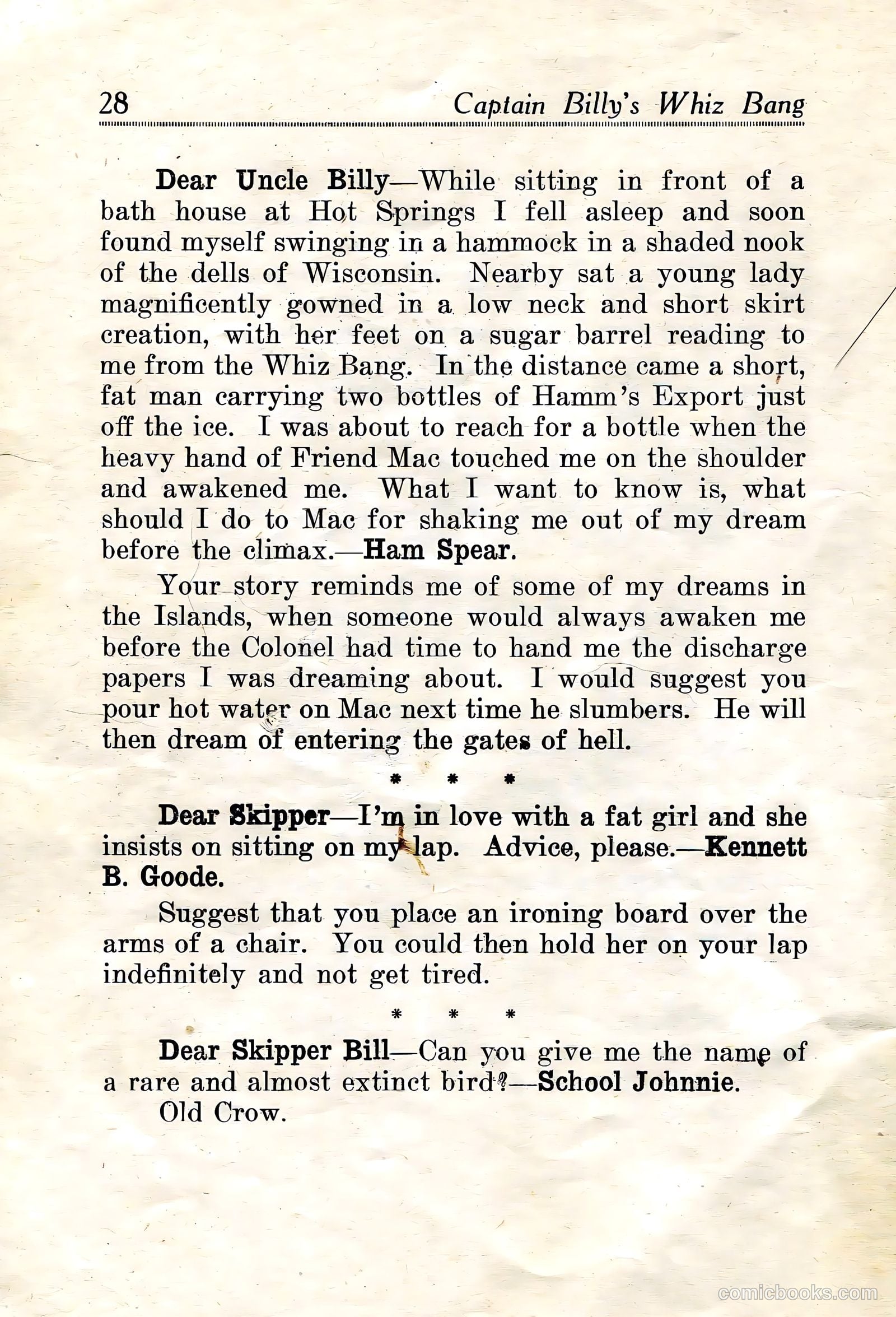
This page contains advice-column humor rather than political cartoons. Three humorous letters appear: 1. **"Ham Spear"** describes falling asleep at Hot Springs, Wisconsin, and dreaming of a flirtatious scene before being awakened by "Friend Mac." Uncle Billy's response jokes about pouring hot water on Mac so he dreams of "entering the gates of hell"—crude retaliatory humor. 2. **"Kennett B. Goode"** complains about his heavy girlfriend sitting on his lap. The response suggests placing an ironing board over chair arms to support her weight indefinitely—slapstick humor mocking both the man's predicament and the woman's size. 3. **"School Johnnie"** asks for a rare, nearly extinct bird's name. The answer is "Old Crow"—a pun, likely referencing the whiskey brand. The humor is crude, weight-based mockery typical of 1920s entertainment.
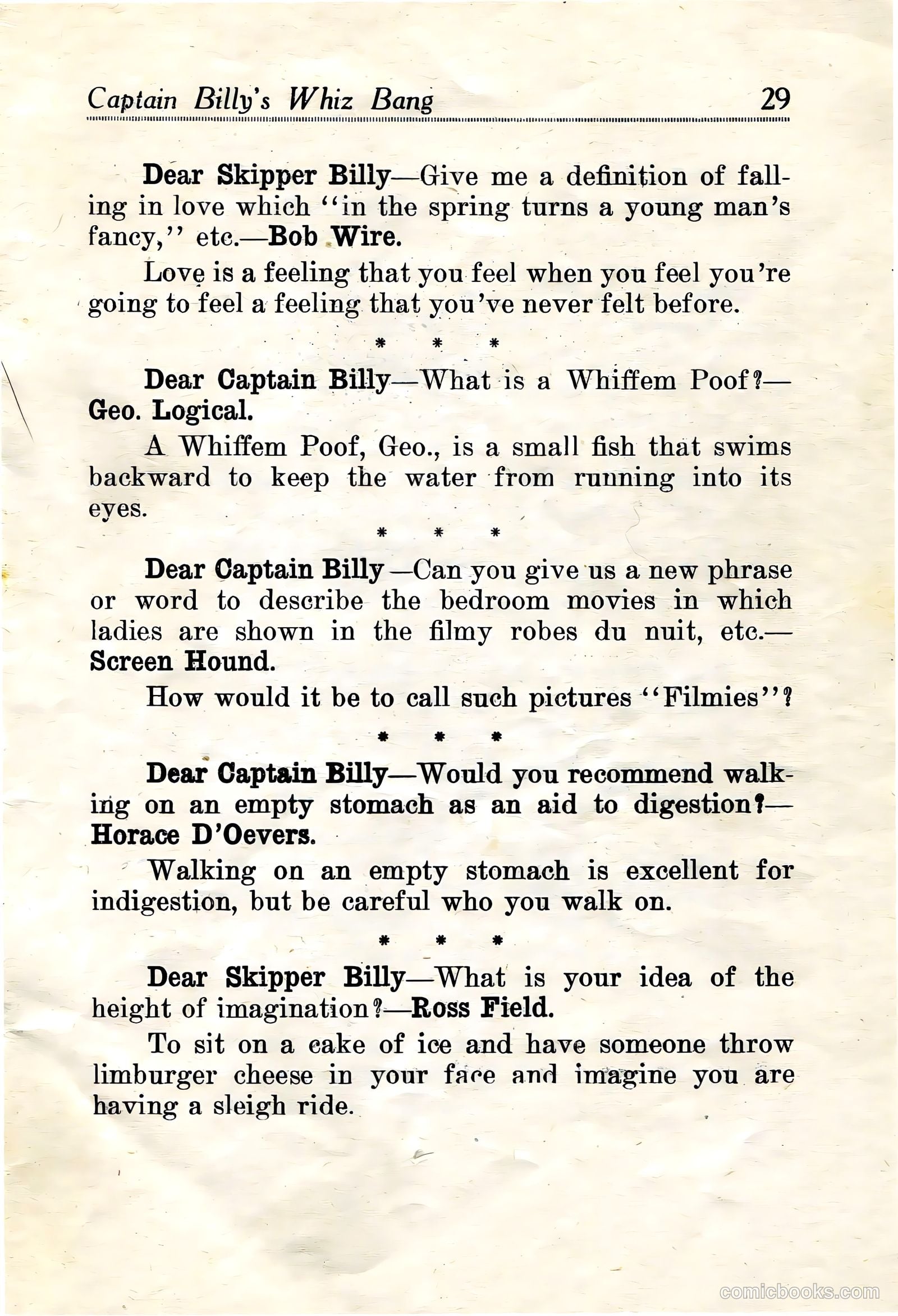
This is a humorous advice column featuring absurdist responses to readers' questions. The page contains five Q&A exchanges with deliberately silly or nonsensical answers: 1. A circular definition of falling in love 2. A made-up fish ("Whiffem Poof") with absurd behavior 3. Coining "Filmies" as a term for bedroom movies shown to women 4. Joking advice about walking on an empty stomach for digestion 5. An absurdist definition of imagination involving sitting on ice cream while having cheese thrown at one's face The humor relies on wordplay, deliberate non-sequiturs, and mock-serious responses to sincere questions. This reflects 1920s-era absurdist humor common in satirical magazines, where the joke was the disconnection between reasonable questions and completely ridiculous answers.
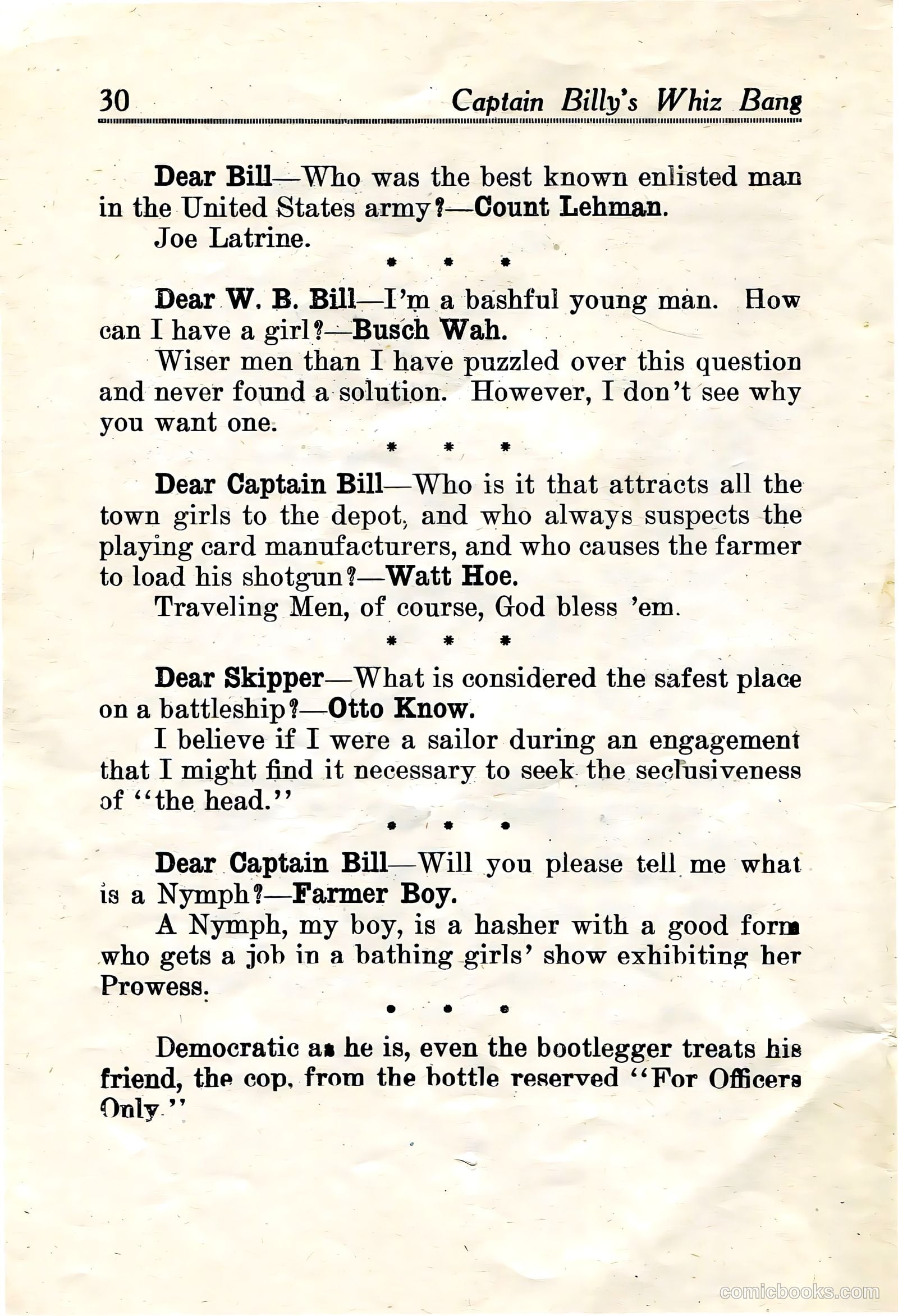
This page from *Captain Billy's Whiz Bang* (a post-WWI satirical magazine, circa 1920s) presents a "Dear Bill" advice column featuring pun-based jokes with sexually suggestive answers. The humor relies on **wordplay disguising double meanings**: "Count Lehman" sounds like "Count 'em" (enlisted soldiers), "Busch Wah" suggests bravado, "Watt Hoe" implies a traveling salesman's reputation for seduction, and "Otto Know" sounds like "ought to know." Key social references include: - **Traveling salesmen** as stock seducers of small-town girls - **Farmers protecting daughters** from outsiders - **Nymphs/bathing girls** as sexualized entertainers in vaudeville shows - **Prohibition-era bootleggers** and corrupt cops sharing illegal alcohol The final line satirizes **class hypocrisy**: even lawbreakers maintain hierarchical distinctions ("For Officers Only"). The overall tone is risqué working-class humor typical of post-war American magazines targeting servicemen and working men.
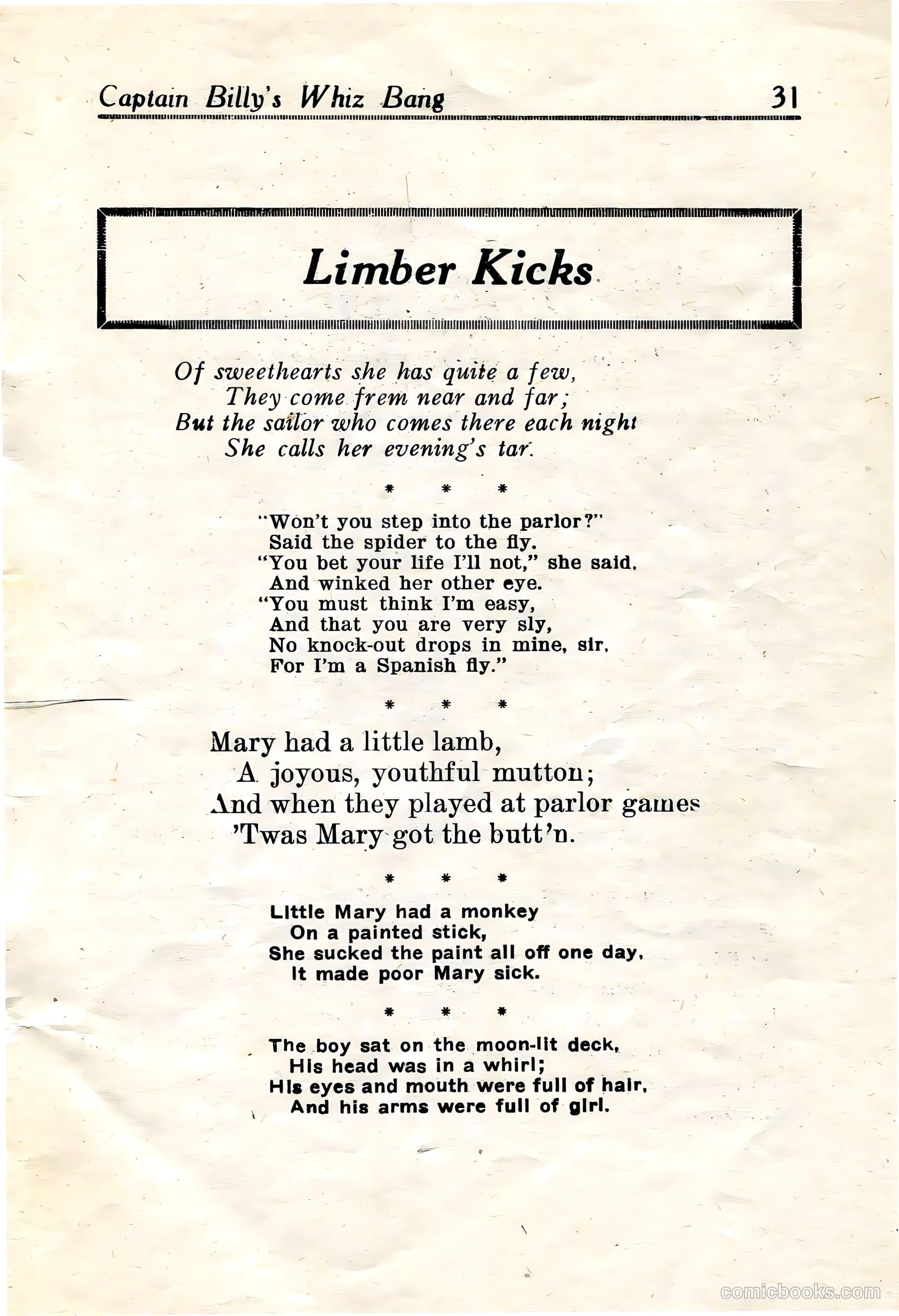
This page from the satirical magazine contains a series of bawdy, double-entendre-heavy limericks and short verses typical of 1920s humor. The jokes rely on sexual innuendo rather than political content: - A woman has multiple suitors but favors a sailor she calls her "evening's tar" - A riff on "The Spider and the Fly" where a woman refuses a man's advances, claiming she's a "Spanish fly" (a supposed aphrodisiac, but here she's rejecting the comparison) - Crude plays on words: "Mary got the butt'n" (buttoning/sexual contact), a monkey licking paint off a stick (oral sex metaphor), and a boy with "his arms full of girl" These are examples of the irreverent, sex-joke-focused humor that made *Captain Billy's Whiz Bang* popular among soldiers and working-class men in the post-WWI era. The satire targets social propriety and sexual prudishness rather than politics.
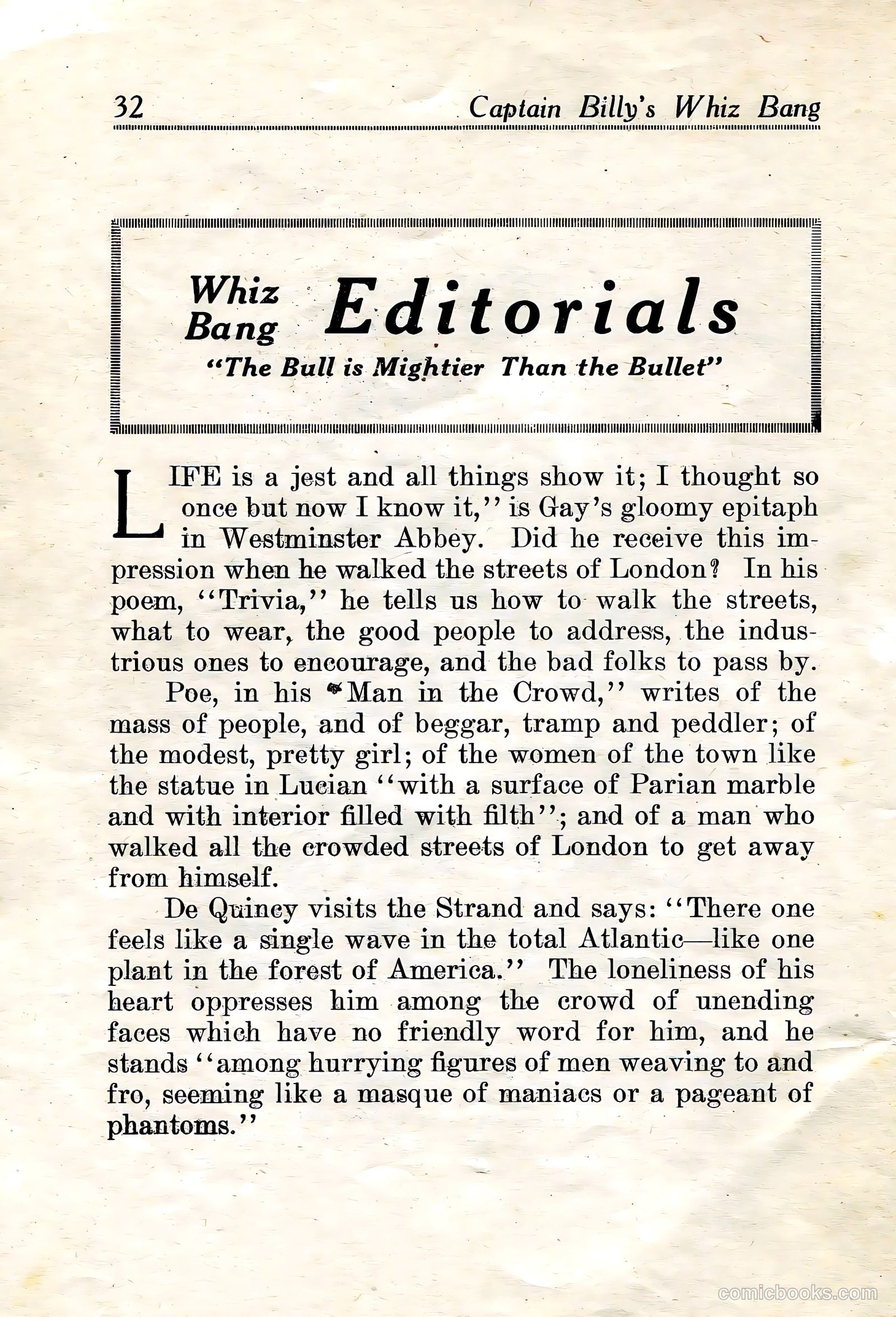
This is an **editorial essay**, not a cartoon. It discusses the psychological alienation of urban life through literary references. The piece compares how classic writers (Gay, Poe, De Quincy) portrayed **London street crowds** as sources of profound loneliness despite being surrounded by masses of people. The editorial uses literary quotations to argue that city life creates emotional isolation—people feel like "a single wave in the total Atlantic" or "one plant in the forest of America." The satire targets the **paradox of urban anonymity**: crowds don't create community but rather intensify personal disconnection. The references to "women of the town" and "hurrying figures seeming like maniacs" suggest Victorian anxieties about urban vice and moral decay. The editorial's title—"The Bull is Mightier Than the Bullet"—remains unclear from this page alone, though it likely critiques some contemporary social problem through ironic understatement.
This appears to be a **moralizing editorial essay** rather than a cartoon. The text presents a moralistic critique of urban life, likely from the 1920s-1930s era. The piece contrasts nature (where one studies God) with cities (where one studies human "sham, struggle and sin"). It acknowledges that recreation and play are necessary, but pivots sharply to condemn nighttime urban behavior—particularly women. The author warns that after respectable people retire, "the Devil" leads others into vice causing "disease of body, darkness of mind, and death of soul." The final passage explicitly attacks sex workers and "giddy girls," calling cities a "Demon's brain" and such women "evil thoughts." **Context**: This reflects conservative, religious anxiety about urbanization, changing social mores (particularly regarding women's appearance and freedom), and moral panic around nightlife—typical of early-20th-century moralist publications.
This page from *Captain Billy's Whiz Bang* (a WWI-era satirical magazine) contains a moralistic editorial essay, not a cartoon. The text criticizes urban street life, describing poverty, disease, and moral decay. It argues that institutional solutions—Art Galleries, Parks, Vice Commissions—are insufficient; instead, religious moral training ("Gospel of hand, head and heart") is needed to reform society. The final section introduces a historical debate about alcohol prohibition by quoting Hollinshed's *Chronicles* (1577), which categorizes drinks and claims moderate consumption has health benefits—slowing age, strengthening youth, aiding digestion. This appears to be setting up an ironic contrast: the passage was written before prohibition was enacted (1920), suggesting the author is sarcastically presenting historical "evidence" that alcohol consumption was once considered beneficial, perhaps to mock contemporary prohibition advocates or the debate surrounding it.
This page from *Captain Billy's Whiz Bang* (a 1920s satirical magazine) tackles **Prohibition-era politics**. The opening text—a mock-archaic medical endorsement of alcohol—humorously lists supposed health benefits of drinking, using deliberately old-fashioned language ("kepyth," "relisheth") to satirize outdated thinking. The page then quotes **Sir Walter Scott** to argue that **prohibition is as extreme as drunkenness itself**. Scott's fictional dialogue presents moderate alcohol use as a "gift of God" and suggests that abstaining is foolish—inverting temperance arguments by calling strict prohibition a form of intoxication or moral excess. The secondary section on American short stories appears unrelated but may serve as filler content. **Context**: This represents anti-Prohibition sentiment common in satirical publications during the 1920s, mocking temperance advocates by suggesting their zealotry was itself a form of extremism, while defending moderate drinking as reasonable and even religious.
This page from *Captain Billy's Whiz Bang* (a 1920s-era satirical magazine) contains no political cartoons, but rather humorous editorial and verse content. The opening essay sardonically compares "clean" American short stories to "naughty stories," arguing that while respectable fiction claims moral purity, it actually derives its narrative efficiency from risqué storytelling traditions. The satire mocks American prudishness and hypocrisy about sexual content. The two brief pieces below are crude, working-class humor typical of the magazine's style: - **"A Song Without Music"** depicts a miner whose girlfriend is literally a pack mule he drives in the mines—absurdist humor playing on rural/mining stereotypes. - **"Our Monthly Motto"** presents a bachelor's twisted logic: since wine, women, and song ruin men, he's eliminated only singing—keeping the other two vices. It's self-aware, irreverent humor about male indulgence. The overall tone targets middle-class morality while celebrating bawdy, anti-establishment humor for working-class readers.
This is a humorous fake baseball game report using player names that are actually puns or objects. The joke relies entirely on wordplay: "Molasses" at bat (slow), "Smallpox" catching (spotty), "Cigar" pitching (smoke), "Horn" at first base (horns/sounds), "Axe" batting (he "chopped"), "Bread" on base (he "loafed"), "Wind" pitching (he "blew"), "Hammer" batting (he "knocked"), "Lightning" pitching (he "struck"), and "Soap" playing (he "cleaned up"). The satire mocks overly earnest sports journalism by applying these absurd pun-names to standard baseball play-by-play commentary. It's wordplay disguised as legitimate sports reporting—typical of *Whiz Bang's* lighthearted humor. The final joke about Jonah and the whale is an unrelated Biblical gag where Jonah fears abandonment by the whale carrying him.
This page announces upcoming content in *Captain Billy's Whiz Bang*, a humor magazine. The main feature promotes George J. Liebst, "The Hobo Jungle Poet of the West," who writes poetry about hobo life and conventions, using the rhythm of train wheels for meter. The poem samples characters like "Texas Slim" and "The San Diego Kid"—colorful hobo nicknames typical of Depression-era railroad culture. The teaser references a future "Mighty Casey" baseball story, likely playing on the famous "Casey at the Bat" poem, suggesting a comedic comeback narrative. The final verse parodies the sentimental 1910 song "In the Shade of the Old Apple Tree," subversively reimagining Adam and Eve as lazy rather than innocent—a mild sexual joke for the era. The page reflects *Whiz Bang's* blend of working-class humor, literary parody, and irreverent takes on established culture.
This page features a prison poem attributed to an Alcatraz inmate, presenting the military prison as brutal and dehumanizing. The author emphasizes Alcatraz Island's notorious reputation—comparing it to the Philippine penal facility Bilibid as a feared punishment destination for soldiers. The poem expresses despair about harsh conditions: metal bunks, lost rights, beatings, and psychological deterioration. It appeals for sympathy toward prisoners, arguing that "good" and "bad" inmates are fundamentally equal and worthy of compassion. The closing couplet appears cynical wordplay—possibly mocking religious judgment or suggesting moral ambiguity about one's life and deeds. As a *Whiz Bang* piece, this represents the magazine's interest in satirizing military institutions and conditions while giving voice to enlisted men's grievances. The publication targeted soldier audiences with irreverent humor and social criticism regarding military life.
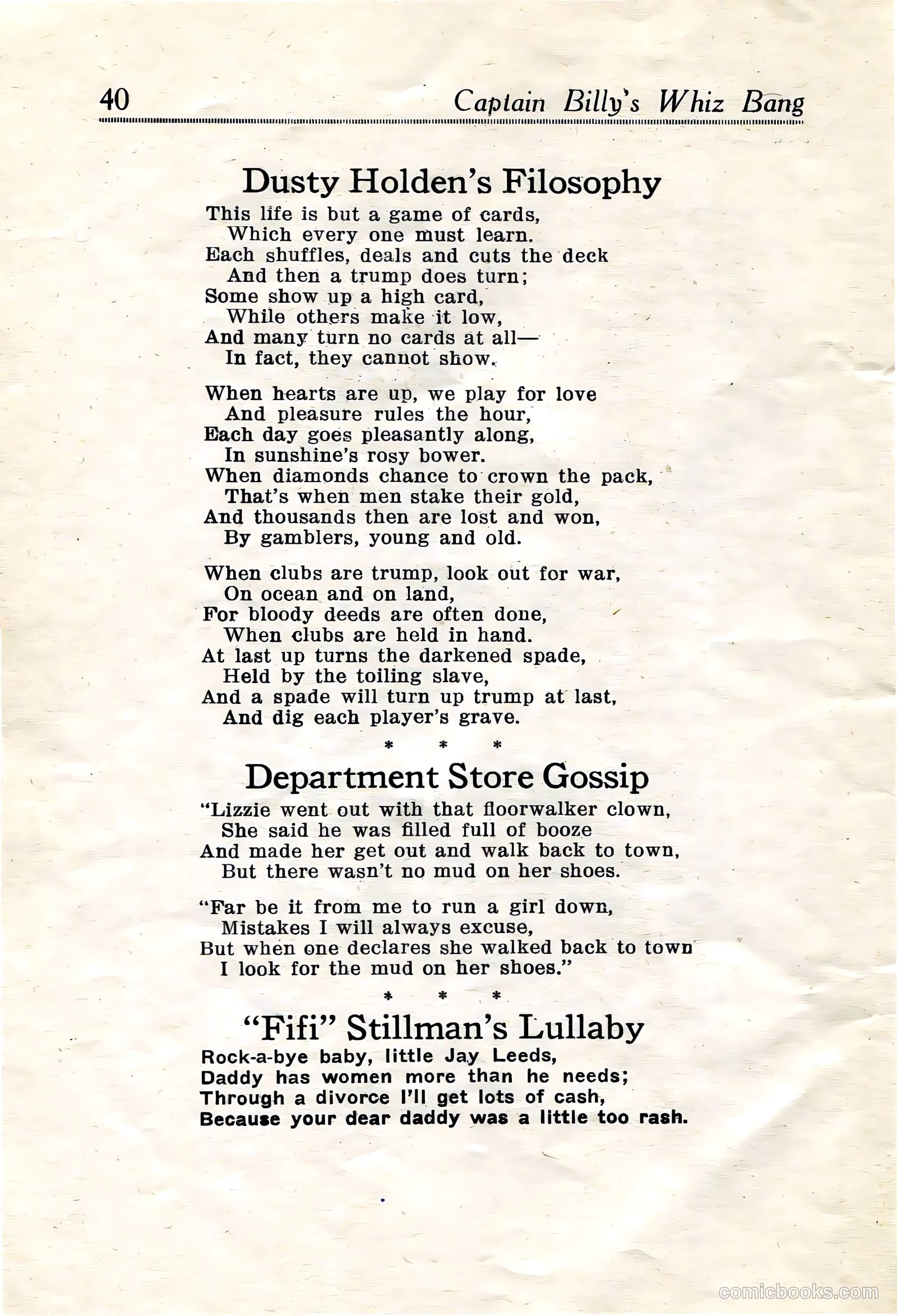
This page contains three humorous poems/verses rather than cartoons: 1. **"Dusty Holden's Philosophy"** - A poem using card-game metaphors to philosophize about life's unpredictability. Hearts represent love, diamonds represent wealth and gambling, clubs represent war. The final spade image suggests death. It's a cynical meditation on fate. 2. **"Department Store Gossip"** - A brief poem about a woman named Lizzie who went out with a "floorwalker clown" (a department store employee), allegedly drunk. The humor centers on a man's attempt to use the absence of mud on her shoes as evidence of her innocence—a crude logical fallacy. 3. **"'Fifi' Stillman's Lullaby"** - A satirical baby lullaby mocking Jay Leeds's father (likely a wealthy businessman), celebrating infidelity and impending divorce profits.
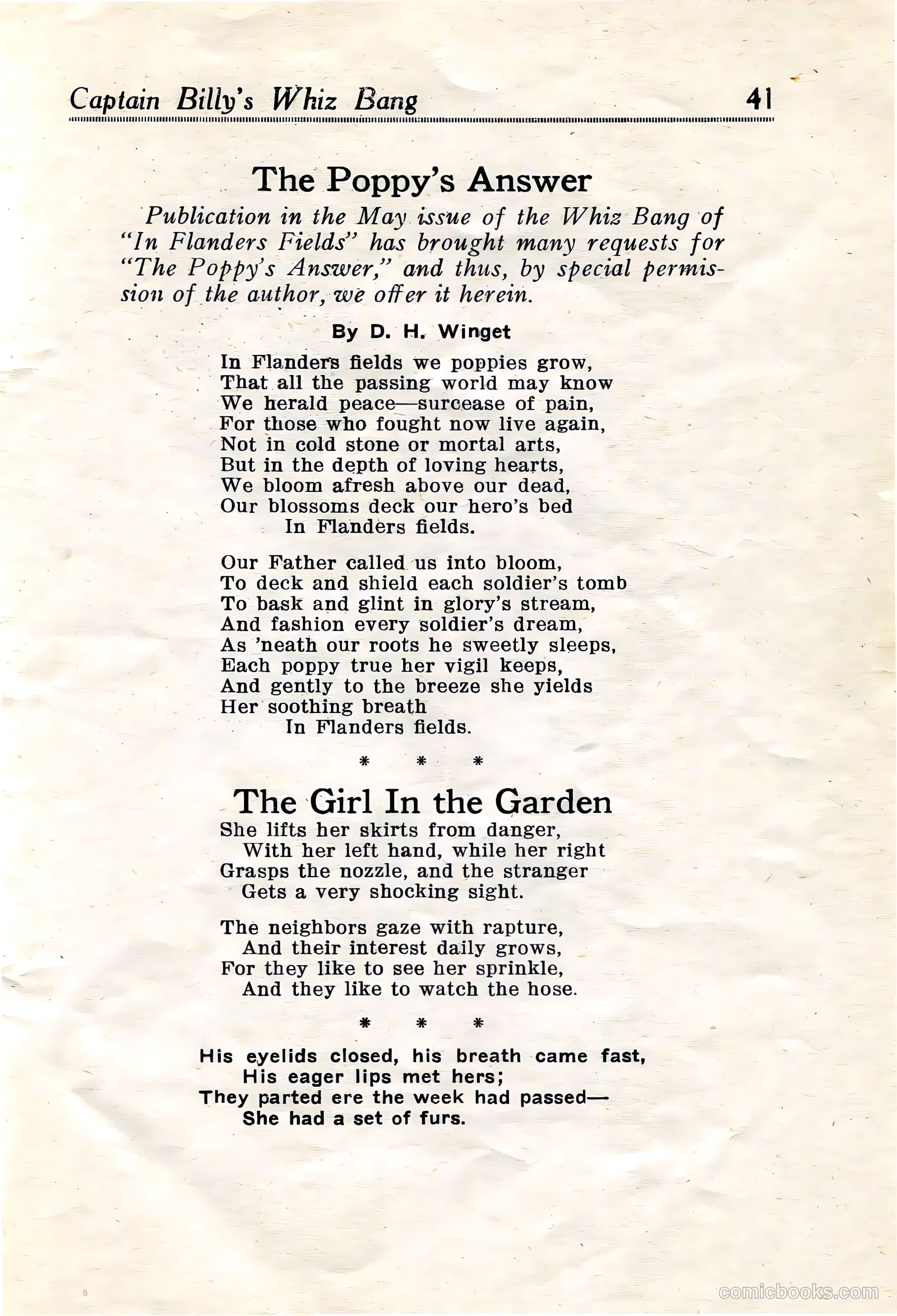
This page contains three poems, not cartoons. "The Poppy's Answer" responds to John McCrae's famous WWI poem "In Flanders Fields," giving voice to the poppies themselves as symbols of fallen soldiers' memory and peace. The two remaining pieces are bawdy humor typical of *Whiz Bang*, a magazine known for risqué content. "The Girl in the Garden" uses double entendre—the woman watering her garden becomes a spectacle for voyeuristic neighbors; the hose and "sprinkle" carry sexual implications. The final untitled verse is a cynical joke about romance and materialism: a woman accepts a man's advances, then leaves him once she obtains a fur coat—commenting on transactional relationships and female materialism. These reflect post-WWI attitudes: reverence for the fallen alongside irreverent humor about courtship and gender relations.
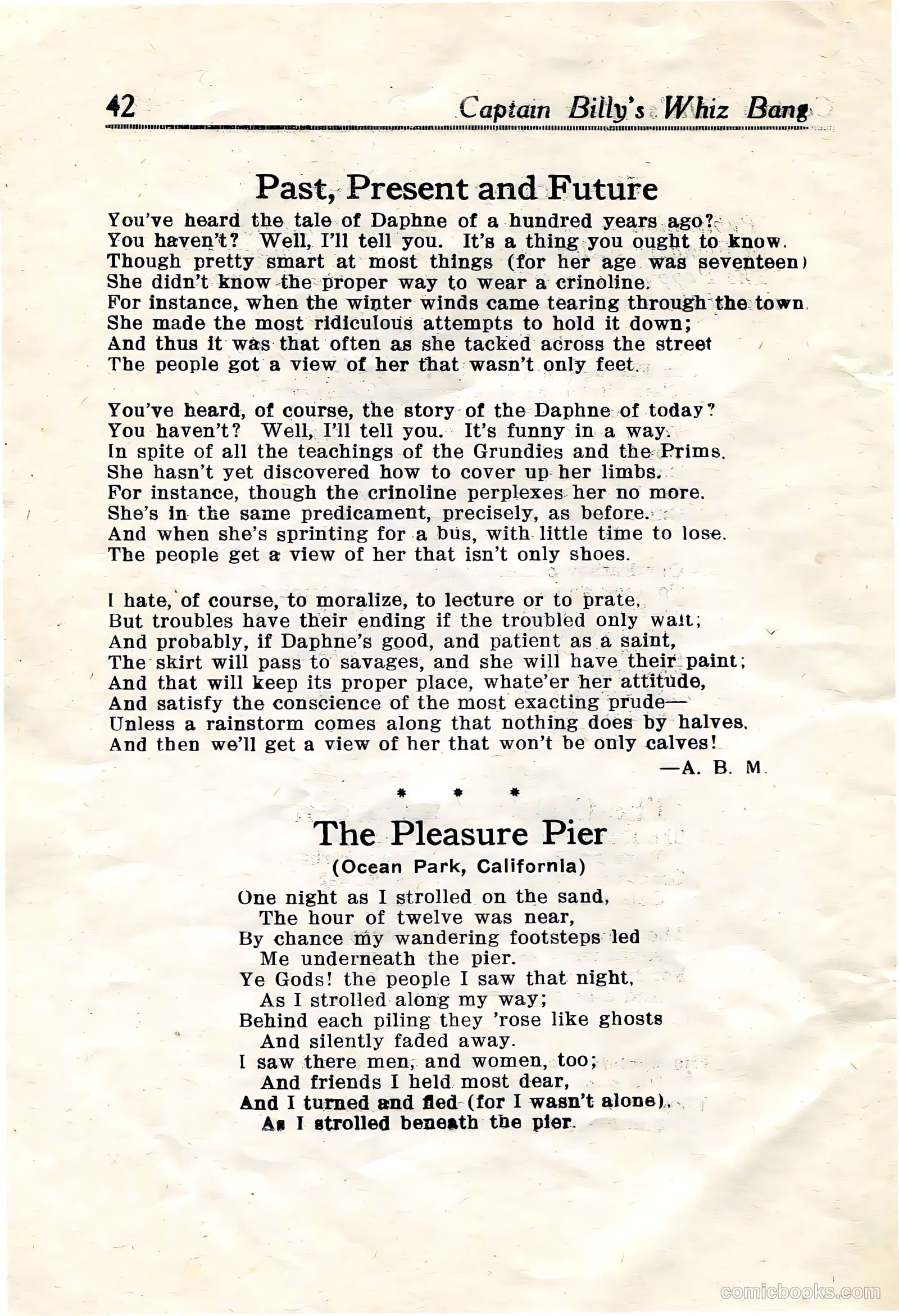
This page contains two satirical pieces from Captain Billy's Whiz Bang, a 1920s humor magazine known for ribald jokes. **"Past, Present and Future"** mocks women's fashion and propriety across generations. It compares a girl from a century ago who couldn't properly wear a crinoline (exposing her legs inadvertently) with modern women in shorter skirts who similarly expose their limbs while running for buses. The joke is that despite changing fashions and moral instruction from "Grundies and Prims" (prudish authority figures), women continue to reveal themselves—and the poem sarcastically suggests even a rainstorm won't help. It's a cheeky commentary on the "flapper" era's shorter hemlines, which scandalized conservatives. **"The Pleasure Pier"** describes stumbling upon couples engaged in illicit romantic encounters under a California pier at midnight. The speaker flees upon realizing he's not alone, implying sexual activity. It's a knowing joke about Prohibition-era moral hypocrisy and secret liaisons. Both pieces reflect 1920s anxieties about changing sexual mores and women's liberation.
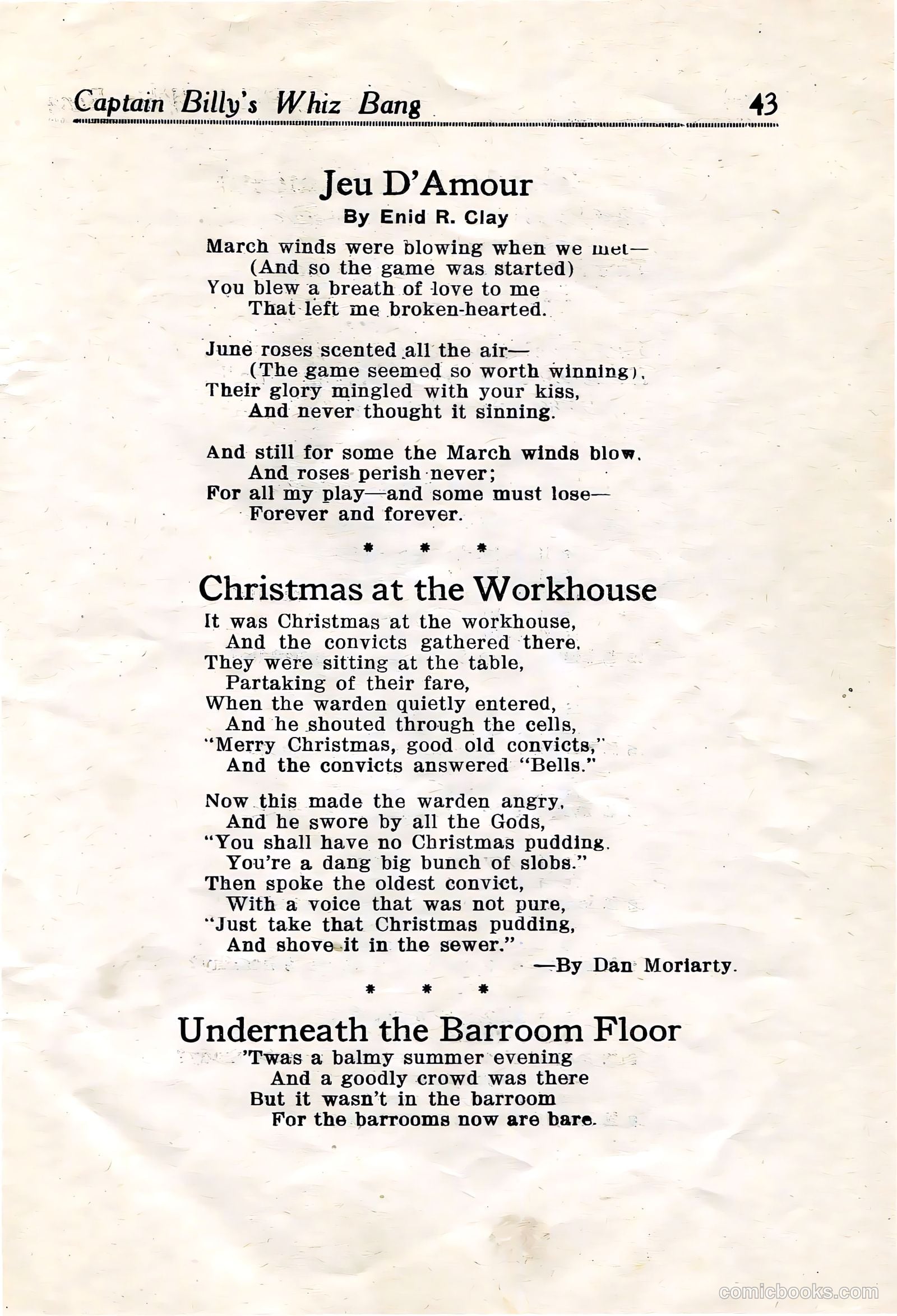
This page from *Captain Billy's Whiz Bang* contains three poems reflecting post-Prohibition American life and social commentary. "Jeu D'Amour" (by Enid R. Clay) is a romantic poem about love's transience—a relationship that began hopefully but ended in heartbreak. "Christmas at the Workhouse" (by Dan Morlarty) is satirical humor depicting convicts mocking their warden. When he wishes them "Merry Christmas," they respond with "Bells"—likely a crude pun or double entendre. The warden's angry threat to deny them Christmas pudding prompts the oldest convict's vulgar retort to "shove it in the sewer," satirizing the indignity of prison conditions and convict defiance. "Underneath the Barroom Floor" references Prohibition (1920-1933). The poem's opening suggests people still gather for drinking, but "the barrooms now are bare"—legal bars have closed. The implication is that drinking continues illegally, in speakeasies or hidden locations "underneath" legitimate establishments, mocking the failed policy's actual effect.
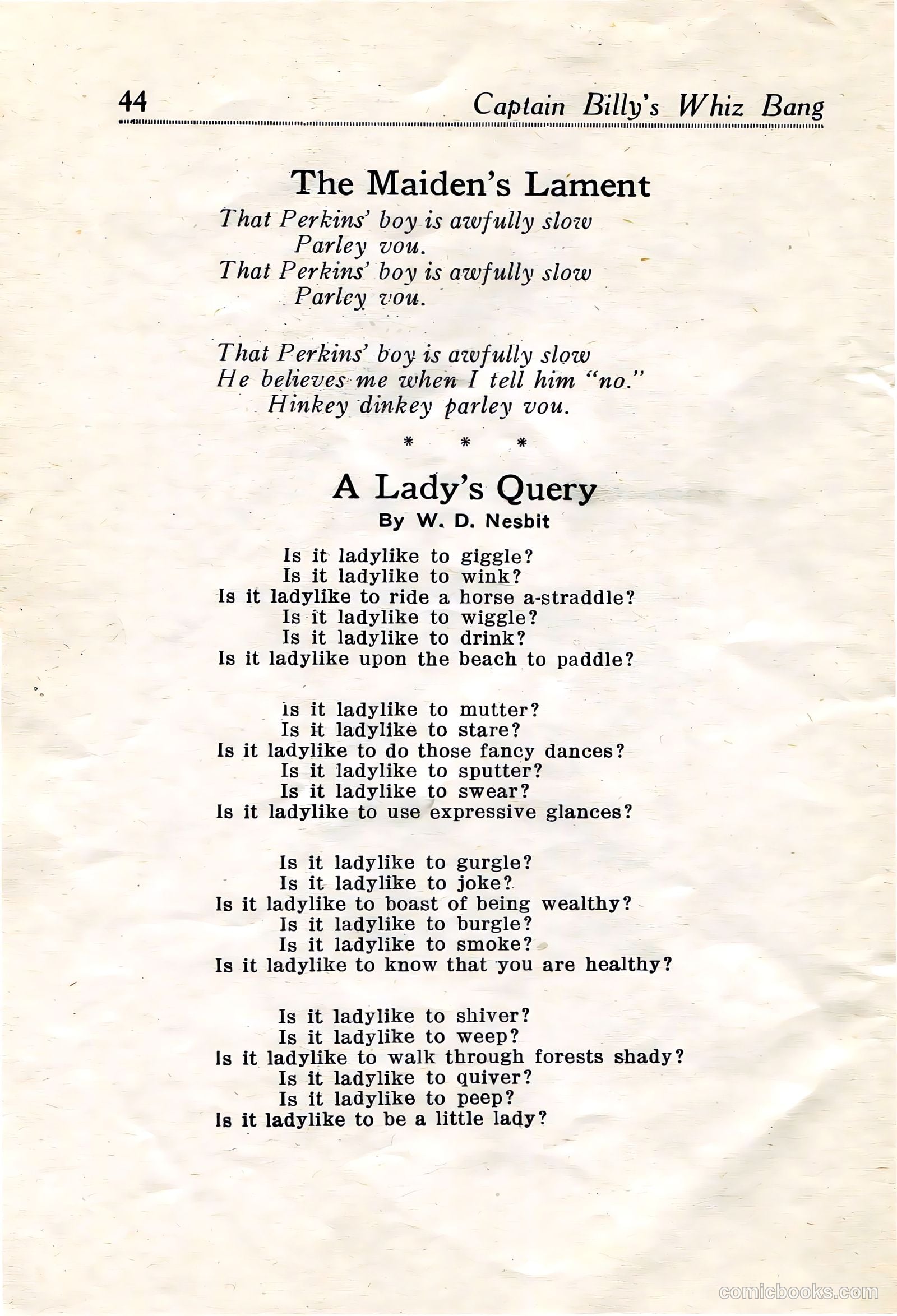
This page from *Captain Billy's Whiz Bang* (a popular WWI-era humor magazine) contains two satirical pieces mocking courtship and changing social norms. **"The Maiden's Lament"** parodies a popular WWI song ("Hinky Dinky Parlez Vous"). A girl complains that Perkins' boy is "awfully slow"—he respects her when she says "no," which frustrates her. The joke inverts romantic expectations: she wants a more aggressive suitor, not one who honors her refusals. **"A Lady's Query"** by W.D. Nesbit catalogs modern behaviors—giggling, winking, riding astride, drinking, smoking, joking, boasting about wealth, even burglary—then repeatedly asks if each is "ladylike." The cumulative effect satirizes the tension between traditional feminine propriety and women's emerging independence and social freedoms in the 1920s. The final line questions whether true ladyhood even exists anymore. Both pieces humorously reflect post-WWI social upheaval and changing gender roles.
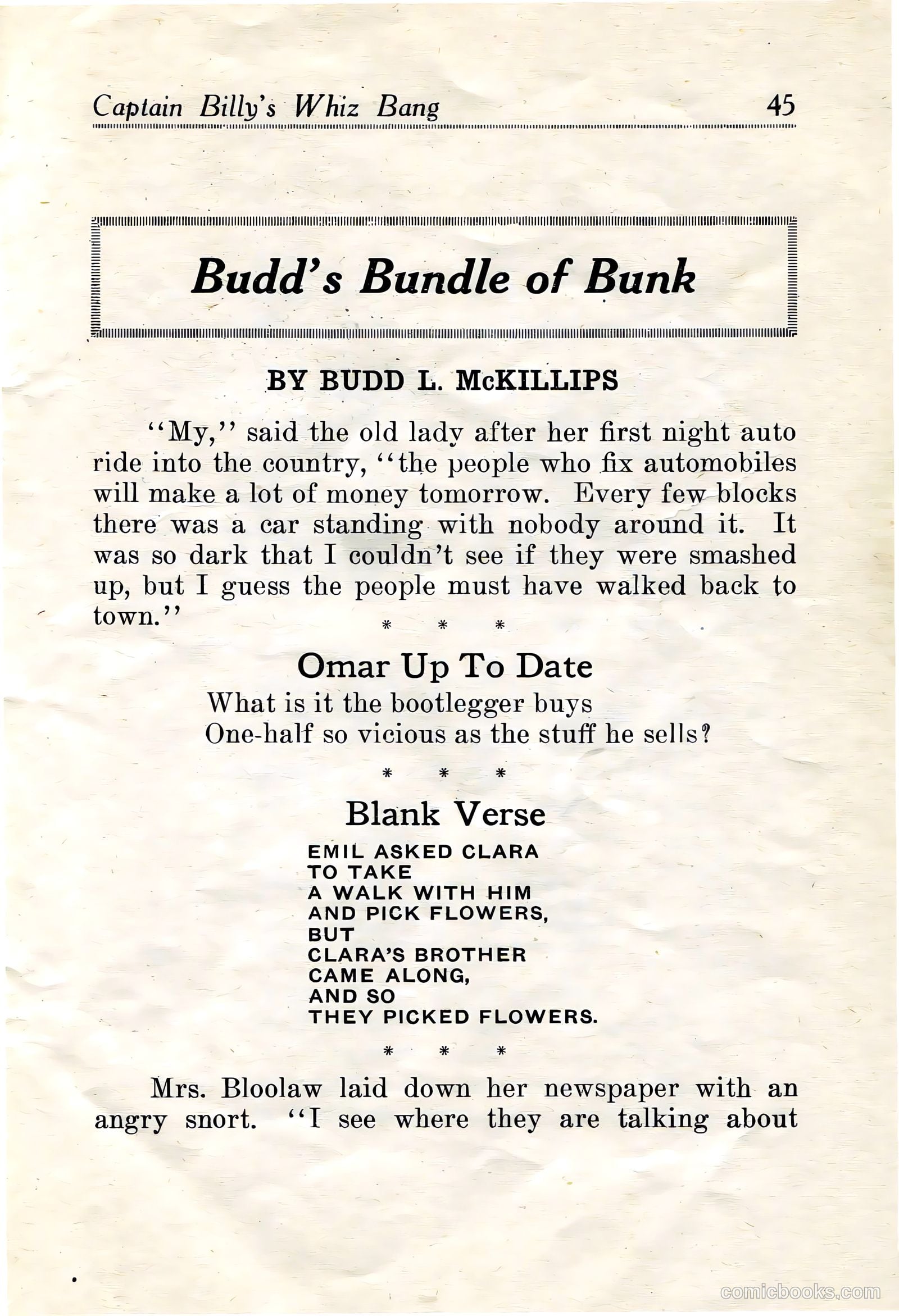
This page contains several short satirical pieces typical of 1920s American humor magazines: **"Budd's Bundle of Bunk"** jokes about an elderly woman's naïveté after her first car ride—she interprets abandoned vehicles as evidence of widespread crashes, not realizing people simply parked them. **"Omar Up To Date"** is a Prohibition-era joke about bootleggers: it questions what inferior product bootleggers purchase that's "half as vicious" as the low-quality alcohol they sell—implying bootleggers deal in dangerously adulterated liquor. **"Blank Verse"** is a gentle joke about courtship: Emil wanted alone time with Clara to pick flowers, but her brother's presence meant the romantic gesture became a group activity instead. **Mrs. Bloolaw's segment** (incomplete) appears to be setting up another joke, though it's cut off. The humor reflects 1920s concerns: early automobile culture, Prohibition enforcement and black-market liquor quality, and dating customs with chaperones.
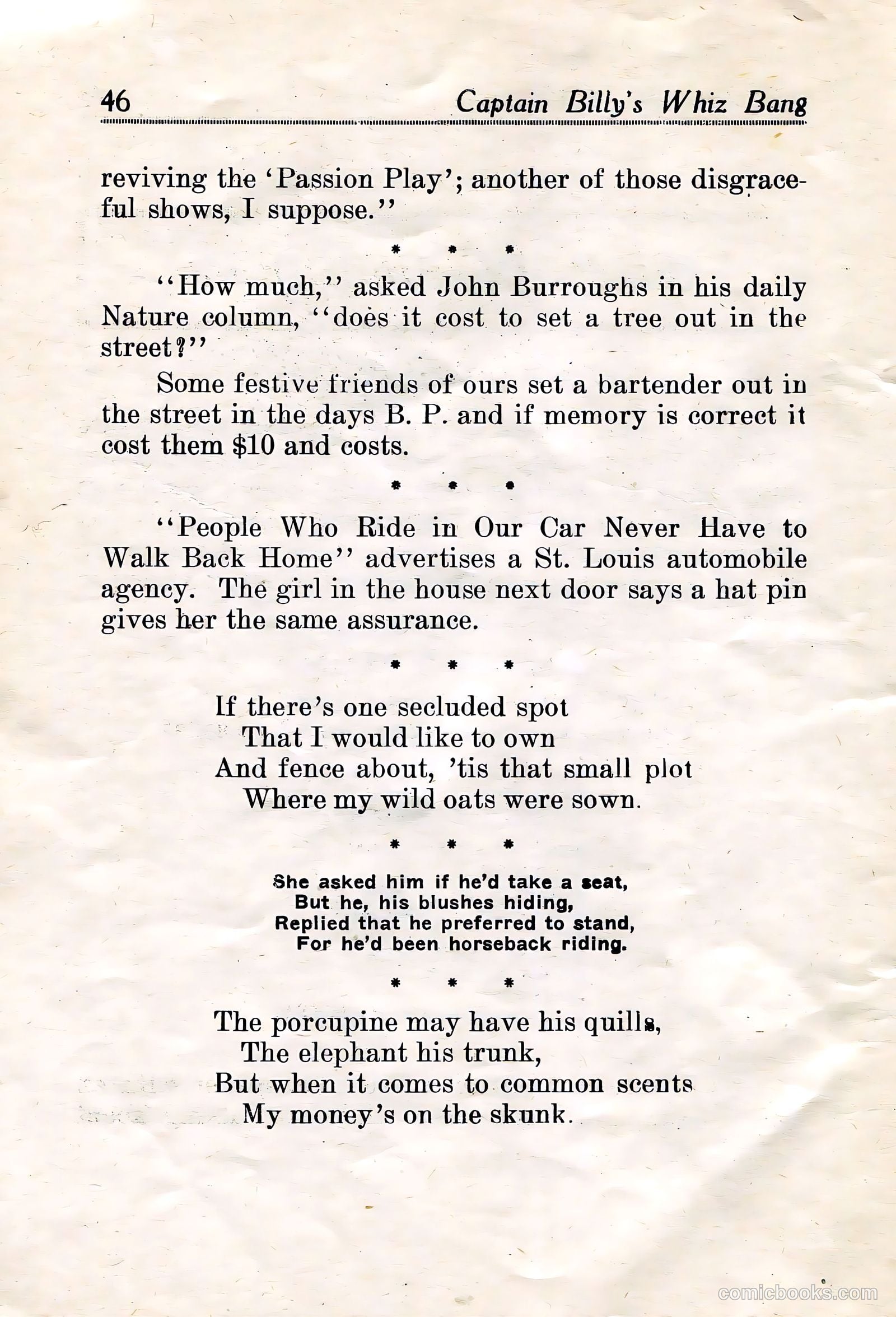
This page from the satirical magazine collects various short humorous observations and light verse. The jokes target early 20th-century social pretensions and concerns: **Main themes:** - A jab at religious theater (the "Passion Play") - A quip about street tree-planting costs, referencing naturalist John Burroughs - A joke about forcibly ejecting a bartender (likely Prohibition-era humor about removing drunk people) - An automobile advertisement parodied by a joke about hat pins as self-defense weapons for women - Sentimental verse about youthful indiscretion - A crude double-entendre about horseback riding causing soreness - A final pun comparing animal characteristics, culminating in a skunk-scent joke The humor is mild, mostly relying on wordplay and innuendo rather than sharp political satire. **Whiz Bang** was known for this accessible, somewhat risqué but family-friendly comedy format popular in the 1920s.
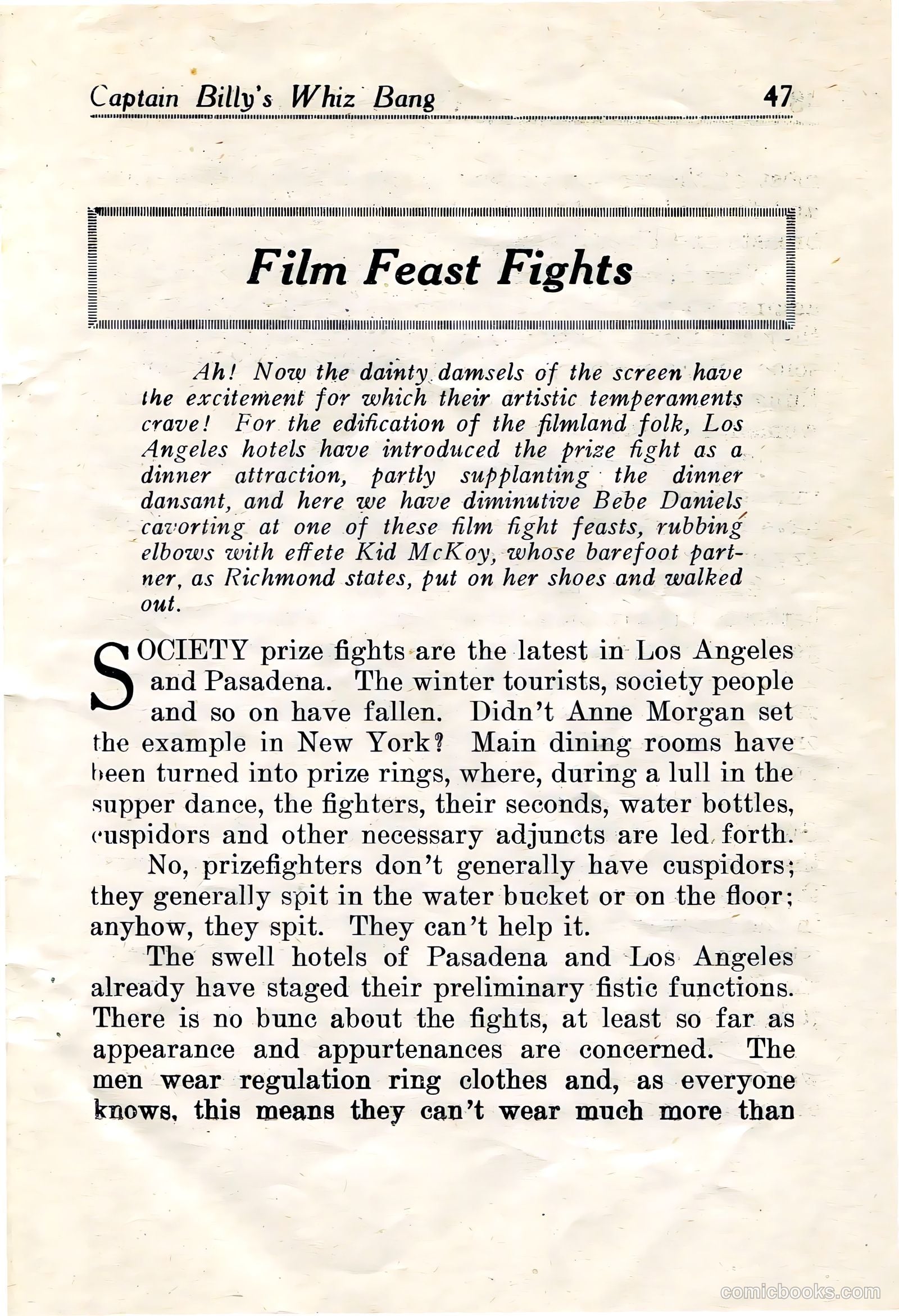
This page describes a fashionable boxing match event, likely from the 1920s. The satire targets high-society entertainment trends and celebrity culture. **Key figures mentioned:** - **Kid McCoy**: A real boxer/celebrity known for multiple marriages, mocked here for his ninth (or fifteenth?) divorce - **Tom Mix**: A famous Western film star who served as referee, drawing crowds willing to pay for his appearance - **Guy Price, Eddie Moriarity, H.M. Walker**: Newspaper sporting writers attending the event **The satire's targets:** The piece mocks the Alexandria-Alec club for starting this "fad" of boxing matches as society entertainment, attracting elite names and newspaper coverage. It jokes that newspaper writers covering fights also write "funny titles" for Semon and Lloyd (likely film comedians), yet maintain artificially serious demeanor. The underlying commentary: wealthy society has adopted boxing as trendy entertainment, turning athletic competition into celebrity spectacle, with film stars and journalists present primarily for social cachet rather than genuine interest.
This page from the satirical magazine discusses Hollywood starlets at a social event, likely a 1920s dance or party. The text focuses on **Bebe Daniels**, a silent film actress, noting her unusually modest demeanor compared to other screen stars—she appears bored by the glamour, suggesting she has common sense about the hollow nature of celebrity ("18 carat bunc"). The satire critiques **high society's obsession with movie stars**: society women find it essential to attend events to see what stars wore and whom they associated with, though the author mocks this as foolish. The piece also jabs at wealthy socialites for gushing over boxing matches staged in hotel dining rooms—essentially watching "mostly naked men fighting." A reference to **"Mary and Doug"** (likely Mary Pickford and Douglas Fairbanks, famous married stars) suggests they maintain exclusive, dignified conduct younger stars should emulate. The overall tone mocks both celebrity culture and high society's breathless fascination with it.
This page contains three separate satirical items typical of 1920s American humor magazines: 1. **Mary and Doug reference**: Gossip about Mary Pickford and Douglas Fairbanks (silent film stars), joking that their staying home generates more scandal than their public appearances. The "Nevada" reference alludes to rumors of marital trouble and potential annulment. 2. **Arkansas Honeymoon joke**: A crude sexual double-entendre. The groom's angry rejection of the conductor's offer of "a berth" (bed) is meant to be funny because the newlywed misinterprets it as an insult—implying the conductor thinks they don't need private accommodations for intimate relations. 3. **Ireland joke**: A dark political gibe. Joining the Royal Irish Constabulary during Ireland's independence struggle (early 1920s) was considered so unpatriotic that doing so seems evidence of insanity. The page demonstrates the magazine's mix of celebrity gossip, ribald humor, and political satire aimed at contemporary readers.
This is a collection of humorous quips and verses from a satirical magazine, likely from the Prohibition era (1920s-early 1930s), based on repeated references to alcohol and "moonshine" (illegal homemade liquor). The jokes mock: - **Prohibition enforcement** through double meanings ("Bentem"/"Rentem" as dental references masking booze-related wordplay) - **Illegal alcohol culture** ("bring your own bottle," "moonshine," "home brew") - **Working-class behavior** (fighting between boys, casual drinking) - **Absurdist humor** (nonsensical verses like "Flippety flop") The page satirizes how ordinary Americans circumvented Prohibition laws and the casual acceptance of bootlegging in popular culture. The tone is irreverent and anti-establishment—typical of *Whiz Bang*, known for crude humor targeting authority and social hypocrisy. No specific political figures are caricatured here; instead, the satire targets Prohibition policy itself through crude jokes about illegal drinking.
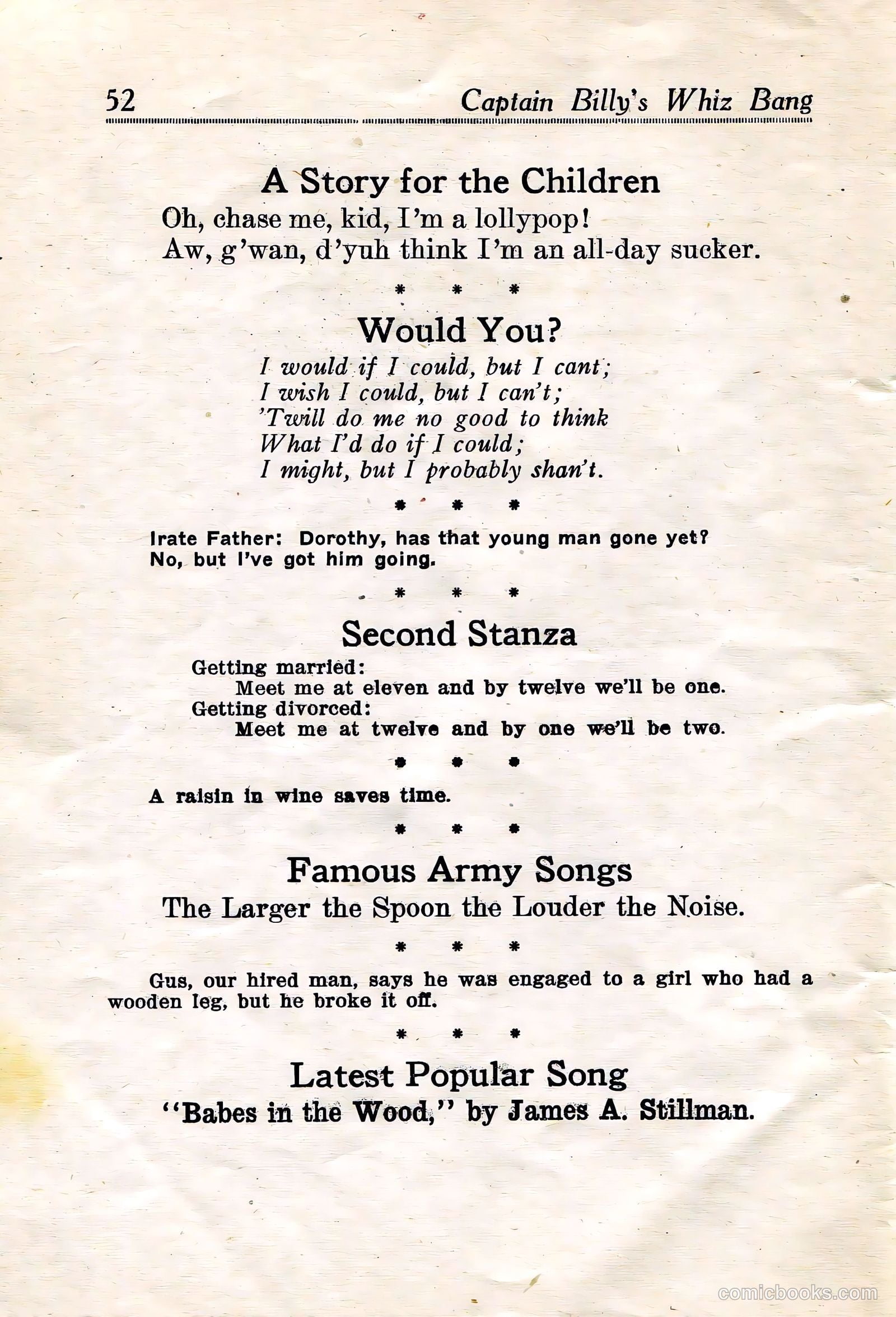
This page from *Captain Billy's Whiz Bang* (a 1920s-era humor magazine) contains brief jokes and quips typical of that era's bawdy, irreverent style: **Main content**: Short jokes about courtship and marriage, playing on double meanings. The "lollypop/all-day sucker" opener uses candy as innuendo. The "irate father" joke implies a young couple engaging in sexual activity ("got him going"). The "getting married/divorced" couplet makes a crude pun—becoming "one" vs. "two" persons through sex. **Army references** appear to be WWI-era soldier humor, though their exact meaning is unclear without more context. **The "wooden leg" joke** is a pun: "broke it off" means both ended the engagement and literally broke her prosthetic limb. The magazine's approach was deliberately irreverent and sexually suggestive—shocking for mainstream 1920s publication. This represents humor targeting young soldiers and urban audiences who enjoyed frank, cheeky content that challenged Victorian propriety.
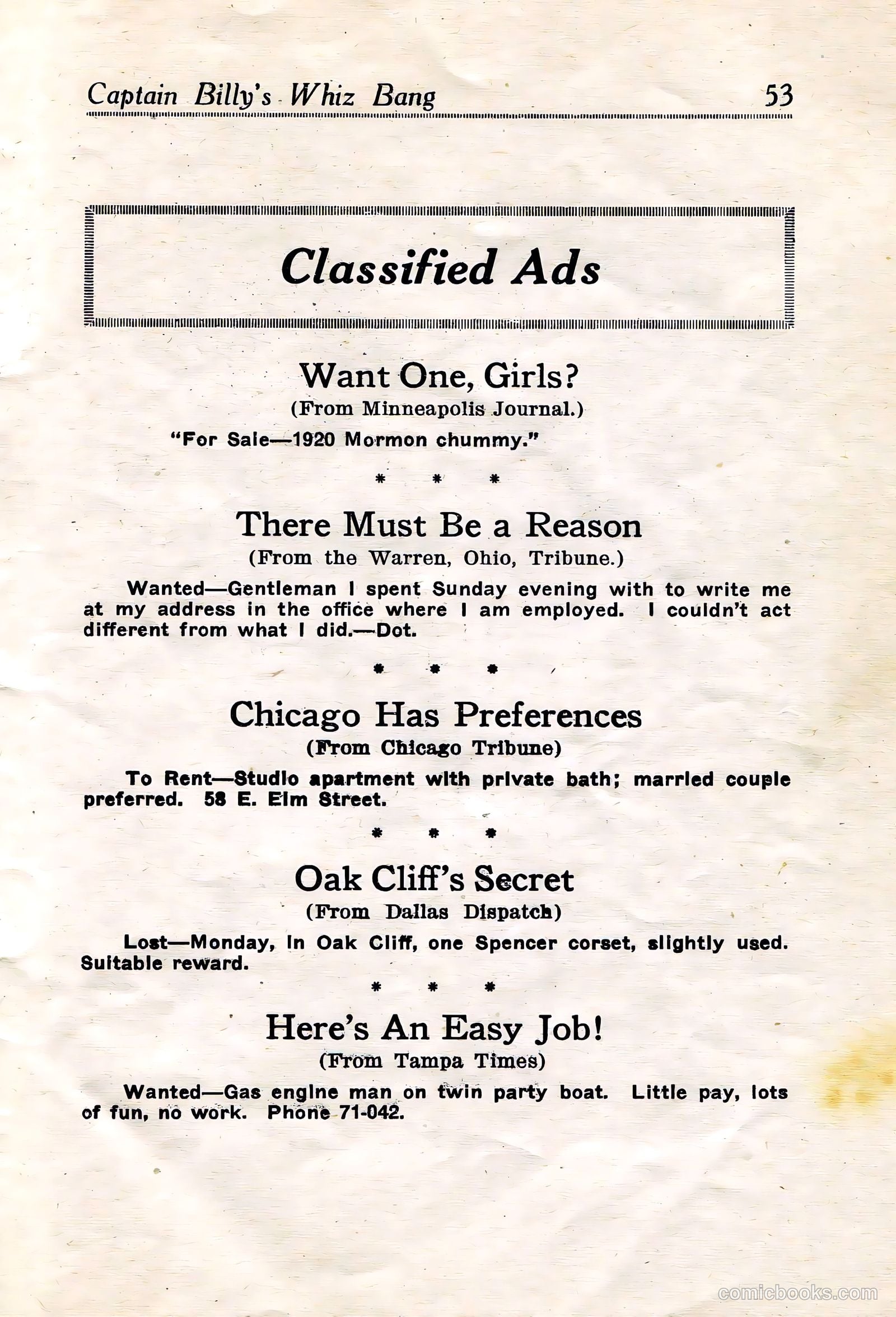
This page from *Captain Billy's Whiz Bang* (a 1920s humor magazine) reprints humorous classified ads from newspapers, mocking their unintentional comedy. The satire works through absurdity and innuendo: - **"Mormon chummy"**: jokes about Mormon polygamy practices - **Dot's personal ad**: implied compromising behavior she regrets - **Chicago apartment**: the emphasis on "married couple preferred" suggests landlord discrimination or suspicion - **Lost corset**: the specificity ("slightly used") creates embarrassing implications about the item's owner - **"Easy job"**: the contradiction ("little pay, lots of fun, no work") highlights how unrealistic job postings can be The magazine's premise is collecting real newspaper ads that accidentally reveal human foibles, class anxieties, social awkwardness, and questionable behavior through their straightforward wording. These weren't intentionally funny—their humor came from what they inadvertently revealed about 1920s society.
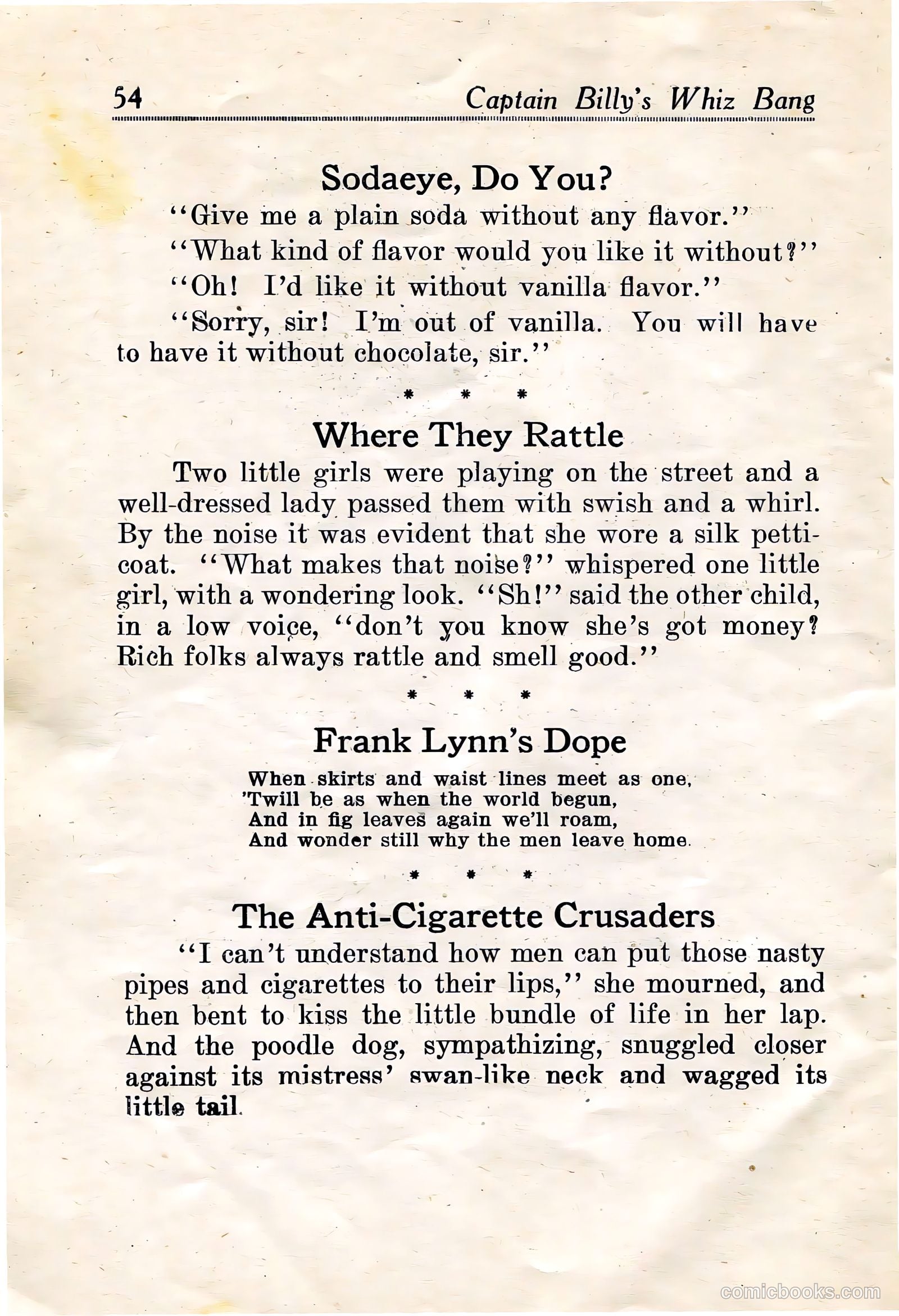
This page contains four brief satirical pieces typical of 1920s humor magazines: **"Sodaeye, Do You?"** mocks confused communication—a soda clerk and customer talk past each other about flavors. **"Where They Rattle"** satirizes class pretension. Children observe that wealthy women's silk petticoats make noise, equating wealth with conspicuous consumption and distinctive appearance. **"Frank Lynn's Dope"** is a poem criticizing women's changing fashion (shorter skirts, lower waistlines), suggesting modern dress leaves little to imagination and uses biblical allusion ("fig leaves") to imply immodesty drives men away from home. **"The Anti-Cigarette Crusaders"** employs ironic hypocrisy: a woman condemns men's smoking while kissing her baby and petting her dog—implying her concern is misplaced or sanctimonious, since she participates in physical contact without complaint. All pieces use satire to mock social attitudes and manners of the era.
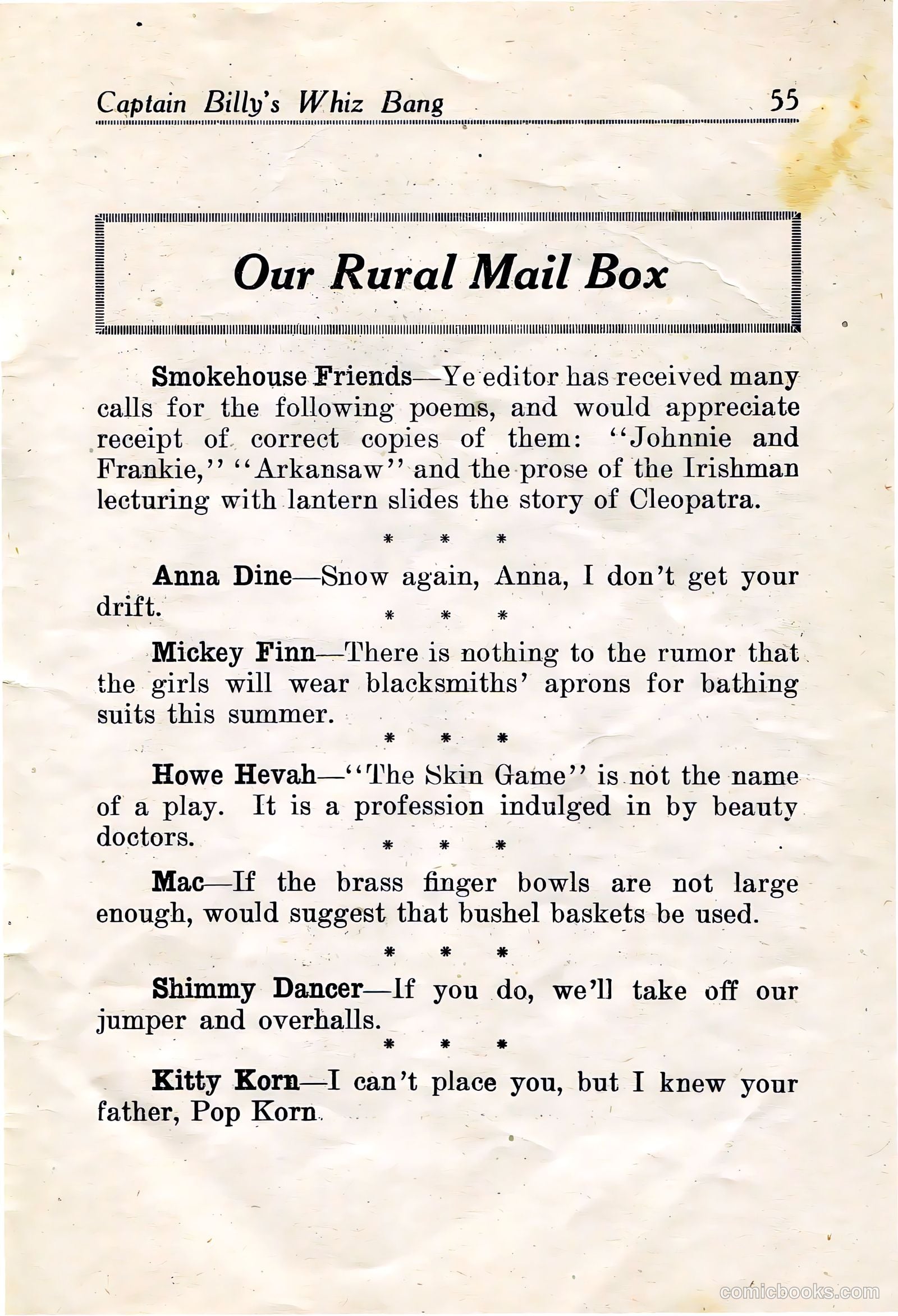
This is a humor column of fake reader submissions with punny pseudonyms and double-entendre jokes typical of 1920s satirical magazines. The humor relies on wordplay and risqué innuendo: - **Mickey Finn** jokes about girls wearing blacksmith aprons as bathing suits (a crude reference) - **Howe Hevah** makes a pun: "The Skin Game" isn't a play but what beauty doctors practice - **Mac** suggests bushel baskets for finger bowls (mocking pretentious etiquette) - **Shimmy Dancer** references the scandalous "shimmy" dance while threatening to undress - **Kitty Korn** contains a pun on her father "Pop Korn" (popcorn) The column parodies advice columns and reader mail while delivering risqué humor about contemporary fads (the shimmy dance, beauty treatments) and social affectations. The fake names are themselves jokes—transparent puns the editor creates rather than genuine submissions.
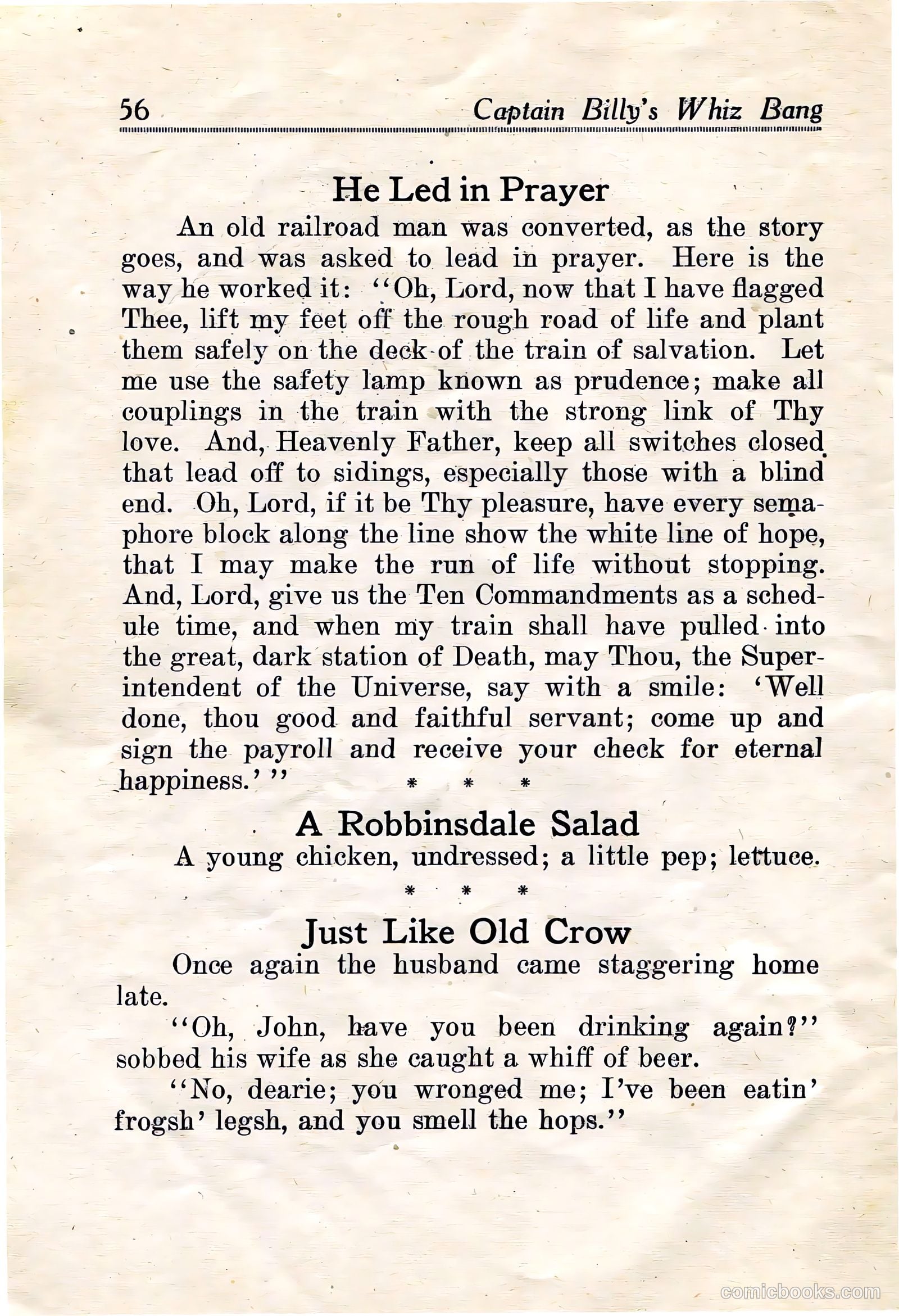
This page contains three separate humor pieces typical of 1920s satirical magazines: **"He Led in Prayer"** mocks religious conversion through a railroad worker's prayer that uses only railroad terminology (flagged, deck, couplings, switches, semaphore) to express spiritual concepts. The satire critiques both superficial religious conversion and working-class speech patterns, presenting the prayer as absurdly literal-minded. **"A Robbinsdale Salad"** is a one-liner joke: the "salad" is a young, unplucked chicken with "pep" and lettuce—essentially nothing, mocking pretentious or fraudulent restaurant fare. **"Just Like Old Crow"** depicts a drunk husband's excuse: he claims he's eaten frog legs (which he pronounces phonetically as "frogsh' legsh") and that's why he smells of beer and hops. The humor relies on his absurd, obviously false excuse and working-class dialect ("dearie," slurred speech). All three pieces use class-based humor targeting working-class men and their speech patterns, typical of the era's popular comedy.
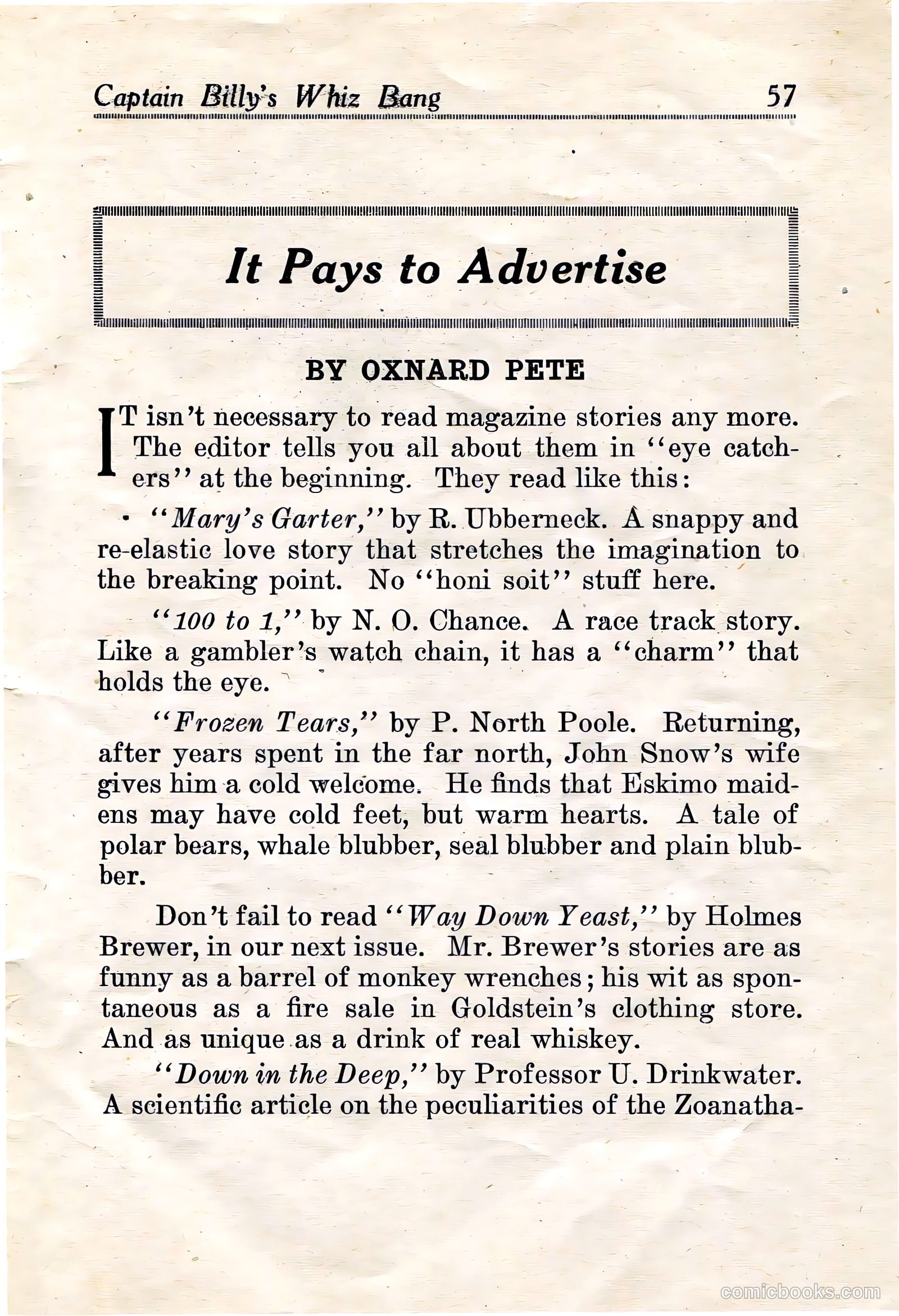
This is satirical commentary on magazine marketing practices. The piece mocks how editors use sensational "eye-catchers"—promotional descriptions—to sell stories without readers actually reading them. The satire works through absurdist author names ("N. O. Chance," "P. North Poole," "U. Drinkwater") and ridiculous plot summaries. For example, "Frozen Tears" promises "whale blubber, seal blubber and plain blubber"—the joke being the description devolves into nonsense. The humor also relies on ethnic stereotypes (the Eskimo maid reference) and contemporary references (fire sales at "Goldstein's clothing store," real whiskey) typical of 1920s American satire. The core joke: magazine editors rely on flashy summaries and marketing rather than actual story quality to attract readers—advertising has replaced substance.
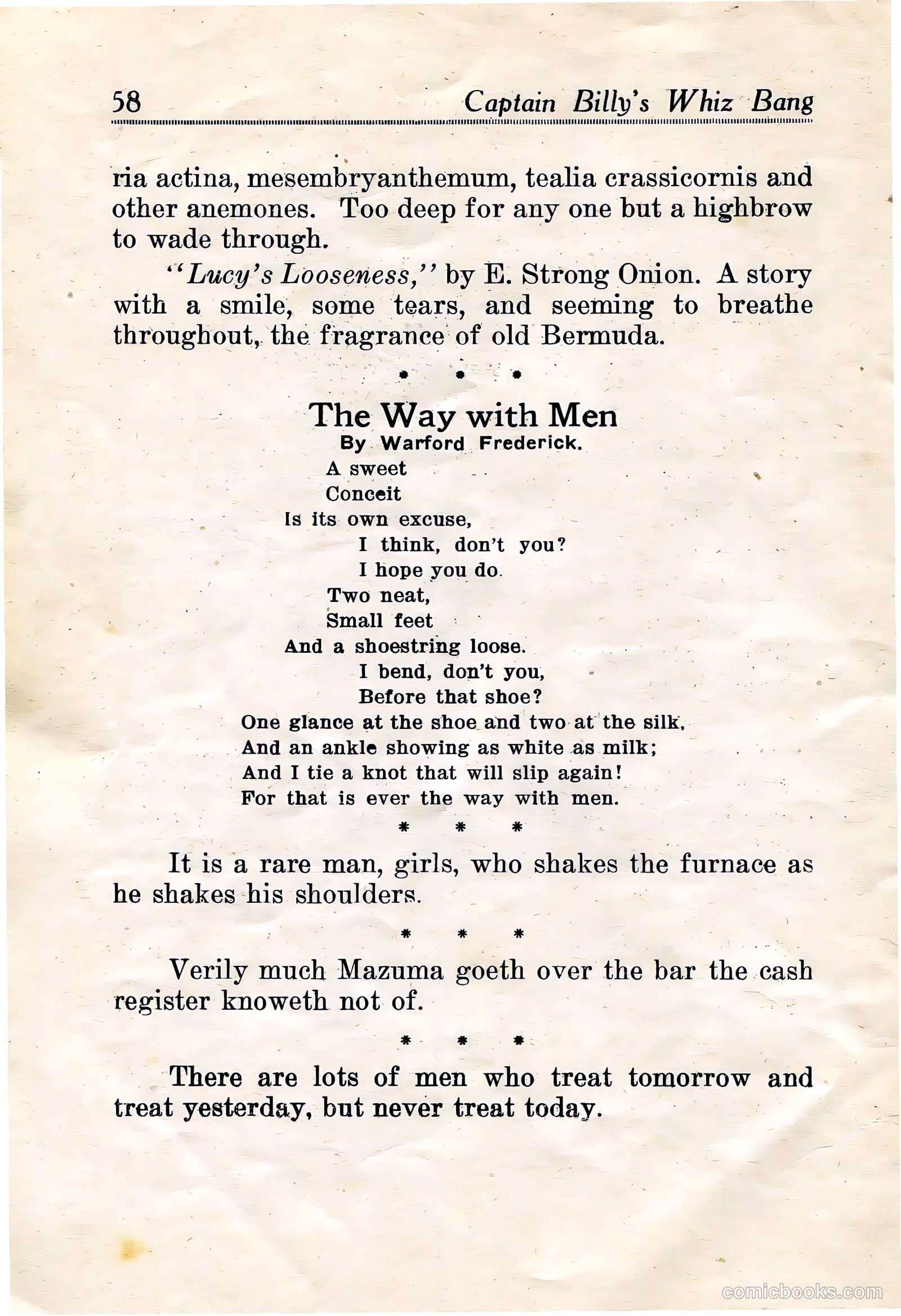
This page from *Captain Billy's Whiz Bang* (a satirical magazine popular in the 1920s) contains humorous observations about male behavior, presented as brief poems and aphorisms. The main piece, "The Way with Men" by Warford Frederick, is a flirtatious poem playing on male distraction and insincerity. It describes a man deliberately untying a woman's shoestring to get her attention—then deliberately re-tying it loose so she'll need to bend down again, allowing him to gaze at her ankle and silk stockings. The punchline: this deceptive behavior is simply "the way with men." The accompanying aphorisms reinforce this theme of male unreliability: men rarely work as hard as they claim; money mysteriously disappears from cash registers; men make promises for other days but never follow through today. The satire mocks masculine dishonesty, laziness, and wandering attention as universal male traits—humor aimed at a mixed audience but likely resonating with female readers frustrated by such behavior.
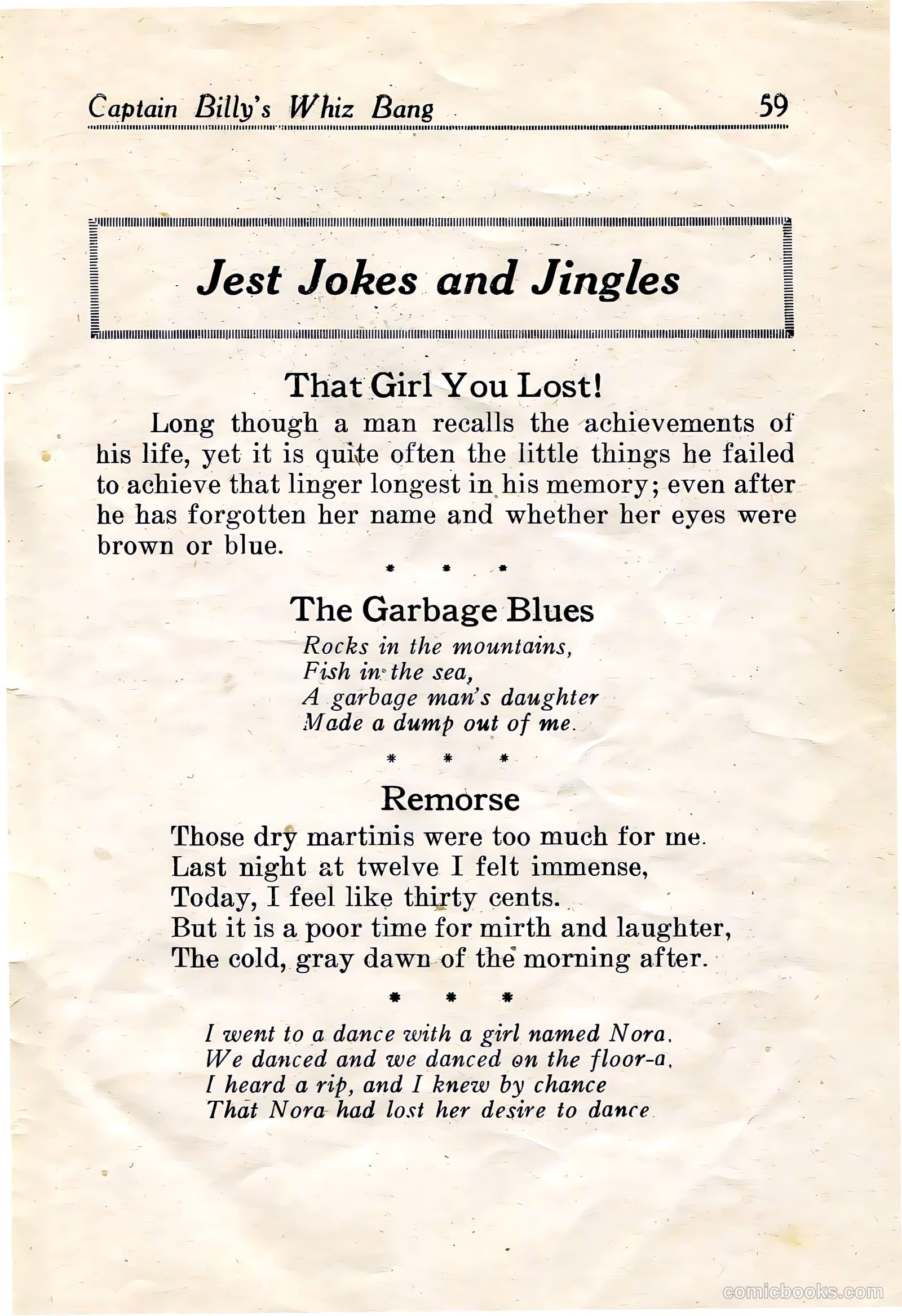
This page from *Captain Billy's Whiz Bang* (a 1920s humor magazine) contains no political cartoons—only humorous poems and jingles about romantic and social embarrassment. The content targets male anxieties of the era: unrequited love ("That Girl You Lost!"), class consciousness ("The Garbage Blues"—mocking a man seduced by a garbage man's daughter), and hangovers ("Remorse"—the "morning after" regret from dry martinis). The final jingle jokes about a wardrobe malfunction at a dance when a woman's clothing tears, causing her to lose interest in dancing. The satire is genteel and domestic rather than political. It reflects 1920s attitudes: mild misogyny (women as conquests), class snobbery, and drinking culture during Prohibition. The humor relied on readers recognizing these social situations and double meanings. Today it reads as quaint period humor about male regret and social awkwardness.
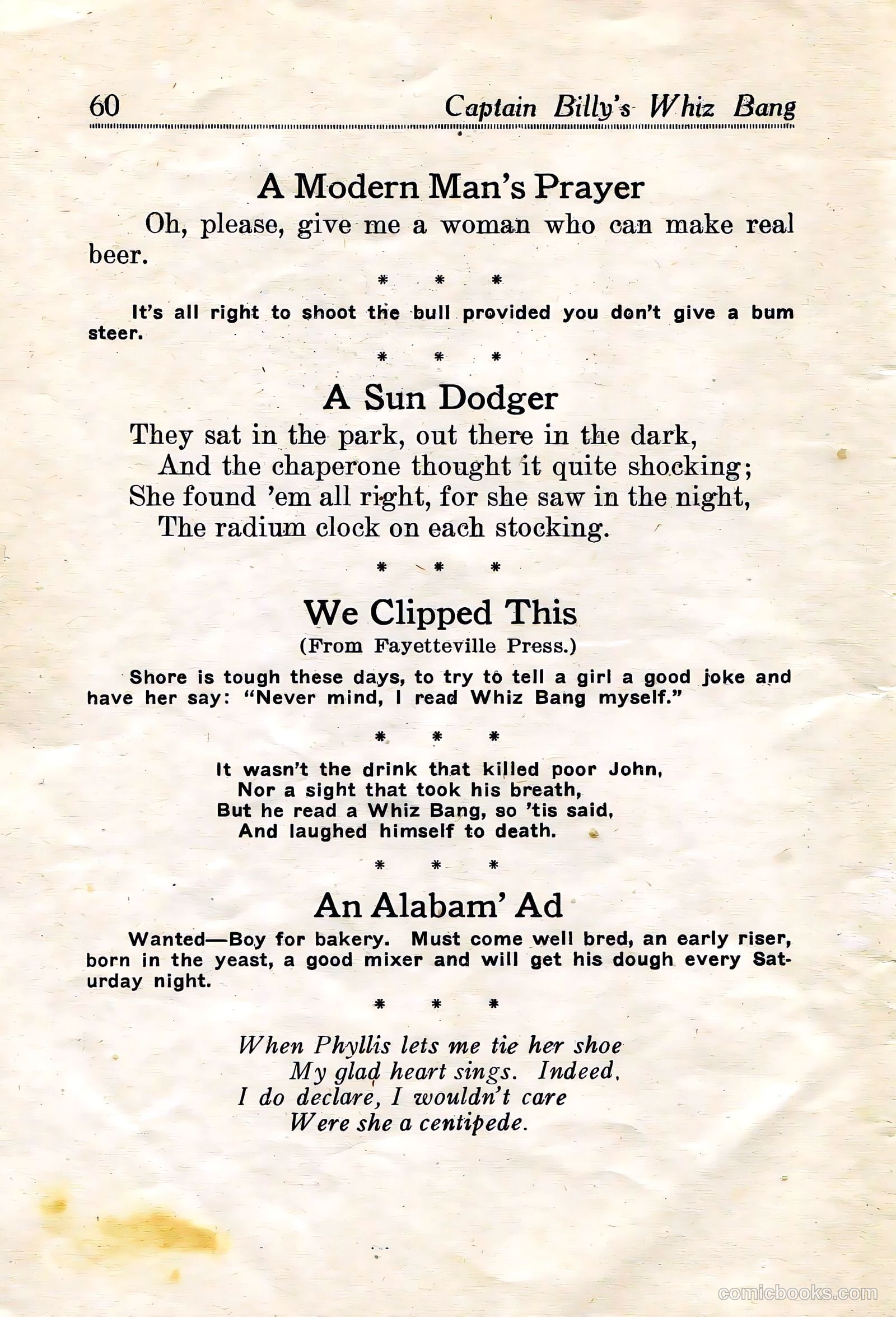
This page collects brief humorous items typical of 1920s satirical magazines. The humor relies on wordplay and risqué innuendo: **"A Sun Dodger"** jokes about young couples necking in parks—the chaperone spots them by the glow of radium-dial watches on their stockings (radium clock faces were common novelties then, emitting visible light). **"An Alabam' Ad"** is a classified ad pun: a bakery seeks a boy "born in the yeast" who's a "good mixer" and will "get his dough"—all double entendres about romance and sex. **"When Phyllis lets me tie her shoe"** uses absurdist exaggeration (not minding if she were a centipede) to express infatuation. The items celebrate Whiz Bang's own comedic brand—the magazine self-promotes by joking that readers now tell its jokes to others. These pieces target adult, urban audiences with sexual humor and puns typical of post-WWI American periodicals.
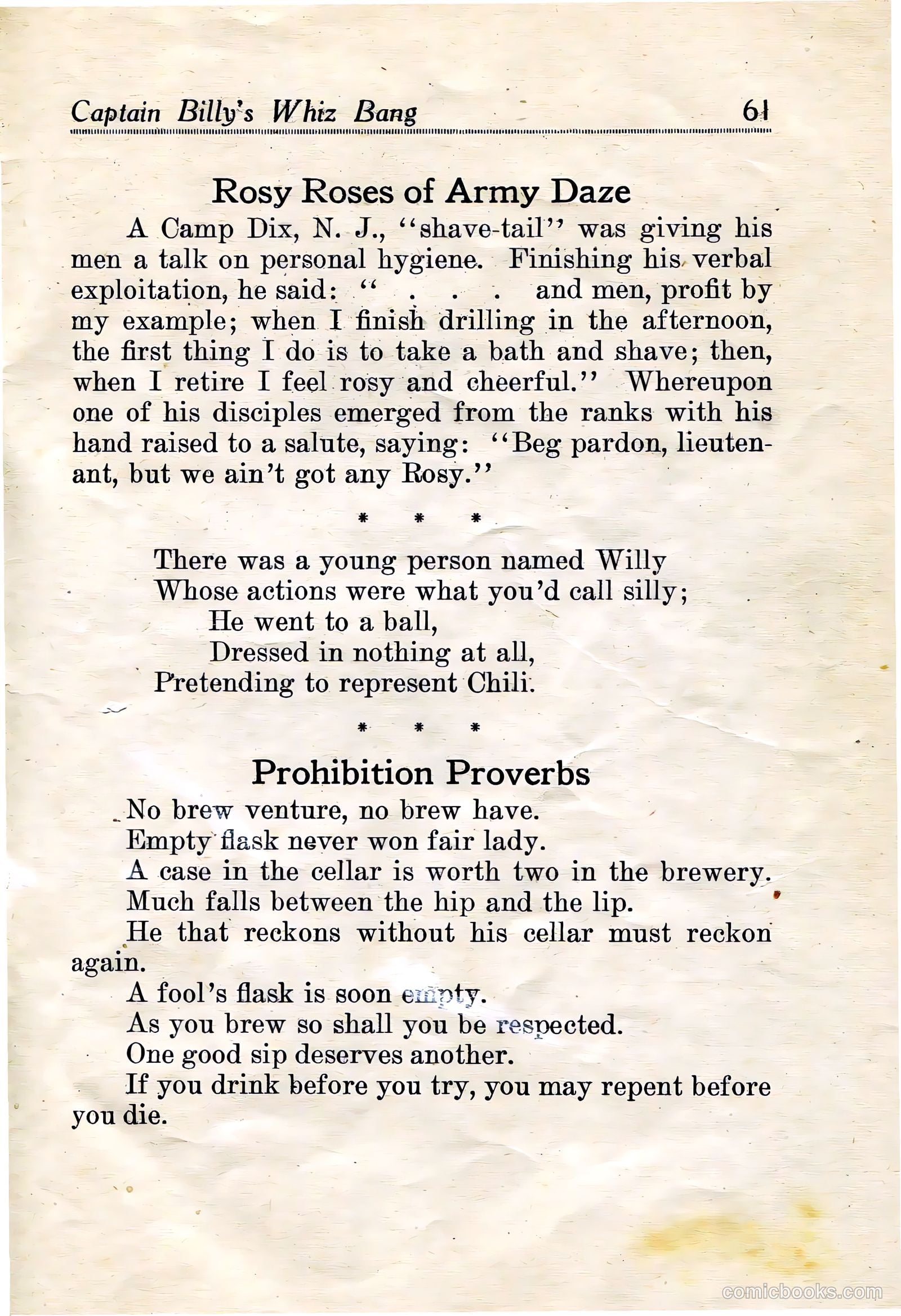
This page from *Captain Billy's Whiz Bang* (a post-WWI humor magazine) contains three satirical pieces: **"Rosy Roses of Army Daze"**: A joke about a junior officer ("shave-tail"—military slang for inexperienced officer) at Camp Dix lecturing troops on hygiene. He claims bathing and shaving make him feel "rosy and cheerful," but a soldier points out they lack "Rosy"—likely referencing a girlfriend or prostitute named Rosy, suggesting soldiers' morale depends on companionship, not hygiene. **Limerick about Willy**: A risqué joke about a nude man at a ball claiming to represent Chile (the country), playing on the phonetic similarity. **"Prohibition Proverbs"**: Parodies of traditional proverbs, all mocking Prohibition (the alcohol ban, 1920-1933). These joke that hiding alcohol ("case in the cellar") and secret drinking are common practices, directly satirizing the law's ineffectiveness and public disregard for it. The page reflects post-war American cynicism about government regulations and military life.
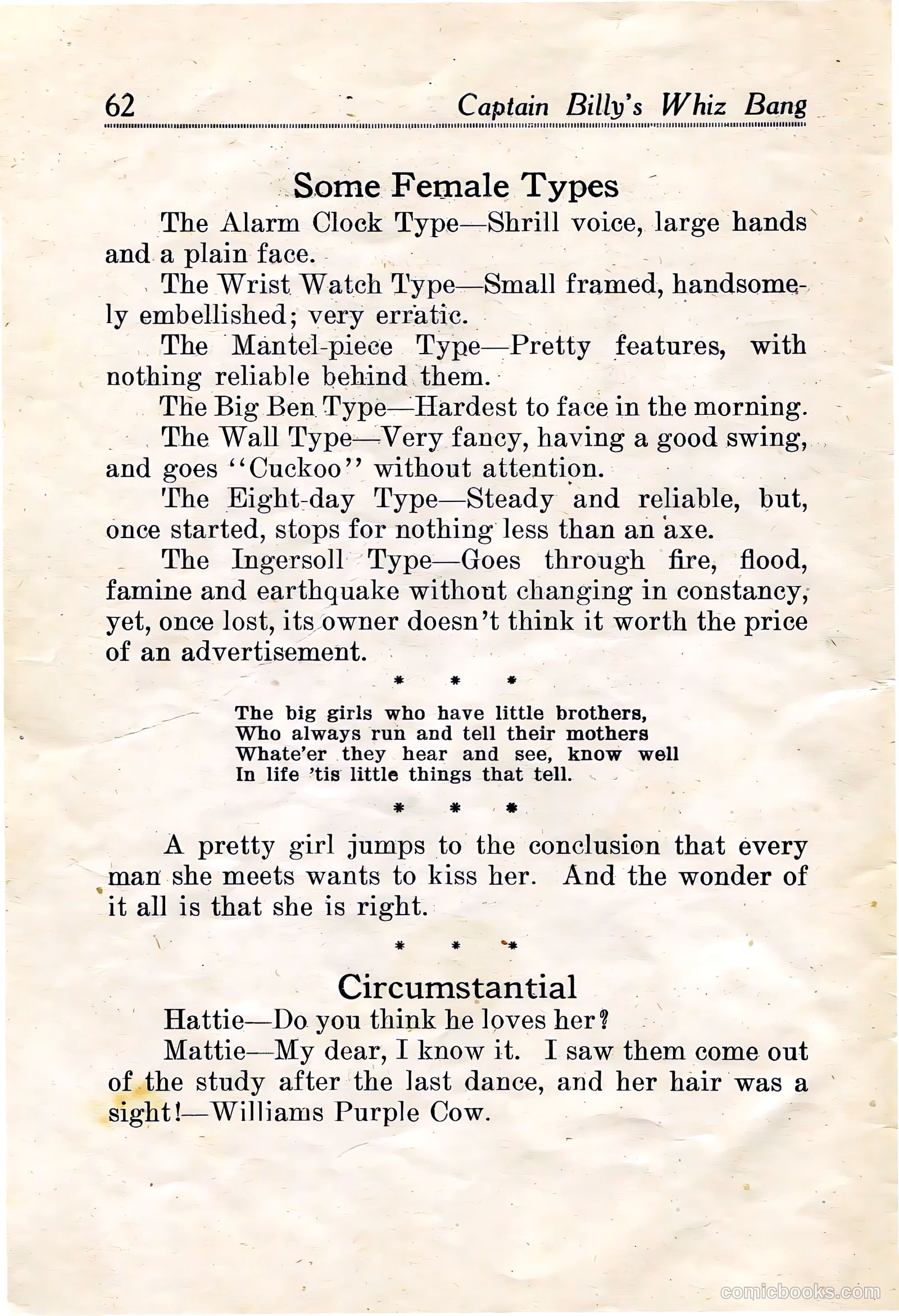
This page from the satirical magazine uses clock and watch brands as metaphors to mock different female personality types. Each comparison is insulting: the "Alarm Clock Type" has a shrill voice and plain face; the "Wrist Watch Type" is beautiful but unreliable; the "Mantel-piece Type" is pretty but shallow. The "Ingersoll Type"—a durable, cheap watch brand—describes a woman so indestructible she survives disasters, yet isn't worth advertising if lost. The subsequent brief jokes mock gossipy women and vanity. The final item, "Circumstantial," presents women as proof of infidelity: Mattie "knows" a man loves a woman because she saw them emerge from a study with the woman's hair disheveled after a dance. Overall, the page reflects early-20th-century misogynistic humor treating women as objects defined by appearance, reliability, and sexual availability—typical of this era's "comic" magazines.
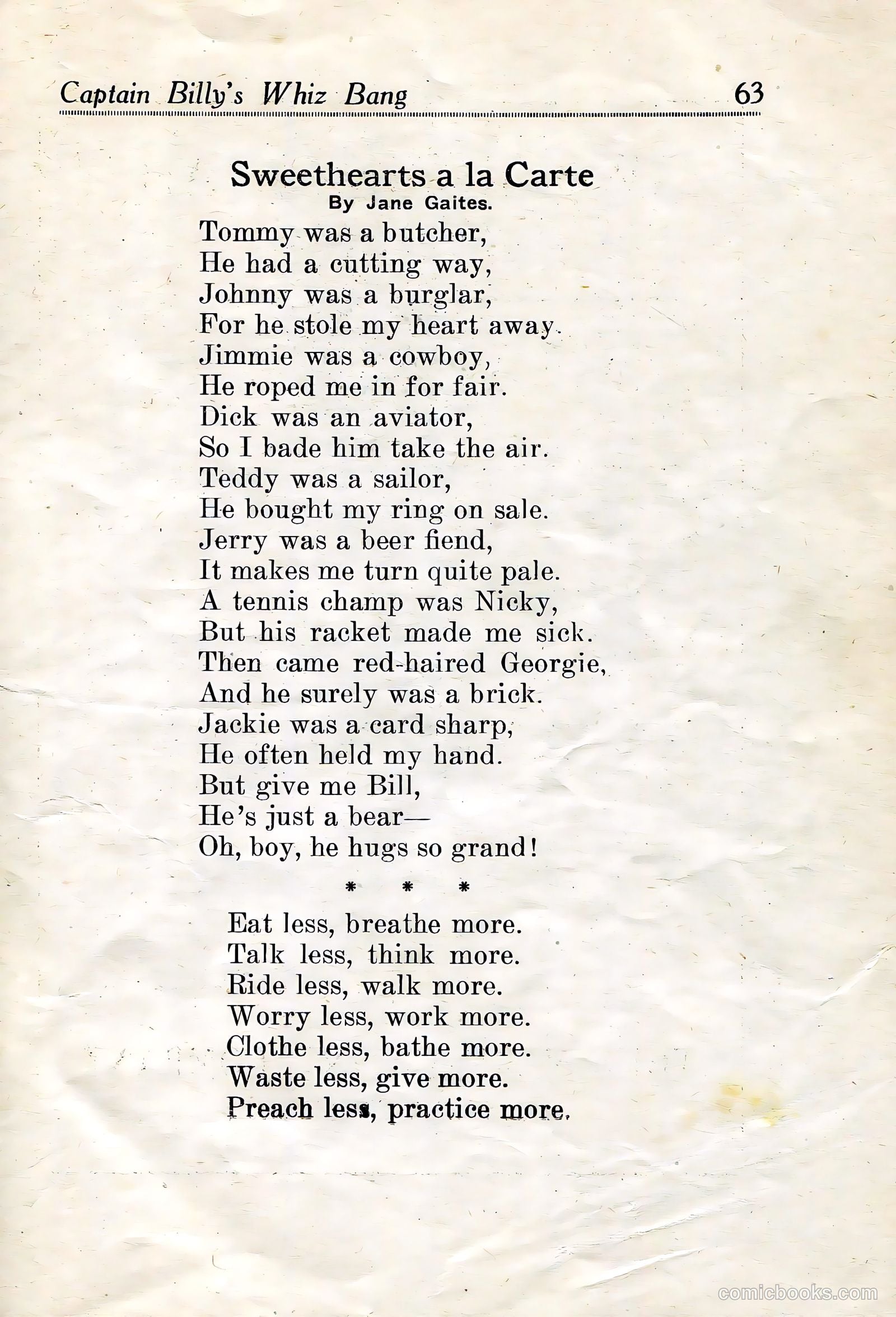
This is a humorous poem by Jane Gaites from *Captain Billy's Whiz Bang*, a satirical magazine popular in the 1920s-30s. The poem catalogs the speaker's romantic history through a series of men defined by their professions or habits—each treated with witty wordplay about why they didn't work out. The joke operates on double meanings: Tommy the butcher has a "cutting way" (rejecting her), Dick the aviator she tells to "take the air" (leave), Teddy the sailor "bought my ring on sale" (cheapskate), and Jerry the "beer fiend" makes her "turn quite pale" (alcoholic concern—relevant during Prohibition era). The punchline favors "Bill, a bear" who "hugs so grand"—he's straightforward and affectionate, contrasting with all the disappointingly complicated professional types. The aphorisms below promote self-improvement, typical of the era's popular wisdom literature. The humor targets romantic disappointments and social pretension through occupational stereotypes common to the period.
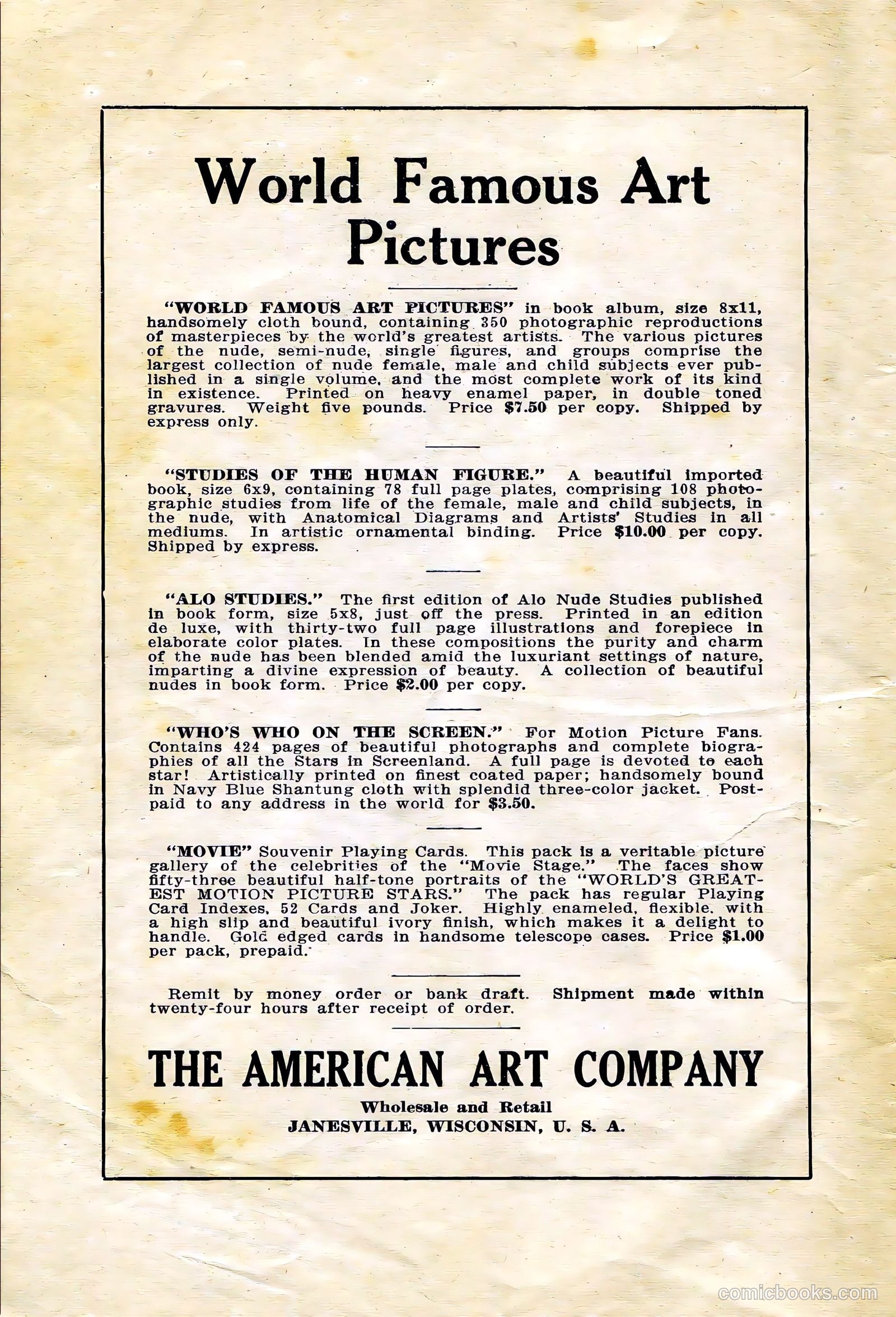
This is an advertising page—not a political cartoon. The American Art Company of Wisconsin is marketing art books and related products, primarily focused on nude figure studies presented as serious artistic instruction and reference materials. The listings emphasize comprehensiveness and educational value. Key offerings include a 350-image collection of masterpieces, anatomical studies of nude subjects (female, male, and child), and high-quality reproductions. There's also a celebrity photo book and movie-star playing cards capitalizing on 1920s-era film industry fascination. The marketing language ("divine expression of beauty," "luxuriant settings") uses fine-art rhetoric to legitimize what may have been perceived as risqué content for the era. The high prices ($7.50-$10) suggest these were marketed as premium, respectable products to serious art students and collectors rather than general consumers.
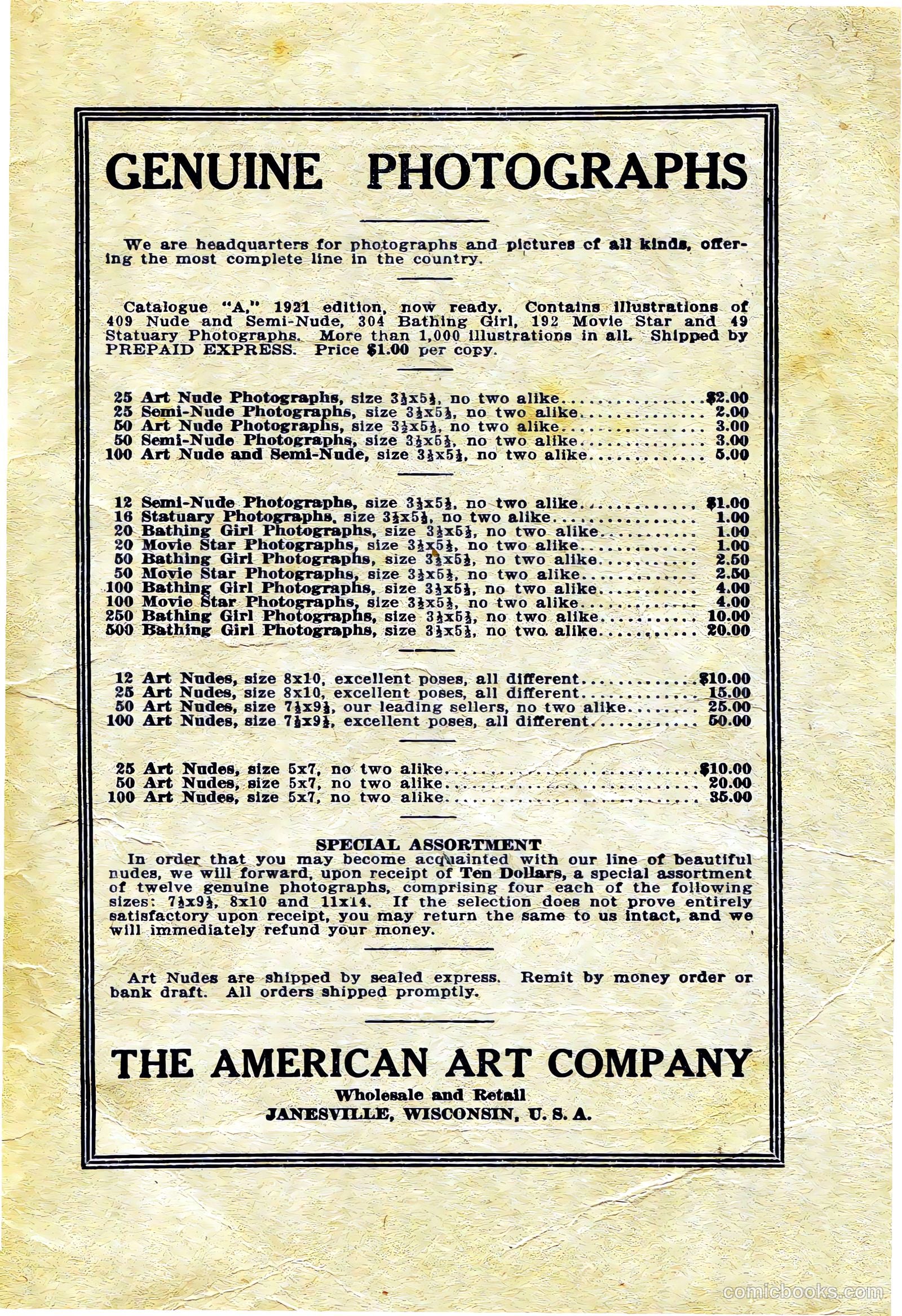
This is not a satirical cartoon page—it's purely **advertising**, specifically a mail-order catalog from The American Art Company in Janesville, Wisconsin, dated 1921. The page advertises "genuine photographs" and "art nudes"—euphemisms for nude and semi-nude photographs of women, sold by mail. The carefully clinical language ("statuary," "excellent poses," "art nudes") masked the explicit nature of the product. Sealed express shipping preserved buyer anonymity. This reflects the early 20th-century photography trade in borderline-obscene material, sold semi-legitimately through catalogs disguised as "art" to evade decency laws. The prominence of "bathing girl" and "movie star" photographs alongside frank nudes shows how entertainment imagery blended with more explicit content for male consumers seeking mail-order erotica.
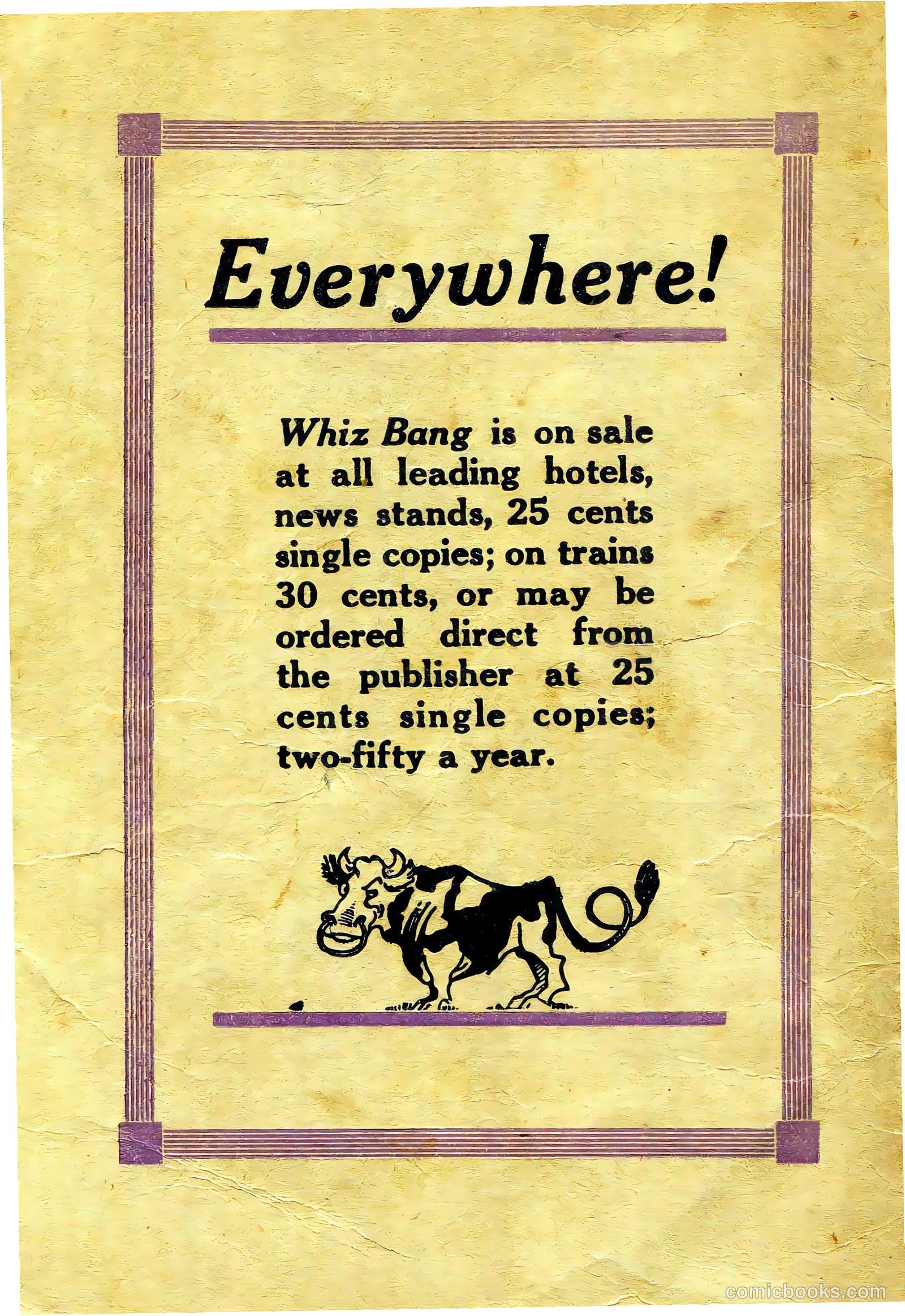
This is a title/advertising page for *Whiz Bang*, an American satirical magazine. The page promotes the publication's availability and pricing across multiple retail channels—hotels, newsstands, and trains—with subscription options. The cartoon features a cow mascot, which appears to be the magazine's logo or recurring character. The cow serves as a visual branding element for *Whiz Bang*, making the advertisement more memorable and distinctive. The page itself isn't satirical commentary; rather, it's a publisher's promotional material designed to reach readers wherever they traveled or shopped. The detailed distribution information and pricing structure suggest *Whiz Bang* was a commercially successful publication with wide circulation during the early-to-mid twentieth century. The cow mascot likely became recognizable to readers as shorthand for the magazine's brand identity.