
Captain Billy's Whiz Bang, June 1921 · page 59 of 67
Captain Billy's Whiz Bang #21 — page 59: what you’re looking at
What you’re looking at
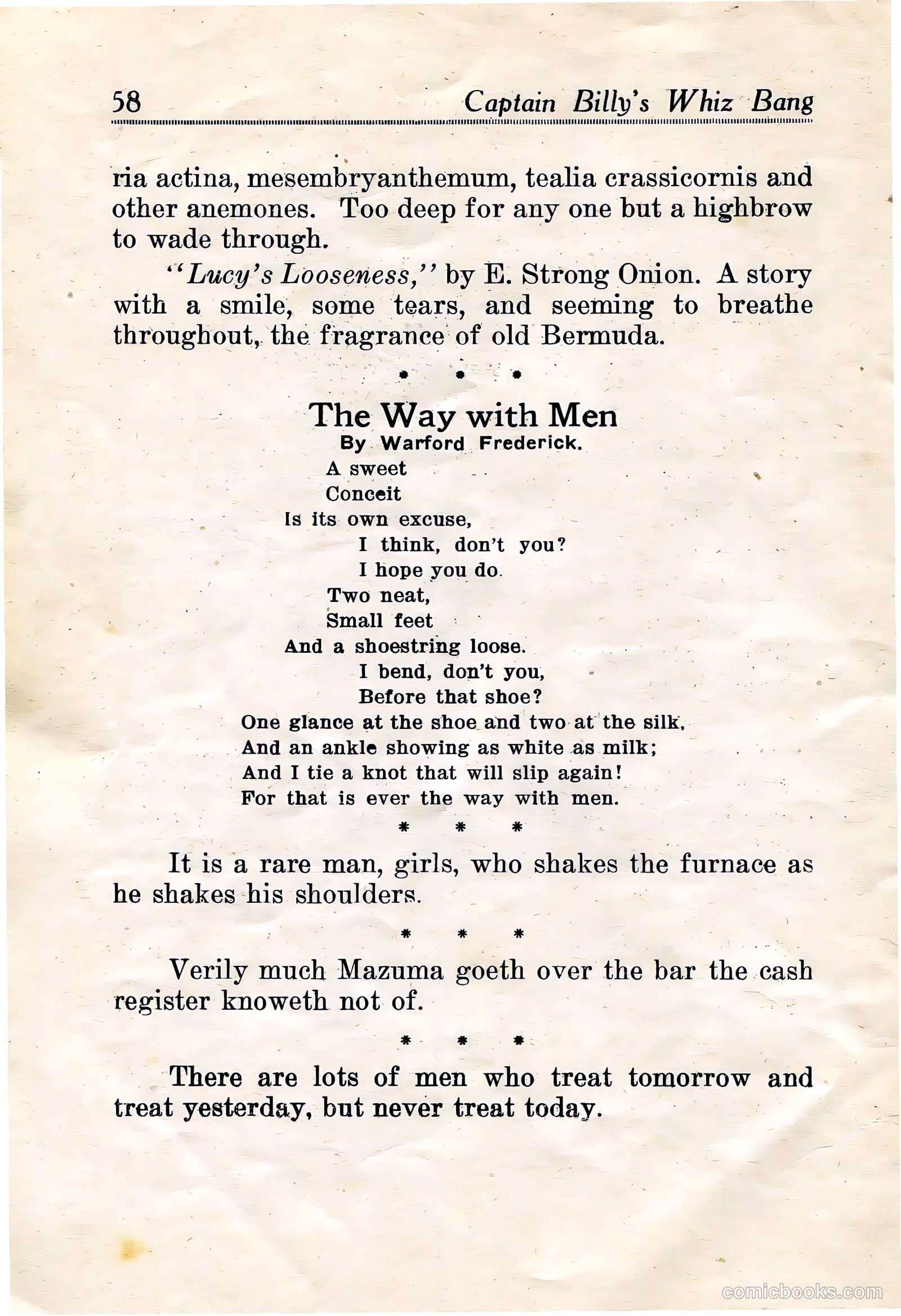
This page from *Captain Billy's Whiz Bang* (a satirical magazine popular in the 1920s) contains humorous observations about male behavior, presented as brief poems and aphorisms. The main piece, "The Way with Men" by Warford Frederick, is a flirtatious poem playing on male distraction and insincerity. It describes a man deliberately untying a woman's shoestring to get her attention—then deliberately re-tying it loose so she'll need to bend down again, allowing him to gaze at her ankle and silk stockings. The punchline: this deceptive behavior is simply "the way with men." The accompanying aphorisms reinforce this theme of male unreliability: men rarely work as hard as they claim; money mysteriously disappears from cash registers; men make promises for other days but never follow through today. The satire mocks masculine dishonesty, laziness, and wandering attention as universal male traits—humor aimed at a mixed audience but likely resonating with female readers frustrated by such behavior.
📄 Transcribed text from this page (OCR, searchable)
Machine-transcribed from the original scan — historical spelling and the odd misread are preserved.
58 Captain Billy's Whiz Bang ria actina, mesembryanthemum, tealia crassicomis and other anemones. Too deep for any one but a highbrow to wade through. “Lucy’s Looseness,” by E. Strong Onion. A story with a smile, some tears, and seeming to breathe throughout, the fragrance of old Bermuda. The Way with Men By Warford Frederick. A sweet Conceit Is its own excuse, I think, don’t you? I hope you do. Two neat, Small feet And a shoestring loose. I bend, don’t you, Before that shoe? One glance at the shoe and two at the silk, And an ankle showing as white as milk; And I tie a knot that will slip again! For that is ever the way with men. * * * It is a rare man, girls, who shakes the furnace as he shakes his shoulders. * * * Verily much Mazuma goeth over the bar the cash register knoweth not of. * * * There are lots of men who treat tomorrow and treat yesterday, but never treat today.