
Captain Billy's Whiz Bang, June 1921 · page 34 of 67
Captain Billy's Whiz Bang #21 — page 34: what you’re looking at
What you’re looking at
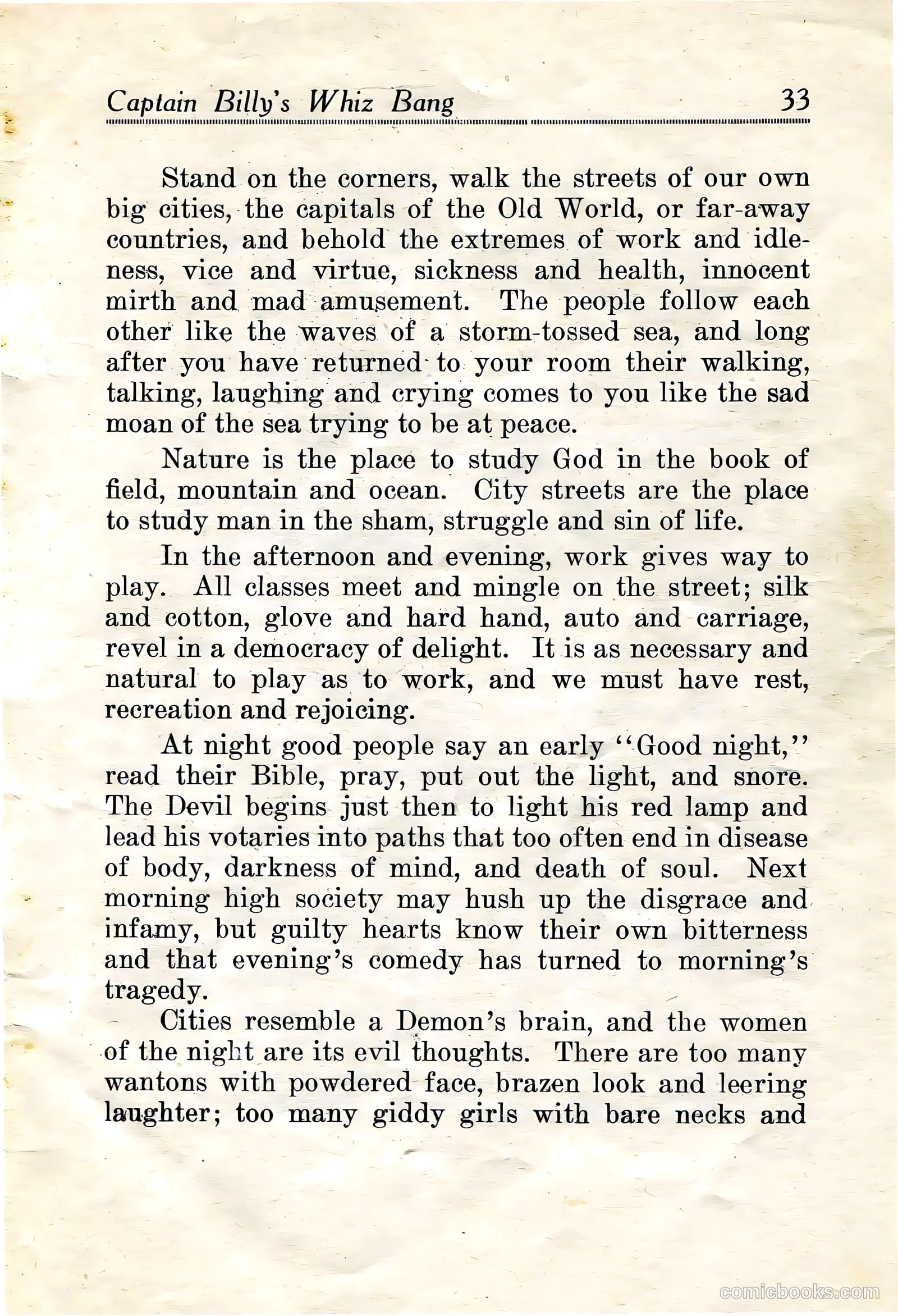
This appears to be a **moralizing editorial essay** rather than a cartoon. The text presents a moralistic critique of urban life, likely from the 1920s-1930s era. The piece contrasts nature (where one studies God) with cities (where one studies human "sham, struggle and sin"). It acknowledges that recreation and play are necessary, but pivots sharply to condemn nighttime urban behavior—particularly women. The author warns that after respectable people retire, "the Devil" leads others into vice causing "disease of body, darkness of mind, and death of soul." The final passage explicitly attacks sex workers and "giddy girls," calling cities a "Demon's brain" and such women "evil thoughts." **Context**: This reflects conservative, religious anxiety about urbanization, changing social mores (particularly regarding women's appearance and freedom), and moral panic around nightlife—typical of early-20th-century moralist publications.
📄 Transcribed text from this page (OCR, searchable)
Machine-transcribed from the original scan — historical spelling and the odd misread are preserved.
Captain Billy's Whiz Bang 33 Stand on the corners, walk the streets of our own big cities, the capitals of the Old World, or far-away countries, and behold the extremes of work and idle- ness, vice and virtue, sickness and health, innocent mirth and mad amusement. The people follow each other like the waves of a storm-tossed sea, and long after you have returned to your room their walking, talking, laughing and crying comes to you like the sad moan of the sea trying to be at peace. Nature is the place to study God in the book of field, mountain and ocean. City streets are the place to study man in the sham, struggle and sin of life. In the afternoon and evening, work gives way to play. All classes meet and mingle on the street; silk and cotton, glove and hard hand, auto and carriage, revel in a democracy of delight. It is as necessary and natural to play as to work, and we must have rest, recreation and rejoicing. At night good people say an early “Good night,” read their Bible, pray, put out the light, and snore. The Devil begins just then to light his red lamp and lead his votaries into paths that too often end in disease of body, darkness of mind, and death of soul. Next morning high society may hush up the disgrace and infamy, but guilty hearts know their own bitterness and that evening’s comedy has turned to morning’s tragedy. Cities resemble a Demon’s brain, and the women of the night are its evil thoughts. There are too many wantons with powdered face, brazen look and leering laughter; too many giddy girls with bare necks and