
Captain Billy's Whiz Bang, June 1921 · page 47 of 67
Captain Billy's Whiz Bang #21 — page 47: what you’re looking at
What you’re looking at
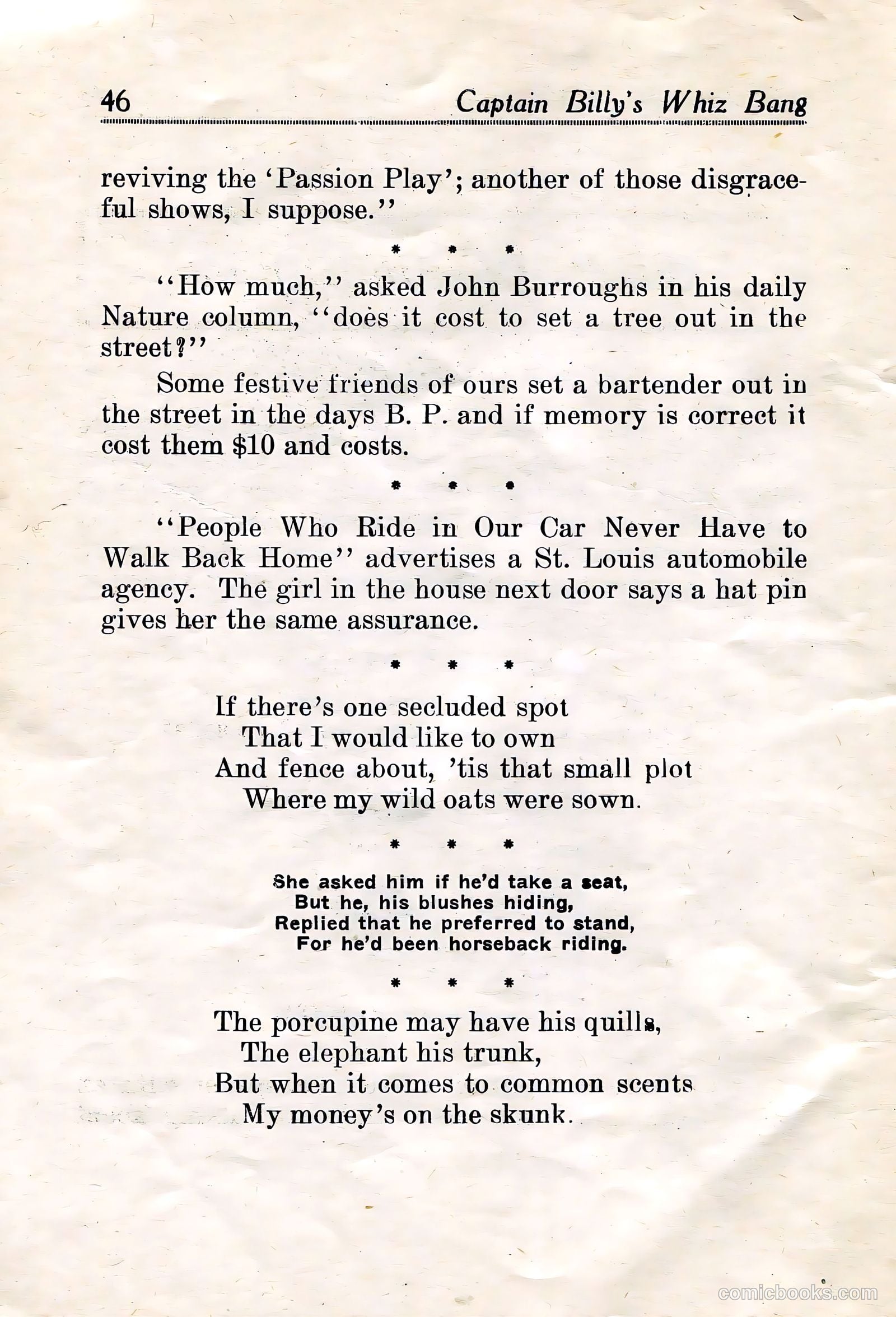
This page from the satirical magazine collects various short humorous observations and light verse. The jokes target early 20th-century social pretensions and concerns: **Main themes:** - A jab at religious theater (the "Passion Play") - A quip about street tree-planting costs, referencing naturalist John Burroughs - A joke about forcibly ejecting a bartender (likely Prohibition-era humor about removing drunk people) - An automobile advertisement parodied by a joke about hat pins as self-defense weapons for women - Sentimental verse about youthful indiscretion - A crude double-entendre about horseback riding causing soreness - A final pun comparing animal characteristics, culminating in a skunk-scent joke The humor is mild, mostly relying on wordplay and innuendo rather than sharp political satire. **Whiz Bang** was known for this accessible, somewhat risqué but family-friendly comedy format popular in the 1920s.
📄 Transcribed text from this page (OCR, searchable)
Machine-transcribed from the original scan — historical spelling and the odd misread are preserved.
46 Captain Billy’s Whiz Bang reviving the ‘Passion Play’; another of those disgrace- ful shows, I suppose.” “How much,” asked John Burroughs in his daily Nature column, “does it cost to set a tree out in the street?” Some festive friends of ours set a bartender out in the street in the days B. P. and if memory is correct it cost them $10 and costs. “People Who Ride in Our Car Never Have to Walk Back Home” advertises a St. Louis automobile agency. The girl in the house next door says a hat pin gives her the same assurance. If there’s one secluded spot That I would like to own And fence about, ’tis that small plot Where my wild oats were sown. She asked him if he’d take a seat, But he, his blushes hiding, Replied that he preferred to stand, For he’d been horseback riding. The porcupine may have his quills, The elephant his trunk, But when it comes to common scents My money’s on the skunk.