
Captain Billy's Whiz Bang, June 1921 · page 35 of 67
Captain Billy's Whiz Bang #21 — page 35: what you’re looking at
What you’re looking at
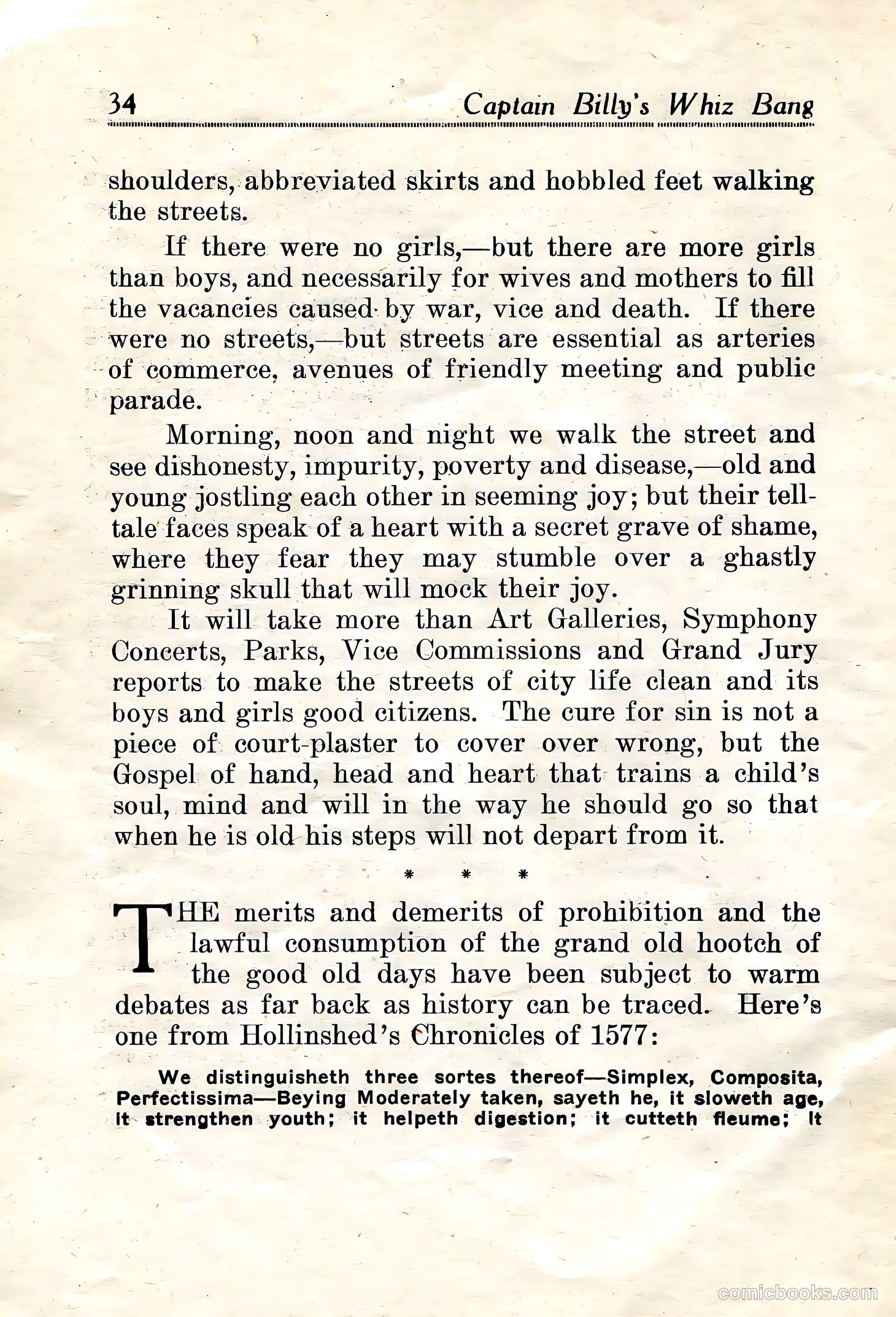
This page from *Captain Billy's Whiz Bang* (a WWI-era satirical magazine) contains a moralistic editorial essay, not a cartoon. The text criticizes urban street life, describing poverty, disease, and moral decay. It argues that institutional solutions—Art Galleries, Parks, Vice Commissions—are insufficient; instead, religious moral training ("Gospel of hand, head and heart") is needed to reform society. The final section introduces a historical debate about alcohol prohibition by quoting Hollinshed's *Chronicles* (1577), which categorizes drinks and claims moderate consumption has health benefits—slowing age, strengthening youth, aiding digestion. This appears to be setting up an ironic contrast: the passage was written before prohibition was enacted (1920), suggesting the author is sarcastically presenting historical "evidence" that alcohol consumption was once considered beneficial, perhaps to mock contemporary prohibition advocates or the debate surrounding it.
📄 Transcribed text from this page (OCR, searchable)
Machine-transcribed from the original scan — historical spelling and the odd misread are preserved.
34 Captain Billy's Whiz Bang shoulders, abbreviated skirts and hobbled feet walking the streets. If there were no girls,—but there are more girls than boys, and necessarily for wives and mothers to fill the vacancies caused by war, vice and death. If there were no streets,—but streets are essential as arteries of commerce, avenues of friendly meeting and public parade. Morning, noon and night we walk the street and see dishonesty, impurity, poverty and disease,—old and young jostling each other in seeming joy; but their tell- tale faces speak of a heart with a secret grave of shame, where they fear they may stumble over a ghastly grinning skull that will mock their joy. It will take more than Art Galleries, Symphony Concerts, Parks, Vice Commissions and Grand Jury reports to make the streets of city life clean and its boys and girls good citizens. The cure for sin is not a piece of court-plaster to cover over wrong, but the Gospel of hand, head and heart that trains a child's soul, mind and will in the way he should go so that when he is old his steps will not depart from it. * * * THE merits and demerits of prohibition and the lawful consumption of the grand old hootch of the good old days have been subject to warm debates as far back as history can be traced. Here's one from Hollinshed's Chronicles of 1577: We distinguisheth three sortes thereof—Simplex, Composita, Perfectissima—Beying Moderately taken, sayeth he, it sloweth age, It strengthen youth; it helpeth digestion; it cutteth fleume; It