
Captain Billy's Whiz Bang, June 1921 · page 33 of 67
Captain Billy's Whiz Bang #21 — page 33: what you’re looking at
What you’re looking at
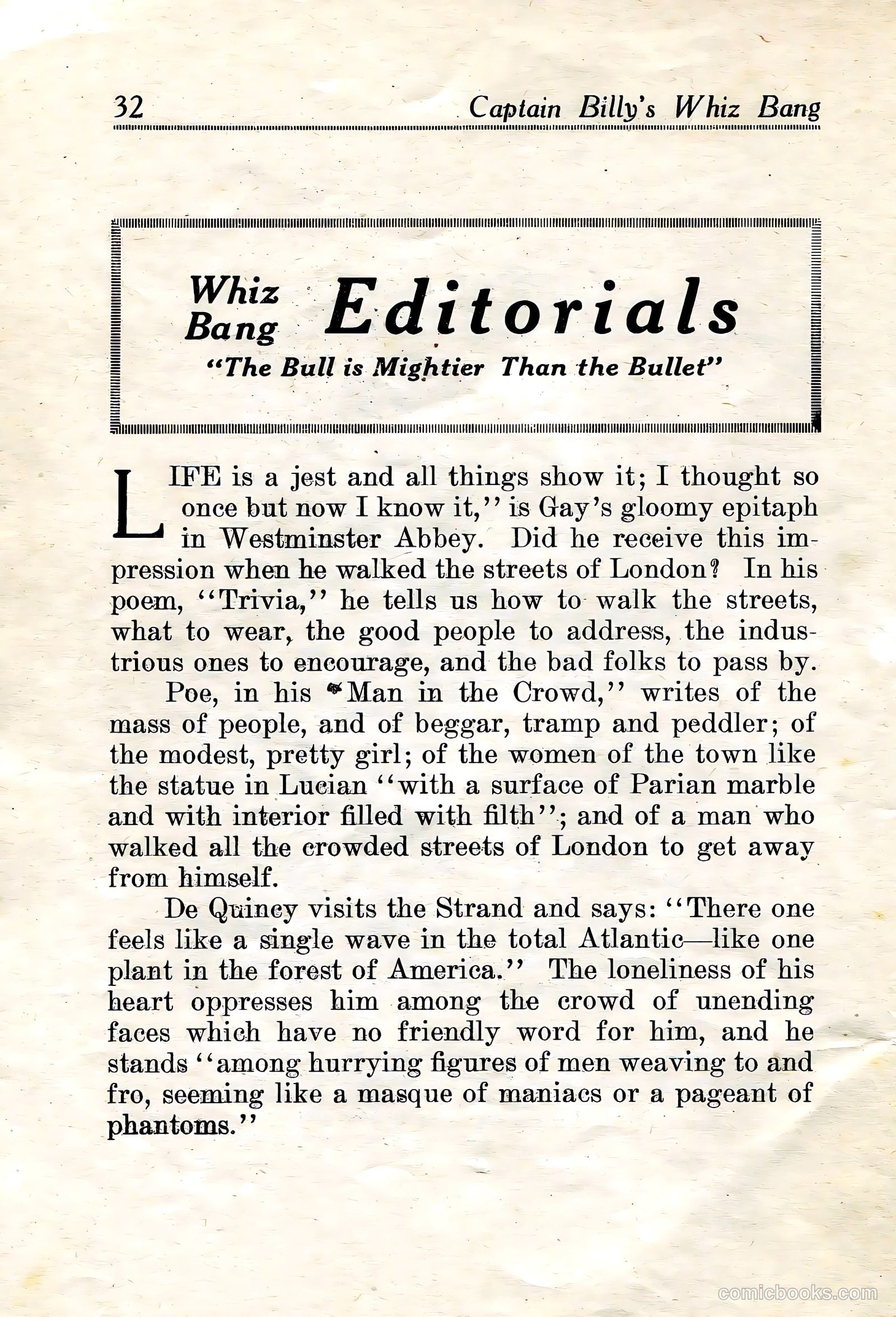
This is an **editorial essay**, not a cartoon. It discusses the psychological alienation of urban life through literary references. The piece compares how classic writers (Gay, Poe, De Quincy) portrayed **London street crowds** as sources of profound loneliness despite being surrounded by masses of people. The editorial uses literary quotations to argue that city life creates emotional isolation—people feel like "a single wave in the total Atlantic" or "one plant in the forest of America." The satire targets the **paradox of urban anonymity**: crowds don't create community but rather intensify personal disconnection. The references to "women of the town" and "hurrying figures seeming like maniacs" suggest Victorian anxieties about urban vice and moral decay. The editorial's title—"The Bull is Mightier Than the Bullet"—remains unclear from this page alone, though it likely critiques some contemporary social problem through ironic understatement.
📄 Transcribed text from this page (OCR, searchable)
Machine-transcribed from the original scan — historical spelling and the odd misread are preserved.
32 Captain Billy's Whiz Bang Whiz Bang Editorials “The Bull is Mightier Than the Bullet” LIFE is a jest and all things show it; I thought so once but now I know it,” is Gay’s gloomy epitaph in Westminster Abbey. Did he receive this impression when he walked the streets of London? In his poem, “Trivia,” he tells us how to walk the streets, what to wear, the good people to address, the industrious ones to encourage, and the bad folks to pass by. Poe, in his “Man in the Crowd,” writes of the mass of people, and of beggar, tramp and peddler; of the modest, pretty girl; of the women of the town like the statue in Lucian “with a surface of Parian marble and with interior filled with filth”; and of a man who walked all the crowded streets of London to get away from himself. De Quincy visits the Strand and says: “There one feels like a single wave in the total Atlantic—like one plant in the forest of America.” The loneliness of his heart oppresses him among the crowd of unending faces which have no friendly word for him, and he stands “among hurrying figures of men weaving to and fro, seeming like a masque of maniacs or a pageant of phantoms.”