
Captain Billy's Whiz Bang, June 1921 · page 53 of 67
Captain Billy's Whiz Bang #21 — page 53: what you’re looking at
What you’re looking at
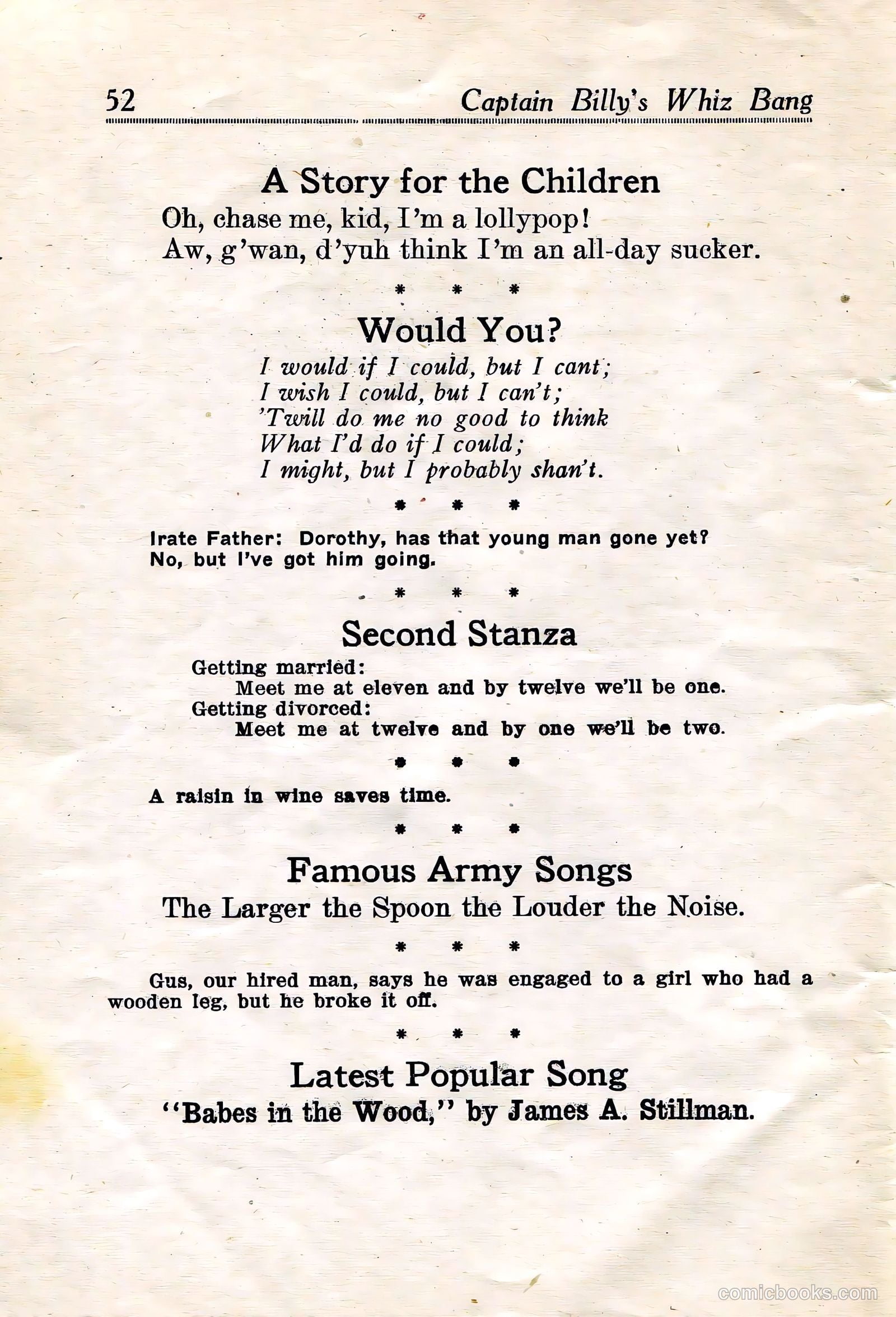
This page from *Captain Billy's Whiz Bang* (a 1920s-era humor magazine) contains brief jokes and quips typical of that era's bawdy, irreverent style: **Main content**: Short jokes about courtship and marriage, playing on double meanings. The "lollypop/all-day sucker" opener uses candy as innuendo. The "irate father" joke implies a young couple engaging in sexual activity ("got him going"). The "getting married/divorced" couplet makes a crude pun—becoming "one" vs. "two" persons through sex. **Army references** appear to be WWI-era soldier humor, though their exact meaning is unclear without more context. **The "wooden leg" joke** is a pun: "broke it off" means both ended the engagement and literally broke her prosthetic limb. The magazine's approach was deliberately irreverent and sexually suggestive—shocking for mainstream 1920s publication. This represents humor targeting young soldiers and urban audiences who enjoyed frank, cheeky content that challenged Victorian propriety.
📄 Transcribed text from this page (OCR, searchable)
Machine-transcribed from the original scan — historical spelling and the odd misread are preserved.
52 Captain Billy's Whiz Bang A Story for the Children Oh, chase me, kid, I'm a lollypop! Aw, g'wan, d'yuh think I'm an all-day sucker. * * * Would You? I would if I could, but I can't; I wish I could, but I can't; 'Twill do me no good to think What I'd do if I could; I might, but I probably shan't. * * * Irate Father: Dorothy, has that young man gone yet? No, but I've got him going. * * * Second Stanza Getting married: Meet me at eleven and by twelve we'll be one. Getting divorced: Meet me at twelve and by one we'll be two. * * * A raisin in wine saves time. * * * Famous Army Songs The Larger the Spoon the Louder the Noise. * * * Gus, our hired man, says he was engaged to a girl who had a wooden leg, but he broke it off. * * * Latest Popular Song “Babes in the Wood,” by James A. Stillman.