A complete issue · 116 pages · 1938
10-Story Detective Magazine Cover
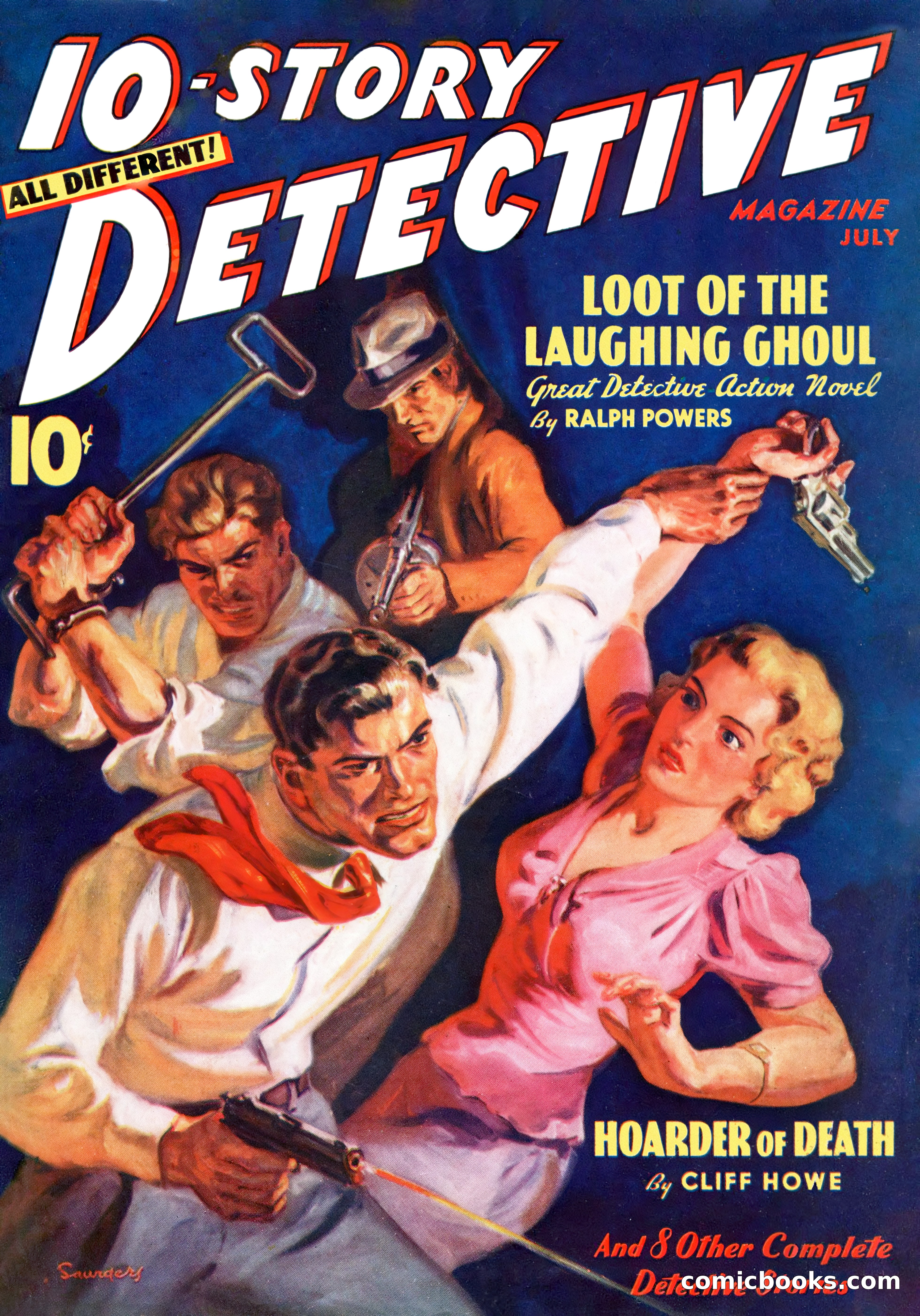
This is the cover of a 10-Story Detective Magazine from July, priced at 10 cents. The cover features dramatic artwork depicting what appears to be an action scene with multiple figures engaged in conflict. The main featured story is "Loot of the Laughing Ghoul," credited as a "Great Detective Action Novel by Ralph Powers." A second story advertised is "Hoarder of Death" by Cliff Howe. The cover promises "And 8 Other Complete Detective" stories. The artwork uses typical pulp-magazine styling with vivid colors and dynamic poses to convey danger and excitement, characteristic of early-20th-century detective fiction marketing.
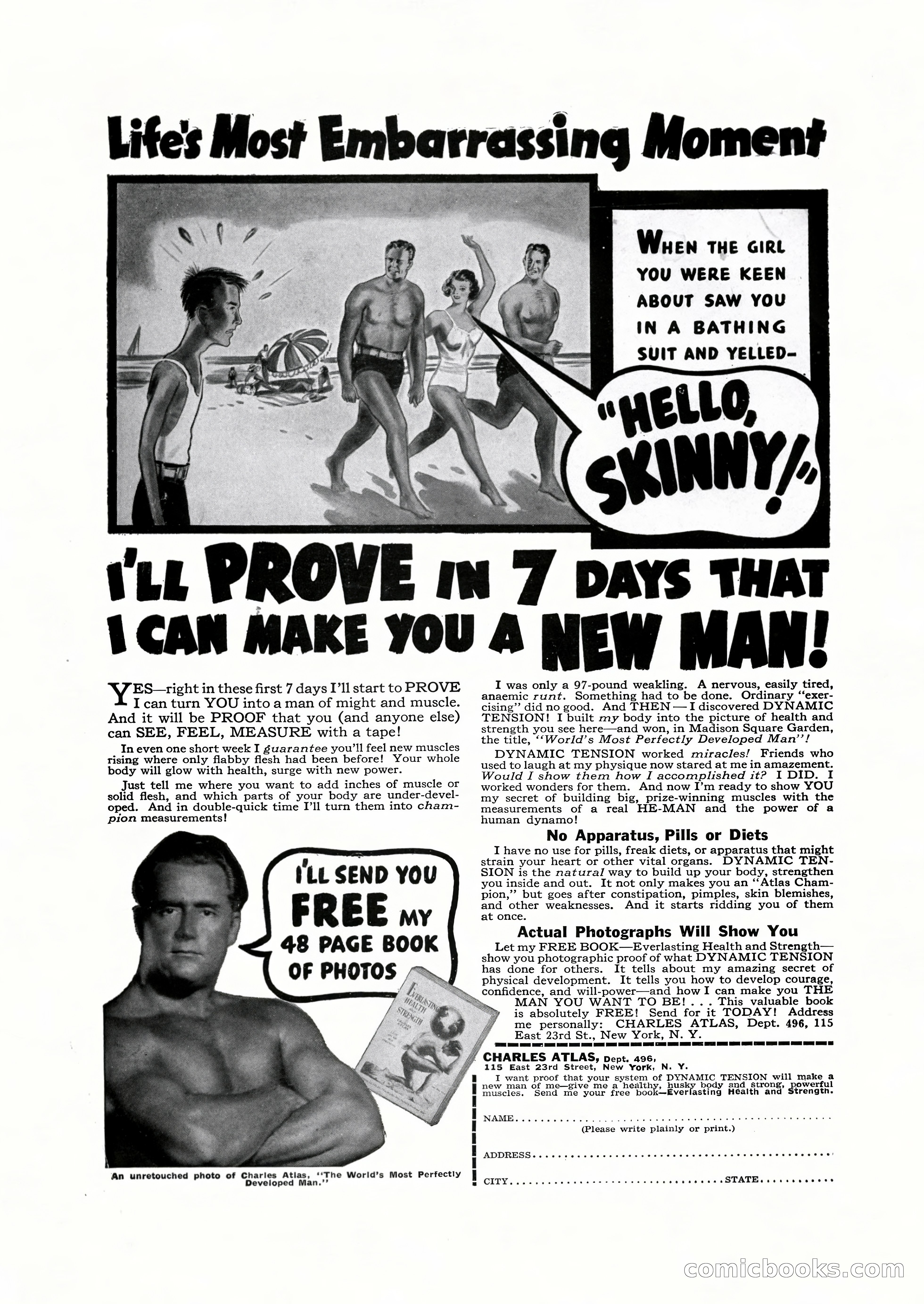
# Analysis of This Page This is an **advertisement page** from an early-20th-century pulp magazine. The page features a comic strip illustration at the top depicting an embarrassing beach encounter, followed by a lengthy promotional ad for Charles Atlas's "Dynamic Tension" bodybuilding system. The ad promises to transform a 97-pound weakling into a muscular man in seven days through isometric exercises, offering a free 48-page photo book as an incentive. A coupon at the bottom allows readers to request the free materials. The page combines entertainment (the comic premise) with mail-order advertising typical of pulp magazines.
This page is primarily an advertisement for International Correspondence Schools (ICS), a correspondence education program based in Scranton, Pennsylvania. At the top is a testimonial from a man describing how an ICS advertisement offered him hope during financial hardship, claiming that after mailing a coupon two years prior, he became a "trained man" earning better pay. Below is an extensive coupon listing dozens of technical, industrial, business, and domestic science courses available through the program, with checkboxes for prospective students to select their subject of interest. The advertisement appears designed to encourage magazine readers to mail in the coupon requesting course information.
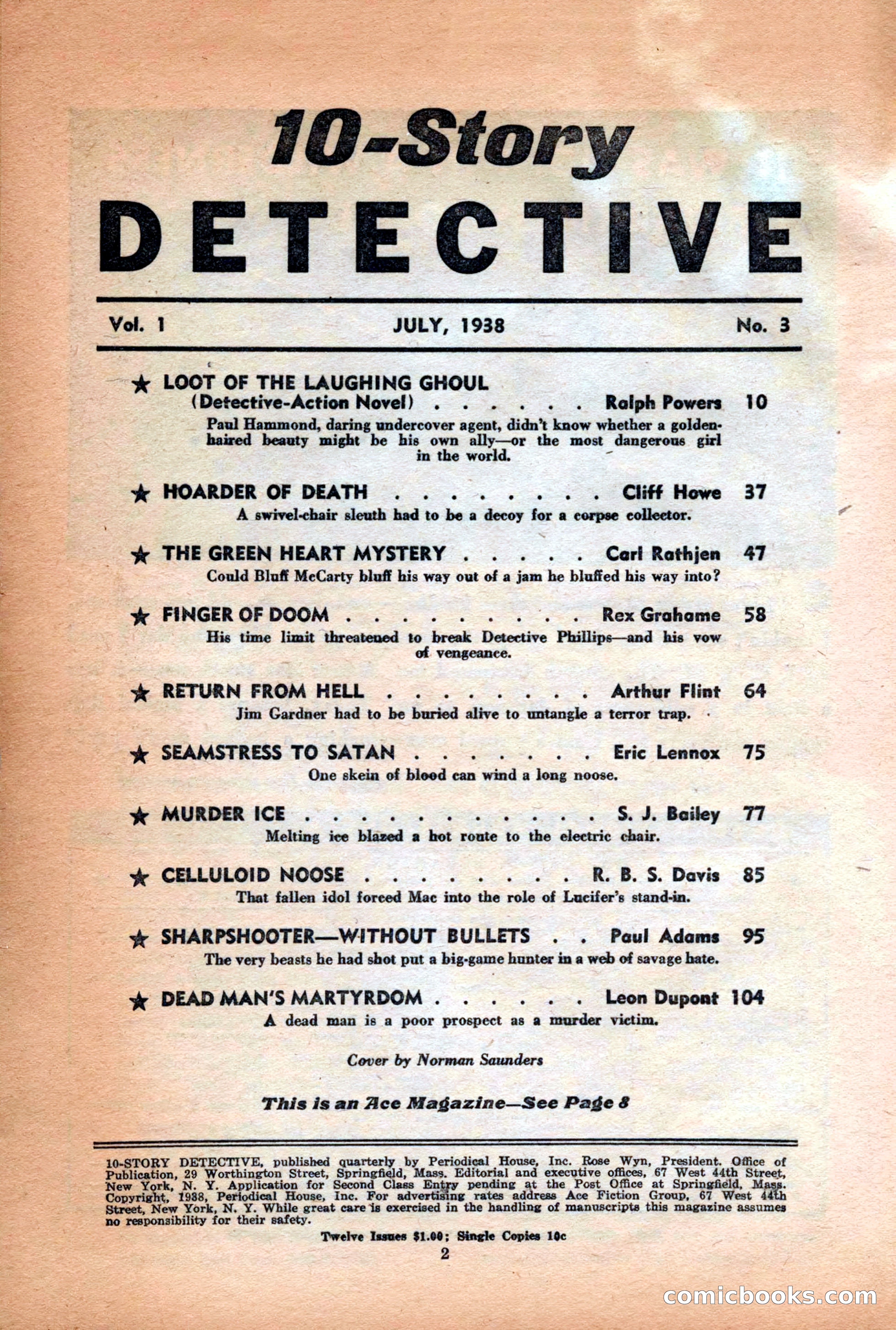
This is a table of contents page from *10-Story Detective*, Vol. 1, No. 3 (July 1938), an Ace Magazine pulp publication. The page lists ten detective and crime stories by various authors, including "Loot of the Laughing Ghoul" by Ralph Powers and "Dead Man's Martyrdom" by Leon Dupont, with brief plot summaries and page numbers for each. The masthead indicates the magazine was published quarterly by Periodical House, Inc., with editorial offices in New York, and cost ten cents per issue.
# Advertisement Page Analysis This is a full-page advertisement from a pulp magazine, dominated by a comic strip sequence at the top depicting men dismissing a young person's job prospects, followed by a large pitch from the National Radio Institute offering home training in radio repair and installation work. The ad promises earnings of $30-$75 weekly for spare-time radio servicing, with full-time positions paying up to $6,000 annually. It emphasizes practical training, includes a mailed equipment kit, and features a mail-in coupon for a free 64-page booklet titled "High Rewards in Radio." The text appears designed to appeal to Depression-era or post-Depression readers seeking income opportunities, presenting radio technician work as an accessible career path requiring no prior experience.
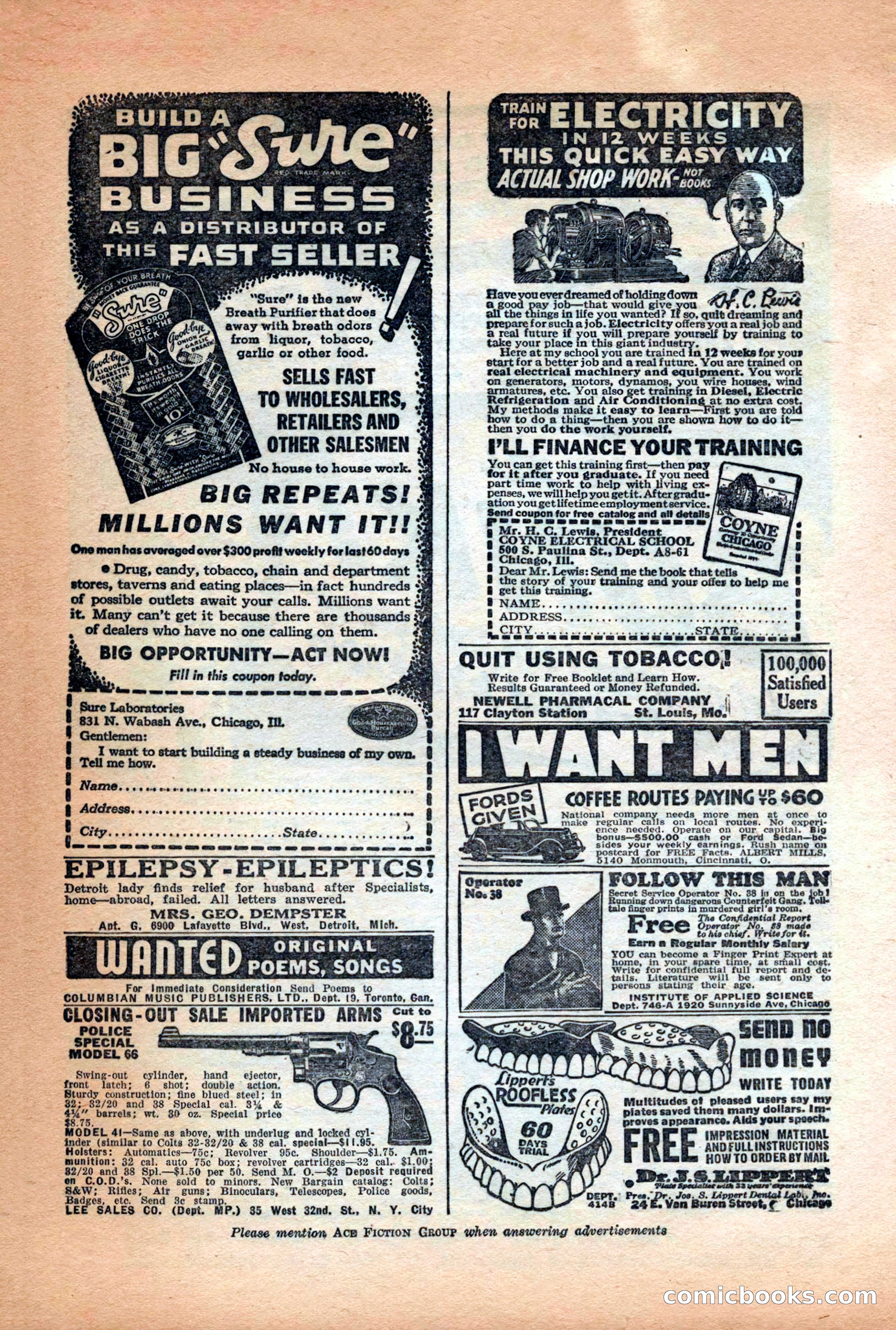
# This is an advertising page from a pulp magazine This page is entirely composed of classified advertisements and mail-order offers typical of early-20th-century pulp magazines. Visible ads include: a breath purifier distributor opportunity, an epilepsy treatment, a poetry submission service, imported firearms for sale, an electricity training school promising employment, a tobacco-cessation product, and various other mail-order business schemes. The layout and typography are characteristic of pulp-era classified sections designed to appeal to readers seeking quick money-making opportunities or self-improvement courses.
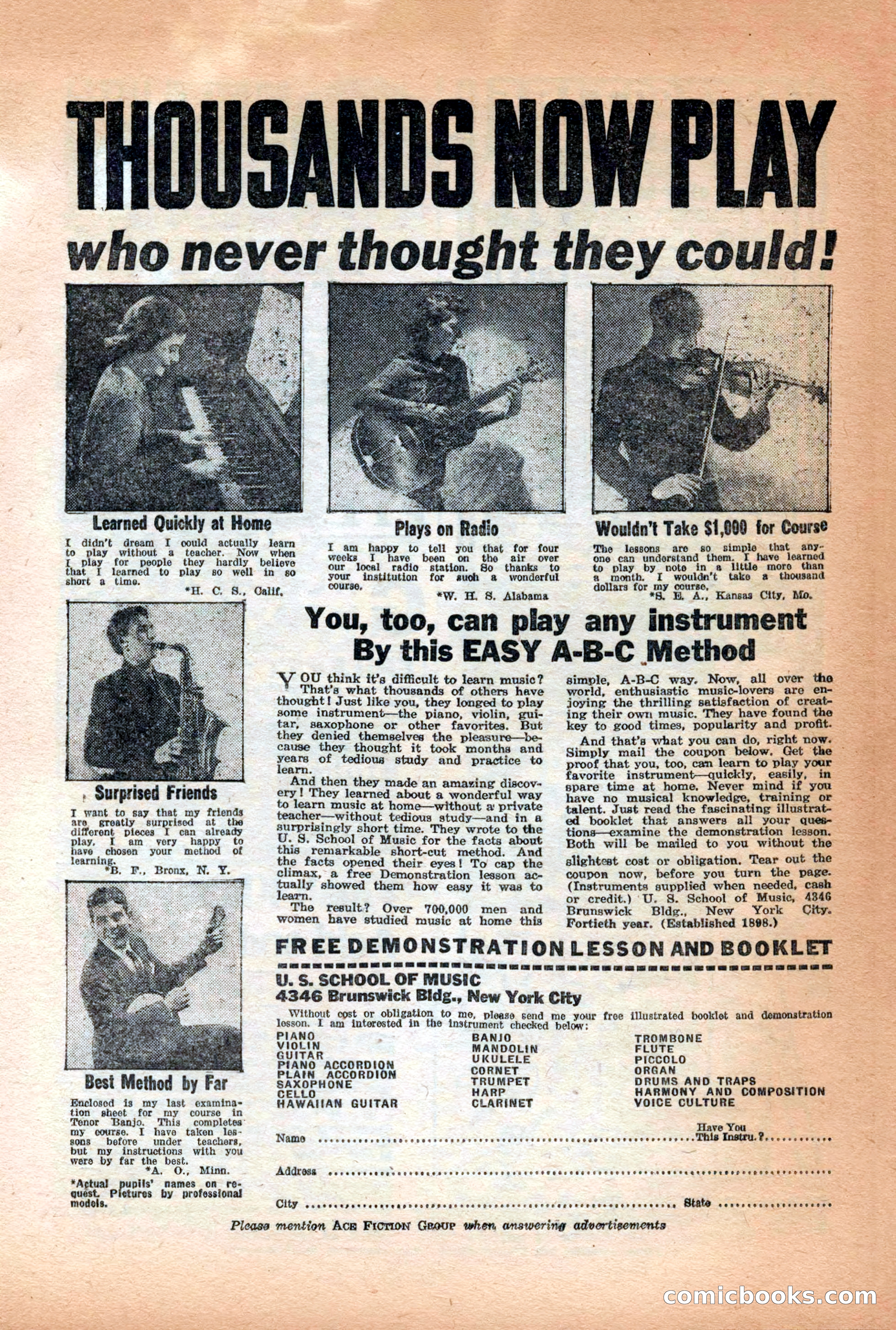
# Analysis of Page This is an **advertisement page** from a pulp magazine, not story content. It promotes the U.S. School of Music's mail-order music instruction method, claiming thousands of people have learned instruments at home using their "Easy A-B-C Method" without a teacher. The page features testimonial quotes from satisfied students alongside photographs, emphasizes rapid learning, and includes a coupon offering a free demonstration lesson and illustrated booklet for interested readers.
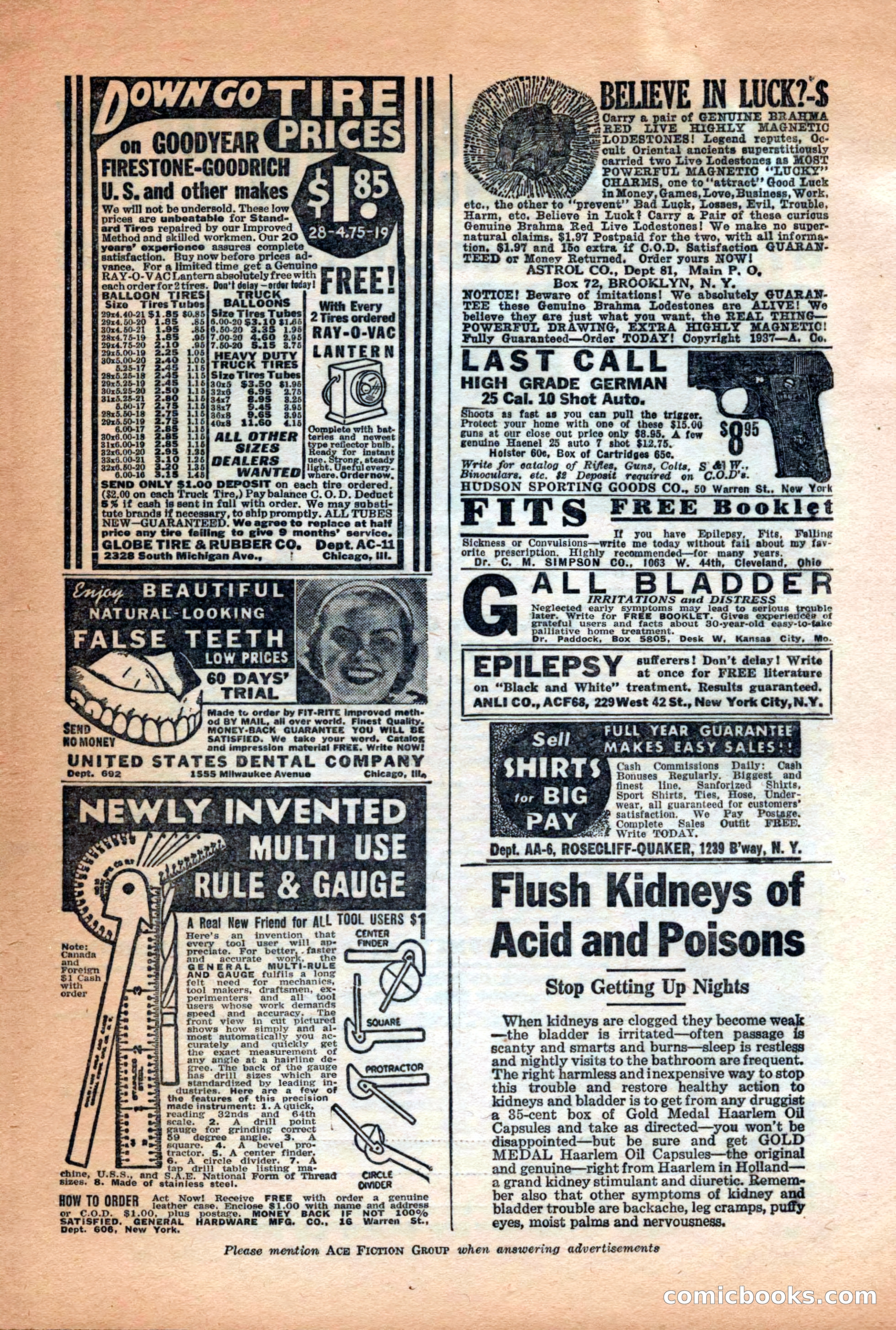
# Advertisement Page from Vintage Pulp Magazine This is an **advertisement page** from an early pulp magazine, containing multiple classified and display ads typical of 1930s publications. The visible advertisements promote consumer goods and services including: discounted Firestone and Goodrich tires with a free Ray-O-Vac lantern offer; false teeth at low prices with a 60-day trial; a newly invented multi-use rule and gauge tool for mechanics and machinists; "lucky" Brahma lodestones claiming to attract good fortune; a German-made 25-caliber automatic pistol; and various other mail-order products. The page reflects the direct-mail marketing culture of Depression-era pulp magazines.
# Advertisement Page This is a full-page advertisement (not story content) from a pulp magazine. The ad promotes National Schools of Los Angeles, offering vocational training in diesel engine mechanics and related trades. It features a coupon for a free instructional booklet, testimonials from satisfied students and educators, and details about the school's comprehensive shop-based training program, transportation assistance to Los Angeles, and employment opportunities in the diesel and internal combustion engine industries.
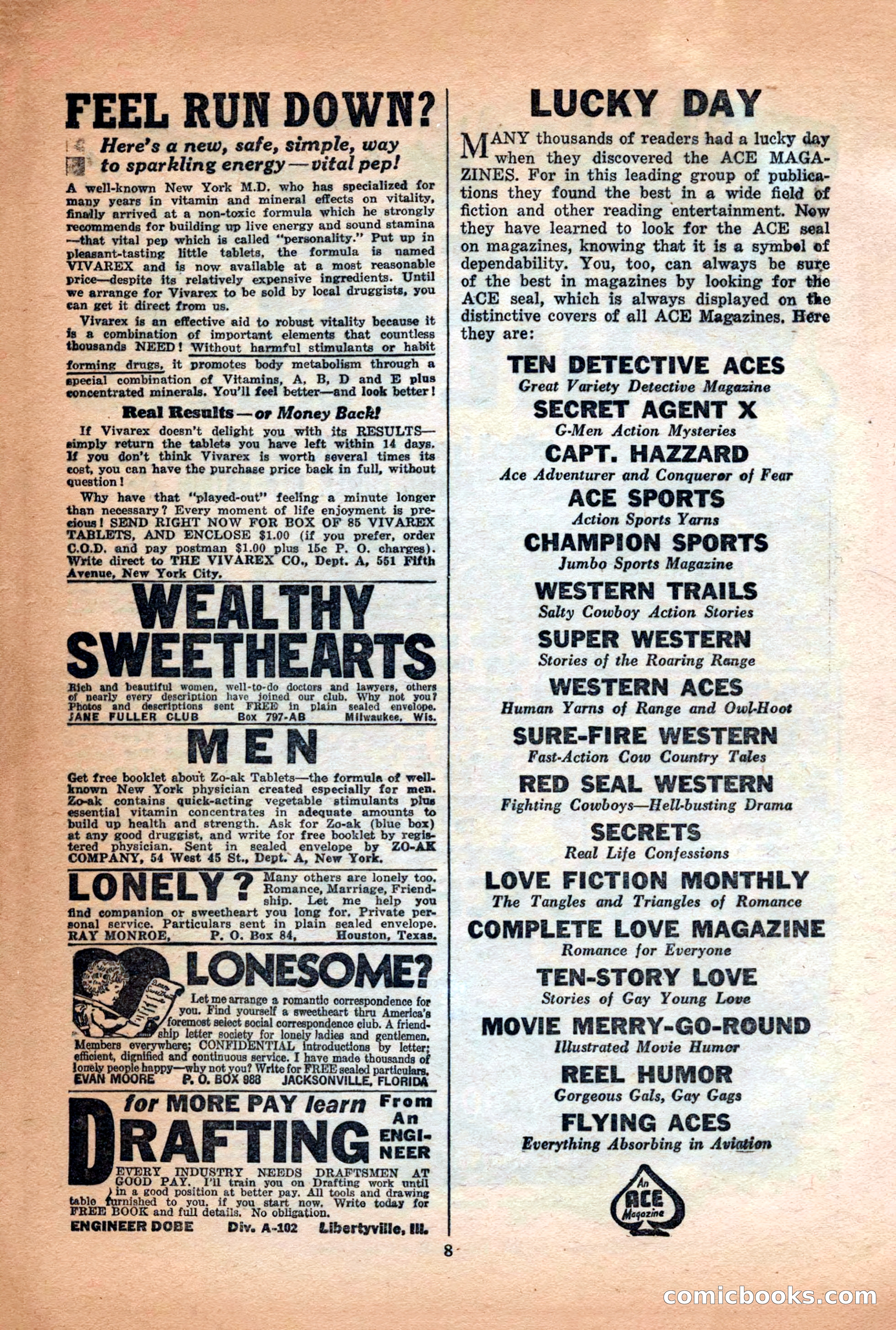
# Page Description This is an **advertisement and editorial page** from a vintage pulp magazine, likely from the 1930s-1940s. The left side contains several mail-order advertisements: Vivarex vitamin tablets (promising energy and vitality), Zo-ak tablets for men's health, and lonely-hearts correspondence clubs. The right side features an editorial section titled "Lucky Day" promoting ACE Magazines' various pulp titles, including *Ten Detective Aces*, *Secret Agent X*, *Capt. Hazzard*, and numerous adventure, western, romance, and humor publications. The page essentially advertises both patent medicines and the magazine publisher's own product line.
# Advertisement Page from Early 20th-Century Pulp Magazine This is an **advertisement page** featuring various mail-order product offers typical of early pulp magazines. The page displays multiple classified-style ads offering items like an "Engineers Watch" for $2.97, asthma treatments, a liquor-habit cure, a doctor's prescription, gambling secrets, a mail-order suit promising $12 daily earnings, and a Royal typewriter. Each ad emphasizes "free trial" or "send no money" purchasing schemes and includes order coupons, reflecting common direct-mail marketing practices of the era.
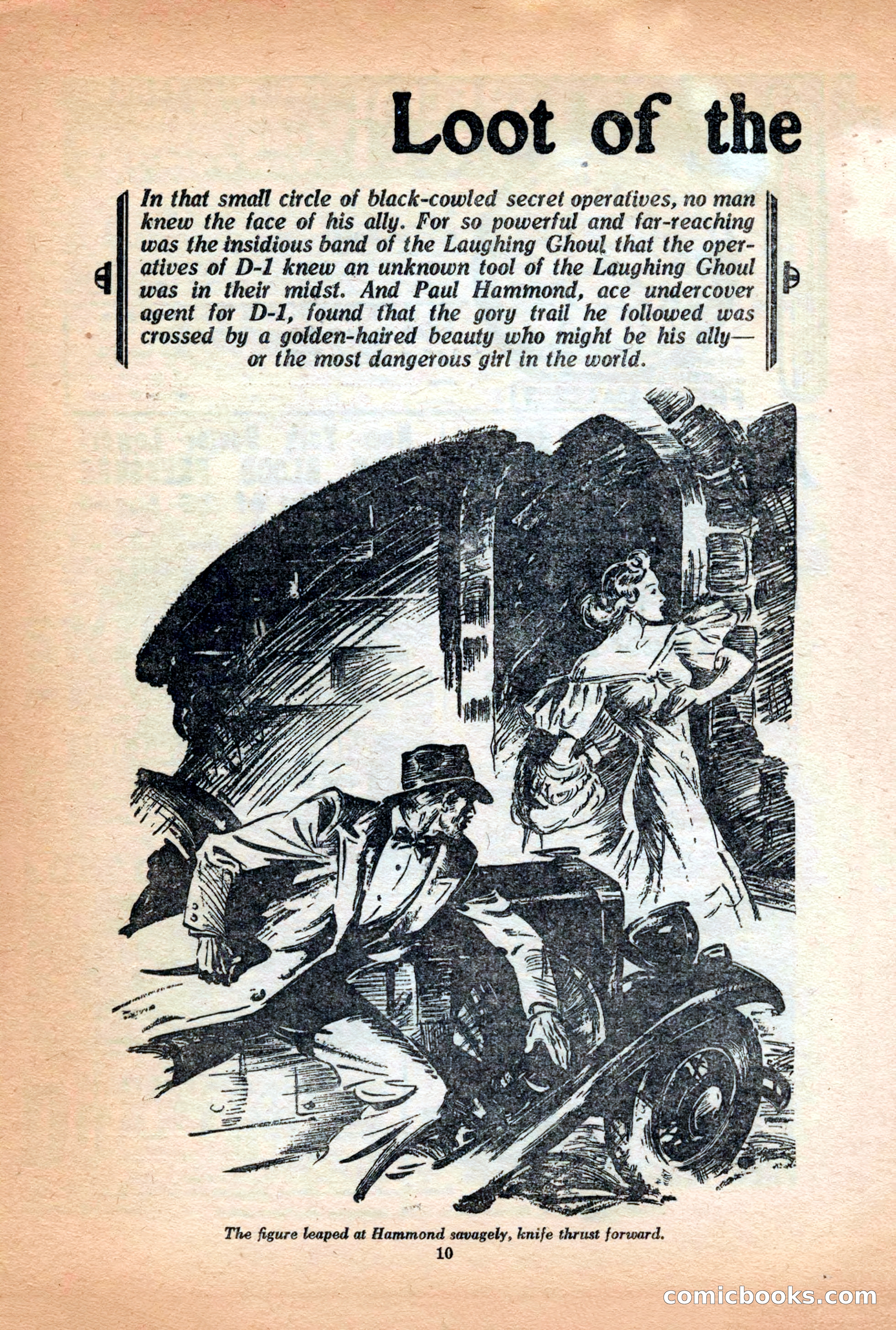
# Page Analysis This is an interior story page from a pulp fiction magazine, likely from the early-to-mid 20th century. The top section contains italicized introductory prose describing a secret operative organization called D-1 and its mysterious operative known as "the Laughing Ghoul," along with protagonist Paul Hammond, an undercover agent who encounters a golden-haired woman of unclear allegiance. Below is a dramatic black-and-white illustration depicting a violent confrontation: a man in a suit and hat is attacked by a figure with a knife. The caption reads "The figure leaped at Hammond savagely, knife thrust forward," confirming this illustrates the action described in the story text above.
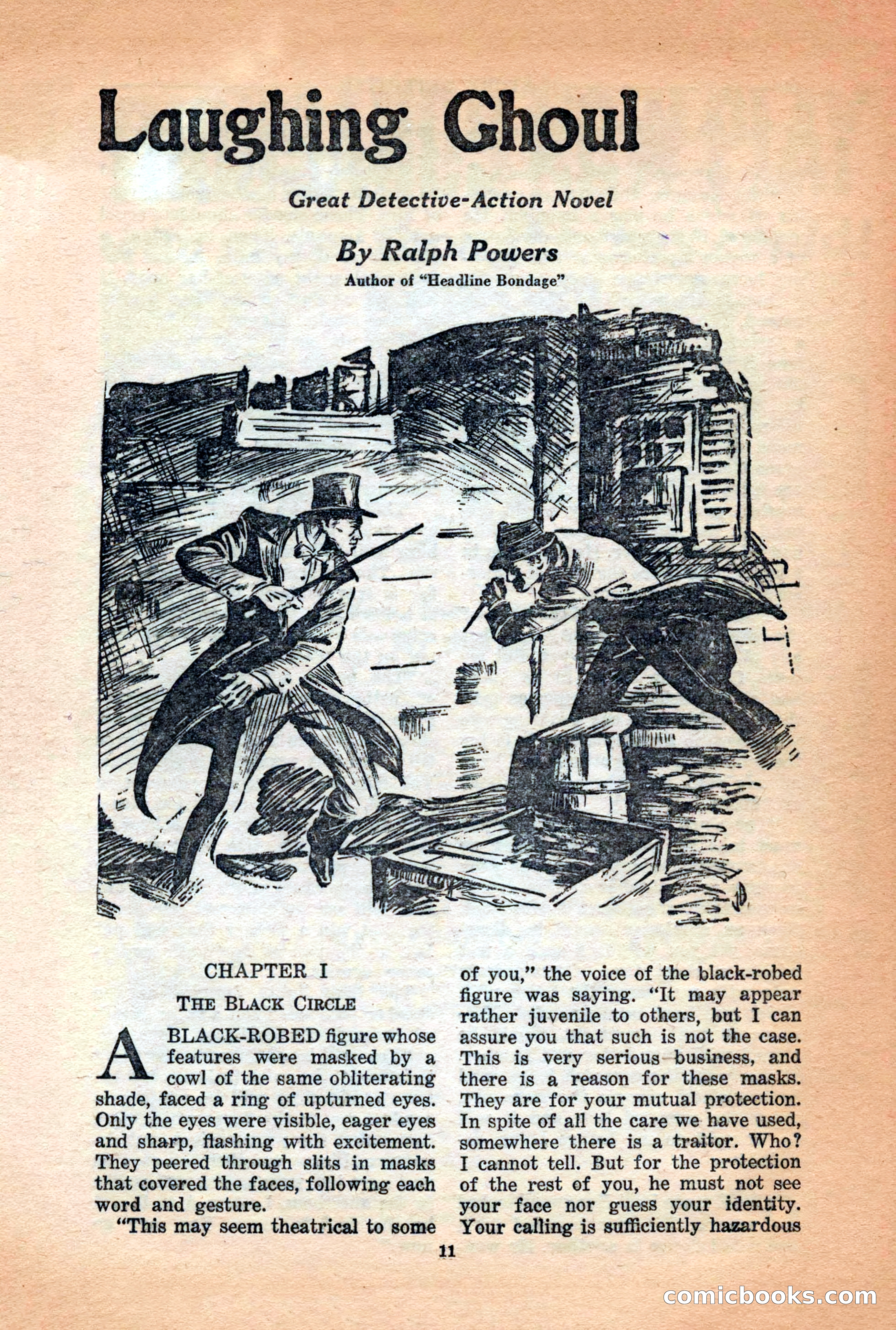
# Page Analysis: "Laughing Ghoul" This is the opening page of a detective-action novel by Ralph Powers. It features the title, author information, and a dramatic illustration showing two figures in conflict—one in dark robes facing another man in what appears to be a confrontation scene. Below the illustration is Chapter I, "The Black Circle," which describes a cloaked figure addressing a group of masked conspirators about a traitor in their ranks and explaining why they must conceal their identities for mutual protection. The visible prose establishes the mysterious, secretive tone typical of early pulp detective fiction.
# Page Analysis: "10-Story Detective" This page contains story prose from what appears to be a hardboiled detective or spy fiction narrative. The text describes a clandestine meeting of undercover agents in a darkened, sound-proof room in New York City. A masked chief briefs the team—including protagonist Paul Hammond—about a criminal conspiracy converging on the West Coast, while Hammond observes a slight figure with distinctive tawny hair that triggers a mysterious memory. The passage emphasizes secrecy protocols and the agents' elite status as members of an organization called "D-1."
# Page Content Description This is story prose from a pulp fiction magazine titled "Loot of the Laughing Ghoul" (page 13). The text follows protagonist Paul Hammond as he boards a train to San Francisco on a secret government mission. Hammond learns that the wealthy South American Señor Pombal—suspected of being "the criminal genius of the continent"—is arriving in the city. While in his train compartment, Hammond is briefly visited by a bearded stranger who claims to have entered the wrong cabin, though Hammond finds the encounter suspicious and responds with an enigmatic smile after the man leaves.
This page contains story prose from what appears to be a hardboiled detective pulp magazine. The narrative follows protagonist Paul Hammond, a detective traveling by train, who encounters a mysterious bearded man in his compartment and later a beautiful woman in the dining car. Hammond attempts to determine the woman's connection to Miami and the "Flower Limited," suspecting she may be involved with the mysterious Max Ulrich, a passenger whose identity troubles Hammond's memory. The text explores Hammond's investigative reasoning as he tries to uncover the true identities and missions of those around him.
# Page Analysis: "Loot of the Laughing Ghoul" This is story prose from a pulp-fiction magazine (page 15). The narrative follows detective Paul Hammond aboard a train where a woman's body—discovered to be Nevel Nason's maid, Ethel—is found stabbed in a compartment. Hammond, who had dined with the government agent Nevel Nason, vouches for her alibi, though the sergeant insists she testify before the coroner. The plot thickens when a bearded stranger named Max Ulrich appears in the corridor and exchanges a meaningful, surprised glance with Nevel Nason, suggesting possible connection to the murder.
# Page Analysis: 10-Story Detective This is **story prose** from a pulp detective magazine (appears to be *10-Story Detective* based on the header). The page shows Chapter II, titled "The Murder Woman," continuing a murder mystery aboard a train. Detective Paul Hammond investigates whether the arrested woman, Nevel Nason, is actually the notorious criminal Bette Langwell—a master of disguise. A mysterious passenger named Max Ulrich, who claims to have witnessed the murder, suddenly departs for Pittsburgh to testify at an inquest, raising Hammond's suspicions about his true identity and involvement in the crime.
This page shows story prose from a pulp-fiction magazine titled "Loot of the Laughing Ghoul." The narrative follows a man named Paul Hammond at San Francisco's Ferry Building, where he encounters a woman he believes to be Nevel Nason emerging from the fog. Hammond grows suspicious when the woman's appearance seems subtly changed following a murder inquiry in Pittsburgh. The scene culminates with Hammond observing the mysterious woman entering a limousine, where a glimpse of a strange, hairy hand from inside the vehicle suggests an ominous presence, heightening the mystery and intrigue typical of pulp-fiction storytelling.
# Page Analysis This page contains **story prose** from a hardboiled detective or spy fiction narrative. The text depicts a clandestine meeting in a fog-shrouded San Francisco, where characters code-named "Max Ulrich" and "Nevel Nason" coordinate plans involving infiltration of the Danvers Hotel and manipulation of a man named Paul Hammond. The passage reveals an espionage operation with mysterious objectives, including references to a hidden woman ("Miss X") and codes, culminating in Hammond's realization that a murder case connects to a larger, baffling puzzle. The narrative emphasizes suspicion, deception, and intrigue typical of early-20th-century pulp crime fiction.
# Page Content Analysis This is **story prose** from page 19 of what appears to be a spy or detective pulp fiction magazine titled "Loot of the Laughing Ghoul." The page depicts secret agent Paul Hammond in his San Francisco hotel room receiving coded telegrams about "The Stone" (possibly referring to an emerald ruby in Los Angeles) and mysterious criminal conspirators led by someone named Señor Pombal. After receiving an intriguing phone call from a woman agent offering cryptic information about "The Stone" in exchange for a dance, Hammond contacts the Department of Justice and the Army to mobilize assistance for what he anticipates will be a dangerous confrontation.
# 10-Story Detective Page Analysis This page contains **story prose** from a pulp detective fiction magazine titled "10-Story Detective." The narrative follows a character named Hammond, who appears to be a detective or government agent. The visible text shows Hammond interacting with a waiter with notably hairy fingers, then later encountering a South American man named Señor Rafael Pombal and a woman named Nevel Nason in a cocktail lounge. The story involves coded recognition signals between Hammond and a Colonel Ward, suggesting an undercover investigation plot. Chapter III is titled "The Laughing Ghoul."
This page contains story prose from "Loot of the Laughing Ghoul," a pulp fiction narrative. The text describes Paul Hammond attending a dinner party where he encounters a mysterious veiled woman who whispers a cryptic warning about danger. Hammond becomes suspicious that two women present—Nevel Mason and Miss Pierson—may not be who they appear to be, possibly involving an impersonation. The passage emphasizes Hammond's growing concern about identifying which woman is which and determining whether one represents a friend or enemy, suggesting this is a mystery or spy-themed crime story.
# Page Analysis: 10-Story Detective This page contains **story prose** from what appears to be page 22 of a pulp detective/espionage story titled "10-STORY DETECTIVE." The narrative follows Paul Hammond, an undercover agent posing as a wine merchant, who dances with a woman named Nevel Mason at what appears to be a social gathering. During their dance, she whispers an emergency code ("KL—47—ATU—93") to him, but Hammond becomes suspicious when he observes a waiter—the same one who served the South American guests at his table—sliding a card beneath Nevel's plate. Hammond's doubt about her loyalty increases, and he subtly rejects her appeal for help. After the dance, Nevel discovers and tears up the mysterious card, which is then removed with her plate.
# Page Analysis This is **story prose** (text only, no illustrations) from page 23 of a pulp fiction magazine titled "Loot of the Laughing Ghoul." The passage depicts a dramatic ambush scene in a fog-shrouded San Francisco. After dinner, protagonist Paul Hammond and reporter Arthur Haycox take a taxicab toward Chinatown when their vehicle is suddenly stopped by armed assailants using a red lantern as a decoy. A firefight erupts; Haycox is shot and Hammond is wounded twice, but he returns fire and the attackers flee into the fog as police and cable cars respond to the commotion. The narrative emphasizes the dense fog and chaos of the surprise attack.
# Page Analysis This is story prose from a hardboiled crime pulp magazine, showing page 24. The narrative follows detective Paul Hammond after a man named Arthur Haycox dies from gunshot wounds, cryptically mentioning "the Stone" and "the Laughing Ghoul." Police arrive and discover Hammond has been shot but wears a bullet-proof vest. Before arrest can occur, mysterious associates intervene. Chapter IV begins as a woman named Nevel Mason appears, noticing Hammond's wound, and finds herself alone with him in the fog near a hotel—suggesting romantic tension amid the crime plot.
# Page Analysis: "Loot of the Laughing Ghoul" This page contains story prose from a pulp fiction narrative titled "Loot of the Laughing Ghoul" (page 25). The text depicts an action sequence in San Francisco where protagonist Paul Hammond, protected by a bullet-proof vest, is attacked by an assailant in thick fog. After being stabbed and shot twice without fatal injury, Hammond is struck on the head and loses consciousness. He awakens surrounded by police officers and a woman with tawny curls. The passage emphasizes Hammond's determination to survive and his mysterious mission, with cryptic references to a chief and coded phrases suggesting spy or detective fiction.
# Page Analysis This is story prose from a hardboiled crime/detective pulp magazine titled "10-STORY DETECTIVE." The page depicts a dramatic scene where detective Paul Hammond, injured from an attack, discovers that a woman he believed to be his enemy—the dangerous Bette Langwell—has actually saved him. Hammond is bewildered by this revelation and suspects a connection to mysterious criminals, including someone called "the Laughing Ghoul" and references to Alcatraz. The page ends with Hammond playing a recorded message from an unknown voice, building suspense about his next discovery.
# Page Analysis This page contains story prose from a pulp fiction narrative, likely crime or detective-oriented based on content. The text describes protagonist Hammond investigating a mysterious voice he's recorded, identifying it as belonging to someone named Max Ulrich. Hammond sets up an ingenious surveillance device using gas pipes and water pipes as electrical terminals to intercept communications. The page culminates with Hammond traveling by taxicab through San Francisco fog toward a warehouse on Martel Street to investigate criminal activity. Chapter V begins at the bottom, titled "Lethal Loot," continuing the narrative as Hammond approaches his destination in worsening fog conditions.
# 10-Story Detective — Story Prose This page contains prose from a hardboiled detective story featuring protagonist Paul Hammond. Hammond pursues a mysterious woman named Bette Langwell, whom he believes is "the most dangerous woman in the world." After losing a limousine in the fog and infiltrating a warehouse under false pretenses as a building inspector, Hammond locates Langwell at a residential address. He forces his way inside and confronts her, asking cryptically which "side" she is on, suggesting involvement in some larger conflict or conspiracy.
# Page Analysis: "Loot of the Laughing Ghoul" This is a **story prose page** (page 29) from a pulp-fiction magazine, likely science fiction or hardboiled crime based on its content. The text depicts protagonist Paul Hammond investigating a conspiracy after obtaining incriminating evidence on a wax cylinder recording. Hammond interrogates a woman named Bette Langwell about her connection to "D-1," then discovers intercepted communications between conspirators named Nevel, Danny, and others discussing finding a warehouse and completing an unspecified task "today." Realizing the urgency and danger, Hammond orders the recorded sounds photographed and sends an urgent coded message to headquarters before departing to pursue the investigation.
# 10-Story Detective, Page 30 (Story Prose) This page contains prose narrative from what appears to be a hardboiled detective story. The protagonist, Hammond, investigates a waterfront warehouse, breaking in through a window to discover rows of large metal cylinders labeled as petrol tanks. Upon entering, he hears suspicious water sounds beneath the warehouse floor and discovers a trapdoor with an iron ring. The narrative emphasizes tension and danger as Hammond confronts what seems to be part of a criminal conspiracy involving enemy agents.
# Page Content Analysis This is **story prose** from a pulp-fiction narrative, likely crime or espionage-themed. The page depicts a confrontation between Hammond (appears to be a protagonist or spy) and Max Ulrich, who has captured him in a warehouse setting. After a gunfight near metal tanks containing petrol, Hammond is bound and interrogated. Ulrich reveals he was once "Danny Davids," a fugitive from a Chicago murder case, and explains his plan to kill Hammond using TNT while avoiding murder charges by ensuring no "corpus delicti" remains. The scene combines action and tense dialogue typical of hardboiled pulp fiction.
# Page Content Analysis This page displays **story prose** from "Loot of the Laughing Ghoul," a pulp fiction narrative (page 33). The text depicts a tense scene where protagonist Hammond, held prisoner by criminals planning to break out an inmate called the Laughing Ghoul from Alcatraz, attempts escape. While being escorted from an office, Hammond uses a cigarette to ignite petrol tanks, triggering an explosion. The passage alternates between dialogue revealing the criminal scheme and action sequences showing Hammond's quick thinking and resourcefulness during his attempted getaway.
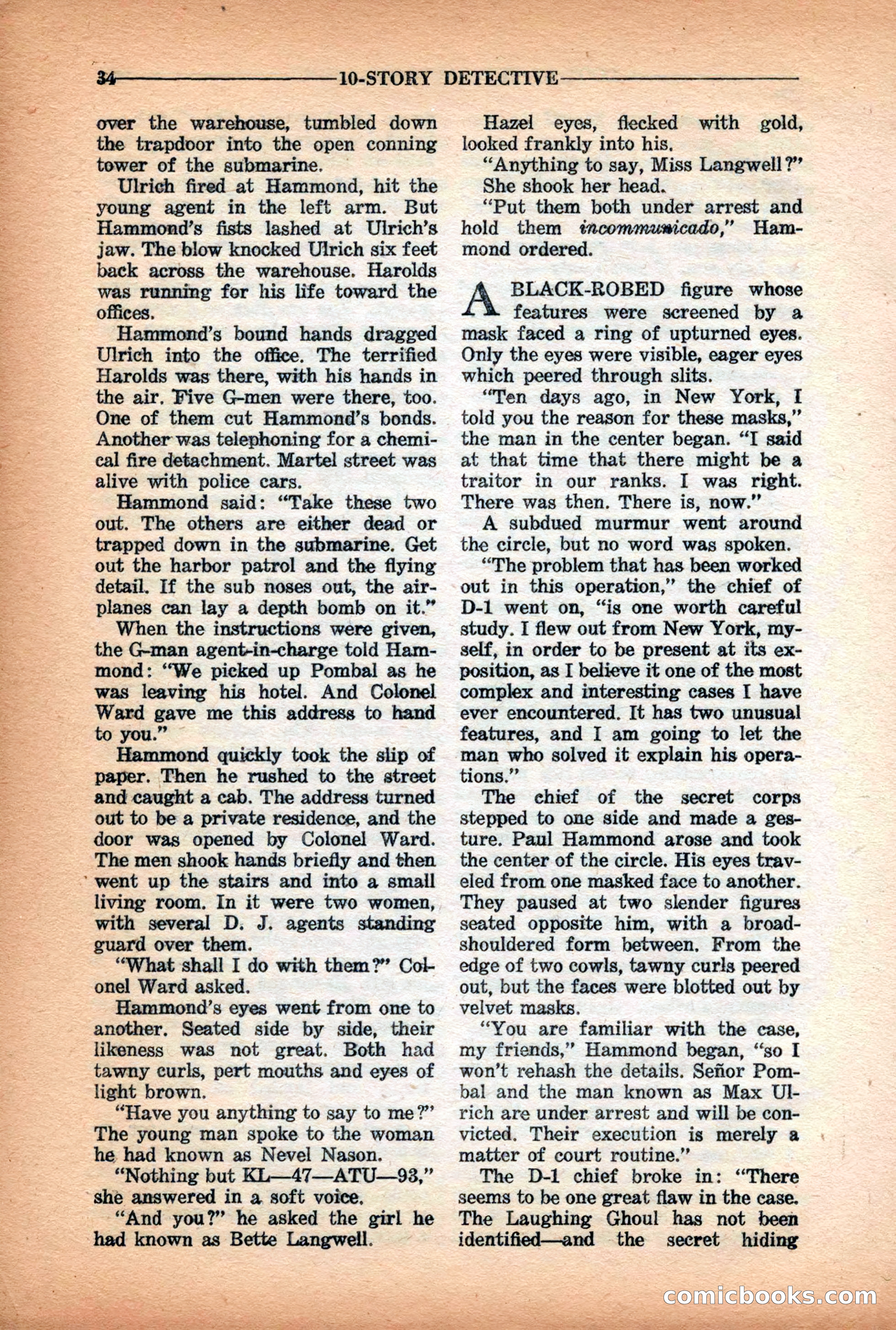
# Page Analysis: "10-Story Detective" Pulp Fiction This page contains **story prose** from what appears to be a hardboiled crime/detective pulp story. The text depicts the climactic aftermath of a submarine-based operation, where secret agent Paul Hammond has apprehended suspects and is now presenting his case findings to a mysterious masked assembly of D-1 (secret corps) officials. The narrative moves from Hammond's field capture of two women suspects through his briefing to superiors, where he explains the resolution of a complex espionage case involving suspects named Pombal and Max Ulrich—though the D-1 chief interrupts to note an apparent flaw in the case remains unsolved.
This page contains story prose from a pulp fiction narrative titled "Loot of the Laughing Ghoul." The text depicts a crime investigation scene where detective Paul Hammond uses early forensic voice analysis—recording voices on a phonograph and visually displaying their sound patterns—to identify suspects in a murder case. Hammond demonstrates how a prisoner named Daniel Davids's voice matches a recorded voice, then plays a recording of a woman's voice to implicate her in the murder of Arthur Haycox, as one of the masked figures in the room reacts by lifting her mask.
# Page Analysis This page contains **story prose** from a detective/mystery tale titled "10-Story Detective." The text concludes a dramatic revelation: detective Paul Hammond has used a phonograph voice-recording test to identify which of two women—Nevel Nason or Bette Langwell (described as "the most dangerous woman in the world")—is the actual criminal. The passage reveals that Bette Langwell was impersonating Nason, while Nason impersonated Langwell in retaliation. Hammond uncovers that Langwell, the real culprit, is now dead. The page also features a vintage **advertisement** for Probak Junior razor blades at the bottom.
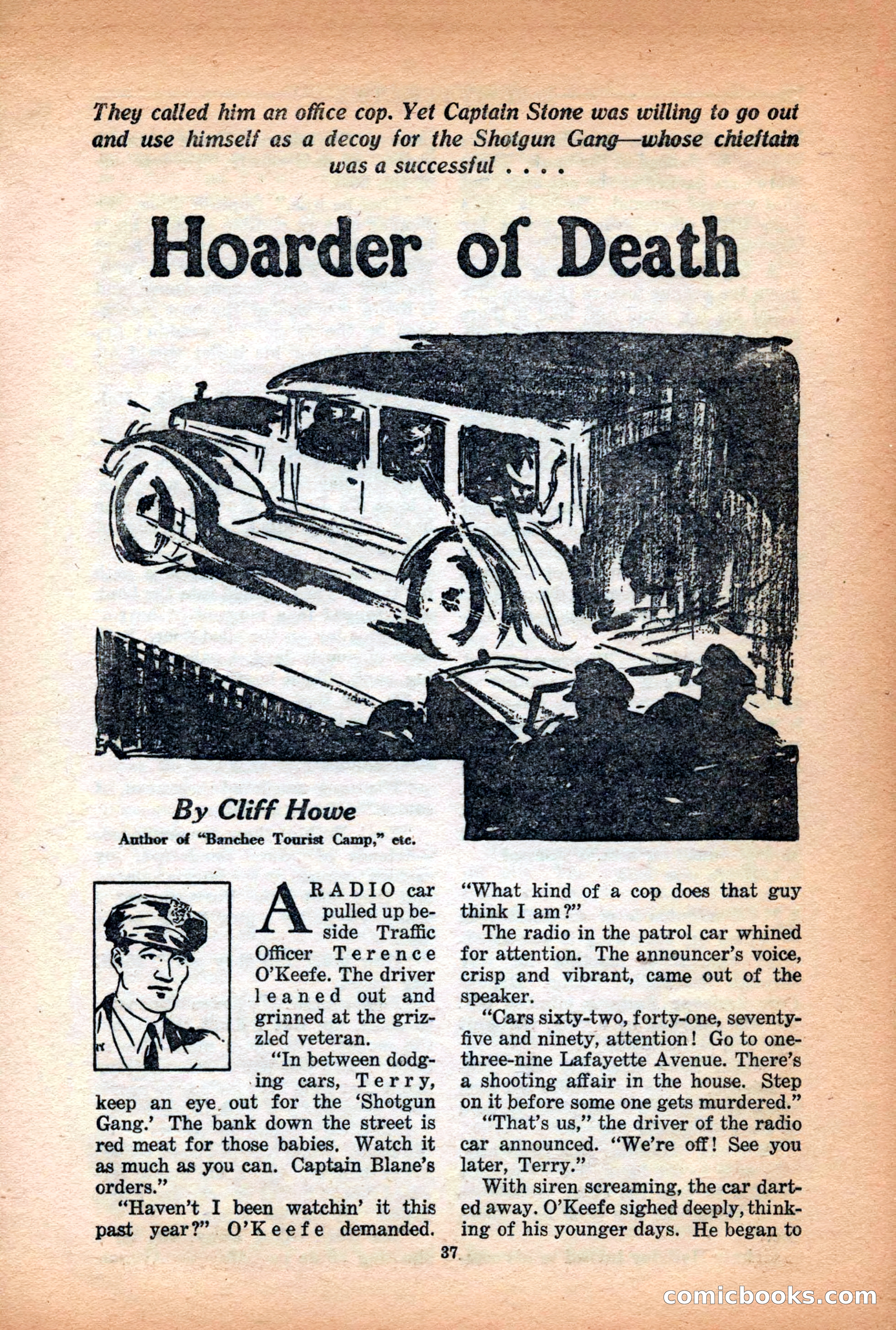
# "Hoarder of Death" by Cliff Howe This is a story opening page from a pulp crime/detective magazine. The page shows the beginning of a hardboiled crime narrative about Captain Stone, described as an "office cop" willing to go undercover as a decoy against the "Shotgun Gang." The visible text introduces Traffic Officer Terence O'Keefe receiving a warning about the gang targeting a nearby bank, then depicts a radio patrol car receiving an urgent dispatch to a shooting incident on Lafayette Avenue. The illustration shows a 1920s-era automobile with armed figures, matching the crime-fiction subject matter.
This page contains prose fiction from a hardboiled crime story titled "10-Story Detective" (visible at page header). The text depicts a bank robbery and shooting in which a police officer named O'Keefe is killed by gunmen from what appears to be the "Shotgun Gang." After O'Keefe's death, Deputy Commissioner Halliday and Captain Stone investigate the scene, discovering two dead bank employees and learning that the robbers escaped with an unspecified amount of money. The narrative focuses on the police response and their suspicion that gang leader Johnny Murtha may be involved.
This page contains story prose from a hardboiled crime pulp magazine titled "Hoarder of Death." The narrative follows Captain Stone and other police officers investigating a series of murders perpetrated by the "Shotgun Gang," a criminal organization committing armed robberies and killings across the city. Stone, head of the radio division, persuades his commissioner for permission to personally pursue the gang. The page then shifts to Stone responding to an emergency call about a murder on Foster Street, racing to the scene with sirens blaring. The text depicts classic pulp crime fiction elements: detective work, gang violence, and urban police procedurals.
# Page Analysis: 10-Story Detective This page contains story prose from what appears to be a hardboiled detective pulp magazine. The narrative follows Detective Stone investigating an apparent suicide in a boarding house—a young man found dead from a bullet wound to the head. However, Stone observes suspicious details: someone watching from across the street through binoculars with a rifle. The scene takes on greater significance when Stone intercepts a radio message about the "Shotgun Gang" striking again, suggesting the suicide may be connected to larger criminal activity that Stone is deliberately allowing to proceed as part of his investigation plans.
This page contains prose fiction from a story titled "Hoarder of Death." The narrative follows Detective Stone investigating what appears to be a suicide in a rooming house. Stone works with a coroner to publicly declare it suicide while privately acknowledging it's murder, aware they're being watched through field glasses. Stone then changes into civilian clothes and begins trailing a suspect named Welton, who leaves the house and enters a drug store to make a phone call—which Stone overhears from an adjacent booth. The page depicts a classic hardboiled detective story with elements of mystery and surveillance.
# 10-Story Detective: Page 42 This page contains **story prose** from a hardboiled detective narrative titled "10-Story Detective." The visible text follows Detective Stone as he tails a suspect named Welton to a tobacco store, then pursues him through an underground tunnel beneath an abandoned factory. Stone discovers Welton meeting with criminals in a hidden room below, where they discuss silencing a landlady who knows about their activities. The narrative emphasizes Stone's careful surveillance and physical confrontation with the store proprietor to gain information.
# "Hoarder of Death" - Story Prose Page This is story prose from what appears to be a hardboiled crime pulp magazine. The page depicts a violent confrontation in a factory cellar where a character named Stone—apparently an undercover cop—is captured by a mob led by someone named Murtha. After a shootout in a tunnel, Stone is overpowered, tied to a chair near a window on an upper floor, and the criminals plan to set the building ablaze while they rob the Ambassador Theatre, intending Stone's screams to draw police away from their heist. The text is heavy with period dialogue and violent action typical of early 20th-century crime pulp fiction.
# This Page This is story prose from a pulp detective magazine. Captain Stone, apparently a police officer, escapes a burning building where he's been held captive, reaches a truck equipped with radio equipment, and attempts to broadcast police orders to intercept the "Shotgun Gang" at a theatre. However, criminals named Welton and Mike—who had been hiding in the crowd—surprise him at gunpoint in the truck cab, forcing him to surrender the microphone at threat of death.
# Page Analysis This is story prose from a hardboiled crime pulp magazine. The page depicts an intense hostage situation where a criminal named Welton holds Captain Stone at gunpoint in a truck, forcing Stone to help broadcast ransom demands over the radio. Stone manages to turn the tables when an external sniper shoots the driver, allowing Stone to fight back against Welton. The narrative emphasizes violent action and high stakes typical of pulp crime fiction.
# Page Analysis: 10-Story Detective This page contains story prose from what appears to be a hardboiled crime pulp fiction narrative titled "10-Story Detective" (visible in the header). The text depicts Captain Stone conducting a climactic confrontation with a criminal gang outside a theater. Using radio communications and tactical coordination with police, Stone orchestrates the gang's capture, resulting in a shootout where the gang leader Murtha is killed. The passage concludes with Commissioner Halliday praising Stone's detective work and Stone deducing that a rooming house landlady is connected to the mob. The narrative focuses on police procedure, crime-fighting action, and dialogue between law enforcement officials.
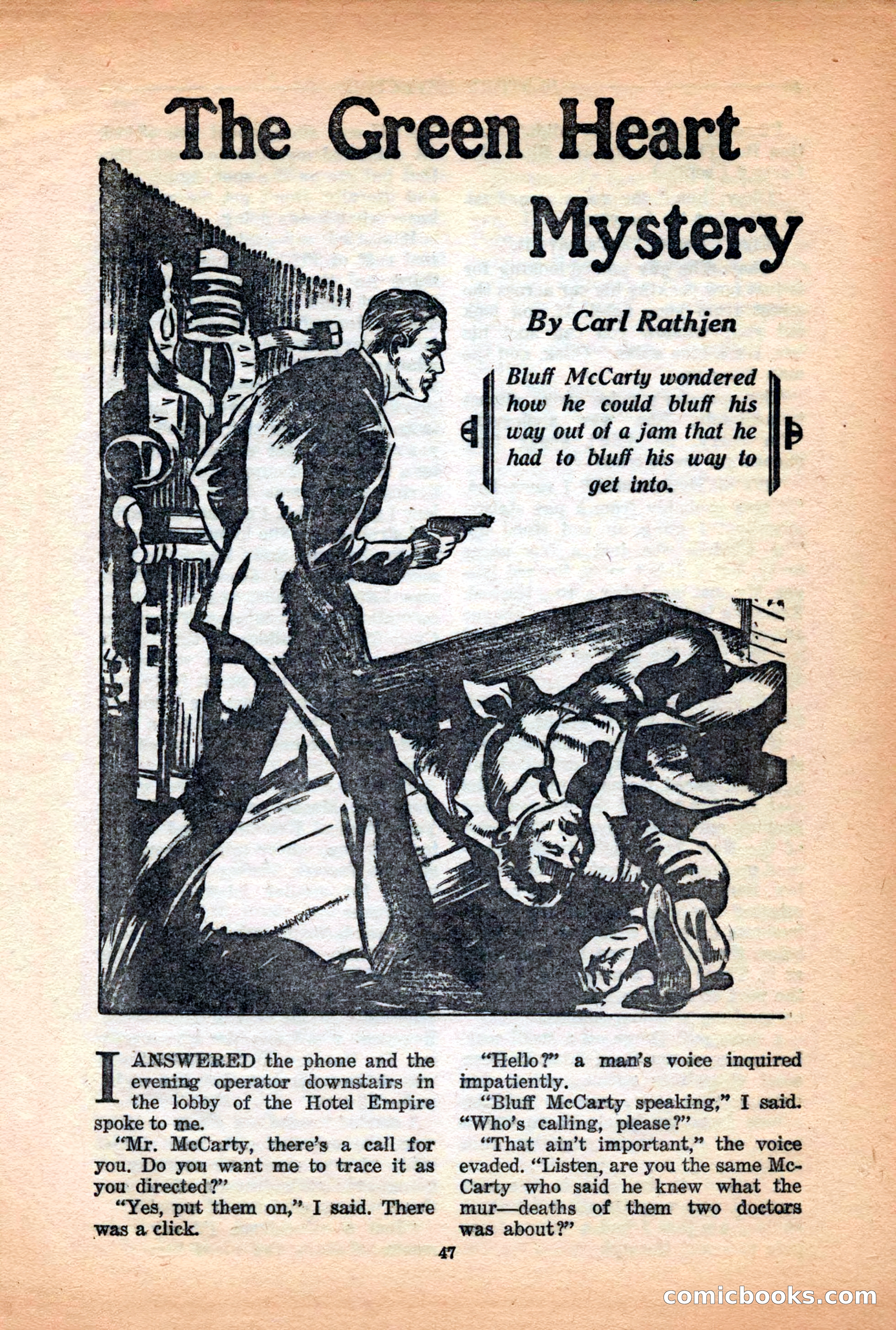
# Page Analysis This is a **story page** from a pulp fiction magazine, specifically the opening of "The Green Heart Mystery" by Carl Rathjen. The page combines a dramatic black-and-white illustration at the top with prose text below. The illustration shows a man in a suit (presumably the protagonist Bluff McCarty) in what appears to be a tense situation. The visible text depicts the beginning of the story: a hotel phone operator connects McCarty to a mysterious caller who cryptically references McCarty's knowledge about "the deaths of them two doctors." The narrative establishes an air of intrigue and danger typical of hardboiled crime pulp fiction.
# Page Analysis This page contains **story prose** from a hardboiled detective magazine titled "10-Story Detective." The narrative follows detective Bluff McCarty as he describes narrowly avoiding an assassination attempt at his hotel—someone shoots at a dummy he creates using his coat and coat hanger—then transitions to McCarty entering an exclusive New York club where he encounters four prominent men (a news commentator, an automobile manufacturer, a medical examiner, and a criminologist) discussing what appears to be suspicious deaths involving cases named Hardwicke and Plunkett.
# Page from "The Green Heart Mystery" This is a prose story page from a pulp fiction magazine. The narrator, identifying himself as "Bluff McCarty," joins a group of men at what appears to be the Toppers Club to discuss two recent deaths of X-ray doctors—Dr. Hardwicke and Harlan Plunkett—who both fell or jumped from buildings. While authorities call them accidents or suicides, McCarty insists the deaths are murders, citing the suspicious similarities. The other men present, including a medical examiner and criminologist named Kittring, dismiss his theory, though commentator Lawson Reade appears intrigued rather than hostile.
# 10-Story Detective (Page 50) This is **story prose** from a hardboiled detective pulp magazine. The page shows a confrontation between the protagonist, Bluff McCarty (a detective who has just arrived from London), and several men including Dr. Reade and Tollam. McCarty claims he can prove that two recent deaths were murders rather than accidents. When challenged, McCarty makes a five-thousand-dollar bet that he can expose the killer, though Tollam and others dispute whether conditions can be added to the wager. The scene depicts the tense negotiation of this bet among the gathered men.
# Page 51 of "The Green Heart Mystery" — Story Prose This page contains story prose from a hardboiled crime narrative. The protagonist, "Bluff McCarty," recounts how his public statements about investigating doctors' deaths attracted newspaper attention and a mysterious visitor. A nervous, thin man suddenly enters his fifth-floor room, claiming to have "ditched them," and demands to know if McCarty is working with police. The visitor appears connected to the murders McCarty is investigating, creating tension as they probe each other's intentions and allegiances.
# Analysis This is **story prose** from a hardboiled crime pulp magazine titled "10-Story Detective." The page depicts a detective confrontation: a man named Charley Gammer has just confessed to the narrator that two doctors he visited have died under suspicious circumstances, and he fears being blamed. As Gammer flees, two visitors arrive—Matt Stellman and Droopy Donlan, associates of a deceased gem thief named Paul Keller. The narrator, recognizing them, retrieves a concealed automatic pistol as the three men face off with hands in their pockets, suggesting imminent danger.
# Page Content Analysis This page contains **story prose** from a hardboiled crime pulp fiction narrative. The text depicts a tense interrogation scene where the narrator (McCarty) is confronted by two criminals—Stellman and Droopy Donlan—who want to make a deal. They claim to have information about the deaths of two doctors (Hardwicke and Plunkett) in exchange for details about a stolen green heart made of emeralds. The scene involves accusations, negotiation, and the narrator's skepticism about their timeline, as they've allegedly just been released from prison but somehow know about recent murders.
# Page Analysis This is **story prose** from a hardboiled detective pulp magazine. The page shows two connected sections of narrative: the protagonist physically confronting Stellman after a tense interrogation, then later discovering newspaper clippings about a gem thief named Keller who died in a sanatorium after killing a detective. The detective narrator is now investigating the case further and deciding whether to visit Doctor Jollard's sanatorium, uncertain but driven to solve multiple suspicious deaths involving what appears to be a stolen "heart of emeralds."
# The Green Heart Mystery - Page 55 This page contains story prose from a hardboiled crime pulp fiction tale. The narrator, apparently a detective named McCarty, has burst into what appears to be Jollard's office to find a dead man on the floor, an unconscious Gammer, and two men (Stellman and Droopy) engaged in a struggle. After firing a warning shot at Droopy, McCarty confronts the suspects about a stolen "green heart" (an emerald) taken from a murder victim named Keller. McCarty accuses Jollard of theft and connects the crime to murders involving victims named Hardwicke and Plunkett, suggesting he knows where the heart is hidden and what it proves.
# Page Analysis This is **story prose** from a hardboiled detective pulp magazine titled "10-Story Detective." The page shows the climactic conclusion of a mystery involving a stolen "green heart" and multiple murders. The narrator, detective Bluff McCarty, confronts and shoots Gammer, revealing him as the killer of a man named Plunkett. McCarty deduces that Gammer murdered Plunkett to prevent him from exposing Gammer's knowledge of the stolen green heart and his blackmail scheme against a criminal named Jollard. The text features typical pulp-fiction action sequences, dialogue-heavy exposition, and hard-boiled detective narration.
# Page Analysis: "The Green Heart Mystery" This page contains story prose from a pulp detective fiction magazine, appearing near the conclusion of a mystery narrative. The text shows the detective protagonist—"Bluff McCarty"—revealing how he located a surgically-implanted green heart using an X-ray fluoroscope, exposing the culprit Gammer. The passage concludes with McCarty returning to the Toppers Club, collecting a five-thousand-dollar wager from a character named Tollam, and making peace with medical examiners he'd earlier criticized. The page ends with a promotional footer advertising the next "10-Story Detective" installment.
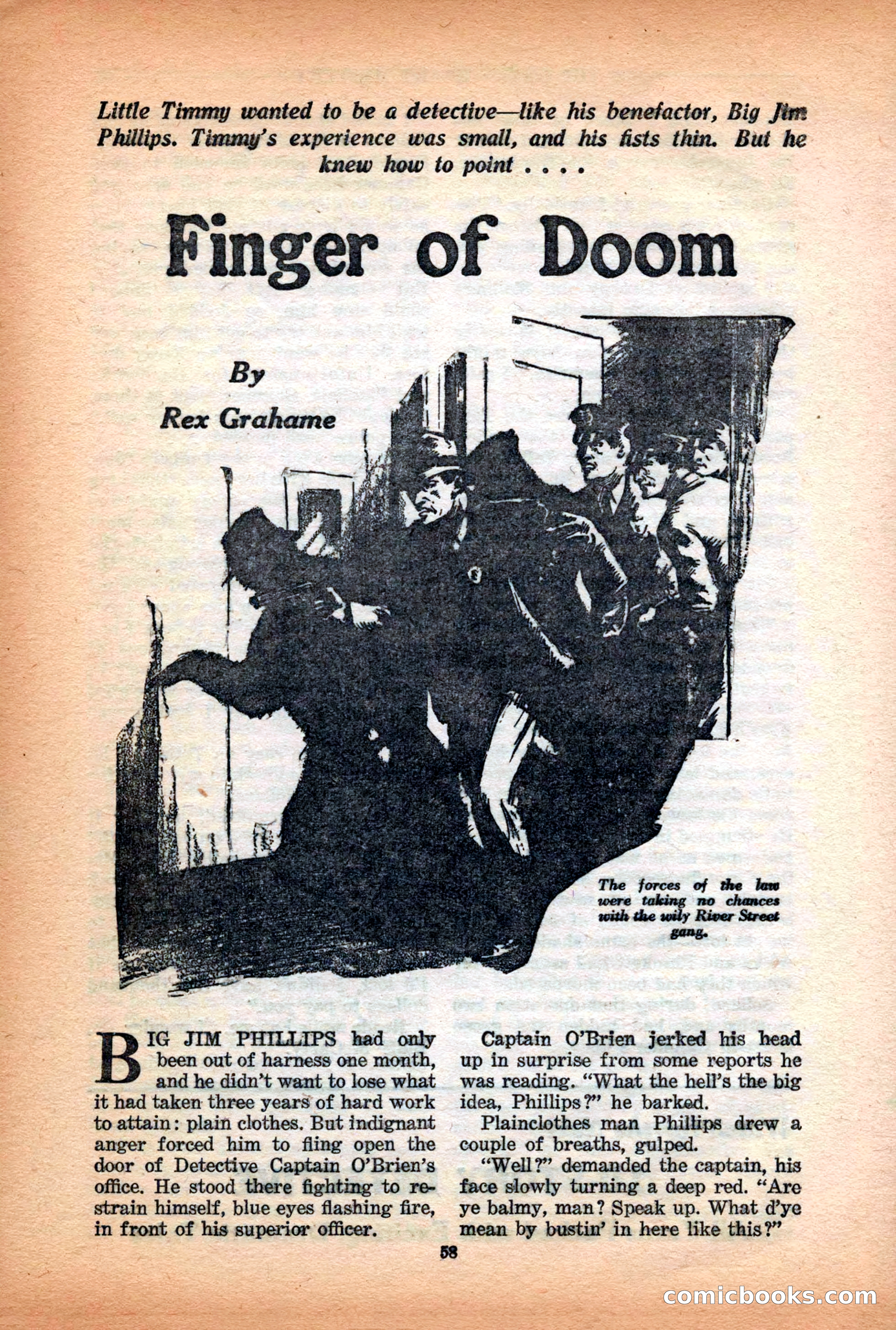
# Page Analysis This is an interior story page from a pulp magazine, featuring the opening of a crime/detective fiction story titled "Finger of Doom" by Rex Grahame. The page includes a dramatic illustration showing what appears to be law enforcement officers confronting suspects, and beneath it, prose narrative describing detective Big Jim Phillips bursting into Captain O'Brien's office in anger. The story appears to concern a plainclothes detective newly promoted after three years of work, now confronting his superior about some undisclosed matter. The page establishes a hardboiled crime setting with dramatic dialogue and tension between the characters.
# Page Analysis: Story Prose from Pulp Fiction Magazine This page contains story prose from what appears to be a hardboiled crime pulp fiction magazine. The narrative depicts a heated confrontation between Detective Captain O'Brien and plainclothes officer Jim Phillips over the captain's use of a young boy named Timmy as an informant in saloons and pool halls. Phillips argues passionately against involving the child, whom he has personally supported. The captain initially resists but eventually relents, revealing he once had a child who died. The scene then shifts to Phillips visiting Timmy's home, where he finds the boy with his grandmother—who displays visible anxiety about Phillips's unexpected visit.
# Page Analysis: 10-Story Detective This is **story prose** from page 60 of a pulp detective magazine. The narrative follows Detective Jim Phillips as he learns that young Timmy's grandmother is gravely ill with heart disease, then later confronts Timmy about secretly practicing detective work with a police captain. Phillips sternly orders Timmy to obey him rather than pursue dangerous detective activities. The scene concludes with Phillips staking out the Arcadia Dance Hall to observe members of the River Street gang, a criminal organization he's investigating.
# Page Analysis This is **story prose** from a hardboiled crime pulp fiction magazine titled "Finger of Doom" (page 61). The passage depicts Detective Jim Phillips discovering a murdered boy named Timmy in a telephone booth at a dance hall. Though the shoeshine boy has been shot, he manages to leave black fingerprints on his own collar using shoe polish—an apparent clue to his killer's identity. Phillips recognizes the meaningful gesture and locks down the scene, confronting the River Street gang members present at the venue. The narrative suggests Timmy had been playing detective and collecting information, which likely led to his death.
# Page Analysis: 10-Story Detective **Type:** Story prose (text page with no illustrations) **Content Summary:** This page continues a hardboiled crime story in which Detective Jim Phillips confronts his captain about a murdered boy named Timmy. Phillips insists on interrogating the River Street gang, leveraging the captain's guilt over the death. The narrative follows Phillips as he attempts to solve the murder by examining clues—finger marks on the victim's collar and a missing gun—while the gang members are brought in for questioning. Phillips struggles against a "blank wall" of evidence, desperately hoping something will break the case open.
# Page Analysis This is story prose from a hardboiled crime pulp fiction magazine (page 63). The narrative concludes a detective mystery involving a dying boy named Timmy who, shot in a phone booth, manages to leave fingerprints on his murderer's shoes as evidence before dying. Detective Jim Phillips deduces this plan, attacks the suspect (Spike Dugan), and recovers the shoes. Captain O'Brien confirms the fingerprints match, securing an indictment. Phillips reveals Timmy, terminally ill, died happily having caught a murderer—his lifelong ambition—prompting O'Brien's gruff but sympathetic response.
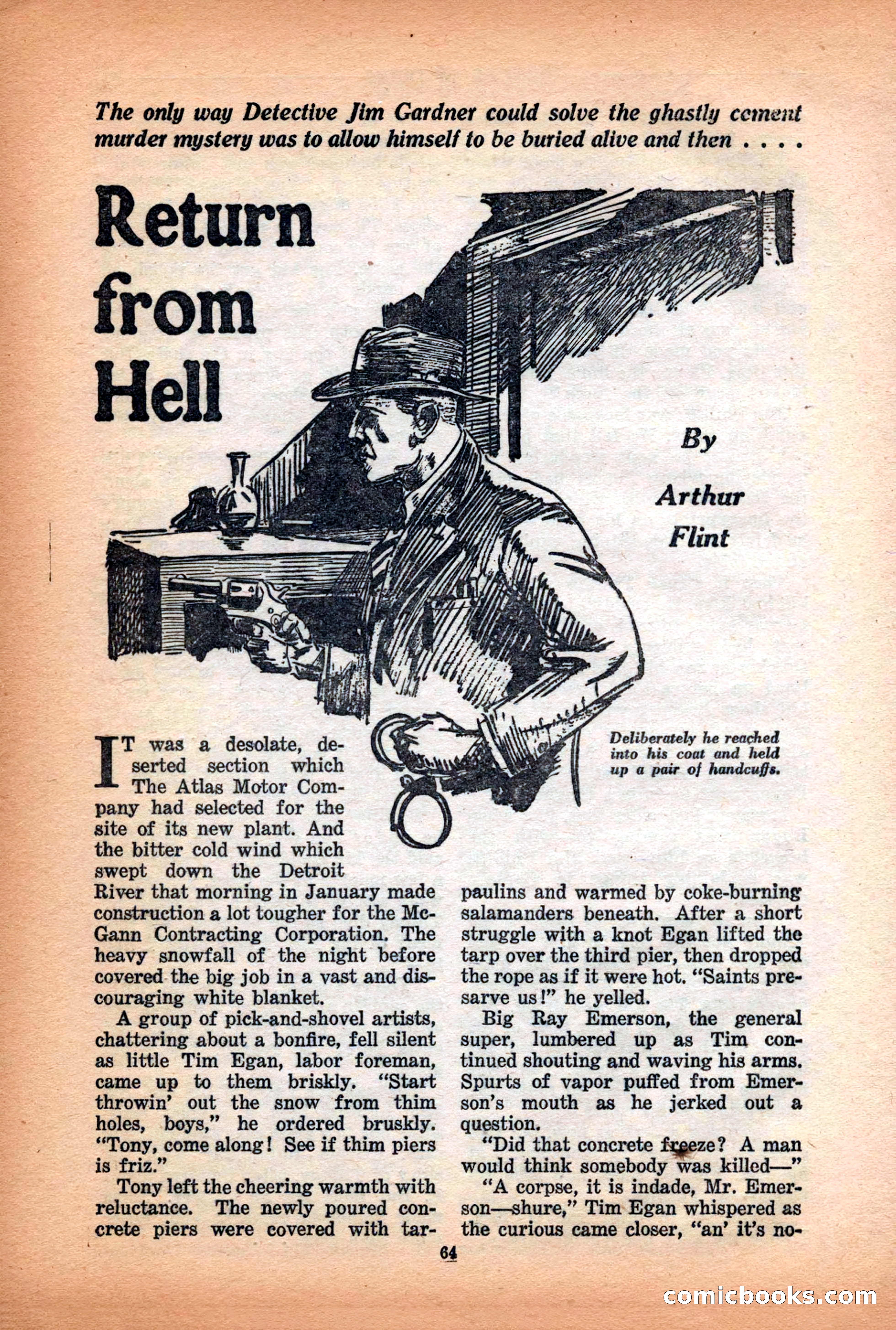
# Analysis This is a **story prose page** from a pulp fiction magazine, specifically page 64 of a hardboiled crime/mystery story titled "Return from Hell" by Arthur Flint, featuring Detective Jim Gardner. The visible text describes a January construction scene at a Detroit motor company site where workers discover what appears to be a human body frozen in newly poured concrete pilings. Labor foreman Tim Egan and general superintendent Big Ray Emerson react with alarm, with Egan whispering to the gathering crowd that "it's a corpse" embedded in the concrete. The passage establishes the mysterious death that appears central to the story's plot.
# Page Analysis This page contains **story prose** from a hardboiled crime/mystery pulp magazine. The visible text depicts the discovery of a dead timekeeper named Johnny Thorpe at a construction site, initially appearing to be an accident but ultimately suspected as murder. Foreman Egan notices the tarp rope securing the pit was tied with a different knot than he originally secured it with, suggesting foul play. The narrative then shifts to Monday when Superintendent Emerson presents this case to Detective Agency president Thomas McGann, requesting investigative assistance.
This page contains story prose from a hardboiled detective pulp fiction tale. It depicts a conversation between Jimmy Gardner, a newly independent private detective, and Jane Thorpe, a young woman he's recruited to help investigate the McGann Corporation. Gardner reveals he believes Jane's brother Johnny was murdered in connection with the McGann contracts and asks for her assistance. The scene shifts from flirtation to serious business as Gardner's demeanor hardens when discussing the case.
# Page Analysis: "10-Story Detective" This page contains **story prose** from a hardboiled crime fiction narrative. The text depicts a confrontation at a construction site between Jimmy Gardner (apparently a private investigator posing as an inspector) and Drew (the timekeeper), which escalates into a physical fight. Gardner defeats Drew, then meets with a superintendent character who reveals he needs help investigating something involving someone named Johnny and a young man named Thorpe. The scene establishes Gardner's undercover operation and introduces a mystery the superintendent wants investigated.
# Page Content Description This is story prose from a hardboiled crime or detective fiction narrative. The page depicts a detective named Gardner investigating a suspicious death at a construction site. The text describes Gardner's interviews with site personnel (including Emerson, Bill, Slemmins, and others) and his theory-building about who caused a worker named Thorpe's death in a pit filled with coke gas. The narrative then shifts to Friday, when another worker, Tim Egan, is pouring concrete for a cupola foundation in freezing conditions while Gardner observes. The page shows the detective methodically gathering information before acting on his suspicions.
This page contains story prose from a hardboiled detective pulp magazine titled "10-Story Detective." The visible text depicts a detective named Gardner visiting a construction site office at night to examine payroll records, only to be ambushed and beaten by three men. The narrative shifts to Gardner being revived and kidnapped, his arms bound with a leather strap from his own boot, as he's carried toward a dark sedan. The action-heavy prose is typical of early-20th-century pulp crime fiction.
# Page Analysis This is **story prose** from page 71 of a pulp-fiction narrative titled "Return from Hell." The text depicts a violent scene in which the protagonist Gardner, bound and seemingly unconscious, overhears criminals planning to murder him by dumping his body into a concrete foundation pit. The passage details Gardner's physical predicament, his desperate attempts to escape his bonds, and the criminals' callous discussion of disposing of him—either through a pickaxe blow or suffocation via concrete and toxic coke gas. The prose emphasizes Gardner's internal struggle between maintaining his "possum" ruse and his survival instincts as a truck arrives to deliver fresh concrete.
# What This Page Contains This is story prose from a pulp detective magazine. The page depicts a dramatic scene where a character named Gardner, buried under wet concrete, fights for survival by holding his breath and escaping from beneath a tarpaulin. After his escape, the narrative shifts to the following Saturday, where Gardner enters an office and overhears a conversation among coworkers—including Tim Egan, Jane Thorpe, and Thomas McGann—discussing a man named Jonas and questioning whether Gardner attacked someone with a weapon, with Emerson interrupting to suggest Jonas may be unreliable.
# Page Analysis: Story Prose from Pulp Crime Fiction This page contains story prose from what appears to be a hardboiled crime detective story titled "Return From Hell" (page 73). Detective Gardner confronts multiple suspects—Slemmins, Tim Egan, and others—accusing them of theft involving fake cement invoices and, more seriously, the murder of Johnny Thorpe. Through physical confrontation and deductive reasoning about details like tooth marks and invoice discrepancies, Gardner systematically exposes a criminal scheme involving fictitious employees and fraudulent payroll checks. Egan denies killing Thorpe, but Gardner presents evidence linking him to the crime.
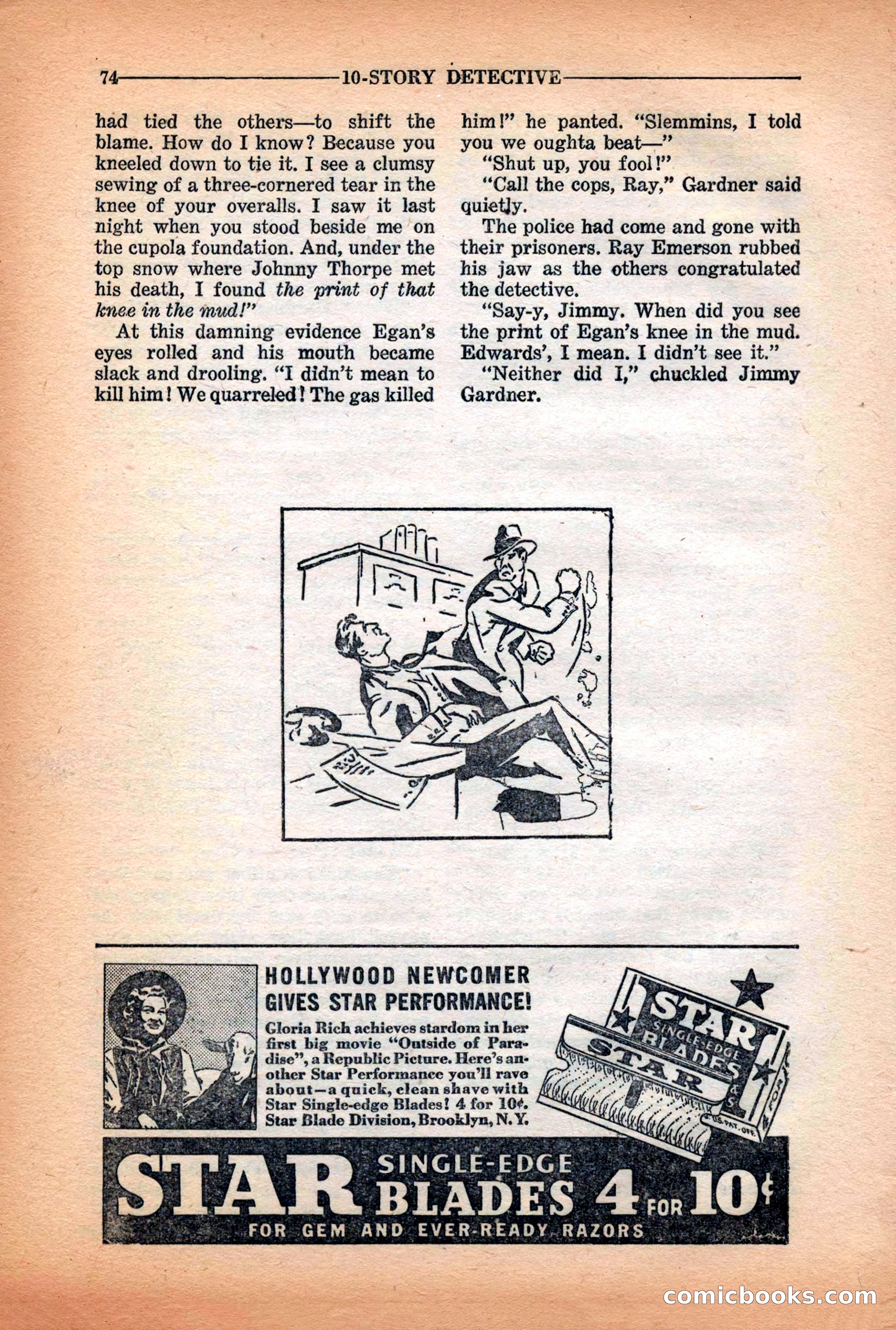
# Page Content Analysis This page contains the conclusion of a crime story from *10-Story Detective*, a pulp fiction magazine. The visible prose shows a detective (Jimmy Gardner) revealing how he identified the murderer Egan through a torn knee print in mud—then humorously admitting he never actually saw the evidence. Below the story text is an illustration depicting what appears to be a physical confrontation scene, followed by a vintage advertisement for Star Single-Edge razor blades featuring an endorsement by actress Gloria Rich. The page is primarily story prose with integrated advertising.
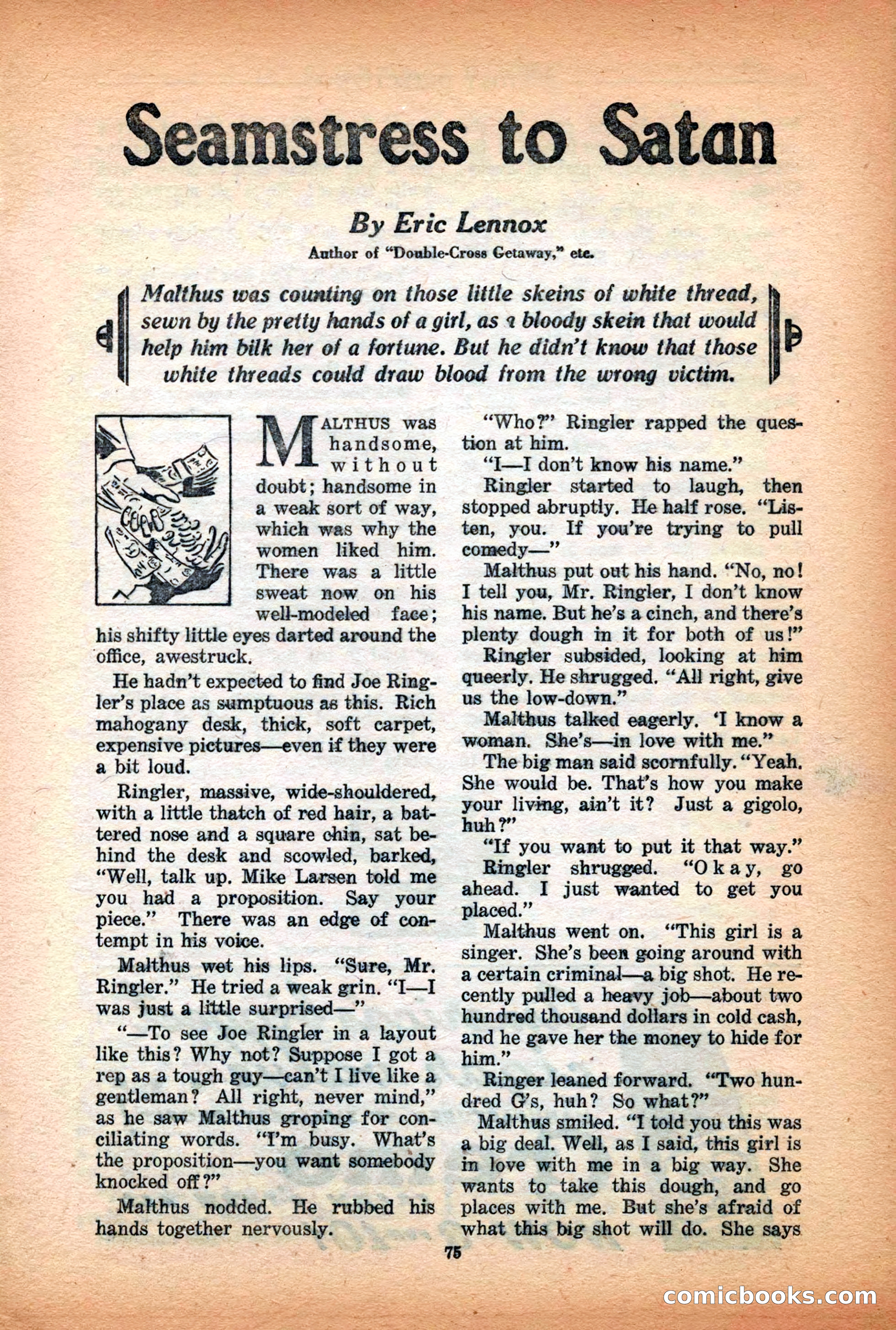
# Page Analysis This is a **story prose page** from a pulp-fiction magazine, specifically the opening of "Seamstress to Satan" by Eric Lennox. The page includes a small illustration in the left margin showing hands working with thread. The story depicts a conversation between Malthus, a weak-faced schemer, and Joe Ringler, a tough, wealthy criminal. Malthus proposes a scheme involving a female singer in love with him who possesses $200,000 in stolen cash from a criminal associate. Malthus aims to convince Ringler to help him acquire the money. The story's teaser promises that white threads sewn by a girl will unexpectedly harm the wrong victim, suggesting a twist ending.
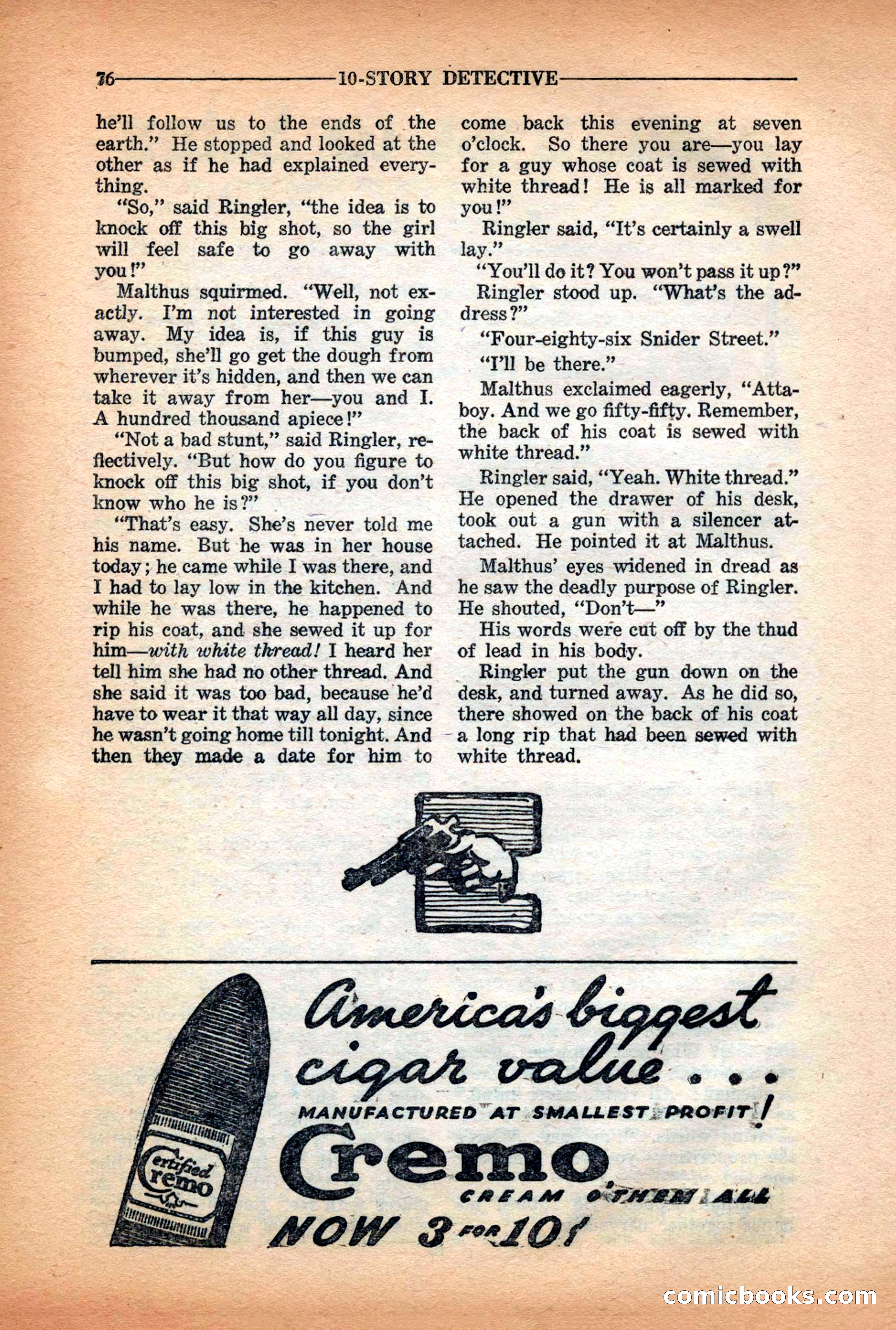
# Page Analysis: 10-Story Detective This page contains story prose from a hardboiled crime narrative. Two criminals, Malthus and Ringler, discuss a plot to murder an unknown man and steal money. Malthus explains they can identify their target by the white thread visibly sewn on his coat's rip. The twist arrives when Ringler shoots Malthus and leaves—revealing that *Ringler himself* wears a coat with a rip sewn with white thread, suggesting he was the intended victim all along or is the mysterious man Malthus described. The page concludes with a Cremo cigar advertisement.
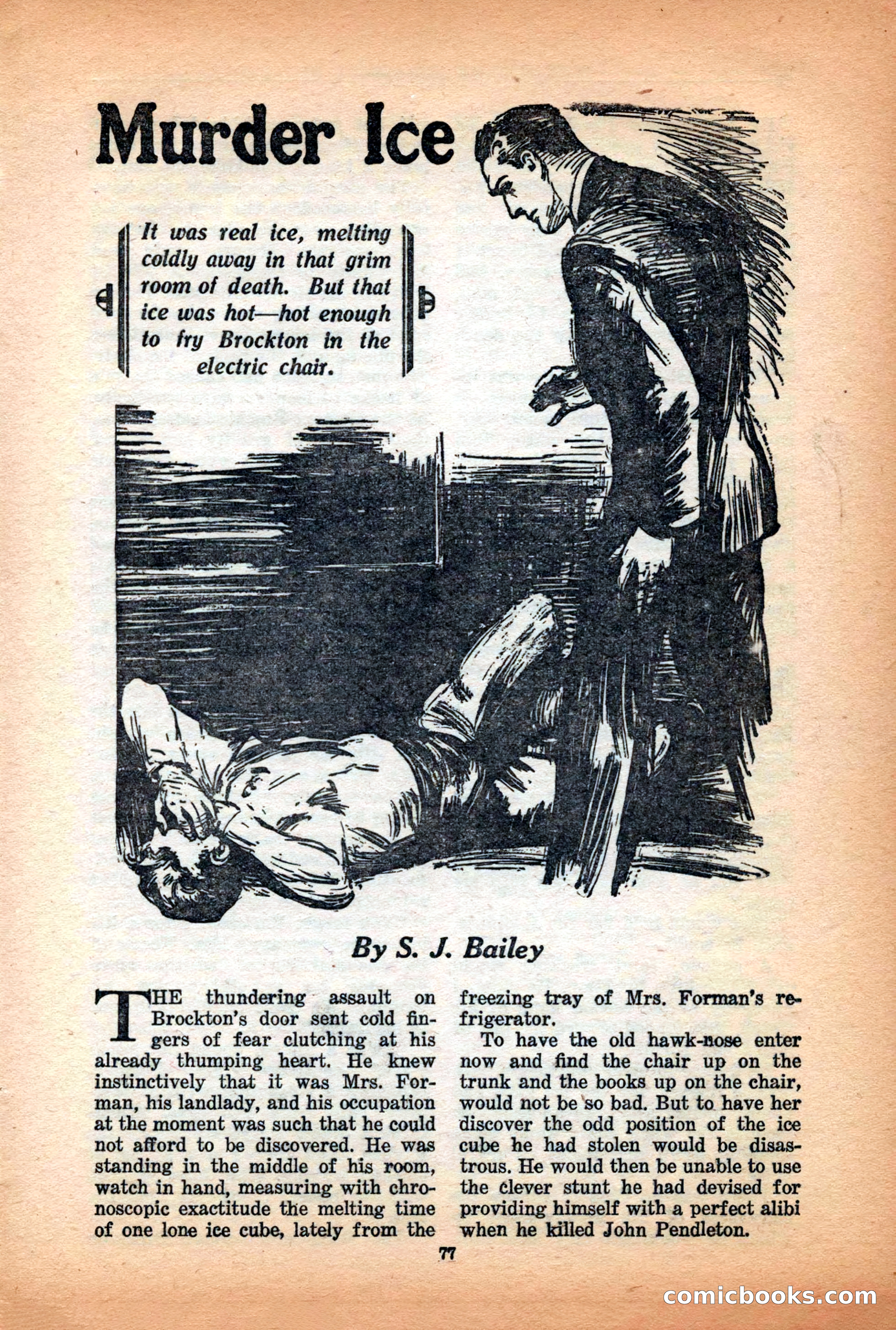
# Page Analysis This is an interior story page from a pulp fiction magazine featuring "Murder Ice" by S. J. Bailey. The page includes a dramatic woodcut-style illustration showing a man standing over a body lying on the floor, with what appears to be an execution chair visible in the background. The visible prose describes a man named Brockton measuring how long an ice cube takes to melt—apparently planning to use this knowledge to create an alibi for murdering someone named John Pendleton, while his landlady Mrs. Forman threatens to discover his scheme.
# "10-Story Detective" - Story Prose Page This page contains story prose from a crime/detective pulp fiction narrative. The text describes a character named Brockton who has orchestrated an elaborate murder scheme using a melting ice cube to create a deadly booby trap—a chair balanced with books that will topple when the ice melts. The passage shows Brockton frantically dismantling his trap when a woman (Mrs. Forman) pounds on his door, then him attempting to deceive her about his activities. The narrative focuses on Brockton's criminal planning and his tense interaction with a suspicious landlady who may have witnessed suspicious behavior.
# Page 79 of "Murder Ice" This page contains story prose from a hardboiled crime narrative. The text depicts a murderer named Brockton meticulously planning to kill a man named Pendleton during a weekend gathering at Ingham's country house. Brockton has arranged a convenient alibi—carrying death-claim papers for a deceased policyholder—and intends to slip upstairs to kill Pendleton while witnesses remain downstairs playing pinochle. The passage then shifts to the following evening, where Brockton attends dinner and grows anxious as he anticipates the murder, while Doctor Blake arrives and the group begins preparing mint juleps.
# Page Analysis This is **story prose** from a hardboiled detective or crime pulp magazine (page 80, titled "10-STORY DETECTIVE" at the header). The visible text depicts a tense dinner scene where Brockton, an insurance cashier, is revealed to be blackmailing his host Ingham over past dealings. After dinner, Brockton confronts Ingham in the hallway, demanding money and threateningly suggesting that if Ingham's elderly guest Pendleton died, Ingham would inherit twenty thousand dollars. When Ingham refuses and expresses contempt, Brockton leaves the house, retrieves a tire iron from his car, and sneaks toward the back entrance with clear murderous intent.
# Analysis of Page This is story prose from a pulp-fiction magazine (appears to be a crime or mystery story). The page depicts a murder being staged to appear as an accident. A character named Brockton attacks an elderly man named Pendleton with a tire iron in Pendleton's bedroom, then arranges an elaborate scene: he positions an ice cube under books balanced on a chair, scatters dust and blood to simulate a fall, and breaks a water glass on the floor. Brockton's plan relies on the melting ice cube eventually causing the chair to tip and the books to fall, making Pendleton's death appear to be an accidental injury from the falling furniture rather than murder.
This page is story prose from a hardboiled detective pulp magazine. The narrative follows a scheme unfolding at a house party: Brockton, apparently plotting something sinister involving death papers and blackmail, observes as the other men discover an accident or death upstairs in Pendleton's room. Doctor Blake examines the body while Brockton, despite his involvement, skillfully poses as an innocent bystander, filling in forged death papers downstairs and savoring what he believes is a perfectly executed plan.
# Page 83: "Murder Ice" — Story Prose This page contains text from a hardboiled crime story titled "Murder Ice." Doctor Blake has just accused Brockton of murdering a man named Pendleton, claiming the killer used an ice cube strategically placed to create a noise at a predetermined time, establishing a false alibi. Brockton denies the accusation, insisting Blake is bluffing. The scene shows tension between the characters as Blake attempts to prove Brockton guilty of a seemingly perfect murder, while Brockton maintains his innocence and questions Blake's theory.
This page contains story prose from a pulp detective magazine, specifically the climactic conclusion of a murder mystery. The text shows detective Blake exposing the murderer Brockton by revealing how green-tinted ice cubes from the housekeeper left traces at the crime scene—evidence that ultimately leads to a confrontation where Blake shoots the suspect. Below the story excerpt is an advertisement announcing upcoming pulp fiction titles, including "Secret Agent X," "The Corpse That Murdered," and other adventure stories available in June.
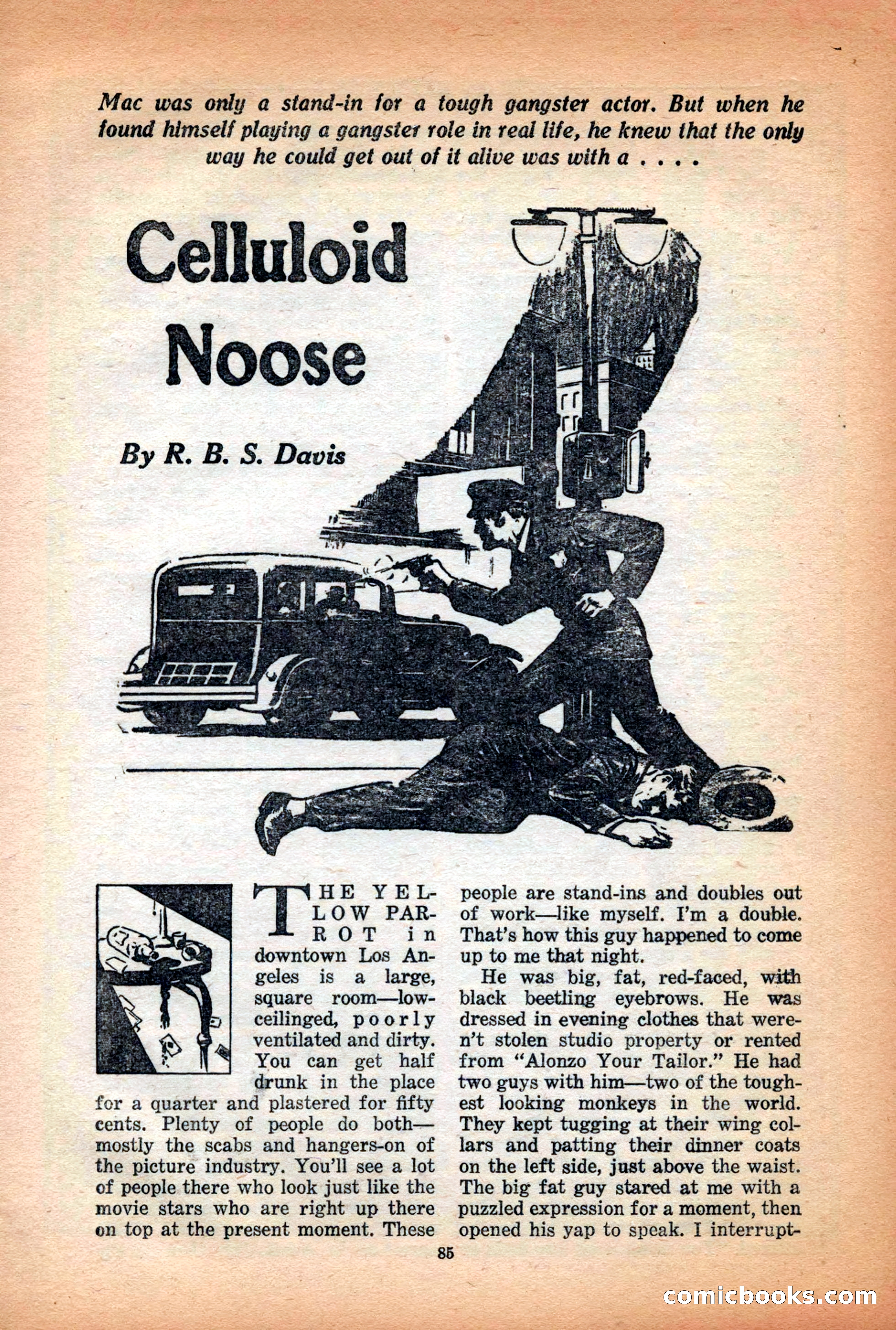
# Analysis of Page This is a story page from a pulp magazine, specifically the opening of "Celluloid Noose" by R.B.S. Davis. The page features a dramatic illustration showing a man in a suit being threatened by gangsters near a 1930s-era automobile, with a noose visible above. The text introduces Mac, a film stand-in who becomes entangled with actual gangsters. The story begins in a seedy Los Angeles bar frequented by studio extras and describes the narrator's encounter with a large, menacing man accompanied by two thugs. The headline promises that a "Celluloid Noose" will be Mac's only escape from this dangerous situation.
# 10-Story Detective: Story Prose This page contains the body text of a hardboiled crime or detective story. The narrator, a Hollywood extra and double for actor Jimmy Cronin, encounters a mysterious fat man in a bar called the Parrot who offers him a mysterious job involving "a picture" at "the location." The narrator, desperate after Cronin's career collapsed and taking his double's prospects with it, reluctantly agrees to the offer despite his suspicions about the man's intentions and character.
# Page 87 from "Celluloid Noose" This page contains story prose from what appears to be a hardboiled crime or noir pulp fiction narrative. The narrator describes being recruited by a mysterious fat man named Jake to participate in what is ostensibly a movie production about a bank heist. After being driven to a remote ranch, the narrator and his companion Shorty discover a film crew with cameras, sound equipment, and weapons. Jake then explains their roles in staging a bank robbery scene, though the narrator begins to suspect the "movie" may actually be a real crime being filmed as cover.
# Page Analysis: 10-Story Detective This page contains **story prose** from a hardboiled crime pulp fiction magazine. The narrative depicts a criminal planning a fake bank robbery using a film crew as cover. The protagonist narrator confronts the ringleader "Jake" about shooting down police and civilians while disguised as a movie production, then attempts to walk away. When Jake's armed associates open fire, the narrator reluctantly agrees to participate. The text describes staging a robbery scene with professional film equipment—klieg lights, a sound truck, camera crane—and the narrator's minimal role as an armed extra. The passage emphasizes the blurred line between authentic filmmaking and criminal activity.
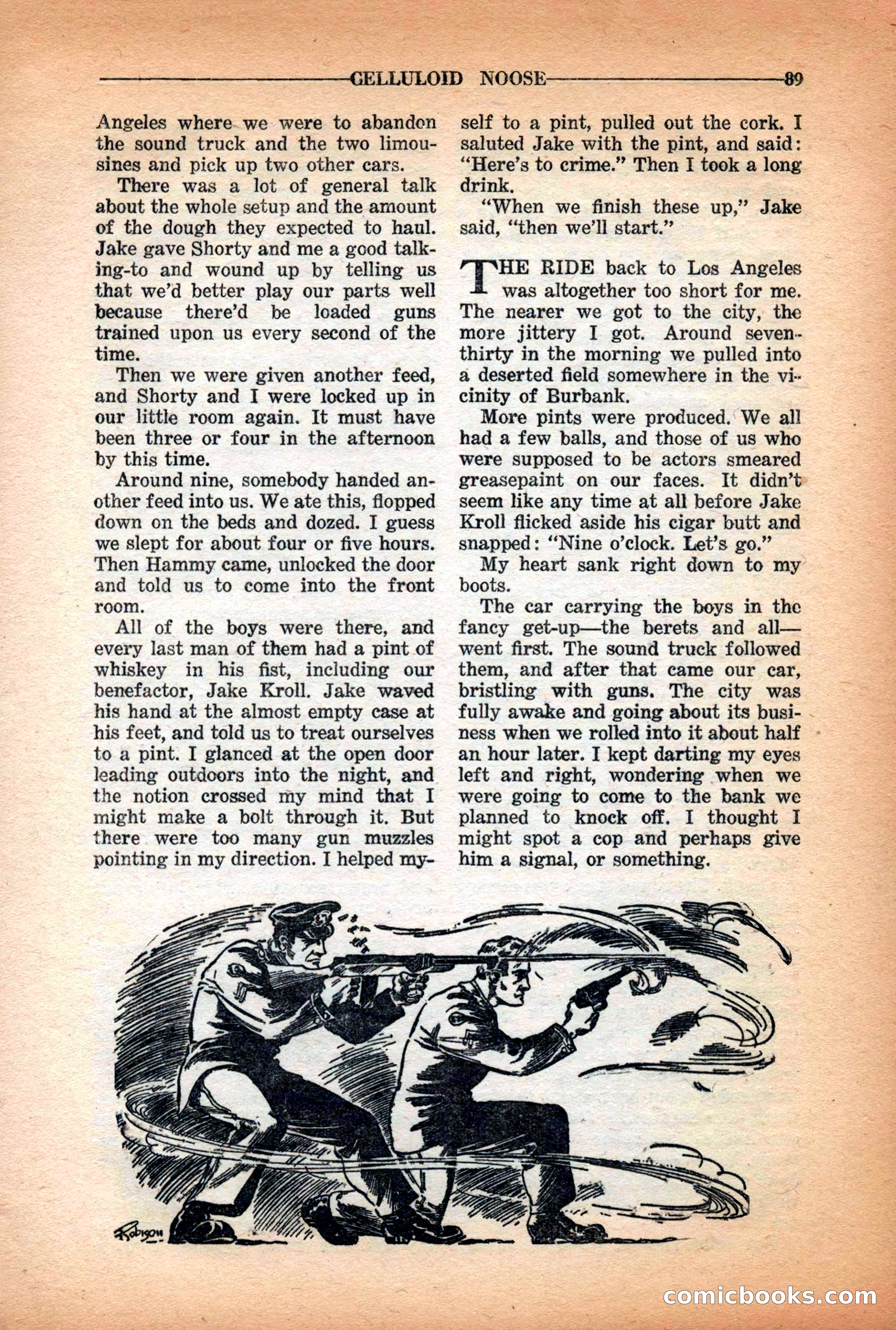
# Page Analysis This is a story prose page from a pulp magazine featuring a hardboiled crime narrative. The text describes a criminal operation in Los Angeles: the narrator and accomplices are preparing for what appears to be a bank robbery, receiving instructions from a crime boss named Jake Kroll, consuming whiskey, and driving toward their target in Burbank at dawn. The narrator expresses anxiety and considers signaling police. Below the prose is an illustration showing figures with weapons in an action scene, consistent with the crime story's violent content.
# Page Analysis: "10-Story Detective" Pulp Fiction This is **story prose** from a pulp crime/detective magazine. The narrative follows a narrator who is part of a criminal gang orchestrating what appears to be a bank robbery on Fifth Avenue. The text describes the narrator's anxiety as they approach the bank in a limousine, the setup of the heist using a sound truck and camera crane (apparently as cover), and the sudden eruption of gunfire when a bank clerk and then police officers intervene. The passage concludes with gang members returning fire, resulting in civilian casualties and a policeman's death. The narrator wrestles with complicity in the crime while secretly planning to inform police.
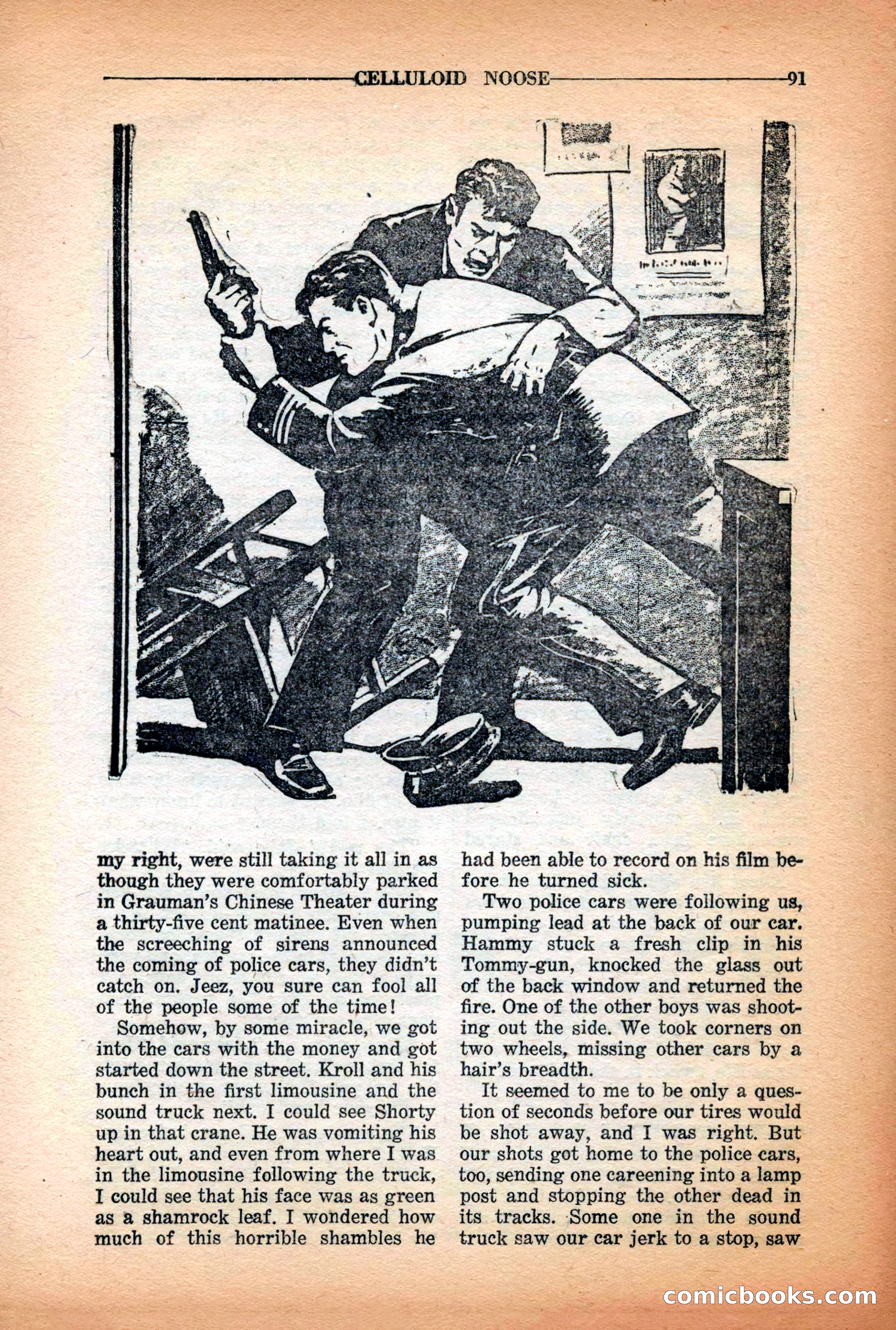
# Page Analysis: "Celluloid Noose" This is an interior story page (page 91) from a pulp magazine, featuring both an illustration and prose text. The illustration shows two men in what appears to be a violent confrontation or chase scene. The text describes a criminal escape involving getaway cars, police pursuit, and gunfire. The narrator recounts how criminals fled a film set with stolen money while being chased by police cars, with shooting occurring between the vehicles. One character named Hammy fires a tommy-gun from their car while others return fire, eventually disabling the pursuing police vehicles. The story appears to be a hardboiled crime narrative, though the "Celluloid Noose" title suggests possible film industry involvement.
# Page Analysis **Type:** Story prose (interior page of a pulp detective/crime fiction magazine) **Content:** This page continues a hardboiled crime narrative titled "10-Story Detective." The narrator, apparently involved in a criminal heist, describes the aftermath of a murder—a cameraman named Shorty has been shot. After escaping with stolen money, the gang holes up in an apartment. The narrator's photograph appears in newspapers covering the crime, making him a wanted fugitive. Tension escalates when gang members consider killing him, but he reveals he's hidden the film reel from the camera, which could have incriminated everyone. Jake, apparently the gang leader, accepts this and suggests they'll "cut your heart out" tomorrow, though his tone suggests dark humor rather than immediate threat.
# Page Analysis: "Celluloid Noose," Page 93 This is **story prose** from a pulp fiction narrative. The page depicts a protagonist secretly developing stolen photographic film in a bathroom, then concealing it by feeding it out a window while sitting near other people in an apartment. The narrator has apparently photographed a bank robbery and is attempting to hide the incriminating evidence from his associates, who remain unaware of his actions. The text emphasizes the tension and danger of his situation as he waits anxiously for someone to discover his scheme.
# Page Analysis: 10-Story Detective This page contains story prose from a hardboiled crime pulp magazine. The narrator describes the climactic moments of a bank robbery setup: he dangles a stolen film out a window as bait, then chaos erupts when police raid the apartment. The passage details a violent gunfight between criminals and police, with the narrator grappling with Jake Kroll. The narrator concludes by explaining how the film footage proved his innocence and led to his meeting a woman named Gloria (Miss Hodge) who recovered the film and turned it over to police. The story emphasizes action, suspense, and a romantic subplot emerging from criminal circumstances.
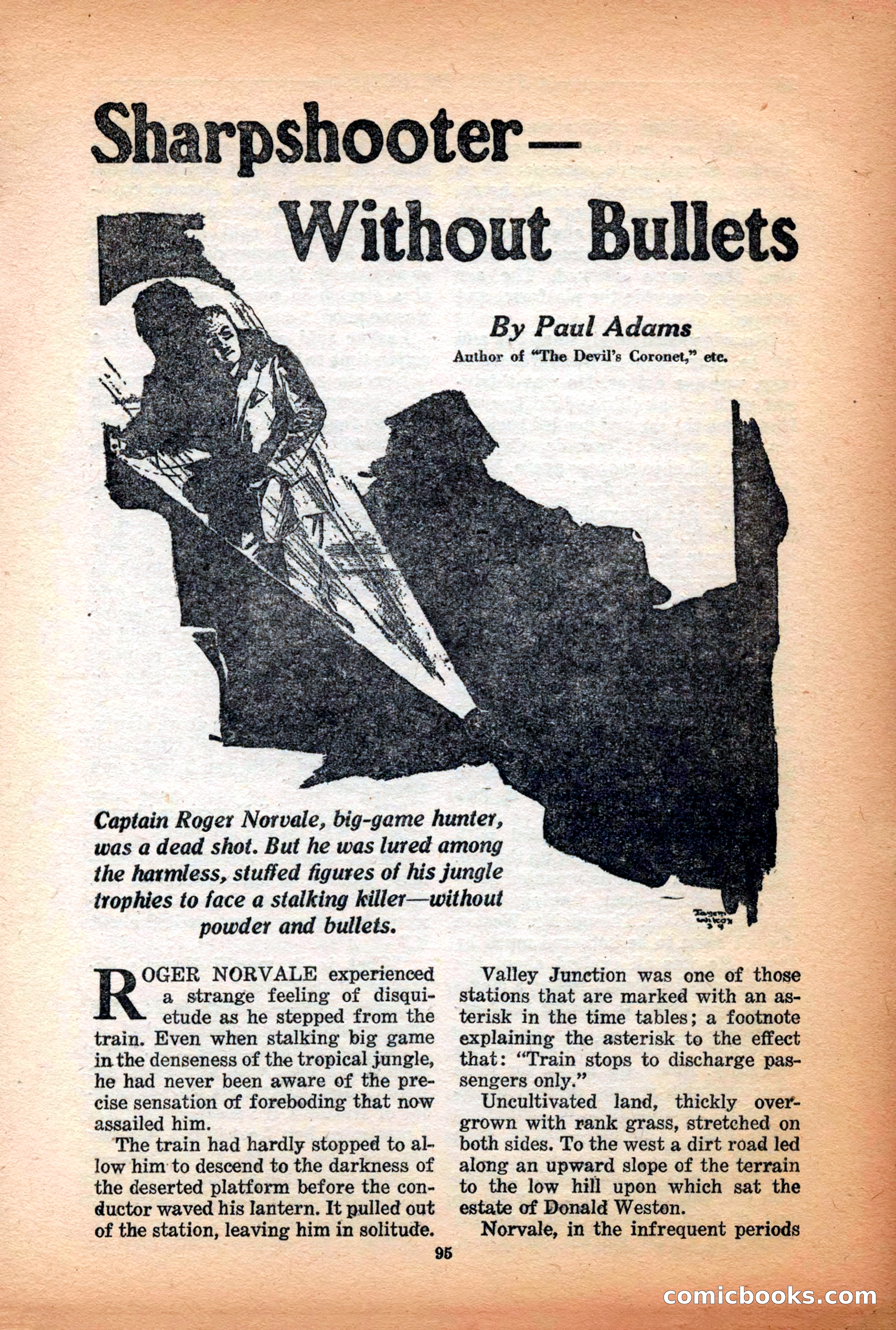
# Analysis of This Page This is an interior story page from a pulp magazine featuring the opening of "Sharpshooter—Without Bullets" by Paul Adams. The page includes a dramatic illustration showing a silhouetted figure with a rifle amid what appears to be taxidermied animals. The story, which begins mid-page, introduces Captain Roger Norvale, a skilled big-game hunter who arrives at a remote train station called Valley Junction and experiences an unusual sense of foreboding. The narrative establishes that Norvale will face an unnamed killer without access to firearms or ammunition, setting up the story's central premise.
# Page Content Analysis This is **story prose** from a pulp detective magazine (page 96 of "10-Story Detective"). The visible text depicts a conversation between Captain Norvale, who has just arrived by car, and Rex Parker, Weston's secretary. Parker drives Norvale up a hill while revealing that their employer Weston has lost five million dollars in the stock market through short-selling. Parker also hints at additional unspecified trouble involving someone named Brenda Ewing, Weston's ward, whose twenty-first birthday celebration is apparently connected to this problem. The narrative establishes tension through Parker's evasiveness and Norvale's growing concern.
This page contains story prose from a pulp fiction mystery or crime narrative titled "Sharpshooter—Without Bullets." The text depicts characters Parker and Norvale investigating the abduction of a young woman named Brenda from a wealthy estate. Parker explains that Brenda was kidnapped from her locked room the previous night by a masked man, and that she must still be on the heavily guarded grounds, which feature electrified fencing and multiple guards. They then meet with the estate's owner, Donald Weston, a millionaire collector who employs Parker. Norvale begins questioning the circumstances surrounding Brenda's disappearance and Parker's romantic interest in her.
This page contains story prose from what appears to be a detective or mystery pulp fiction tale titled "10-Story Detective." The narrative follows characters Weston and Norvale as they explore Weston's house, including his taxidermy collection and Doctor Loring's workroom. The plot takes a dramatic turn when they discover Doctor Loring's body on the floor, stabbed through the eye with a glover's needle. Weston expresses shock and concern that a murderer is loose in the house despite his security measures. The text focuses on building suspense and advancing the mystery plot.
# Page Analysis This is story prose from page 99 of a pulp fiction magazine titled "Sharpshooter—Without Bullets." The text depicts a murder investigation scene in a museum where detective Norvale examines the body of Dr. Loring, a taxidermist who has been stabbed. When Norvale enters the main hall, he discovers an argument between Weston (his employer) and Parker (a secretary attempting to leave). A state trooper is present. Norvale announces that Loring has been murdered, and Parker—initially a suspect due to his sudden departure—denies involvement, though his defensive reaction suggests complications ahead in the investigation.
# Page Analysis This is **story prose** from a pulp detective magazine titled "10-Story Detective." The page depicts a dramatic scene in which a suspect named Parker, accused of murdering Doctor Loring, attempts to escape while being questioned by a trooper and other characters. When the officer pursues Parker into an upstairs bedroom, Parker slams and locks the door. After the trooper shoots out the lock and forces entry, they discover the room empty with an open window—Parker has fled outside. The trooper alerts guards on the grounds to apprehend the escaped suspect.
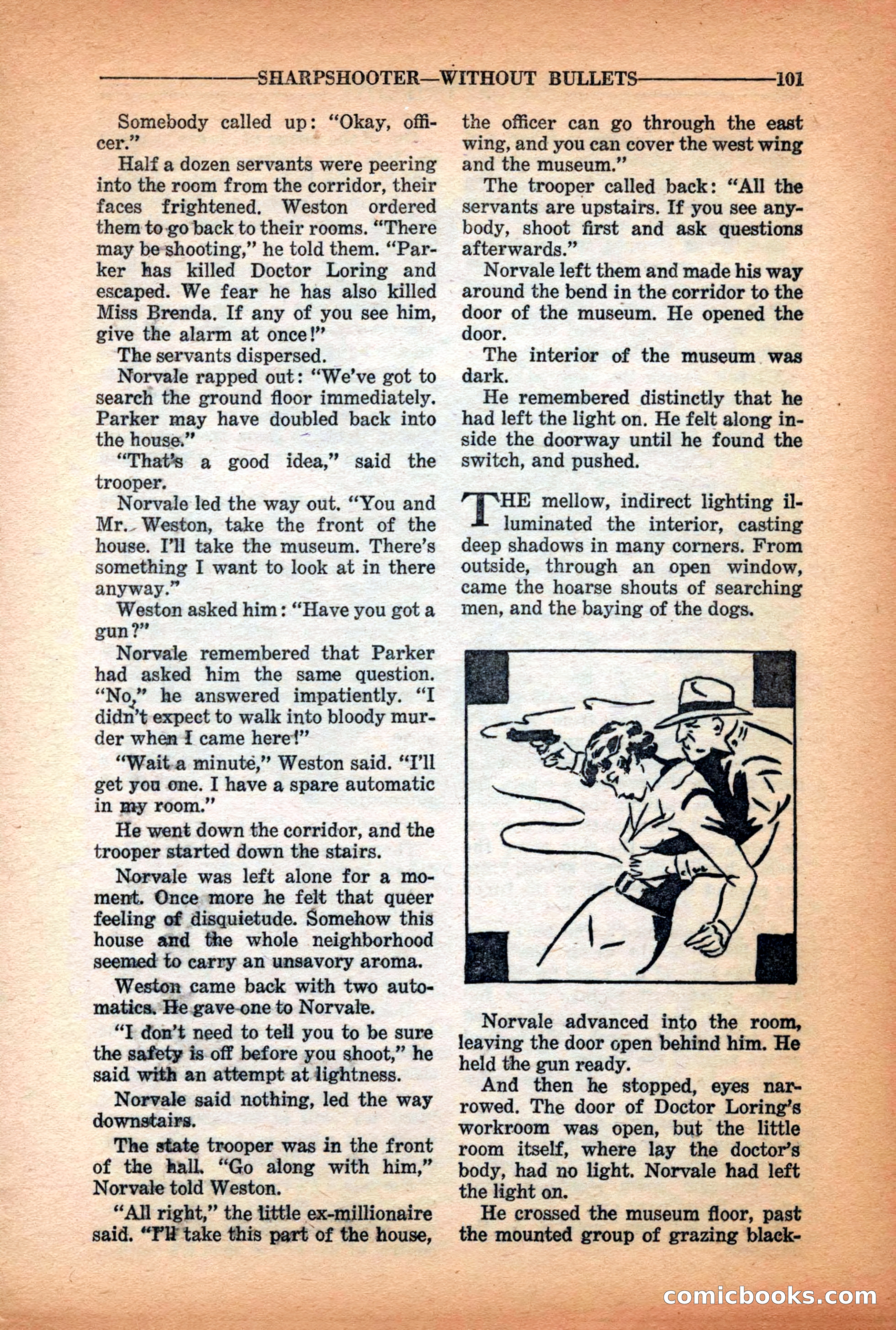
# Page Analysis This is story prose from a pulp fiction mystery or crime narrative, page 101 of "Sharpshooter—Without Bullets." The text depicts a search of a house following a murder: after Doctor Loring and Miss Brenda are killed by someone named Parker, characters Norvale, Weston, and a state trooper divide the premises to hunt for the suspect. Norvale enters a dark museum and notices lights have been turned off despite his having left them on, creating suspense as he discovers details suggesting the killer may still be present. An illustration showing two figures with guns appears mid-page.
# Page Analysis This page contains **story prose** from a pulp detective magazine titled "10-Story Detective" (visible as a running header). The narrative depicts a detective named Norvale investigating a murder in a museum. The text describes Norvale discovering that a mounted taxidermied panther conceals the body of a woman named Brenda Ewing, then being confronted by someone named Weston in the darkened museum. The passage culminates in Norvale accusing Weston of murdering Brenda Ewing, his ward, to maintain control of her estate. The story involves elements of crime mystery and suspense typical of early pulp detective fiction.
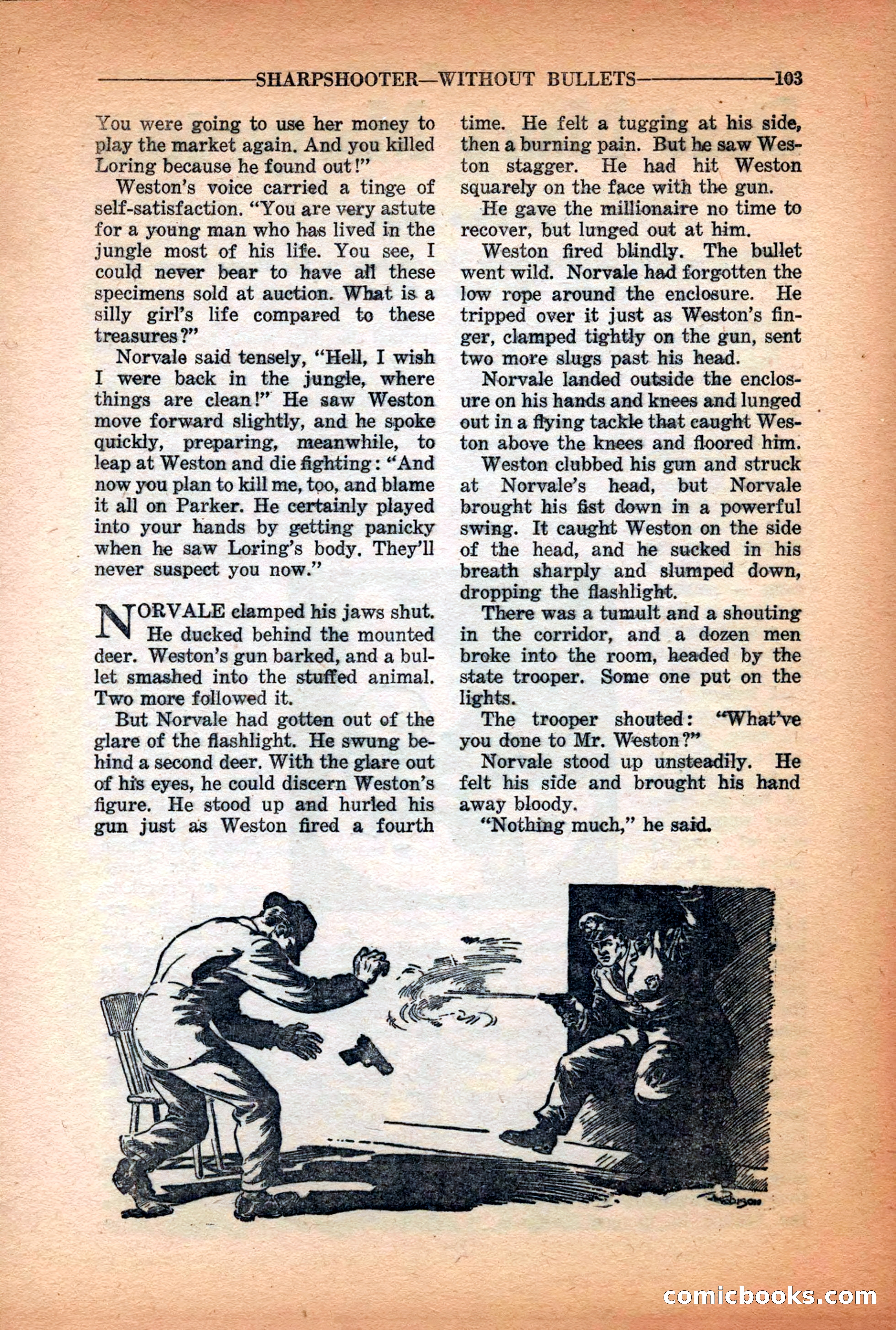
# Page Analysis This is **story prose** from page 103 of a pulp fiction magazine titled "Sharpshooter—Without Bullets." The text depicts a climactic confrontation between characters named Norvale and Weston in what appears to be a room with mounted animal specimens. Weston, revealed as a murderer who killed someone named Loring, shoots at Norvale multiple times. After a violent struggle involving gunfire, Norvale subdues Weston and is discovered wounded by state troopers entering the room. The passage combines action, gunplay, and dialogue typical of early-20th-century crime or adventure pulp fiction. An illustration below shows two figures in conflict.
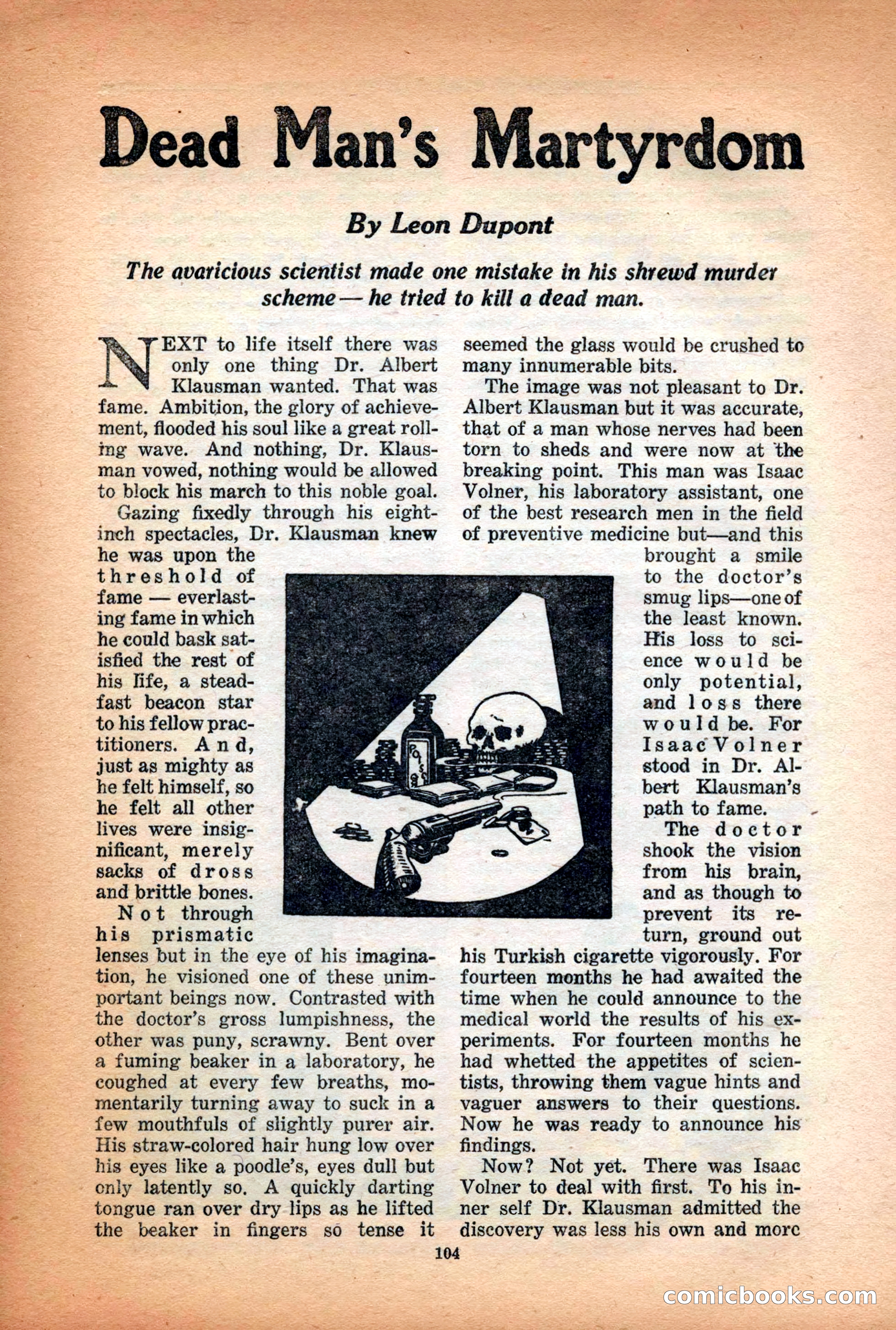
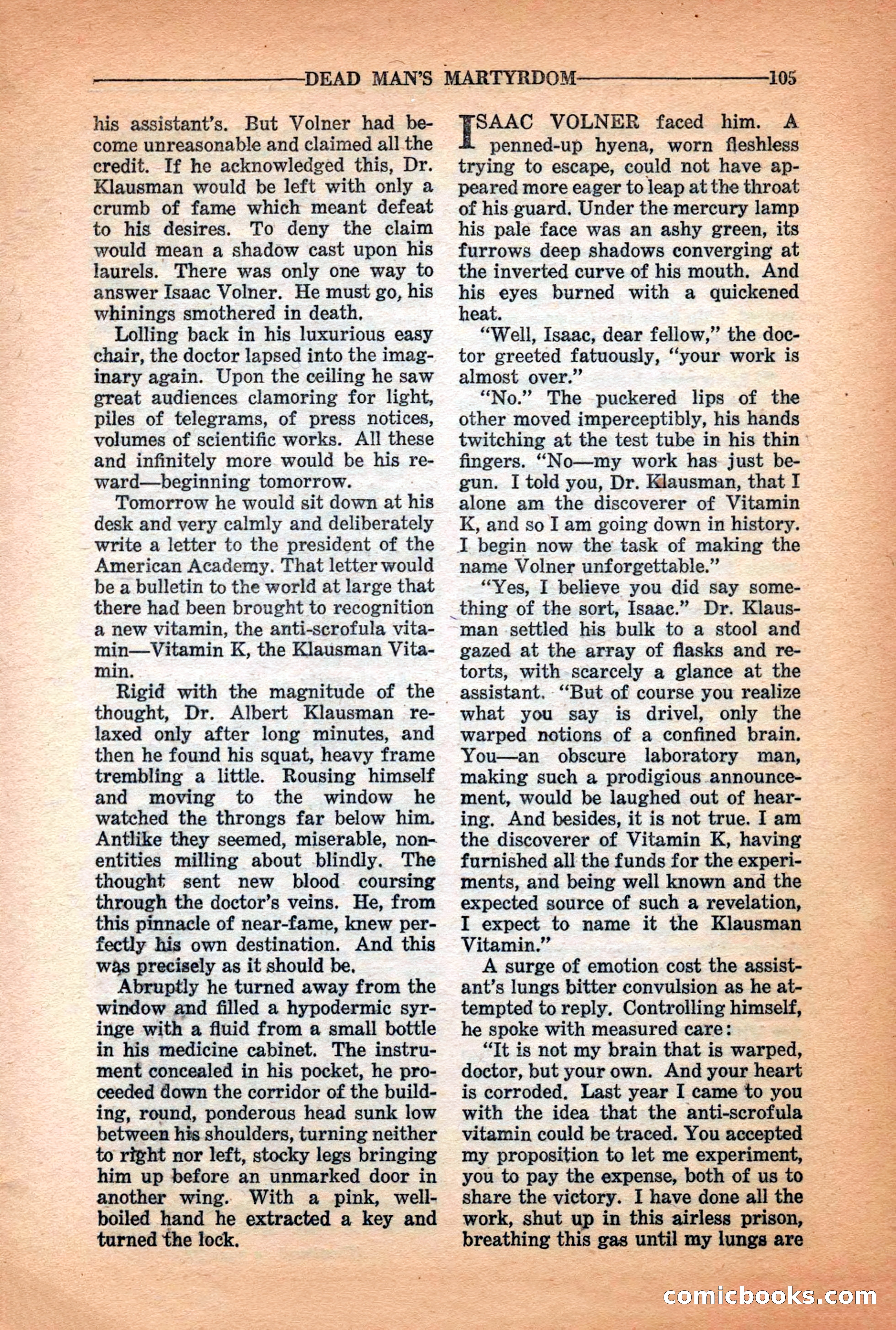
# Dead Man's Martyrdom This is a text page from a pulp fiction story by Leon Dupont. The page contains prose narrative with an embedded illustration showing a skull, bottles, and revolvers on a white cloth—suggesting a murder plot. The story concerns Dr. Albert Klausman, an ambitious scientist obsessed with achieving fame, who views his laboratory assistant Isaac Volner as an obstacle to his recognition. The narrative establishes that Klausman plans to eliminate Volner and claim sole credit for their joint medical research discoveries.
# Page Analysis This is **story prose** from a pulp fiction narrative titled "Dead Man's Martyrdom" (page 105). The text depicts a tense confrontation between Dr. Albert Klausman and his assistant Isaac Volner over credit for discovering Vitamin K. Klausman, seeking sole recognition, has prepared a lethal injection and confronts the confined Volner, who insists he is the true discoverer. Volner accuses Klausman of theft and moral corruption, while Klausman dismisses him as a deluded laboratory worker. The scene builds dramatic tension as the two men dispute priority and reputation in what appears to be a medical laboratory setting.
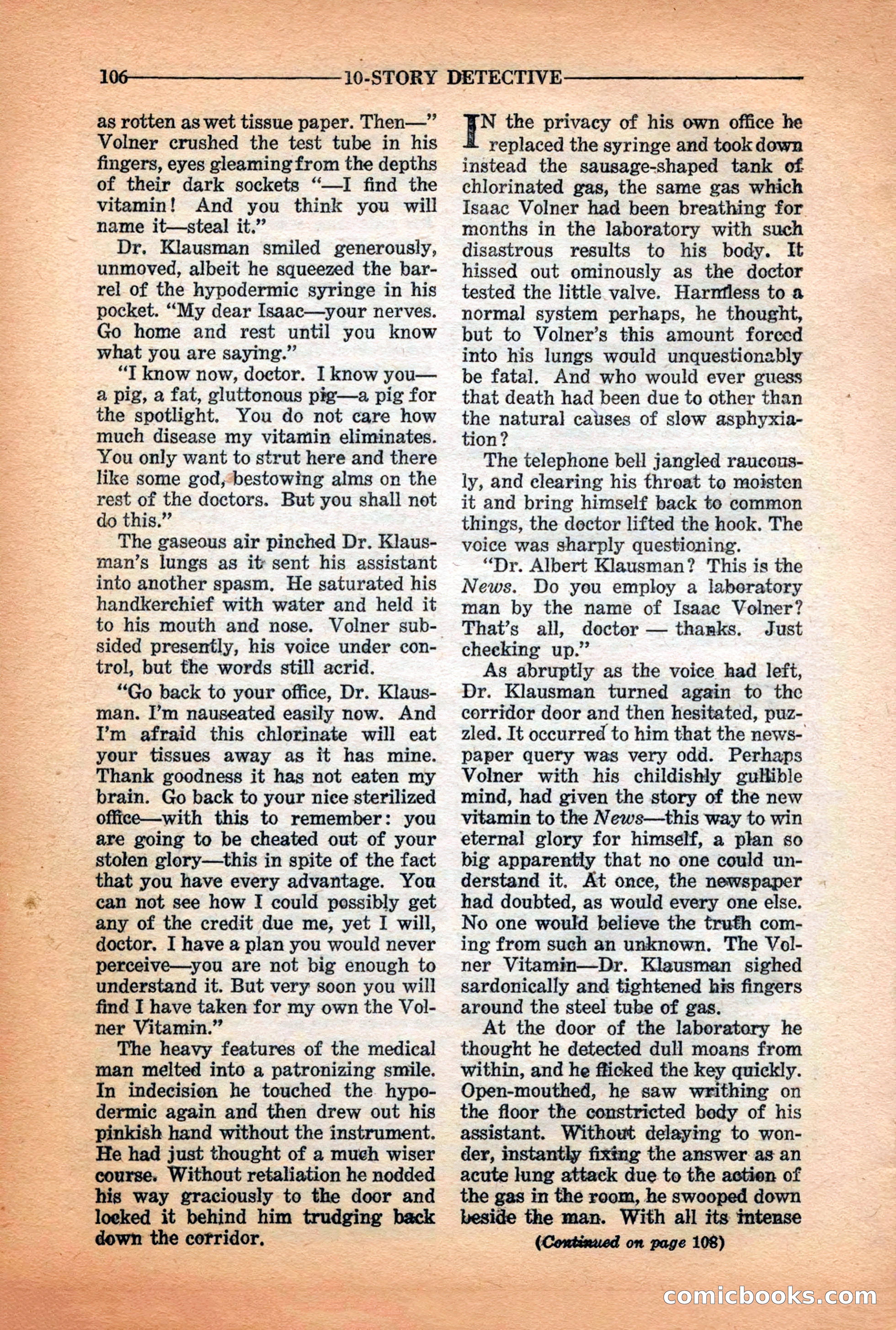
This page contains story prose from what appears to be a detective or crime pulp magazine titled "10-Story Detective." The narrative depicts a confrontation between Dr. Klausman and Isaac Volner over credit for discovering a new vitamin. After Volner threatens to steal the glory, Klausman privately retrieves a tank of chlorinated gas, apparently planning to murder his rival by exposing him to the toxic substance. A telephone call from a newspaper inquiring about Volner then interrupts his scheme, leaving Klausman puzzled about whether Volner has leaked the story to the press.
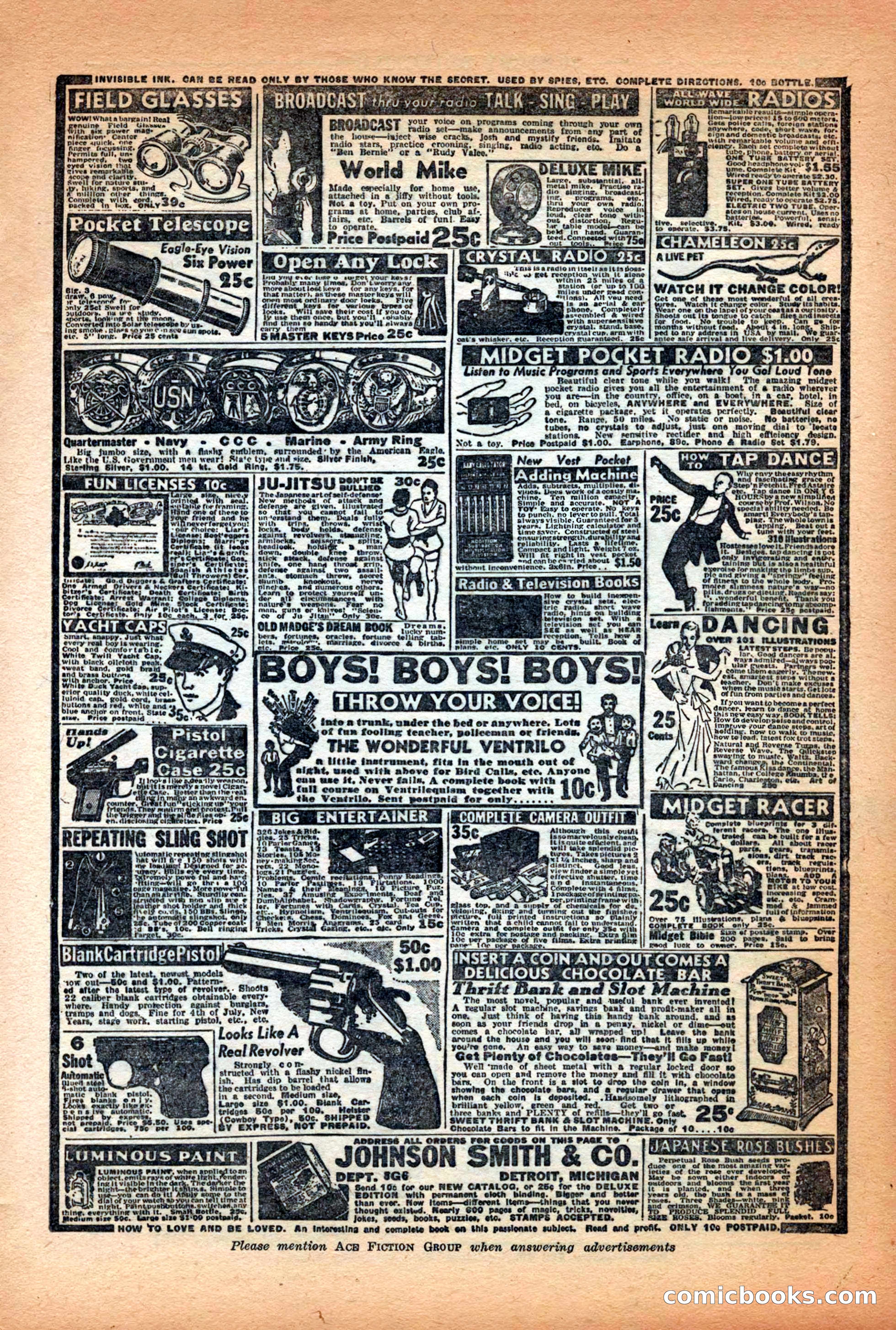
This is an **advertising page** from an early pulp magazine. It displays dozens of mail-order product advertisements typical of the era, including items like field glasses, pocket telescopes, broadcast microphones, crystal radios, lock-picking tools, ventriloquism kits, ju-jitsu instruction courses, dance lessons, and novelty gadgets. The page represents the commercial side of pulp publishing, where advertisements subsidized the magazine's cost and offered readers fantastical or practical products they could purchase by mail.
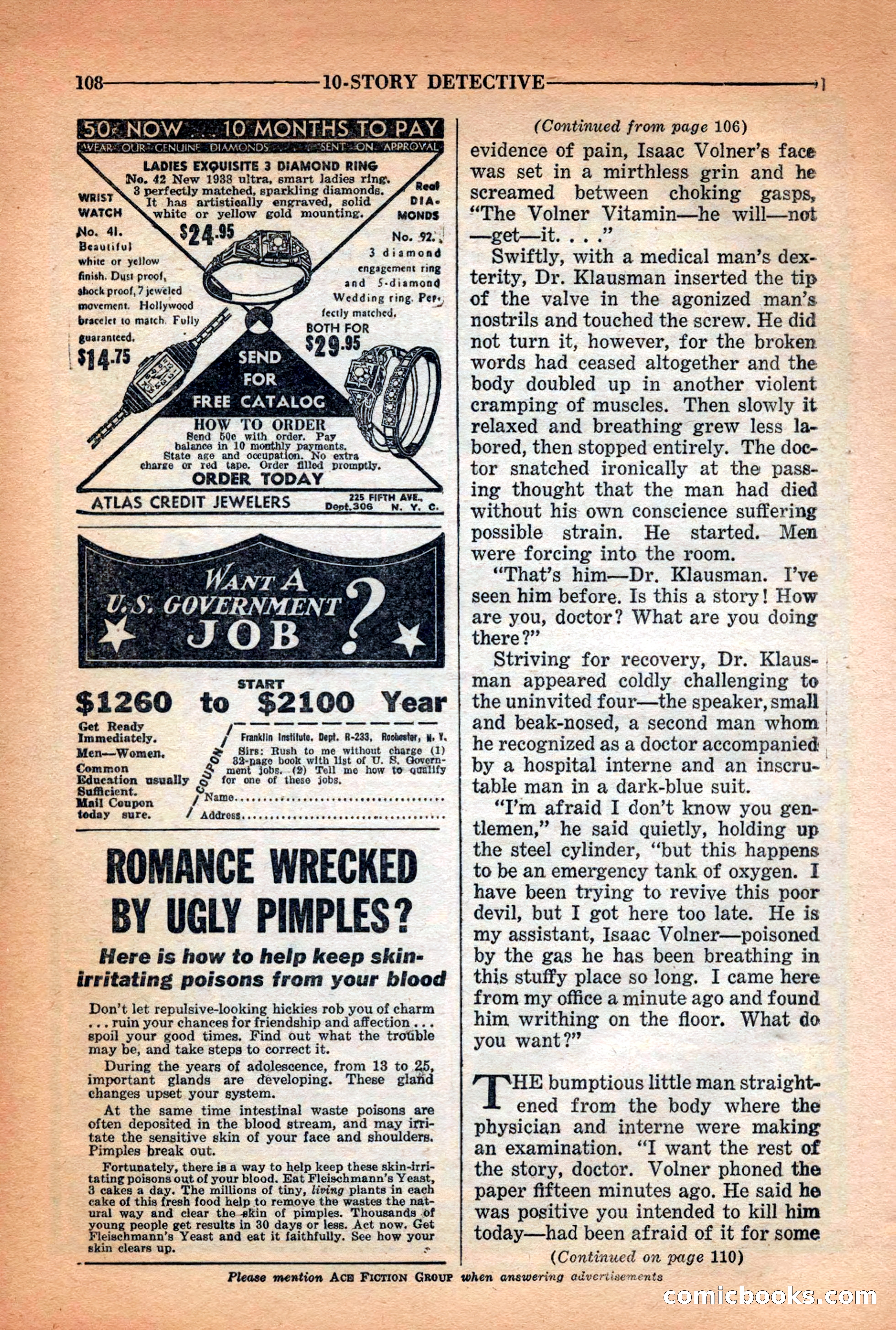
This is page 108 of a pulp magazine titled "10-Story Detective." The page contains advertisements (diamonds rings, government job listings, and Fleischmann's Yeast for acne), along with the continuation of a story involving Dr. Klausman and a deceased man named Isaac Volner. The story excerpt describes a dramatic scene where Dr. Klausman apparently fails to revive Volner using an oxygen tank, then is confronted by suspicious visitors claiming Klausman intended to murder Volner.
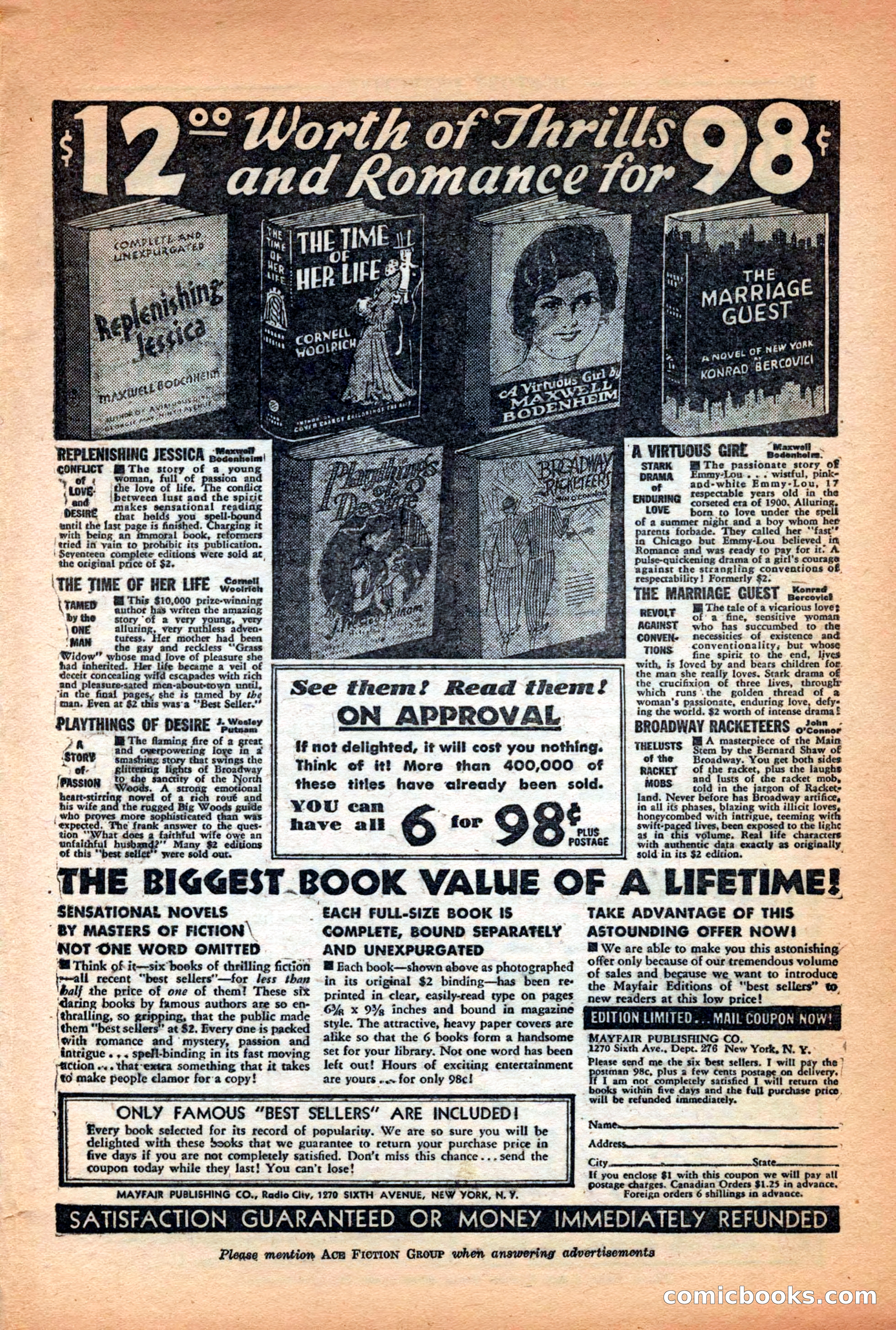
# What This Page Shows This is a **magazine advertisement**, not story prose or a cover. The page promotes a book offer from Mayfair Publishing Co., advertising six full-size novels—including titles like "Replenishing Jessica," "The Time of Her Life," and "The Marriage Guest"—described as bestselling works by "masters of fiction." The central offer promises $12 worth of books for 98 cents on approval, with a satisfaction guarantee. Book descriptions emphasize romantic and dramatic plots involving passion, scandal, and moral conflict typical of pulp-era fiction.
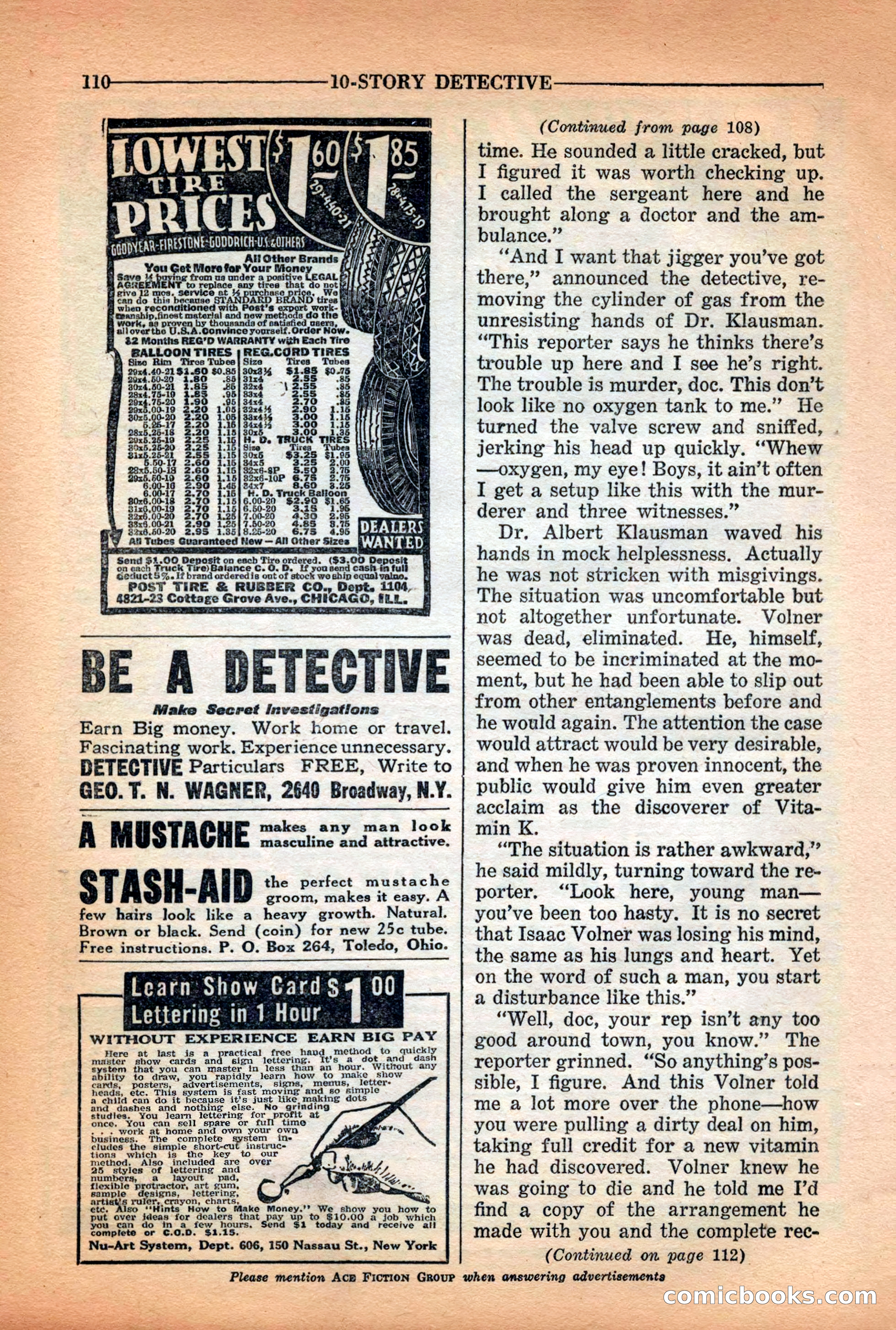
# Page Analysis This is a text page from a pulp detective fiction magazine, containing the continuation of a story titled "10-Story Detective." The visible prose describes a murder investigation scene where a detective arrives to find Dr. Klausman holding what appears to be a gas cylinder. The detective suspects murder and notes the cylinder doesn't contain oxygen. Dr. Klausman remains calm despite appearing incriminated, viewing the situation as ultimately advantageous for his reputation. The page is surrounded by period advertisements for tire prices, detective work opportunities, mustache products, and mail-order courses.
This page is primarily a collection of classified advertisements rather than magazine story content. The visible text advertises various mail-order services popular in the 1930s-40s era: dating and matchmaking clubs ("Lonely Hearts," "Get Acquainted Club"), fertility/medical advice services, massage profession courses, and correspondence clubs. The ads promise romantic connections, financial opportunity, and solutions to loneliness and health concerns, targeting lonely or vulnerable readers through small display advertisements scattered across the page layout.
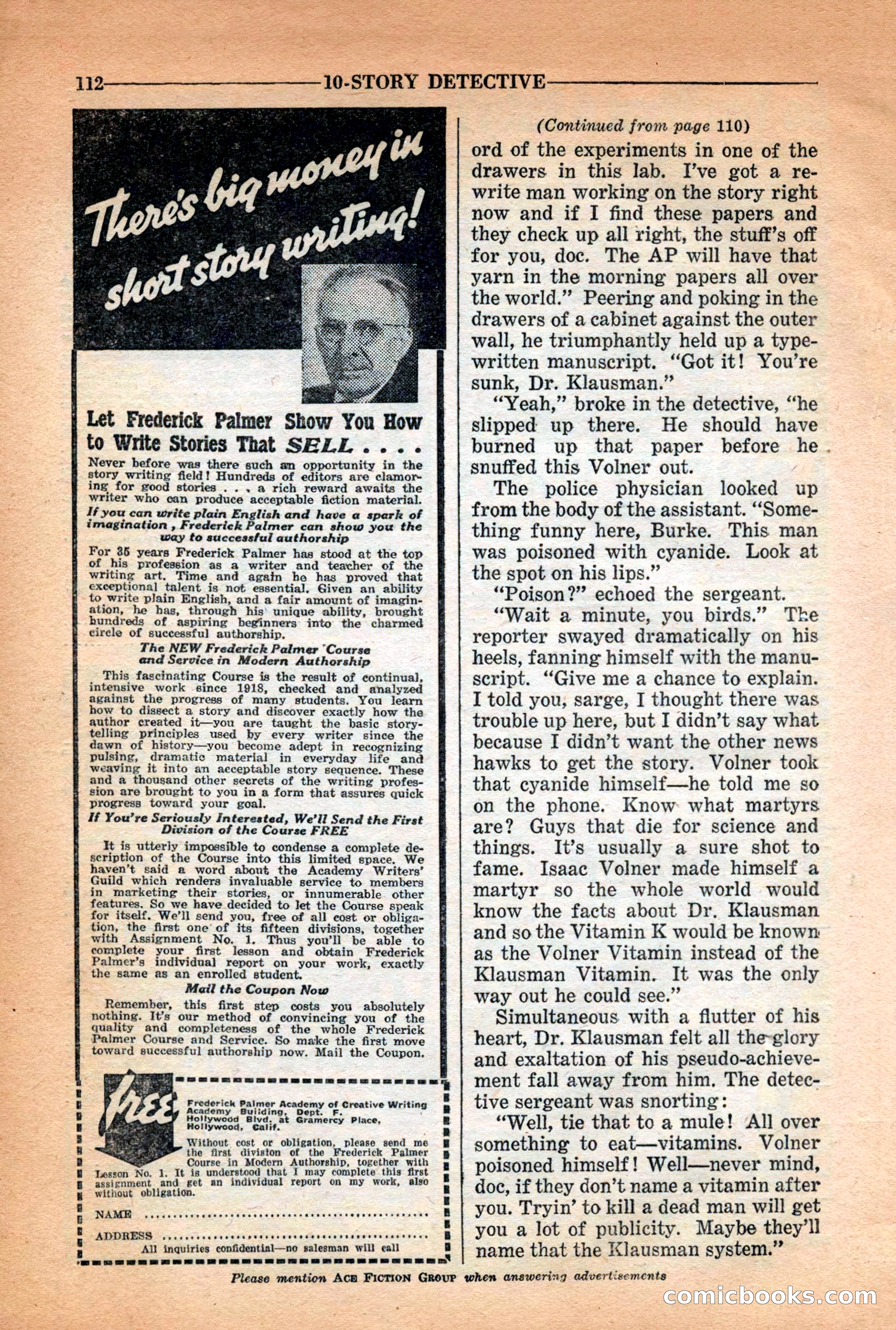
This page is primarily **advertising and story prose** combined on a single page from a pulp magazine. The left two-thirds features a large advertisement for Frederick Palmer's writing course, promising to teach aspiring authors how to write saleable fiction. The right side continues a detective story (from page 110) in which a newspaper reporter discovers a typewritten manuscript at a crime scene involving cyanide poisoning. The story apparently involves Dr. Klausman, a scientist, and a victim named Volner, with the reporter suggesting Volner poisoned himself to become a martyr for science.
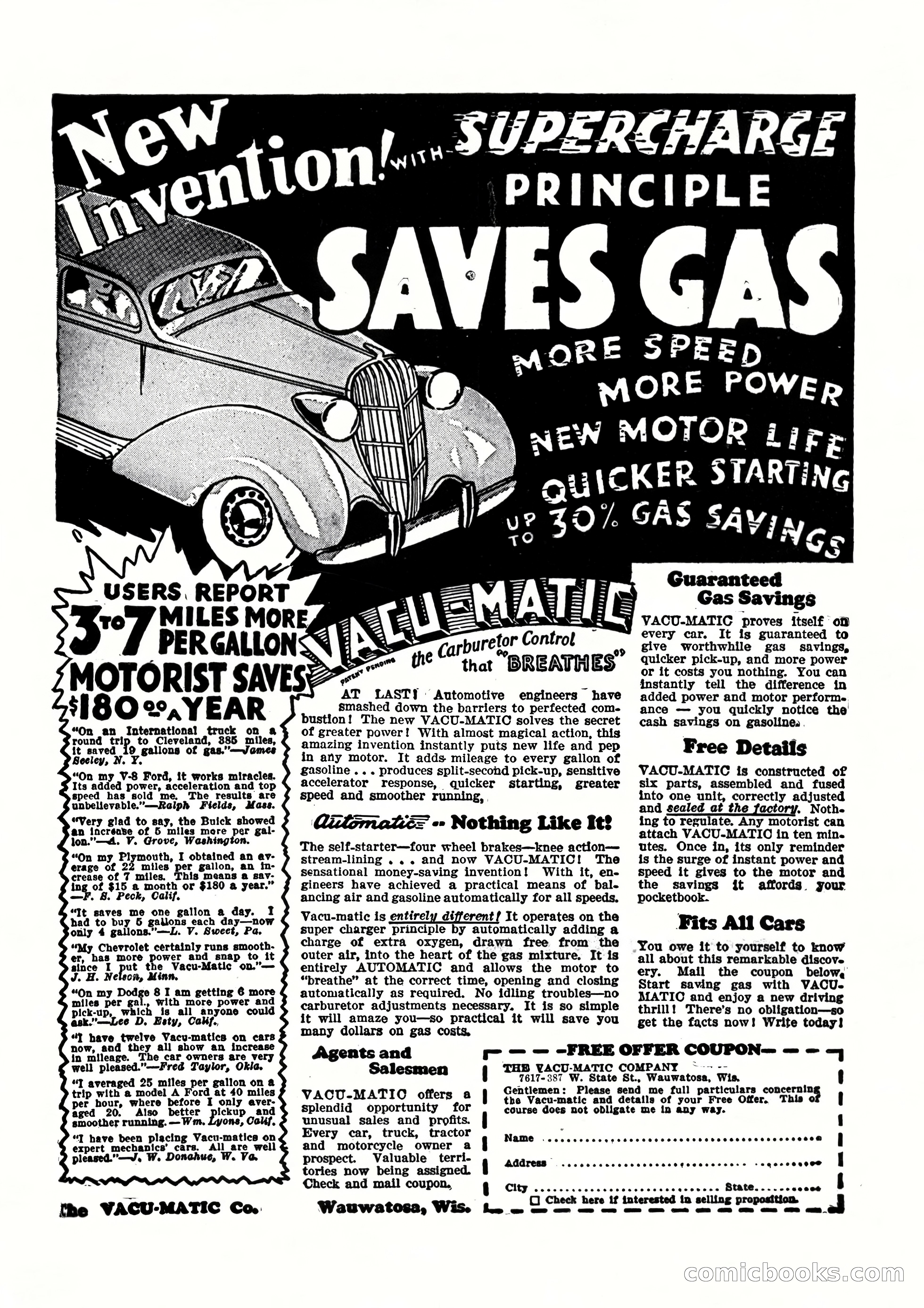
This page is primarily an advertisement for the Vacu-Matic, a purported automotive fuel-saving device. The ad features testimonials from satisfied customers claiming 3-7 miles-per-gallon improvements and annual gas savings up to $180, along with claims of increased engine power and smoother operation. The product allegedly works via a "supercharge principle" that automatically adds oxygen to the fuel mixture. The page includes a coupon for free details and information for sales agents, representing a typical early-20th-century patent-medicine-style automotive gadget advertisement.
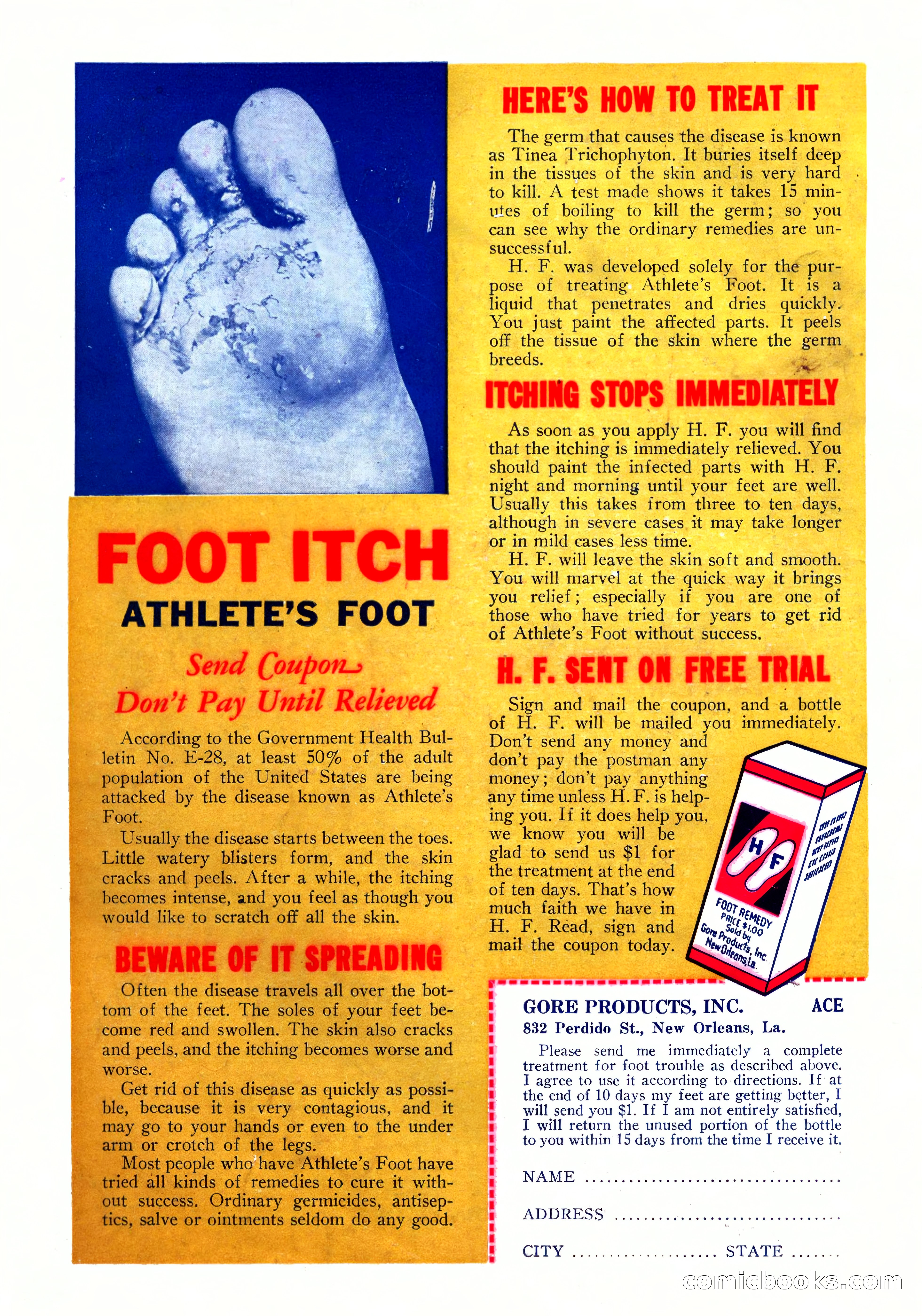
# Advertisement Page: H.F. Athlete's Foot Treatment This is a full-page advertisement from an early-20th-century publication promoting H.F., a purported liquid cure for athlete's foot. The page features a clinical photograph of an infected foot (left side) and extensive text describing athlete's foot symptoms, the product's claimed mechanism of action, and instructions for ordering via a free trial coupon. The ad asserts that the fungal germ *Tinea Trichophyton* requires fifteen minutes of boiling to kill, making ordinary remedies ineffective, and claims H.F. provides immediate itch relief. Customers could order risk-free from Gore Products, Inc. in New Orleans, Louisiana, paying only $1 after ten days if satisfied.