
Pulp Fiction, 1938 · page 68 of 116
10-Story Detective Magazine Cover — page 68: what you’re looking at
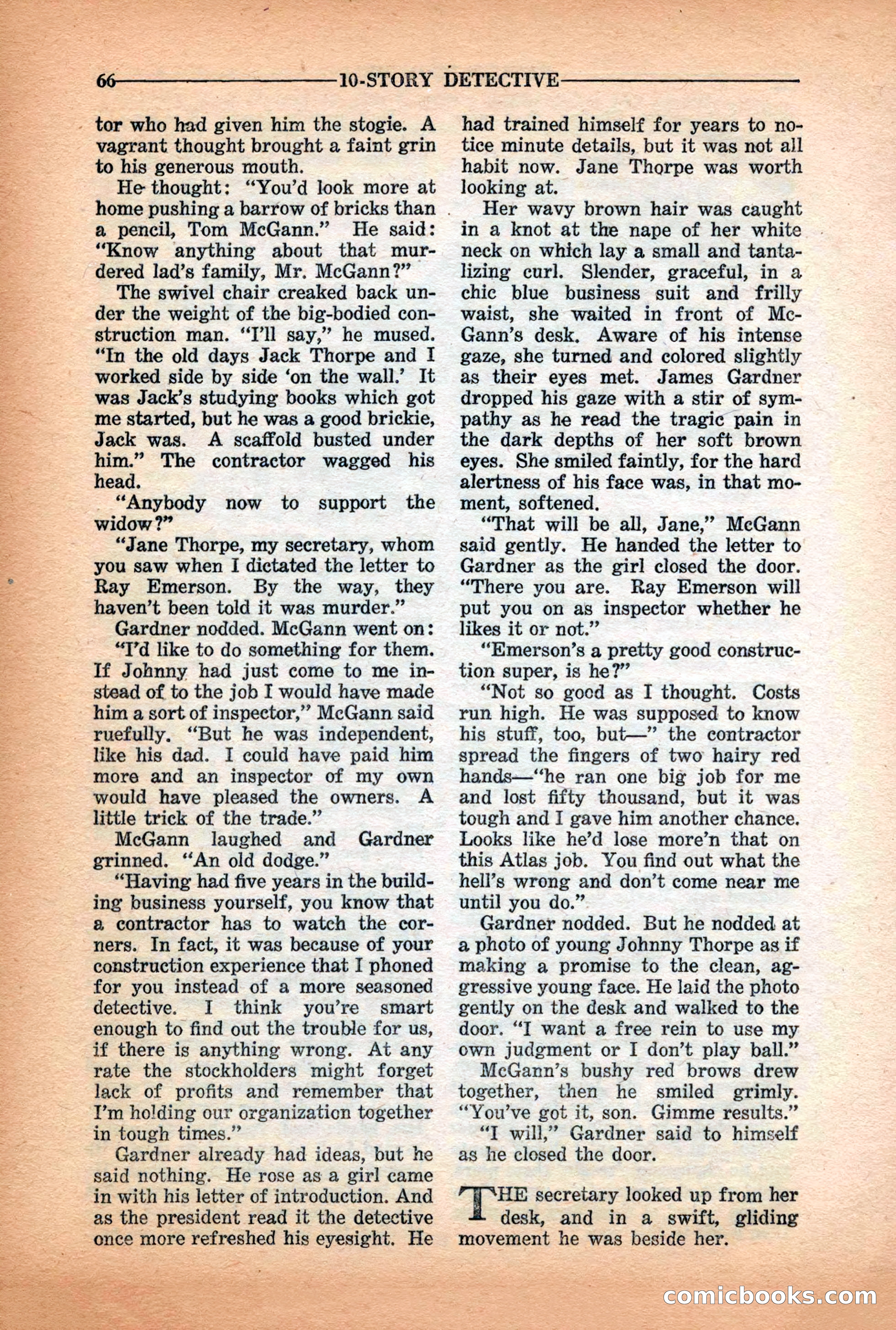
A restored page from Pulp Fiction, 1938. Page through the whole issue in the reader above.
📄 Transcribed text from this page (OCR, searchable)
Machine-transcribed from the original scan — historical spelling and the odd misread are preserved.
66—$_$_$_<—_——_—_—_———10-STORY DETECTIVE _ tor who had given him the stogie. A vagrant thought brought a faint grin to his generous mouth. He thought: “You’d look more at home pushing a barrow of bricks than . a pencil, Tom McGann.” He said: “Know anything about that mur- dered lad’s family, Mr. McGann?” The swivel chair creaked back un- der the weight of the big-bodied con- struction man. “‘T’ll say,’”? he mused. “In the old days Jack Thorpe and I worked side by side ‘on the wall.’ It was Jack’s studying books which got me started, but he was a good brickie, Jack was. A scaffold busted under him.” The contractor wagged his head. “Anybody now to support the widow?” “Jane Thorpe, my secretary, whom you saw when I dictated the letter to Ray Emerson. By the way, they haven’t been told it was murder.” Gardner nodded. McGann went on: “T’d like to do something for them. If Johnny had just come to me in- stead of to the job I would have made him a sort of inspector,’’ McGann said ruefully. “But he was independent, like his dad. I could have paid him more and an inspector of my own would have pleased the owners. A little trick of the trade.” McGann laughed and Gardner grinned. “An old dodge.” “Having had five years in the build- ing business yourself, you know that a contractor has to watch the cor- ners. In fact, it was because of your construction experience that I phoned for you instead of a more seasoned detective. I think you’re smart enough to find out the trouble for us, if there is anything wrong. At any rate the stockholders might forget lack of profits and remember that I’m holding our organization together in tough times.” Gardner already had ideas, but he said nothing. He rose as a girl came in with his letter of introduction. And as the president read it the detective once more refreshed his eyesight. He had trained himself for years to no- tice minute details, but it was not all habit now. Jane Thorpe was worth looking at. Her wavy brown hair was caught in a knot at the nape of her white neck on which lay a small and tanta- lizing curl. Slender, graceful, in a chic blue business suit and frilly waist, she waited in front of Mc- Gann’s desk, Aware of his intense gaze, she turned and colored slighily as their eyes met. James Gardner dropped his gaze with a stir of sym- pathy as he read the tragic pain in the dark depths of her soft brown eyes. She smiled faintly, for the hard alertness of his face was, in that mo- ment, softened. “That will be all, Jane,” MeGann said gently. He handed the letter to Gardner as the girl closed the door. “There you are. Ray Emerson will put you on as inspector whether he likes it or not.” “Emerson’s a pretty good construc- tion super, is he?” “Not so goed as I thought. Costs run high. He was supposed to know his stuff, too, but—” the contractor spread the fingers of two hairy red hands—‘“‘he ran one big job for me and lost fifty thousand, but it was tough and I gave him another chance. Looks like he’d lose more’n that on this Atlas job. You find out what the hell’s wrong and don’t come near me until you do.” Gardner nodded. But he nodded at a photo of young Johnny Thorpe as if making a promise to the clean, ag- gressive young face. He laid the photo gently on the desk and walked to the door. “I want a free rein to use my own judgment or I don’t play ball.” MecGann’s bushy red brows drew together, then he smiled grimly. “You’ve got it, son. Gimme results.” “T will,” Gardner said to himself as he closed the door. HE secretary looked up from her desk, and in a swift, gliding movement he was beside her. Comicbooks (Eo)