
Pulp Fiction, 1938 · page 103 of 116
10-Story Detective Magazine Cover — page 103: what you’re looking at
A restored page from Pulp Fiction, 1938. Page through the whole issue in the reader above.
📄 Transcribed text from this page (OCR, searchable)
Machine-transcribed from the original scan — historical spelling and the odd misread are preserved.
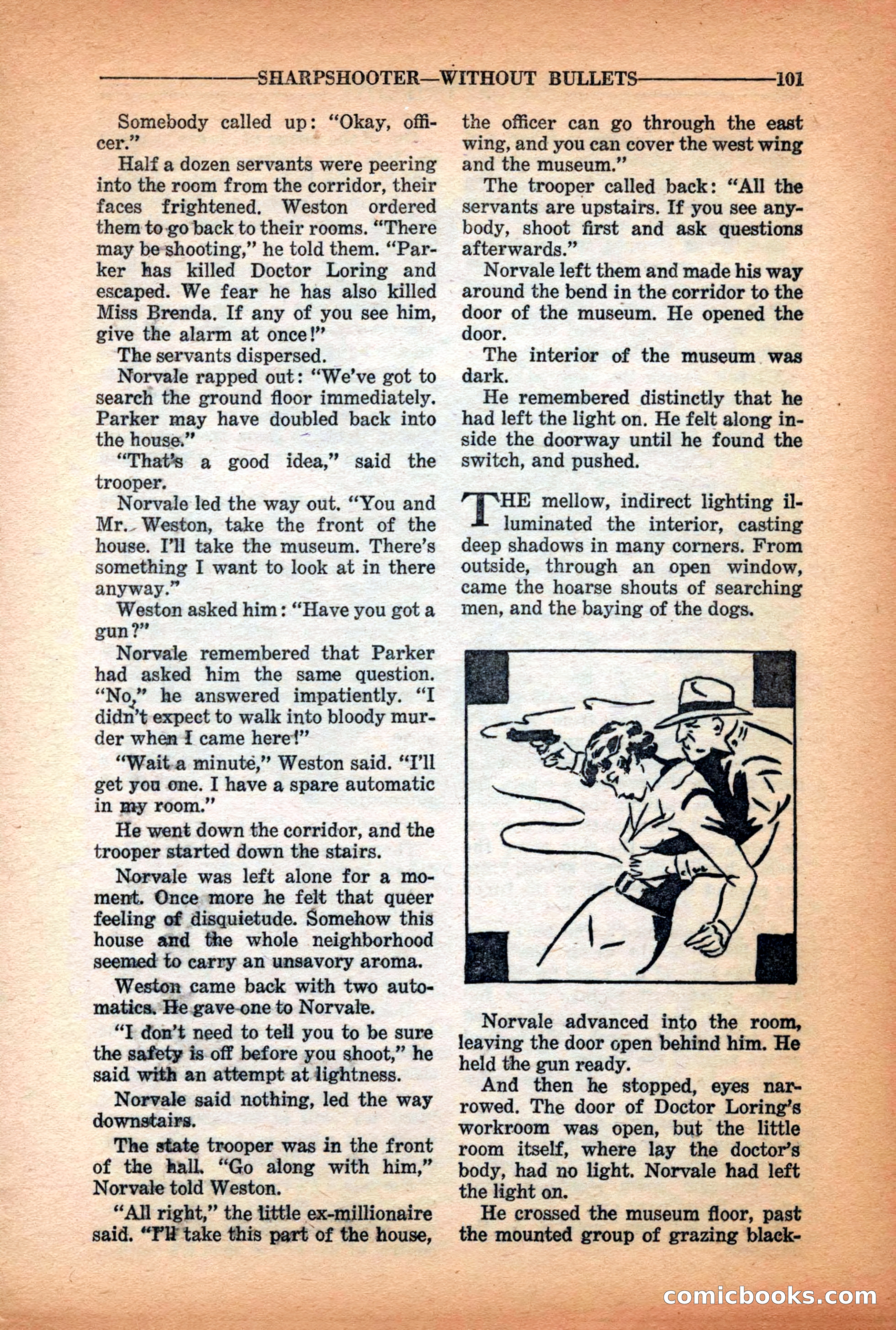
SHARPSHOOTER—WITHOUT BULLETS————————101 Somebody called up: cer.” 7 Half a dozen servants were peering into the room from the corridor, their faces frightened. Weston ordered them to-go back to their rooms. “There may be-shooting,” he told them. “‘Par- ker has killed Doctor Loring and escaped. We fear he has also killed Miss Brenda. If any of you see him, give the alarm at once!” The servants dispersed. Norvale rapped out: “We’ve got to search the ground floor immediately. Parker may have doubled back into the house.” : “That's a good idea,’ said the trooper. Norvale led the way out. “You and Mr.- Weston, take the front of the house. I’ll take the museum. There’s something I want to look at in there anyway.” Weston asked him: “Have you gota gun 9 Norvale remembered that Parker had asked him the same question. “No,” he answered impatiently. “I didn’t expect to walk into bloody mur- der when i came here?” “Wait.a minute,” Weston said. “I'll get you one. I have a spare automatic in me room.” He went down the corridor, and the trooper started down the stairs. Norvale was left alone for a mo- ment. Once more he felt that queer feeling of disquietude. Somehow this house and the whole neighborhood seemed to carry an unsavory aroma. Weston came back with two auto- matics, He gave-one to Norvale. “fT don’t need to tell you to be sure the safety is.off before you shoot,” he said with an attempt at lightness. Norvale said nothing, led the way downstairs. The state trooper was in the front of the hall. “Go along with him,” Norvale told Weston. “All right,” the little ex-millionaire said. “Pl take this part of the house, “Okay, offi- the officer can go through the east wing, and you can cover the west wing and the museum.” The trooper called back: “All the servants are upstairs. If you see any- body, shoot first and ask questions afterwards.” Norvale left them and made his way around the bend in the corridor to the door of the museum. He opened the door. The interior of the museum was dark. He remembered distinctly that he had left the light on. He felt along in- side the doorway until he found the switch, and pushed. HE mellow, indirect lighting il- luminated the interior, casting deep shadows in many corners. From outside, through an open window, came the hoarse shouts of searching men, and the baying of the dogs. Norvale advanced into the room, leaving the door open behind him. He held the gun ready. And then he stopped, eyes nar- rowed. The door of Doctor Loring’s workroom was open, but the little room itself, where lay the doctor’s body, had no light. Norvale had left the light on. He crossed the museum floor, past the mounted group of grazing black-