
Pulp Fiction, 1938 · page 50 of 116
10-Story Detective Magazine Cover — page 50: what you’re looking at
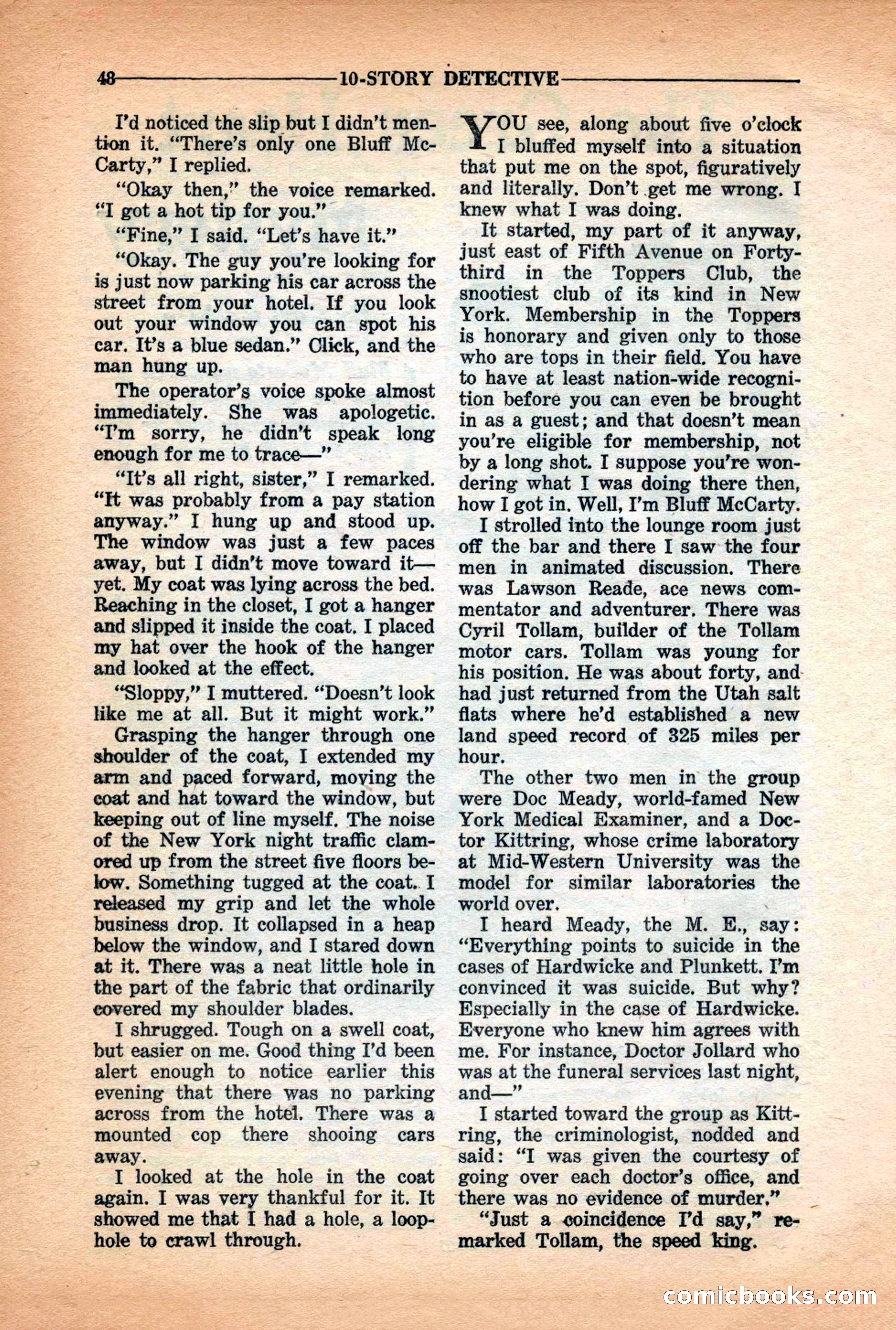
A restored page from Pulp Fiction, 1938. Page through the whole issue in the reader above.
📄 Transcribed text from this page (OCR, searchable)
Machine-transcribed from the original scan — historical spelling and the odd misread are preserved.
‘ * —— - . ~~. Fe oF 7 ee “ ay » 5 a ay . a non — at Les — s~ : Pa es - = Se a ST ~S a > —_ - : —. a hee a ai cn =~ “ 2 A _ oe soe = er. ae “De Z + sa = SS — a nt =a: “. So Ra cetes . ey i Se Sa Si vise ey 4g —____________10-STORY DETECTIVE- I’d noticed the slip but I didn’t men- tion it. “There’s only one Bluff Mc- Carty,” I replied. “Okay then,” the voice remarked. “T got a hot tip for you.” “Fine,” I said. “Let’s have it.” “Okay. The guy you’re looking for is just now parking his car across the street from your hotel. If you look out your window you can spot his car. It’s a blue sedan.” Click, and the man hung up. The operator’s voice spoke almost immediately. She was apologetic. “I'm sorry, he didn’t speak long enough for me to trace—” “It’s all right, sister,” I remarked. “Tt was probably from a pay station anyway.” I hung up and stood up. The window was just a few paces away, but I didn’t move toward it— yet. My coat was lying across the bed. Reaching in the closet, I got a hanger and slipped it inside the coat. I placed my hat over the hook of the hanger and looked at the effect. ‘Sloppy,” I muttered. “Doesn’t look like me at all. But it might work.” Grasping the hanger through one shoulder of the coat, I extended my arm and paced forward, moving the eoat and hat toward the window, but keeping out of line myself, The noise of the New York night traffic clam- ored up from the street five floors be- low. Something tugged at the coat.. I released my grip and let the whole business drop. It collapsed in a heap below the window, and I stared down at it. There was a neat little hole in the part of the fabric that ordinarily eovered my shoulder blades. I shrugged. Tough on a swell coat, but easier on me. Good thing I’d been alert enough to notice earlier this evening that there was no parking across from the hotel. There was a mounted cop there shooing cars away. Fin looked at the hole in the coat . | was very thankful for it. It showed me that I had a hole, a loop- hole to crawl through. Sr en Ee a ee OU see, along about five o’clock I bluffed myself into a situation that put me on the spot, figuratively and literally. Don’t get me wrong. I knew what I was doing. It started, my part of it anyway, just east of Fifth Avenue on Forty- third in the Toppers Club, the snootiest club of its kind in New York. Membership in the Toppers is honorary and given only to those who are tops in their field. You have to have at least nation-wide recogni- tion before you can even be brought in as a guest; and that doesn’t mean you’re eligible for membership, not by a long shot. I suppose you’re won- dering what I was doing there then, how I got in. Well, I’m Bluff McCarty. I strolled into the lounge room just off the bar and there I saw the four men in animated discussion. There was Lawson Reade, ace news com- mentator and adventurer. There was Cyril Tollam, builder of the Tollam motor cars. Tollam was young for his position. He was about forty, and. had just returned from the Utah salt flats where he’d established a new land speed record of 325 miles per hour. The other two men in the group were Doc Meady, world-famed New York Medical Examiner, and a Doc- tor Kittring, whose crime laboratory at Mid-Western University was the model for similar laboratories the world over. I heard Meady, the M. E., say: “Everything points to suicide in the cases of Hardwicke and Plunkett. I’m convinced it was suicide. But why? Especially in the case of Hardwicke. Everyone who knew him agrees with me. For instance, Doctor Jollard who was at the funeral services last night, and—” I started toward the group as Kitt- ring, the criminologist, nodded and said: “I was given the courtesy of going over each doctor’s office, and there was no evidence of murder,” “Just a coincidence I’d say,” marked Tollam, the speed king. (eo) Eomichoo