
Pulp Fiction, 1938 · page 15 of 116
10-Story Detective Magazine Cover — page 15: what you’re looking at
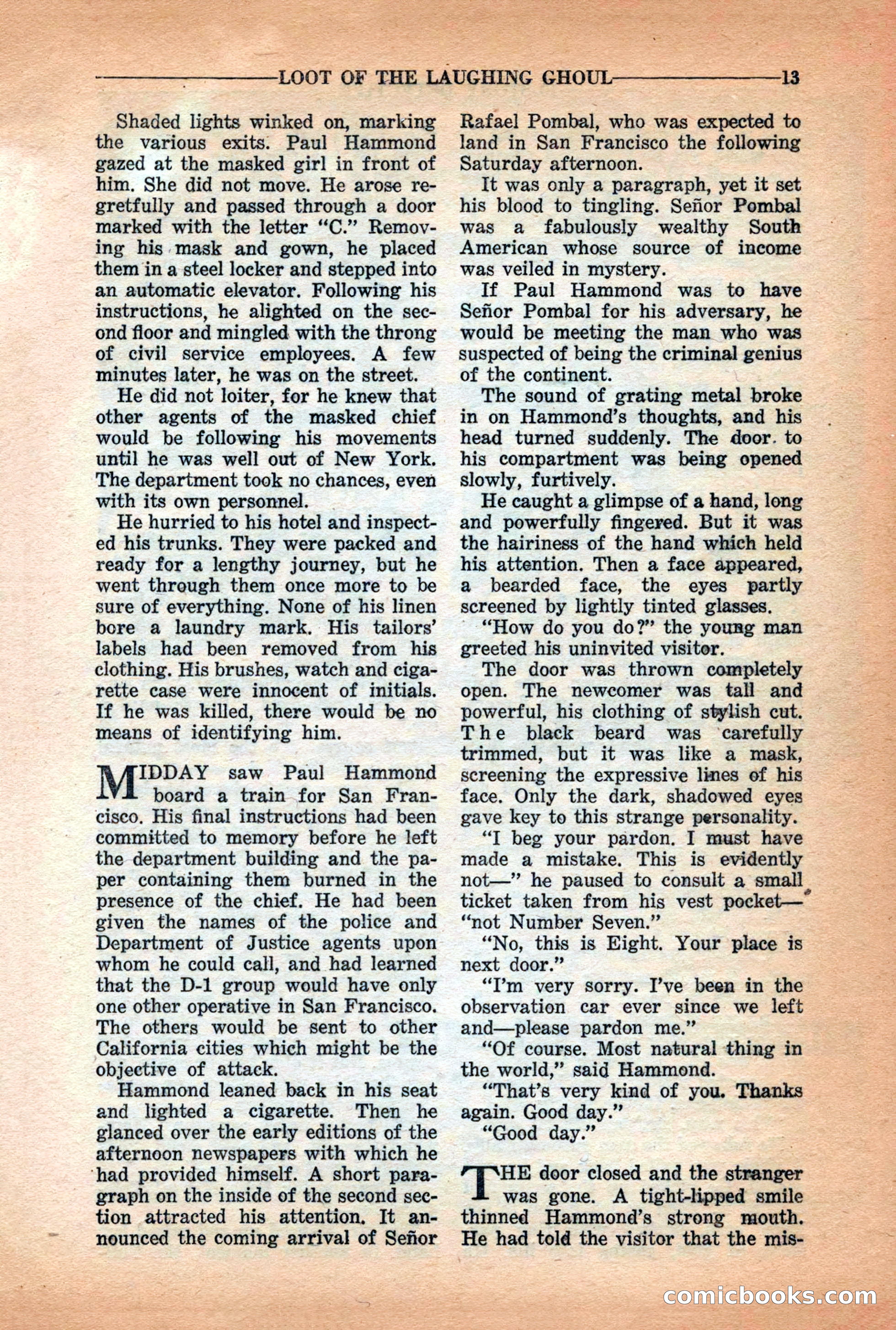
A restored page from Pulp Fiction, 1938. Page through the whole issue in the reader above.
📄 Transcribed text from this page (OCR, searchable)
Machine-transcribed from the original scan — historical spelling and the odd misread are preserved.
LOOT OF THE LAUGHING GHO Shaded lights winked on, marking the various exits. Paul Hammond gazed at the masked girl in front of him. She did not move. He arose re- gretfully and passed through a door marked with the letter “C.”’ Remov- ing his mask and gown, he placed them in a steel locker and stepped into an automatic elevator. Following his instructions, he alighted on the sec- ond floor and mingled with the throng of civil service employees. A few minutes later, he was on the street. He did not loiter, for he knew that other agents of the masked chief would be following his movements until he was well out of New York. The department took no chances, even with its own personnel. He hurried to his hotel and inspect- ed his trunks. They were packed and ready for a lengthy journey, but he went through them once more to be sure of everything. None of his linen bore a laundry mark. His tailors’ labels had been removed from his clothing. His brushes, watch and ciga- rette case were innocent of initials. If he was killed, there would be no means of identifying him. IDDAY saw Paul Hammond board a train for San Fran- cisco. His final instructions had been committed to memory before he left the department building and the pa- per containing them burned in the presence of the chief. He had been given the names of the police and Department of Justice agents upon whom he could call, and had learned that the D-1 group would have only one other operative in San Francisco. The others would be sent to other California cities which might be the objective of attack. Hammond leaned back in his seat and lighted a cigarette. Then he glanced over the early editions of the afternoon newspapers with which he ‘had provided himself. A short para- graph on the inside of the second sec- tion attracted his attention. It an- nounced the coming arrival of Sefior Rafael Pombal, who was expected to land in San Francisco the following Saturday afternoon. It was only a paragraph, yet it set his blood to tingling. Sefior Pombal was a fabulously wealthy South American whose source of income was veiled in mystery. If Paul Hammond was to have Sefior Pombal for his adversary, he would be meeting the man who was suspected of being the criminal genius of the continent. The sound of grating metal broke in on Hammond’s thoughts, and his head turned suddenly. The door. to his compartment was being opened slowly, furtively. He caught a glimpse of a hand, long and powerfully fingered. But it was the hairiness of the hand which held his attention. Then a face appeared, a bearded face, the eyes partly screened by lightly tinted glasses. “How do you do?” the young man greeted his uninvited visitor. The door was thrown completely open. The newcomer was tall and powerful, his clothing of stylish cut. | The black beard was ‘carefully trimmed, but it was like a mask, screening the expressive lines of his face. Only the dark, shadowed eyes gave key to this strange personality. “T beg your pardon. I must have made a mistake. This is evidently — not—”’ he paused to consult a small ticket taken from his vest pocket—" “not Number Seven.” “No, this is Eight. Your place is next door.” “I’m very sorry. I’ve been in the observation car ever since we left = and—please pardon me.” “Of course. Most natural thing in the world,” said Hammond. “That's very kind of you. Thanks * again. Good day.” “Good day.” HE door closed and the stranger was gone. A tight-lipped smile | thinned Hammond’s strong mouth. He had tele the visitor that the = = ( i : ; Hits aT 7 vA wedi el eh Viewed ee rr “2 1) a Lee asta flee eet ie Wet Baty 8 eset ' Caan bt nie eye al \ ORs Ss Bu Pa Na Mg ae PURGE Mary a »? Pepe baa ed Ay) OU aa hate, Se I) gn Btu? et el 7 A ee . 1 Fie wl eV Unit yt ds AAD vy ai) Daina te Cir s Dee's tee Ak ot eg PAT CU LiCbt awe ae a es A . ay td he ik - : Va Niue EY A hay Vay iy n This ' ABA ets) Md ai RMA La OS yi) \' ye ig he y \ AAV re A} WL Sa yy sie he. yh ; na bt NeUh A an ANY +4 i'4 i Mas ie oy AS 4 Q et PAGANO ae tr 2 ASA ® nc SM + de Th , Tw Pe me ee hh OWEN,