
Pulp Fiction, 1938 · page 21 of 116
10-Story Detective Magazine Cover — page 21: what you’re looking at
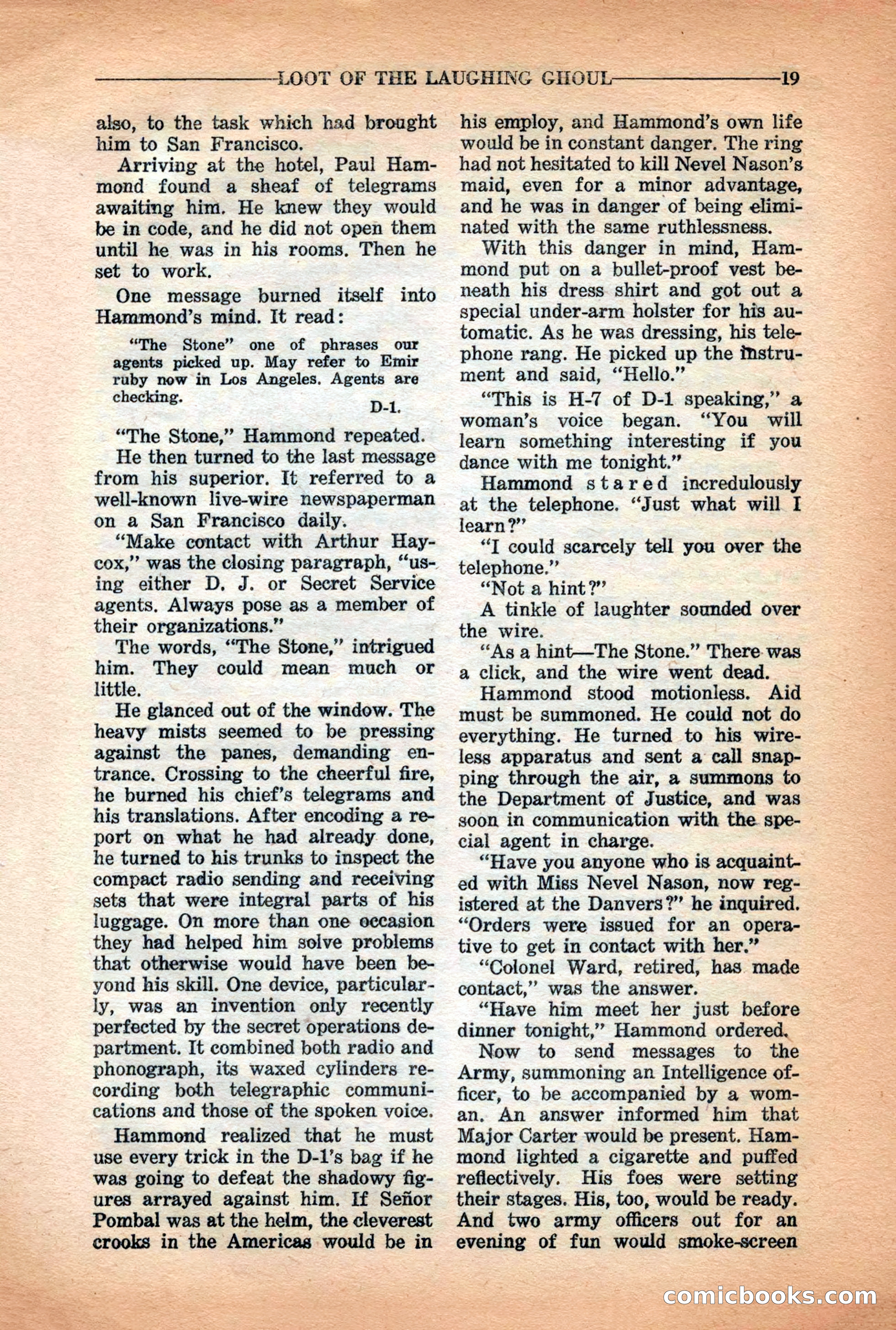
A restored page from Pulp Fiction, 1938. Page through the whole issue in the reader above.
📄 Transcribed text from this page (OCR, searchable)
Machine-transcribed from the original scan — historical spelling and the odd misread are preserved.
ee a OF THE LAUGHING gouL———_———19 Ss also, to the task which had brought him to San Francisco. Arriving at the hotel, Paul Ham- mond found a sheaf of telegrams awaiting him. He knew they would be in code, and he did not open them until he was in his rooms. Then he set to work. One message burned itself into Hammond’s mind. It read: “The Stone” one of phrases our agents picked up. May refer to Emir ruby now in Los Angeles. Agents are checking. D-1 “The Stone,” Hammond repeated. He then turned to the last message from his superior, It referred to a well-known live-wire newspaperman on a San Francisco daily. “Make contact with Arthur Hay- cox,” was the closing paragraph, “us- ing either D. J. or Secret Service agents. Always pose as a member of their organizations.” The words, “The Stone,” intrigued him. They could mean much or little. He glanced out of the window. The heavy mists seemed to be pressing against the panes, demanding en- trance. Crossing to the cheerful fire, he burned his chief’s telegrams and his translations. After encoding a re- port on what he had already done, he turned to his trunks to inspect the compact radio sending and receiving sets that were integral parts of his luggage. On more than one occasion they had helped him solve problems that otherwise would have been be- yond his skill. One device, particular- ly, was an invention only recently perfected by the secret operations de- partment. It combined both radio and phonograph, its waxed cylinders re- cording both telegraphic communi- cations and those of the spoken voice. Hammond realized that he must use every trick in the D-1’s bag if he was going to defeat the shadowy fig- ures arrayed against him. If Sefior Pombal was at the helm, the cleverest crooks in the Americas would be in - To ‘o> . — - ? ae ~ —— his employ, and Hammond’s own life would be in constant danger. The ring | had not hesitated to kill Nevel Nason’s maid, even for a minor advantage, and he was in danger of being elimi- nated with the same ruthlessness. With this danger in mind, Ham- mond put on a bullet-proof vest be- neath his dress shirt and got out a special under-arm holster for his au- tomatic. As he was dressing, his tele- phone rang. He picked up the Mstru- ment and said, “Hello.” “This is H-7 of D-1 speaking,” a woman’s voice began. “You will learn something interesting if you dance with me tonight.” Hammond stared incredulously at the telephone. “Just what will I learn?” “T could scarcely tell you over the telephone.” “Not a hint ?”’ A tinkle of laughter sounded over the wire. “Ag a hint—The Stone.” There. was a click, and the wire went dead. Hammond stood motionless. Aid must be summoned. He could not do everything. He turned to his wire- less apparatus and sent a call snap- ping through the air, a summons to the Department of Justice, and was soon in communication with the spe- — cial agent in charge. “Have you anyone who is acquaint- ed with Miss Nevel Nason, now reg- istered at the Danvers?” he inquired. “Orders were issued for an opera- tive to get in contact with her.” “Colonel Ward, retired, has made contact,” was the answer. “Have him meet her just before dinner tonight,” Hammond ordered, Now to send messages to the Army, summoning an Intelligence of-_ ficer, to be accompanied by a wom- an. An answer informed him that Major Carter would be present. Ham- mond lighted a cigarette and puffed — refiectively. His foes were setting their stages. His, too, would be ready. | And two army officers out for an evening of fun would smoke-screen = = =