
Pulp Fiction, 1938 · page 52 of 116
10-Story Detective Magazine Cover — page 52: what you’re looking at
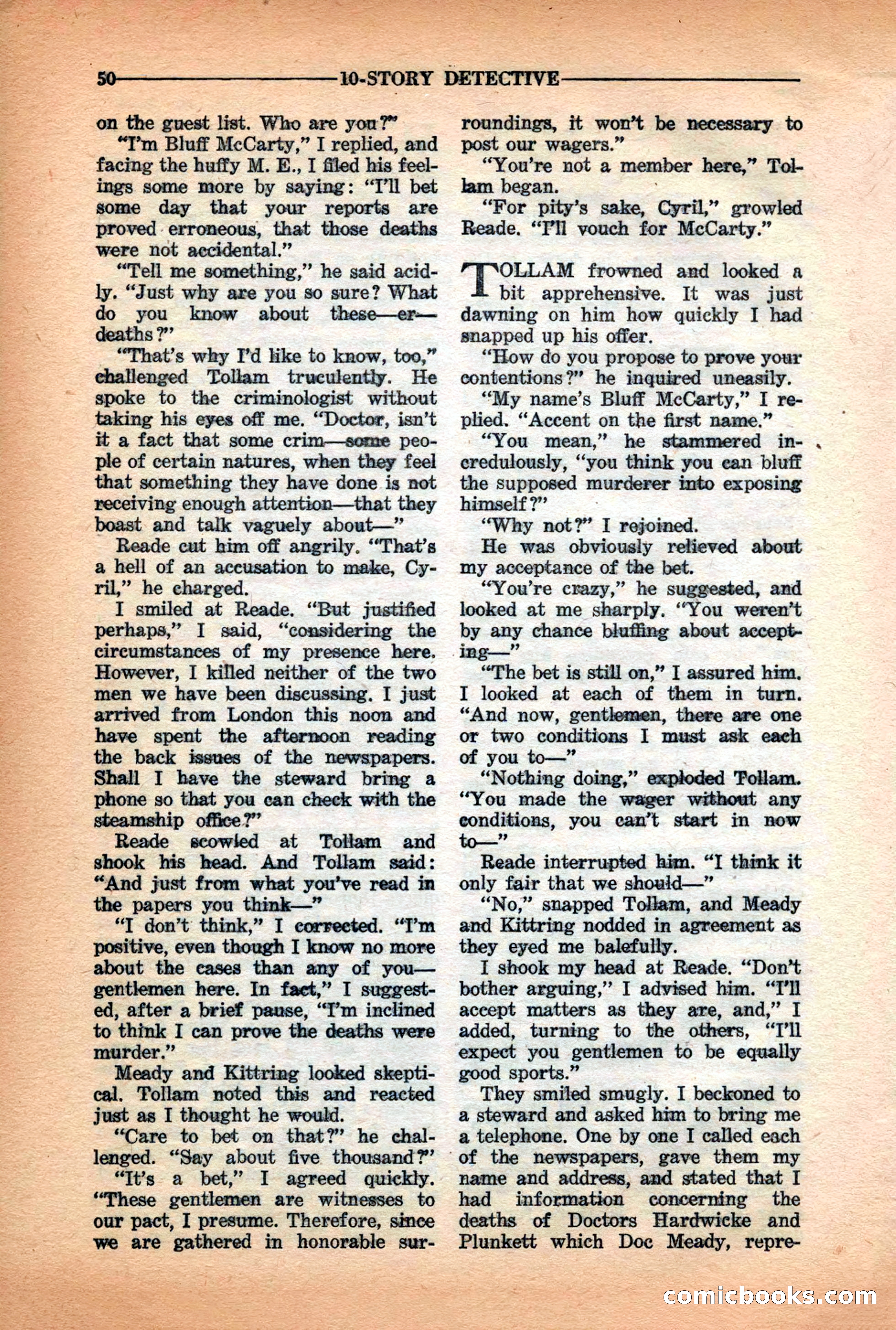
A restored page from Pulp Fiction, 1938. Page through the whole issue in the reader above.
📄 Transcribed text from this page (OCR, searchable)
Machine-transcribed from the original scan — historical spelling and the odd misread are preserved.
= ae a tak Who are you?” “T’m Bluff McCarty,” I replied, and facing the huffy M. E., I filed his feel- ings some more by saying: “I'll bet some day that your reports are were not accidental.” “Tell me something,” he said acid- ly. “Just why are you so sure? What do you know about these—er— deaths ?”’ “That’s why I’d like to know, too,” ehallenged Tollam truculentl. He spoke to the criminologist without taking his eyes off me. “Doctor, isn’t it a fact that some crim—some peo- ple of certain natures, when they feel that something they have done is not - receiving enough attention—that they boast and talk vaguely about—” Reade cut him off angrily. “That’s a hell of an accusation to make, Cy- ril,” he charged. I smiled at Reade. “But justified perhaps,” I said, “considering the circumstances of my presence here. However, I killed neither of the two men we have been discussing. I just arrived from London this noon and have spent the afternoon reading the back issues of the newspapers. : Shall I have the steward bring a oe phone so that you ean check with the ‘Reade scowled at Tollam and _ ghook his head. And Tollam said: “And just from what you’ve read in the papers you think—” “I don’t think,” I corrected. “I’m -_ about the eases than any of you— gentlemen here. In facet,” I suggest- ed, after a brief pause, “I’m inclined to think I can prove the deaths were murder.” - Meady and Kittring looked skepti- cal. TFollam noted this and reacted “Care to bet on that?’ he chal- ane “Say about five thousand?’ “Tt’s a bet,” I agreed quickly. “These gentlemen are witnesses to == _ our pact, I presume. Therefore, since Z we are ee: in —— sur- 3 : = i =. , <——~ ge . ee wa — oa ~ & _—" r. -— * Se ow 2a MS pela ~ _ ee ee an Phe, By > Sie a = mes “i = Sartre <5 355, = af. + gw et x" a a , ESS hs oe ~ " oa? : aoa ge aes ~ ee —— <— ae. ame ~<- oy ae ee eos — a — * <% — ~a © ; = ae - aa - ee ‘. -* gal = : wa * < ee - at ~ * ed oo —— - ~ an a ee a eee -_: —_ es. me oa Lo _ Sane a : AN af ee <5 - es - a - i - er . >» “rz x <A = —_ z ~ — « ra - 5 roundings, it won't be necessary to post our wagers.” “You’re not a member here,” Tol- lam began. “For pity’s sake, Cyril,” growled Reade. “TF'll vouch for McCarty.” OLLAM frowned and looked a bit apprehensive. It was just dawning on him how quickly I had snapped up his offer. “How do you propose to prove your contentions?” he inquired uneasily. “My name’s Bluff McCarty,” I re- plied. “Accent on the first name.” “You mean,” credulously, “you think you ean bluff the supposed murderer into exposing himself ?”’ “Why not?” I rejomed. He was obviously relieved about my acceptance of the bet. “You're crazy,” he suggested, and looked at me sharply. ‘““You weren't by any chance bluffing about accept- Ing—” “The bet is still on,” I assured him, I looked at each of them in turn. “And now, gentlemen, there are one or two conditions I must ask each of you to—” “Nothing doing,” exploded Follam. “You made the wager without any conditions, you ean’t start in now po EE Reade interrupted him. “I think it only fair that we shouid—” “No,” snapped Tollam, and Meady and Kittring nodded in agreement as they eyed me balefully. I shook my head at Reade. “Don’t bother arguing,’ I advised him. “T’ll accept matters as they are, and,” I added, turning to the others, “T’ll expect you gentlemen to be equally good sports.” They smiled smugly. I beckoned to a steward and asked him to bring me a telephone. One by one I called each ‘of the newspapers, gave them my name and address, and stated that I had information concerning the deaths of Doctors Hardwicke and Plunkett which Doc Meady, repre- he stammered in- .