
A complete issue · 16 pages · 1879
Puck — October 22, 1879
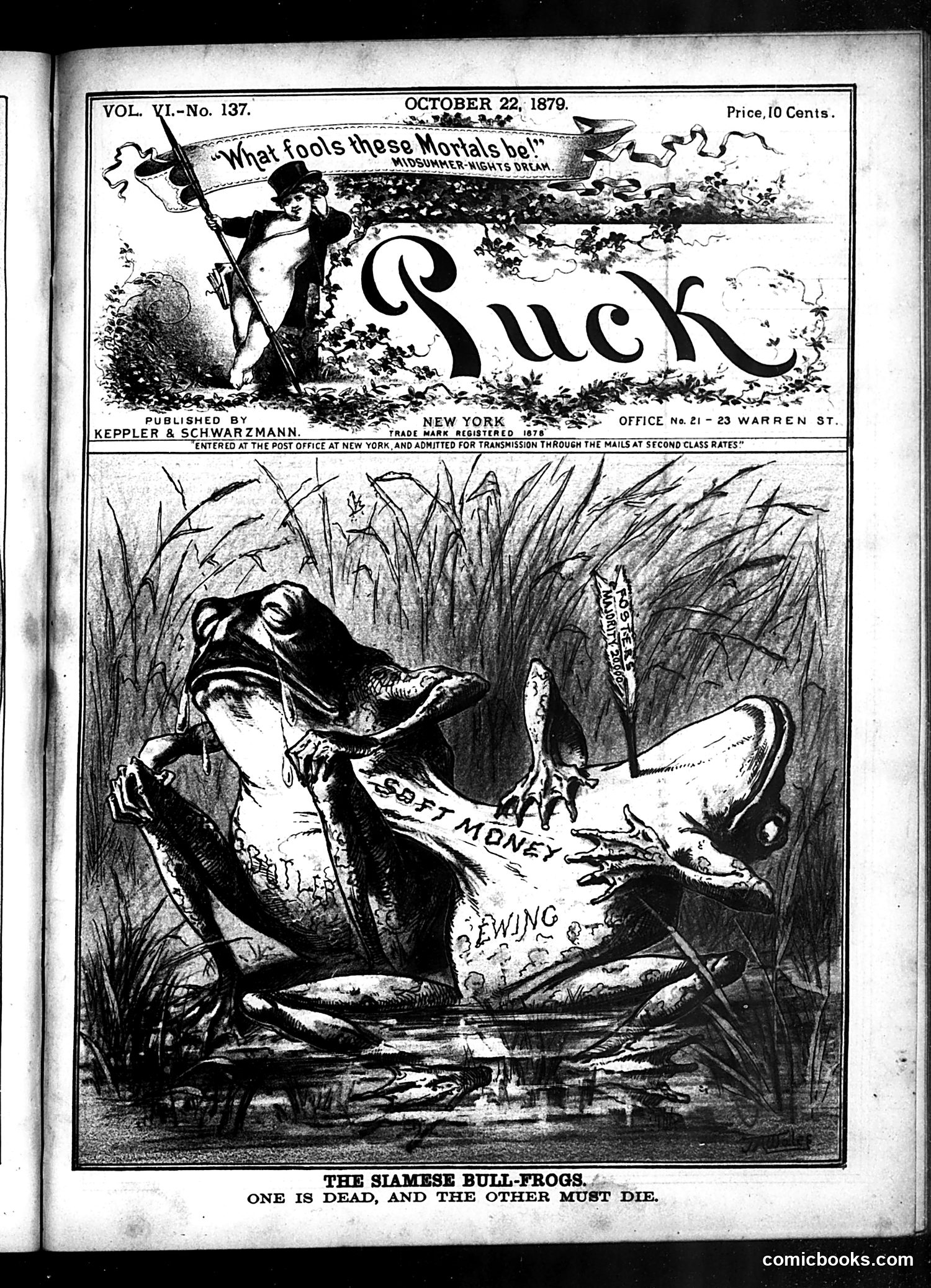
**Title:** "The Siamese Bull-Frogs: One is Dead, and the Other Must Die" This political cartoon depicts two bull-frogs locked in combat in a marsh setting. The frogs are labeled with text referencing "SOFT MONEY" and "SEWING" (likely "SPECIE"), representing the monetary debate of the era. The Siamese bull-frogs metaphor suggests two inseparable opposing forces—likely the hard money versus soft money factions within American politics during the late 1870s. The caption's grim conclusion ("one is dead, and the other must die") indicates the cartoonist's view that this ongoing monetary conflict would prove mutually destructive, with no viable resolution possible for either side.
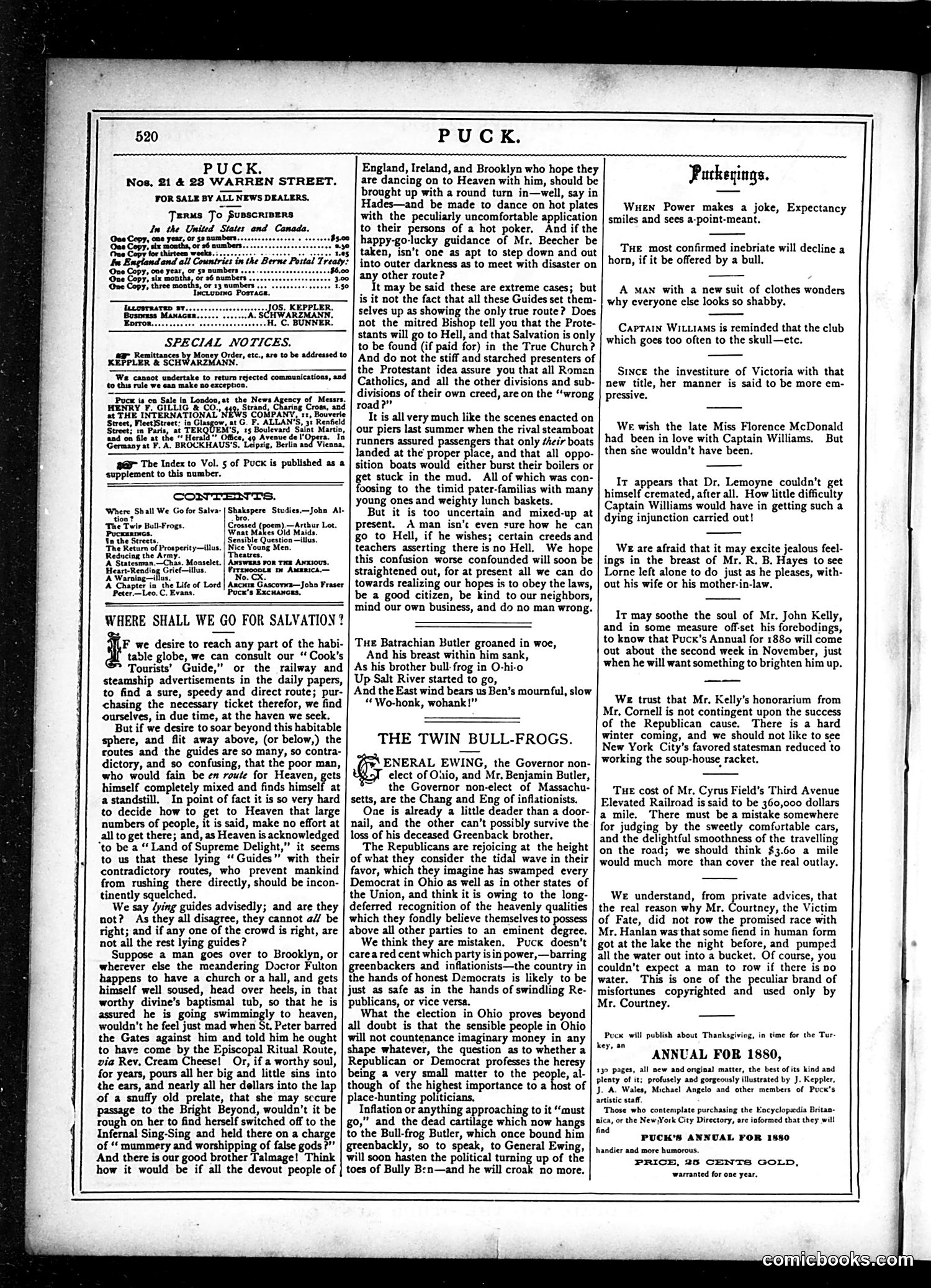
This page is primarily **text-based content rather than illustrated cartoons**. The main sections include: **"Where Shall We Go for Salvation?"** - A satirical piece about religious denominations (Catholics, Protestants, various Christian sects) debating theological correctness, mocking their mutual accusations of heresy. **"The Twin Bull-Frogs"** - Political satire about Ohio's 1880 election, likely referencing Republican candidates. The piece criticizes both major parties' self-righteousness while warning against imaginary political dangers. The satire targets **religious sectarianism and political hypocrisy**, portraying competing groups as equally self-deluded about their superiority. The tone suggests Puck's characteristic irreverent approach to institutions claiming moral authority. The page contains substantial editorial commentary rather than visual cartooning.
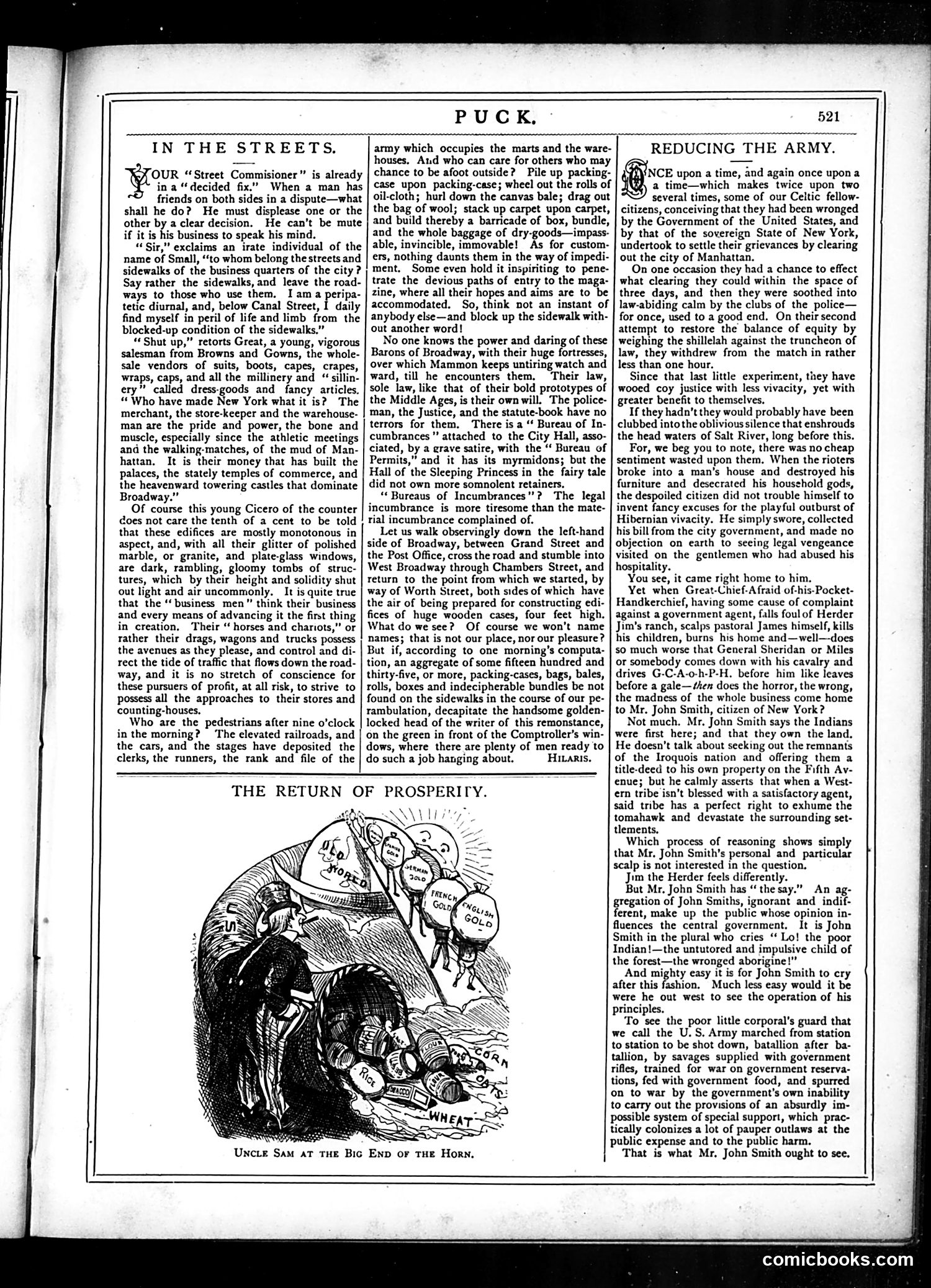
This cartoon satirizes post-Civil War government spending and corruption. "Uncle Sam" (the bearded American figure) is portrayed as grotesquely overloaded with labeled sacks representing various government expenditures and patronage: "Pork," "Offices," "Contracts," "Whiskey," and "Wheat" among others. The satire targets the belief that prosperity has "returned" despite massive federal waste. The accompanying article discusses John Smith, representing ordinary citizens, whose property disputes with the government remain unresolved while corrupt officials exploit public resources. The cartoon's point: rather than actual economic recovery benefiting citizens, government bloat from wasteful spending and corruption—particularly in military procurement and Indian affairs—is what truly characterizes the era's "prosperity."
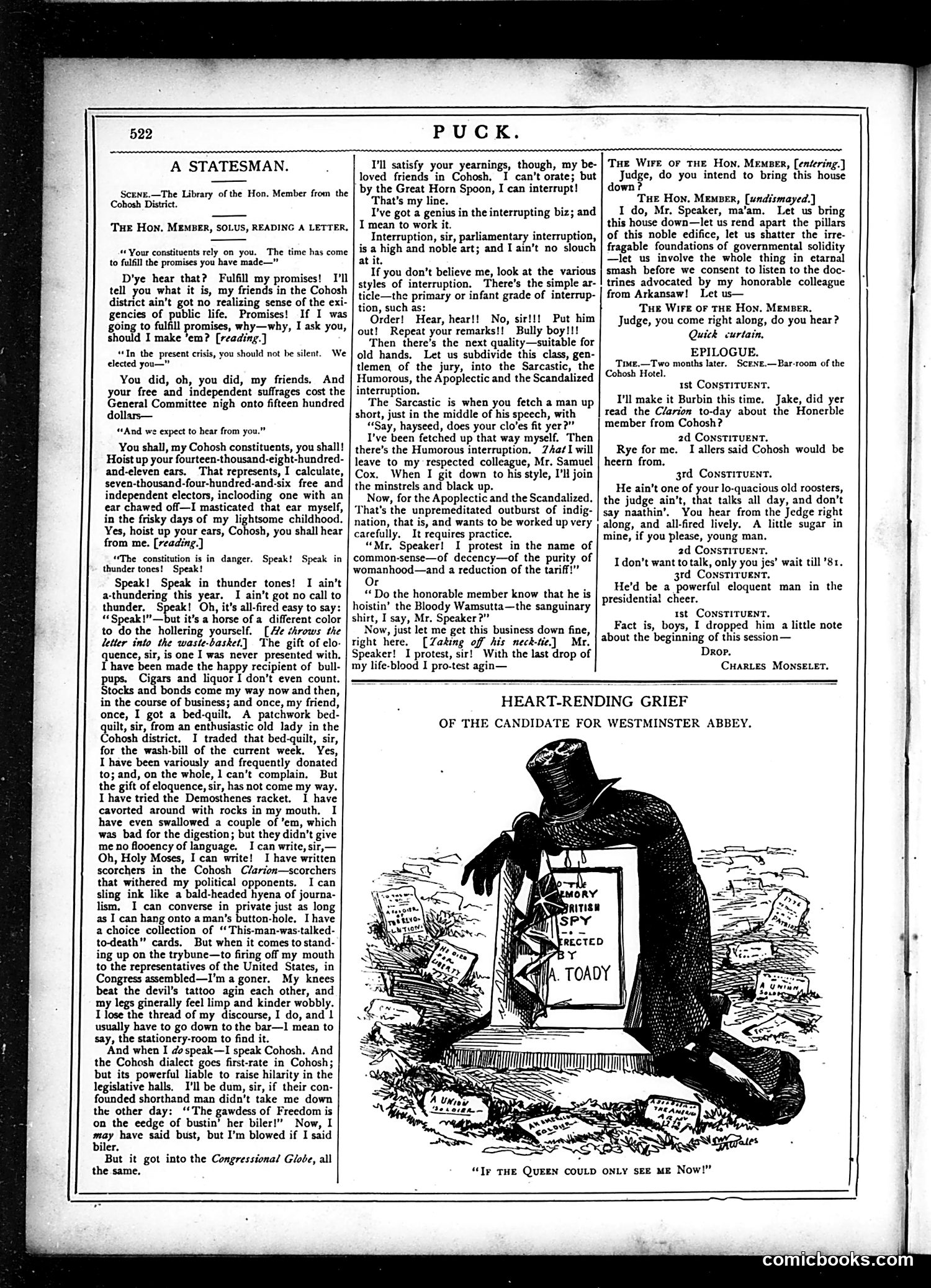
The main cartoon, titled "Heart-Rending Grief of the Candidate for Westminster Abbey," depicts a toad wearing formal dress, mourning at a tombstone marked "REJECTED." The figure appears to represent a political candidate who failed to gain admission to Westminster Abbey—apparently a prestigious honor or position. The satire mocks the exaggerated emotional display of someone rejected for this distinction. The toad's elaborate grief is presented as absurdly disproportionate to the actual loss. The left page contains "A Statesman," a lengthy speech by a Cohosh District representative defending his record against accusations of corruption and misuse of public funds. The humor lies in his verbose, rambling self-justification, which inadvertently suggests the very improprieties he denies—a classic technique of Puck's political satire.
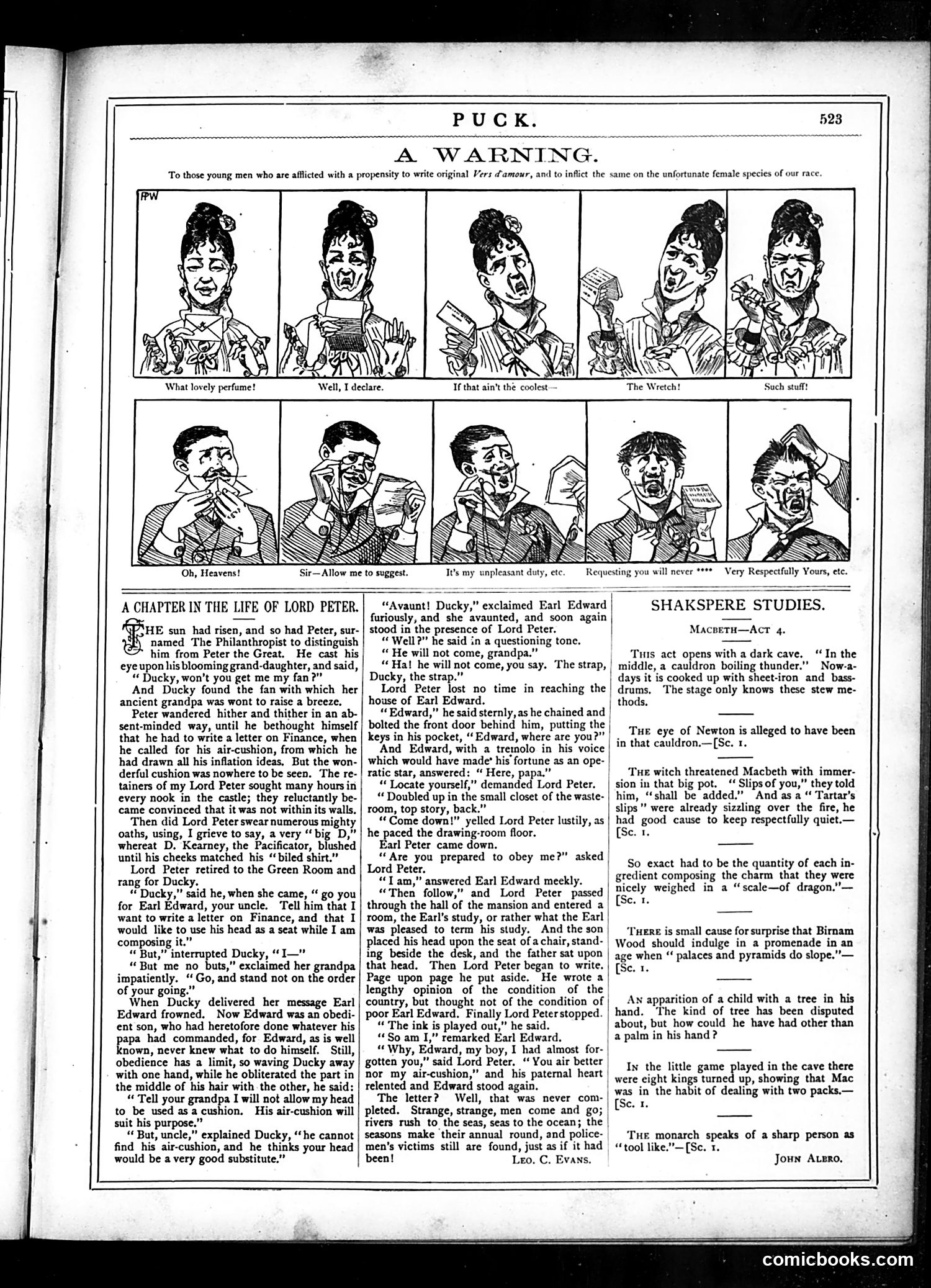
This cartoon mocks young men who write romantic poetry ("vers d'amour") to women. The ten panels show exaggerated male facial expressions progressing from confident seduction ("What lovely perfume?") through increasingly desperate pleas ("Sir—Allow me to suggest," "It's my unpleasant duty") to resigned rejection ("Very Respectfully Yours, etc."). The satire targets the era's overwrought romantic posturing—the pretentious literary affectations and manipulative tactics men employed in courtship. By depicting the same man's changing expressions as his advances fail, Puck ridicules both the artificiality of romantic poetry and the predictable, pathetic trajectory of male rejection. The "warning" ironically cautions against such transparent, unsuccessful seduction attempts.
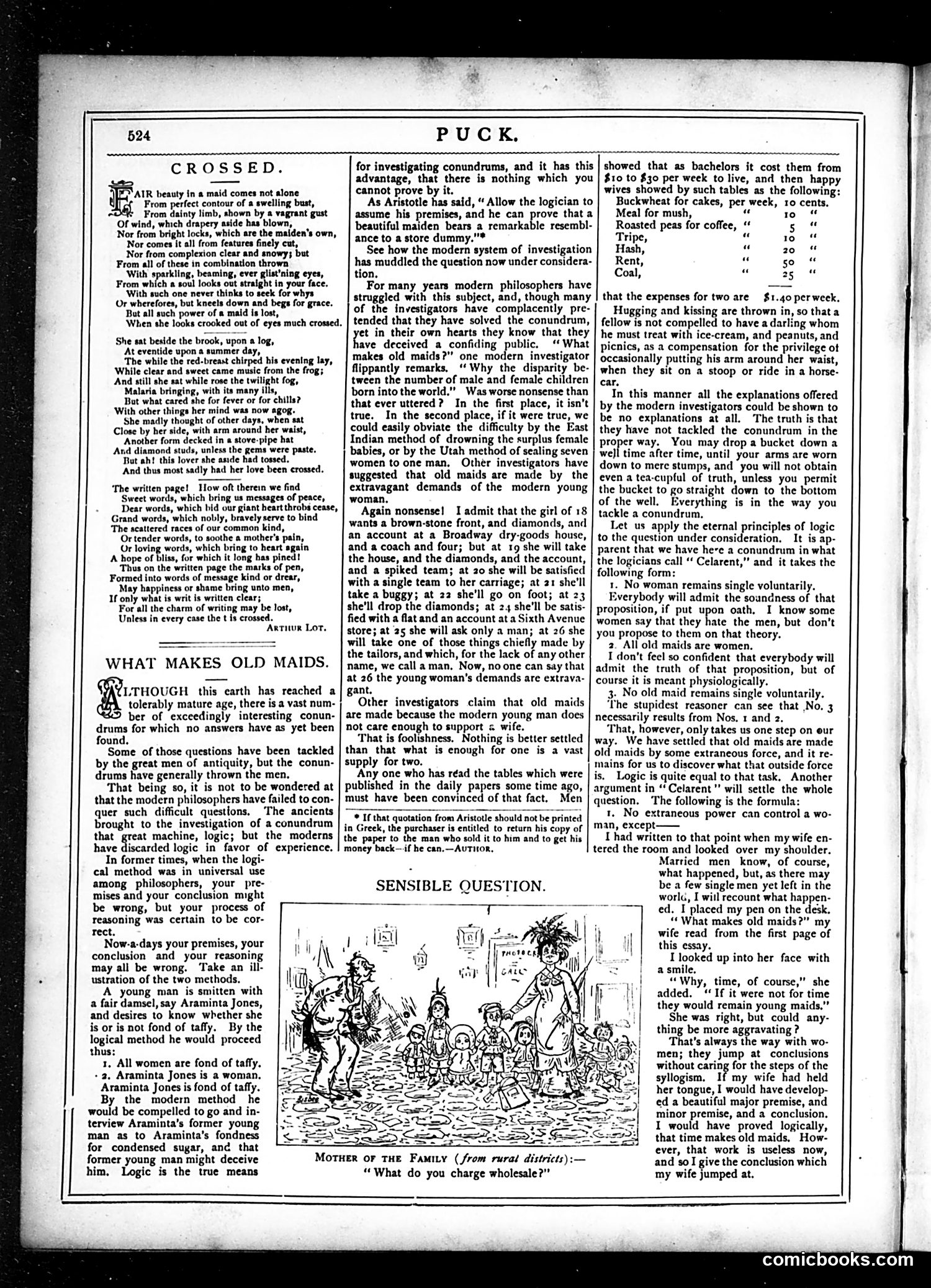
This single cartoon at the page bottom depicts a rural family scene with the caption "**Mother of the Family** (from rural districts): 'What do you charge wholesale?'" The satire appears to target rural mothers' economic shrewdness and bargain-hunting mentality. The cartoon shows a large family of children, suggesting the stereotype of rural families being large and poor. The mother's question about "wholesale" pricing humorously implies she's perpetually seeking deals—treating her numerous children like bulk commodities rather than individuals. This likely reflects early-20th-century urban attitudes toward rural populations as unsophisticated yet cunning with money. The joke reinforces period stereotypes about rural poverty and family size, presented through gentle domestic humor typical of Puck magazine's satirical approach.
This page contains primarily **text content rather than political cartoons**. The main sections include: 1. **"Nice Young Men"** — an editorial criticizing young male journalists for sensationalism and impropriety, arguing they prioritize scandalous subjects over serious journalism. 2. **"Fitznoodle in America"** — appears to be a serialized humor column featuring a character named Fitznoodle discussing social encounters, including an awkward interaction with a woman named Miss Marguerite. 3. **"Answers for the Anxious"** — an advice column addressing reader questions about social etiquette and personal matters. 4. **"The Theatres"** — brief theater reviews. The page functions as typical Puck content: satirizing contemporary social behavior and journalistic practices through humor and social commentary rather than through visual cartoons.
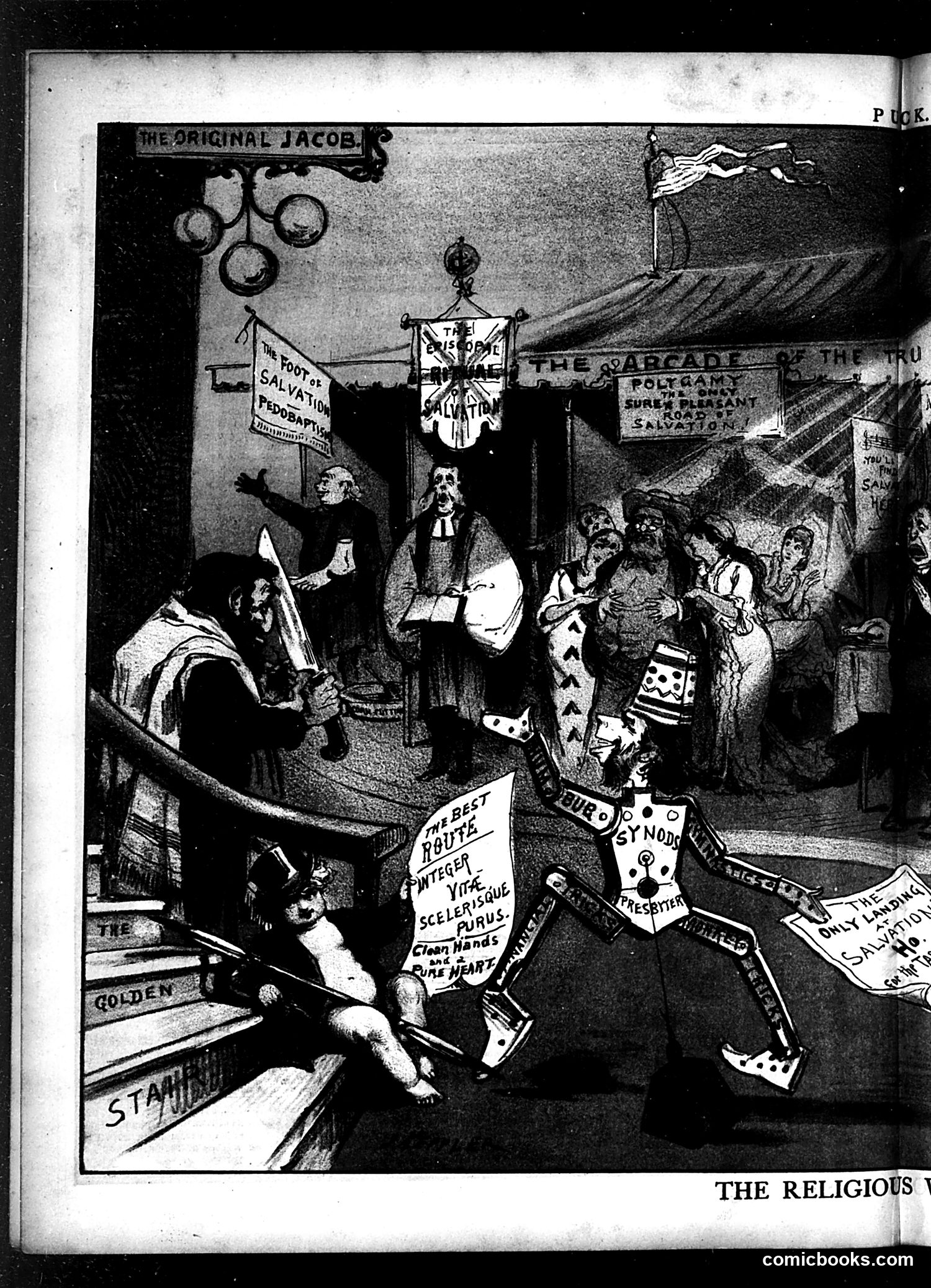
This appears to be a satirical cartoon about religious salvation movements and evangelicalism. The scene depicts what looks like a revival meeting or religious gathering, with various figures labeled with signs referencing salvation theology ("The Foot of Salvation," "The Best Route," "Sincere Pursuit"). The central figures appear to be religious leaders or evangelists directing crowds. Signs visible include references to different religious paths and doctrines. The cartoon satirizes the competitive nature of various Christian denominations and salvation approaches popular during the late 19th/early 20th century—mocking how different religious groups each claimed to offer the "best" or "only true" route to salvation. The overall tone suggests Puck magazine was critiquing religious fervor and the commercialization of spiritual salvation during this period.
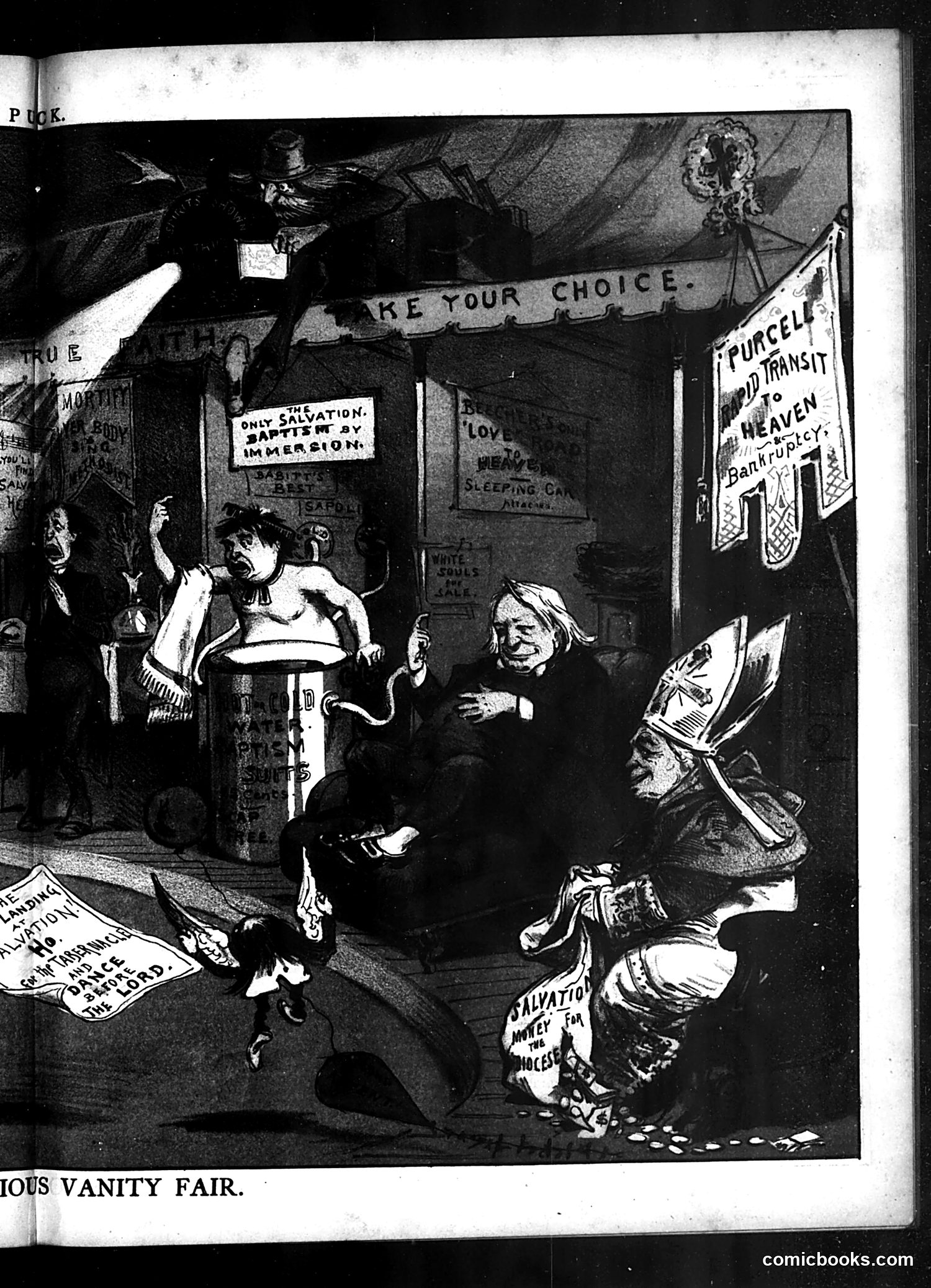
This appears to be a satirical scene depicting religious salvation schemes as a theatrical "Vanity Fair." The central figure is an older woman surrounded by various religious and salvation-themed signs and banners reading "ONLY SALVATION MATTERS BY IMMERSION," "LOVE WEARS A SLEEPING CAR," and "PURCELL'S RAPID TRANSIT TO HEAVEN: BANKRUPTCY." The satire mocks competing religious denominations and their promises of salvation, portrayed as carnival attractions offering different paths to heaven. The theatrical setting with curtains and props suggests these are merely performances rather than genuine spiritual guidance. Various caricatured figures represent different religious movements. The cartoon critiques how different churches market salvation as competing commercial products, treating religious faith like entertainment or consumer choice rather than sincere spirituality.
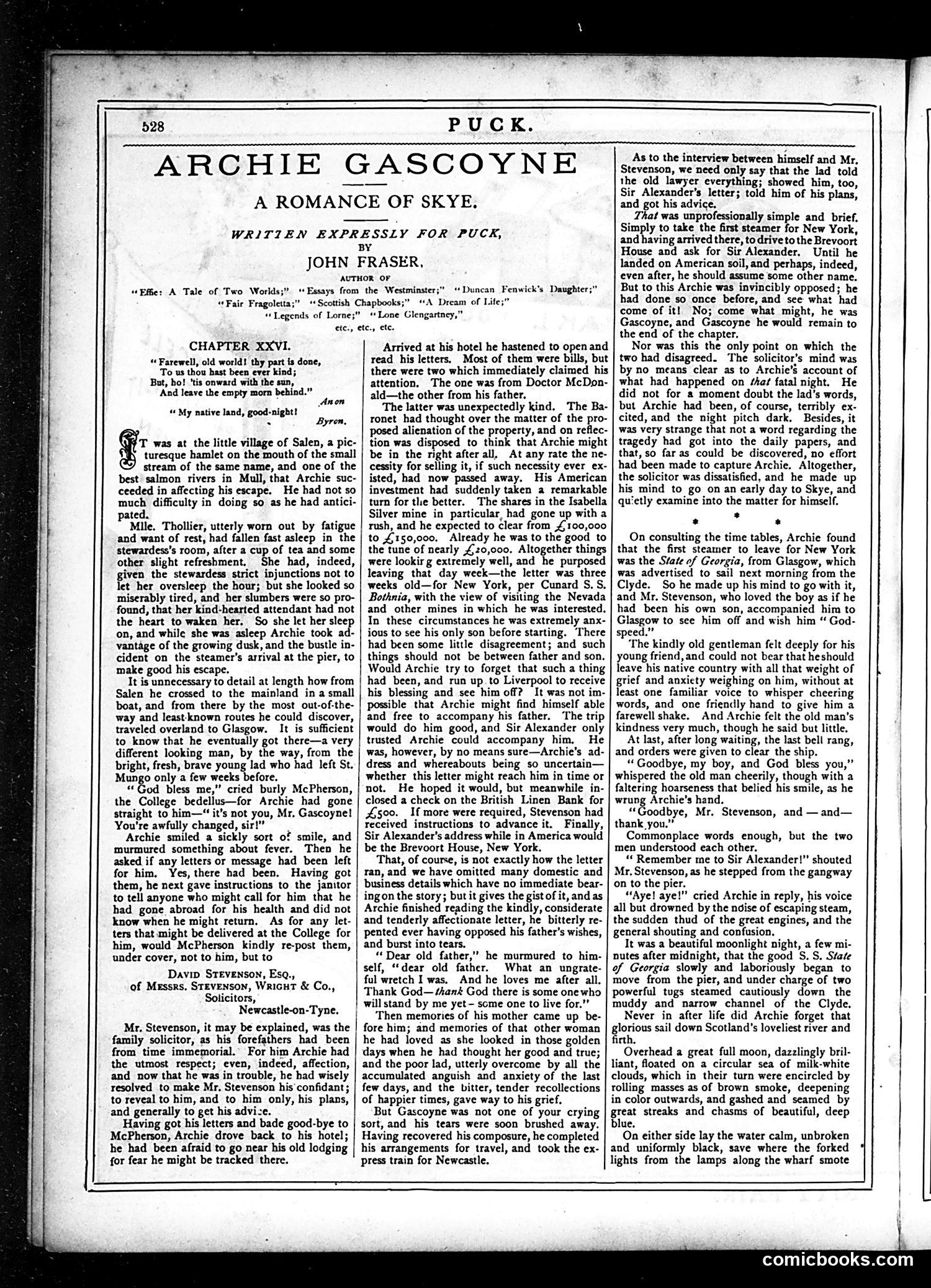
This page contains the beginning of a serialized romance story by John Fraser, written expressly for Puck magazine. It is not a political cartoon or satire, but rather a work of fiction. The story follows a young Scottish man named Archie who receives unexpected letters from his father and a solicitor while staying at a modest hamlet on the Isle of Skye. The narrative establishes that Archie's financial circumstances have dramatically improved—he's inherited substantial wealth including interests in American mines and Nevada silver properties. The plot centers on his internal conflict about leaving Scotland and his reluctance to pursue his romantic interests before departing. This appears to be a serialized romantic adventure tale rather than satirical content.
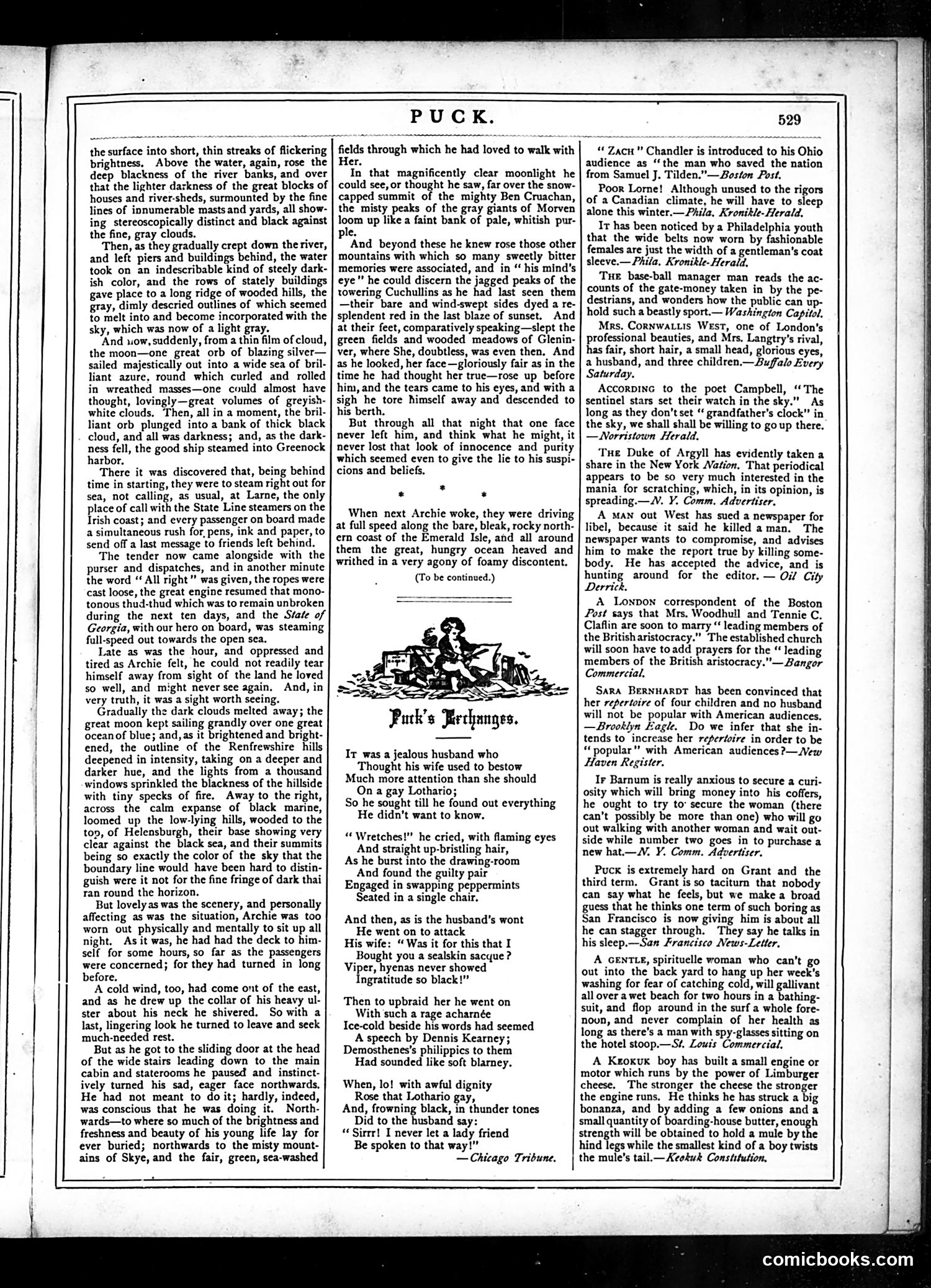
This page contains a serialized narrative story with a small illustration titled "Flirt's Exchanges" depicting a couple in an intimate moment. The story text describes romantic and domestic scenes, including references to a character named Lothario and marital discord. The page is primarily **literary content rather than political satire**. The "Flirt's Exchanges" section appears to be humorous verse about infidelity and romantic entanglement—typical of Puck's light satirical fare mocking social conventions and human follies. The right column contains brief gossip items about theatrical figures and society scandals (mentions of marriages, performances, and newspaper disputes), which was common filler content in Puck. This page lacks the sharp political cartoons or caricatures Puck is famous for; it's focused on social/romantic satire through narrative rather than visual caricature.
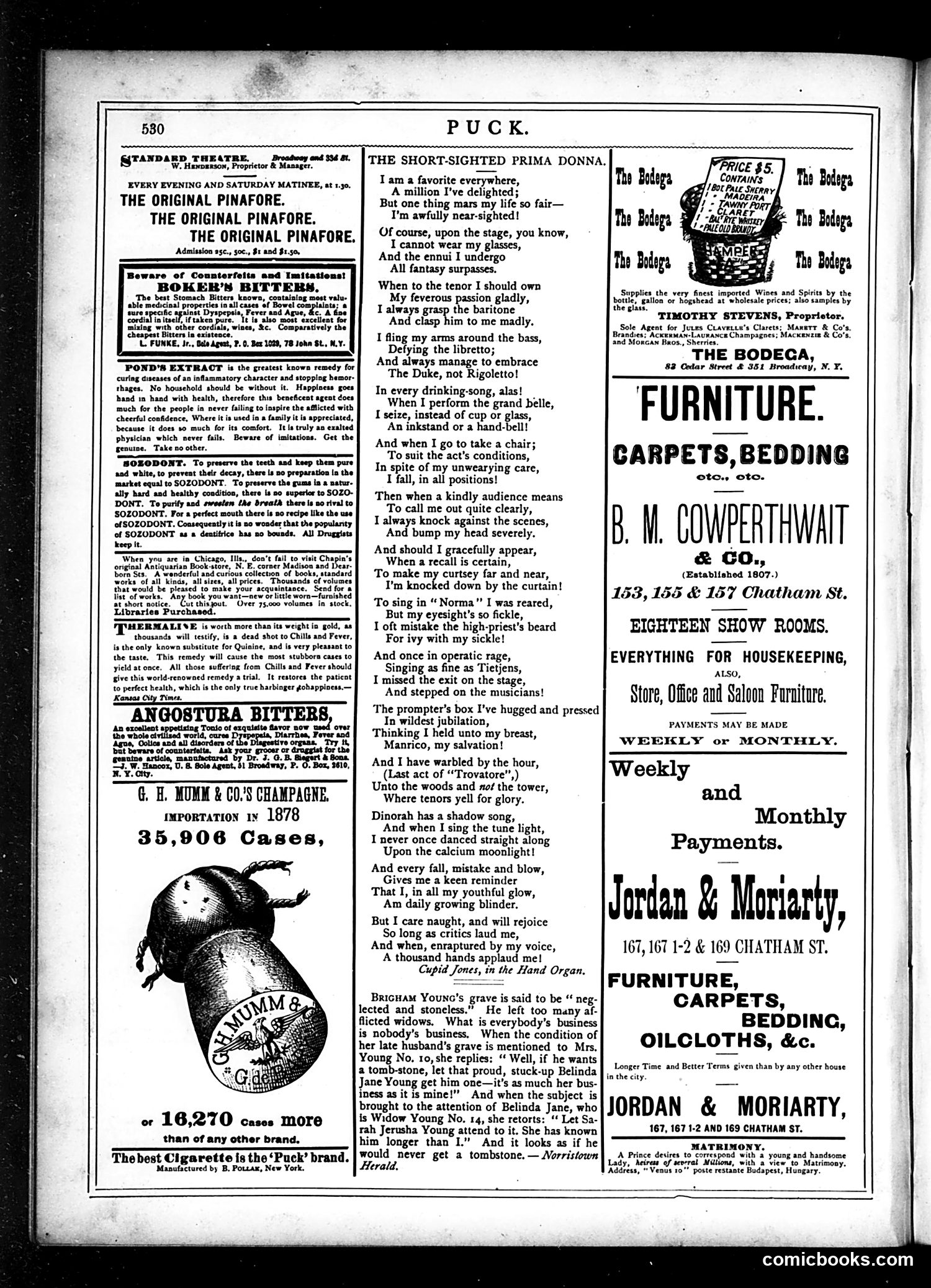
This page is predominantly **advertisements** for period products and services, not political satire. The main content includes: - Commercial ads for medicines (Boker's Bitters, Sozodont toothpaste, Angostura Bitters, Thermoline remedy) - G.H. Mumm champagne (with an illustrated bottle) - Furniture and carpet retailers (B.M. Cowperthwait Co., Jordan & Moriarty) - The Bodega wine and spirits shop The only editorial content is a poem titled **"The Short-Sighted Prima Donna"** — a humorous verse about an opera singer's mishaps on stage due to poor eyesight (losing glasses, hitting scenery, missing her cues). This is light entertainment, not political commentary. The page reflects Puck's era as a magazine mixing humor, social content, and commercial advertising.
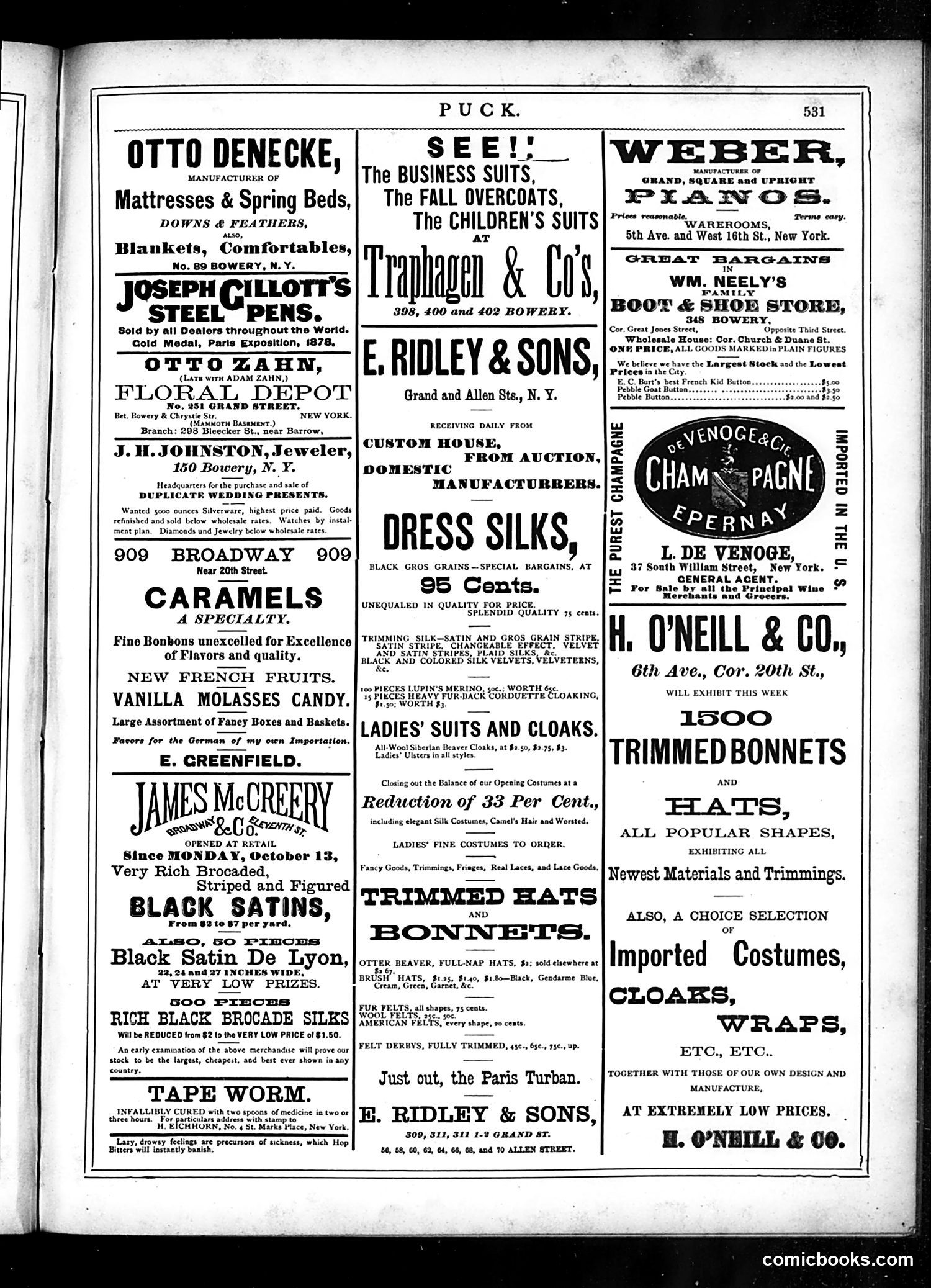
This page is primarily **advertising**, not editorial content or political cartoons. It contains numerous Victorian-era commercial advertisements for goods and services available in New York City, including: - Mattresses, pianos, jewelry, and clothing - Food items (candies, molasses) - Silk dress fabrics and bonnets - Ladies' fashion and costumes The only non-advertising element is a **Champagne label** (Chavenoge & Co., Epernay) featured as a decorative oval graphic. The page represents typical late 19th-century magazine revenue: *Puck* relied heavily on paid advertisements to fund its satirical content. No political commentary, caricatures, or jokes appear on this particular page—it's essentially a classified advertising section typical of period publications.
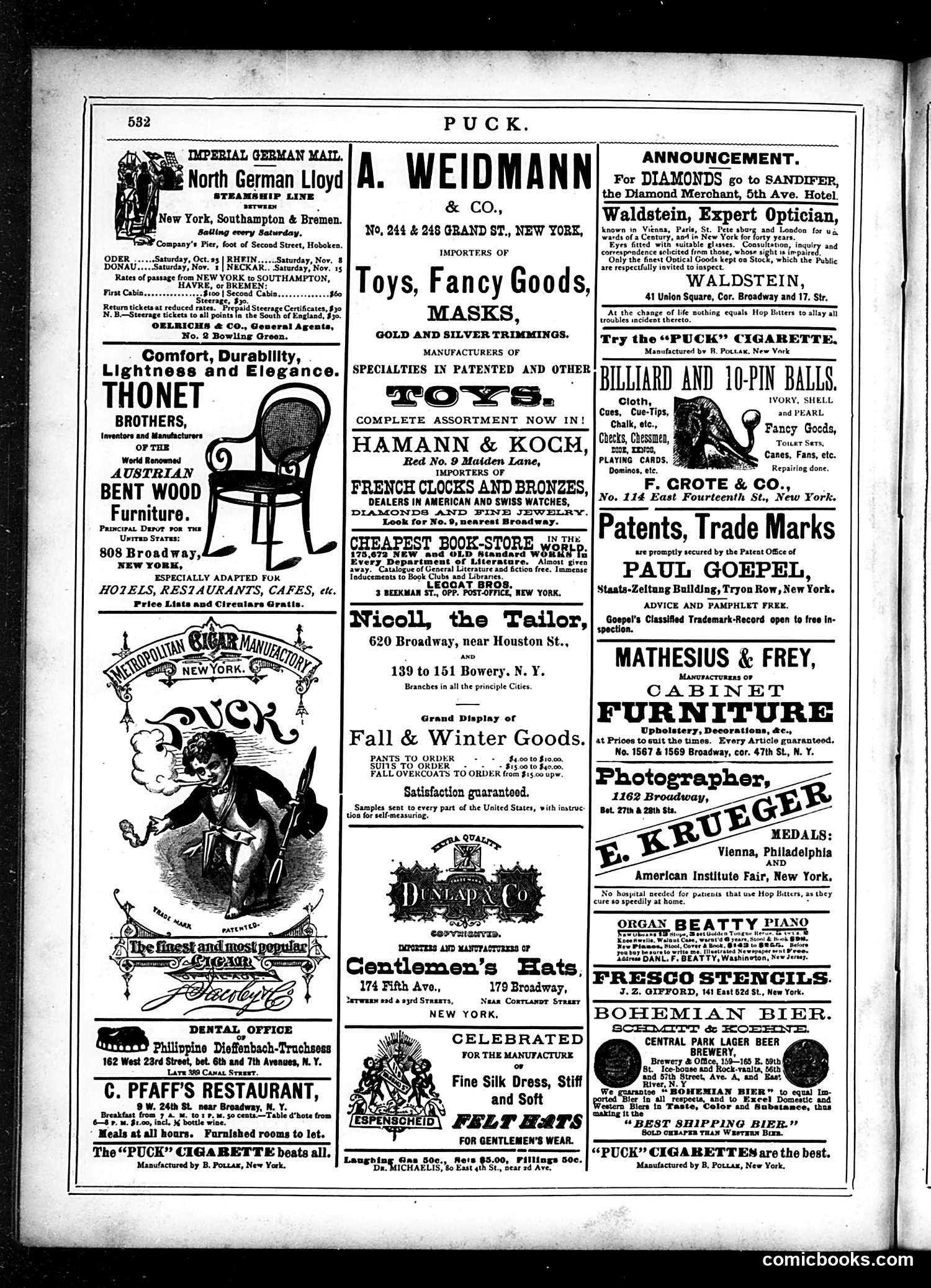
This is primarily an **advertising page** from Puck magazine, not a political cartoon or satirical commentary page. The page is filled with late 19th/early 20th-century New York business advertisements for luxury goods and services: furniture makers, tailors, photographers, restaurants, a dental office, and various importers of toys, fancy goods, and German merchandise. The only illustrated content with potential satirical intent is a small decorative **Puck mascot** (the mischievous fairy character that gave the magazine its name) shown in a classical pose at the bottom left, which was a recurring house design element rather than commentary on specific events or figures. The page functions as revenue-generating advertising space rather than editorial content.
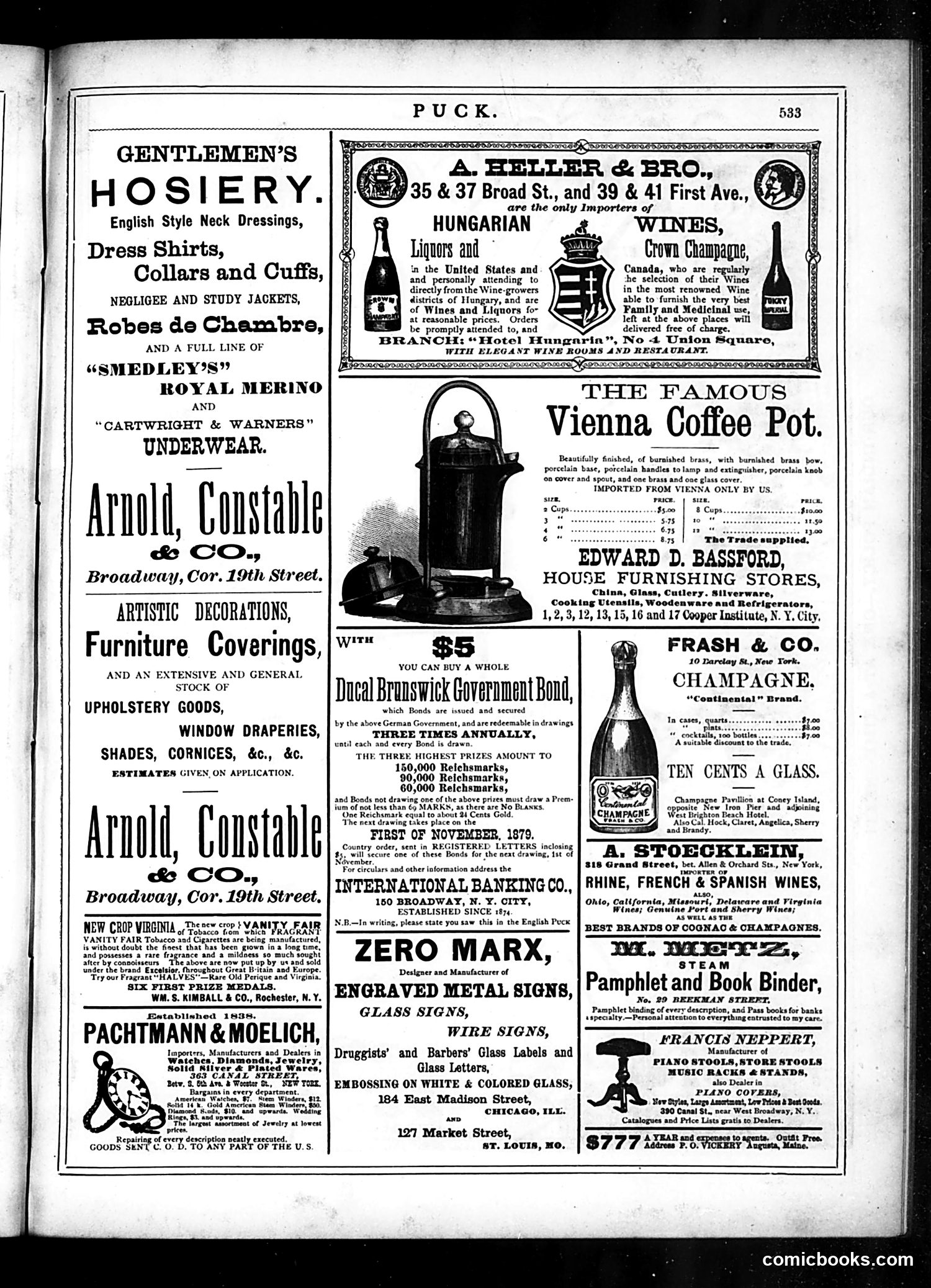
This page is **primarily advertising**, not editorial content or cartoons. It contains commercial advertisements from late 19th-century New York businesses, including: - Gentlemen's clothing and haberdashery shops - A Vienna Coffee Pot (imported housewares) - Hungarian wines and champagne - House furnishings and upholstery goods - Jewelry and watch repair - Metal signs and engraving services - A pamphlet bindery The page number indicates this is from Puck magazine, but no satirical cartoons or political commentary appear here. It represents the revenue model for 19th-century magazines: editorial content subsidized by paid advertisements. The ads reflect the consumer goods and services available to affluent urban readers of the period.
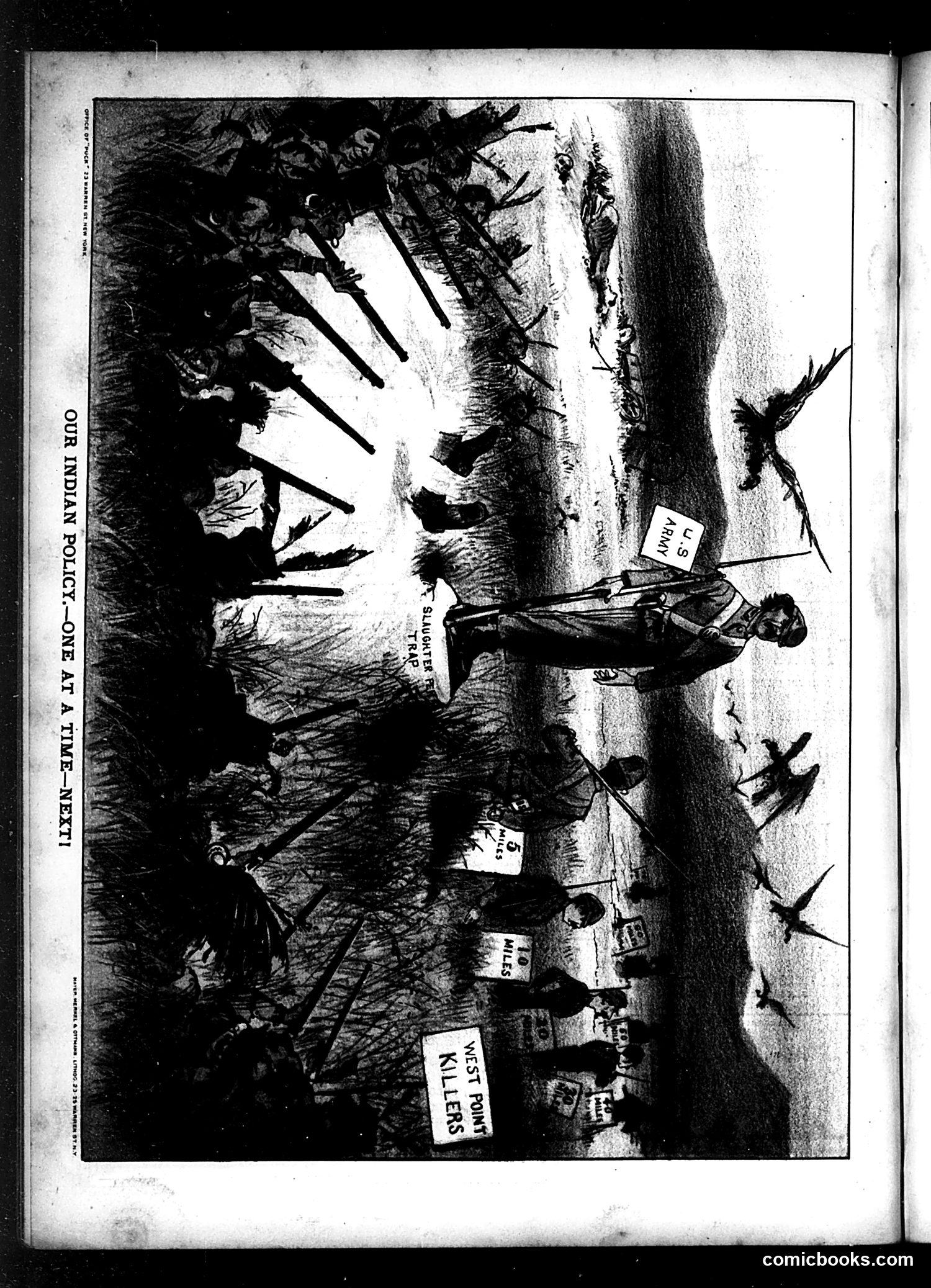
I can see this is a Puck magazine page with the heading "WEST POINT KILLERS" visible on labels in the image. The photograph appears to show multiple military figures arranged in a scene, rotated 90 degrees on the page, with name placards beneath them. However, I cannot reliably read most of the individual names on the placards due to image quality, nor can I confidently identify the specific historical incident or figures being satirized. The title "West Point Killers" suggests this relates to a scandal or incident involving U.S. Military Academy personnel, but without being able to clearly read the labels or know the publication date, I cannot accurately explain the specific political satire or social commentary intended. To properly explain this cartoon's meaning to a modern reader, I would need clearer visibility of the names and additional context about when this was published.