
Puck, 1879-10-22 · page 5 of 16
Puck — October 22, 1879 — page 5: what you’re looking at
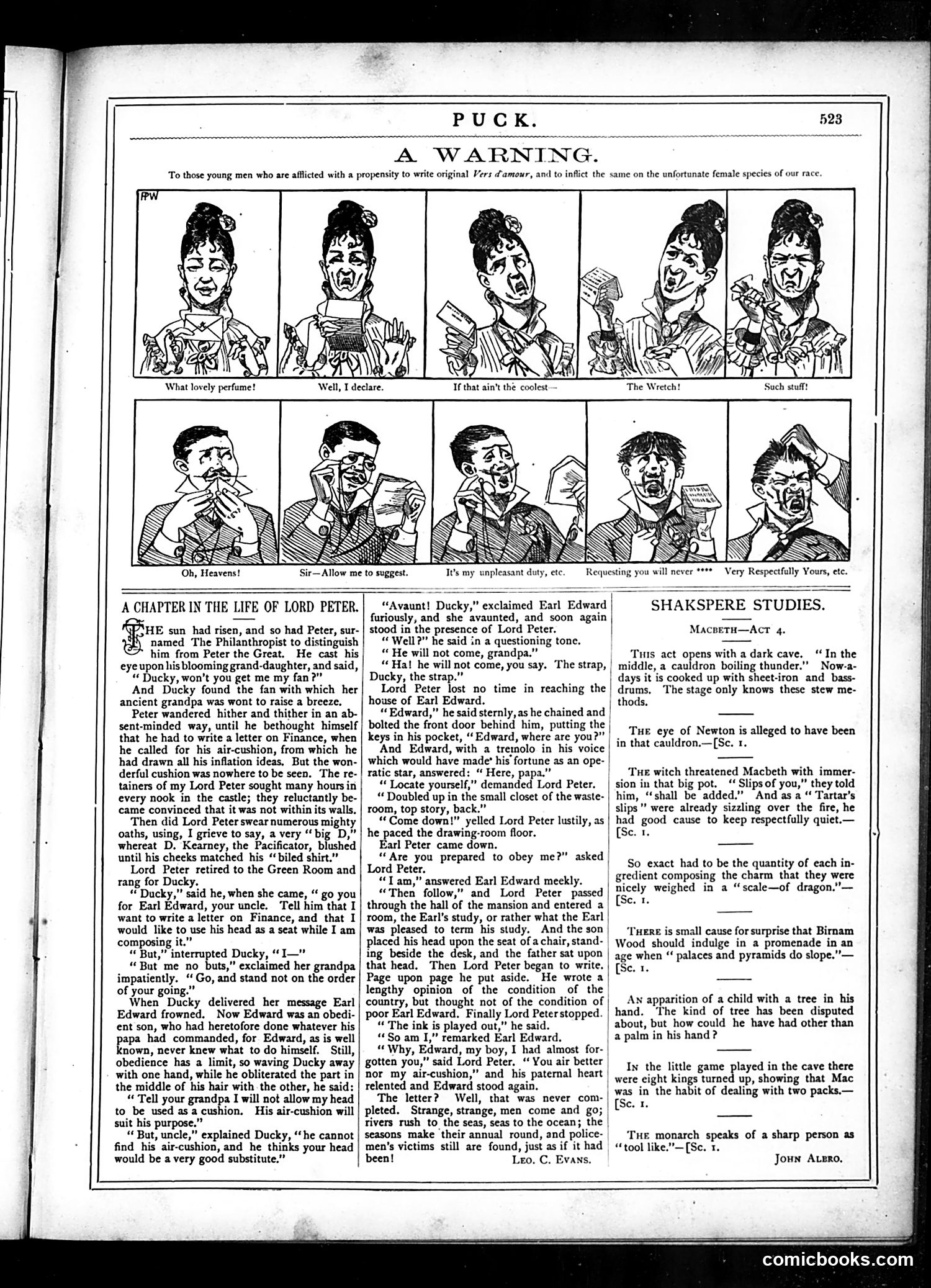
What you’re looking at
This cartoon mocks young men who write romantic poetry ("vers d'amour") to women. The ten panels show exaggerated male facial expressions progressing from confident seduction ("What lovely perfume?") through increasingly desperate pleas ("Sir—Allow me to suggest," "It's my unpleasant duty") to resigned rejection ("Very Respectfully Yours, etc."). The satire targets the era's overwrought romantic posturing—the pretentious literary affectations and manipulative tactics men employed in courtship. By depicting the same man's changing expressions as his advances fail, Puck ridicules both the artificiality of romantic poetry and the predictable, pathetic trajectory of male rejection. The "warning" ironically cautions against such transparent, unsuccessful seduction attempts.
📄 Transcribed text from this page (OCR, searchable)
Machine-transcribed from the original scan — historical spelling and the odd misread are preserved.
PUCK. ‘Well, I declare. Sir—Allow me to suggest. To those young men who are afflicted with a propensity to write original Vers amour, and to inflict the same on the unfortunate female species of our race. If that ain't the coolest— It’s my unpleasant duty, ete. Requesting you will never D> Very Respectfully Yours, ete. A CHAPTER IN THE LIFE OF LORD PETER. HE sun had risen, and so had Peter, sur- named The Philanthropist to distinguish him from Peter the Great. He cast his eye upon his blooming grand-daughter, and said, “ Ducky, won't you get me my fan?” And Ducky found the fan with which her ancient grandpa was wont to raise a breeze. Peter wandered hither and thither in an ab- sent-minded way, until he bethought himself that he had to write a letter on Finance, when he called for his air-cushion, from which he had drawn all his inflation ideas, But the won- derful cushion was nowhere to be seen. The re- tainers of my Lord Peter sought many hours in every nook in the castle; they reluctantly be- came convinced that it was not within its walls, Then did Lord Peter swear numerous mighty oaths, using, I grieve to say, a very “big D,” whereat D. Kearney, the Pacificator, blushed until his cheeks matched his ‘biled shirt.” Lord Peter retired to the Green Room and rang for Ducky. “Ducky,” said he, when she came, “ go you for Earl Edward, your uncle. Tell him that I want to write a letter on Finance, and that I would like to use his head as a seat while I am composing it.” “ But,” interrupted Ducky, “I—" “ But’ me no buts,” exclaimed her grandpa impatiently. ‘“ Go, and stand not on the order of your going.” When Ducky delivered her message Earl Edward frowned. Now Edward was an obedi- ent son, who had heretofore done whatever his apa had commanded, for Edward, as is well nown, never knew what to do himself. Still, obedience has a limit, so waving Ducky away with one hand, while he obliterated the part in the middle of his hair with the other, he said: “ Tell your grandpa I will not allow my head to be used as acushion. His air-cushion will suit his purpose,” “But, uncle,” explained Ducky, ‘he cannot find his air-cushion, and he thinks your head would be a very good substitute.” “Avaunt! Ducky,” exclaimed Earl Edward furiously, and she avaunted, and soon again stood in the presence of Lord Peter. “ Well?” he said in a questioning tone, “ He will not come, grandpa.” “Ha! he will not come, you say. The strap, | Ducky, the strap.” | Lord Peter lost no time in reaching the | house of Earl Edward. | “Edward,” he said sternly,as he chained and bolted the front door behind him, putting the | keys in his pocket, “Edward, where are you?” And Edward, with a tremolo in his voice which would have made’ his fortune as an ope- ratic star, answered: “ Here, papa.” “ Locate yourself,” demanded Lord Peter. “ Doubled up in the small closet of the waste- room, top story, back.” “Come down!” yelled Lord Peter lustily, as he paced the drawing-room floor. arl Peter came down. “Are you prepared to obey me?” asked Lord Peter, “Tam,” answered Earl Edward meekly. “Then follow,” and Lord Peter passed | through the hall of the mansion and entered a room, the Earl’s study, or rather what the Earl | was pleased to term his study. And the son placed his head upon the seat of a chair, stand- ing beside the desk, and the father sat upon | that head. Then Lord Peter began to write. Page upon page he put aside. He wrote a lengthy opinion of the condition of the country, but thought not of the condition of poor Earl Edward. Finally Lord Peter stopped. “ The ink is played out,” he said. “So am I,” remarked Earl Edward. “Why, Edward, my boy, I had almost for- gotten you,” said Lord Peter. ‘You air better nor my air-cushion,” and his paternal heart | relented and Edward stood again. | The letter? Well, that was never com- | pleted. Strange, strange, men come and go; rivers rush to the seas, seas to the ocean; the | seasons make their annual round, and police- men’s victims still are found, just as if it had been! Leo. C. Evans. ~ SHAKSPERE STUDIES. MacsetH—ACT 4. Tus act opens with a dark cave. ‘In the middle, a cauldron boiling thunder.” Now-a- days it is cooked up with sheet-iron and bass- drums, The stage only knows these stew me- thods. Tue eye of Newton is alleged to have been in that cauldron.—[Se. 1. ‘Tue witch threatened Macbeth with immer- sion in that big pot. ‘‘ Slips of you,” they told him, “shall be adde« And as a “ Tartar’s slips” were already sizzling over the fire, he pas good cause to keep respectfully quiet.— Se. 1. So exact had to be the quantity of each in- gredient composing the charm that they were nicely weighed in a “scale—of dragon.”— [Sc. 1. ‘Tere is small cause for surprise that Birnam Wood should indulge in a promenade in an age when “ palaces and pyramids do slope.” — [Se. 1. AN apparition of a child with a tree in his hand. The kind of tree has been disputed about, but how could he have had other than | a palm in his hand? In the little game played in the cave there were eight kings turned up, showing that Mac was in the habit of dealing with two packs.— | [Sc. 1. ‘THe monarch speaks of a sharp person as “tool like.”—[Se. 1. Joun Acero, comicbooks.com