
Puck, 1879-10-22 · page 4 of 16
Puck — October 22, 1879 — page 4: what you’re looking at
What you’re looking at
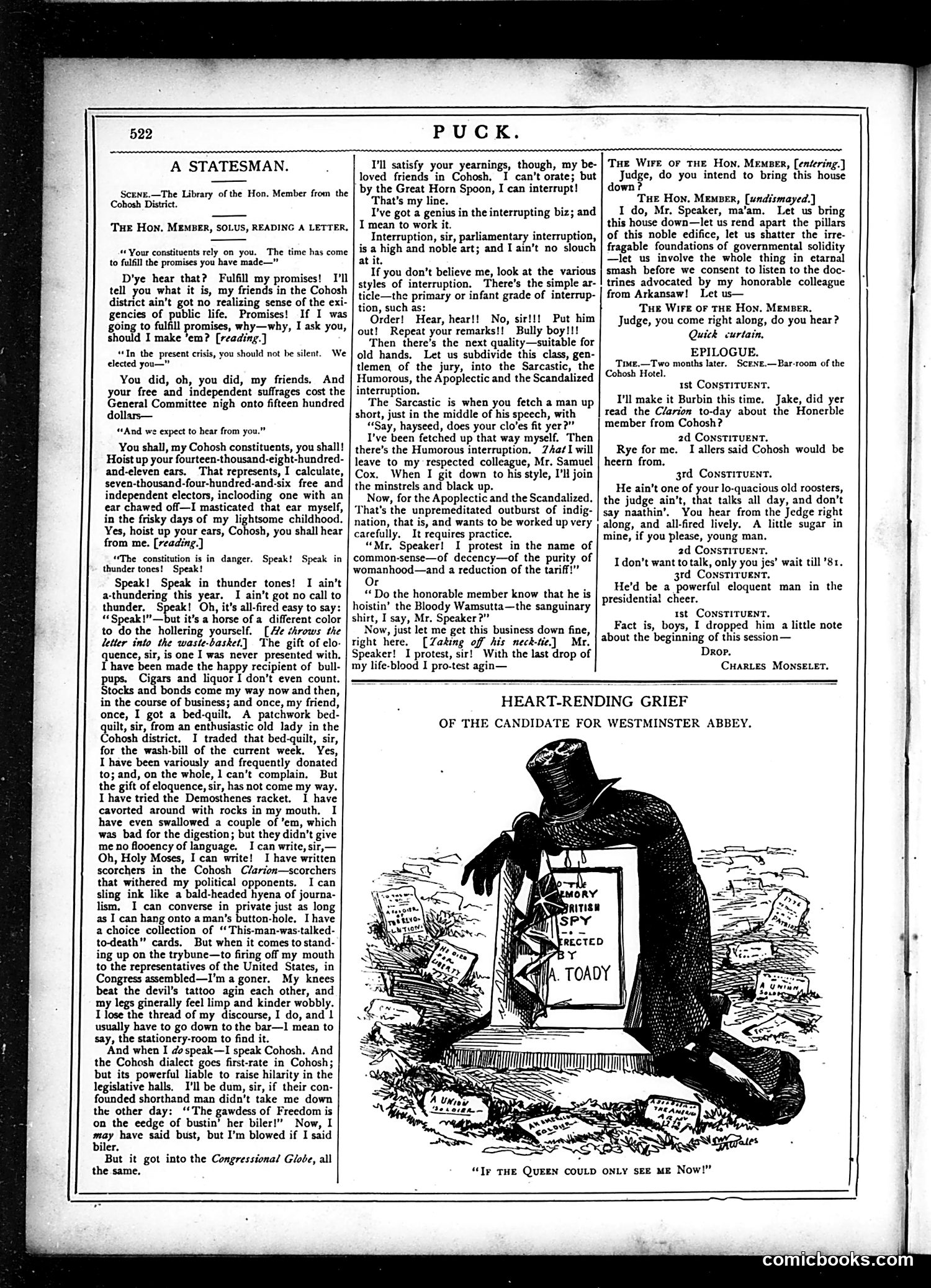
The main cartoon, titled "Heart-Rending Grief of the Candidate for Westminster Abbey," depicts a toad wearing formal dress, mourning at a tombstone marked "REJECTED." The figure appears to represent a political candidate who failed to gain admission to Westminster Abbey—apparently a prestigious honor or position. The satire mocks the exaggerated emotional display of someone rejected for this distinction. The toad's elaborate grief is presented as absurdly disproportionate to the actual loss. The left page contains "A Statesman," a lengthy speech by a Cohosh District representative defending his record against accusations of corruption and misuse of public funds. The humor lies in his verbose, rambling self-justification, which inadvertently suggests the very improprieties he denies—a classic technique of Puck's political satire.
📄 Transcribed text from this page (OCR, searchable)
Machine-transcribed from the original scan — historical spelling and the odd misread are preserved.
PUCK. A STATESMAN. Scene.—The Library of the Hon. Member from the Cohosh District. ‘THe Hon. MEMBER, SOLUS, READING A LETTER. “Your constituents rely on you. The time has come to fulfill the promises you have made—” D'ye hear that? Fulfill my promises! I'll tell you what it is, my friends in the Cohosh district ain't got no realizing sense of the exi- gencies of public life. Promises! If I was going to fulfill promises, why—why, I ask you, should I make 'em? [reading.] “In the present crisis, you should not be silent. elected you—" You did, oh, you did, my friends. And your free and independent suffrages cost the General Committee nigh onto fifteen hundred dollars— “And we expect to hear from you.” You shall, my Cohosh constituents, you shall! Hoist up your fourteen-thousand-eight-hundred- and-eleven ears. That represents, I calculate, seven-thousand-four-hundred-and-six free and independent electors, inclooding one with an ear chawed off—I masticated that ear myself, in the frisky days of my lightsome childhood. Yes, hoist up your ears, Cohosh, you shall hear from me. [reading.] “The constitution is in danger. thunder tones! Speak! Speak! Speak in thunder tones! I ain’t a-thundering this year. I ain’t got no call to thunder, Speak Oh, it’s all-fired easy to say: “Speak !"—but it’s a horse of a different color to do the hollering yourself. [He throws the etter into the waste-basket] The gift of elo- We Speak! Speak in quence, sir, is one I was never presented with, I have been made the happy recipient of bull- pups. Cigars and liquor I don’t even count. Stocks and bonds come my way now and then, in the course of business; and once, my friend, once, I got a bed-quilt, A patchwork bed- guilt, sir, from an enthusiastic old lady in the ‘ohosh district. I traded that bed-quilt, sir, for the wash-bill of the current week. Yes, I have been variously and frequently donated to; and, on the whole, 1 can’t complain, But the gift of eloquence, sir, has not come my way. I have tried the Demosthenes racket. I have cavorted around with rocks in my mouth. I have even swallowed a couple of ’em, which was bad for the digestion; but they didn't give me no flooency of language. I can write, sir,— Oh, Holy Moses, I can write! I have written scorchers in the Cohosh C/arion—scorchers that withered my political opponents. I can sling ink like a bald-headed hyena of journa- lism, I can converse in private just as long as I can hang onto aman’s button-hole. I have a choice collection of ‘This-man-was-talked- to-death" cards. But when it comes to stand- ing up on the trybune—to firing off my mouth to the representatives of the United States, in Congress assembled—I’m a goner. My knees beat the devil’s tattoo agin each other, and my legs ginerally feel limp and kinder wobbly. I lose the thread of my discourse, I do, and 1 usually have to go down to the bar—I mean to say, the stationery-room to find it. And when I dospeak—I speak Cohosh. And the Cohosh dialect goes first-rate in Cohosh; but its powerful liable to raise hilarity in the legislative halls, I'll be dum, sir, if their con- founded shorthand man didn’t take me down the other day: “The gawdess of Freedom is on the eedge of bustin’ her biler!” Now, I may have said bust, but I’m blowed if I said biler. But it got into the Congressional Globe, all the same. V'll satisfy your yearnings, though, my be- loved friends in Cohosh, I can’t orate; but by the Great Horn Spoon, I can interrupt! ‘That's my line. I’ve got a genius in the interrupting biz; and I mean to work it. Interruption, sir, parliamentary interruption, is a high and noble art; and I ain’t no slouch at it, If you don’t believe me, look at the various styles of interruption, There's the simple ar- ticle—the primary or infant grade of interrup- tion, such as: Order! Hear, hear!! No, sir!!! Put him out! Repeat your remarks!" Bully boy!!! Then there’s the next quality—suitable for old hands. Let us subdivide this class, gen- tlemen of the jury, into the Sarcastic, the Humorous, the Apoplectic and the Scandalized interruption, ‘The Sarcastic is when you fetch a man up short, just in the middle of his speech, with “Say, hayseed, does your clo’es fit yer?” I've been fetched up that way myself. ‘Then there’s the Humorous interruption. 7a I will leave to my respected colleague, Mr. Samuel Cox. When I git down to his style, I'll join the minstrels and black up. Now, for the Apoplectic and the Scandalized. That's the unpremeditated outburst of indig- nation, that is, and wants to be worked up very carefully, It requires practice. “Mr, Speaker! I protest in the name of common-sense—of decency—of the purity of womanhood—and a reduction of the tariff!” Or “Do the honorable member know that he is hoistin’ the Bloody Wamsutta—the sanguinary shirt, I say, Mr. Speaker?” Now, just let me get this business down fine, right here. [Yaking off his neck-tie.] Mr. Speaker! I protest, sir! With the last drop of my life-blood I pro-test agin— HEART-RENDING GRIEF Tue Wire or THE Hon, Memper, [enéering.] Judge, do you intend to bring this house down? Tue Hon. Memper, [undismayed.] I do, Mr. Speaker, ma’am. Let us bring this house down—let us rend apart the pillars of this noble edifice, let us shatter the irre- fragable foundations of governmental solidity —let us involve the whole thing in etarnal smash before we consent to listen to the doc- trines advocated by my honorable colleague from Arkansaw! Let us— Tue Wire or THE Hon. Memper. Judge, you come right along, do you hear? Quick curtain, EPILOGUE. Tie.—Two months later. Scene.—Bar-room of the Cohosh Hotel. 1st CONSTITUENT. I'll make it Burbin this time. Jake, did yer read the Clarion to-day about the Honerble member from Cohosh? 2d ConsTITUENT. Rye for me. I allers said Cohosh would be heern from. 3rd Constituent. He ain’t one of your lo-quacious old roosters, the judge ain’t, that talks all day, and don’t say naathin’, You hear from the Jedge right along, and all-fired lively. A little sugar in mine, if you please, young man. 2d ConstiTueNT. I don’t want to talk, only you jes’ wait till '81. gtd Constituent. He'd be a powerful eloquent man in the presidential cheer. 1st CONSTITUENT. Fact is, boys, I dropped him a little note about the beginning of this session — Drop. CHartes MonseELet. OF THE CANDIDATE FOR WESTMINSTER ABBEY.