
Puck, 1879-10-22 · page 3 of 16
Puck — October 22, 1879 — page 3: what you’re looking at
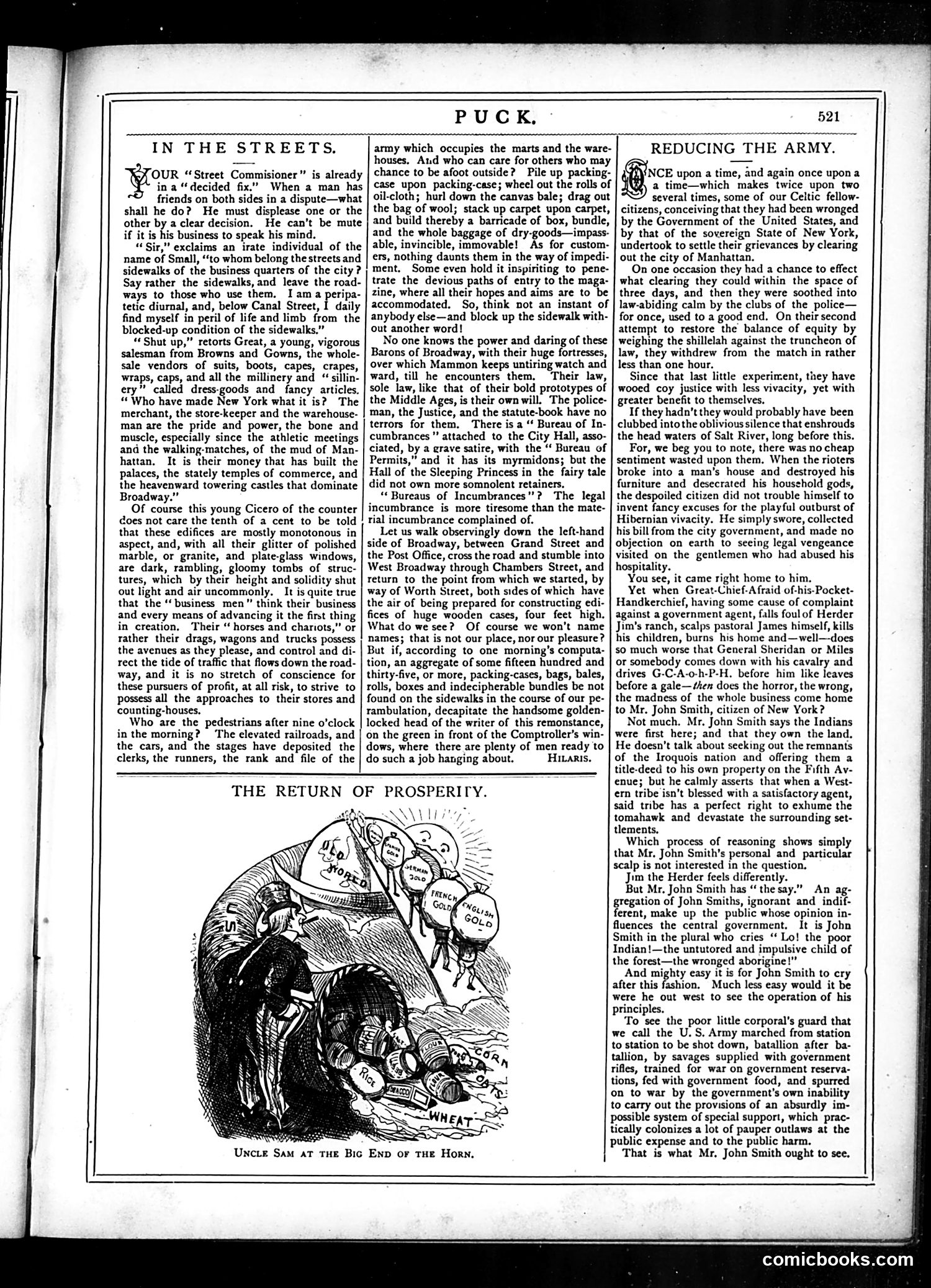
What you’re looking at
This cartoon satirizes post-Civil War government spending and corruption. "Uncle Sam" (the bearded American figure) is portrayed as grotesquely overloaded with labeled sacks representing various government expenditures and patronage: "Pork," "Offices," "Contracts," "Whiskey," and "Wheat" among others. The satire targets the belief that prosperity has "returned" despite massive federal waste. The accompanying article discusses John Smith, representing ordinary citizens, whose property disputes with the government remain unresolved while corrupt officials exploit public resources. The cartoon's point: rather than actual economic recovery benefiting citizens, government bloat from wasteful spending and corruption—particularly in military procurement and Indian affairs—is what truly characterizes the era's "prosperity."
📄 Transcribed text from this page (OCR, searchable)
Machine-transcribed from the original scan — historical spelling and the odd misread are preserved.
PUCK, 521 IN THE STREETS. OUR “Street Commisioner” is already in a “decided fix.” When a man friends on both sides in a dispute—what shall he do? He must displease one or the other by a clear decision. He can't be mute if it is his business to speak his mind. “Sir,” exclaims an irate individual of the name of Small, to whom belong thestreets and sidewalks of the business quarters of the city? Say rather the sidewalks, and leave the road- ways to those who use them. I am a peripa- tetic diurnal, and, below Canal Street, I daily find myself in peril of life and limb from the blocked-up condition of the sidewalks.” “Shut up,” retorts Great, a young, vigorous salesman from Browns and Gowns, the whole- sale vendors of suits, boots, capes, crapes, wraps, caps, and all the millinery and “ sillin- ery” called dress-goods and fancy articles. “Who have made New York what it is? The merchant, the store-keeper and the warehouse- man are the pride and power, the bone and muscle, especially since the athletic meetings and the walking-matches, of the mud of Man- hattan. It is their money that has built the palaces, the stately temples of commerce, and the heavenward towering castles that dominate Broadway.” Of course this young Cicero of the counter oes not care the tenth of a cent to be told that these edifices are mostly monotonous in aspect, and, with all their glitter of polished marble, or granite, and plate-glass windows, are dark, rambling, gloomy tombs of struc- tures, which by their height and solidity shut out light and air uncommonly. It is quite true that the ‘business men” think their business and every means of advancing it the first thing in creation, Their “ horses and chariots,” or rather their drags, wagons and trucks possess the avenues as they please, and control and di- rect the tide of traffic that flows down the road- way, and it is no stretch of conscience for these pursuers of profit, at all risk, to strive to possess all the approaches to their stores and counting-houses. Who are the pedestrians after nine o'clock in the morning? The elevated railroads, and the cars, and the stages have deposited the clerks, the runners, the rank and file of the army which occupies the marts and the ware- houses. And who can care for others who may chance to be afoot outside? Pile up packing- case upon packing-case; wheel out the rolls of oil-cloth; hurl down the canvas bale; drag out the bag of wool; stack up carpet upon carpet, and build thereby a barricade of box, bundle, and the whole baggage of dry-goods—impass- able, invincible, immovable! As for custom- ers, nothing daunts them in the way of impedi- ment. Some even hold it inspiriting to pene- trate the devious paths of entry to the maga- zine, where all their hopes and aims are to be accommodated. So, think not an instant of anybody else—and block up the sidewalk with- out another word! No one knows the power and daring of these Barons of Broadway, with their huge fortresses, over which Mammon keeps untiring watch and ward, till he encounters them, ‘Their law, sole law, like that of their bold prototypes of the Middle Ages, is their own will. The police- man, the Justice, and the statute-book have no terrors for them. There is a ‘‘ Bureau of In- cumbrances”’ attached to the City Hall, asso- ciated, by a grave satire, with the “ Bureau of Permits,” and it has its myrmidons; but the Hall of the Sleeping Princess in the fairy tale did not own more somnolent retainers. “ Bureaus of Incumbrances"? The legal incumbrance is more tiresome than the mate- rial incumbrance complained of. Let us walk observingly down the left-hand side of Broadway, between Grand Street and the Post Office, cross the road and stumble into West Broadway through Chambers Street, and return to the point from which we started, by way of Worth Street, both sides of which have the air of being prepared for constructing edi- fices of huge wooden cases, four feet high. What do we see? Of course we won't name names; that is not our place, nor our pleasure? But if, according to one morning's computa- tion, an aggregate of some fifteen hundred and thirty-five, or more, packing-cases, bags, bales, rolls, boxes and indecipherable bundles be not found on the sidewalks in the course of our pe- rambulation, decapitate the handsome golden- locked head of the writer of this remonstance, on the green in front of the Comptroller’s win- dows, where there are plenty of men ready to do such a job hanging about. Hiraris. Uncte Sam AT THE Bic Enp oF THE Horn, REDUCING THE ARMY. NCE upon a time, and again once upon a a time—which makes twice upon two several times, some of our Celtic fellow- citizens, conceiving that they had been wronged by the Government of the United States, and by that of the sovereign State of New York, undertook to settle their grievances by clearing out the city of Manhattan. On one occasion they had a chance to effect what clearing they could within the space of three days, and then they were soothed into law-abiding calm by the clubs of the police— for once, used to a good end. On their second attempt to restore the balance of equity by weighing the shillelah against the truncheon of law, they withdrew from the match in rather less than one hour. Since that last little experiment, they have wooed coy justice with less vivacity, yet with greater benefit to themselves, If they hadn’t they would probably have been clubbed into the oblivious silence that enshrouds the head waters of Salt River, long before this. For, we beg you to note, there was no cheap sentiment wasted upon them. When the rioters broke into a man’s house and destroyed his furniture and desecrated his household gods, the despoiled citizen did not trouble himself to invent fancy excuses for the playful outburst of Hibernian vivacity. He simply swore, collected his bill from the city government, and made no objection on earth to seeing legal vengeance visited on the gentlemen who had abused his hospitality. You see, it came right home to him. Yet when Great-Chief-Afraid of-his-Pocket- Handkerchief, having some cause of complaint against a government agent, falls foul of Herder Jim's ranch, scalps pastoral James himself, kills his children, burns his home and—well—does so much worse that General Sheridan or Miles or somebody comes down with his cavalry and drives G-C-A-o-h-P-H. before him like leaves before a gale—¢hen does the horror, the wrong, the madness of the whole business come home to Mr. John Smith, citizen of New York? Not much. Mr. John Smith says the Indians were first here; and that they own the land, He doesn’t talk about seeking out the remnants of the Iroquois nation and offering them a title-deed to his own property on the Fifth Av- enue; but he calmly asserts that when a West- ern tribe isn’t blessed with a satisfactory agent, said tribe has a perfect right to exhume the tomahawk and devastate the surrounding set- tlements. Which process of reasoning shows simply that Mr, John Smith's personal and particular scalp is not interested in the question, Jmm the Herder feels differently. But Mr, John Smith has “the say.” An ag- gregation of John Smiths, ignorant and indif- ferent, make up the public whose opinion in- fluences the central government. It is John Smith in the plural who cries ‘‘ Lo! the poor Indian!—the untutored and impulsive child of the forest—the wronged aborigine!"” And mighty easy it is for John Smith to cry after this fashion. Much less easy would it be were he out west to see the operation of his principles. To see the poor little corporal’s guard that we call the U.S. Army marched from station to station to be shot down, batallion after ba- tallion, by savages supplied with government rifles, trained for war on government reserva- tions, fed with government food, and spurred on to war by the government’s own inability to carry out the provisions of an absurdly im- possible system of special support, which prac- tically colonizes a lot of pauper outlaws at the public expense and to the public harm. That is what Mr, John Smith ought to see. comicbooks.com