
Puck, 1879-10-22 · page 6 of 16
Puck — October 22, 1879 — page 6: what you’re looking at
What you’re looking at
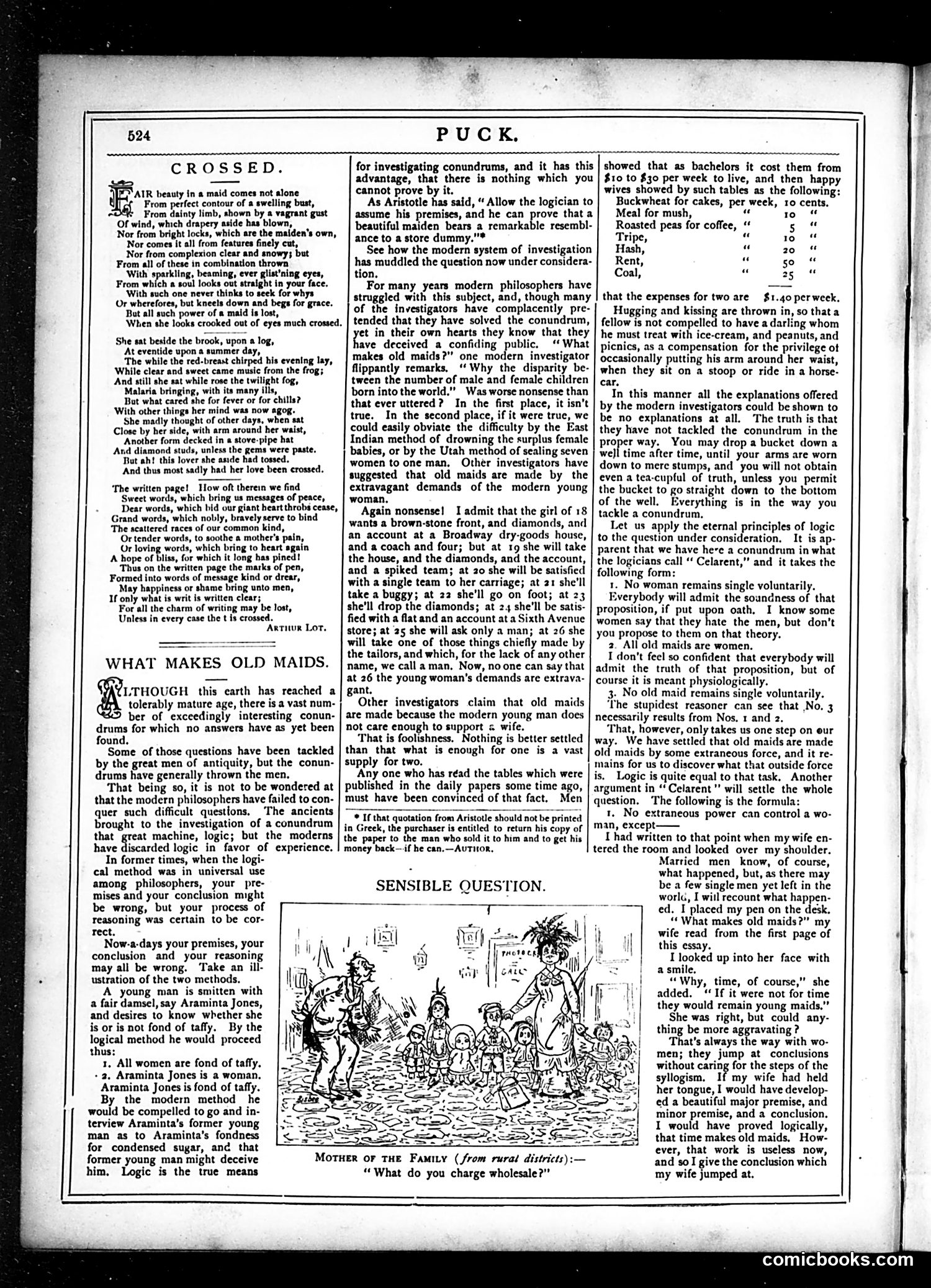
This single cartoon at the page bottom depicts a rural family scene with the caption "**Mother of the Family** (from rural districts): 'What do you charge wholesale?'" The satire appears to target rural mothers' economic shrewdness and bargain-hunting mentality. The cartoon shows a large family of children, suggesting the stereotype of rural families being large and poor. The mother's question about "wholesale" pricing humorously implies she's perpetually seeking deals—treating her numerous children like bulk commodities rather than individuals. This likely reflects early-20th-century urban attitudes toward rural populations as unsophisticated yet cunning with money. The joke reinforces period stereotypes about rural poverty and family size, presented through gentle domestic humor typical of Puck magazine's satirical approach.
📄 Transcribed text from this page (OCR, searchable)
Machine-transcribed from the original scan — historical spelling and the odd misread are preserved.
524 PUCK. CROSSED. q 'AIR beauty in a maid comes not alone From perfect contour of a swelling bust, From dainty limb, shown by a vagrant gust Of wind, which drapery aside has blown, Nor from bright locks, which are the maiden’s own, Nor comes it all from features finely cut, Nor from complexion clear and snowy; but From all of these in combination thrown. With sparkling, beaming, ever glist’ning eyes, From which a soul looks out straight in your face. ‘With such one never thinks to seek for whys Or wherefores, but kneels down and begs for grace. But all such power of a maid is lost, ‘When she looks crooked out of eyes much crossed. She sat beside the brook, upon a log, ‘At eventide upon a summer day, 1¢ red-breast chirped his evening lay, ‘and sweet came music from the frog; I she sat while rose the twilight fog, Malaria bringing, with its many ills, Bot what cared she for fever or for chills? With other things her mind was now agog. She madly thought of other days, when sat Close by her side, with arm around her waist, Another form decked in a stove-pipe hat And diamond studs, unless the gems were paste. But aht this lover she aside had tossed. ‘And thus most sadly had her love been crossed. ‘The written page! How off therein we find ‘Sweet words, which bring us messages of peace, Dear words, which bid our giant heart throbs cease, Grand words, which nobly, bravely serve to bind ‘The acattered races of our common kind, Or tender words, to soothe a mother's pain, Or loving words, which bring to heart sgain A hope ‘of bliss, for which it long has pined! Thus on the written page the marks of pen, Formed into words of message kind or drear, May happiness or shame bring unto men, If only what is writ is written clear; For all the charm of writing may be lost, Unless in every case the t is crossed. Artie Lot. WHAT MAKES OLD MAIDS. LTHOUGH this earth has reached a tolerably mature age, there is a vast num- ber of exceedingly interesting conun- drums for which no answers have as yet been found, Some of those questions have been tackled by the great men of antiquity, but the conun- drums have generally thrown the men, That being so, it is not to be wondered at that the modern philosophers have failed to con- quer such difficult questions, The ancients brought to the investigation of a conundrum that great machine, logic; but the moderns have Giscarded logic in favor of experience. In former times, when the logi- cal method was in universal use among philosophers, your pre- mises and your conclusion might for investigating conundrums, and it has this advantage, that there is nothing which you cannot prove by it. As Aristotle has said, “ Allow the logician to assume his premises, and he can prove that a beautiful maiden bears a remarkable resembl- ance to a store dummy."* See how the modern system of investigation has muddled the question now under considera- tion, For many years modern philosophers have struggled with this subject, and, though many of the investigators have complacently pre- tended that they have solved the conundrum, et in their own hearts they know that they have deceived a confiding public. ‘ What makes old maids?” one modern investigator flippantly remarks, ‘Why the disparity be- tween the number of male and female children born into the world.” Was worse nonsense than that ever uttered? In the first place, it isn't true. In the second place, if it were true, we could easily obviate the difficulty by the East Indian method of drowning the surplus female babies, or by the Utah method of sealing seven women to one man, Other investigators have suggested that old maids are made by the extravagant demands of the modern young woman, Again nonsense! I admit that the girl of 18 wants a brown-stone front, and diamonds, and an account at a Broadway dry-goods house, and a coach and four; but at 1g she will take the house, and the diamonds, and the account, and a spiked team; at 20 she will be satisfied with a single team to her carriage; at 21 she'll take a buggy; at 22 she'll go on foot; at 23 she'll drop the diamonds; at 24 she'll be satis- fied with a flat and an account at a Sixth Avenue store; at 25 she will ask only a man; at 26 she will take one of those things chiefly made by the tailors, and which, for the lack of any other name, we call aman. Now, noone can say that at 26 the young woman's demands are extrava- gant. Other investigators claim that old maids are made because the modern young man does not care enough to support « wife. That is foolishness, Nothing is better settled than that what is enough for one is a vast supply for two. Any one who has réad the tables which were published in the daily papers some time ago, must have been convinced of that fact. Men * If that quotation from Aristotle should not be printed in Greek, the purchaser is entitled to return his copy of the paper to the man who sold it to him and to get his money back—if he can.—AUTHOR. SENSIBLE QUESTION. showed that as bachelors it cost them from $10 to $30 per week to live, and then happy wives showed by such tables as the following: Buckwheat for cakes, per week, 10 cents. Meal for mush, i to Roasted peas for coffee, 5 Tripe, ‘ 10 Hash, 20 Rent, 5° Coal, 25 that the expenses for two are $1.40 perweek. Hugging and kissing are thrown in, so that a fellow is not compelled to have a darling whom he must treat with ice-cream, and peanuts, and picnics, as a compensation for the privilege ot occasionally putting his arm around her waist, when they sit on a stoop or ride in a horse- car, In this manner all the explanations offered by the modern investigators could be shown to be no explanations at all. The truth is that they have not tackled the conundrum in the proper way. You may drop a bucket down a we}l time after time, until your arms are worn down to mere stumps, and you will not obtain even a tea-cupful of truth, unless you permit the bucket to go straight down to the bottom of the well, Everything is in the way you tackle a conundrum, Let us apply the eternal principles of logic to the question under consideration. It is ap- parent that we have here a conundrum in what the logicians call ‘‘ Celarent,” and it takes the following form: 1. No woman remains single voluntarily. Everybody will admit the soundness of that proposition, if put upon oath, I know some women say that they Fate the men, but don’t you propose to them on that theory. 2. All old maids are women. I don't feel so confident that everybody will admit the truth of that proposition, but of course it is meant physiologically. 3. No old maid remains single voluntarily. ‘The stupidest reasoner can see that No. 3 necessarily results from Nos. 1 and 2. That, however, only takes us one step on eur way. We have settled that old maids are made old maids by some extraneous force, and it re- mains for us to discover what that outside force is, Logic is quite equal to that task. Another argument in ‘‘Celarent”’ will settle the whole question. The following is the formula: 1, No extraneous power can control a wo- man, except—— Thad written to that point when my wife en- tered the room and looked over my shoulder. Married men_ know, of course, what happened, but, as there may be a few single men yet left in the worlc, I will recount what happen- “ be wrong, but your process of reasoning was certain to be cor- rect. . Now-a-days your premises, your conclusion and your reasoning may all be wrong. ‘Take an ill- ustration of the two methods. A young man is smitten with a fair damsel, say Araminta Jones, and desires to know whether she is or is not fond of taffy. By the logical method he would proceed thus: 1, All women are fond of taffy. +2, Araminta Jones is a woman, Araminta Jones is fond of taffy. By the modern method he would be compelled to go and in- terview Araminta’s former young man as to Araminta’s fondness 4 ed. I placed my pen on the desk. «What makes old maids?” my wife read from the first page of this essay. T looked up into her face with a smile. “Why, time, of course,” she added. ‘If it were not for time they would remain young maids.” She was right, but could any- thing be more aggravating ? That's always the way with wo- men; they jump at conclusions without caring for the steps of the syllogism. If my wife had held her tongue, I would have develop- ed a beautiful major premise, and minor premises and a conclusion, I would have proved logically, that time makes old maids, How- for condensed sugar, and that former young man might deceive him, Logic is the true means MorTHER oF THE FamiLy (from rural districts): “What do you charge wholesale?” ever, that work is useless now, and soI give the conclusion which my wife jumped at. comicbooks.com