
Puck, 1879-10-22 · page 10 of 16
Puck — October 22, 1879 — page 10: what you’re looking at
What you’re looking at
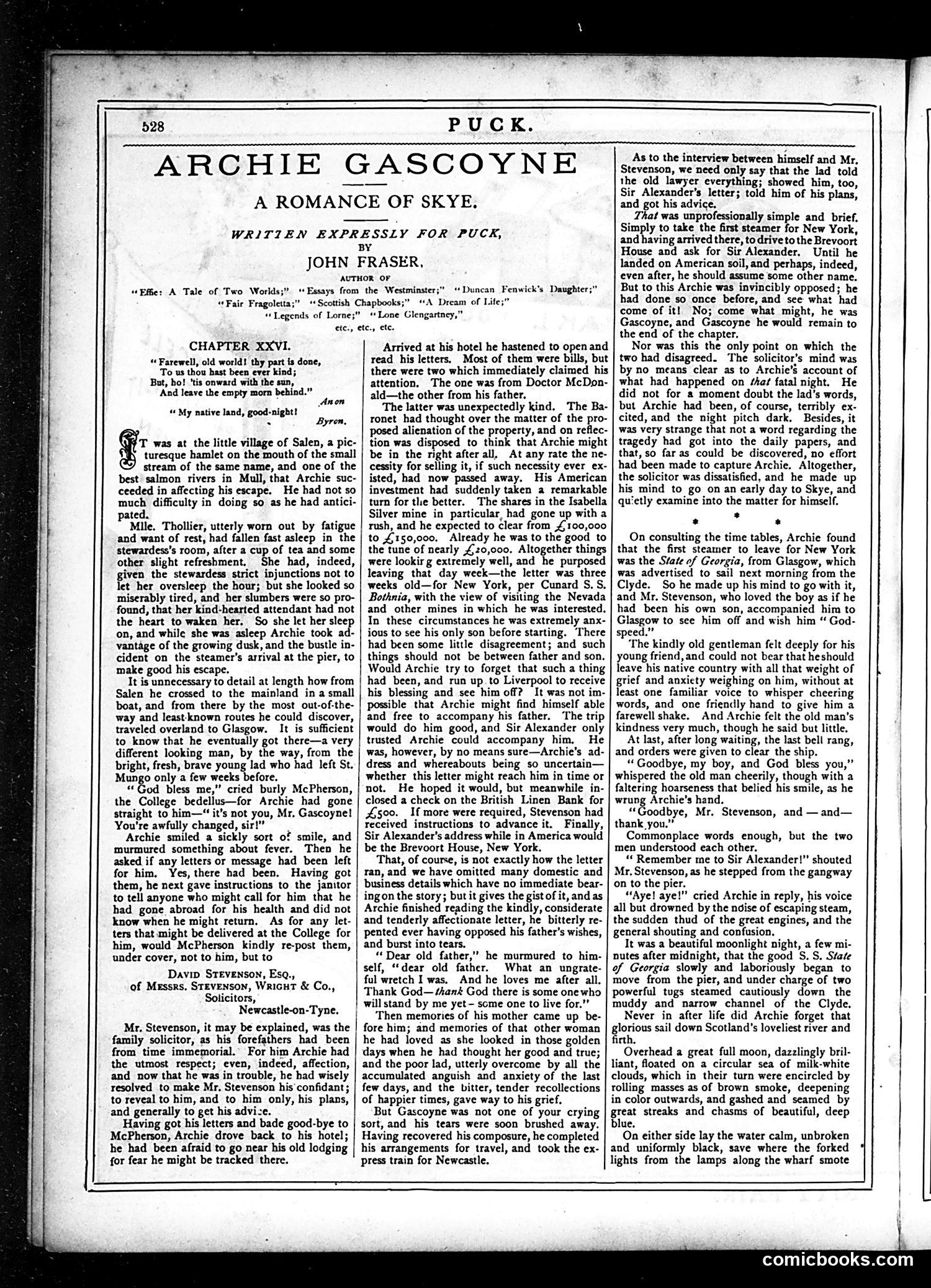
This page contains the beginning of a serialized romance story by John Fraser, written expressly for Puck magazine. It is not a political cartoon or satire, but rather a work of fiction. The story follows a young Scottish man named Archie who receives unexpected letters from his father and a solicitor while staying at a modest hamlet on the Isle of Skye. The narrative establishes that Archie's financial circumstances have dramatically improved—he's inherited substantial wealth including interests in American mines and Nevada silver properties. The plot centers on his internal conflict about leaving Scotland and his reluctance to pursue his romantic interests before departing. This appears to be a serialized romantic adventure tale rather than satirical content.
📄 Transcribed text from this page (OCR, searchable)
Machine-transcribed from the original scan — historical spelling and the odd misread are preserved.
PUCK. ARCHIE GASCOYNE A ROMANCE OF SKYE, WRITTEN EXPRESSLY FOR PUCK, BY JOHN FRASER, AUTHOR OF “Effie: A Tale of Two Worlds;” ‘Essays from the Westminster; ‘Duncan Fenwick’s Daughter;” “Fair Fragoletta;” ‘+ Scottish Chapbooks;” A Dream of Life;” “Legends of Lorne; ‘Lone Glengartney,” ete., ete., ete. CHAPTER XXVI. «Farewell, old world! thy part is done, To us thou hast been ever kind; But, ho! ‘tis onward with the sun, And leave the empty morn behind.” «« My native land, good-night! 3 Byron, ¢ was at the little village of Salen, a pic- turesque hamlet on the mouth of the small stream of the same name, and one of the best salmon rivers in Mull, that Archie suc- ceeded in affecting his escape. He had not so much difficulty in doing so as he had antici- pated. Mile. Thollier, utterly worn out by fatigue and want of rest, had fallen fast asleep in the stewardess’s room, after a cup of tea and some other slight refreshment. She had, indeed, given the stewardess strict injunctions not to let her oversleep the hour; but she looked so miserably tired, and her slumbers were so pro- found, that her kind-hearted attendant had not the heart to waken her. So she let her slee; on, and while she was asleep Archie took ad- vantage of the growing dusk, and the bustle in- cident on the steamer’s arrival at the pier, to make good his escape. It is unnecessary to detail at length how from Salen he crossed to the mainland in a small boat, and from there by the most out-of-the- way and least known routes he could discover, traveled overland to Glasgow. It is sufficient to know that he eventually got there—a very different looking man, by the way, from the bright, fresh, brave young lad who had left St. Mungo only a few weeks before. us Bod bless me,” cried burly McPherson, the College bedellus—for Archie had gone straight to him—“ it’s not you, Mr. Gascoyne! You're awfully changed, sir!” Archie smiled a sickly sort of smile, and murmured something about fever. Then he asked if any letters or message had been left for him. Yes, there had been. Having got them, he next gave instructions to the janitor to tell anyone who might call for him that he had gone abroad for his health and did not know when he might return, As for any let- ters that might be delivered at the College for him, would McPherson kindly re-post them, under cover, not to him, but to Davip STEvENsoN, Esq., of Messrs. STEVENSON, WricuT & Co., Solicitors, Newcastle-on-Tyne. Mr. Stevenson, it may be explained, was the family solicitor, as his forefathers had been from time immemorial. For him Archie had the utmost respect; even, indeed, affection, and now that he was in trouble, he had wisely resolved to make Mr. Stevenson his confidant; to reveal to him, and to him only, his plans, and generally to get his advi-e. Having got his letters and bade good-bye to McPherson, Archie drove back to his hotel; he had been afraid to go near his old lodging for fear he might be tracked there. Arrived at his hotel he hastened to open and read his letters, Most of them were bills, but there were two which immediately claimed his attention. The one was from Doctor McDon- ald—the other from his father. ‘The latter was unexpectedly kind. The Ba- ronet had thought over the matter of the pro- posed alienation of the property, and on reflec- tion was dis; to think that Archie might be in the right after all, At any rate the ne- cessity for selling it, if such necessity ever ex- isted, had now passed away. His American investment had suddenly taken a remarkable turn for the better. The shares in the Isabella Silver mine in particular, had gone up with a rush, and he expected to clear from £100,000 to £150,000, Already he was to the good to the tune of nearly £20,000. Altogether things were lookirg extremely well, and he purposed leaving that day week—the letter was three weeks old—for New York, per Cunard S.S, Bothnia, with the view of visiting the Nevada and other mines in which he was interested. In these circumstances he was extremely anx- ious to see his only son before starting. ‘There had been some little disagreement; and such things should not be between father and son. Would Archie try to forget that such a thing had been, and run up. to Liverpool to receive his blessing and see him off? It was not im- possible that Archie might find himself able and free to accompany his father. ‘The trip would do him good, and Sir Alexander only trusted Archie could accompany him. He was, however, by no means sure—Archie’s ad- dress and whereabouts being so uncertain— whether this letter might reach him in time or not. He hoped it would, but meanwhile in- closed a check on the British Linen Bank for 4500. If more were required, Stevenson had received instructions to advance it. Finally, Sir Alexander's address while in America would be the Brevoort House, New York. That, of course, is not exactly how the letter ran, and we have omitted many domestic and business details which have no immediate bear- ingon the story; but it gives the gist of it, and as Archie finished reading the kindly, considerate and tenderly affectionate letter, he bitterly re- pented ever having opposed his father’s wishes, and burst into tears. “Dear old father,” he murmured to him- self, ‘dear old father. What an ungrate- ful wretch I was. And he loves me after all. Thank God—¢hank God there is some one who will stand by me yet- some one to live for.” Then memories of his mother came up be- fore him; and memories of that other woman he had loved as she looked in those golden days when he had thought her good and true; and the poor lad, utterly overcome by all the accumulated anguish and anxiety of the last few days, and the bitter, tender recollections of happier times, gave way to his grief. But Gascoyne was not one of your crying sort, and his tears were soon brushed away. Having recovered his composure, he completed his arrangements for travel, and took the ex- press train for Newcastle. As to the interview between himself and Mr. Stevenson, we need only say that the lad told the old lawyer everything; showed him, too, Sir Alexander's letter; told him of his plans, and got his advice, That was unprofessionally simple and brief. Simply to take the first steamer for New York, and having arrived there, to drive to the Brevoort House and ask for Sir Alexander. Until he landed on American soil, and perhaps, indeed, even after, he should assume some other name. But to this Archie was invincibly opposed; he had done so once before, and see what had come of it! No; come what might, he was Gascoyne, and Gascoyne he would remain to the end of the chapter. Nor was this the only point on which the two had disagreed. The solicitor’s mind was by no means clear as to Archie’s account of what had happened on “haf fatal night. He did not for a moment doubt the lad’s words, but Archie had been, of course, terribly ex- cited, and the night pitch dark. Besides, it was very strange that not a word regarding the tragedy had got into the daily papers, and that, so far as could be discovered, no effort had been made to capture Archie. Altogether, the solicitor was dissatisfied, and he made up his mind to go on an early day to Skye, and quietly examine into the matter for himself. * * * On consulting the time tables, Archie found that the first steamer to leave for New York was the State of Georgia, from Glasgow, which was advertised to sail next morning from the Clyde. So he made up his mind to go with it, and Mr. Stevenson, who loved the boy as if he had been his own son, accompanied him to Glasgow to see him off and wish him “ God- speed.” The kindly old gentleman felt deeply for his young friend, and could not bear that heshould leave his native country with all that weight of grief and anxiety weighing on him, without at Teast one familiar voice to whisper cheering words, and one friendly hand to give him a farewell shake. And Archie felt the old man’s kindness very much, though he said but little. At last, after long waiting, the last bell rang, and orders were given to clear the ship. “Goodbye, my boy, and God bless you,” whispered the old man cheerily, though with’a faltering hoarseness that belied his smile, as he wrung Archie's hand. “Goodbye, Mr. Stevenson, and — and— thank you.” Commonplace words enough, but the two men understood each other. “Remember me to Sir Alexander!" shouted Mr. Stevenson, as he stepped from the gangway on to the pier. “Aye! aye!” cried Archie in reply, his voice all but drowned by the ndise of escaping steam, the sudden thud of the great engines, and the general shouting and confusion. It was a beautiful moonlight night, a few mi- nutes after midnight, that the good S. S. State of Georgia slowly and laboriously began to move from the pier, and under charge of two powerful tugs steamed cautiously down the muddy and narrow channel of the Clyde. Never in after life did Archie forget that lorious sail down Scotland's loveliest river and rth, Overhead a great full moon, dazzlingly bril- liant, floated on a circular sea of milk-white clouds, which in their turn were encircled by rolling masses as of brown smoke, deepening in color outwards, and gashed and seamed by great streaks and chasms of beautiful, deep blue. On either side lay the water calm, unbroken and uniformly black, save where the forked lights from the lamps along the wharf smote comicbooks.com