
Puck, 1879-10-22 · page 11 of 16
Puck — October 22, 1879 — page 11: what you’re looking at
What you’re looking at
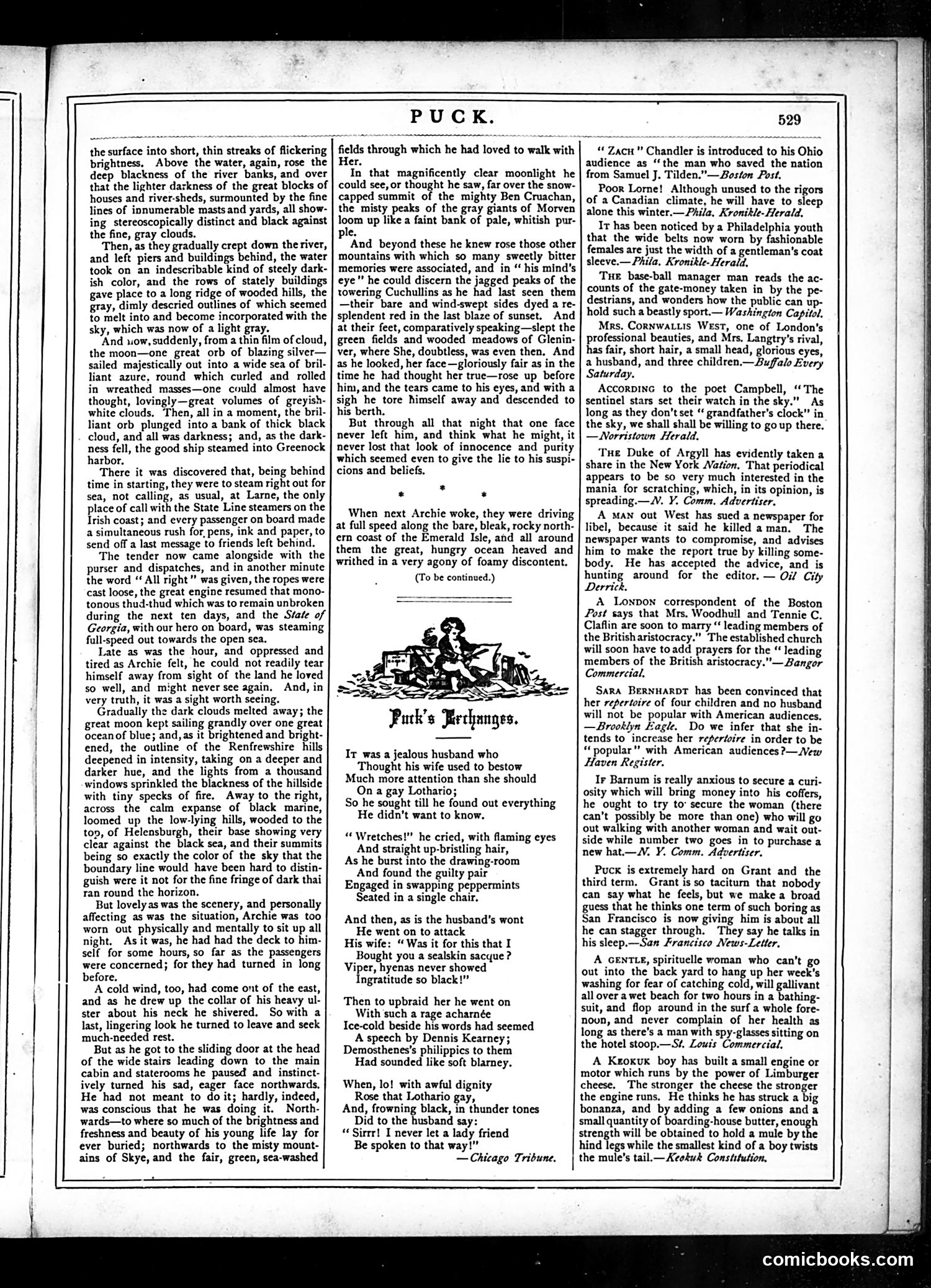
This page contains a serialized narrative story with a small illustration titled "Flirt's Exchanges" depicting a couple in an intimate moment. The story text describes romantic and domestic scenes, including references to a character named Lothario and marital discord. The page is primarily **literary content rather than political satire**. The "Flirt's Exchanges" section appears to be humorous verse about infidelity and romantic entanglement—typical of Puck's light satirical fare mocking social conventions and human follies. The right column contains brief gossip items about theatrical figures and society scandals (mentions of marriages, performances, and newspaper disputes), which was common filler content in Puck. This page lacks the sharp political cartoons or caricatures Puck is famous for; it's focused on social/romantic satire through narrative rather than visual caricature.
📄 Transcribed text from this page (OCR, searchable)
Machine-transcribed from the original scan — historical spelling and the odd misread are preserved.
the surface into short, thin streaks of flickering brightness, Above the water, again, rose the deep blackness of the river banks, and over that the lighter darkness of the great blocks of houses and river-sheds, surmounted by the fine lines of innumerable masts and yards, all show- ing stereoscopically distinct and black against the fine, gray clouds. ; Then, as they gradually crept down the river, and left piers and buildings behind, the water took on an indescribable kind of steely dark- ish color, and the rows of stately buildings gave place to a long ridge of wooded hills, the gray, dimly descried outlines of which seemed to melt into and become incorporated with the sky, which was now of a light gray. ‘And uow, suddenly, from a thin film of cloud, the moon—one great orb of blazing silver— sailed majestically out into a wide sea of bril- liant azure, round which curled and rolled in wreathed masses—one could almost have thought, lovingly—great volumes of greyish- white clouds. Then, all in a moment, the bril- liant orb plunged into a bank of thick black cloud, and all was darkness; and, as the dark- ness fell, the good ship steamed into Greenock harbor, There it was discovered that, being behind time in starting, they were to steam right out for sea, not calling, as usual, at Larne, the only place of call with the State Line steamers on the Irish coast; and every passenger on board made a simultaneous rush for, pens, ink and paper, to send off a last message to friends left behind. The tender now came alongside with the purser and dispatches, and in another minute the word “All right ” was given, the ropes were cast loose, the great engine resumed that mono- tonous thud-thud which was to remain unbroken during the next ten days, and the State of Georgia, with our hero on board, was steaming full-speed out towards the open sea. Late as was the hour, and oppressed and tired as Archie felt, he could not readily tear himself away from sight of the land he loved so well, and might never see again, And, in very truth, it was a sight worth seeing. Gradually the dark clouds melted away; the great moon kept sailing grandly over one great oceanof blue; and, as it brightened and bright- ened, the outline of the Renfrewshire hills deepened in intensity, taking on a deeper and darker hue, and the lights from a thousand windows sprinkled the blackness of the hillside with tiny specks of fire. Away to the right, across the calm expanse of black marine, loomed up the low-lying hills, wooded to the too, of Helensburgh, their base showing very clear against the black sea, and their summits being so exactly the color of the sky that the boundary line would have been hard to distin- guish were it not for the fine fringe of dark thai ran round the horizon. But lovely as was the scenery, and personally affecting as was the situation, Archie was too worn out physically and mentally to sit up all night. As it was, he had had the deck to him- self for some hours, so far as the passengers were concerned; for they had turned in long before. A cold wind, too, had come ont of the east, and as he drew up the collar of his heavy ul- ster about his neck he shivered. So with a last, lingering look he turned to leave and seek much-needed rest. But as he got to the sliding door at the head of the wide stairs leading down to the main cabin and staterooms he paused and instinct- ively turned his sad, eager face northwards, He had not meant to do it; hardly, indeed, was conscious that he was doing it. North- wards—to where so much of the brightness and freshness and beauty of his young life lay for ever buried; northwards to the ty mount- of Skye, and the fair, green, sea-washed PUCK. fields through which he had loved to walk with Her. In that magnificently clear moonlight he could see, or thought he saw, far over the snow- capped summit of the mighty Ben Cruachan, the misty peaks of the gray giants of Morven loom up like a faint bank of pale, whitish pur- le, P And beyond these he knew rose those other mountains with which so many sweetly bitter memories were associated, and in “ his mind’s eye’ he could discern the jagged peaks of the towering Cuchullins as he had last seen them —their bare and wind-swept sides dyed a re- splendent red in the last blaze of sunset. And at their feet, comparatively speaking—slept the green fields and wooded meadows of Glenin- ver, where She, doubtless, was even then, And as he looked, her face—gloriously fair as in the time he had thought her true—rose up before him, and the tears came to his eyes, and with a sigh he tore himself away and descended to his berth. But through all that night that one face never left him, and think what he might, it never lost that look of innocence and purity which seemed even to give the lie to his suspi- cions and beliefs, * * * When next Archie woke, they were driving at full speed along the bare, bleak, rocky north- ern coast of the Emerald Isle, and all around them the great, hungry ocean heaved and writhed in a very agony of foamy discontent. (To be continued.) Ir was a jealous husband who Thought his wife used to bestow Much more attention than she should On a gay Lothario; So he sought till he found out everything He didn’t want to know. “‘Wretches!” he cried, with flaming eyes And straight up-bristling hair, As he burst into the drawing-room And found the guilty pair Engaged in swapping peppermints Seated in a single chair, And then, as is the husband’s wont He went on to attack His wife: “ Was it for this that I Bought you a sealskin sacque ? Viper, hyenas never showed Ingratitude so black!” Then to upbraid her he went on With such a rage acharnée Ice-cold beside his words had seemed A speech by Dennis Kearney; Demosthenes’s philippics to them Had sounded like soft blarney. When, lo! with awful dignity Rose that Lothario gay, And, frowning black, in thunder tones Did to the husband say: “ Sirrr! I never let a lady friend 529 “ Zacu" Chandler is introduced to his Ohio audience as ‘‘the man who saved the nation from Samuel J. Tilden.”—Boston Post. Poor Lorne! Although unused to the rigors of a Canadian climate, he will have to sleep alone this winter.— Phila, Kronikle-Herald, Ir has been noticed by a Philadelphia youth that the wide belts now worn by fashionable females are just the width of a gentleman's coat sleeve.— Phila, Kronikle-Herald, Tue base-ball manager man reads the ac- counts of the gate-money taken in by the pe- destrians, and wonders how the public can up- hold such a beastly sport.— Washington Capitol. Mrs, Cornwatuis West, one of London's professional beauties, and Mrs. Langtry's rival, has fair, short hair, a small head, glorious eyes, a husband, and three children.— Buffalo Every Saturday, AccorDING to the poet Campbell, “The sentinel stars set their watch in the sky.” As long as they don’t set “ grandfather's clock” in the sky, we shall shall be willing to go up there. —WNorristown Herald. ‘Tue Duke of Argyll has evidently taken a share in the New York Nation. That periodical appears to be so very much interested in the mania for scratching, which, in its opinion, is spreading.—/. ¥. Comm, Advertiser, A MAN out West has sued a newspaper for libel, because it said he killed aman. The newspaper wants to compromise, and advises him to make the report true by killing some- body. He has accepted the advice, and is hunting around for the editor. — Oi City Derrick. A Lonpon correspondent of the Boston Post says that Mrs. Woodhull and Tennie C. Claflin are soon to marry “‘ leading members of the British aristocracy.” The established church will soon have toadd prayers for the “ leading members of the British aristocracy."”— Bangor Commercial, Sara BeRNHARDT has been convinced that her repertoire of four children and no husband will not be popular with American audiences. —Brooklyn Eagle. Do we infer that she in- tends to increase her repertoire in order to be “popular” with American audiences?—ew Haven Register. Ir Barnum is really anxious to secure a curi- osity which will bring money into his coffers, he ought to try to: secure the woman (there can't possibly be more than one) who will go out walking with another woman and wait out- side while number two goes in to purchase a new hat.—W. ¥. Comm. Advertiser. Puck is extremely hard on Grant and the third term. Grant is so taciturn that nobody can say what he feels, but we make a broad guess that he thinks one term of such boring as San Francisco is now giving him is about all he can stagger through. They say he talks in his sleep.—San Francisco News-Letter, A GENTLE, spirituelle woman who can’t go out into the back yard to hang up her week's washing for fear of catching cold, will gallivant all over a wet beach for two hours in a bathing- suit, and flop around in the surf a whole fore- noun, and never complain of her health as long as there's a man with spy-glasses sitting on the hotel stoop.—.S¢, Louis Commercial, A Keoxux boy has built a small engine or motor which runs by the power of Limburger cheese, The stronger the cheese the stronger the engine runs. He thinks he has struck a big bonanza, and by adding a few onions and a small quantity of boarding-house butter, enough strength will be obtained to hold a mule by the hind legs while the smallest kind of a boy twists the mule's tail.— Keokuk Constitution, comicbooks.com