
A complete issue · 18 pages · 1879
Puck — October 1, 1879
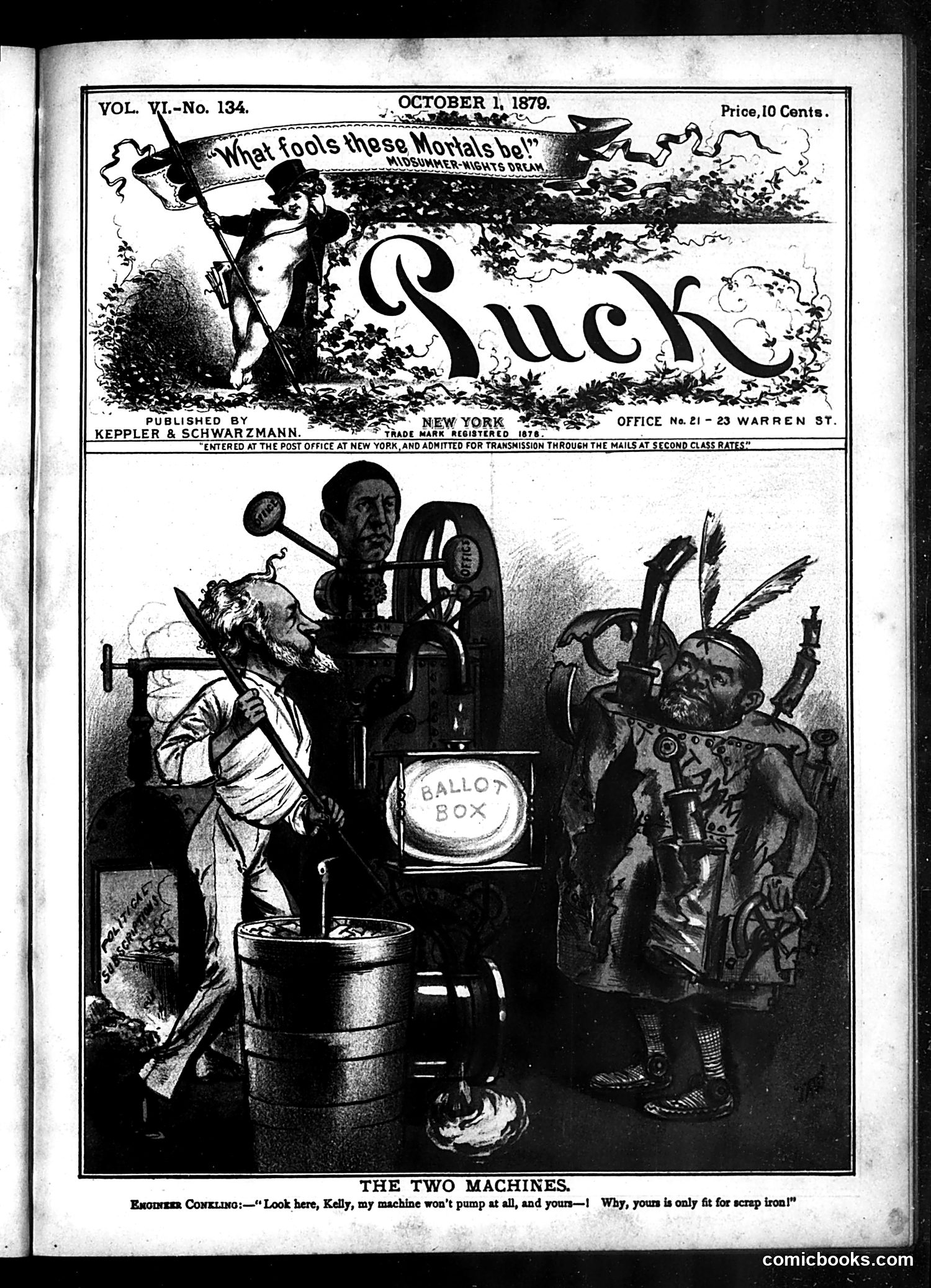
This political cartoon satirizes the 1876 U.S. presidential election machinery. The central image shows two figures operating around a ballot box—one labeled as an "Engineer" speaking to "Kelly," complaining that his machine "won't pump at all" while the other machine works fine. Kelly responds that the other machine is "only fit for scrap iron." The cartoon critiques competing voting systems or electoral manipulation tactics during this contentious election period. The figures appear to represent different political factions or operatives struggling with election machinery—likely referencing fraud concerns, ballot-box tampering, or disputes over voting mechanisms that characterized the 1876 Hayes-Tilden election controversy.
This page is primarily **text-based editorial content** rather than illustrated political cartoons. The main sections include: **"Pain and Pedestrianism"** critiques a walking match phenomenon popular in the 1880s-90s, where participants endured extreme physical hardship over multiple days. Puck satirizes the spectacle as cruel entertainment and questions society's lack of outrage, noting we have animal protection societies but apparently tolerate torturing humans for amusement. **"Coal Fire or Hell Fire"** discusses a fireman named Johnston who worked Sundays, presenting a moral debate about labor and religious observance. The **"Puckerings"** section contains brief satirical jabs at various public figures and contemporary events, including references to General Grant and political situations. The page demonstrates Puck's editorial function: social criticism through prose satire rather than visual caricature.
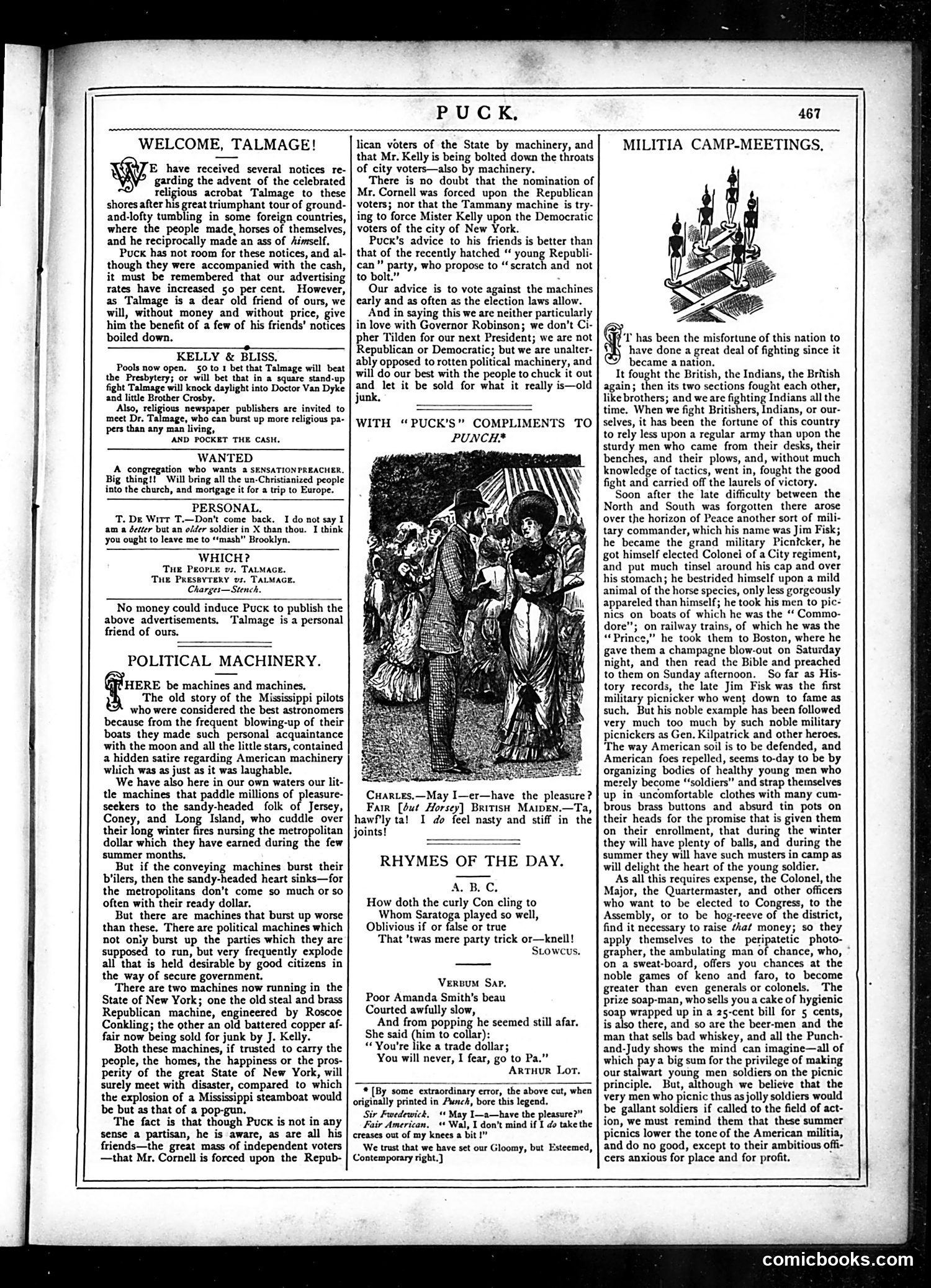
The main article satirizes corrupt electoral practices in New York State politics. It references Roscoe Conkling (Republican machine boss) and another "old-time politician" whose names the text withholds, criticizing how political machines manipulate voting through corruption and coercion. The satire specifically attacks: - Governor Robinson and the Democratic machine - The Republican "young Republican party" - Both parties' attempts to control voters through organizational pressure rather than genuine persuasion The accompanying illustration (center-right) depicts a crowded political gathering or rally, though specific figures are unclear. The text criticizes these machines as undemocratic forces that exploit ordinary voters' interests while serving elite political bosses' power and profit motives.
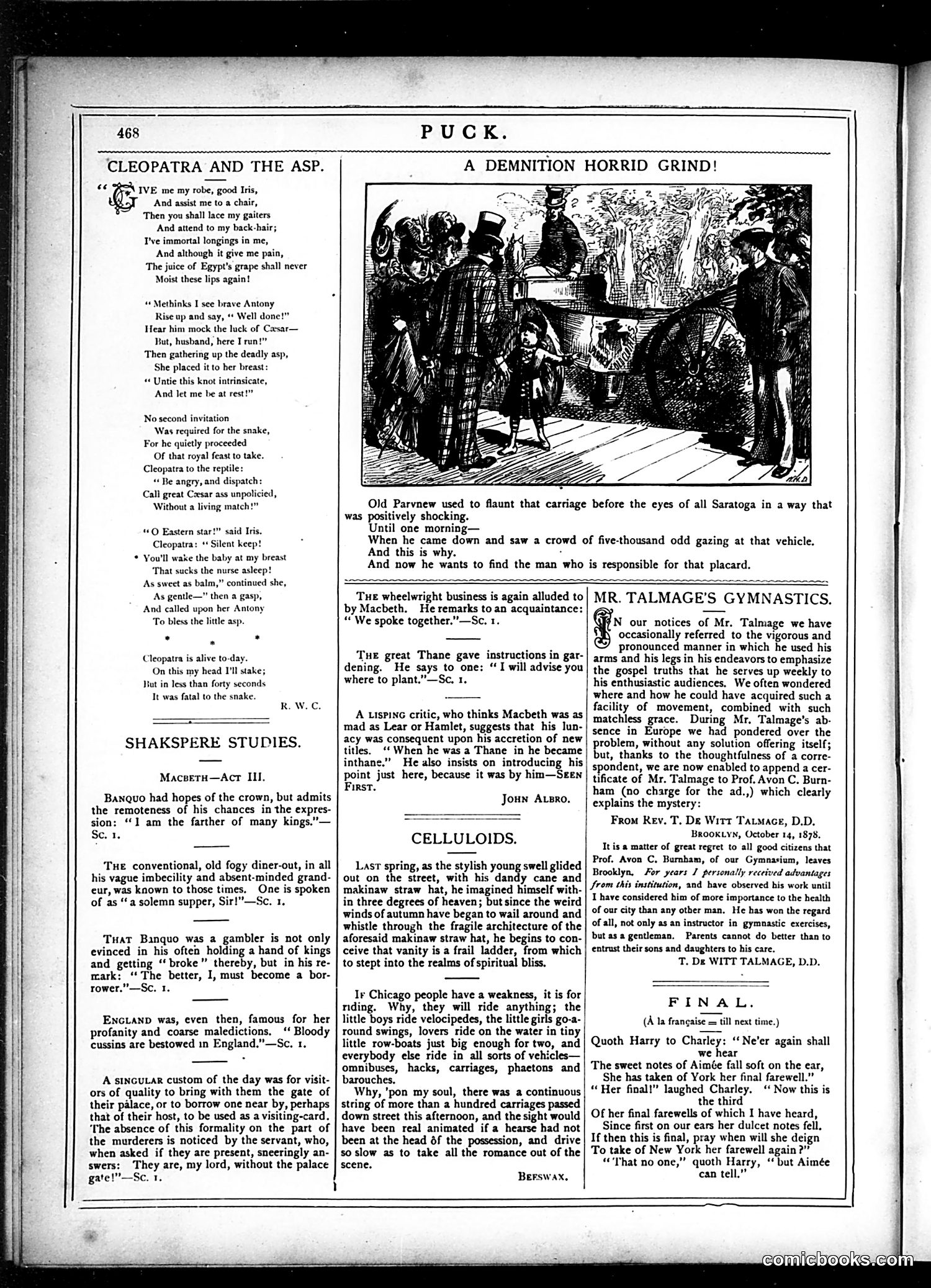
The main cartoon depicts what appears to be a public scandal involving a carriage in Saratoga (a fashionable resort town). The text states Old Parvenu "used to flaunt that carriage before the eyes of all Saratoga in a way that positively shocked" society, but now he's desperately searching for "the man who is responsible for that placard." The satire targets nouveau riche social climbers who ostentatiously display wealth to impress high society. The "horrid grind" refers to the embarrassment and social comedown when someone's pretensions are publicly exposed or mocked—a fitting punishment for vulgar wealth-display that offended refined sensibilities. The cartoon mocks both the character's arrogance and society's obsession with status symbols.
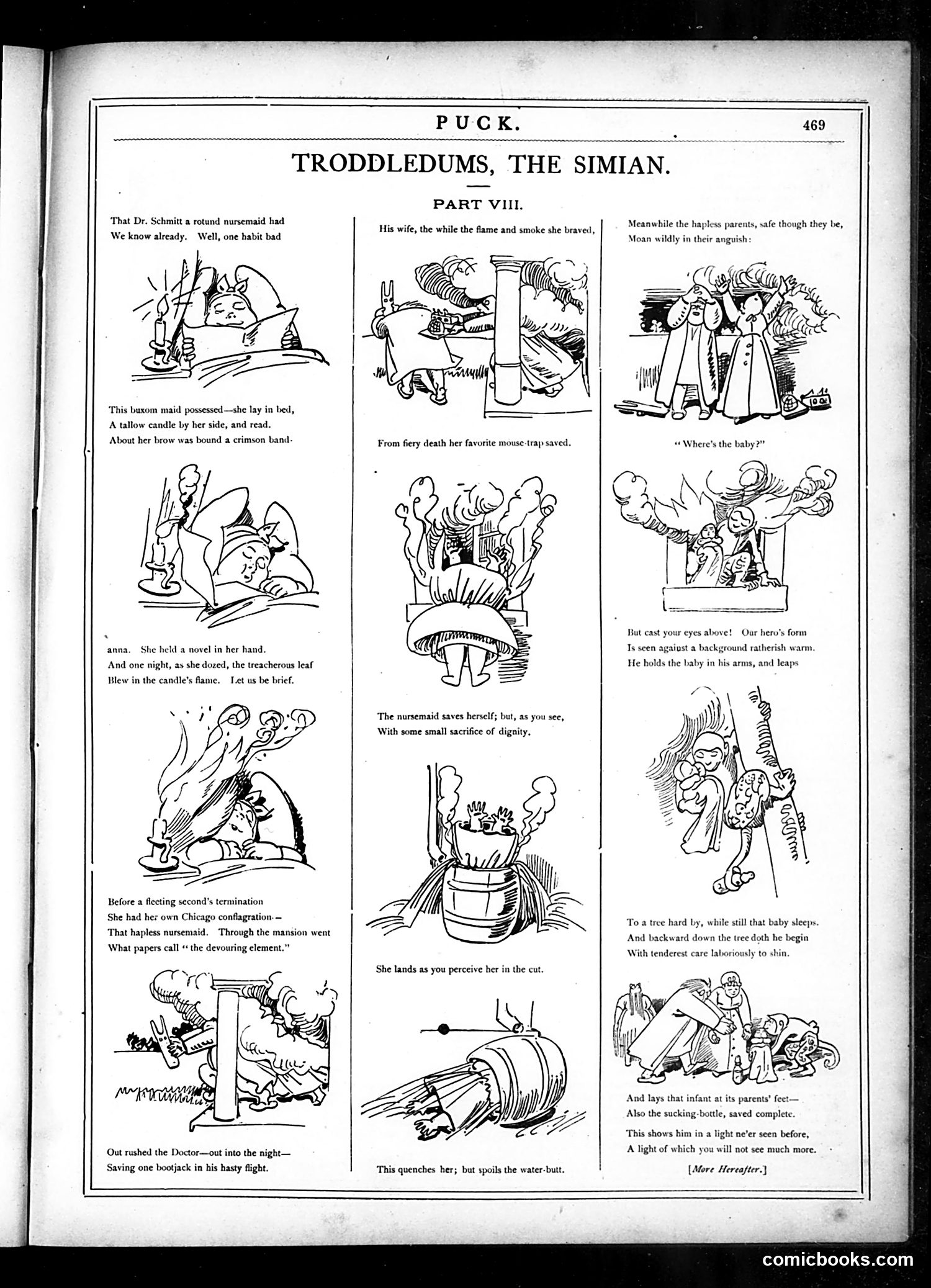
This is a serialized humorous story in verse, illustrated with comic panels. The narrative follows a hapless nursemaid who must care for an infant while dealing with various domestic mishaps—a candle blowing out, a fire, a water bucket mishap, and ultimately delivering the baby to its parents. The "Simian" in the title suggests mockery of someone through animal comparison, though the specific political target is unclear from this page alone. The story appears primarily comedic rather than overtly political satire, focusing on slapstick domestic chaos and the nursemaid's incompetence. The illustrations use exaggerated expressions and physical comedy typical of Puck's satirical style, but this particular installment emphasizes entertainment over pointed social commentary.
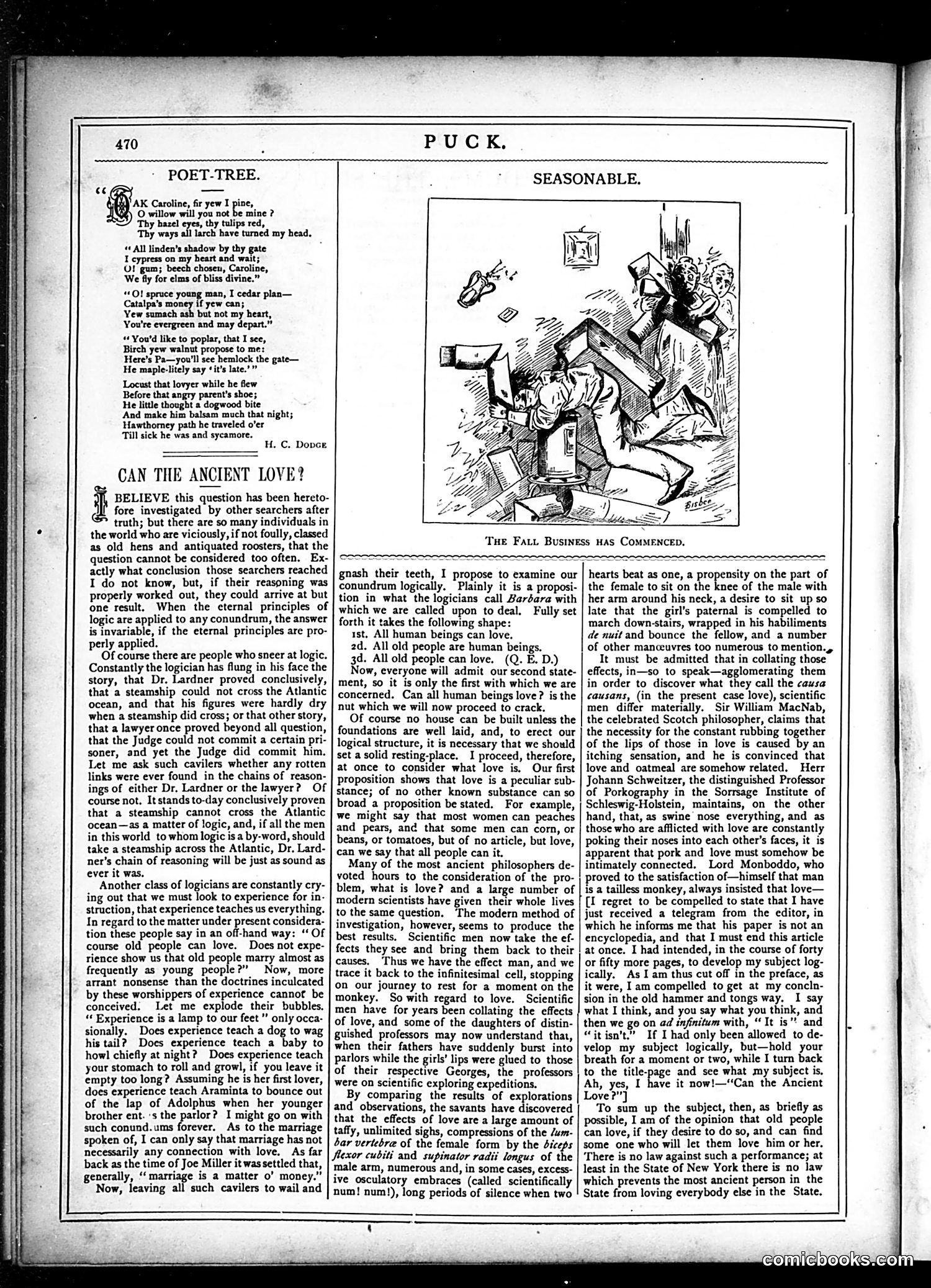
The page contains two distinct items: **"Poet-Tree"** (left): A poem by C. Dodge, likely a sentimental verse about Caroline and willow trees—typical light poetry for the era. **"The Fall Business Has Commenced"** (right): The cartoon depicts a figure surrounded by scattered items and papers, appearing disheveled or in distress. Without clearer identifying features visible, the exact subject remains unclear, though the title suggests commentary on autumn commercial activity or economic hardship during fall seasons. The messy composition may satirize business chaos or financial instability. **"Can the Ancient Love?"** (center/bottom): A substantial article examining whether love among elderly people is possible, presented as pseudo-scientific philosophical inquiry—typical of Puck's humorous treatment of earnest Victorian intellectual debates. The tone is satirical, mocking both romantic sentimentality and overwrought scientific analysis.
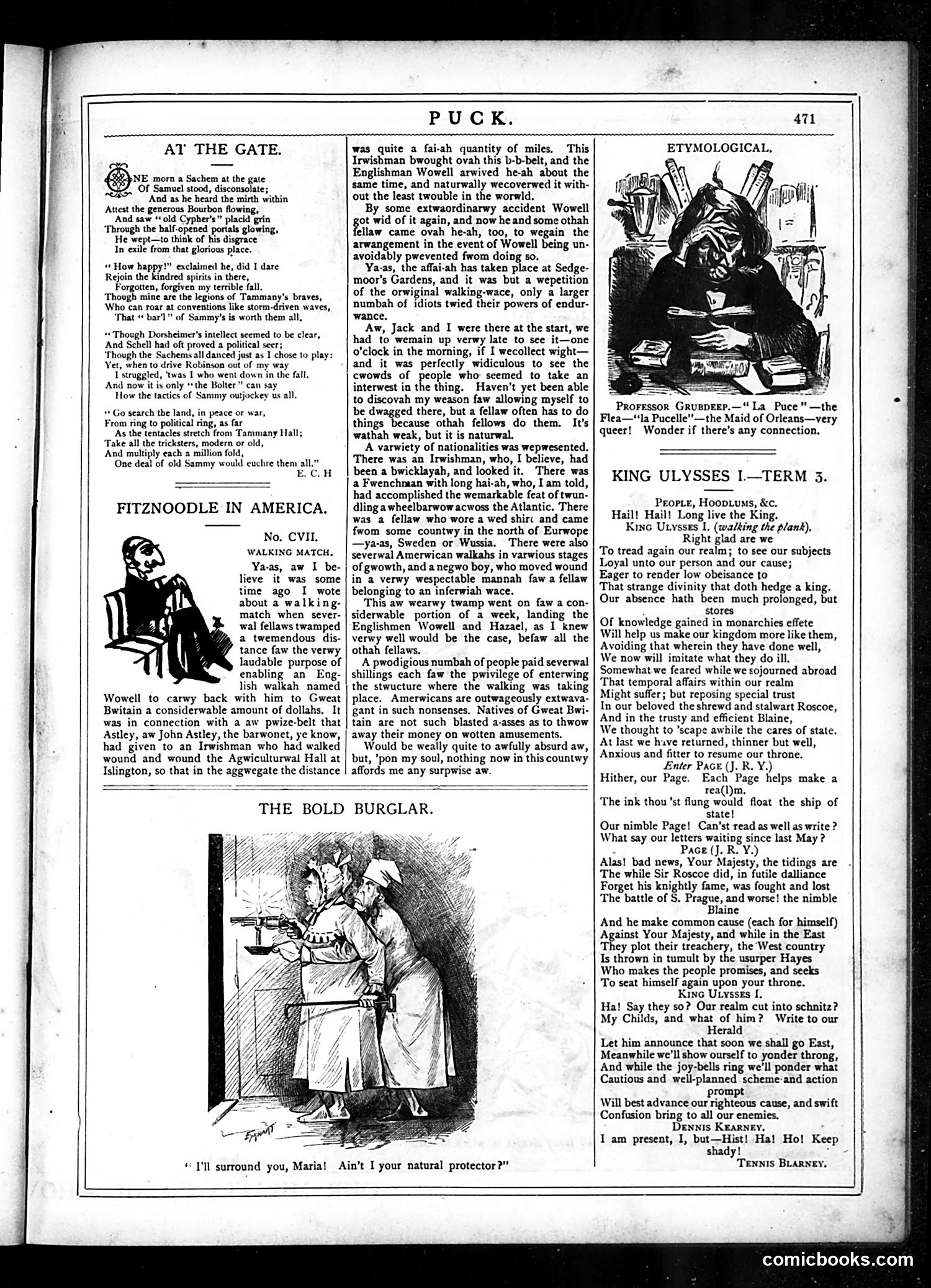
This cartoon satirizes a domestic confrontation, likely depicting a social or political commentary through the interaction between two figures. The man appears to be a burglar or intruder confronting a woman, with the caption: "I'll surround you, Maria! Ain't I your natural protector?" The satire likely mocks masculine authority claims or domestic power dynamics of the era. The "bold burglar" framing suggests irony—the supposed "protector" is actually behaving like a criminal threatening the woman he claims to protect. This appears to critique how men justified controlling behavior toward women under the guise of protection, a common Puck target during this period when women's rights and suffrage were contested issues.
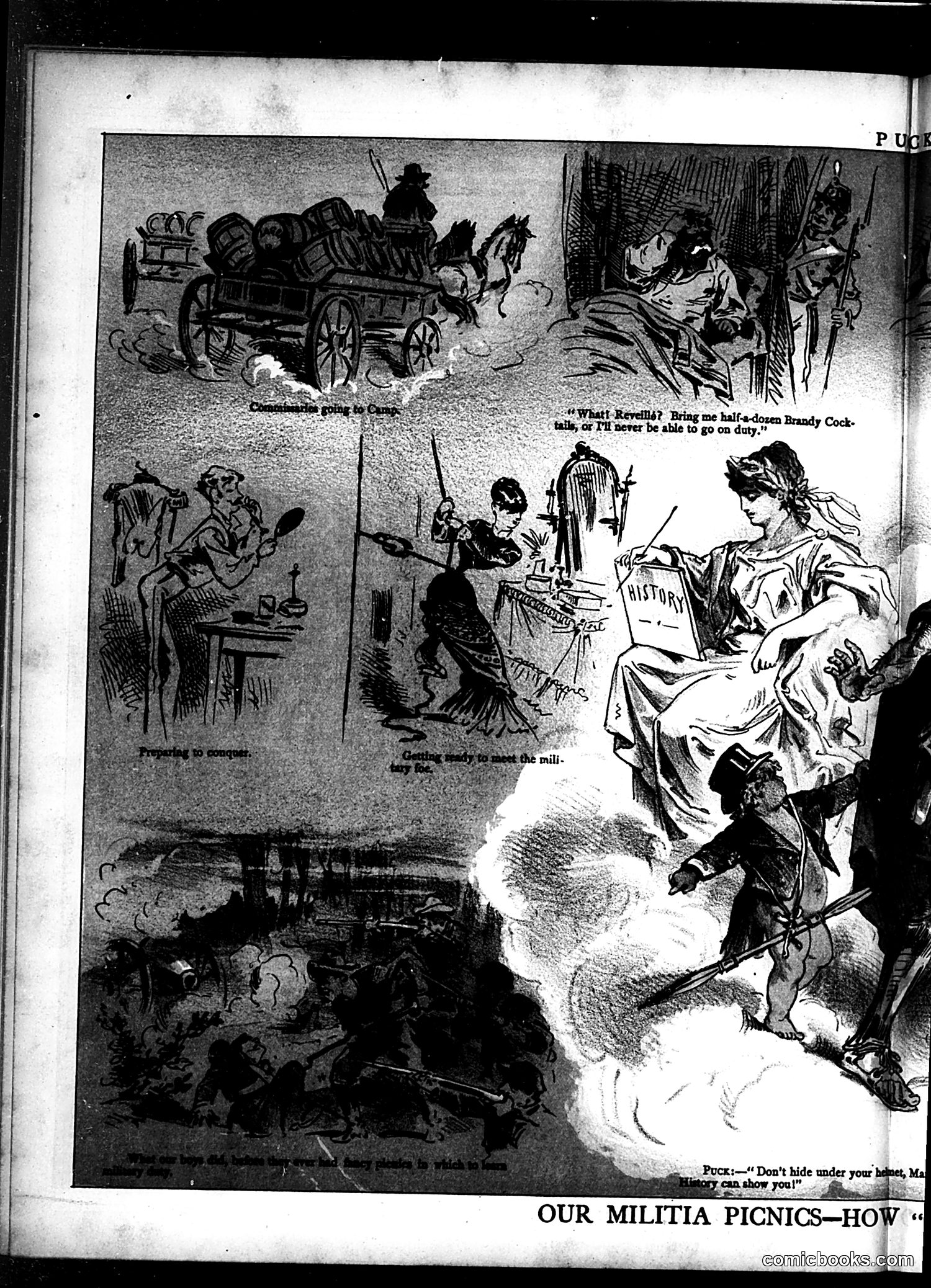
This page from Puck satirizes American militia activities, likely from the late 19th century. The comic strips depict various mishaps at militia picnics: a wagon overloaded with supplies tipping over, soldiers engaged in awkward physical comedy, and what appears to be attempts at military drills gone wrong. The satire targets the militia system—civilian military units that were often poorly trained and comically inept. The repeated emphasis on chaos and failure suggests Puck is mocking these militia groups' competence and discipline. One caption references "Brandy Cocktails," implying alcohol and unprofessionalism among the participants. The bottom panel shows a woman (possibly representing "History" based on the visible book) observing soldiers with the caption about hiding under blankets—reinforcing the message that these militia members performed poorly and would be embarrassed by historical record.
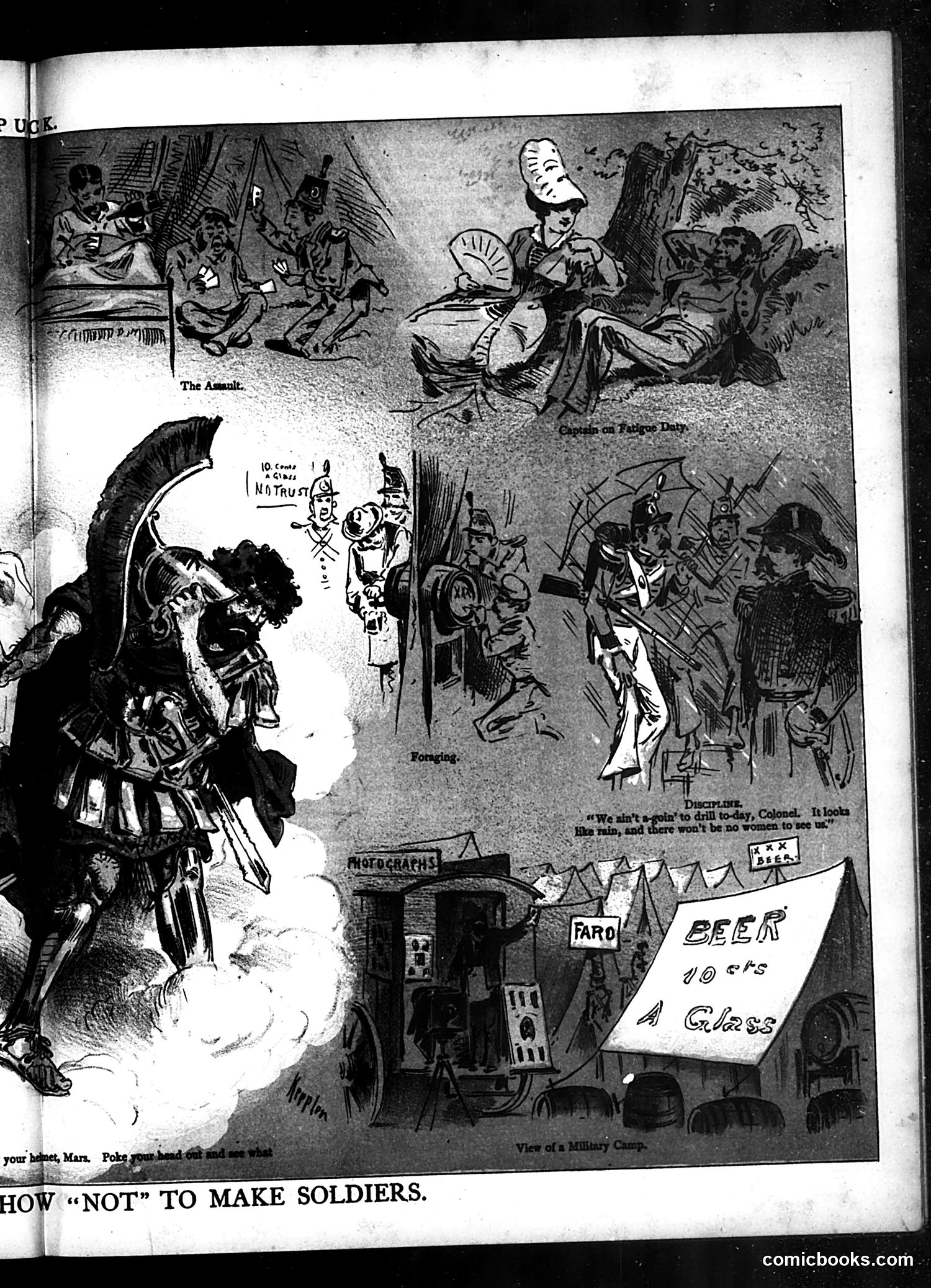
This satirical page from Puck critiques military training practices through five cartoon vignettes. The headline suggests the cartoons illustrate counterproductive or misguided approaches to soldier development. Visible panels include: - **"The Assault"** (top left): depicts chaotic combat training - **"Capering on Fatigues Duty"** (top right): shows undisciplined behavior during exercises - **"Foraging"** (middle): suggests improper supply practices - **"Discipline"** (bottom right): includes a quote about Colonel's relaxed attitude toward drilling - **"View of a Military Camp"** (bottom): depicts a camp with a beer tent marked "10 CTS A GLASS," satirizing poor camp management The overall satire targets inadequate or absurd military training and camp conditions, likely commenting on American military preparedness or administration.
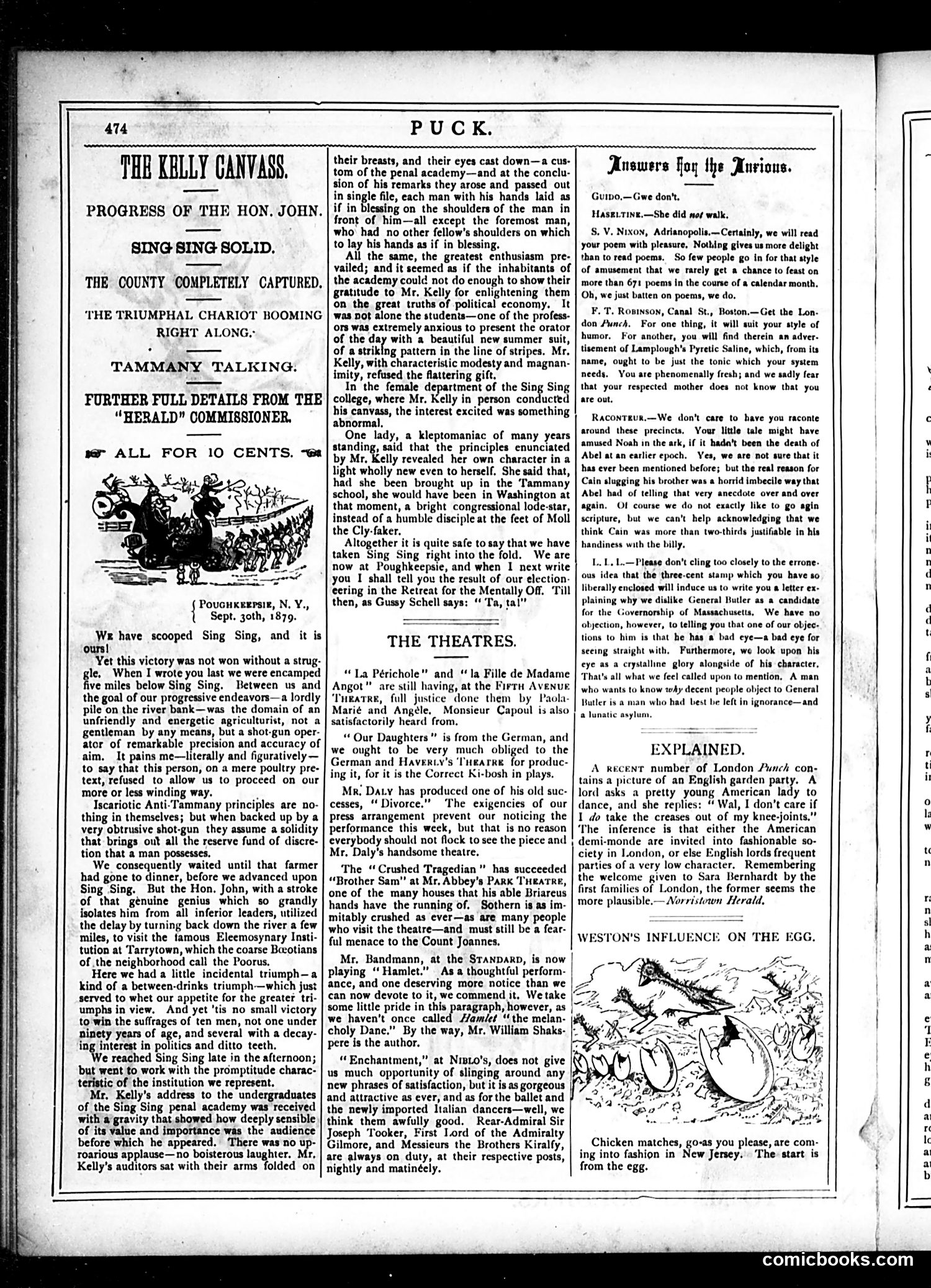
This page contains theater reviews and a satirical illustration titled "Weston's Influence on the Egg" showing chickens. The egg-related cartoon likely references Edward Payson Weston, a famous pedestrian (long-distance walker) of the era—a celebrity who inspired public fascination and imitation. The joke appears to be that even chickens are copying Weston's walking style or behavior. The theater section reviews contemporary productions including German plays and works by performers like Sara Bernhardt. The page's left column describes a Sing Sing prison event and Kelly's Academy visit, mixing serious reporting with satirical commentary typical of Puck's approach to current events and institutions.
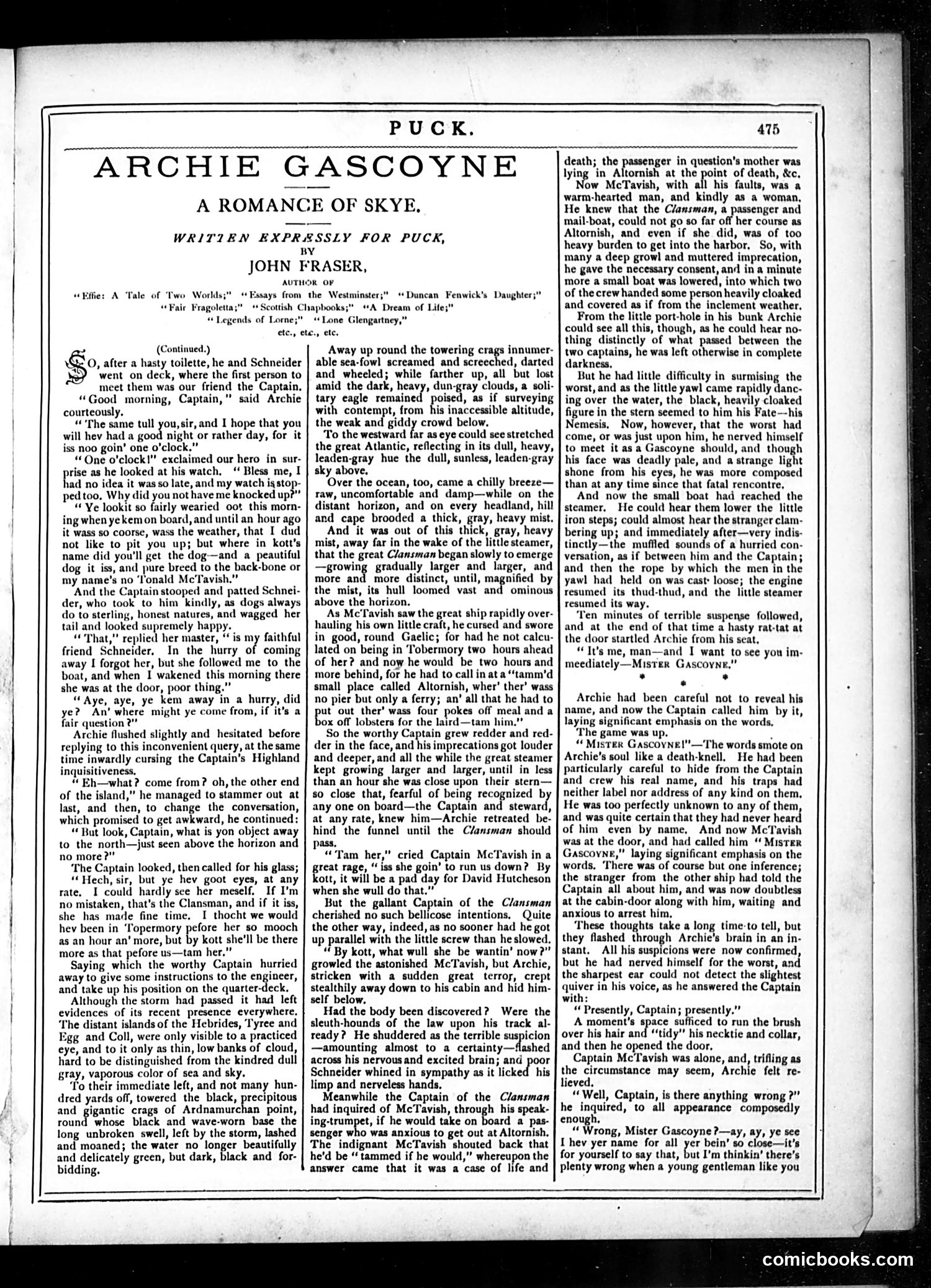
This page contains **serialized fiction, not political satire or cartoons**. It's a continuation of "Archie Gascoyne: A Romance of Skye," a serialized story by John Fraser written expressly for Puck magazine. The page shows narrative prose describing maritime scenes—a ship called the *Clannsman*, passengers, and dialogue between characters including Captain McTavish and someone named Archie. The story involves what appears to be a passenger ship encounter and some mystery or tension involving a character's whereabouts. **No political figures, social satire, or cartoon illustrations are present on this page.** It's purely literary content, demonstrating that Puck—primarily known for satirical cartoons—also published serialized fiction for its readers.
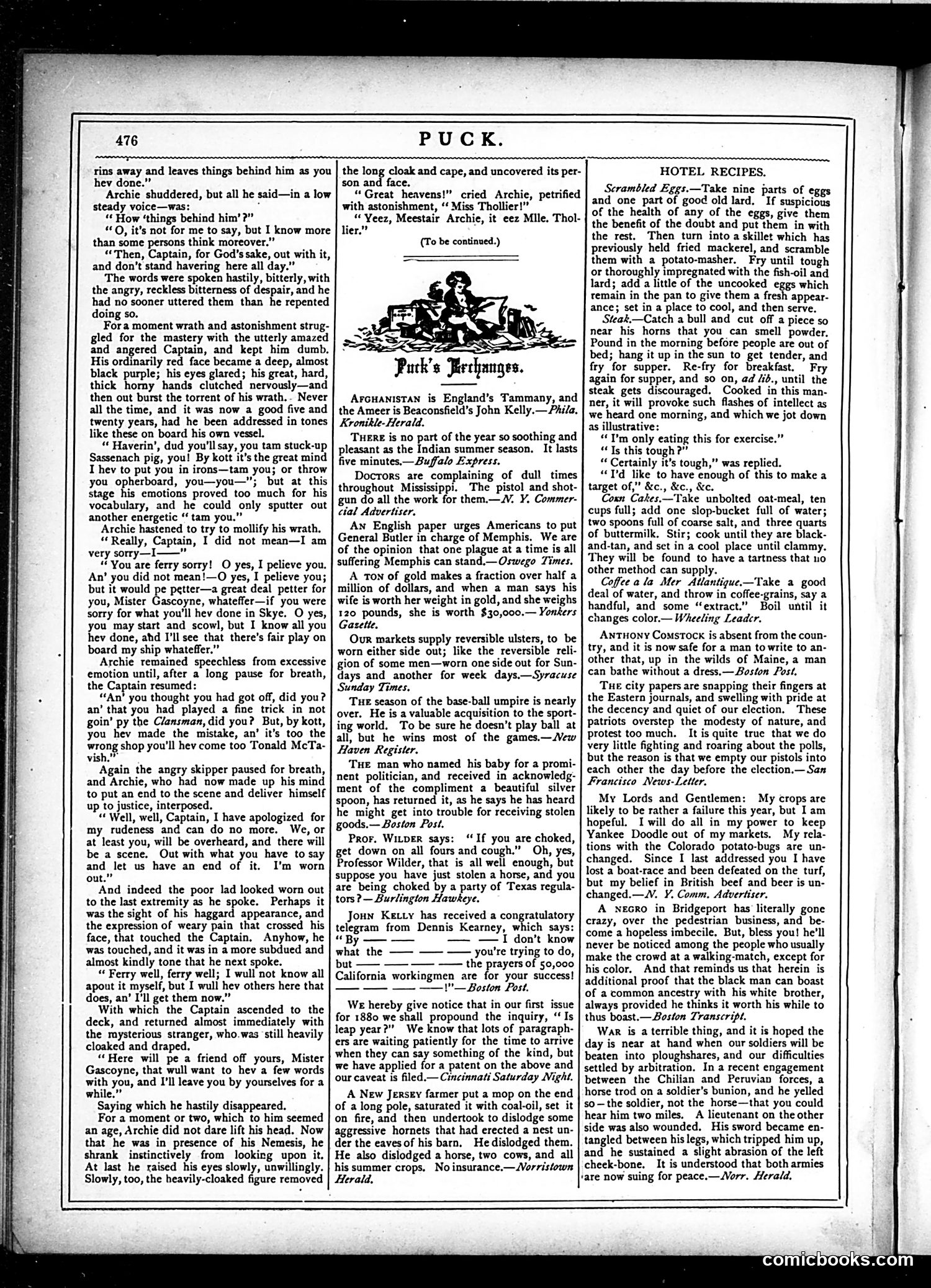
This page contains **"Puck's Pertinences,"** a humor column mixing brief satirical anecdotes with hotel recipes and miscellaneous jokes. The central illustration shows two figures in what appears to be a comedic scene, though specific identities aren't clearly marked. The column satirizes various American social issues of its era: military incompetence, political corruption, class pretension, and gender relations. References include Memphis plague concerns, baseball umpires, stolen horses, and California labor disputes. The tone is lighthearted mockery of everyday absurdities rather than targeting specific named individuals. The page also includes practical hotel cooking advice, indicating Puck's mixed entertainment/utility purpose. Without visible dates or clearer illustration labels, the exact contemporary events referenced remain somewhat unclear to modern readers.
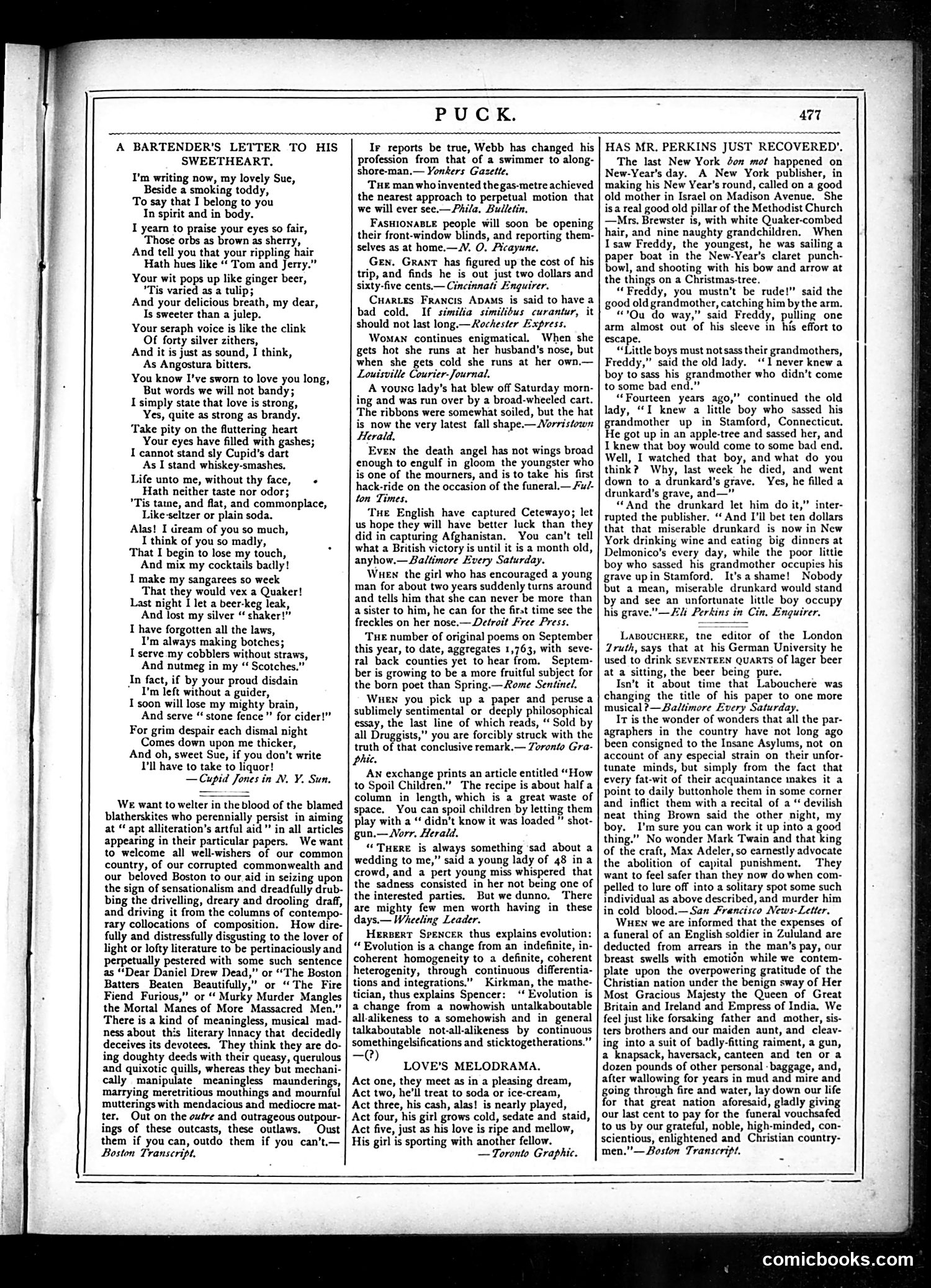
This page is primarily text-based content from Puck magazine, featuring multiple short satirical pieces and jokes rather than political cartoons. The content includes: 1. "A Bartender's Letter to His Sweetheart" — a humorous poem about a bartender's romantic feelings 2. Various brief satirical notes on contemporary topics (gas meters, weather, military costs, women's behavior) 3. "Love's Melodrama" — a comic poem about courtship The pieces mock everyday social observations: women's fashion choices, marital dynamics, military expenditures, and romantic conventions. Without identifying specific political figures, the satire targets general social pretensions and hypocrisies of the era. The format reflects Puck's style of combining short, punchy social commentary with light verse rather than illustrated political cartoons.
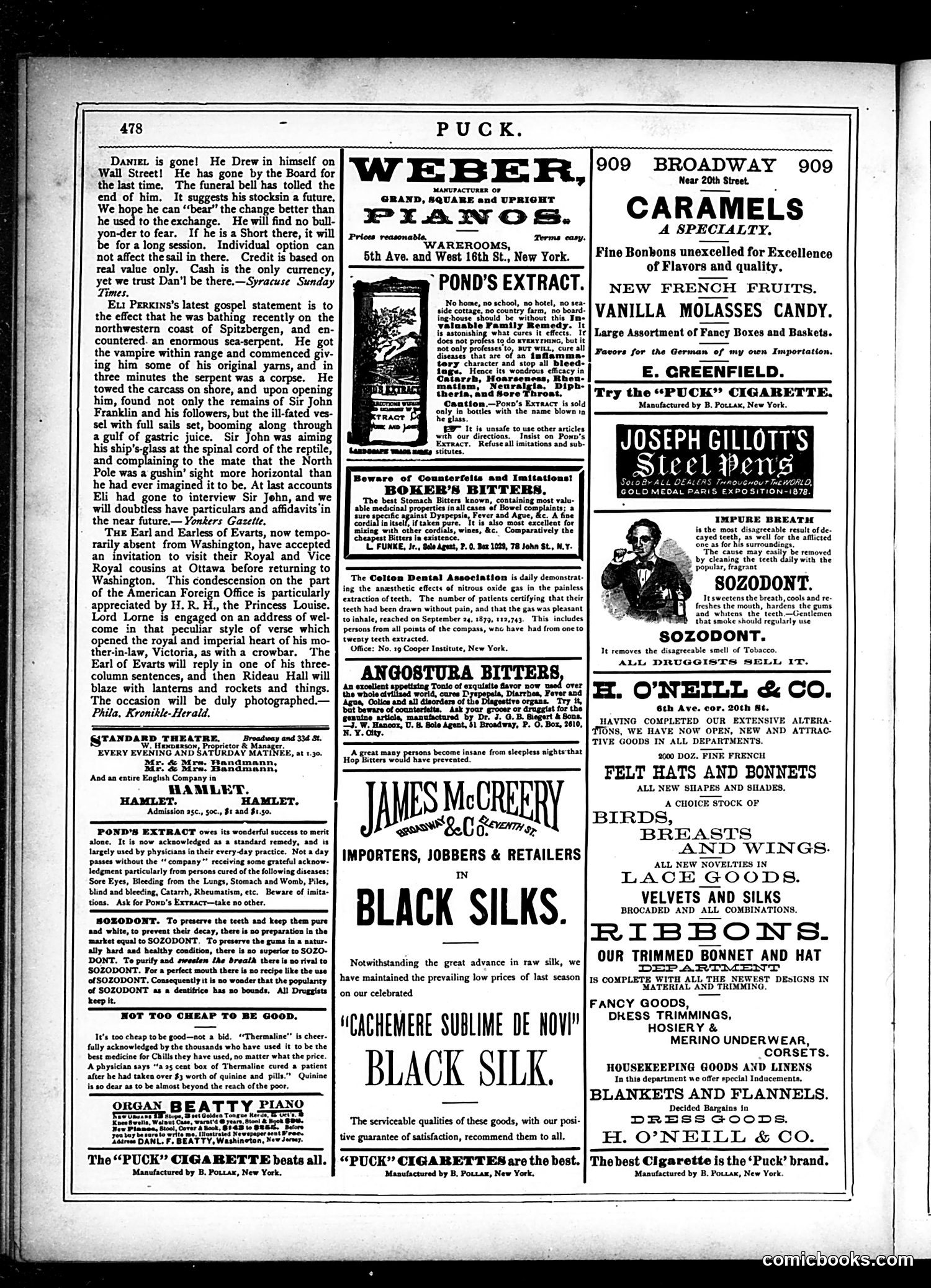
This page is primarily **advertising**, not satirical content. It contains numerous commercial advertisements for products and services typical of the era, including: - **Weber pianos** and caramels - **Pond's Extract** (a patent medicine) - **Joseph Gillott's steel pens** - **Sozodont** toothpaste - **James McCreery & Co.** (black silk importer) - **H. O'Neill & Co.** (department store) - **Puck cigarettes** (promoted multiple times) The top-left contains a brief text item about "Daniel" going to Wall Street, but it's a minor news snippet, not a political cartoon. This appears to be a typical Puck magazine page mixing satirical journalism with period advertising. No significant political satire or caricature is present.
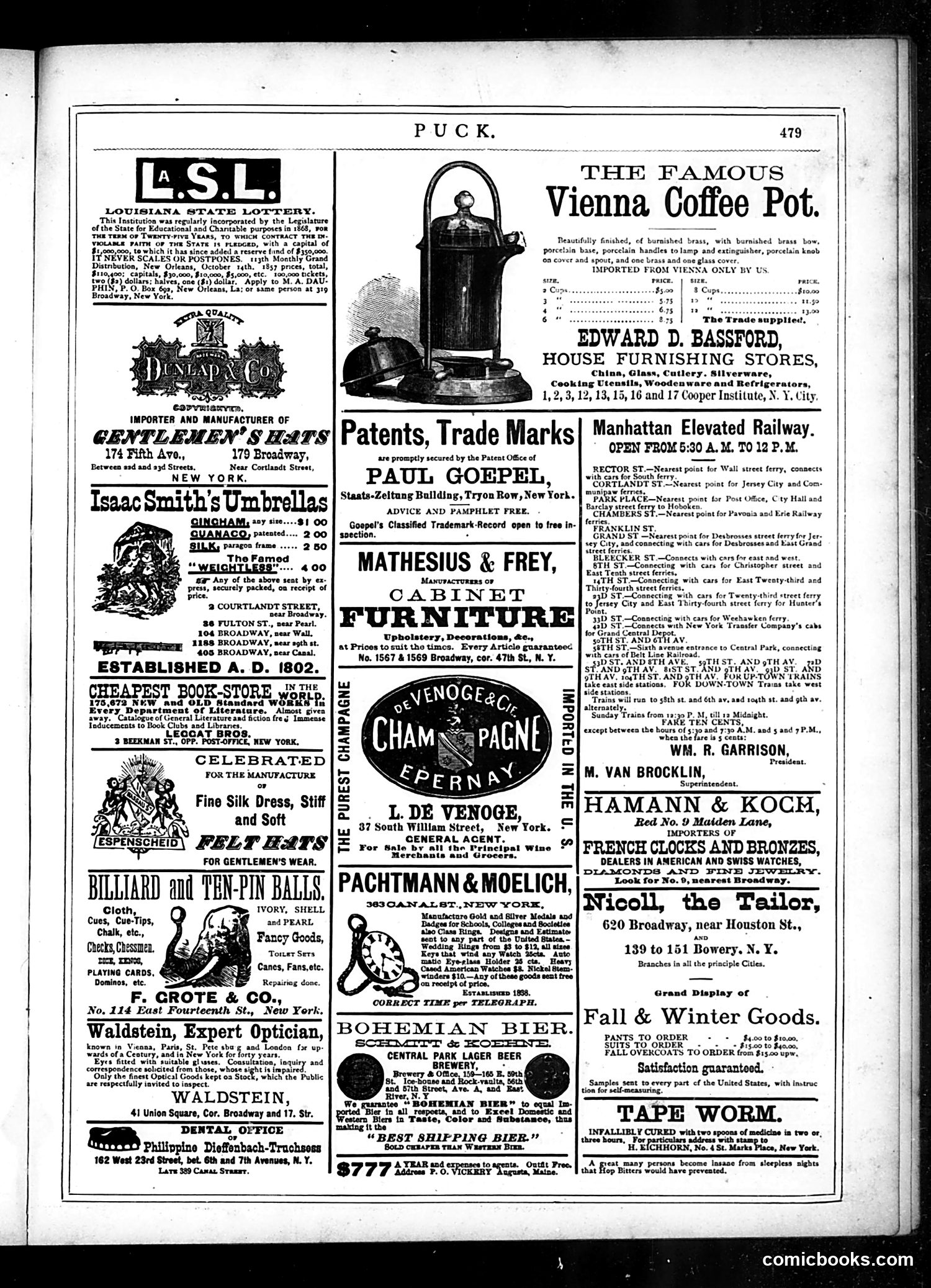
This page is primarily **advertising**, not editorial content. It contains numerous commercial advertisements from late 19th-century New York businesses, including: - A Vienna Coffee Pot (housewares) - Patents and trademarks services - Cabinet furniture - Champagne and wine merchants - French clocks and jewelry - Billiard and ten-pin ball equipment - Dental services - Bohemian beer The only non-advertising element is a masthead reading "PUCK" at the top, identifying this as page 479 of the satirical magazine. There are no visible political cartoons or satirical content on this particular page—it functions as a revenue-generating advertisement section typical of 19th-century magazine publishing.
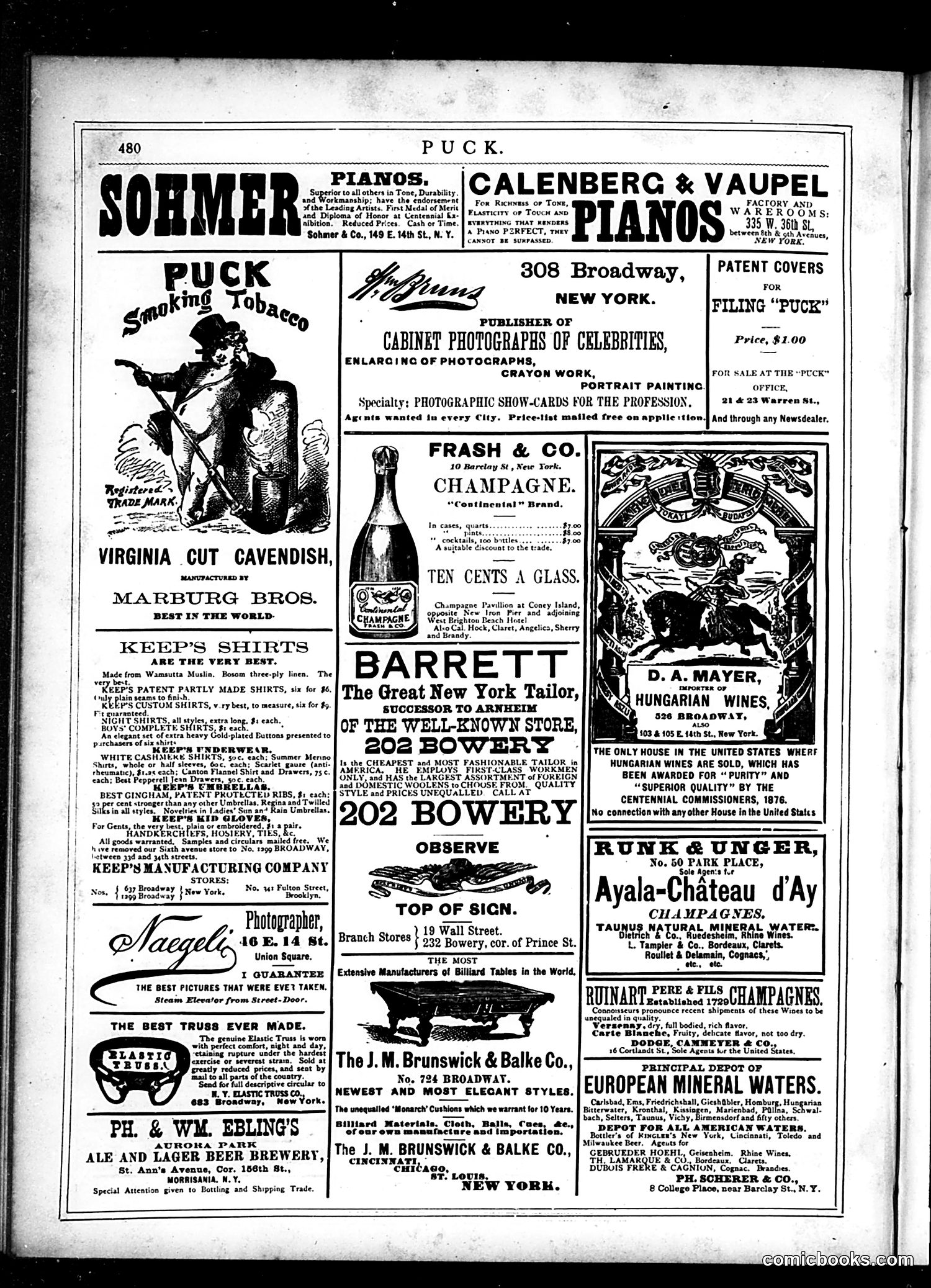
This is primarily an **advertising page** from Puck magazine (page 480), not a cartoon or satirical piece. It contains numerous late 19th-century advertisements for: - **Musical instruments** (Sohrmer and Calenberg & Vaupel pianos) - **Tobacco** (Puck brand smoking tobacco, Virginia Cut Cavendish) - **Clothing** (Keep's shirts, Barrett tailoring at 202 Bowery) - **Beverages** (Frash champagne, Hungarian wines, beer) - **Billiards tables** (J.M. Brunswick & Balke Co.) - **Photographic services** and other goods The only illustration of note is the "Puck" mascot—a mischievous sprite—advertising smoking tobacco, which was the magazine's namesake character. The page reflects turn-of-the-century consumer culture and New York City businesses rather than political satire.
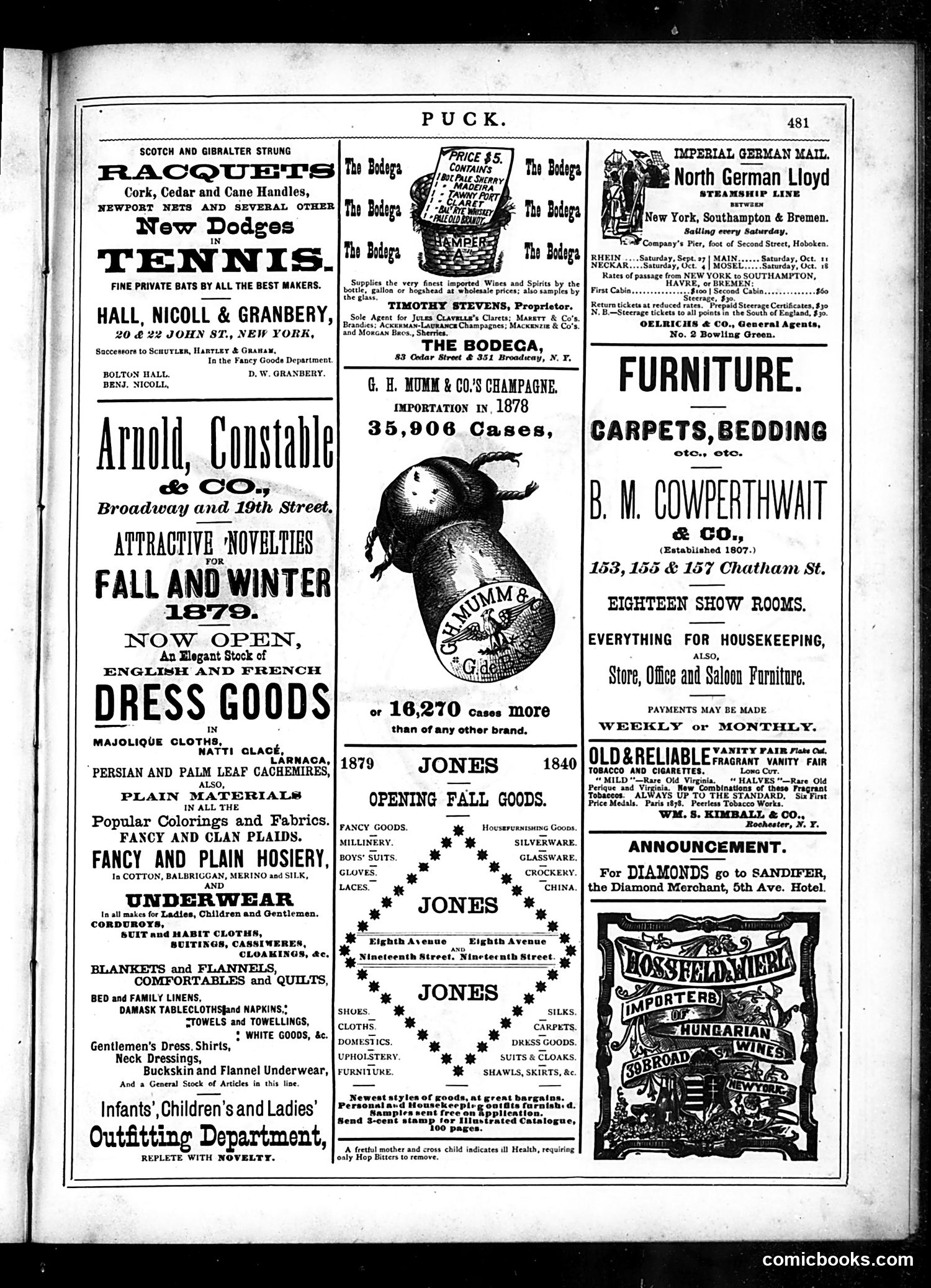
This is primarily an **advertising page** from Puck magazine (page 481), not a political cartoon. The page contains numerous commercial advertisements from late 19th-century New York businesses, including: - Racquet and tennis equipment dealers - Furniture and carpet retailers - Dress goods and clothing merchants - Champagne importers - A diamond merchant The only illustration with potential satirical content is **G. Humm & Co.'s Champagne advertisement**, featuring a large bottle with a cherub or putto figure. However, this appears to be straightforward product advertising rather than political satire. The page reflects **Puck's business model**: generating revenue through luxury goods advertisements targeting wealthy urban readers, rather than editorial cartoons on this particular spread.
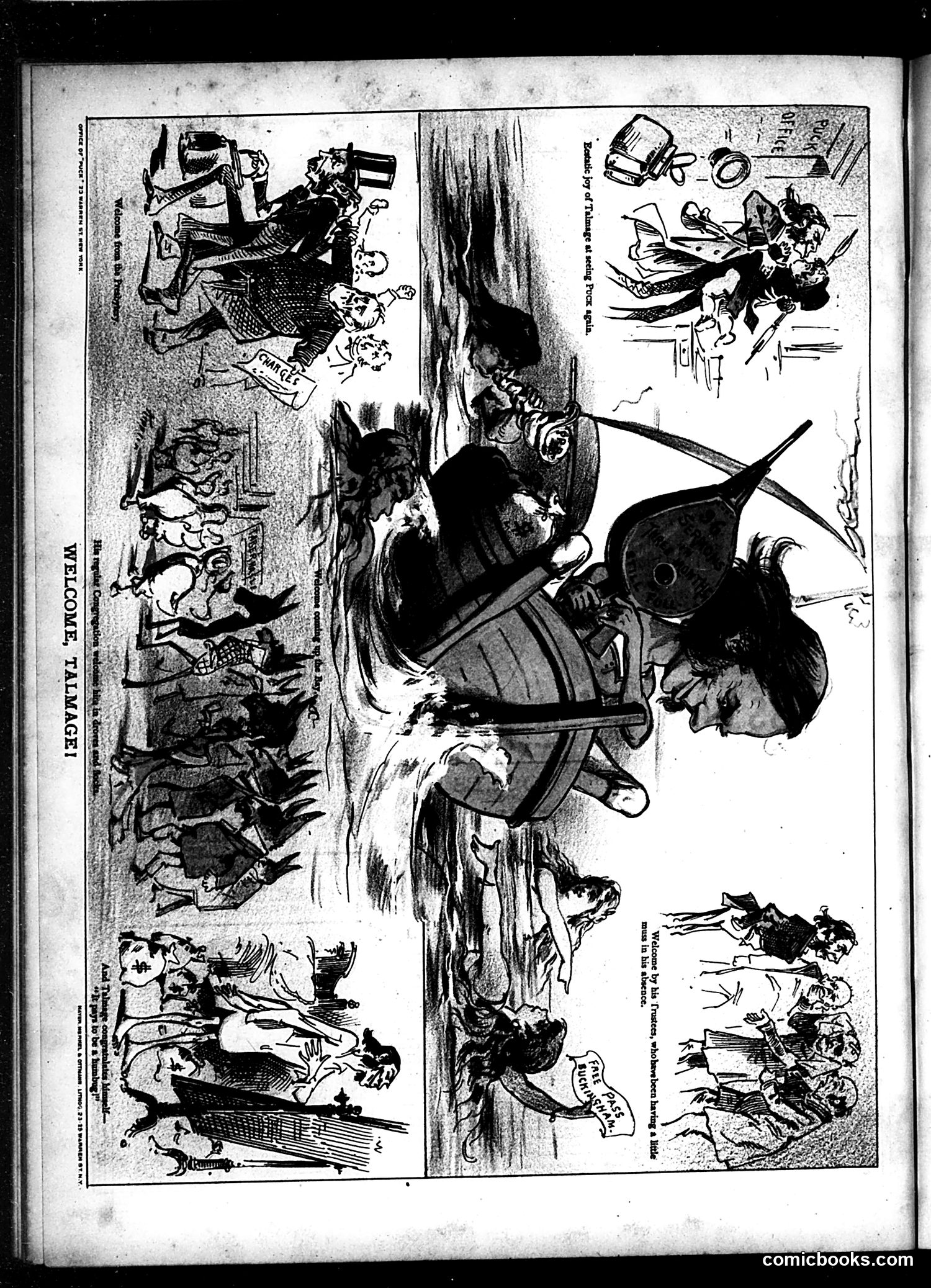
I can see this is a page from *Puck* magazine with multiple cartoon panels arranged on the page, but the OCR text provided appears to be blank or unreadable. From the IMAGE alone, I can observe: - Multiple black and white satirical cartoon panels - Text captions beneath panels (too small to read clearly in this reproduction) - What appears to be period-appropriate clothing and artistic style consistent with late 19th or early 20th century American political cartooning - Various human figures in different scenes suggesting social or political commentary However, without legible captions or the OCR text, I cannot reliably identify the specific figures, political references, or satirical points being made. To accurately explain this page's meaning to a modern reader, I would need clearer text or additional context about which *Puck* issue this is from.