
Puck, 1879-10-01 · page 6 of 18
Puck — October 1, 1879 — page 6: what you’re looking at
What you’re looking at
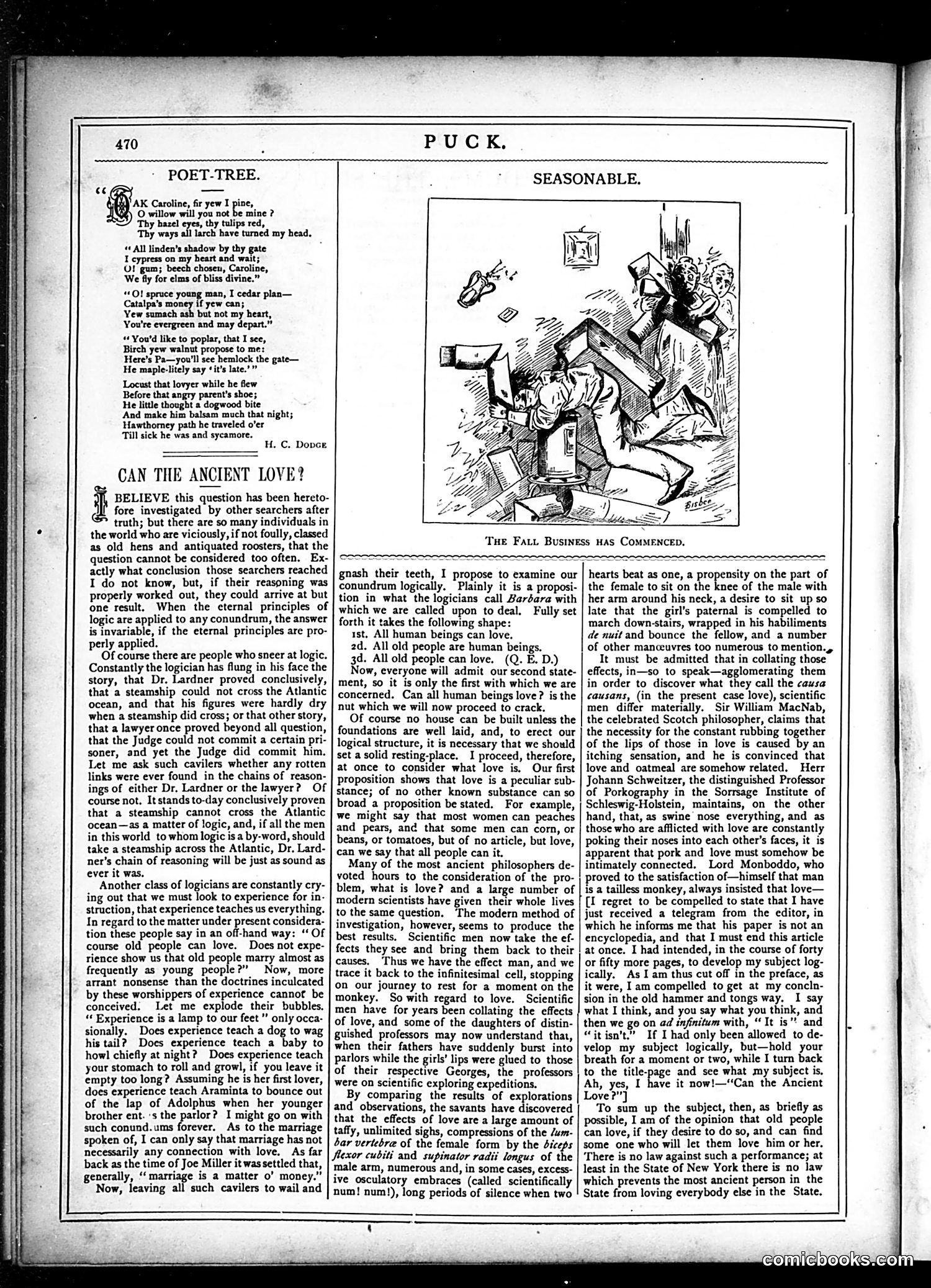
The page contains two distinct items: **"Poet-Tree"** (left): A poem by C. Dodge, likely a sentimental verse about Caroline and willow trees—typical light poetry for the era. **"The Fall Business Has Commenced"** (right): The cartoon depicts a figure surrounded by scattered items and papers, appearing disheveled or in distress. Without clearer identifying features visible, the exact subject remains unclear, though the title suggests commentary on autumn commercial activity or economic hardship during fall seasons. The messy composition may satirize business chaos or financial instability. **"Can the Ancient Love?"** (center/bottom): A substantial article examining whether love among elderly people is possible, presented as pseudo-scientific philosophical inquiry—typical of Puck's humorous treatment of earnest Victorian intellectual debates. The tone is satirical, mocking both romantic sentimentality and overwrought scientific analysis.
📄 Transcribed text from this page (OCR, searchable)
Machine-transcribed from the original scan — historical spelling and the odd misread are preserved.
470 POET-TREE. “ 'AK Caroline, fir yew I pine, O willow will you not be mine ? Thy hazel eye, thy talips red, Thy ways all larch have turned my head, ‘All inden's shadow by thy I cypress on my heart and wait; Of gum; beech chosen, Caroline, We fly for elms of bliss divine.” “O! spruce young man, I cedar plan— Catalpa’s money if yew can; Yew sumach ash but not my heart, You're evergreen and may depart.” «You'd like to poplar, that I see, Birch yew walnut propose to me: Here's Pa—you'll see hemlock the gate— He maple-litely say ‘it’s late.’ ” Locust that lovyer while he flew Before that angry parent's shoe; He little thought a dogwood bite And make him balsam much that night; Hawthorney path he traveled o'er Till sick he was and sycamore. H. C. Dover CAN THE ANCIENT LOVE? BELIEVE this question has been hereto- fore investigated by other searchers after truth; but there are so many individuals in the world who are viciously, if not foully, classed as old hens and antiquated roosters, that the question cannot be considered too often. Ex- actly what conclusion those searchers reached I do not know, but, if their reasoning was properly worked out, they could arrive at but one result. When the eternal principles of logic are applied to any conundrum, the answer is invariable, if the eternal principles are pro- perly applied. Of course there are people who sneer at logic. Constantly the logician has flung in his face the story, that Dr. Lardner proved conclusively, that a steamship could not cross the Atlantic ocean, and that his figures were hardly dry when a steamship did cross; or that other story, that a lawyer once proved beyond all question, that the Judge could not commit a certain pri- soner, and yet the Judge did commit him. Let me ask such cavilers whether any rotten links were ever found in the chains of reason- ings of either Dr. Lardner or the lawyer? Of course not. It stands to-day conclusively proven that a steamship cannot cross the Atlantic ocean—as a matter of logic, and, if all the men in this world to whom logic isa by-word, should take a steamship across the Atlantic, Dr, Lard- ner’s chain of reasoning will be just as sound as ever it was. Another class of logicians are constantly cry- ing out that we must look to experience for in- struction, that experience teaches us everything. In regard to the matter under present considera- tion these people say in an off-hand way: ‘Of course old people can love. Does not expe- rience show us that old people marry almost as frequently as young people?” Now, more arrant nonsense than the doctrines inculcated by these worshippers of experience cannot be conceived. Let me explode their bubbles, «« Experience is a lamp to our feet " only occa- sionally. Does experience teach a dog to wag his tail? Does experience teach a baby to howl chiefly at night? Does experience teach your stomach to roll and growl, if you leave it empty too long? Assuming he is her first lover, does experience teach Araminta to bounce out of the lap of Adolphus when her younger brother ent. :s the parlor? I might go on with such conund.ums forever. As to the marriage spoken of, I can only say that marriage has not necessarily any connection with love. As far back as the time of Joe Miller it was settled that, generally, ‘‘ marriage is a matter o’ money.” Now, leaving all such cavilers to wail and SEASONABLE. Tue Fatt Business Has COMMENCED, gnash their teeth, I propose to examine our conundrum logically. Plainly it is a proposi- tion in what the logicians call Barbara with which we are called upon to deal. Fully set forth it takes the following shape: rst. All human beings can love. 2d. All old people are human beings. 3d. All old people can love. (Q. E. D.) Now, everyone will admit our second state- ment, so it is only the first with which we are concerned. Can all human beings love? is the nut which we will now proceed to crack. Of course no house can be built unless the foundations are well laid, and, to erect our logical structure, it is necessary that we should set a solid resting-place. I proceed, therefore, at once to consider what love is. Our first Proposition shows that love is a peculiar sub- stance; of no other known substance can so broad a proposition be stated, For example, we might say that most women can peaches and pears, and that some men can corn, or beans, or tomatoes, but of no article, but love, can we say that all people can it. Many of the most ancient philosophers de- voted hours to the consideration of the pro- blem, what is love? and a large number of modern scientists have given their whole lives to the same question. The modern method of investigation, however, seems to produce the best results, Scientific men now take the ef- fects they see and bring them back to their causes, Thus we have the effect man, and we trace it back to the infinitesimal cell, stopping on our journey to rest for a moment on the monkey. So with regard to love. Scientific men have for years been collating the effects of love, and some of the daughters of distin- guished professors may now understand that, when their fathers have suddenly burst into parlors while the girls’ lips were glued to those of their respective Georges, the professors were on scientific exploring expeditions. By comparing the results of explorations and observations, the savants have discovered that the effects of love are a large amount of taffy, unlimited sighs, compressions of the /um- bar vertebra of the female form by the diceps flexor cubiti and supinator radii longus of the male arm, numerous and, in some cases, excess- ive osculatory embraces (called scientifically num! num!), long periods of silence when two hearts beat as one, a propensity on the part of the female to sit on the knee of the male with her arm around his neck, a desire to sit up so late that the girl's paternal is compelled to march down-stairs, wrapped in his habiliments de nuit and bounce the fellow, and a number of other manceuvres too numerous to mention., It must be admitted that in collating those effects, in—so to speak—agglomerating them in order to discover what they call the causa causans, (in the present case love), scientific men differ materially. Sir William MacNab, the celebrated Scotch philosopher, claims that the necessity for the constant rubbing together of the lips of those in love is caused by an itching sensation, and he is convinced that love and oatmeal are somehow related. Herr Johann Schweitzer, the distinguished Professor of Porkography in the Sorrsage Institute of Schleswig-Holstein, maintains, on the other hand, that, as swine nose everything, and as those who are afflicted with love are constantly poking their noses into each other’s faces, it is apparent that pork and love must somehow be intimately connected. Lord Monboddo, who roved to the satisfaction of—himself that man is a tailless monkey, always insisted that love— [I regret to be compelled to state that I have just received a telegram from the editor, in which he informs me that his paper is not an encyclopedia, and that I must end this article at once. I had intended, in the course of forty or fifty more pages, to develop my subject log- ically. As I am thus cut off in the preface, as it were, Iam compelled to get at my concln- sion in the old hammer and tongs way, I say what I think, and you say what you think, and then we go on ad infinitum with, “It is” and “it isn't.” If I had only been allowed to de- velop my subject logically, but—hold your breath for a moment or two, while I turn back to the title-page and see what my subject is. Ah, yes, I fave it now!—“Can the Ancient Love ?""] To sum up the subject, then, as briefly as possible, I am of the opinion that old people can love, if they desire to do so, and can find some one who will let them love him or her. ‘There is no law against such a performance; at least in the State of New York there is no law which prevents the most ancient person in the State from loving everybody else in the State.