
Puck, 1879-10-01 · page 12 of 18
Puck — October 1, 1879 — page 12: what you’re looking at
What you’re looking at
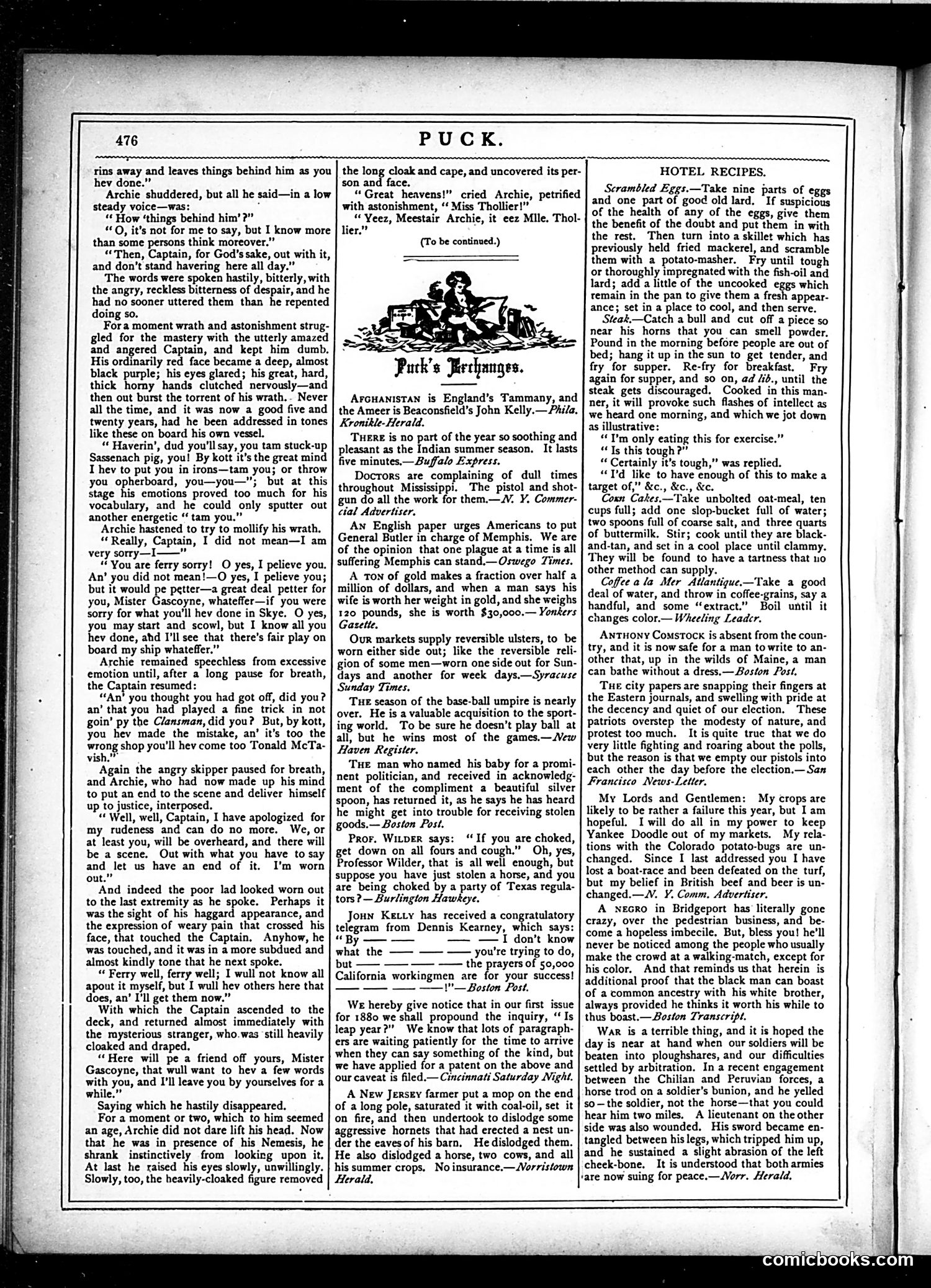
This page contains **"Puck's Pertinences,"** a humor column mixing brief satirical anecdotes with hotel recipes and miscellaneous jokes. The central illustration shows two figures in what appears to be a comedic scene, though specific identities aren't clearly marked. The column satirizes various American social issues of its era: military incompetence, political corruption, class pretension, and gender relations. References include Memphis plague concerns, baseball umpires, stolen horses, and California labor disputes. The tone is lighthearted mockery of everyday absurdities rather than targeting specific named individuals. The page also includes practical hotel cooking advice, indicating Puck's mixed entertainment/utility purpose. Without visible dates or clearer illustration labels, the exact contemporary events referenced remain somewhat unclear to modern readers.
📄 Transcribed text from this page (OCR, searchable)
Machine-transcribed from the original scan — historical spelling and the odd misread are preserved.
476 PUCK. rins away and leaves things behind him as you hev done.” Archie shuddered, but all he said—in a low steady voice—was: : “ How ‘things behind him’?” “0, it's not for me to say, but I know more than some persons think moreover.” “Then, Captain, for God’s sake, out with it, and don’t stand havering here all day.” ‘The words were spoken hastily, bitterly, with the angry, reckless bitterness of despair, and he had no sooner uttered them than he repented doing so. Fora moment wrath and astonishment strug- gled for the mastery with the utterly amazed and angered Captain, and kept him dumb. His ordinarily red face became a deep, almost black purple; his eyes glared; his great, hard, thick horny hands clutched nervously—and then out burst the torrent of his wrath.. Never all the time, and it was now a good five and twenty years, had he been addressed in tones like these on board his own vessel. “ Haverin’, dud you'll say, you tam stuck-up Sassenach pig, you! By kott it’s the great mind T hev to put you in irons—tam you; or throw you opherboard, you—you—"; but at this stage his emotions proved too much for his vocabulary, and he could only sputter out another energetic “ tam you.”” Archie hastened to try to mollify his wrath. “Really, Captain, I did not mean—I am very sorry—I——"" “You are ferry sorry! O yes, I pelieve you. An’ you did not mean!—O yes, I pelieve you; but it would & petter—a great deal petter for you, Mister Gascoyne, whateffer—if you were sorry for what you'll hev done in Skye. O yes, you may start and scowl, but I know all you hev done, ahd I'll see that there’s fair play on board my ship whateffer.”” Archie remained speechless from excessive emotion until, after a long pause for breath, the Captain resumed: “An’ you thought you had got off, did you? an’ that you had played a fine trick in not goin’ py the C/ansman, did you? But, by kott, you hev made the mistake, an’ it’s too the wrong shop you'll hev come too Tonald McTa- vish.”” Again the angry skipper paused for breath, and Archie, who had now made up his mind to put an end to the scene and deliver himself up to justice, interposed. “Well, well, Captain, I have apologized for my rudeness and can do no more. We, or at least you, will be overheard, and there will be a scene. Out with what you have to say and let us have an end of it. I'm worn out.” And indeed the poor lad looked worn out to the last extremity as he spoke. Perhaps it was the sight of his haggard appearance, and the expression of weary pain that crossed his face, that touched the Captain. Anyhow, he was touched, and it was in a more subdued and almost kindly tone that he next spoke. “ Ferry well, ferry well; I wull not know all apout it myself, but I wull hev others here that does, an’ I'll get them now.” With which the Captain ascended to the deck, and returned almost immediately with the mysterious stranger, who.was ‘still heavily cloaked and draped. “Here will pe a friend off yours, Mister Gascoyne, that wull want to hev a few words with you, and I'll leave you by yourselves for a while.” Saying which he hastily disappeared. For a moment or two, which to him seemed an age, Archie did not dare lift his head. Now that he was in presence of his Nemesis, he shrank instinctively from looking upon it. At last he raised his eyes slowly, unwillingly. Slowly, too, the heavily-cloaked figure removed the long cloak and cape, and uncovered its per- son and face. “Great heavens!” cried Archie, petrified with astonishment, ‘ Miss Thollier!”” * Yeez, Meestair Archie, it eez Mlle. Thol- lier." (To be continued.) AFGHANISTAN is England’s Tammany, and the Ameer is Beaconsfield’s John Kelly.— Phila, Kronikle-Herald. Tuerz is no part of the year so soothing and pleasant as the Indian summer season. It lasts five minutes. Buffalo Express. Docrors are complaining of dull times throughout Mississippi. The pistol and shot- gun do all the work for them.—V. Y. Commer- tial Advertiser, An English paper urges Americans to put General Butler in charge of Memphis, We are of the opinion that one plague at a time is all suffering Memphis can stand.— Oswego Times. A TON of gold makes a fraction over half a million of dollars, and when a man says his wife is worth her weight in gold, and she weighs 120 pounds, she is worth $30,000.— Yonkers Gasette. Our markets supply reversible ulsters, to be worn either side out; like the reversible reli- gion of some men—worn one side out for Sun- days and another for week days.—Syracuse Sunday Times, Tue season of the base-ball umpire is nearly over. He is a valuable acquisition to the sport- ing world, To be sure he doesn’t play ball at all, but he wins most of the games.—Mew Haven Register. THe man who named his baby for a promi- nent politician, and received in acknowledg- ment of the compliment a beautiful silver spoon, has returned it, as he says he has heard he might get into trouble for receiving stolen goods.— Boston Post. Pror. WitpeR says: ‘If you are choked, get down on all fours and cough.” Oh, yes, Professor Wilder, that is all well enough, but suppose you have just stolen a horse, and you are being choked by a party of Texas regula- tors?— Burlington Hawkeye. Joun Ketty has received a congratulatory telegram from Dennis Kearney, which says: “By — — don’t know what the —— —— —— you're trying to do, but —— —— — the prayers of 50,000 California workingmen are for your success! "—Boston Post. We hereby give notice that in our first issue for 1880 we shall propound the inquiry, “Is leap year?” We know that lots of paragraph- ers are waiting patiently for the time to arrive when they can say something of the kind, but we have applied for a patent on the above and our caveat is filed.— Cincinnati Saturday Night. A New Jersey farmer put a mop on the end of a long pole, saturated it with coal-oil, set it on fire, and then undertook to dislodge some aggressive hornets that had erected a nest un- der the eaves of his barn, He dislodged them. He also dislodged a horse, two cows, and all his summer crops. No insurance.—/orristown Herald, ——_—I HOTEL RECIPES. Scrambled Eggs.—Take nine parts of eggs and one part of good old lard. If suspicious of the health of any of the eggs, give them the benefit of the doubt and put them in with the rest. Then turn into a skillet which has previously held fried mackerel, and scramble them with a potato-masher. Fry until tough or thoroughly impregnated with the fish-oil and lard; add a little of the uncooked eggs which remain in the pan to give them a fresh appear- ance; set in a place to cool, and then serve, Steak,—Catch a bull and cut off a piece so near his horns that you can smell powder. Pound in the morning before people are out of bed; hang it up in the sun to get tender, and fry for supper. Re-fry for breakfast. ’ Fry again for supper, and so on, ad /é., until the steak gets discouraged. Cooked in this man- ner, it will provoke such flashes of intellect as we heard one morning, and which we jot down as illustrative: “P'm only eating this for exercise.” “Ts this tough?” “ Certainly it’s tough,” was replied. “I'd like to have enough of this to make a target of,” &c., &c., &e. Coxn Cakes.—Take unbolted oat-meal, ten cups full; add one slop-bucket full of water; two spoons full of coarse salt, and three quarts of buttermilk. Stir; cook until they are black- and-tan, and set in a cool place until clammy. They will be found to have a tartness that no other method can supply. Coffee ala Mer Atlantique,—Take a good deal of water, and throw in coffee-grains, say a handful, and some “extract.” Boil until it changes color.— Wheeling Leadcr. Antuony Comstock is absent from the coun- try, and it is now safe for a man towrite to an- other that, up in the wilds of Maine, a man can bathe without a dress,— Boston Post, Tue city papers are snapping their fingers at the Eastern journals, and swelling with pride at the decency and quiet of our election. These patriots overstep the modesty of nature, and Protest too much. It is quite true that we do very little fighting and roaring about the polls, but the reason is that we empty our pistols into each other the day before the election.— San Francisco News-Letter. My Lords and Gentlemen: My crops are likely to be rather a failure this year, but Iam hopeful. Iwill do all in my power to keep Yankee Doodle out of my markets. My rela- tions with the Colorado potato-bugs are un- changed. Since I last addressed you I have lost a boat-race and been defeated on the turf, but my belief in British beef and beer is un- changed.—. Y, Comm. Advertiser. A NEGRO in Bridgeport has literally gone crazy, over the pedestrian business, and be- come a hopeless imbecile. But, bless you! he'll never be noticed among the people who usually make the crowd at a walking-match, except for his color. And that reminds us that herein is additional proof that the black man can boast of a common ancestry with his white brother, always provided he thinks it worth his while to thus boast.—Boston Transcript. War is a terrible thing, and it is hoped the day is near at hand when our soldiers will be beaten into ploughshares, and our difficulties settled by arbitration. In a recent engagement between the Chilian and Peruvian forces, a horse trod on a soldier's bunion, and he yelled so—the soldier, not the horse—that you could hear him two miles. A lieutenant on the other side was also wounded. His sword became en- tangled between his legs, which tripped him up, and he sustained a slight abrasion of the left cheek-bone. It is understood that both armies tare now suing for peace.—Norr. Herald,