
Puck, 1879-10-01 · page 3 of 18
Puck — October 1, 1879 — page 3: what you’re looking at
What you’re looking at
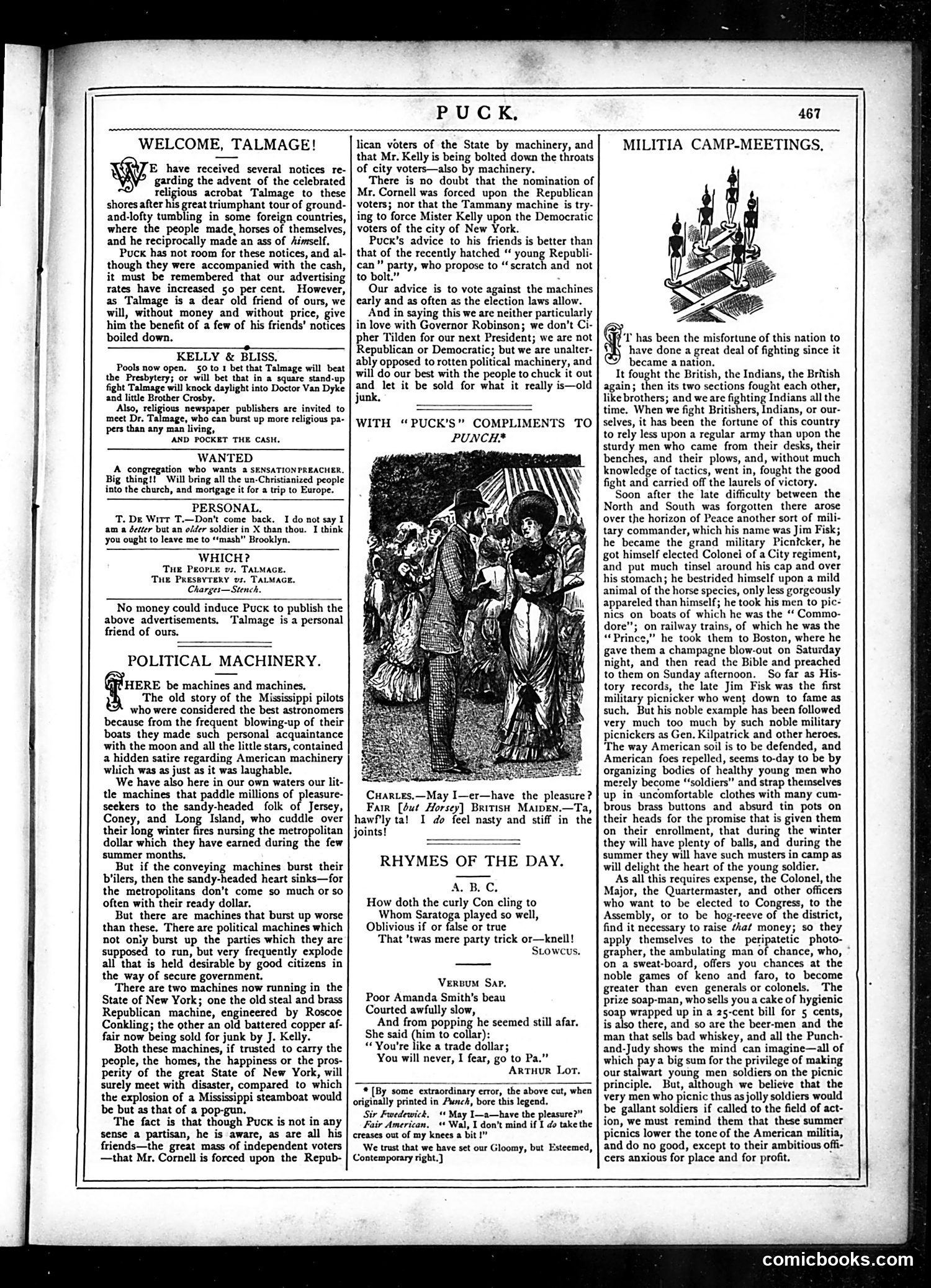
The main article satirizes corrupt electoral practices in New York State politics. It references Roscoe Conkling (Republican machine boss) and another "old-time politician" whose names the text withholds, criticizing how political machines manipulate voting through corruption and coercion. The satire specifically attacks: - Governor Robinson and the Democratic machine - The Republican "young Republican party" - Both parties' attempts to control voters through organizational pressure rather than genuine persuasion The accompanying illustration (center-right) depicts a crowded political gathering or rally, though specific figures are unclear. The text criticizes these machines as undemocratic forces that exploit ordinary voters' interests while serving elite political bosses' power and profit motives.
📄 Transcribed text from this page (OCR, searchable)
Machine-transcribed from the original scan — historical spelling and the odd misread are preserved.
PUCK, 467 WELCOME, TALMAGE! E have received several notices re- garding the advent of the celebrated religious acrobat Talmage to these shores after his great triumphant tour of ground- and-lofty tumbling in some foreign countries, where the people made, horses of themselves, and he reciprocally made an ass of Aimself. Puck has not room for these notices, and al- though they were accompanied with the cash, it must be remembered that our advertising rates have increased 50 per cent. However, as Talmage is a dear old friend of ours, we will, without money and without price, give him the benefit of a few of his friends’ notices boiled down. n KELLY & BLISS. Pools now open. 50 to 1 bet that Talmage will beat the Presbytery; or will bet that in a square stand-up fight Talmage will knock daylight into Doctor Van Dyke and little Brother Crosby. Also, religious newspaper publishers are invited to meet Dr. Talmage, who can burst up more religious pa- pers than any man living, AND POCKET THE CASH. WANTED A congregation who wants a SENSATIONPREACHER. Big thing! Will bring all the un-Christianized people into the church, and mortgage it for a trip to Europe. PERSONAL, T. De Witt T.—Don’t come back. I do not say I am a defer but an older soldier in X than thou. I think you ought to leave me to “mash” Brooklyn. WHICH? Tue Peor.e vs, TALMAGE. Tue Peessyrery vs. TALMAGE. Charges—Stench. No money could induce Puck to publish the above advertisements. ‘Talmage is a personal friend of ours. POLITICAL MACHINERY. HERE be machines and machines. The old story of the Mississippi pilots who were considered the best astronomers because from the frequent blowing-up of their boats they made such personal acquaintance with the moon and all the little stars, contained a hidden satire regarding American machinery which was as just as it was laughable. We have also here in our own waters our lit- tle machines that paddle millions of pleasure- seekers to the sandy-headed folk of Jersey, Coney, and Long Island, who cuddle over their long winter fires nursing the mstropolian dollar which they have earned during the few summer months, But if the conveying machines burst their biilers, then the sandy-headed heart sinks—for the metropolitans don’t come so much or so often with their ready dollar, But there are machines that burst up worse than these. There are political machines which not oniy burst up the parties which they are supposed to run, but very frequently explode all that is held desirable by good citizens in the way of secure government. There are two machines now running in the State of New York; one the old steal and brass Republican machine, engineered by Roscoe Conkling; the other an old battered copper af- fair now being sold for junk by J. Kelly. Both these machines, if trusted to carry the people, the homes, the happiness or the pros- perity of the great State of New York, will surely meet with disaster, compared to which the explosion of a Mississippi steamboat would be but as that of a pop-gun. The fact is that though Puck is not in any sense a partisan, he is aware, as are all his friends—the great mass of independent voters —that Mr. Cornell is forced upon the Repub- lican voters of the State by machinery, and that Mr. Kelly is being bolted down the throats of city voters—also by machinery. There is no doubt that the nomination of Mr. Cornell was forced upon the Republican voters; nor that the Tammany machine is try- ing to force Mister Kelly upon the Democratic voters of the city of New York. Puck's advice to his friends is better than that of the recently hatched “ young Republi- can" party, who propose to “scratch and not to bolt.” : Our advice is to vote against the machines early and as often as the election laws allow. And in saying this we are neither particularly in love with Governor Robinson; we don’t Ci- pher Tilden for our next President; we are not Republican or Democratic; but we are unalter- ably opposed to rotten political machinery, and will do our best with the people to chuck it out and let it be sold for what it really is—old junk. WITH “PUCK’S” COMPLIMENTS TO Cuartes.—May I—er—have the pleasure? Far [6ut Horsey] British Maiwen.—Ta, hawfly ta! I do feel nasty and stiff in the joints! RHYMES OF THE DAY. A. B.C. How doth the curly Con cling to Whom Saratoga played so well, Oblivious if or false or true That 'twas mere party trick or—knell! Stowcus. Verbum Sap. Poor Amanda Smith’s beau Courted awfully slow, And from popping he seemed still afar. She said (him to collar): “You're like a trade dollar; You will never, I fear, go to Pa.”” ArtHuR Lot. * [By some extraordinary error, the above cut, when originally printed in Punch, bore this legend. Sir Fwedewick, “ May 1—a—have the pleasure?” Fair American.“ Wal, I don't mind if I do take the creases out of my knees a bit !” We trust that we have set our Gloomy, but Esteemed, Contemporary right.] MILITIA CAMP-MEETINGS, have done a great deal of fighting since it became a nation. It fought the British, the Indians, the British again; then its two sections fought each other, like brothers; and we are fighting Indians all the time. When we fight Britishers, Indians, or our- selves, it has been the fortune of this country to rely less upon a regular army than upon the sturdy men who came from their desks, their benches, and their plows, and, without much knowledge of tactics, went in, fought the good fight and carried off the laurels of victory. Soon after the late difficulty between the North and South was forgotten there arose over the horizon of Peace another sort of mili- tary commander, which his name was Jim Fisk; he became the grand military Picntcker, he got himself elected Colonei of a City regiment, and put much tinsel around his cap and over his stomach; he bestrided himself upon a mild animal of the horse species, only less gorgeously appareled than himself; he took his men to pic- nics on boats of which he was the ‘‘ Commo- dore”; on railway trains, of which he was the “Prince,” he took them to Boston, where he gave them a champagne blow-out on Saturday night, and then read the Bible and preached to them on Sunday afternoon. So far as His- tory records, the late Jim Fisk was the first military picnicker who went down to fame as such, But his noble example has been followed very much too much by such noble military picnickers as Gen. Kilpatrick and other heroes, ‘The way American soil is to be defended, and American foes repelled, seems to-day to be by organizing bodies of healthy young men who merely become “soldiers” and strap themselves up in uncomfortable clothes with many cum- brous brass buttons and absurd tin pots on their heads for the promise that is given them on their enrollment, that during the winter they will have plenty of balls, and during the summer they will have such musters in camp as will delight the heart of the young soldier, As all this requires expense, the Colonel, the Major, the Quartermaster, and other officers who want to be elected to Congress, to the Assembly, or to be hog-reeve of the district, find it necessary to raise that money; so they apply themselves to the peripatetic photo- gtapher, the ambulating man of chance, who, * on a sweat-board, offers you chances at the noble games of keno and faro, to become greater than even generals or colonels. The prize soap-man, who sells you a cake of hygienic soap wrapped up in a 25-cent bill for 5 cents, is also there, and so are the beer-men and the man that sells bad whiskey, and all the Punch- and-Judy shows the mind can imagine—all of which pay a big sum for the privilege of making our stalwart young men soldiers on the picnic principle. But, although we believe that the very men who picnic thus asjolly soldiers would be gallant soldiers if called to the field of act- ion, we must remind them that these summer picnics lower the tone of the American militia, and do no good, except to their ambitious offi- cers anxious for place and for profit. ie has been the misfortune of this nation to comicbooks.com