
Puck, 1879-10-01 · page 13 of 18
Puck — October 1, 1879 — page 13: what you’re looking at
What you’re looking at
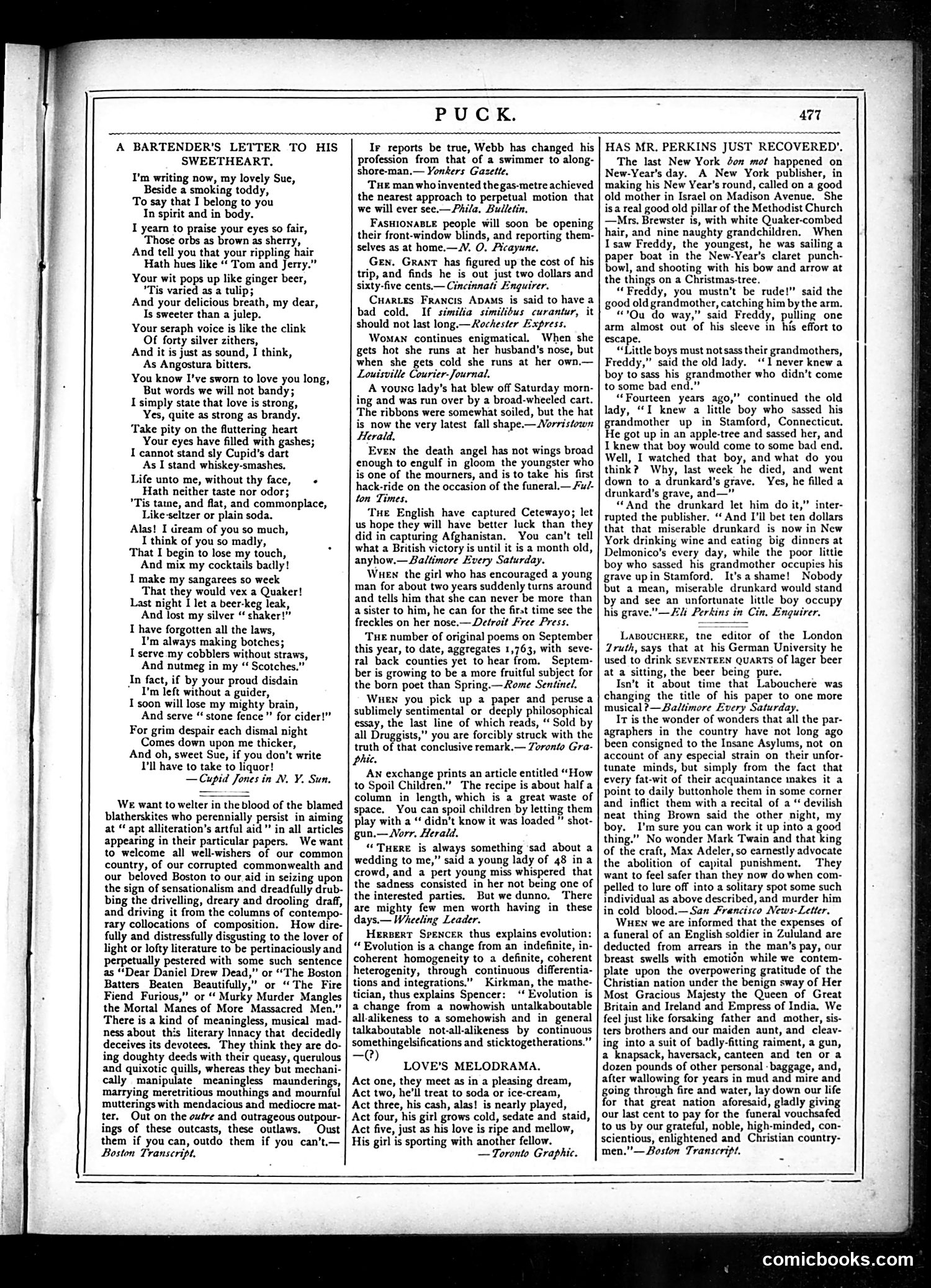
This page is primarily text-based content from Puck magazine, featuring multiple short satirical pieces and jokes rather than political cartoons. The content includes: 1. "A Bartender's Letter to His Sweetheart" — a humorous poem about a bartender's romantic feelings 2. Various brief satirical notes on contemporary topics (gas meters, weather, military costs, women's behavior) 3. "Love's Melodrama" — a comic poem about courtship The pieces mock everyday social observations: women's fashion choices, marital dynamics, military expenditures, and romantic conventions. Without identifying specific political figures, the satire targets general social pretensions and hypocrisies of the era. The format reflects Puck's style of combining short, punchy social commentary with light verse rather than illustrated political cartoons.
📄 Transcribed text from this page (OCR, searchable)
Machine-transcribed from the original scan — historical spelling and the odd misread are preserved.
PUCK. ACT A BARTENDER'S LETTER TO HIS SWEETHEART, I'm writing now, my lovely Sue, Beside a smoking toddy, To say that I belong to you In spirit and in body. I yearn to praise your eyes so fair, Those orbs as brown as sherry, And tell you that your rippling hair Hath hues like “ Tom and Jerry.” Your wit pops up like ginger beer, ‘Tis varied as a tulip; And your delicious breath, my dear, Is sweeter than a julep. Your seraph voice is like the clink Of forty silver zithers, And it is just as sound, I think, As Angostura bitters. You know I've sworn to love you long, But words we will not bandy; I simply state that love is strong, Yes, quite as strong as brandy. Take pity on the fluttering heart Your eyes have filled with gashes; I cannot stand sly Cupid’s dart As I stand whiskey-smashes. Life unto me, without thy face, . Hath neither taste nor odor; ‘Tis tame, and flat, and commonplace, Like-seltzer or plain soda. Alas! I dream of you so much, I think of you so madly, That I begin to lose my touch, And mix my cocktails badly! I make my sangarees so week That they would vex a Quaker! Last night I let a beer-keg leak, And lost my silver “ shaker!” I have forgotten all the laws, I'm always making botches; I serve my cobblers without straws, And nutmeg in my “ Scotches.” In fact, if by your proud disdain I'm left without a guider, I soon will lose my mighty brain, And serve “ stone fence”’ for cider!” For grim despair each dismal night Comes down upon me thicker, And oh, sweet Sue, if you don’t write I'll have to take to liquor! —Cupid Jones in N. Y. Sun. We want to welter in the blood of the blamed blatherskites who perennially persist in aiming at “ apt alliteration’s artful aid” in all articles appearing in their particular papers. We want to welcome all well-wishers of our common country, of our corrupted commonwealth and our beloved Boston to our aid in seizing upon the sign of sensationalism and dreadfully drub- bing the drivelling, dreary and drooling draff, and driving it from the columns of contempo- rary collocations of composition. How dire- fully and distressfully disgusting to the lover of light or lofty literature to be pertinaciously and rpetually pestered with some such sentence as “Dear Daniel Drew Dead,” or “The Boston Batters Beaten Beautifully,” or “The Fire Fiend Furious,” or “‘ Murky Murder Mangles the Mortal Manes of More Massacred Men.” There is a kind of meaningless, musical mad- ness about this literary Innacy that decidedly deceives its devotees. They think they are do- ing doughty deeds with their queasy, querulous and quixotic quills, whereas they but mechani- cally manipulate meaningless maunderings, marrying meretritious mouthings and mournful mutterings with mendacious and mediocre mat- ter. Out on the oufre and outrageous outpour- ings of these outcasts, these outlaws. Oust them if you can, outdo them if you can’t,— Boston Transcript. Ir reports be true, Webb has changed his profession from that of a swimmer to along- shore-man.— Yonkers Gasette, ‘Tue man who invented thegas-metre achieved the nearest approach to perpetual motion that we will ever see.— Phila, Bulletin, FASHIONABLE people will soon be opening their front-window blinds, and reporting them- selves as at home.—. O. Picayune, Gen. Grant has figured up the cost of his trip, and finds he is out just two dollars and sixty-five cents.— Cincinnati Enguirer. Cuarces Francis Apams is said to have a bad cold. If similia similibus curantur, it should not last long.— Rochester Express. Woman continues enigmatical. When she gets hot she runs at her husband's nose, but when she gets cold she runs at her own.— Louisville Courier-Journal, A youn lady’s hat blew off Saturday morn- ing and was run over by a broad-wheeled cart. The ribbons were somewhat soiled, but the hat is now the very latest fall shape.— Norristown Herald, Even the death angel has not wings broad enough to engulf in gloom the youngster who is one of the mourners, and is to take his first hack-ride on the occasion of the funeral.— Fu/- ton Times, Tue English have captured Cetewayo; let us hope they will have better luck than they did in capturing Afghanistan. You can't tell what a British victory is until it is a month old, anyhow.— Baltimore Every Saturday. Wuew the girl who has encouraged a young man for about two years suddenly turns around and tells him that she can never be more than a sister to him, he can for the first time see the freckles on her nose.—Detroit Free Press. ‘Tue number of original poems on September this year, to date, aggregates 1,763, with seve- ral back counties yet to hear from. Septem- ber is growing to be a more fruitful subject for the born poet than Spring.— Rome Sentinel. Wuen you pick up a paper and peruse a sublimely sentimental or deeply philosophical essay, the last line of which reads, “ Sold by all Druggists,” you are forcibly struck with the truth of that conclusive remark.— Zoronto Gra- Phic, An exchange prints an article entitled “How to Spoil Children.” The recipe is about half a column in length, which is a great waste of space. You can spoil children by letting them play with a “ didn’t know it was loaded ” shot- gun.—Norr. Herald. “Tere is always something ‘sad about a wedding to me,” said a young lady of 48 ina crowd, and a pert young miss whispered that the sadness consisted in her not being one of the interested parties, But we dunno, There are mighty few men worth having in these days.— Wheeling Leader. Herzert Spencer thus explains evolutioi “ Evolution is a change from an indefinite, in- coherent homogeneity to a definite, coherent heterogenity, through continuous differentia- tions and integrations.” Kirkman, the mathe- tician, thus explains Spencer: ‘‘ Evolution is a change from a nowhowish untalkaboutable all-alikeness to a somehowish and in general talkaboutable not-all-alikeness by continuous somethingelsifications and sticktogetherations.”” —(@) LOVE'S MELODRAMA, Act one, they meet as in a pleasing dream, Act two, he'll treat to soda or ice-cream, Act three, his cash, alas! is nearly played, Act four, his girl grows cold, sedate and staid, Act five, just as his love is ripe and mellow, His girl is sporting with another fellow. —Toronto Graphic. HAS MR. PERKINS JUST RECOVERED’. The last New York don mot happened on New-Year’s day. A New York publisher, in making his New Year's round, called on a good old mother in Israel on Madison Avenue. She isa real good old pillar of the Methodist Church —Mrs. Brewster is, with white Quaker-combed hair, and nine naughty grandchildren. When Isaw Freddy, the youngest, he was sailing a paper boat in the New-Year’s claret punch- bowl, and shooting with his bow and arrow at the things on a Christmas-tree. “Freddy, you mustn't be rude!” said the good old grandmother, catching him by the arm. “Ou do way,” said Freddy, puiling one arm almost out of his sleeve in his effort to escape. “Little boys must not sass their grandmothers, Freddy,” said the old lady. ‘1 never knew a boy to sass his grandmother who didn’t come to some bad end.” “Fourteen years ago,” continued the old lady, ‘I knew a little boy who sassed his grandmother up in Stamford, Connecticut. He got up in an apple-tree and sassed her, and I knew that boy would come to some bad end, Well, I watched that boy, and what do you think? Why, last week he died, and went down to a drunkard’s grave. Yes, he filled a drunkard’s grave, and—" “And the drunkard let him do it,’ inter- rupted the publisher. ‘‘ And I'll bet ten dollars that that miserable drunkard is now in New York drinking wine and eating big dinners at Delmonico's every day, while the poor littie boy who sassed his grandmother occupies his grave upin Stamford. It’s a shame! Nobody but a mean, miserable drunkard would stand by and see an unfortunate little boy occupy his grave."—£li Perkins in Cin, Enquirer. Laxoucuere, tne editor of the London Truth, says that at his German University he used to drink SEVENTEEN QuaRTs of lager beer at a sitting, the beer being pure. Isn’t it about time that Labouchere was changing the title of his paper to one more musical ?—Baltimore Every Saturday. It is the wonder of wonders that all the par- agraphers in the country have not long ago been consigned to the Insane Asylums, not on account of any especial strain on their unfor- tunate minds, but simply from the fact that every fat-wit of their acquaintance makes it a point to daily buttonhole them in some corner and inflict them with a recital of a “‘ devilish neat thing Brown said the other night, my boy. I'm sure you can work it up into a good thing.” No wonder Mark Twain and that king of the craft, Max Adeler, so earnestly advocate the abolition of capital punishment. They want to feel safer than they now do when com- pelled to lure off into a solitary spot some such individual as above described, and murder him in cold blood.—San Francisco News-Letter. Wuen we are informed that the expenses of a funeral of an English soldier in Zululand are deducted from arrears in the man’s pay, our breast swells with emotién while we contem- plate upon the overpowering gratitude of the Christian nation under the benign sway of Her Most Gracious Majesty the Queen of Great Britain and Ireland and Empress of India, We feel just like forsaking father and mother, sis- ters brothers and our maiden aunt, and cleav- ing into a suit of badly-fitting raiment, a gun, a knapsack, haversack, canteen and ten or a dozen pounds of other personal -baggage, and, after wallowing for years in mud and mire and going through fire and water, lay down our life for that great nation aforesaid, gladly giving our last cent to pay for the funeral vouchsafe to us by our grateful, noble, high-minded, con- scientious, enlightened and Christian country- men.”— Boston Transcript. comicbooks.com