
Puck, 1879-10-01 · page 4 of 18
Puck — October 1, 1879 — page 4: what you’re looking at
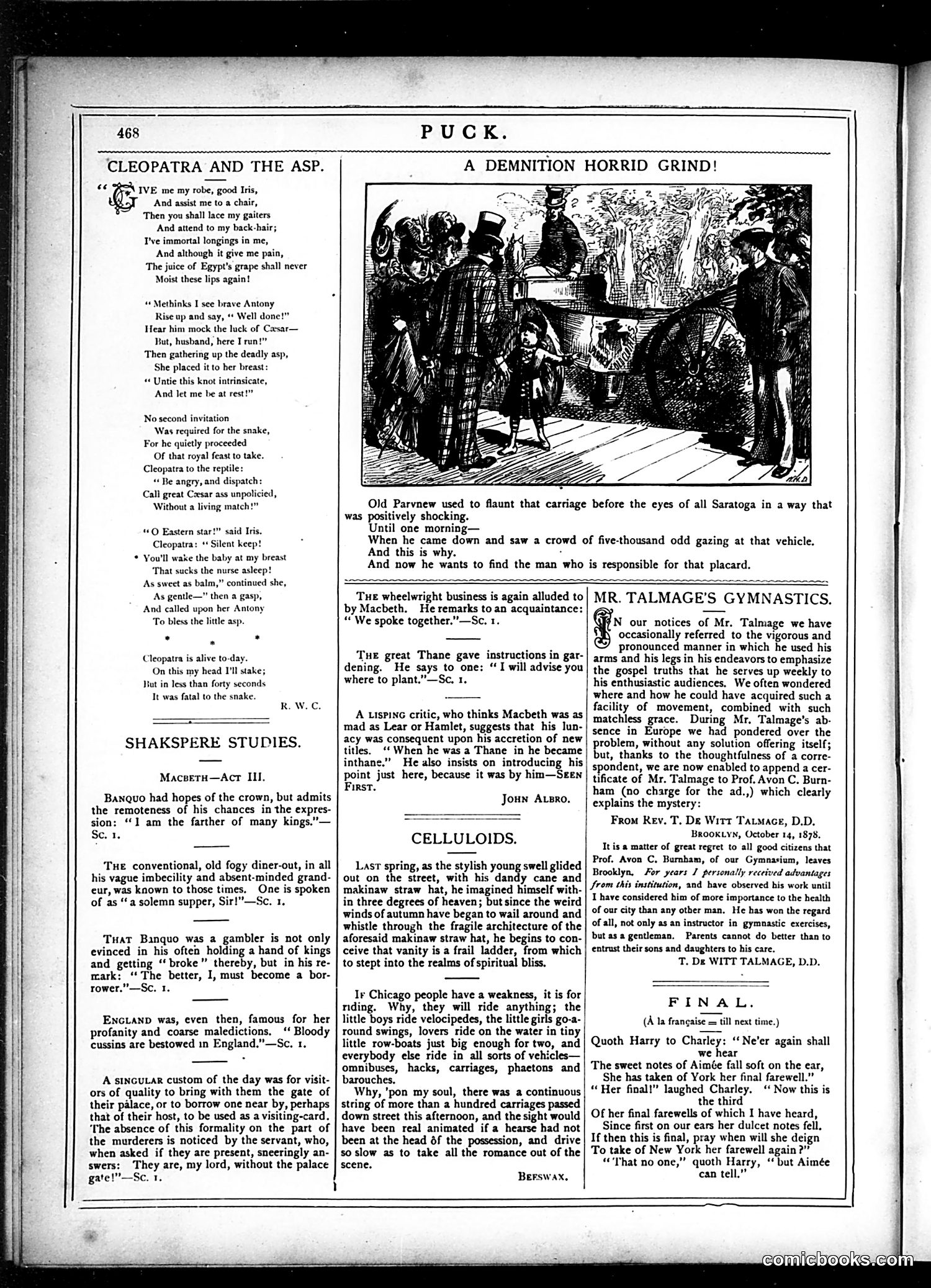
What you’re looking at
The main cartoon depicts what appears to be a public scandal involving a carriage in Saratoga (a fashionable resort town). The text states Old Parvenu "used to flaunt that carriage before the eyes of all Saratoga in a way that positively shocked" society, but now he's desperately searching for "the man who is responsible for that placard." The satire targets nouveau riche social climbers who ostentatiously display wealth to impress high society. The "horrid grind" refers to the embarrassment and social comedown when someone's pretensions are publicly exposed or mocked—a fitting punishment for vulgar wealth-display that offended refined sensibilities. The cartoon mocks both the character's arrogance and society's obsession with status symbols.
📄 Transcribed text from this page (OCR, searchable)
Machine-transcribed from the original scan — historical spelling and the odd misread are preserved.
468 PUCK. CLEOPATRA AND THE ASP. ‘Se me my robe, good Iris, And assist me to a chair, ‘Then you shall lace my gaiters And attend to my back-hair; Tve immortal longings in me, And although it give me pain, ‘The juice of Egypt's grape shall never Moist these lips again! “Methinks I see brave Antony Rise up and say, “¢ Well done!” Hear him mock the luck of Cxxsar— But, husband, here I run!” Then gathering up the deadly asp, She placed it to her breast: « Untie this knot intrinsicate, And let me be at rest!”” No second invitation Was required for the snake, For he quietly proceeded OF that royal feast to take. Cleopatra to the reptile: «Be angry, and dispatch: Call great Cxesar ass unpolicied, Without a living match!” «0 Eastern star!” said Iris. Cleopatra: * Silent keep! You'll wake the baby at my breast ‘That sucks the nurse asleep! ‘As sweet as balm,” continued she, As gentle—" then a gasp, And called upon her Antony To bless the little asp. Cleopatra is alive to-day. On this my head I'll stake; Hut in less than forty seconds It was fatal to the snake. SHAKSPERE STUDIES. MacsetH—Act III. Banquo had hopes of the crown, but admits the remoteness of his chances in the expres- sion: “1 am the farther of many kings.”— Sc. 1. Tue conventional, old fogy diner-out, in all his vague imbecility and absent-minded grand- eur, was known to those tim One is spoken of as “a solemn supper, Sir!”—Sc. 1. Tuat Banquo was a gambler is not only evinced in his often holding a hand of kings and getting “broke” thereby, but in his re- mark: ‘“ The better, I, must become a bor- rower."—Sc. 1. ENGLAND was, even then, famous for her profanity and coarse maledictions. ‘ Bloody cussins are bestowed in England.”—Sc. 1. A SINGULAR custom of the day was for visit- ors of quality to bring with them the gate of their palace, or to borrow one near by, perhaps that of their host, to be used as a visiting-card. ‘The absence of this formality on the part of the murderers is noticed by the servant, who, when asked if they are present, sneeringly an- swers: They are, my lord, without the palace gate!”—Sc. 1. 1 Old Parvnew used to flaunt that carriage before the eyes of all Saratoga in a way that was positively shocking. Until one morning— When he came down and saw a crowd of five-thousand odd gazing at that vehicle. And this is why. And now he wants to find the man who is responsible for that placard. Tue wheelwright business is again alluded to by Macbeth. He remarks to an acquaintance: “We spoke together."”—Sc. 1. ‘Tue great Thane gave instructions in gar- dening. He says to one: “I will advise you where to plant.”—Sc, 1. A LispinG critic, who thinks Macbeth was as mad as Lear or Hamlet, suggests that his lun- acy was consequent upon his accretion of new titles. ‘When he was a Thane in he became inthane.” He also insists on introducing his point just here, because it was by him—Sgen First. Joun Axsro. CELLULOIDS. Last spring, as the stylish young swell glided out on the street, with his dandy cane and makinaw straw hat, he imagined himself with- in three degrees of heaven; but since the weird winds of autumn have began to wail around and whistle through the fragile architecture of the aforesaid makinaw straw hat, he begins to con- ceive that vanity is a frail ladder, from which to stept into the realms of spiritual bliss. Ir Chicago people have a weakness, it is for nding. Why, they will ride anything; the little boys ride velocipedes, the little girls go-a- round swings, lovers ride on the water in tiny little row-boats just big enough for two, and everybody else ride in all sorts of vehicles— omnibuses, hacks, carriages, phaetons and barouches, Why, 'pon my soul, there was a continuous string of more than a hundred carriages passed down street this afternoon, and the sight would have been real animated if a hearse had not been at the head df the possession, and drive so slow as to take all the romance out of the scene. Berswax. MR. TALMAGE’S GYMNASTICS. N our notices of Mr. Talmage we have occasionally referred to the vigorous and pronounced manner in which he used his arms and his legs in his endeavors to emphasize the gospel truths that he serves up weekly to his enthusiastic audiences. We often wondered where and how he could have acquired such a facility of movement, combined with such matchless grace. During Mr. Talmage’s ab- sence in Europe we had pondered over the problem, without any solution offering itself; but, thanks to the thoughtfulness of a corre- | spondent, we are now enabled to append a cer- tificate of Mr. Talmage to Prof. Avon C. Burn- | ham (no charge for the ad.,) which clearly explains the mystery: From Rev. T, De Witt Tatmace, D.D. BROOKLYN, October 14, 1878, It is a matter of great regret to all good citizens that Prof. Avon C, Burnham, of our Gymnasium, leaves Brooklyn, For years J personally received advantages from this institution, and have observed bis work until I have considered him of more importance to the health of our city than any other man, He has won the regard of all, not only as an instructor in gymnastic exercises, but asa gentleman, Parents cannot do better than to entrust their sons and daughters to his care. T. De WITT TALMAGE, D.D. FINAL. I next time.) (A la frangai Quoth Harry to Charley: ‘Ne’er again shall we hear The sweet notes of Aimée fall soft on the ear, She has taken of York her final farewell.” “Her final!” laughed Charley. ‘‘ Now this is the third Of her final farewells of which I have heard, Since first on our ears her dulcet notes fell. If then this is final, pray when will she deign To take of New York her farewell again?” “That no one,” quoth Harry, “but Aimée can tell.”