
A complete issue · 16 pages · 1879
Puck — July 2, 1879
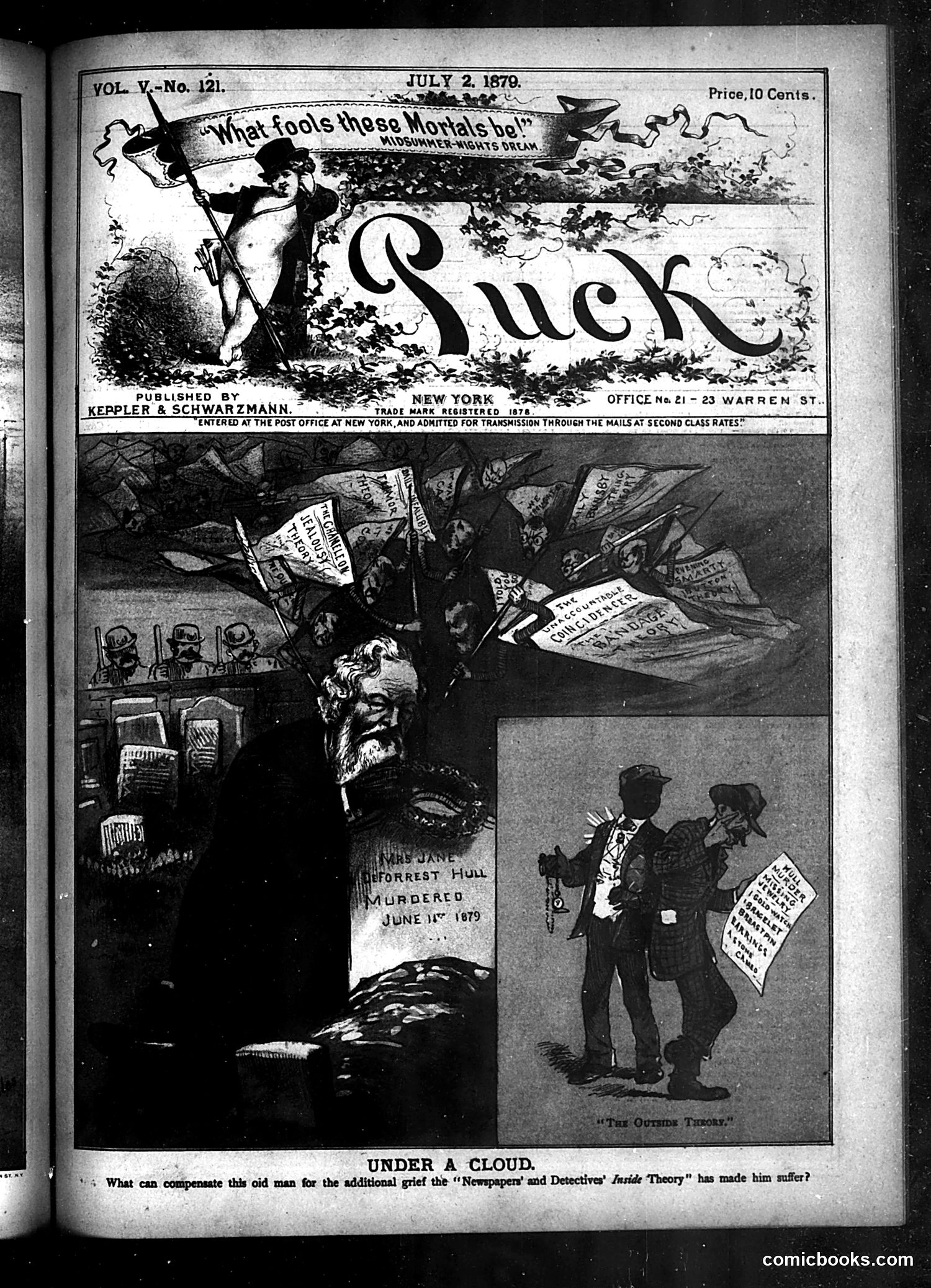
This page satirizes the murder of Jane Forrest Hull on June 14, 1879. The main cartoon, titled "Under a Cloud," depicts an elderly bearded man (likely a figure blamed or suspected in the case) tormented by newspapers and detectives promoting various theories about the crime. The top section shows Puck's masthead with the tagline "What fools these Mortals be!"—Shakespeare's famous quote about human folly. The satire targets sensationalist journalism and competing murder theories ("Newspapers' and Detectives' Inside Theory"), suggesting that conflicting public explanations compound the victim's family's grief. The cartoon critiques how media coverage and amateur detective work create confusion rather than clarity in criminal investigations.
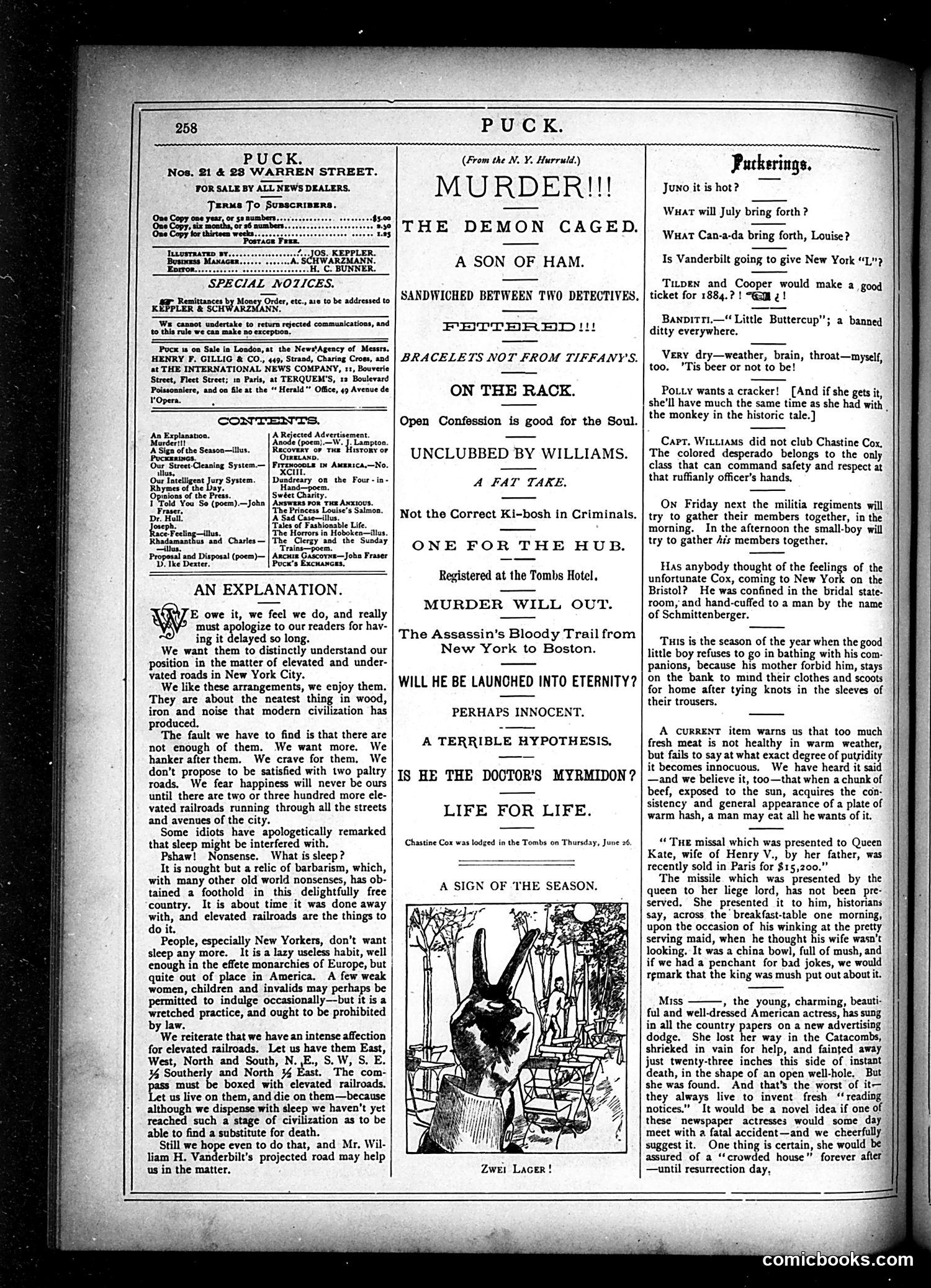
This page from Puck magazine contains satirical headlines and commentary rather than a traditional political cartoon. The main content mocks sensational crime reporting of the era, with headlines like "MURDER!!!" and "THE DEMON CAGED" parodying lurid newspaper coverage. A small illustration shows a donkey in formal dress, captioned "ZWEI LAGER!" (Two Beers), likely a reference to German beer culture or immigrant stereotypes. The right column, "Puckerings," offers brief social commentary on topics including weather, New York society figures (Vanderbilt, Tilden, Cooper), and military matters. The overall tone satirizes both contemporary journalism's sensationalism and New York's social establishment, typical of Puck's satirical mission during this period.
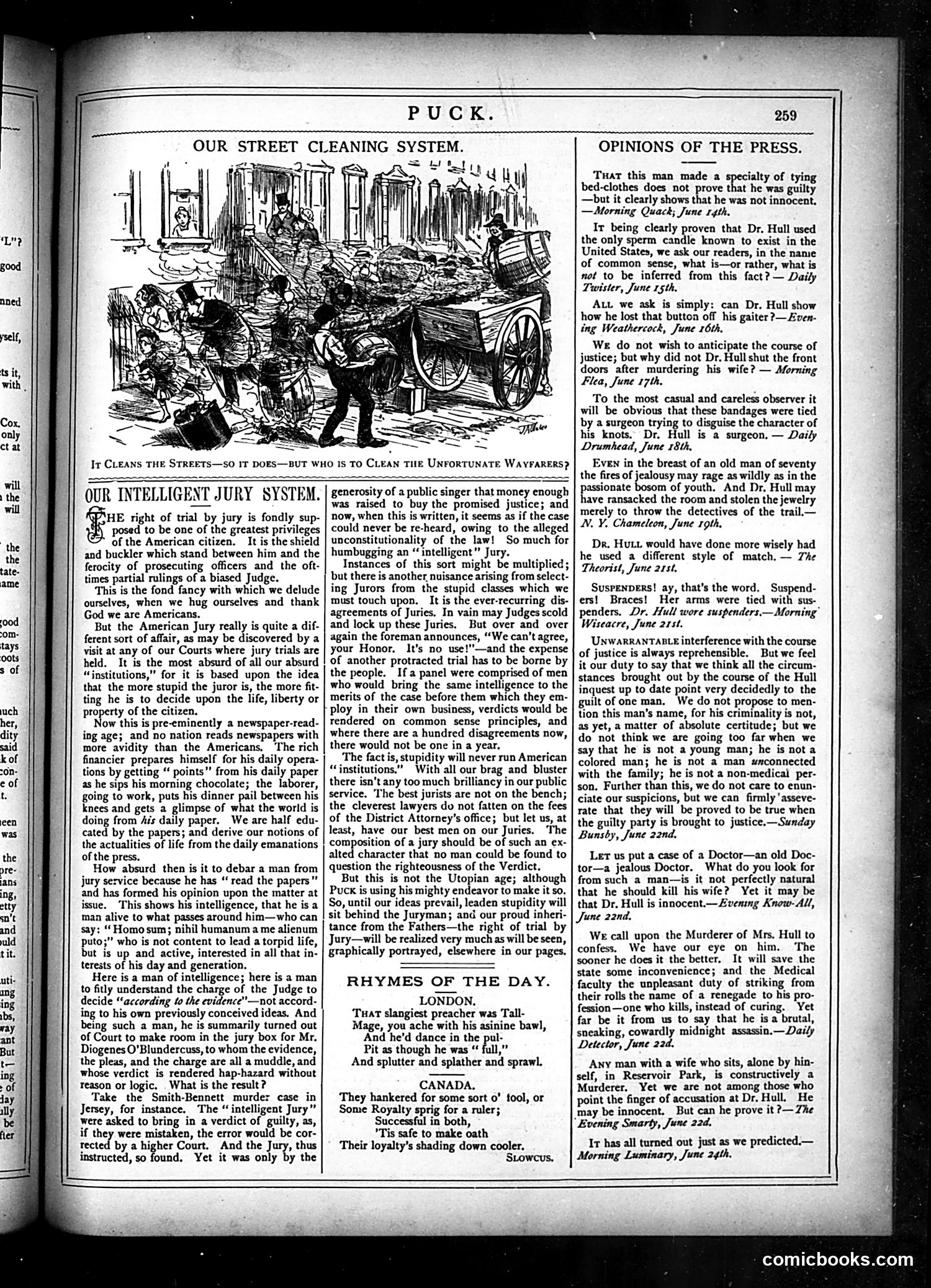
This Puck cartoon satirizes New York's street sanitation through a chaotic scene showing garbage piled high with workers and a cart amid the refuse. The accompanying text critiques the city's ineffective cleaning infrastructure, with the headline asking "who is to clean the unfortunate wayfarers?" The satire targets the disconnect between the city's public sanitation claims and street reality—streets remained filthy despite claims of systematic cleaning. The cartoon's exaggerated depiction of waste accumulation emphasizes the failure of municipal services to address urban cleanliness. The page also includes commentary on jury trials and references what appears to be a contemporary murder case (Dr. Hull), suggesting this reflects broader public frustration with both civic mismanagement and the justice system circa June 1911.
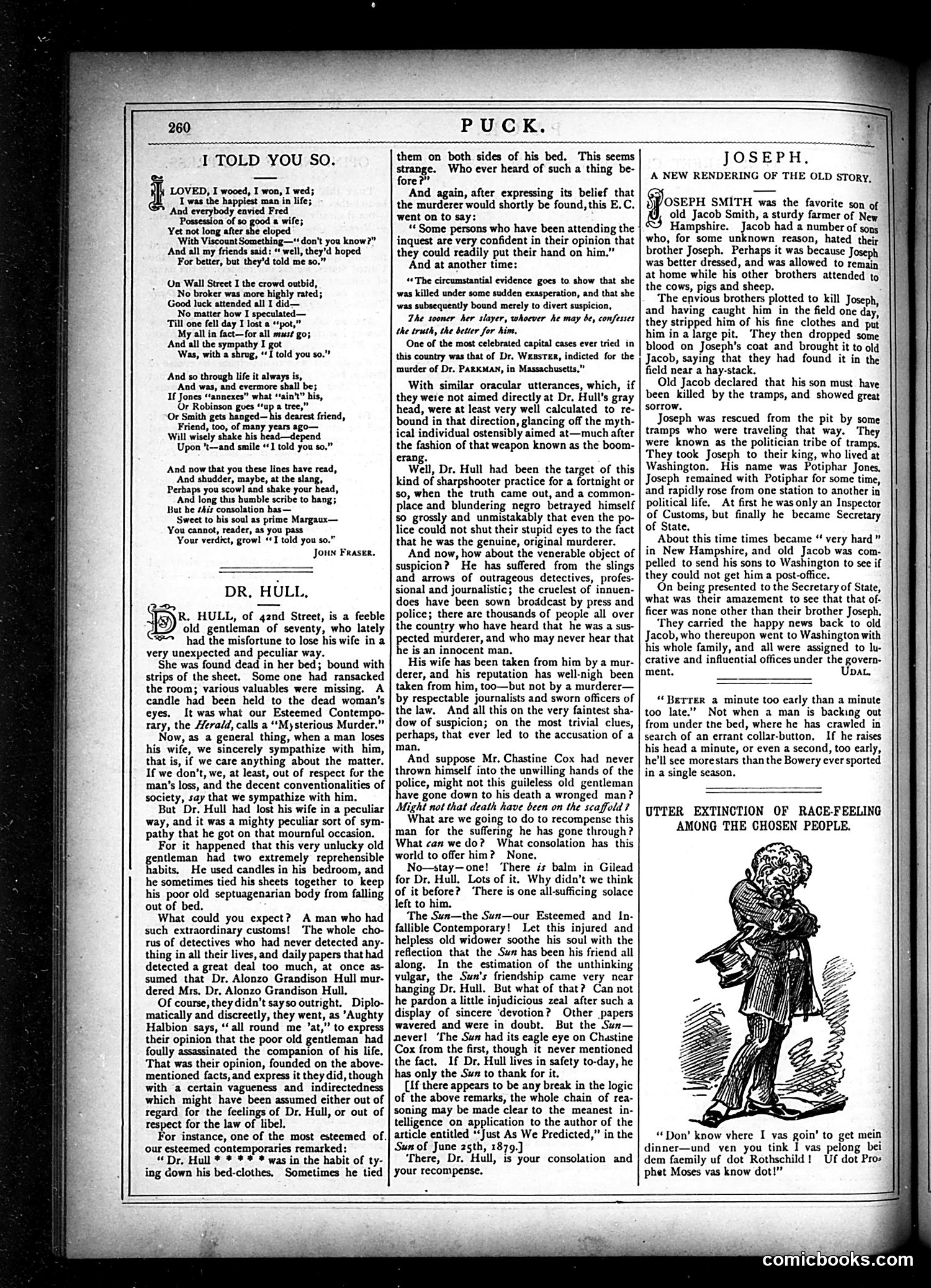
This page contains three distinct sections: a poem titled "I Told You So," a prose piece about "Dr. Hull," and an illustration labeled "Utter Extinction of Race-Feeling Among the Chosen People." The content appears to address Dr. Webster's murder trial in Massachusetts, discussing public suspicion and journalistic coverage of the case. The text critiques how newspapers and detectives mishandled the investigation, with commentary on Dr. Hull's suffering from false accusations and damaged reputation. The illustration depicts what appears to be caricatured figures in conversation, likely satirizing social attitudes, though specific identities are unclear from the image alone. Without clearer historical context about which Dr. Hull case is referenced or when this issue was published, precise political/social meaning remains uncertain. The overall tone suggests satire of justice system failures and media sensationalism.
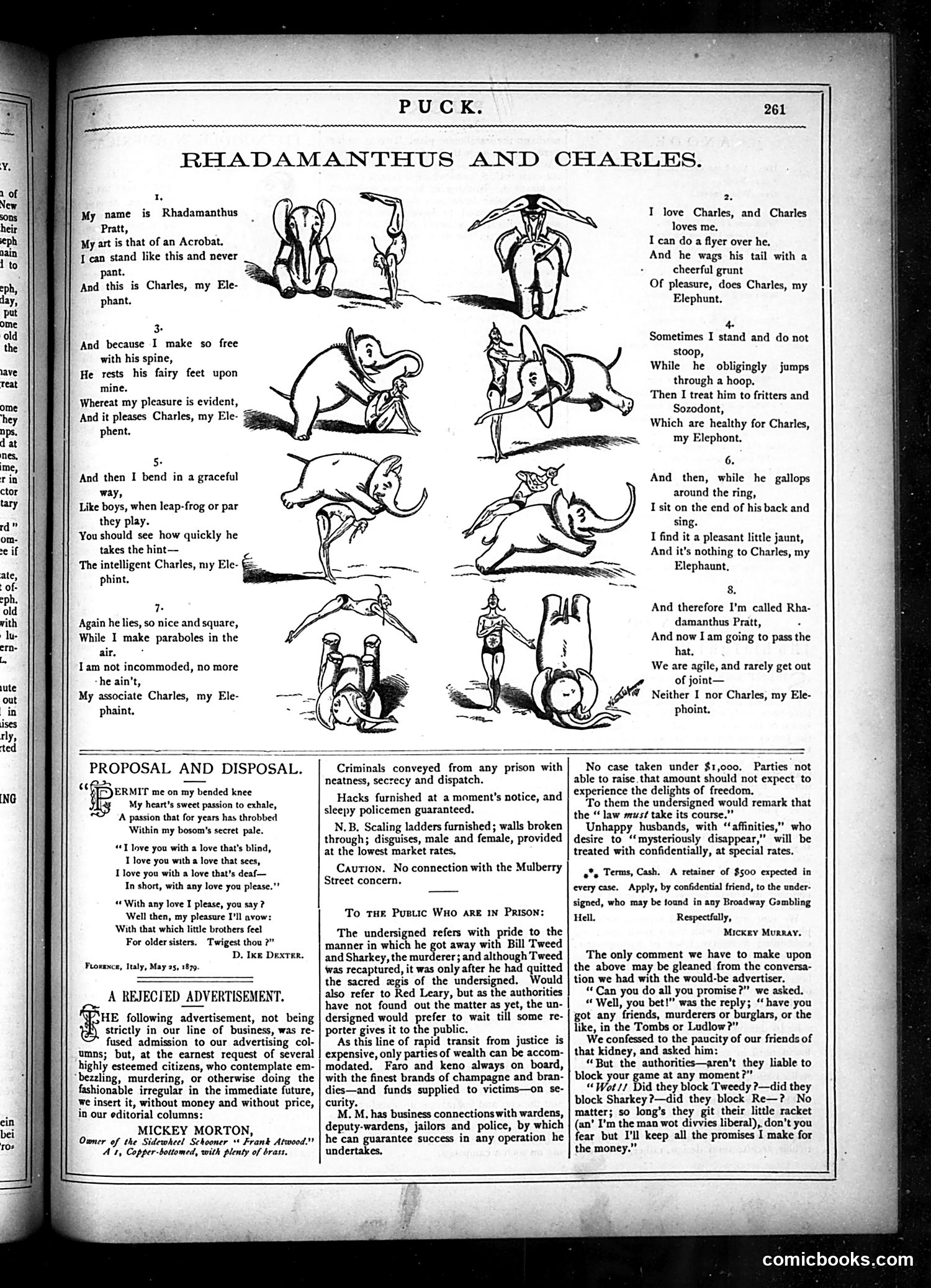
This page features a whimsical poem about an acrobat named Rhadamanthus Pratt and his elephant Charles. The illustrated verses describe the acrobat's various tricks and contortions performed atop the elephant—bending gracefully, doing handstands, and other athletic feats. The satire appears gentle: Rhadamanthus boasts of his flexibility and agility, claiming he "can stand like this and never part" and performs "parable[s] in the air." The accompanying illustrations show exaggerated, absurd acrobatic positions. The remainder of the page contains unrelated satirical advertisements and commentary typical of Puck magazine's format, including social criticism beneath the main cartoon feature. Without additional historical context identifying the specific acrobat or elephant referenced, the primary humor appears to rest on the absurdist physical comedy rather than topical satire.
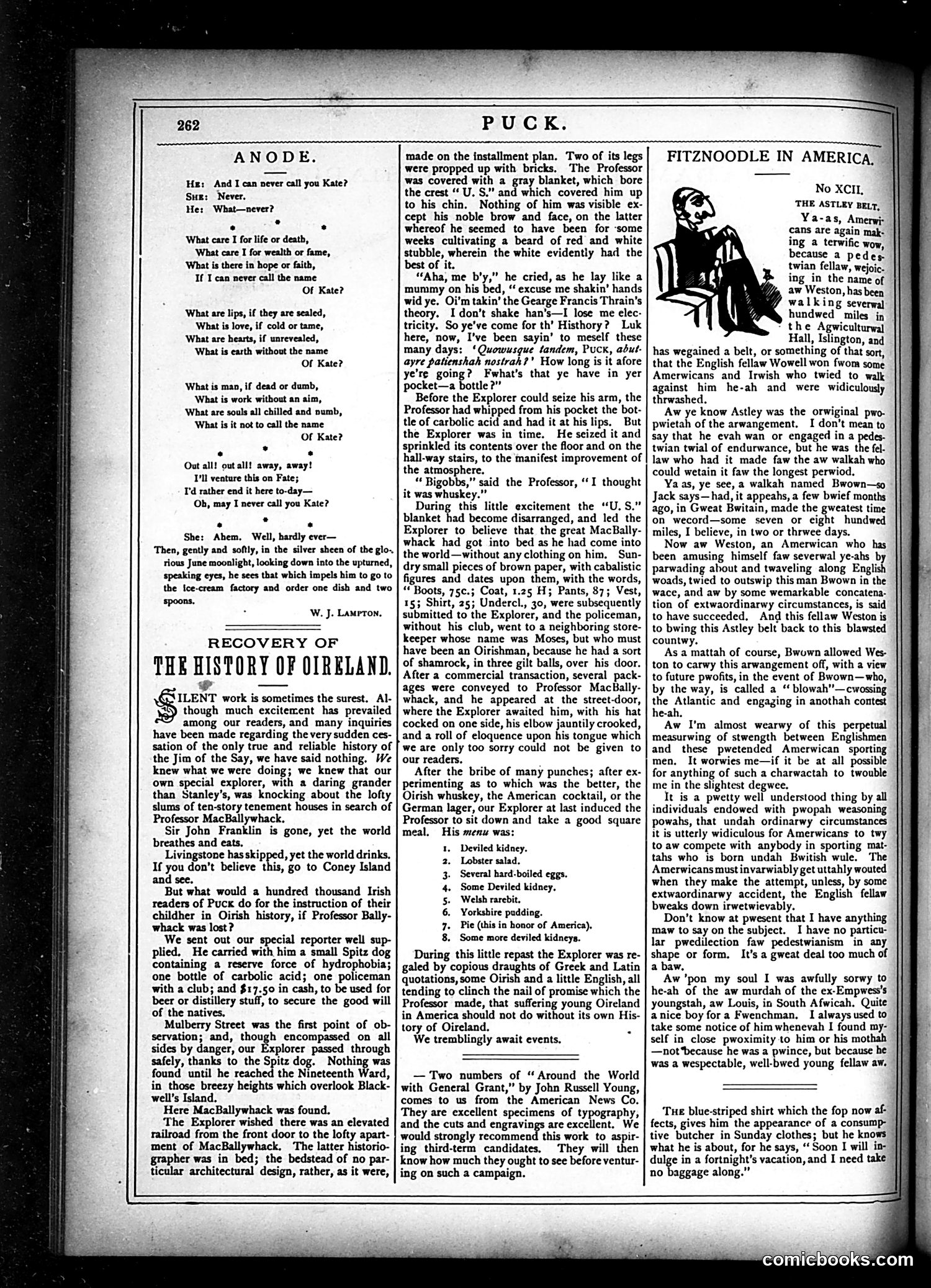
This page contains two distinct sections: **Left side ("Anode")**: A dramatic dialogue-heavy poem about Kate, exploring themes of love, death, wealth, and fate through increasingly urgent questioning. It's literary rather than satirical. **Right side ("Fitznoodle in America")**: A humorous travel narrative about an English pedestrian named Fitznoodle (or Bingobia) touring America. The satire mocks the contrast between English and American customs—particularly hunting, sports, and social behaviors. The text describes Fitznoodle's bewilderment at American habits, his arrangement to compete in a "pedestrian match," and his shock at local practices. It's lighthearted cultural commentary rather than sharp political satire, typical of Puck's often-genteel humor comparing national stereotypes. The page includes a small illustration of a seated figure but the cartoon is minor compared to the text-heavy content.
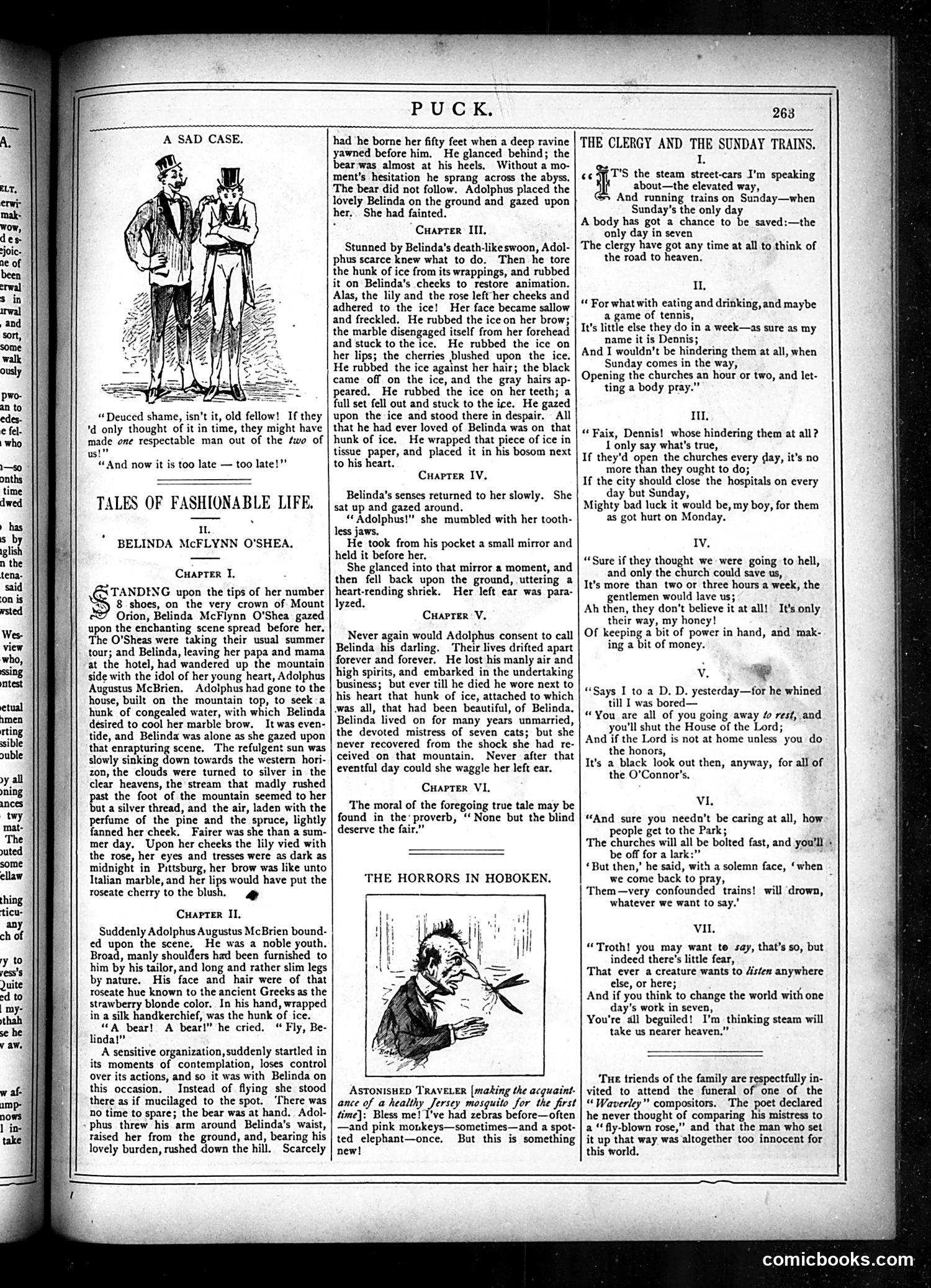
This page contains **serialized fiction rather than political cartoons**. The main content is "Tales of Fashionable Life" by Belinda McFlynn O'Shea, a narrative story with accompanying illustrations. The page includes two illustrated sections: "A Sad Case" (showing a man and woman in period dress) and "The Horrors in Hoboken" (depicting a grotesque creature or monster). There's also a separate section titled "The Clergy and the Sunday Trains," which presents a dialogue about steam-powered street-cars and Sunday train service—likely satirizing contemporary debates about religious observance and modern transportation. This appears to be **general entertainment content** rather than political satire, typical of Puck's mix of humorous fiction and social commentary aimed at middle-class readers.
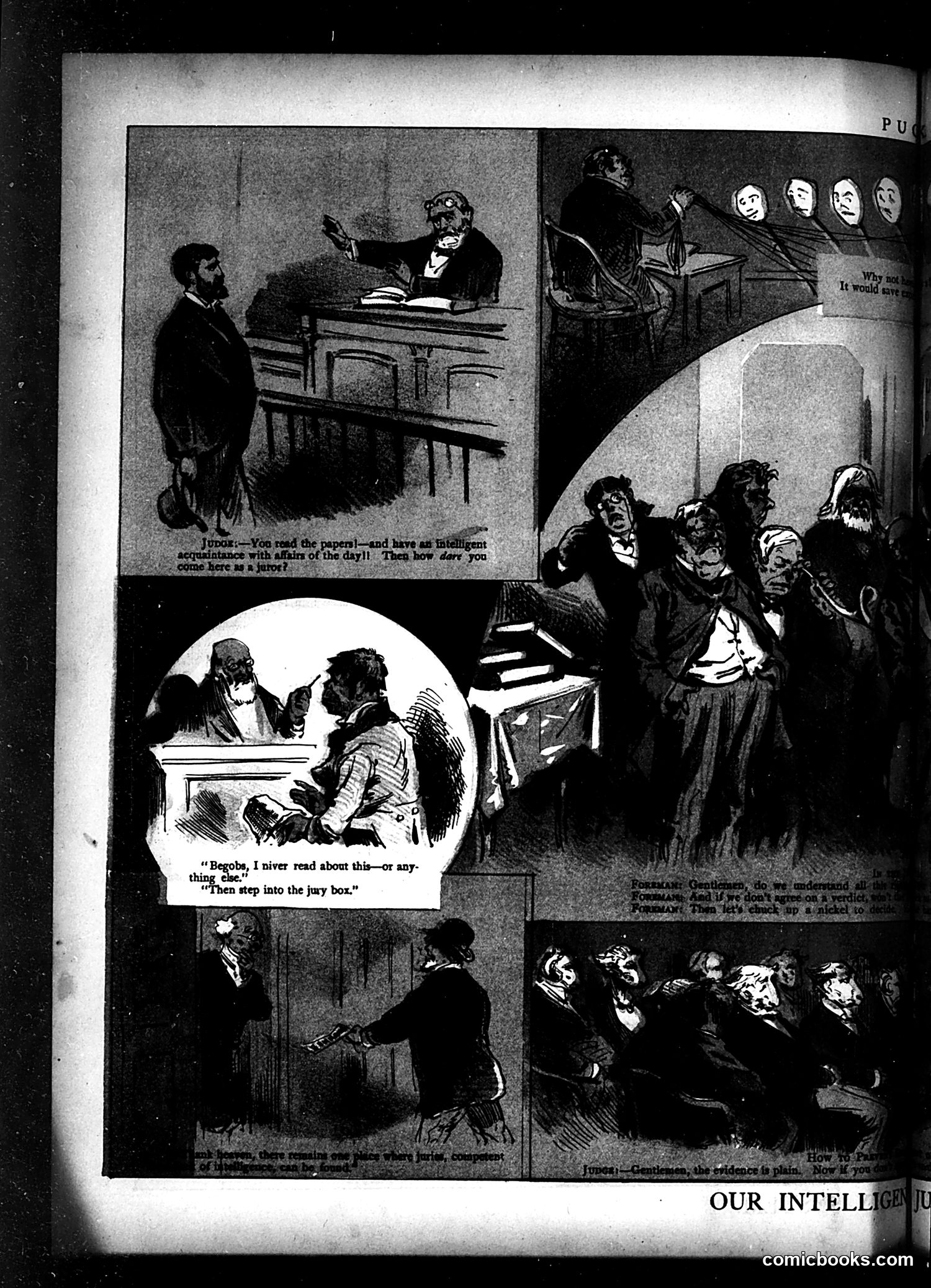
This page depicts **a courtroom jury trial scene**, likely satirizing the American justice system's reliance on jurors with limited literacy or understanding of cases. **The sequence shows:** - Top: A judge questions a juror about reading newspapers and maintaining "intelligent acquaintance with affairs of the day" - Middle: A juror admits "I never read about this—or anything else" before entering the jury box - Bottom: The full jury deliberating, suggesting these largely uninformed individuals will decide the case's outcome **The satire's point:** Puck mocks how juries composed of ordinary citizens—many poorly educated or disengaged from current events—were entrusted with serious legal decisions. The cartoon suggests this democratic system produced absurd outcomes when jurors admitted complete ignorance of case facts.
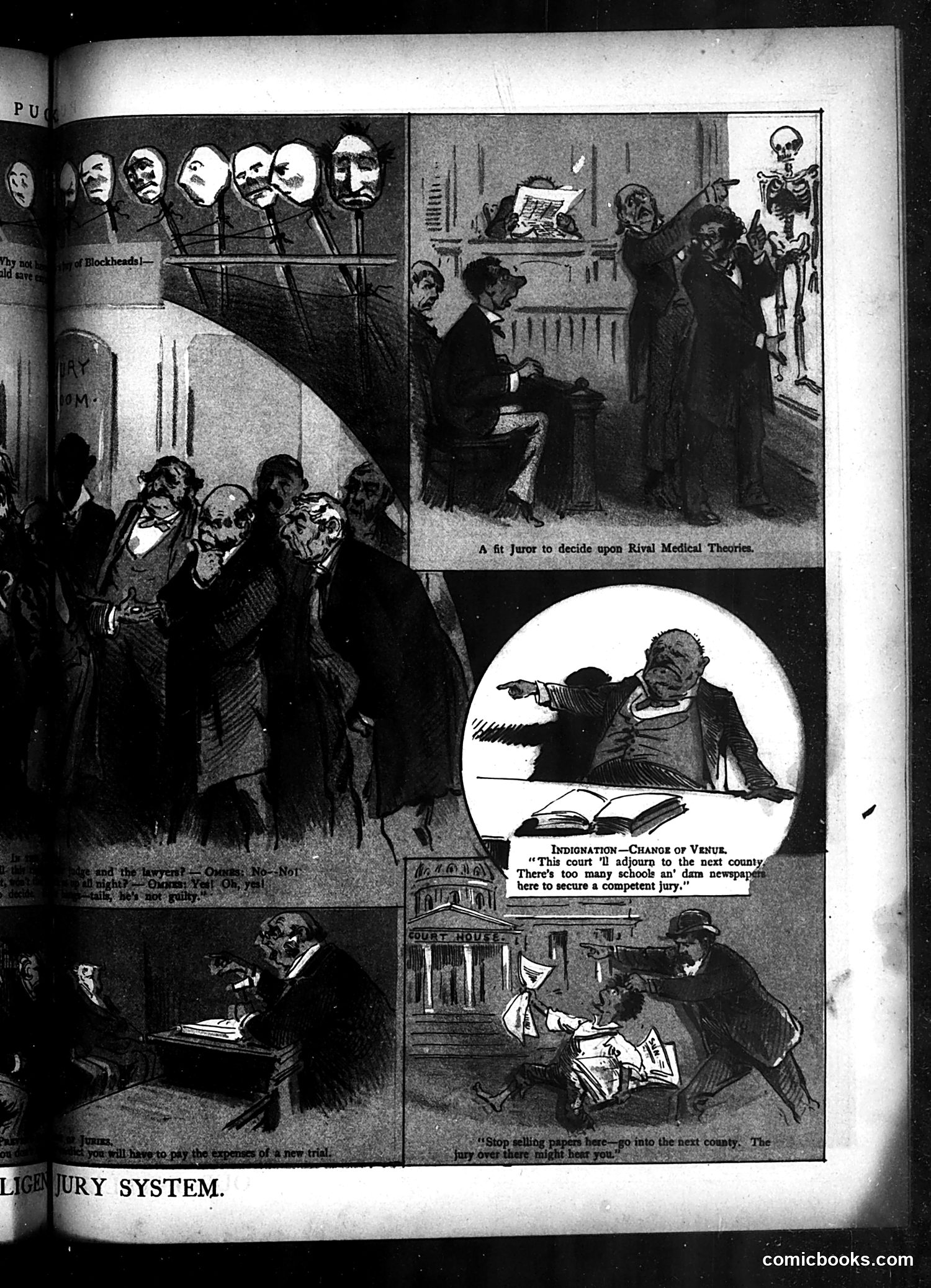
This Puck page satirizes the jury system through multiple scenes. The top panel shows "A fit Juror to decide upon Rival Medical Theories"—depicting jurors with exaggerated, grotesque faces, suggesting ordinary citizens lack competence to judge complex expert testimony. The circular inset mocks "Indignation—Change of Venue," where a judge notes too many schools and newspapers exist locally to secure an impartial jury, highlighting how publicity compromises fair trials. Lower panels show attorneys manipulating jurors and evidence, with dialogue about moving trials to avoid educated jurors—the final panel warns a lawyer that changing venue to escape scrutiny will only increase trial costs. The satire criticizes both juror incompetence and legal manipulation of the system.
This page contains a satirical poem titled "Dundreary on the Four-in-Hand" mocking a foolish character, likely a dandy or social climber obsessed with fashionable horse-drawn carriages and appearances. The poem ridicules his pretensions and incompetence. Below that, "Sweet Charity: Poor Vanderbilt" describes a scheme to relieve William H. Vanderbilt's financial burdens by having wealthy New Yorkers contribute avenues and boulevards for his personal use—a biting satire of Vanderbilt's legendary wealth and the absurdity of the ultra-rich needing public assistance. The remaining content includes brief social commentary and answers to readers' questions, typical of Puck's satirical format. The overall theme targets wealthy industrialists and social pretension in Gilded Age New York.
This page contains serialized fiction rather than political satire or cartoons. It's Chapter XI of "Archie Gascoyne, A Romance of Skye" by John Fraser, written expressly for Puck magazine. The narrative focuses on romantic and social drama among Scottish Highland characters—Archie, Campbell, Maggie, the Doctor, and others. The humor derives from character dialogue and situations: Campbell's romantic jealousy, Archie's teasing about Highland customs (notably the recurring joke about "picking up collars"), and social pretensions. Rather than political commentary, this represents Puck's serialized fiction content, which complemented the magazine's satirical cartoons elsewhere.
This page contains a literary short story titled "Beside the Brook" rather than a political cartoon. The narrative poem describes a young man fishing by a brook, reading love songs and romantic literature while seeking solace in nature. The page also includes several brief satirical notes commenting on contemporary topics: circus employee practices, newspaper advertisements, patent medicines, and church fundraising controversies. One item mocks the "cosey seats" at theaters; another critiques the Brooklyn Eagle's coverage of President Hayes. The humor is gentle social commentary rather than sharp political satire—typical of Puck's miscellaneous editorial content. No specific political figures or major events are caricatured on this particular page.
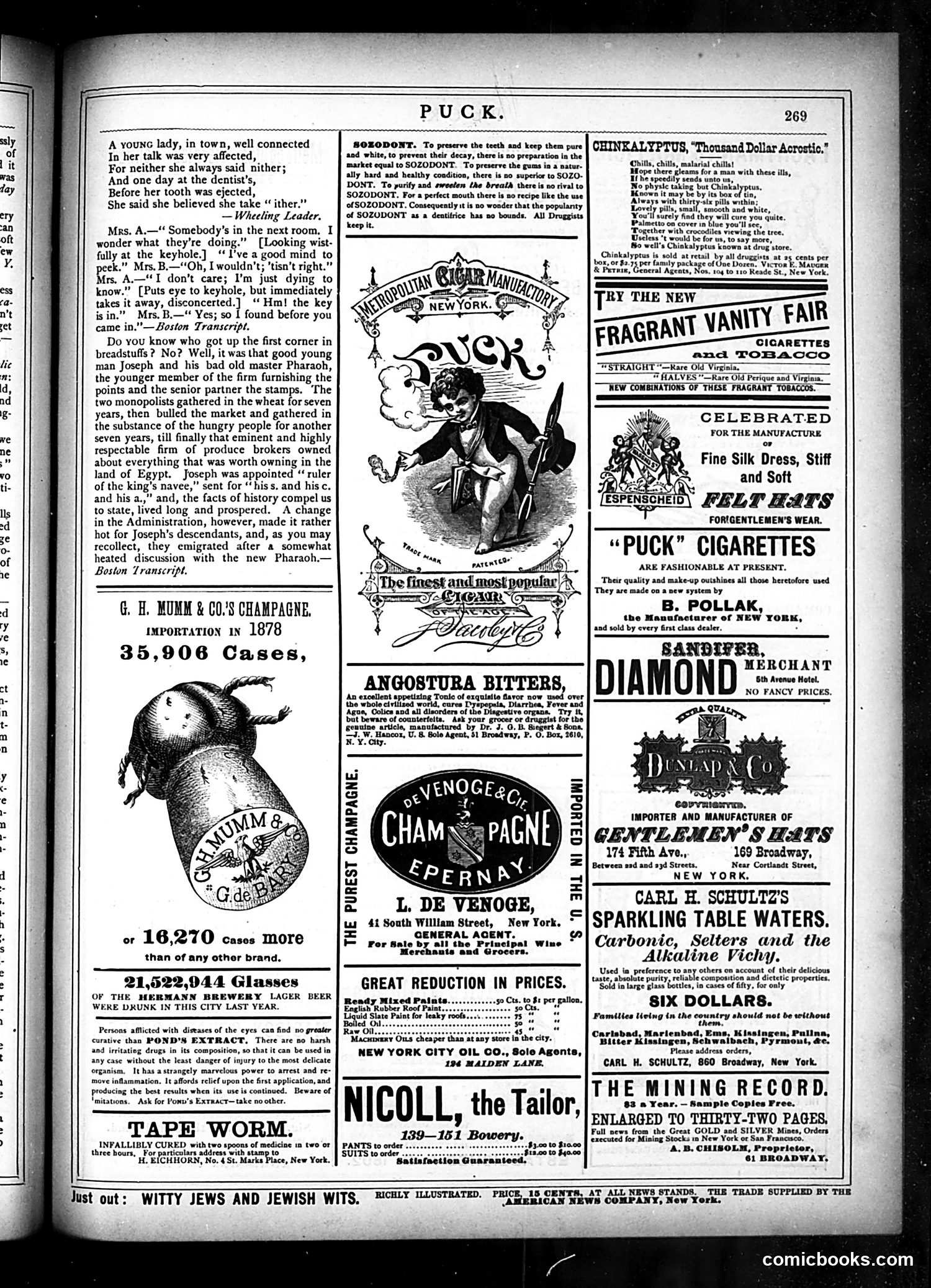
This page is **primarily advertisements** with one central cartoon. The main illustration depicts a cherub or putto figure labeled "Puck" riding what appears to be a pig or similar creature, promoting cigars and tobacco products. The page contains mostly commercial ads for luxury goods—champagne (G. Humm & Co.), bitters, cigars (Puck brand), silk dress fabric, sparkling waters, and tailoring services. One text section humorously discusses acquiring a "corner lot" in Jerusalem near the pyramids, seemingly satirizing speculation and business schemes. The cartoon itself functions mainly as a brand mascot rather than political commentary. The overall page reflects **late 19th-century American commercial culture** more than satirical content.
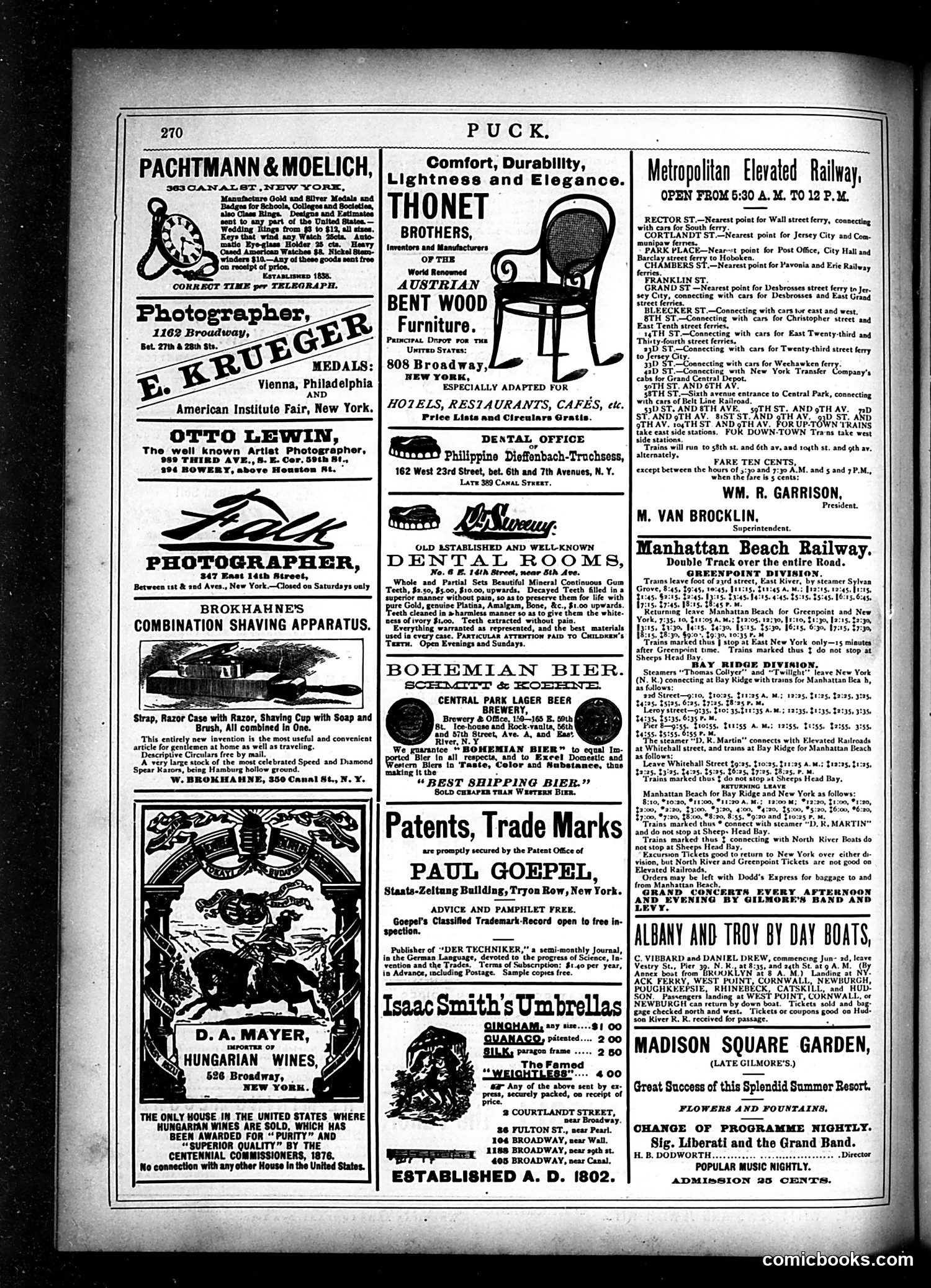
This is primarily an **advertising page** from Puck magazine (page 270), not a political cartoon. It contains numerous commercial advertisements for businesses including: - Photographers (Krieger, Otto Lewin) - Furniture (Thonet Brothers' bentwood chairs) - Dental services - Railroads (Metropolitan Elevated, Manhattan Beach) - Day boats and steamers - Madison Square Garden - Hungarian wines - Umbrellas - Patent services The page reflects **late 19th-century New York commerce**—featuring transportation services, photography studios, and entertainment venues typical of the era. No political satire or recognizable caricatures are evident. This is a straightforward advertising section rather than editorial content.
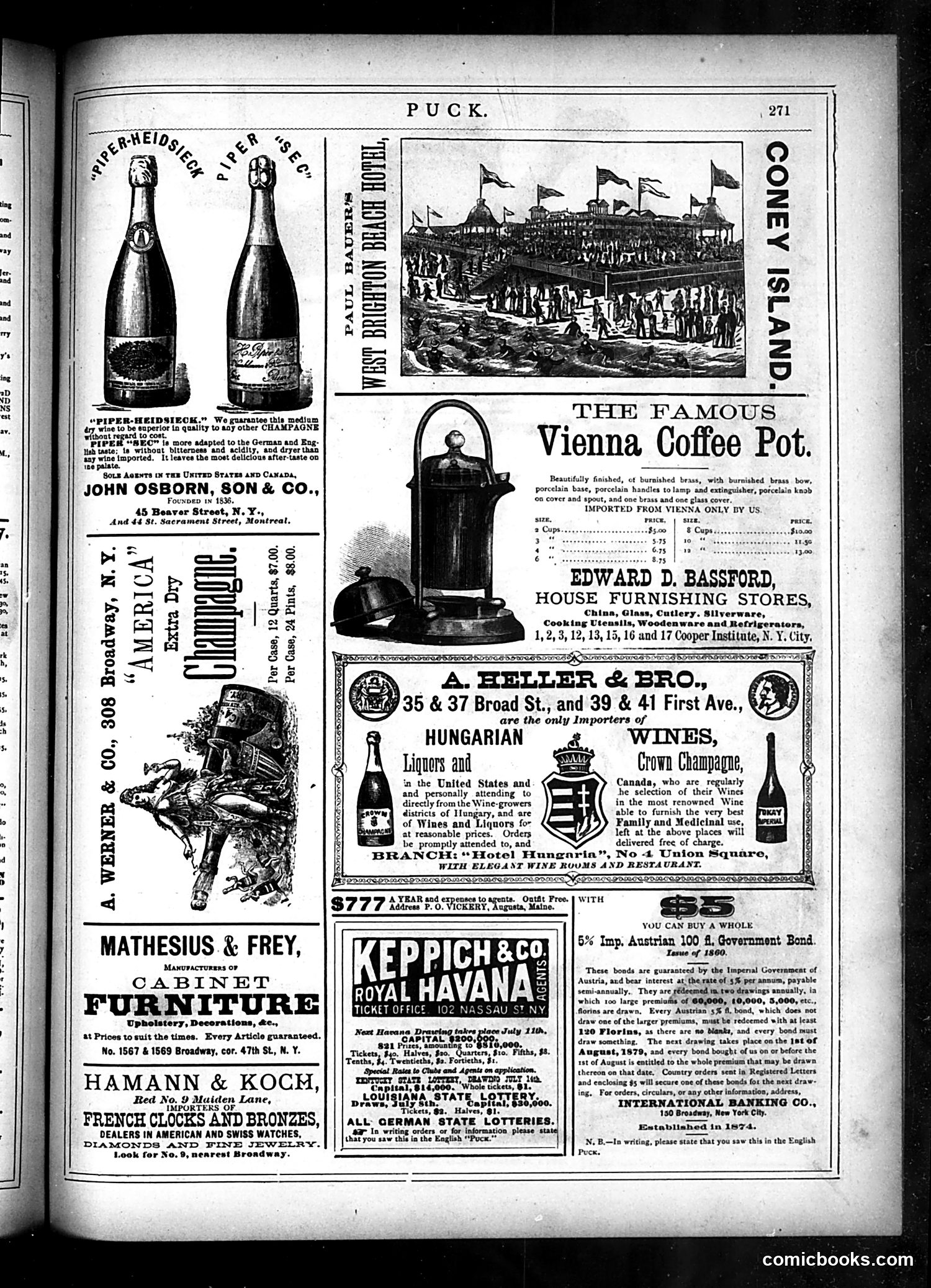
This page is primarily **advertising**, not political satire. The main content features: - **"The Famous Vienna Coffee Pot"** advertisement by Edward D. Bassford (House Furnishing Stores) — promoting imported Austrian kitchenware - **A. Heller & Bro.** advertising Hungarian wines and Crown Champagne - Various other period advertisements: Keppich & Co. lottery tickets, Mathesius & Frey furniture, Hamann & Koch clocks and bronzes - A large illustration of **Coney Island** at top, showing the crowded amusement park with flags and pavilions The Coney Island image appears to be promotional artwork highlighting this newly-popular New York destination. The surrounding ads target affluent households seeking imported European goods—wines, furniture, and fine kitchenware. This reflects late 19th-century American consumer culture and fascination with European imports.
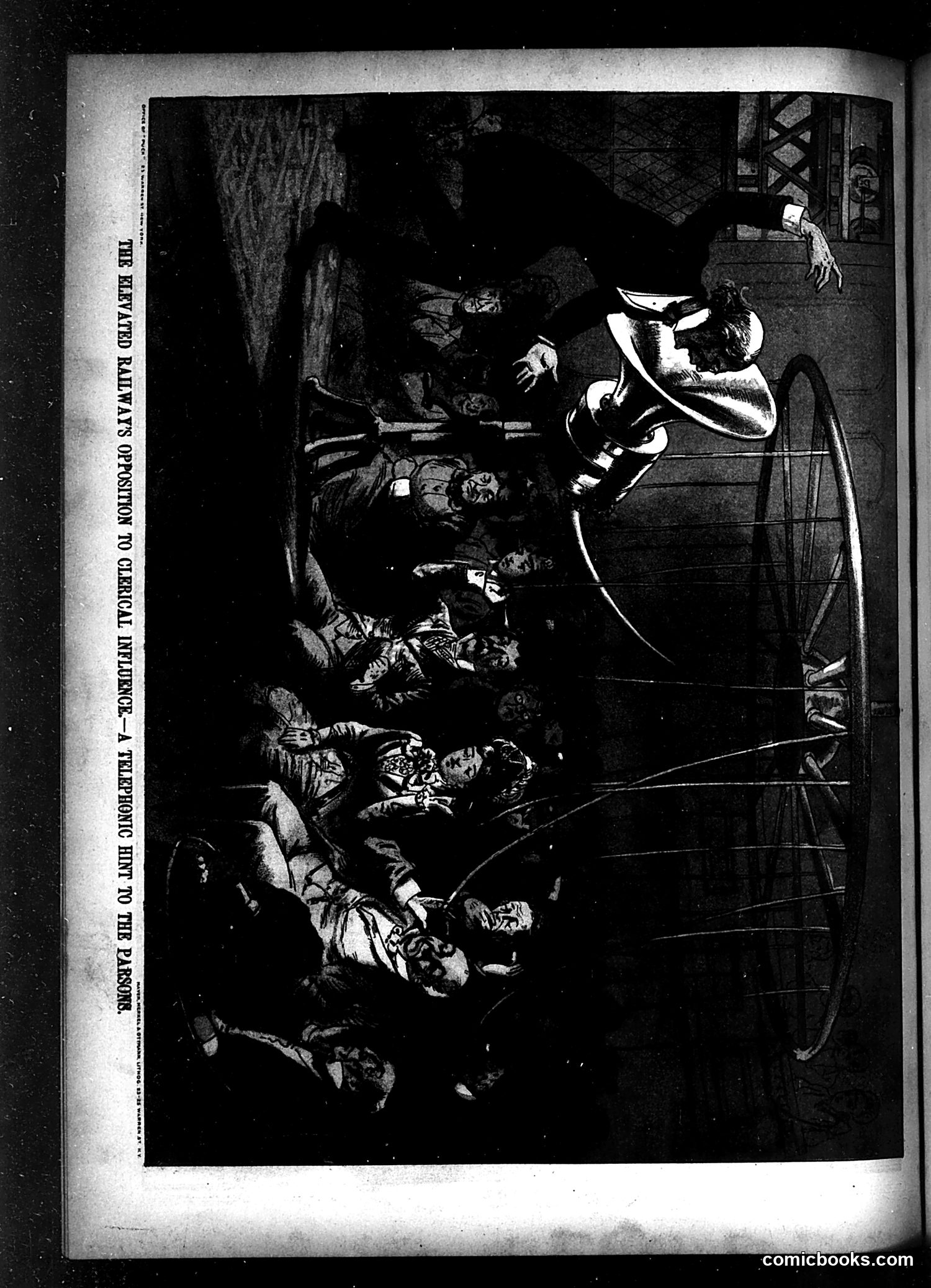
This page shows "The Retarded Admirals' Persuasion to Carroll Intendence—Telepathic Hint to the Passenger," though the OCR text is garbled and difficult to parse clearly. The cartoon appears to depict a naval or maritime scene with uniformed figures. Based on the title's reference to "admirals" and "persuasion," this likely satirizes naval bureaucracy or military decision-making of the Gilded Age/early 20th century period when Puck was prominent. The dramatic lighting and composition suggest a serious or absurd situation being mocked. Without clearer OCR text, the specific political or social target remains unclear, but Puck typically lampooned government inefficiency, military overreach, or power dynamics. The "telepathic hint" reference suggests satirizing miscommunication or absurd reasoning among authority figures.