
Puck, 1879-07-02 · page 4 of 16
Puck — July 2, 1879 — page 4: what you’re looking at
What you’re looking at
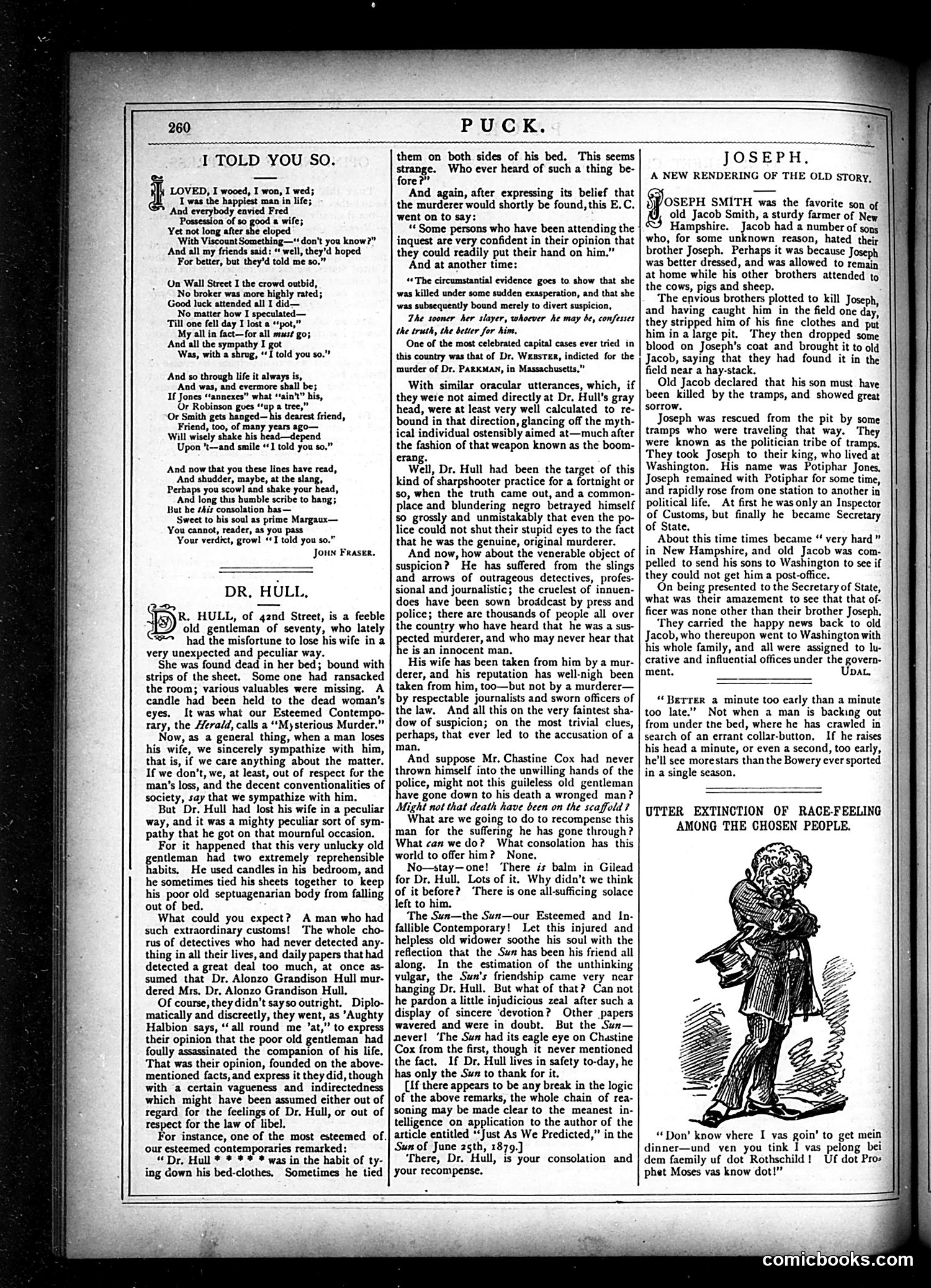
This page contains three distinct sections: a poem titled "I Told You So," a prose piece about "Dr. Hull," and an illustration labeled "Utter Extinction of Race-Feeling Among the Chosen People." The content appears to address Dr. Webster's murder trial in Massachusetts, discussing public suspicion and journalistic coverage of the case. The text critiques how newspapers and detectives mishandled the investigation, with commentary on Dr. Hull's suffering from false accusations and damaged reputation. The illustration depicts what appears to be caricatured figures in conversation, likely satirizing social attitudes, though specific identities are unclear from the image alone. Without clearer historical context about which Dr. Hull case is referenced or when this issue was published, precise political/social meaning remains uncertain. The overall tone suggests satire of justice system failures and media sensationalism.
📄 Transcribed text from this page (OCR, searchable)
Machine-transcribed from the original scan — historical spelling and the odd misread are preserved.
PUCK. I TOLD YOU SO. LOVED, I wooed, I won, I wed; Iwas the happiest man in life; ‘And everybody envied Fred Possession of 80 peed a wife; Yet not long after she eloped ‘With Viscount Something—‘ don’t you know?” ‘And all my friends said: “ well, they'd hoped For better, but they'd told me so.” On Wall Street I the crowd outbid, No broker was more highly rated; Good luck attended all I did— No matter how I speculated— Till one fell day I lost a “pot,” My all in fact—for all mus? go; ‘And all the sympathy I got Was, with a shrug, ‘I told you so.’” And so through life it always is, And was, and evermore shall be; If Jones ‘‘annexes” what “aint” his, Or Robinson gues “up a tree,” Or Smith gets hanged—his dearest friend, Friend, too, of many years ago— Will wisely shake his head—depend Upon *—and smile “1 told you so.” And now that you these lines have read, ‘And shudder, maybe, at the slang, Perhaps you scowl and shake your head, ‘And long this humble scribe to hang; But he ¢Ais consolation has— ‘Sweet to his soul as prime Margaux— You cannot, reader, as you Your verdict, growl ‘I told you so.” Joun Fraser. DR. HULL, 3 aes 5% HULL, of g2nd Street, is a feeble old gentleman of seventy, who lately had the misfortune to lose his wife in a very unexpected and peculiar way. She was found dead in her bed; bound with strips of the sheet. Some one had ransacked the room; various valuables were missing. A candle had been held to the dead woman's eyes. It was what our Esteemed Contempo- rary, the Hera/d, calls a ‘Mysterious Murder.” Now, as a general thing, when a man loses his wife, we sincerely sympathize with him, that is, if we care anything about the matter. If we don’t, we, at least, out of respect for the man’s loss, and the decent conventionalities of society, say that we sympathize with him. But Dr. Hull had lost his wife in a peculiar way, and it was a mighty peculiar sort of sym- pathy that he got on that mournful occasion. For it happened that this very unlucky old gentleman had two extremely reprehensible habits, He used candles in his bedroom, and he sometimes tied his sheets together to keep his poor old septuagenarian body from falling out of bed. What could you expect? A man who had such extraordinary customs! ‘The whole cho- tus of detectives who had never detected any- thing in all their lives, and daily papers that had detected a great deal too much, at once as- sumed that Dr. Alonzo Grandison Hull mur- dered Mrs. Dr. Alonzo Grandison Hull, Of course, they didn’t say so outright. Diplo- matically and discreetly, they went, as ’Aughty Halbion says, ‘all round me ’at,” to express their opinion that the poor old gentleman had foully assassinated the companion of his life, That was their opinion, founded on the above- mentioned facts, and express it they did, though with a certain vagueness and indirectedness which might have been assumed either out of regard for the feelings of Dr. Hull, or out of respect for the law of libel. REL For instance, one of the most esteemed of. our esteemed contemporaries remarked: “Dr, Hull * * * * ® was in the habit of ty- ing down his bed-clothes. Sometimes he tied them on both sides of his bed. This seems strange. Who ever heard of such a thing be- fore?” And again, after expressing its belief that the murderer would shortly be found, this E.C. went on to say: ‘* Some persons who have been attending the inquest are very confident in their opinion that they could readily put their hand on him,” And at another time: «The circumstantial evidence goes to show that she was killed under some sudden exasperation, and that she was subsequently bound merely to divert suspicion, The sooner her slayer, whoever he may be, confesses the truth, the better for him, ‘One of the most celebrated capital cases ever tried in this country was that of Dr, WessteR, indicted for the murder of Dr. PARKMAN, in Massachusetts,” With similar oracular utterances, which, if they weie not aimed directly at Dr. Hull’s gray head, were at least very well calculated to re- bound in that direction, glancing off the myth- ical individual ostensibly aimed at—much after the fashion of that weapon known as the boom- erang. Wall, Dr. Hull had been the target of this kind of sharpshooter practice for a fortnight or so, when the truth came out, and a common- place and blundering negro betrayed himself so grossly and unmistakably that even the po- lice could not shut their stupid eyes to the fact that he was the genuine, original murderer. And now, how about the venerable object of suspicion? He has suffered from the slings and arrows of outrageous detectives, profes- sional and journalistic; the cruclest of innuen- does have been sown broddcast by press and police; there are thousands of people all over the country who have heard that he was a sus- scted murderer, and who may never hear that ¢ is an innocent man. His wife has been taken from him by a mur- derer, and his reputation has well-nigh been taken from him, too—but not by a murderer— by respectable journalists and sworn officers of the law. And all this on the very faintest sha- dow of suspicion; on the most trivial clues, perhaps, that ever led to the accusation of a man, And suppose Mr. Chastine Cox had never thrown himself into the unwilling hands of the police, might not this guileless old gentleman have gone down to his death a wronged man? Might not that death have been on the scaffold ? What are we going to do to recompense this man for the suffering he has gone through? What can we do? What consolation has this world to offer him? None, No—stay—one! ‘There és balm in Gilead for Dr. Hull, Lots of it. Why didn’t we think of it before? ‘There is one all-sufficing solace left to him, The Sun—the Sun—our Esteemed and In- fallible Contemporary! Let this injured and helpless old widower soothe his soul with the reflection that the Suv has been his friend all along, In the estimation of the unthinking vulgar, the Sun's friendship came very near hanging Dr. Hull. But what of that? Can not he pardon a little injudicious zeal after such a display of sincere ‘devotion? Other papers wavered and were in doubt. But the Sun— never! ‘The Sun had its eagle eye on Chastine Cox from the first, though it never mentioned the fact. If Dr. Hull lives in safety to-day, he has only the Sun to thank for it. [if there appears to be any break in the logic of the above remarks, the whole chain of rea- soning may be made clear to the meanest in- telligence on application to the author of the article entitled ‘‘Just As We Predicted,” in the Sun of June 25th, 1879.) ‘There, Dr. Hull, is your consolation and your recompense, JOSEPH, A NEW RENDERING OF THE OLD sTory, ‘OSEPH SMITH was the favorite son of old Jacob Smith, a sturdy farmer of New Hampshire. Jacob had a number of sons who, for some unknown reason, hated their brother Joseph. Perhaps it was because Ji was better dressed, and was allowed to remain at home while his other brothers attended to the cows, pigs and sheep. The envious brothers plotted to kill Joseph, and having caught him in the field one day, they stripped him of his fine clothes and put him in a large pit. ‘They then dropped some blood on Joseph’s coat and brought it to old Jacob, saying that they had found it in the field near a hay-stack. Old Jacob declared that his son must. have been killed by the tramps, and showed great sorrow. Joseph was rescued from the pit by some tramps who were traveling that way. They were known as the politician tribe of tramps, They took Joseph to their king, who lived at Washington, His name was Potiphar Jones, Joseph remained with Potiphar for some time, and rapidly rose from one station to another in political life. At first he was only an Inspector of Customs, but finally he became Secretary of State. About this time times became “ very hard” in New Hampshire, and old Jacob was com- pelled to send his sons to Washington to see if they could not get him a post-office. On being presented to the Secretary of State, what was their amazement to sec that that of- ficer was none other than their brother Joseph, ‘They carried the happy news back to old Jacob, who thereupon went to Washington with his whole family, and all were assigned to lu- crative and influential offices under the govern- ment. Upat, ‘‘BeTrer a minute too early than a minute too late.” Not when a man is backing out from under the bed, where he has crawled in search of an errant collar-button, If he raises his head a minute, or even a second, too early, he'll see morestars than the Bowery ever sported in a single season. UTTER EXTINCTION OF RACE-FEELING AMONG THE CHOSEN PEOPLE. ‘Don’ know vhere I vas goin’ to get mein dinner—und ven you tink I vas pelong bei dem faemily uf dot Rothschild! Uf dot Pros phet Moses vas know dot!"”