
Puck, 1879-07-02 · page 10 of 16
Puck — July 2, 1879 — page 10: what you’re looking at
What you’re looking at
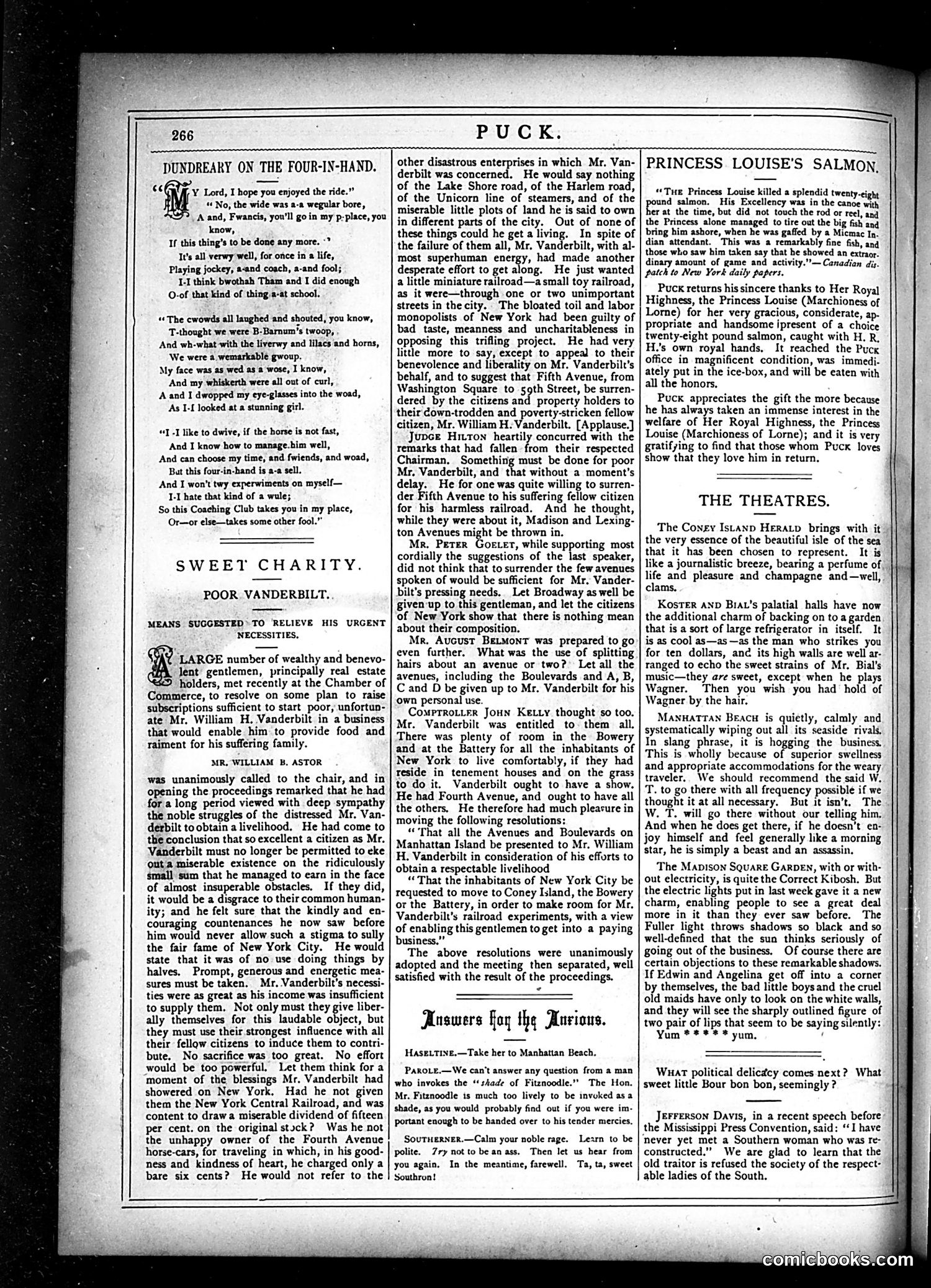
This page contains a satirical poem titled "Dundreary on the Four-in-Hand" mocking a foolish character, likely a dandy or social climber obsessed with fashionable horse-drawn carriages and appearances. The poem ridicules his pretensions and incompetence. Below that, "Sweet Charity: Poor Vanderbilt" describes a scheme to relieve William H. Vanderbilt's financial burdens by having wealthy New Yorkers contribute avenues and boulevards for his personal use—a biting satire of Vanderbilt's legendary wealth and the absurdity of the ultra-rich needing public assistance. The remaining content includes brief social commentary and answers to readers' questions, typical of Puck's satirical format. The overall theme targets wealthy industrialists and social pretension in Gilded Age New York.
📄 Transcribed text from this page (OCR, searchable)
Machine-transcribed from the original scan — historical spelling and the odd misread are preserved.
PUCK. DUNDREARY ON THE FOUR-IN-HAND. ce Y Lord, I hope you enjoyed the ride.” «No, the wide was a-a wegular bore, ‘A. and, Fwancis, you'll goin my p-place, you know, If this thing’s to be done any more. It's all verwy well, for once in a life, Playing jockey, aand coach, a-and fool} [-I think bwothah Tham and I did enough of that kind of thing.a-at school. “The cwowds all laughed and shouted, you know, T-thought we were B-Barnum’s twoop, ‘And wh-what with the liverwy and lilacs and horns, ‘We were a. wemarkable gwoup. My face was as wed as a wose, I know, ‘And my whiskerth were all out of curl, ‘A and I dwopped my eye-glasses into the woad, As I-f looked at a stunning girl. 1-1 like to dwive, if the horse is not fast, ‘And I know how to manage.him well, ‘And can choose my time, and fwiends, and woad, Bat this four-in-hand is a-a sell. ‘And I won’t twy experwiments on myself— 1-1 hate that kind of a wule; So this Coaching Club takes you in my place, Or—or else—takes some other fool.” SWEET CHARITY. POOR. VANDERBILT. MEANS SUGGESTED» TO RELIEVE HIS URGENT NECESSITIES, LARGE number of wealthy and benevo- Jent gentlemen, principally real estate holders, met recently at the Chamber of Commerce, to resolve on some plan to raise subscriptions sufficient to start poor, unfortun- ate Mr. William H. Vanderbilt in a business that would enable him to provide food and raiment for his suffering family. MR, WILLIAM B. ASTOR was unanimously called to the chair, and in opening the proceedings remarked that he had fora long period viewed with deep sympathy the noble struggles of the distressed Mr. Van- derbilt to obtain a livelihood. He had come to the conclusion that so excellent a citizen as Mr. Vanderbilt must no longer be permitted to eke outa miserable existence on the ridiculously small sum that he managed to earn in the face of almost insuperable obstacles. If they did, it would be a disgrace to their common human- ity; and he felt sure that the kindly and en- couraging countenances he now saw before him would never allow such a stigma to sully the fair fame of New York City. He would state that it was of no use doing things by halves. Prompt, generous and energetic mea- sures must be taken. Mr. Vanderbilt’s necessi- ties were as great as his income was insufficient to supply them. Not only must they give liber- ally themselves for this laudable object, but they must use their strongest influence with all their fellow citizens to induce them to contri- bute. No sacrifice was too great. No effort would be too powerful. Let them think for a moment of the blessings Mr. Vanderbilt had showered on New York. Had he not given them the New York Central Railroad, and was content to drawa miserable dividend of fifteen per cent. on the original stock? Was he not the unhappy owner of the Fourth Avenue horse-cars, for traveling in which, in his good- ness and kindness of heart, he charged only a bare six cents? He would not refer to the other disastrous enterprises in which Mr. Van- derbilt was concerned. He would say nothing of the Lake Shore road, of the Harlem road, of the Unicorn line of steamers, and of the miserable little plots of land he is said to own in different parts of the city. Out of none of these things could he get a living. In spite of the failure of them all, Mr. Vanderbilt, with al- most superhuman energy, had made another desperate effort to get along. He just wanted a little miniature railroad—a small toy railroad, as it were—through one or two unimportant streets in the city. The bloated toil and labor monopolists of New York had been guilty of bad taste, meanness and uncharitableness in opposing this trifling project. He had very little more to say, except to appeal to their benevolence and liberality on Mr. Vanderbilt's behalf, and to suggest that Fifth Avenue, from Washington Square to 59th Street, be surren- dered by the citizens aad property holders to their down-trodden and poverty-stricken fellow citizen, Mr. William H. Vanderbilt. [Applause.] Jupce Hitton heartily concurred with the remarks that had fallen from their respected Chairman. Something must be done for poor Mr. Vanderbilt, and that without a moment's delay. He for one was quite willing to surren- der Fifth Avenue to his suffering fellow citizen for his harmless railroad. And he thought, while they were about it, Madison and Lexing- ton Avenues might be thrown in, Mr. Peter Gorter, while supporting most cordially the suggestions of the last speaker, did not think that to surrender the few avenues spoken of would be sufficient for Mr. Vander- bilt’s pressing needs. Let Broadway as well be given up to this gentleman, and let the citizens of New York show that there is nothing mean about their composition. Mr. Aucust BeLmonT was prepared to go even further. What was the use of splitting hairs about an avenue or two?) Let all the avenues, including the Boulevards and A, B, Cand D be given up to Mr. Vanderbilt for his own personal use. ComPrroLtER JoHN KeLty thought so too. Mr. Vanderbilt was entitled to them all. There was plenty of room in the Bowery and at the Battery for all the inhabitants of New York to live comfortably, if they had reside in tenement houses and on the grass to do it. Vanderbilt ought to have a show. He had Fourth Avenue, and ought to have all the others, He therefore had much pleasure in moving the following resolutions: “That all the Avenues and Boulevards on Manhattan Island be presented to Mr. William H. Vanderbilt in consideration of his efforts to obtain a respectable livelihood ‘That the inhabitants of New York City be requested to move to Coney Island, the Bowery or the Battery, in order to make room for Mr. Vanderbilt's railroad experiments, with a view of enabling this gentlemen to get into a paying business,”” The above resolutions were unanimously adopted and the meeting then separated, well satisfied with the result of the proceedings. Answers Foy the Anrions. Haseutine.—Take her to Manhattan Beach, PARoLe.—We can't answer any question from a man who invokes the “shade of Fitznoodle.” The Hon. Mr. Fitznoodle is much too lively to be invoked as a shade, as you would probably find out if you were im- portant enough to be handed over to his tender mercies. SouTHeRNER.—Calm your noble rage. Lexn to be polite. 7Zry not to bean ass. Then let us hear from you again, In the meantime, farewell. Ta, ta, sweet Southron! PRINCESS LOUISE'S SALMON. «Tie Princess Louise killed a splendid twenty-eight und salmon. His Excellency was in the canoe with jer at the time, but did not touch the rod or reel, and the Princess alone managed to tire out the big fish and bring him ashore, when he was gaffed by a Micmac In. dian ‘attendant. ‘This was a remarkably fine fish, and those who saw him taken say that he showed an extraor. dinary amount of game and activity.""—Canadian dis. patch to New York daily papers. Puck returns his sincere thanks to Her Royal Highness, the Princess Louise (Marchioness of Lorne) for her very gracious, considerate, ap. propriate and handsome ipresent of a choice twenty-eight pound salmon, caught with H. R, H.'s own royal hands, It reached the Puck office in magnificent condition, was immedi- ately put in the ice-box, and will be eaten with all the honors, Puck appreciates the gift the more because he has always taken an immense interest in the welfare of Her Royal Highness, the Princess Louise (Marchioness of Lorne); and it is very gratifying to find that those whom Puck loves show that they love him in return, THE THEATRES. The Coney Istanp HERALD brings with it the very essence of the beautiful isle of the sea. that it has been chosen to represent. It is like a journalistic breeze, bearing a perfume of life and pleasure and champagne and—well, clams. Koster Anp Biat’s palatial halls have now the additional charm of backing on to a garden that is a sort of large refrigerator in itself. It is as cool as—as —as the man who strikes you for ten dollars, and its high walls are well ar- ranged to echo the sweet strains of Mr. Bial’s music—they are sweet, except when he plays Wagner. Then you wish you had hold of Wagner by the hair. Manuattan Beacu is quietly, calmly and systematically wiping out all its seaside rivals, In slang phrase, it is hogging the business. This is wholly because of superior swellness and appropriate accommodations for the weary. traveler. We should recommend the said W, T. to go there with all frequency possible if we thought it at all necessary. But it isn’t. The W. T. will go there without our telling him, And when he does get there, if he doesn’t en- joy himself and feel generally like a morning star, he is simply a beast and an assassin, The Mapison Square GarDEN, with or with- out electricity, is quite the Correct Kibosh. But the electric lights put in last week gave it a new charm, enabling people to see a great deal more in it than they ever saw before. The Fuller light throws shadows so black and so well-defined that the sun thinks seriously of going out of the business. Of course there are certain objections to these remarkable shadows. If Edwin and Angelina get off into a corner by themselves, the bad little boys and the cruel old maids have only to look on the white walls, and they will see the sharply outlined figure of two pair of lips that seem to be saying silently: Yum ** *** yum, fi Wuar political delicd#cy comes next? What sweet little Bour bon bon, seemingly ? Jerrerson Davis, in a recent speech before the Mississippi Press Convention, said: I have never yet met a Southern woman who was re- constructed.” We are glad to learn that the old traitor is refused the society of the respect- able ladies of the South.